← What A Day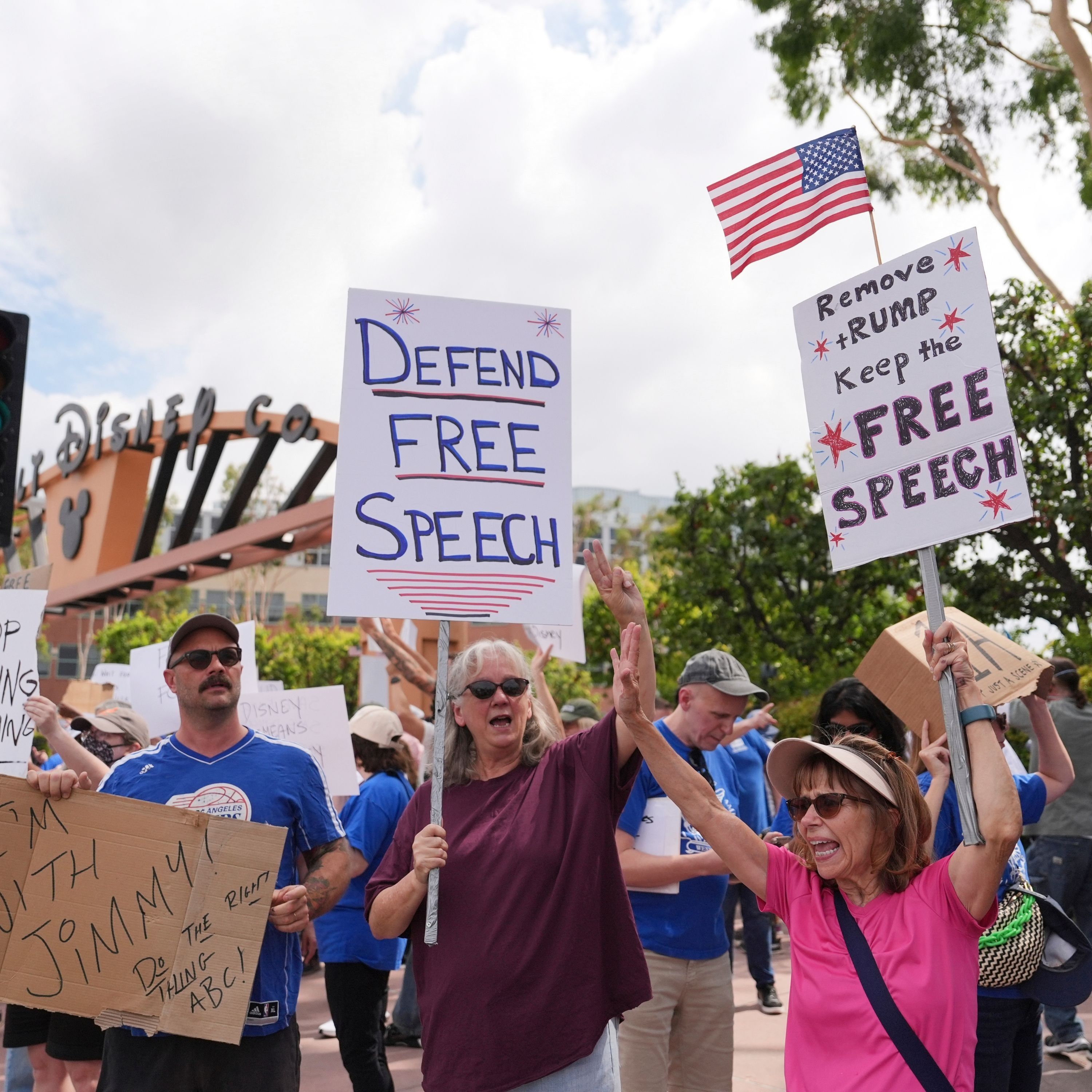
What A Day
How To Survive Online Speech Wars Without Self-Censorship
00:26:22
Following the assassination of conservative activist Charlie Kirk, a wave of everyday people have been punished, getting doxxed and even losing their jobs because of statements they made online regarding Kirk and his death. Even the Vice President of the United States, JD Vance, encouraged Americans to call the employers of anyone they feel is “celebrating Charlie’s murder.” Free speech matters now, more than ever. But what can we say without fear of retribution? To find out what the rules around speech in America really are, and why this is no time to self-censor, we spoke to Ari Cohn. He’s lead counsel at the Foundation for Individual Rights and Expression, with a focus on tech policy. And in the news: Oregon sues the Trump administration to stop the deployment of the state’s National Guard to protect federal buildings, current New York City Mayor Eric Adams pulls out of the upcoming mayoral race, and Israeli Prime Minister Benjamin Netanyahu changes his story on what happened w...
Loading summary
Transcript53 lines
- [00:02]
A
It's Monday, September 29th. I'm Jane Coston, and this is what a Day. The show that is thinking about New York City Mayor Eric Adams, who once said, quote, all my haters become my waiters when I sit down at the table of success with his exit from the mayoral race. Will those waiters lose their jobs? On today's show, Oregon sues the Trump administration to stop the deployment of the state's National Guard to protect federal buildings. And Israeli Prime Minister Benjamin Netanyahu changes the story on what happened with those bunker busters in Iran. But let's start with free speech. We've been talking a lot about speech on the show lately, and for good reason, because late night talk show host Jimmy Kimmel is just the start. Following the assassination of conservative activist Charlie Kirk, a wave of everyday people have been punished, getting doxxed and even losing their jobs because of statements they made online regarding Kirk and his death. Here's CNN from earlier this month.
- [00:57]
B
These companies and organizations have reported either terminating or suspending employees for posts about Kirk, and that includes Middle Tennessee State University firing a worker they say had, quote, zero empathy for Kirk's death. Conservative activists, Republican lawmakers, and even a doxing website are flagging the comments in what critics say is a campaign to punish those posters.
- [01:16]
A
Yes, and in this case, conservative activists and Republican lawmakers include the Vice President of the United States, J.D. vance. Here he is guest hosting Kirk's show from the White House.
- [01:26]
C
So when you see someone celebrating Charlie's murder, call them out in hell. Call their employer. We don't believe in political violence, but we do believe in civility.
- [01:36]
A
But people aren't just getting fired for, quote, celebrating Charlie Kirk's death. NBC News reported that a Ball State University employee was fired for writing on her personal Facebook page, quote, charlie Kirk's death is a reflection of the violence, fear and hatred he sowed. It does not excuse his death and the sad truth. And an elementary school teacher's assistant in South Carolina was even fired for quoting Kirk directly. A statement in which Kirk said that this second Amendment was worth, quote, some gun deaths every single year. Remember the whole the left loves cancel culture and the right wants to protect free speech thing from, like, nine months ago. Here's President Donald Trump with a reminder.
- [02:13]
D
After years and years of illegal and unconstitutional federal efforts to restrict free, free expression, I will also sign an executive order to immediately stop all government censorship and bring back free speech to America.
- [02:31]
A
Ah, memories. Free speech matters now more than ever. But if every post on Instagram that doesn't fit the right wing definition of free speech now comes with harsh penalties because of censorious assholes. What should folks like you and me be saying online or elsewhere? To find out what the rules around speech in America really are and why this is no time to self censor. I spoke to Ari Cohn. He's lead counsel at the foundation for Individual Rights and Expression with a focus on tech policy. Ari, welcome to what a day.
- [03:01]
E
Thanks for having me.
- [03:02]
A
Since the assassination of Charlie Kirk, I'm sure you've noticed that there's been an about face from Republicans on the topic of free speech. President Trump even recently suggested that negative press coverage of him is against the law, saying, quote, they'll take a great story and they'll make it bad. See, I think that's really illegal, personally. Now, it's obviously not illegal, but over the last five years, there have been a lot of people who are very confused about what hate speech is and what free speech is, legally speaking. Can you tell me, is there any such thing really as hate speech in the United States?
- [03:36]
E
Nope, there is no distinction. We have a few certain definite and fairly narrow categories of unprotected speech, and they all have absolutely nothing to do with whether or not speech is hateful. And that's because the First Amendment doesn't allow the government to pick and choose what ideas or views it likes and doesn't like when it's regulating them.
- [03:56]
A
So that actually leads to my next question, which is, what are those categories? Because we've also been seeing a lot of the use of the term incitement.
- [04:05]
E
Incitement is. It's actually much more simple than most people try to make it. It is speech that is both intended to and likely to incite imminent lawless action. And when we say imminent, do we mean right now, right this second, not five minutes from now, not an hour from now, not ten days from now? If you have even a second to stop and think about what you're doing and you still choose to do the unlawful act, then it's not the speaker's fault, it's your fault.
- [04:37]
A
Right. So besides inciting speech like you just described, basically everything else, even if we hate it, even if it's offensive, even it's the worst thing you've ever heard in your entire life, is protected by the First Amendment, Is that correct?
- [04:53]
E
Yeah. I mean, you got things like true threats and incitement, obscenity, which is a whole other crappy category of speech that is an hour conversation in and of itself, things like fraud and defamation. But Generally speaking, yeah. If it's not one of those things, it's protected by the First Amendment, and it doesn't matter if we think it's vile. I mean, the thing that lawyers constantly have to remind people is that the law and ethics, morality are very much not the same thing. That Venn diagram has only a very little overlap. And that's kind of where people get the, you know, there ought to be a law attitude from. Because they think, oh, this feels wrong, it's gross, this shouldn't be allowed, but it is.
- [05:37]
A
Now, I'm sure you've been experiencing this through your work, but there's something about speech that makes a lot of people into giant, massive hypocrites, where you have this back and forth and back and forth and back and forth of, like, you know, free speech. Except for you, free speech. But just for me, what is it about free speech that turns everybody into a hypocrite?
- [05:59]
E
I think it's counterintuitive to stand up in defense of the right to say things that we abhor. That feels very against our nature. And everyone's kind of got their free speech, butt everyone's got that thing where they're like, well, everything else is free speech. But this is particularly icky, and I think it takes thought and actual effort to override that kind of baser human instinct where like, no, this is morally offensive to me, and therefore it should not be allowed. Nobody should even be allowed to say. Takes a conscious effort to override that. And I think in this day and age, particularly where we're so driven by outrage and so driven by whatever is happening at any given moment, it doesn't leave us a lot of room for that introspection that allows us to do it. And, you know, that's not to excuse people, but I can see the ways in which society has kind of moved away from giving us the space for.
- [06:56]
A
It, but to the work that you do. As a lawyer, I've been very worried, and I think a lot of people are very worried about the ways that the government now is basically deciding what free speech is and isn't. In the days after Charlie Kirk's horrible murder, Vice President J.D. vance even encouraged conservatives to reach out to people's employers if they saw someone, quote, celebrating Kirk's death on social media, which included, as far as I can tell from just a general search of Twitter, anything that wasn't mourning or people saying, Charlie Crook's murder was sad, but he was a bad person. Those people are now getting threatened with the loss of Their jobs. Now, companies have always had a right to suspend or fire an employee over something they said, like private companies are permitted to do so. But we're seeing a lot of educators, specifically who have been fired, who are now filing lawsuits to get their jobs back. What are those arguments going to look like in the courts? What kind of recourse do people have to if they are being fired for saying not the right thing about one specific person on the Internet?
- [08:00]
E
Yeah, I mean, it's kind of bizarre. Like, almost North Korea, like, insufficient mourning type business. But, you know, I think it's. You're absolutely right. It's far worse when there are people of immense influence ginning this up. I mean, if you have a private employer, you're mostly out of luck. But for teachers and government employees, actually, they have more protection because their employer is the government. The government does owe them still some first amendment rights. So there are perhaps certain circumstances where someone is in a position such that saying something like that could interfere with the performance of their department. But the government has to prove that those circumstances exist.
- [08:44]
A
That.
- [08:44]
E
And that their interests as an employer should outweigh the employee's right to free speech, in that it either damages close working relationships in the workplace or creates such a disruption just vis a vis the public's view. Say, you know, a police officer making racist comments and saying, I wish I could shoot all people of X color or whatever, Obviously that's gonna create a huge issue. The public's not gonna trust the police. And, you know, that could be something that the government might, you know, might win. But I think if a teacher just said political murder is wrong, but Charlie Kirk engendered this kind of culture. No, that obviously has no impact on her ability to do her job or her department's ability to provide its services. And like, from the people who have loved to use the phrase witch hunt for the past X number of years, they're really going at it here.
- [09:39]
A
Yeah. I mean, can you explain a little bit more about how government protections for public employees protect their speech? And when that doesn't apply? For example, could they post on their personal Facebook their views? And could they post in a comment on the Facebook of their university and say, charlie Kirk sucked or something like that?
- [10:03]
E
Yeah. So to simplify it a bit, if you were speaking in the course of your employment, that is your speech as an employee, and that is not protected. But if you're speaking as a private citizen on a matter of public concern, it's presumptively protected unless the government can show that the speech may be interfered with close working relationships or interfered with the employer's ability to provide its services to the public to a sufficient degree that again, the government's interest as an employer should outweigh the employees right to free speech.
- [10:40]
A
So as you just said, there's a very high bar to uphold, these firings of public employees for their speech, especially as a private citizen. But even still, no one wants to get fired and sue and go through all of that just to find out where that bar is. So how can people still express their opinions but keep themselves safe, especially online?
- [11:01]
E
Yeah, I mean, it's difficult these days because people are, like you said, they're going out looking for it so they can get people in trouble. It's really just. It's kind of unbelievable how much free time some people have, apparently, to be honest. You know, but honestly, there's. There's no way to really be 100% safe. And I don't want to tell people that they should make all of their accounts private and only post to people they know, because part of the great thing about the Internet is that we can all talk to each other. We can reach audiences that before was reserved for only the people with an enormous amount of money or power. And now we all have access to that kind of audience. Some people think that's a bad thing. I actually think it's a great thing. I would argue that really what we have to do is a little bit of spine stiffening. It sucks to think we might have to go through it. But if you give up and if you self censor and if you, you know, abdicate your role in civic discourse, you're handing them the victory that they're looking for. You know, we have to make it difficult. And, you know, I would also urge those people doing the targeting to think to themselves. You know, do we want to live in a culture where we can't have opinions, where we can't say what we think on anything because somebody is going to try and get us fired. And this goes for everyone who does this. You know, we should really think carefully about how we wield this weapon because it's a pretty crude one. And I think, you know, taken to its logical conclusion, and especially with the way that we like to tit for tat in society these days, can lead us down a pretty dark road.
- [12:39]
A
Ari, thank you so much for joining me.
- [12:42]
E
Always happy to join you.
- [12:44]
A
That was my conversation with Ari Cohn, lead counsel at the foundation for Individual Rights and Expression. We'll get to more of the news in a moment, but if you like the show, make sure to subscribe. Leave a five star review on Apple Podcasts, watch us on YouTube and share with your friends. More to come after some ads why today is brought to you by Magic Spoon Magic Spoon makes high protein, zero Sugar Cereal and treats reinvented from your childhood. Oh, nostalgia. Every serving of Magic Spoon High protein cereal has 13 grams of protein, 0 grams of sugar and 4 grams of net carbs. And they come in nostalgic flavors like fruity, cocoa and Frosted. And Magic Spoon's high protein treats are crispy, crunchy, airy and an easy way to get 12 grams of protein on the go. They come in mouthwatering flavors like marshmallow chocolate, peanut butter and dark chocolate. Both are great on the go pre or post workout or as a midnight snack. Get $5 off your next order at magicspoon.com day or look for Magic Spoon on Amazon or in your nearest grocery store. That's magicspoon.comday for $5 off.
- [13:53]
C
The 2026 Chevy Equinox is more than an SUV. It's your Sunday tailgate and your parking lot snack bar. Your lucky jersey, your chairs and your big cooler fit perfectly in your even bigger cargo space. And when it's go time, your 11.3-inch diagonal touchscreen's got the playbook, the playlist and the tech to stay a step ahead. It's more than an suv. It's your Equinox Chevrolet. Together, let's drive.
- [14:26]
B
Try angel stuff for your tushy. It's made by Angels Soft and strong.
- [14:32]
A
Budget friendly. The choice is simple, a roll that feels like paradise and always at a heavenly prize. Angel Soft, angel soft, Soft and strong. So it's simp. Pick up a pack today. Angel soft, Soft and strong Circle. Here's what else we're following today. Head of Lines we don't want to shut down.
- [15:00]
E
We hope that they sit down and have a serious negotiation with us.
- [15:04]
A
That's how it's I would remind Leader Thune that's how we all did it.
- [15:08]
E
In the past, a bipartisan negotiation.
- [15:11]
A
That's why the government didn't shut down while I was leader. That's Democratic Senate Minority Leader Chuck Schumer addressing Republican Majority Leader John Thune on NBC's Meet the Press Sunday. Both senators are digging in their heels ahead of their meeting today with Trump and their counterparts in the House. It's a last ditch effort to have a civil adult conversation before all hell breaks loose tomorrow. If the two parties can't reach a short term spending agreement. By midnight Tuesday, the government shuts down. The sticking point, Affordable Care act tax credits are set to expire later this year. If that happens, about 4 million people could see their premiums go up or lose their health coverage entirely. Some Republicans are fine with letting the credits expire. Others want to table that discussion for later this year. But Democrats want credits extended now in time for health care companies to keep out of pocket costs down by January. And while the negotiation strategy around all of this seems to be make sure Americans know that if the government does shut down, it's the other party's fault, here's thune responding to NBC's Kristen Welker.
- [16:13]
B
Is the government going to shut down this week?
- [16:15]
C
Leader Thune Totally up to the Democrats. This is the ball is in their court. There is a bill sitting at the desk in the Senate right now. We could pick it up today and pass it. That has been passed by the House, that will be signed into law by the president to keep the government open.
- [16:32]
A
Okay then. Meanwhile, the Trump administration told agencies to prep for large scale layoffs, not just furloughs if said shutdown occurs. Are we having fun yet? New York City Mayor Eric Adams announced he's officially bowing out of the mayoral race Sunday via an eight minute video he posted on Twitter.
- [16:51]
F
Also no Some remain unsure of me after the unfortunate events surrounding my federal case. I was wrongfully charged because I felt fought for this city and if I had to do it again, I would fight for New York again. And yet, despite all we've achieved, I cannot continue my re election campaign. The constant media speculation about my future and the Campaign Finance Board's decision to withhold millions of dollars have undermined my ability to raise the funds to needed for a serious campaign.
- [17:32]
A
There's a lot to unpack there because Adams re election campaign was already pretty much doomed since last year. Here's a refresher. Adams was indicted for accepting illegal campaign contributions and travel discounts from a Turkish official and others and returning the favors by helping Turkey open a diplomatic building in Manhattan without passing fire inspections. In January, Manhattan federal prosecutors wrote in court papers that they continued to, quote, uncover additional criminal conduct by Adams and the FBI raided the homes of two of his aides. But Trump's Justice Department dropped the case in April because Adams allegedly made a deal to help the president out with that whole immigration crackdown thing, clearly not a good look for a Democratic mayor. In his concession speech, Adams did not directly mention or endorse any of the remaining candidates in the race, but did warn voters about, quote, insidious forces using local government to, quote, advance divisive agendas. That's clearly a reference to State assembly member Zuram Hamdani, a Democratic socialist who won the mayoral primary in July. Adams dropping out could give a boost to the other centrist candidate for former New York Governor Andrew Cuomo. After the announcement, he praised Adams on Twitter for, quote, putting the well being of New York City ahead of personal ambition, a thing Cuomo knows nothing about. Cuomo followed up with an obvious dig at Mamdani, warning about unspecified, quote, extremist forces. Well, Mandani fired back at Cuomo in a video statement Sunday posted on bluesky.
- [19:00]
E
Daniel Cuomo, you got your wish. You wanted Trump and your billionaire friends.
- [19:04]
A
To help you clear the field.
- [19:06]
E
But don't forget, you wanted me as your opponent in the primary too. And we beat you by 13 points. Looking forward to doing it again on November 4th. Hope you're well.
- [19:15]
A
Insider reference for Real Housewives of Salt Lake City fans. Lisa Barlow would be very proud of that comment. Israeli Prime Minister Benjamin Netanyahu told Fox News on Sunday that the US Bombing of Iranian nuclear facilities in June was never intended to destroy Iran's stockpile of enriched uranium, even though that was a big rationale for the whole attack. Netanyahu made the comment after being asked why just last week he told the UN that that very same stockpile had to be eliminated. Sunday morning, he told Fox News he wasn't just on repeat.
- [19:48]
E
We knew that in advance. In fact, our whole plan before and after the United States decided to join us took into account that we wouldn't get these 400, 450 kilograms of enriched uranium. We knew that what we were targeting is the capacity to make more of those of that enriched uranium and also the attempt to weaponize it.
- [20:10]
A
This makes some sense. Nuclear material doesn't exactly equal a nuclear bomb. But Trump had said in a true social post that the entire program was tanked, saying obliteration is an accurate term. And of course, Trump also called CNN disgraceful for questioning whether the strikes had eliminated Iran's nuclear arsenal. So sure, Oregon and the city of Portland are suing the Trump administration to stop the deployment of the state's National Guard troops. Trump said on Truth Social Saturday that he's sending the troops to protect federal facilities he claims are under attack from antifascists. In the Post, he called Portland war ravaged and said troops could use, quote, full force. Trump has threatened to send the National Guard to Memphis and Chicago, but Portland's also been in his mind lately, too. Here he is at a press conference in the Oval Office late last week.
- [21:02]
D
We're going to get out there and we're going to do a pretty big number of those people in Portland that are doing that. They're professional agitators and anarchists. They're actually anarchists.
- [21:12]
A
Secretary of Defense Pete Hegses sent a memo to Oregon Governor Tina Kotek Sunday authorizing the deployment of 200 National Guard troops for 60 days to protect federal property. The lawsuit claims Trump doesn't have the authority to federalize the National Guard. Oregon State Attorney General Dan Rayfield said in a statement Sunday, quote, what we're seeing is not about public safety. It's about the president flexing political muscle under the guise of law and order, chasing a media hit at the expense of our community. And that's the news. One more thing. I know it's been nine months since President Trump reentered the White House and it's been 10 years since he descended the golden escalator into life as an almost inescapable political figure. And yet somehow I think that many of us forget something about Donald Trump, that almost every single day Donald Trump says or does something that is completely fucking insane. Something that would ruin the careers of pretty much any other politician or anyone ever. But with Trump, it gets lost in the wash. Let's take Saturday night, for example. At 10:19pm Eastern time on Saturday, the President of the United States posted this video to his True Social account, a social media platform that functions as his official messaging apparatus for everything from discussions of the war in Ukraine to his views on late night television hosts to.
- [22:44]
B
This breaking now President Donald J. Trump has announced a historic new health care system, the launch of America's first med bed hospitals, and a national Med bed card for every citizen.
- [22:56]
D
Every American will soon receive their own med bed card. With it, you'll have guaranteed access to our new hospitals to led by the top doctors in the nation. Equipped with the most advanced technology in the world, these facilities are safe, modern and designed to restore every citizen to full health and strength. This is the beginning of a new era in American health care.
- [23:20]
B
In this first phase, only a limited number of med bed cards will be released. Registration details will be announced very soon.
- [23:28]
A
Now, a few things. No, that's not Donald Trump's voice. And no, that's not the voice of Lara Trump, his daughter in law who hosts the fox news show MyView. This video is entirely AI generated and Fox News confirmed it never aired on its network. And the med bed thing, that's a right wing conspiracy theory, a med bed that can cure basically any disease and even regrow lost limbs, but the government is keeping it from you for shadowy reasons. Obviously none of this is real. So now you're probably asking a few questions like why would Donald Trump post an AI generated video of himself and his daughter in law advocating for a product that doesn't exist except in the imaginations of our weirdest citizens? He knows he didn't say any of this, right? Right. Trump appears to have deleted this video from his True Social account on Sunday. And I'm aware that there are bigger things happening in the world right now, but many of those things are the direct responsibility of President Donald Trump. The same person who posted an AI generated video of himself and his daughter in law promoting an imaginary product for absolutely no reason whatsoever. We're in the bad place is what I'm saying. Before we go Vote Save America is running a first of its kind pilot program to recruit candidates from Arizona, North Carolina and Texas. We're talking school board, City Council, State Legislature races that shape our communities and build the bench for long term Democratic power. Even if you're not from those states, VSA will connect you with its incredible partners at the National Democratic Training Committee and run for something to get you set up and ready to run anywhere in the country. VSA has already had thousands of people sign up over the past couple of months. Vote Save America is hosting a live call on Tuesday, October 7th at 5pm Pacific 8pm Eastern time to welcome new people to the program. Crooked's Tommy Vitor will be there along with VoteSave America's partners driving this work to break down what it takes to run and how VSA can support you every step of the way. If you've ever thought about running for office, this is where to start. Sign up for the call and learn more@votesaveamerica.com Run paid for by votesave america. Learn more@votesaveamerica.Com this ad has not been authorized by any candidate or candidates committee. That's all for today. If you like the show, make sure you subscribe, leave a review, avoid corndogs and tell your friends to listen. And if you're into reading, not just about how 58 million pounds of corn dogs and sausage on a stick products are being recalled because there might be wood chips in the batter like me. What a Day is also a nightly newsletter. Check it out and subscribe@cricut.com subscribe I'm Jane Coston and save your corn dog consumption for state Fairs or never. Whataday is a production of Crooked Media. It's recorded and mixed by Desmond Taylor. Our associate producer is Emily Foer. Our video editor is Joseph Dutra. Our video producer is Johanna Case. We have production help today from Greg Walters, Matt Berg, Megan Larson, Gina Pollack and Jonah Eatman. Our senior producer is Erica Morrison and our senior vice president of news and politics is Adrienne Hill. We had help today from the Associated Press. Our theme music is by Colin Gilliard and Kashaka. Our production staff is proudly unionized with the Writers Guild of America East.
- [27:27]
F
Hi, I'm Michael from the Warren Treaty. You know the jingle now discover the facts about Ozempic, a GLP1. Only Novo Nordisk makes FDA approved Ozempic.
- [27:36]
A
Learn about the real thing. Talk to your healthcare professional today. Call 1-833-OZEMPIC or visit ozempic.com to view the medication guide and to learn more about Ozempic. Semaglutide injection 0.5mg, 1mg and 2mg Whirlpool asks what's ickier than a guy who wears shoes with toes? A front load washer without the fresh flow vent system? It's a trio of features that help keep your clothes and washer fresh. Whirlpool Everyday Care.