← What A Day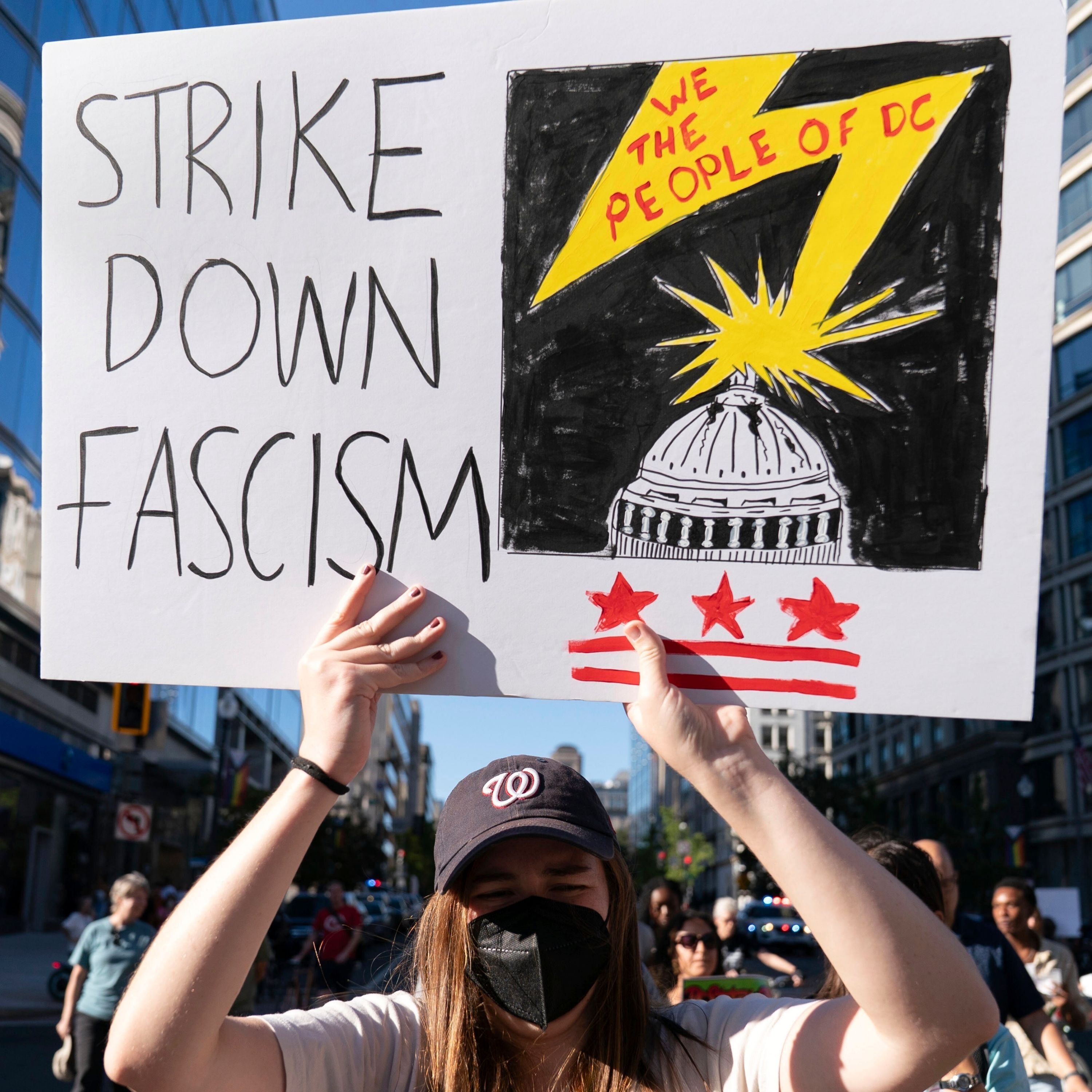
What A Day
MAGA Threats Made Him Leave The Country
00:24:50
A lot happened while we were off this weekend, from President Donald Trump's overly friendly meeting with New York City Mayor-elect Zohran Mamdani to Georgia Republican Congresswoman Marjorie Taylor Greene's resignation announcement. That was a doozy. In a 10-minute-long video on Friday, Greene announced that she's leaving Congress, and explained that she felt betrayed by the party – and the President – she'd spent years fighting for. MTG has detailed the numerous death threats she and her family have received because of her recent opposition to Trump's policies. But she is hardly the first to face threats of violence for saying or doing something that MAGA decides it doesn't like. On today's show, we speak with Mark Bray, a college professor who wrote a book about Antifa. And after the murder of conservative pundit Charlie Kirk earlier this year, Bray became the subject of a conservative media storm, fomented in part by the organization Kirk founded, Turning Point USA. So Bray dec...
Loading summary
Transcript52 lines
- [00:02]
Jane Coaston
It's Monday, November 24th. I'm Jane Coston and this is what a day. The show wondering where Treasury Secretary Scott Besant is going to end up on his tour day, explaining why tariffs are good even when President Donald Trump cancels them.
- [00:15]
Mark Bray
Isn't the fact that you're rolling back.
- [00:18]
Jane Coaston
Tariffs in admission that ultimately they do drive up prices for consumers? Kristen, how much does your arm weigh? And because you have to know where that plane landed, that I do not know exactly. But you know how much you weigh. You get on the scale every morning. Inflation is a composite number and we look at everything. So we are trying, we try to push down the things we can control. I'm so sorry that plane crashed. On today's show, New York City Mayor Elect Zoran Mamdani charms President Trump during a meeting at the oval office, and U.S. and Ukrainian officials say they're making progress in bringing an end to Russia's war in Ukraine. But let's start with maga. Georgia Republican Representative Marjorie Taylor Greene made a big announcement on Friday. She's leaving Congress. In a video, Representative Green explained that she felt betrayed by the party and the president she'd spent years fighting for. I have too much self respect and dignity. I love my family way too much and I do not want my sweet district to have to endure a hurtful and hateful primary against me by the President that we all fought for, only to fight and win my election. While Republicans will likely lose the midterms and in turn be expected to defend the president against impeachment after he hatefully dumped tens of millions of dollars against me and tried to destroy me. It's all so absurd and completely unserious. I refuse to be a battered wife hoping it all goes away and gets better. Marjorie Taylor Greene was elected to Congress on the back of MAGA and conspiracy theories spread by some of Maga's loudest voices. Entering Congress in 2021, she was already famous or infamous for arguing that the September 11 attacks were a hoax and that former Secretary of State Hillary Clinton murdered John F. Kennedy Jr. On the day she was sworn into office. She wore a face mask that said Trump won, a reference to the 2020 presidential election, which he did not win. In a funny way, it seems like Greene wound up being more MAGA than Trump. She broke with the president on AI policies, America's role in the war in Gaza, healthcare policy, and the release of centering on the crimes of convicted sex offender Jeffrey Epstein. And while her views get a lot of support from right wing populists Like Steve Bannon, President Trump called her a, quote, traitor. She responded to his claim in her resignation video. Standing up for American women who were raped at 14 years old, trafficked, and used by rich, powerful men should not result in me being called a traitor and threatened by the President of the United States, whom I fought for. MTG has detailed the numerous death threats she and her family have received because of her recent opposition to Trump's policies. But she is hardly the first to face threats of violence for saying or doing something that MAGA decides it doesn't like. From congressmen to poll workers to random people who post on the Internet. So many people have experienced violent threats because MAGA thinks that they need to be put back in line or pushed out of the conversation entirely. Mark Bray was never a congressman and definitely was never maga. He was a college professor who wrote a book called the Anti Fascist handbook back in 2017. But after the murder of conservative pundit Charlie Kirk earlier this year, Bray became the subject of a conservative media storm, fomented in part by the organization Kirk founded, Turning Point usa. So Bray made the decision to leave the United States to protect himself and his family. I spoke to him about what antifa even is and how writing a book eight years ago cost him his American home. Mark Bray, welcome to what a day.
- [04:02]
Mark Bray
Thanks for having me.
- [04:04]
Jane Coaston
So let's start with the basics. There seems to be a lot of confusion about what antifa even means. You wrote the book on antifa?
- [04:13]
Mark Bray
I did.
- [04:14]
Jane Coaston
So what is it? Or who are they? Or what are we even talking about?
- [04:20]
Mark Bray
Important question. So antifa is short for anti fascist in a variety of different languages. Antifa is a term for a specific tradition of resistance to oppose the far right. That's not a specific group. I sometimes liken it maybe to socialism. There are socialist groups, but socialism itself is not a group. There are antifa groups, but antifa itself is not a group. There's no headquarters, there's no CEO. It's a politics that goes back to, depending on how you want to date it, at least 75 years, if not a hundred years. And Trump has erroneously called it one solitary, singular movement with an alleged leadership which he can never quite name, and an alleged massive funding structure, George Soros and company, which doesn't exist. It's a politics of anti fascism.
- [05:04]
Jane Coaston
Can you tell me a little bit about that history and the historical effectiveness of militant anti fascism? Because I think there's this meme you see online that shows troops, American troops landing at normandy.
- [05:16]
Mark Bray
World War II.
- [05:17]
Jane Coaston
World War II, and basically being like, this is the original antifa. And I'm like, I don't think that's exactly like. I get that response of being like, okay, you know, if we've got fascists, we want to be against fascism. So obviously everybody's antifa. But like, who are we talking about?
- [05:33]
Mark Bray
Right. Well, before I answer your specific question, the ambiguity around the word is common in a lot of countries that sometimes it is just used as shorthand for anti fascists, and that's what's so dangerous about what's going on. But to be more specific, the term antifa is originally a German term. It was used by some of the anti fascist groups that resisted Hitler. There was a group called Anti Fascist Action in the early 1930s in Germany. The specific tradition that came to be known in English as militant antifascism really crystallizes itself after World War II. When you ask the question, how do we make sure this doesn't happen again? And their answer is to deny a platform to fascists, not allow them to organize in society to have their speakers. When you argue for basically treating small and medium sized fascist and Nazi groups as if they could become the nucleus of another Nazi regime, even though of course in most circumstances they wouldn't. So that of course shows that we are, I believe, in a different situation in the US now than those groups we're responding to. But that's the trajectory. And the irony when we want to assess the success of those groups is the more successful those groups are, the more they stop fascist and Nazi groups before they're big enough for anyone to care that they were stopped. And nothing works all the time. But it was a successful politics for a number of decades.
- [06:51]
Jane Coaston
What does it mean to designate anyone who holds certain political beliefs as a terrorist? What is this going to look like?
- [06:58]
Mark Bray
Well, we don't know exactly what it'll look like. Right. And there's a lot of ambiguity because on the one hand, designating a domestic entity a terrorist organization in an executive order carries no legal power. So right now, calling yourself antifa is legal in the United States. Now, from what I understand, being declared a foreign terrorist organization that does carry legal power. And so the the State Department declaring four supposed organizations in Europe to be terrorist organizations, legally, only one of the four has anything to do with anti fascism in an explicit sense seems to me to be a stepping stone towards then declaring American groups to be affiliated with these foreign terrorist groups and therefore foreign terrorist groups themselves. But obviously the goal here is to be able to stigmatize, criminalize and demonize, protest, leftism, anything that the Trump administration doesn't like. This is really textbook authoritarian stuff. It's very transparent.
- [07:54]
Jane Coaston
Well, I want to speak to your personal experience. You wrote the book on Antifa eight years ago. You had to leave the country this year. What happened?
- [08:05]
Mark Bray
Yeah, so I published the book in 2017. I spoke about it incessantly for a few years, and then I moved on to other research. I've been living in suburban New Jersey, teaching at Rutgers. I'm a dad. I've been researching a book about scams. Then Charlie Kirk got killed. And it's clear in the aftermath that Trump wanted to blame the left. Then you get the executive order on Antifa, and that's when the death threats started coming in. After some far right influencers on X started calling me a domestic terrorist professor. And then Turning Point USA organized a petition having me fired for, you know, allegedly being a terrorist. I was not fired. For those listening and are unfamiliar with this story, Fox News picked it up. More death threats. My address was published on X along with information about my family. At that point, it was pretty clear that my family didn't feel safe staying in our home, but we considered spending time somewhere else in the US but as time went along, I felt increasingly concerned about the political climate. And, you know, if we get to the making lists of dissidents stage in authoritarianism, it's pretty clear I would be on that list. And so I felt like I needed some distance from what was going on to assess the political climate. The other thing is that my children have spent time with me in Spain. And so for them, saying, hey, Mommy and Daddy have another research trip is much more intelligible than just moving a town over and trying to explain to them why we couldn't go home. And then things got worse when our flight was mysteriously canceled at the gate. And then the next day when I tried to leave, I was searched and interrogated by federal agents for an hour, despite being accused of no crimes by any law enforcement.
- [09:41]
Jane Coaston
What has it been like since you left the United States, since you've been in Spain? Have the death threats lessened? Because I think that, that one of the hardest parts about experiences like yours is that, like, they move on. You don't like you're still in these moments. So I wanted to ask you, how are you doing? What has this been like over the last couple of months? Have things died down a little bit? What's been happening?
- [10:08]
Mark Bray
Well, I really appreciate you phrasing that way in terms of they move on and you don't, because I've felt that. And you're the first person to articulate that to me, maybe at all. So thank. Thank you for that. Cause that is how it's felt sometimes. I'm in the process of selling my house. I have struggles getting my kids acclimated to a new school in a new country. There's all sorts of bureaucratic nightmares, and things have moved on, which is good. I still do get an occasional threat, but there are many fewer than I used to. I haven't really quite come to terms with everything that's happened. I still am sort of struggling with how to process everything. So the grass is not always greener, but at least for me, it's a change of pace.
- [10:46]
Jane Coaston
So speaking to the United States, this feels kind of like the war on terror, but somehow stupider, where it's like anyone we don't like who didn't support the invasion of Iraq or the war in Afghanistan, was obviously super pro Taliban or loved terrorism. Is there anything people can do about this? And if not, how do you think people can protect themselves? Like, clearly this administration thinks that basically all Democrats are antifa, essentially.
- [11:16]
Mark Bray
Right. So you're either with us or against us. Right. That that framework is old and it's very obvious to intelligent observers. I think that what it's important to. To say is that we can all resist Trump in our own different ways. There's no one way to do it. He's attacking people's lives in so many different venues that standing up, getting out in your community, organizing mutual aid, anti ICE actions, educational events, resisting efforts to change local curricula, school board elections, whatever have you. I think that the effort by Trump is to normalize the fear and normalize the dichotomy and normalize the growing authoritarianism. Make it normal for there to be National Guard soldiers in our streets when that is far from normal. Make it normal for ICE to hunt down Latinx people, citizens, non citizens, without any kind of civilian oversight as to what they're actually doing. Resist that normalization. And I think ideally we need to push towards stepping outside of simply voting or simply marching towards more creative forms of resistance. And that'll look different in different places. And I don't have a magic solution to that, but when you look at historical examples of mass resistance, it's taken a lot of people, it's taken a variety of different forms of resistance and has taken creativity.
- [12:37]
Jane Coaston
Mark, thank you so much for your time. I really appreciate it.
- [12:40]
Mark Bray
Thank you.
- [12:42]
Jane Coaston
That was my conversation with historian and Professor Mark Bray, author of the Anti Fascist Handbook. We'll get to more of the news in a moment, but if you like the show, make sure to subscribe. Leave a five star review on Apple Podcasts, watch us on YouTube and share with your friends. More to come after some ads. Why Today is brought to you by Bombas this time of year, it's sensory overload everywhere but one feeling we're still chasing Cozy and Bombas has the socks, slippers and basically everything to get you there. Honestly, there's something weirdly therapeutic about fresh socks. Bombas channels that energy into everything Slippers. You will sink into the perfect fitting ankle sock and they keep the good going. Wear, after wear. And Bombas is really stepping up their footwear too. New colors, new styles, fluffy things, suede things. If you've got feet, they've got something for them. The best part? For every pair you buy, Bombas donates one to someone facing homelessness. Cozy for you, cozy for someone else. And they really are the coziest socks imaginable. Head over to bombas.comday and use code DAY for 20% off your first purchase. That's B O M B-A-S.comdaycodeday at checkout. Save over $200 when you book weekly. Stays with VRBO this winter. If you haven't seen your college besties since, well, college. You need a week to catch up in a snowy cabin. Take a week long vacation and save over $200. Book now@vrbo.com.
- [14:19]
Mark Bray
The 2026 Chevy Equinox is.
- [14:21]
Jane Coaston
More than an SUV.
- [14:23]
Mark Bray
It's your Sunday tailgate and your parking lot snack bar.
- [14:27]
Jane Coaston
Your lucky jersey, your chairs and your big cooler fit perfectly in your even bigger cargo space. And when it's go time, your 11.3-inch.
- [14:35]
Mark Bray
Diagonal touchscreen's got the playbook, the playlist and the tech to stay a step ahead.
- [14:40]
Jane Coaston
It's more than an suv. It's your Equinox Chevrolet.
- [14:45]
Mark Bray
Together, let's drive.
- [14:49]
Jane Coaston
Here's what else we're following today. Header lines I think working for the people of New York City demands that you work with everyone and anyone and that you always look to find those areas of agreement while not overlooking the places of disagreement. And I think this was something that came up in our meeting on Sunday, New York City Mayor Elect Zahran Mamdani appeared on NBC's Meet the Press to break down his and I don't think this is an understatement. Surreal Meeting with President Trump On Friday, Trump met with Mamdani, a man he Once called, quote, a 100% communist lunatic and, quote, total nutjob. Trump even threatened to cut off federal funding for New York City if Mamdani were to win the mayoral election. That version of Trump seemingly evaporated.
- [15:35]
Mark Bray
I think you're going to have, hopefully.
- [15:36]
Jane Coaston
A really great mayor. The better he does, the happier I am. I will say there's no difference in party. There's no difference in anything. And we're going to be helping him to make everybody's dream come true. Everybody's dream come true. Who is this Disney fairy godmother sounding president? What is going on? Mamdani and Trump set aside their differences and acted cordially in front of reporters. Both men said they discussed the issue of affordability, an issue both Mamdani and Trump ran on in their respective elections and one seriously dogging Trump's presidency. Trump even went on to say that, quote, some of his ideas are really the same ideas that I have in regards to inflationary issues, always copying someone else's homework. Mamdani found common ground with the president without overtly praising him, noting that many of his own voters supported Trump in the last election, a sentiment Trump seemed to appreciate because of course he would. And whenever Disney magic was at play, it showed up bigly. During this question from a Are you affirming that you think President Trump is a fascist? I've spoken about. That's okay. You could just say yes. Okay. It's easier. It's easier than explaining it. I don't mind. You know what? It is easier. I think today was worthwhile.
- [16:56]
Mark Bray
It was very, very.
- [16:57]
Jane Coaston
It is probably the most productive day we have had on this issue, maybe in the entirety of our engagement, but certainly in a very long time. Secretary of State Marco Rubio on Sunday painted an optimistic picture of talks with Ukraine on Trump's latest peace plan with Russia. Rubio was in Switzerland to Discuss the new 28 point plan that came to light last week with Ukrainian and European officials. The plan stipulates Ukraine cedes territory to Russia, kneecaps Ukraine's combat abilities and prevents it from ever joining NATO. Basically a wish list that Russia would ask for if it sat on Santa's lap. And that's because, according to Senator Angus King, it is. Here's what King said Saturday at a panel discussion at the Halifax International Security Forum in Canada. This has been an extraordinary weekend, both because of the sessions that we've had.
- [17:44]
Mark Bray
With people from all over the world.
- [17:46]
Jane Coaston
But also because of the communication, as.
- [17:48]
Mark Bray
Was mentioned today, from Secretary Rubio, and.
- [17:51]
Jane Coaston
The leaked 28 point plan, which, according.
- [17:57]
Mark Bray
To Secretary Rubio, is not the administration's position. It is essentially the wish list of, of the Russians that is now being presented to the, to the Europeans and to the Ukrainians.
- [18:12]
Jane Coaston
King and a bipartisan group of senators at the conference said Rubio reached out to them on his way to Geneva and said the plan, quote, was not the administration's plan. But according to the Associated Press, a State Department spokesperson refuted their account, calling it, quote, blatantly false. Rubio himself then escalated the situation by claiming online that the senators were mistaken, even though they said he gave them the information. The Trump administration with another masterclass in foreign policy. During a speech, Ukrainian President Volodymyr Zelensky stopped short of rejecting the proposal, but called for fair treatment and said he would, quote, work calmly with Washington and other partners during what he described as, quote, one of the most difficult moments in our history. Trump, ever the conciliator in chief, once again blasted Ukraine for being, you guessed it, I'm grateful. Posting on trusocial quote, ukraine leadership has expressed zero gratitude for our efforts. It was in all caps. That's why I said it like that. Which is weird because typically when someone sticks a knife in your back, you always say thank you. May have another There was this explosive report that the Coast Guard is no longer going to characterize swastikas and uses as hate symbols. DHS called that a lie and fake news. Can you clear up? I don't know anything about it. When was this written? Yesterday. Well, look, the Coast Guard's an incredible group of people I know very well. We just ordered a lot of new Coast Guard cutters. Beautiful. The most magnificent ship. They look like yachts with lots of guns on them.
- [19:46]
Mark Bray
So I don't know.
- [19:47]
Jane Coaston
I haven't seen any report like that. Follow up question, Mr. President, what does the Coast Guard do anyway? The U.S. coast Guard had to do some damage control after the Washington Post reported Thursday that a new policy was set to downgrade the classification of swastikas and nooses from hate symbols, which they definitely are, to just potentially divisive, you know, like the new Wicked movie or whether or not baggy jeans are cool. Department of Homeland security spokesperson Tricia McLaughlin called the reporting, quote, fake crap. According to the Post, the new policy was going to take effect December 15th. But following understandable and inevitable backlash from lawmakers, duh, the Coast Guard very quickly corrected its course. Acting Commandant of the Coast Guard Admiral Kevin Lundy said in a memo issued later Thursday the Guard does not, quote, tolerate the display of divisive or hate symbols and flags. Lundy said that includes swastikas, nooses and quote, any symbols or flags co opted or adopted by hate based groups as representations of supremacy, racial or religious intolerance, antisemitism or any other improper bias. Lundy also noted just to be extra clear, that his order tops any other previous guidance issued on the subject. An accompanying Coast Guard press release said the new policy is meant to, quote, combat any misinformation and double down that the US Coast Guard forbids these symbols. Say it with me. Sure, RFK Jr. Promised you that he wouldn't do this. Here is an exchange you had with him during his confirmation hearing. If the data is brought to you.
- [21:23]
Mark Bray
And these studies that have been out.
- [21:25]
Jane Coaston
There for quite some time and have.
- [21:26]
Mark Bray
Been peer reviewed and it shows that.
- [21:28]
Jane Coaston
These two vaccines are not associated with autism, will you ask no, I need even more or will you say no, I see this. It stood the test of time and I unequivocally and without qualification say that this does not cause autism.
- [21:43]
Mark Bray
Not only will I do that, but I will apologize for any statements that misled people otherwise.
- [21:49]
Jane Coaston
Thank you Dr. Cassidy. He lied to you. Well, first let me say what is most important to the American people. Speaking as a physician, vaccines are safe Louisiana Republican Senator Bill Cassidy spoke with CNN's Jake Tapper on Sunday. During their interview, Cassidy refused to admit that Health and Human Services Secretary Robert F. Kennedy Jr. Played him on vaccine policy. Cassidy is a doctor and was a crucial vote in approving RFK Jr. S cabinet appointment back in February. At the time, Cassidy outlined a handful of commitments Kennedy had reportedly made to him, including a promise that the Centers for Disease Control and Prevention would not remove statements on its website saying that vaccines do not cause autism because they don't. Fast forward nine months and the CDC website still has a header with that language, but now it has a nice little asterisk at the end. It points to a statement that says the header has not been removed, quote, due to an agreement with the chair of the U.S. senate Health, Education, labor and Pensions Committee that it would remain on the CDC website. So don't worry, RFK Jr kept his promise. The page also now says that the claim is, quote, not an evidence based claim because studies have not ruled out the possibility that infant vaccines cause autism. In an interview with the New York Times on Thursday, Kennedy said he himself directed the CDC to adjust its stance, even though changes in guidance usually come from the agency's scientists, not the US Health secretary. And that's the news. Before we go this week is the best time to shop at the Crooked Store, and not just because it's an excuse to avoid your MAGA family members. The deals are great. Grab holiday gifts for all the libs and pod lovers in your life and pick up something for yourself while the best sales of the year are on. From brand new stocking stuffers to that classic tea you've had your eye on, it'll all be on sale. Head to crooked.comstore to shop the sale. That's all for today. If you like the show, make sure you subscribe, Leave a review, put your frozen turkey in the fridge to defrost today and tell your friends to listen. And if you're into reading and not just about how a frozen Turkey takes about 24 hours per per four to five pounds to defrost and we are not having a tricky disaster this year. Like me, what a Day is also a nightly newsletter. Check it out and subscribe@qriket.com subscribe I'm Jane Coastin, and when it comes to getting food poisoning or accidentally having a turkey still frozen on the day of Turkey, this podcast just says no. What a Day is a production of Crooked Media. It's recorded and mixed by Desmond Taylor. Our associate producers are Emily Foer and Chris Allport. Our video editor is Joseph Dutra. Our video producer is Johanna Case. We had production help today from Greg Walters, Matt Berg, Kaitlin Plummer, Tyler Hill, and Ethan Oberman. Our senior producer is Erica Morrison and our senior vice president of news and politics is Adrienne Hill. We had help today from the Associated Press. Our theme music is by Colin Gilliard and Kashaka. Our production staff is proudly unionized with the Writers Guild of America East. Noches mas brilliantes momentos mas intensos y tu aroma debe Desta Cartanto Como 2 La Collection Azzaro wanted ofrese fragancias, calidas y sensuales parada temporada The Most Wanted Odepafem Intense 10 UN Aroma Magnetico Deliciosamentes seductor conotas de toffi y madeira Sambar Forever Wanted elixir combina notas de cuero y frambuesas con elegancia e intencidar es la confiance Elijah to favorito or regala telos dos des cubre azaro y esta tempurada be wanted compraya a KFC tale in the pursuit of flavor the holidays.
- [26:10]
Mark Bray
Were tricky for the Colonel.
- [26:11]
Jane Coaston
He loved people, but he also loved peace and quiet. So he cooked up. KFC's 499 Chicken Pot Pie Warm, flaky, with savory sauce and vegetables, it's a tender, chicken filled excuse to get some time to yourself and step away from decking the halls, whatever that means. The Colonel lived so we could. Chicken KFC's Chicken Pot Pie the best $4.99 you'll spend this season.
- [26:33]
Mark Bray
Prices and participation may vary. While supplies last, taxes, tips and fees extra.