← What A Day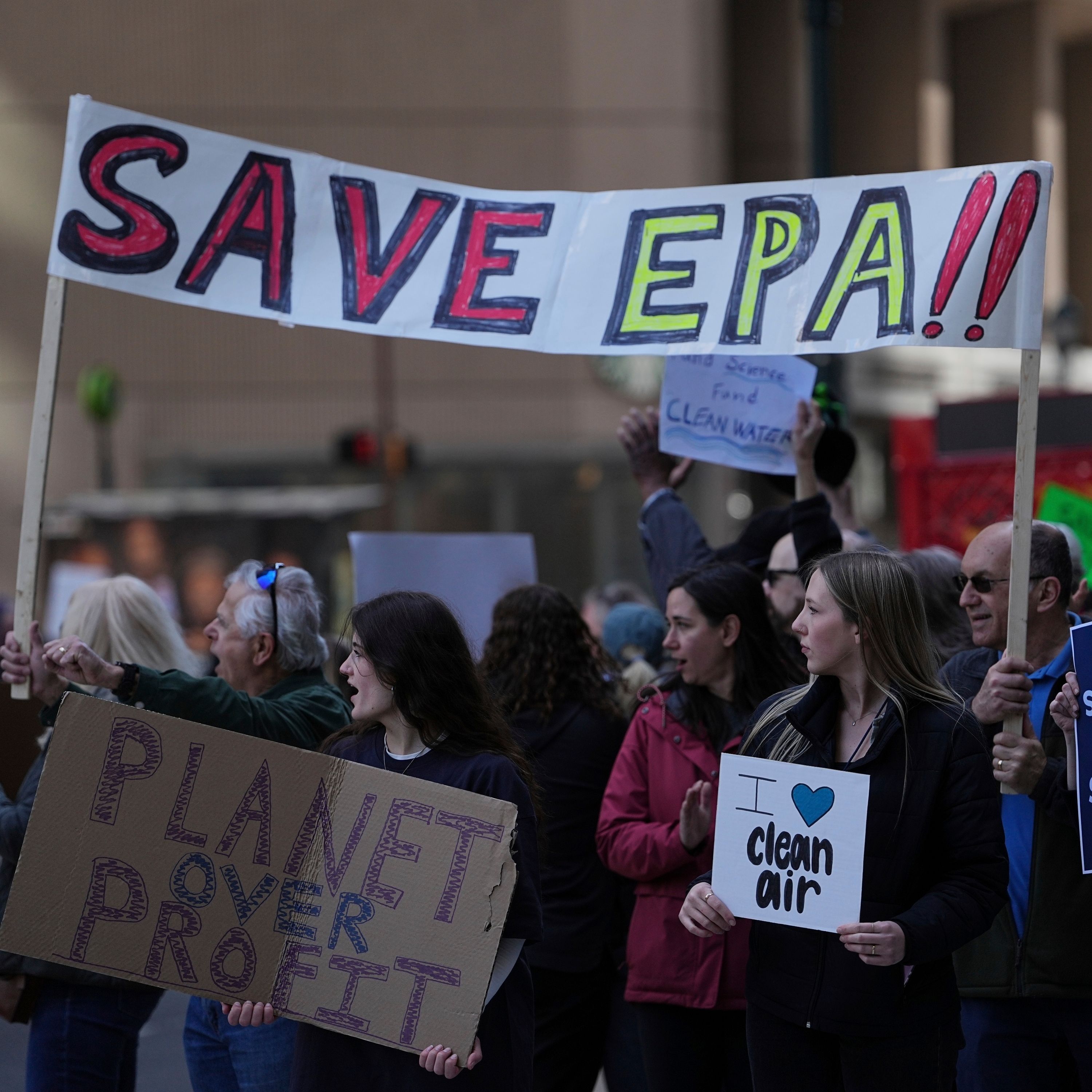
What A Day
New EPA To Argue Greenhouse Gases Are Totally Fine
00:29:14
Sometime this week, the Trump Administration is expected to launch an assault on one of the major cornerstones of U.S. climate policy, known as the 'endangerment finding.' It's the scientific conclusion that greenhouse gases are dangerous to people's health and safety, and should therefore be regulated by government agencies that are supposed to protect our interests. While the specifics of the administration's plans are still unknown, if successful, it could be one of the most devastating blows to the federal government's ability — and the world's ability — to mitigate the increasingly devastating effects of a warming planet. Zack Coleman, who covers climate change for Politico, tells us more about the 'endangerment finding' and the potential consequences of gutting it. Later in the show, Crooked Climate Correspondent Anya Zoledziowski debunks the latest right-wing weather conspiracies around this month's devastating floods in Texas. And in headlines: President Donald Trump annou...
Loading summary
Transcript64 lines
- [00:02]
Todd Zwillick
It's Monday, July 28th. I'm Todd Zwillick in for Jane Coastin and this is what a Day. The show that would never ask the caddy to help us cheat. If you haven't seen the video, head to our YouTube channel to see it. Yup, your president cheats at golf. Sad. On today's show, a the European Union. And President Donald Trump takes his anger out on Beyonce as he continues to dodge all of the swirling questions about the Epstein files. But let's start with the story of a cover up, one going on right now where Donald Trump is trying to bury the facts and enlisting lots and lots of people in the government to help him hide what everyone except his most devoted supporters can see. No, this time it's not about avoiding the truth about Trump's years long friendship with Jeffrey Epstein and all of the people who may have been harmed along the way. It's about burying the truth about climate change and all of the people who will be harmed along the way. We don't yet know exactly how Trump is going to argue that climate change isn't a thing that government should care about, but we're pretty sure he's going to argue it nonetheless. Sometime this week, we expect the Trump administration to launch an assault on what's known at the Environmental Protection Agency as the endangerment finding. Now, that's the scientific conclusion saying what we already know. The greenhouse gases are dangerous to the health and safety of all of us and that the government agencies that are supposed to protect our interests, like the epa, should use their power to regulate them. It's essentially the cornerstone of US Climate policy. Well, Trump's hostility to anything acknowledging climate change is obvious. He's attacked electric cars, car charging, clean air standards, and even the tax breaks that make it cheaper to put solar panels on your roof. Even in the UK this weekend, the President indulged his strange obsession with wind power.
- [02:11]
Donald Trump
And the other thing I say to Europe, we will not allow a windmill to be built in the United States. They're killing us. They're killing the beauty of our scenery, our valleys, our beautiful planes. And I'm not talking about airplanes. I'm talking about beautiful plains, beautiful areas in the United States. And you look up and you see windmills all over the place. It's a, it's a horrible thing.
- [02:36]
Todd Zwillick
That's weird. Trump's claims that the noise from wind turbines causes cancer are weird. But the risks of all of this are real because the Trump administration appears to be gunning to officially ignore the science of Climate change. What do they favor instead? A little later in the show, we're going to talk about all of the wild theories that MAGA has come up with to explain deadly flooding in Texas, except the one staring us all right in the face. But now, the endangerment finding and what we're all going to find out about Donald Trump's quest to burn more fossil fuel. For more, I spoke with Zach Coleman. He's a reporter covering climate change for Politico. Zach, welcome to what a day.
- [03:20]
Zach Coleman
Happy to be here.
- [03:21]
Todd Zwillick
So, to start, can you explain what this endangerment finding is and how it's been used by the EPA since it was established in 2009? It's not a new thing, right?
- [03:32]
Zach Coleman
No, it's not new. The endangerment finding is essentially the scientific body of literature that says greenhouse gas emissions, which is carbon dioxide, methane, the things that human heat the planet, pose an immediate and urgent danger to public health and to the US Economy. Really. It flows from a Supreme court decision in 2007 that said essentially greenhouse gases are a pollutant and if they endanger the public health, then the EPA must regulate them.
- [04:01]
Todd Zwillick
So has that science, that body of scientific literature, changed? Why are we here?
- [04:07]
Zach Coleman
Well, it's changed in the sense that it's gotten more clear. I mean, we've only seen the temperatures keep rising. And when we think about all of the major disasters that we see that are influenced by climate change, we've gotten only more confident that humans are the one driving the temperatures higher from burning fossil fuels, primarily. So, no, I mean, that's changed in the sense that we are more confident that humans are doing this to the planet and that it is having an effect on our well being.
- [04:35]
Todd Zwillick
Okay, so even more confident, even more obvious than 2009 when the endangerment finding came out after the Supreme Court said the EPA basically has to regulate greenhouse gases. So now here we are in Trump 2.0. What are they doing legally to try to undermine all this? What's the argument the Trump administration is making that in fact they don't have to regulate greenhouse gases?
- [05:01]
Zach Coleman
Well, so it's a little complicated right now because we don't know exactly how the Trump administration is going to frame this at this moment. But what they intend to do, based on my reporting and a lot of my colleagues in the press, is they intend to revoke the endangerment finding. And the logic being that they say the Supreme Court said the EPA has the authority to regulate greenhouse gas emissions, but they're not required to do that, essentially the idea is the Clean Air act is the kind of major law in this country about what needs to be regulated for air pollution. And that Clean Air act was enacted in 1970, expanded upon in 1990, well before we were really talking about climate change. So it actually doesn't say the word greenhouse gases in that act. So the Trump administration, we imagine, is going to find some sort of way to kind of split hairs and say, look, it doesn't say this in the law. They're going to go back and try to get this reheard by the Supreme Court. I mean, they think with a more conservative Supreme Court that they might get a better hearing of their arguments.
- [06:06]
Todd Zwillick
And what about on the science itself? I mean, what kind of pushback is the Trump administration likely to get in court, if any, on the basic idea that greenhouse gases aren't harmful to human health?
- [06:20]
Zach Coleman
Yeah, I mean, this is the interesting thing. We're not certain whether they're going to make a scientific argument. They might just purely try to go the legal route and say, look, we understand the science. We understand that greenhouse gases are affecting the planet. We just think that EPA overstepped here and that we don't have to do this if we don't want to. They might also then take a more kind of piecemeal approach to the science and say essentially that they're going to try to bolt this onto tailpipe rules for vehicles, essentially saying that the U.S. transportation sector alone does not significantly cause enough greenhouse gas that's experienced by the entire world to really endanger the public in the U.S. i think that that's a really tough thing to really argue, because US Transportation emissions are the number one emitting sector in the US Economy, which is the second largest emitter in the world, which is the largest historical contributor to climate change, where the world has already warmed 1.3 degrees Celsius since the Industrial Revolution began. So you start to unwind this, and you cannot say that the US Is not a significant contributor for the number one historically. So I don't know how they're going to make this scientific argument, because it kind of falls on its face. We are the most significant emitter in the grand scheme of things.
- [07:40]
Todd Zwillick
And how does this endangerment, finding this effort, Zach, fit into all of the other things the Trump administration is already doing to knock holes in the environmental effort to at least begin to address climate change? I mean, they have hamstrung wind and solar projects. You just mentioned tailpipe emissions. They've shuttered the EPA scientific research arm. The Trump administration shut down the effort to build an electric charging infrastructure across the country, scrapped emission limits for power plants. I'm not going to go on anymore, although I could. Is this fundamental to all of that? Is this an add on? What does this latest effort tell us about the, the overall posture, the aggression, really, toward climate change mitigation?
- [08:23]
Zach Coleman
I mean, this is the most aggressive step that they could take to revoke the endangerment finding. And if they eventually win in court, which we don't know whether they will, we don't know exactly what legal argument they're going to test. But if they do win in court, it erases the bedrock for all US Greenhouse gas regulations in the country. So you would never have to regulate climate change again. If the Trump administration is successful, and if you were just to do a business as usual, kind of letting the free market decide whether we should be producing electric vehicles or deploying clean energy, and that consumers should have that choice and, well, we're not going to hit climate targets. We're just already off track in a business as usual case. So you're going to see hotter temperatures, you're going to see more intense rainfall, like these flash floods that we've been seeing. You're going to see more intense hurricanes, stronger wildfires, deeper droughts. I mean, these things will be impossible to unwind if we do not get ahead of this and start reducing emissions. And regulations have been one of the ways in which the US has been able to be successful in reducing emissions.
- [09:33]
Todd Zwillick
Zach, what is all this for, aside from Donald Trump's fever dream that climate change is a hoax and windmills are terrible, kill birds and cause cancer. Put that to the side. What is all this really for? Is it to boost demand for fossil fuels? Has that work? Is that what this is for? What, what are we doing?
- [09:52]
Zach Coleman
I mean, I kind of think it's an Occam's Razor explanation. I mean, in some ways, it's just because they don't like it, they, they don't value it, they don'. I don't care about climate change as a policy matter. It's not one of the things that ranks very highly for the general voter in terms of what motivates them. And I think the Trump administration is counting on that continuing to be the case by unwinding these rules. And I think it also stems from if liberals did it, then they don't like it. It's this pendulum swing, and we're going to continue to see that because things are just getting more partisan. And that's what we're Seeing here, one.
- [10:31]
Todd Zwillick
Of the arguments also is that environmental regulation costs American families lots and lots of money, that it's wasteful. Green New Deal liberals are costing you money by making you, I don't know, buy $12 light bulbs or something like that. Is there any evidence that the new posture from the Trump administration on all these different regulations that we mentioned, cars, power plants, wind and solar and climate change, tailpipe emissions, any evidence that that is actually driving prices down for consumers, is it working for the stated purpose that Donald Trump has said it's for?
- [11:05]
Zach Coleman
I mean, what. What is absolutely true is that regulations can cost money. But what is also true is that by not addressing climate change, we are costing the economy money. I mean, there is so much damage that comes from these climate fuel disasters. There's lost labor productivity from searing heat waves, that there's thinking about construction workers or agricultural. Agricultural workers, some really kind of bedrock sectors of our economy that just do less in this heat. And in the long kind of sweep of what you're trying to solve with climate change is you're trying to limit these big shocks, these big damaging costs, and also these insidious costs. I mean, when you talk about health and lost labor productivity, and even also the mental aspect of this, like if you are from an area that had a disaster that was fueled by climate change, the kind of mental health repercussions that come with that, the social services that you have to rely upon to get upon your feet, these are also drains on our economy.
- [12:11]
Todd Zwillick
So, Zach, let's end where we started, the endangerment rule. When are we gonna know? When are we gonna know what route the Trump administration is gonna take here to try to tank this thing? Are they gonna come out with a paper? Are they gonna sue somebody? Are they gonna declare that it's void and get sued? When are we going to have the answer?
- [12:29]
Zach Coleman
So we're expecting to get an answer this week. We will not see a resolution for some time. This is. If they're going to follow the normal procedures here, they have to post it for public comment. They have to get a bunch of responses. They have to respond to those comments. They have to do a rulemaking process. That is, if they follow the normal procedure, which I have every reason to believe that they will. So this starts a clock of a longer process, and it might be years until we really know whether their gambit is successful. And it could be. I mean, it was Chief Justice Roberts who wrote the dissent in 2007, who disagreed with the Supreme Court saying that the EPA must regulate greenhouse gas emissions. So the court is now a conservative supermajority. I don't know what's going to happen. I don't think anybody does, and it's going to take some time to figure it out.
- [13:22]
Todd Zwillick
Zach Coleman, Politico thanks so much.
- [13:25]
Zach Coleman
Thank you.
- [13:26]
Todd Zwillick
That was my conversation with Zach Coleman. He covers climate change for Politico. We'll link to his work in our show Notes. We'll get to more of the news in just a moment, but if you like the show, make sure to subscribe. Leave a five star review on Apple Podcasts, watch us on YouTube and share with your friends. More to come after some ads what.
- [13:57]
Ad
A day is brought to you by Zebiotics Pre Alcohol let's face it, after a night with drinks, I don't bounce back the next day like I used to. I have to make a choice. I can either have a great night or a great next day. That is, until I found Pre Alcohol Zebiotics Pre Alcohol Probiotic Drink is the world's first genetically engineered probiotic. It was invented by PhD scientists to tackle rough mornings after drinking. Here's how it when you drink, alcohol gets converted into a toxic byproduct in the gut. It's a buildup of this byproduct, not dehydration, that's to blame for rough days after drinking. Pre alcohol produces an enzyme to break this byproduct down. Just remember to make pre alcohol your first drink of the night. Drink responsibly and you'll feel your best tomorrow. Every time I have pre alcohol before drinks, I notice a difference the next day. Even after a night out, I can confidently plan on working out without worrying. Summer is here, which means more opportunities to celebrate the warm weather. But before that, backyard barbecue brew, glass of Pinot, watching the sunset at the beach, or a cocktail by the campfire. Don't forget your Zebiotics Pre Alcohol Drink one before drinking and wake up feeling great and ready to take on the next day and all that summer has to offer. Go to zbiotics.com wad to learn more and get 15% off your first order. When you use code WAD at checkout, Zebiotics is backed with a 100% money back guarantee, so if you're unsatisfied for any reason, they'll refund your money, no questions asked. Remember to head to zbiotics.com wad and use the code WAD at checkout for 15% off.
- [15:23]
Zach Coleman
It's Carl's Jr. S new Queso Crunch Burger, tortilla strips and Queso on a burger A Queso Creamy masterpiece A Queso Pepper Jack Cheesy Queso Crunchy Queso Mind Blowing Charbroiled Queso Crunch Burger Combo with fries in a frozen drink for just 9.99 queso.
- [15:42]
Anya Zolajowski
So what are you waiting for?
- [15:44]
Zach Coleman
I'm not waiting. The new Queso Crunch Burger only at Carl's Jr available for a limited time at participating restaurants. Tax not included. Need to restock inventory, cover seasonal dips or manage payroll.
- [15:57]
Todd Zwillick
On Deck Small business line of credit.
- [15:59]
Zach Coleman
Provides immediate access to funds up to.
- [16:01]
Todd Zwillick
$100,000 exactly when your business needs it. With flexible draws, transparent pricing and full control over repayment, you can tackle unexpected expenses without missing a beat. Apply today@ondeck.com and fund could be available.
- [16:15]
Zach Coleman
As soon as tomorrow.
- [16:16]
Todd Zwillick
Depending on certain loan attributes, your business loan may be issued by On Deck or Celtic Bank. On Deck does not land in North Dakota.
- [16:21]
Zach Coleman
All loans and amounts subject to lender approval.
- [16:24]
Todd Zwillick
Here's what else we're following today.
- [16:26]
Zach Coleman
Head of Lines.
- [16:31]
Donald Trump
I think it's great that we made a deal today instead of playing games and maybe not making a deal at all. I think it's. I'm going to let you say, but I think it's the biggest deal ever made. Thank you very much.
- [16:42]
Anya Zolajowski
Thank you very much.
- [16:45]
Todd Zwillick
Definitely not the biggest deal ever made. Thank you very much. That was President Trump talking to Ursula von der Leyen, president of the European Commission, at his golf course on the west coast of Scotland on Sunday. The trade deal sets a 15% tariff on most goods from the European Union. The president also used the opportunity to promote his golf course, telling reporters, even though I own it, it's probably the best course ever in the world. This all comes after weeks of tense negotiations, including a letter sent to von der Leyen from Trump on July 11, threatening to raise tariffs to 30% if they didn't reach an agreement by August 1. European leaders were hoping for a rate closer to 10%. A lot of details still need to be ironed out, but here's what we know so far. The new agreement includes cars. That's a reprieve for European automakers. They've been struggling under a 25% tariff that the Trump administration set in April, but inputs like steel and aluminum are still at a 50% tariff. Both the United States and the EU will drop tariffs on a few other goods, including airplanes and airplane parts and some chemicals and agricultural products. The president said the EU will invest $600 billion in the United States and that the EU also agreed to buy $750 billion in US energy. The Israeli military began daily pauses in fighting on Sunday in three populated areas of Gaza. It said the tactical pause would increase humanitarian aid entering the territory. But as it previously warned, combat operations still continued in parts of the Gaza Strip. Meanwhile, images of emaciated children have fanned criticism of Israel. The government has said Hamas siphons food and other aid and use those claims to justify restricting food from entering the territory. According to unicef, most of those who've died from malnutrition since the start of Israel's war against Hamas have been children. During his meeting with the EU President in Scotland on Sunday, Trump was asked whether Israel should be doing more to let food and other aid into Gaza. Here's what he said.
- [18:57]
Donald Trump
Israel, should Israel be doing more to allow food into Gaza? Well, you know, we gave $60 million two weeks ago and nobody even acknowledged it for food. And it's terrible. You know, you really at least want to have somebody say thank you.
- [19:17]
Todd Zwillick
The president parroted Israel's long standing excuse for limiting aid while evidence of a crisis mounts.
- [19:23]
Donald Trump
Well, it's terrible. You know, when I see the children and when I see, especially over the last couple of weeks and people are stealing the food, they're stealing the money, they're stealing the money for the food, they're stealing weapons, they're stealing everything. It's a mess. That whole place is a mess.
- [19:41]
Todd Zwillick
Back in the U.S. republican Senator Lindsey Graham of South Carolina suggested all of this is like World War II. Here he is speaking on NBC's Meet the Press on Sunday.
- [19:52]
Zach Coleman
I think Israel's come to conclude that they can't achieve a goal of ending the war with Hamas that would be satisfactory to the safety of Israel and that they're going to do in Gaza.
- [20:06]
Todd Zwillick
What we did in Tokyo and Berlin, take the place by force, then start.
- [20:11]
Zach Coleman
Over again, presenting a better future for the Palestinians, hopefully having the Arabs take over the west bank and Gaza.
- [20:19]
Todd Zwillick
Last week, the United States and Israel recalled negotiating teams from Qatar. Israeli Prime Minister Benjamin Netanyahu said his government was considering, quote, alternative options to cease fire talks with Hamas, leaving efforts to hash out a peace agreement once again in limbo. President Trump and his allies are facing yet another week of increased pressure and outrage over Ghislaine Maxwell's role in the Epstein files. Last week, in a bipartisan vote, a House oversight subcommittee moved to subpoena the Justice Department for those files. On Meet the Press on Sunday, host Kristen Welker asked House Speaker Mike Johnson if he would support a presidential pardon or commutation for Maxwell Epstein's longtime fixer and ex girlfriend.
- [21:05]
Zach Coleman
Again, not my decision, but I have great pause about that, as any reasonable person would.
- [21:12]
Todd Zwillick
Things that give Mike Johnson great pardoning a convicted sex trafficker in exchange for her help in a cover up. This comes after Kentucky Republican Congressman Thomas Massie said a pardon for Maxwell should be considered in case she has information that could shed light on the case. Todd Blanche, the Deputy Attorney General and Donald Trump's former personal lawyer also drew scrutiny after meeting one on one with Maxwell in prison last week. She's currently serving a 20 year sentence for sex trafficking in connection with Jeffrey Epstein. And speaking of Jeffrey Epstein, President Trump is still trying so, so desperately to change the subject that he's just blurting out names of famous black people, even saying that in another post yesterday that Beyonce, Oprah, Al Sharpton, Kamala Harris, among others, they should all be prosecuted.
- [22:07]
Anya Zolajowski
Not Beyonce. No, let's not go to Beyonce. Come on, she's in Vegas right now.
- [22:13]
Todd Zwillick
Love that CNN panels like Leave Beyonce Alone. The president claimed on Truth Social that Democrats admitted to paying Mrs. Carter $11 million to endorse then Vice President Kamala Harris. He said that was probably illegal and then several sentences later said it was totally illegal. In reality, not illegal at all. The Harris campaign did give a legally required reimbursement of $165,000 to Beyonce's production company for an October 2024 campaign appearance in Houston. But according to PolitiFact, there's just no evidence of Queen Bey getting $11 million from anywhere. It appears to be totally made up. And that's all right. One more thing. As climate change gets more intense, so does the damage caused by the kinds of storms that were once unthinkable. Also getting more intense, the conspiracy theories from climate change deniers. Surprise, surprise. In Texas, the death toll from this month's heavy rain and flooding has topped out at 135 people. It's tragic, but high profile conservatives are all abuzz with implausible ideas about what really caused the storm. Well, here with a good old fashioned debunking is crooked climate correspondent Anya Zolajowski. Hi Anya.
- [23:53]
Anya Zolajowski
Hello.
- [23:54]
Todd Zwillick
Okay, so tell me, what's the big leading conspiracy theory following these tragic floods that we saw in Texas on July 4th? I know it's not climate change. So what really explains it?
- [24:06]
Anya Zolajowski
Yeah, so there are a few conspiracy theories. You know, one thing we've seen is the Environmental Protection Agency's administrator, Lee Zeldin started elevating concerns around potential weather modification technology. He was looking at for example, contrails or condensation trails that can form behind aircraft because some people have claimed that they're behind the floods, which they're not. Another really big conspiracy theory that's come out and has been publicly linked to the floods by people like former Trump adviser General Mike Flynn, Marjorie Taylor Greene. You know, the usual suspects is this idea that the government or some kind of murky cabal manipulated the weather in such a way that it either caused or exacerbated the floods. And the tech at the heart of that conspiracy is known as cloud seeding. It's a weather modification process that introduces particles like silver iodide or salt into clouds that then triggers rain or snow. So it is a thing, but it's not what conspiracy theorists would have you think.
- [25:11]
Todd Zwillick
So cloud seeding is real. They use it to, you know, stimulate rain over crops? Maybe. Is there any plausible way it could have caused or contributed to the flooding that we saw in Texas?
- [25:22]
Anya Zolajowski
Definitely. Definitely. Definitely not. In an inconvenient coincidence, California based startup Rainmaker, which specializes in cloud seeding operations, did a job about a hundred miles away from Kerr County a couple of days before the floods. And so job ultimately produced a drizzle, a mild drizzle. So an amount of rain smaller than a handful of skittles, according to the company's CEO, while Texas saw 15 inches of rain. So that's a massive difference. Still, the people peddling the conspiracy theories are linking Rainmaker and Cloud seeding to the floods. The company has, of course, denied these claims and said that there's no chance that Rainmaker contributed to the floods. The company also confirmed that it actually stopped work when its own meteorologists identified that moisture was flowing into the region and actually advised a pause on operations. Still, you've got these high profile, you know, conservatives really ringing these alarm bells. And Green even promised to introduce a bill that makes processes like cloud seeding a felony offense. Florida just passed a similar one. And I just want to be very clear that some. Several scientists and meteor. Meteorologists have confirmed that it is literally impossible for cloud seeding to create the kind of deluge we saw in Texas. So human influence did make the floods worse, but the human influence is in the form of climate change and not cloud seeding.
- [26:51]
Todd Zwillick
Can you just spend a minute on the opportunity cost of all of this kookiness? We can laugh at it. We can say, oh, another round of conspiracy theories. But it's everything but right. It's everything but the thing that's right in front of us. The planet is heating Totally.
- [27:07]
Anya Zolajowski
I mean, right away the Rainmaker CEO was getting death threats, which is a big problem. But bigger than that too, you know, in terms of forward looking reflection, when the Trump administration is hamstringing fema, the National Weather Service, climate science writ large, it's important to still be able to separate fact from fiction. Especially since these natural disasters like floods, wildfires, droughts, hurricanes, they're happening more frequently and they're becoming deadlier. So people need access to credible information.
- [27:38]
Todd Zwillick
And yeah, I'm going to let you go. Can we just hover over one thing you said at the top, which I'm stuck on? Yeah, the contrails. Conspiracy theory. The person who's looking into it, it's not from the, from the weird reaches of the Internet. Lee Zeldin is the administrator of the epa. The administrator of the EPA is pandering.
- [27:58]
Anya Zolajowski
To these fears that are unfounded and not rooted in science at all. So, yeah, these are conspiracy theories, but they're not in fringes. You know, they're making up the political landscape today.
- [28:11]
Todd Zwillick
Anya Zolechowski, thank you so much.
- [28:13]
Anya Zolajowski
Thank you so much. It's been great being here.
- [28:15]
Todd Zwillick
That was my conversation with Crooked Climate correspondent Anya Zolajowski. And this segment was supported by our nonprofit partner, Crooked Ideas. Before we go, great news. What a Day has new merchants, a new what a Day T shirt and bottle opener just dropped. Wearing a soft T shirt and cracking open a cold drink are two of the things that make even the roughest days better. And we're all about that here at wad. The designs are really colorful and fun and I know the WAD squad is just gonna love them. So grab them now@crooked.com store. That's all for today. If you like the show, make sure to subscribe. Leave a review. Take a penalty stroke when you're supposed to. Don't be a golf cheater and tell your friends to listen. And if you're really into reading and not just about tilting in windmills like me, what a Day is also a nightly newsletter. Check it out and subscribe@crooked.com subscribe I'm Todd Zwillick, club champion every single year at all of my many, many golf clubs. What a Day is a production of Crooked Media. It's recorded and mixed by Desmond Taylor. Our associate producer is Emily Foer. Our producer is Michelle Alloy. Our video editor is Joseph Dutra. Our video producer is Joanna Case. We had production help today from Greg Walters, Matt Berg and Gina Pollack. Our senior producer is Erica Morrison. And our senior vice president of news and politics is Adrian Hill. We had help with our headlines from the Associated Press. Our theme music is by Colin Gilliard and Kashaka. Our production staff is proudly unionized with the Writers Guild of America East.
- [30:15]
Anya Zolajowski
I've never felt like this before. It's like you just get me. I feel like my true self with you. Does that sound crazy? And it doesn't hurt that you're gorgeous. Okay, that's it. I'm taking you home with me. I mean, you can't find shoes this good just anywhere. Find a shoe for every you from brands you love like Birkenstock, Nike, Adidas and more at your DSW store or dsw.com.
- [30:48]
Zach Coleman
The world is on the brink. Wars, contentious elections, disinformation spreading at warp speed, and Donald Trump at the center. Center of all of it. But what does it mean for the rest of us? Every week on Pod SA the world, Tommy Vitor and I cut through the noise to explain how global power is shifting. No jargon, no homework, just clear, honest conversations about what's happening and why it matters. From breaking news to long, simmering international conflicts, we dissect it all with critical analysis and some jokes that will surely embarrass our children one day. Tune in to Pod Save the World every Wednesday. Wherever you get your podcasts or catch it on you.