Loading summary
Transcript65 lines
- [00:04]
A
It's Friday, April 10th. I'm Jane Coston and this is what a day. The show that would never buy yerba mate from President Donald Trump's youngest son. That's despite news that Barron Trump is now one of five directors of a company that will soon be selling the caffeinated beverage to the people who buy anything else a Trump would sell them. On today's show, the White House denies reports of a schism between the Trump administration and the Vatican. And Democrats are letting the F bombs fly all over Twitter. They swear it's a good idea, but let's start with the war in Iran and how some people are making a lot of money betting on it. The Wall Street Journal reported on Thursday that the White House has forbidden staffers from betting on the war in prediction markets. And for good reason. From the moment the US and Israel launched strikes in February, quite a few people have been profiting from them. That's because they've been placing extremely well timed bets on the website Polymarket, with some winning hundreds of thousands of dollars. Here's France 24. Back in March, more than a dozen anonymous accounts placed bets predicting that the
- [01:16]
B
United States would strike Iran by Saturday, 28 February. Most of those wagers were placed in
- [01:22]
A
the hours before the first bombs fell, and many of the accounts had been
- [01:26]
B
created only days earlier.
- [01:28]
A
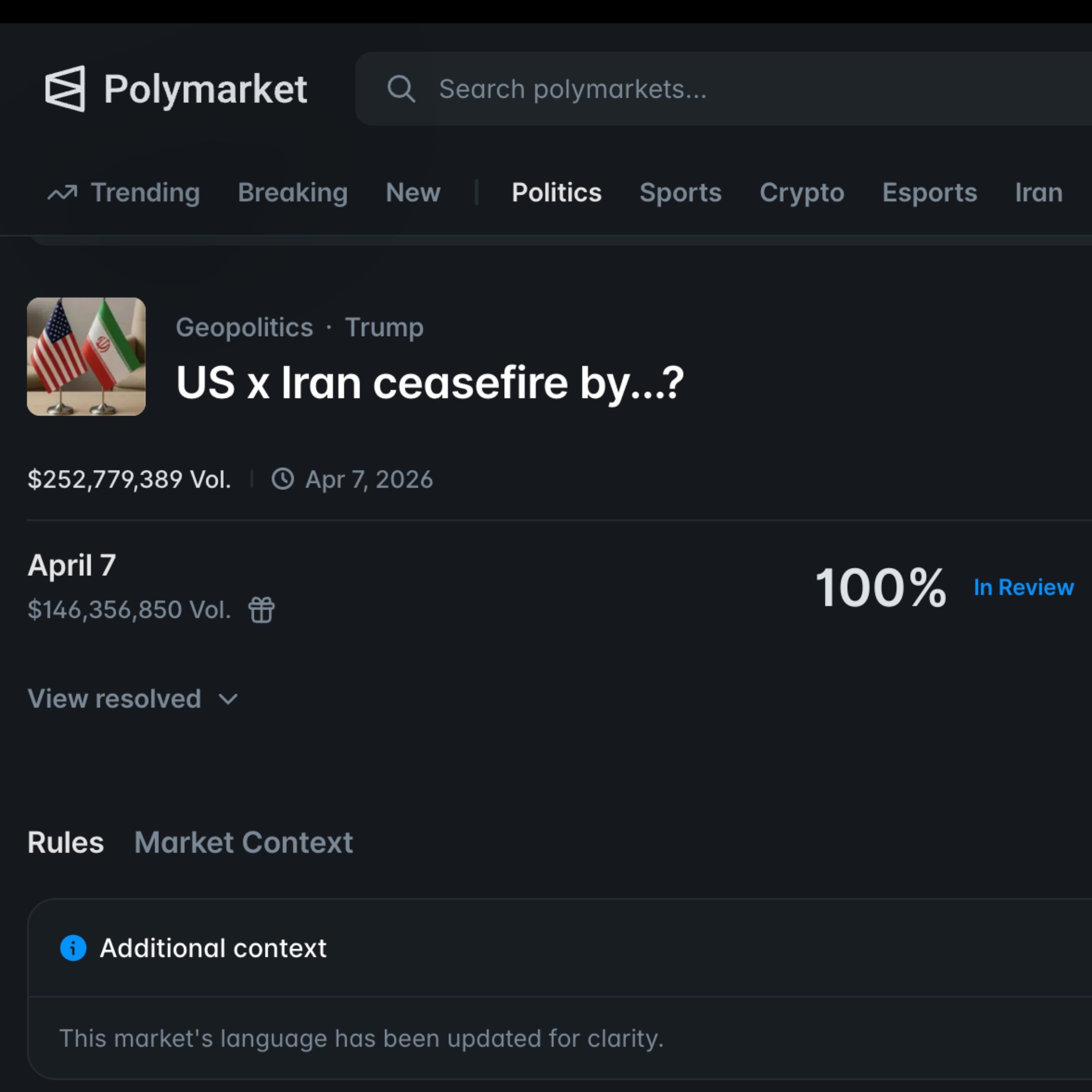
Funnily enough, those extremely well timed bets on action in Iran have been happening for a while now. CNN reported on one trader making nearly $1 million since 2024 by accurately predicting events in the ongoing conflict between the us, Israel and Iran. And just this week, a group of newly created accounts bet correctly on the US and Iran reaching a ceasefire on April 7. What are the odds? Polymarket and its main competitor Kalshi are massive businesses and they're both aware that insider trading is a massive problem. In February, Israeli officials arrested multiple Israeli reservists and a civilian who were using classified information to place bets on the country's military operations. Using, you guessed it, polymarket. So for more on how prediction markets are capitalizing on war, I spoke to Sahil Desai. He's a senior editor at the Atlantic, who recently wrote a piece about the so called war markets. Sahil, welcome to Water Day.
- [02:27]
C
Thanks for having me.
- [02:29]
A
We have seen a huge increase in people betting on the Iran war and what's interesting to me is that they are doing so correctly. Three accounts on polymarket pocketed more than $600,000 betting on the ceasefire, and that's after a single account won another $600,000 on the initial strike zone, Iran. What do we know about these bets and more specifically, who these betters are?
- [02:54]
C
So the short answer, and the most troubling part of this to me is that we know nothing. So, on Poly Market, basically all bets happen through crypto, which essentially means that there's a lot of anonymity under these bets. But based on the suspicious timing of these bets and the fact that, frankly, this happens over and over again in geopolitics, especially this year, we've seen this during the Venezuela raid. We saw this when the bombs first hit Iran. We can't say for sure that it's insider trading, but at some point, when there's smoke, there's fire, frankly, it seems like something suspicious is certainly going on, even though we can't say that with certainty.
- [03:39]
A
Now, I want to back up for a second. We've talked about prediction markets on the show, but can you remind us how they theoretically differ from traditional betting and when they really started to take off in popularity? What's the difference here between this and gambling?
- [03:54]
C
You use the word theoretically, which I think is actually a really useful word to keep in mind here, because these sites say that they are not gambling. They say that they're a type of investing, Right. So you put your money in the stock exchange or whatever, and they claim that betting on war or betting on anything else is akin to that you are betting on the outcome of a future event, and you're not gambling in a sense that there's no house you are betting against. In my opinion, I think that's sort of a risible argument. I think this is essentially gambling. If you even look at the advertising that these prediction markets run on social media, they often talk about this as gambling. So for all intents and purposes, like, it's the same as betting.
- [04:40]
A
So when did we first see people hitting the metaphorical jackpot on events in the Iran war? That, to most people, were a massive surprise.
- [04:49]
C
Yeah, we saw that happening really, like right before the bombs first hit. Right. So there were lots of shady bets in the hours before the Ayatollah was assassinated. And there was a New York Times analysis that I thought was quite telling where people were betting about when the US Might evade Iran or enact missile strikes in Iran. But in the hours leading up to the actual military campaign, there was a huge spike in the. The size of bets and the number of bettors who were placing wagers on it. And so, you know, of course, that just suggests that people who had some inside information were using that to frankly, just make a quick buck.
- [05:41]
A
So we've seen at least one example in Israel of people with confidential information. Members of the Israeli military, the Israeli reserves, who were placing bets on polymarket using confidential information and were arrested. So if these bets are being placed by people with confidential information, are there ways to identify them? You've made the point that they're using cryptocurrency, which is untraceable. But would there be a way to track these people down anyway?
- [06:13]
C
The short answer is probably not, frankly. Like for most cases, say, say you're some military reservist in the US who happens to have information about a strike. If you're in the Pentagon using the Pentagon's Internet, they're probably going to find out what's happening. If you're. I would hope so, at least. But, you know, if you're at home and for whatever reason, you know, you're someone who just has information and you're using a VPN or a virtual private network to sort of access polymarket, it's really hard to, to. To trace that. And there's a reason that we really haven't seen, you know, investigations really lead anywhere into this because it's just like dead ends everywhere.
- [06:54]
A
Now insider trading is illegal, and polymarket has tried to shut it down. They've repeatedly said that you cannot bet using classified information. Obviously, people keep doing it, but I have to imagine that there are other concerns with the idea that people with knowledge of sensitive situations are putting money on them shortly before they happen, as in they are influencing those events. What other issues could arise from these bets?
- [07:19]
C
Yeah, I think that there's a big difference between the things that people can bet on. Prediction markets, such as, for example, people are betting on what Mr. Beast will say in his next YouTube video. In fact, an editor on Mr. Beast got fired for insider trading on using Kalshi for that. But there's a distinction between betting on YouTube videos and betting on war. Right. The fact that there could be insider trading happening here could materially be a problem for military campaigns going forward. Right. There are lots of tools that can now spot potential insider trading basically in real time. And, you know, it's not hard for any military in the world to get access to these types of tools and to sort of try and figure out and decipher a military strike before it happens.
- [08:16]
A
I'm curious where we go from here, because I'll say it, this sounds like gambling. And in Las Vegas, in the casinos, they do a ton of work to fight against the equivalent of insider Trading, as in people getting information and trying to use it to make bets. So what would enforcement or regulation or even that same type of internal security look like on a platform designed for private to see, like Polymarket.
- [08:44]
C
Yeah, so I think that there's a big difference here between polymarket and Kalshi. So Kalshi, the other big prediction market, is a regulated exchange, and so it has to abide by what's called KYC or know your customer regulations, just as any other bank would. Polymarket does not have that. In fact, Polymarket's main platform, really, you can't technically use it to gamble the us. So what's really tricky here is that there's not a great answer on how to stop this, especially since, frankly, the Trump administration has effectively given carte blanche to Polymarket and Kalshi. Trump Jr. Is an advisor to both companies. The Biden administration was actually regulating Polymarket in particular, quite stringently. And then Trump came into office and it was a different story. So it's really hard to see. It's hard to see a future in which this doesn't just keep happening again and again and again.
- [09:44]
A
What are you going to be looking for as whatever is taking place in Iran keeps happening and as these platforms get bigger and bigger? Already we've seen massive valuations for both Polymarket and Kalshi. You've made the point that they're different, but they're very wealthy companies. What should we be looking for?
- [10:03]
C
I think what's particularly concerning to me, apart from the war of it all, is what this all looks like as we careen towards the midterms. We frankly haven't had an election yet in which prediction markets were this big. Right. These platforms existed in 2024, but they were a fraction of the size that they are now. I don't think we're ready for what this could look like in which you could see congressional candidates placing money on themselves. We've seen instances of that happening already. But 2026, the midterms, are poised to be the first prediction market election, and that's about to pose about 1,000 different strange scenarios that no one is ready to deal with.
- [10:47]
A
I am not ready for any of that. Sahil, thank you so much for joining me.
- [10:52]
C
Thanks for having me.
- [10:54]
A
That was my conversation with Sahil Desai, senior editor at the Atlantic. We'll link to his piece in the show Notes. I'll bet you know what I'm going to say, and if you were going to put some money on it, please don't. You'd probably be right. We'll get to more of the news in a moment, but if you like the show, make sure to subscribe. Leave a five star review on Spotify and Apple podcasts, watch us on YouTube and tell your friends to gamble on us. But again, not really. Just in the pun. Way more to come after some ads. This episode of what a Day is brought to you by Wildgrain. Wildgrain is the first bake from frozen subscription box for sourdough breads, artisanal pastries and fresh pastas. Unlike many store bought options, wildgrain uses simple ingredients you can pronounce and a slow fermentation process that can be easier on your belly and richer in nutrients and antioxidants. Plus, all items conveniently bake in 25 minutes or less with no thawing required. Wild Grains boxes are fully customizable. In addition to their variety box, they have a gluten free box, vegan box and a new protein box. I love wild grains, breads and croissants, but I especially love their chocolate chip cookies. Imagine having fresh bakery quality bread, pastries and pasta at home without any trips to the store. And don't just take my word for it. They have over 40,000 five star reviews and have been voted the best food subscription box by USA TODAY for three years in a row. For a limited time, Wildgreen is offering our listeners $30 off your first box plus free croissants for life when you go to wildgreen.com wod to start your subscription today. That's $30 off your first box and free croissants for your life when you visit wildgreen.com wad or you can use the promo code WAD at checkout. Wadaday is brought to you by Mill. You know the moment you open the trash and you get hit with the smell? It's mostly food waste scraps, scary old leftovers, melting lettuce, all just stinking up your house while it waits to head to the landfill. Mill is the odorless, effortless, fully automated food recycler. Potato peels, avocado pits, chicken bones, even dairy. Mill takes almost anything while you sleep. Mill quietly transforms those scraps into nutrient rich shelf stable grounds. No mess, no smells, no fruit flies. Mill can process up to 10 pounds overnight and it can work for weeks before you even have to think about emptying it. We have a mill in our office kitchen and I can't believe the difference it's made from office lunches to just dealing with peach pits and chicken bones it's made our daily routine here easier and cleaner. Try mill risk free for 90 days and get $75 off at mil.com wad and use code wad at checkout. That's $75 off at mill.com wad and use code WAD. Meal.com wad and use codeWAD. I sold my car in Carvana last night. Well, that's cool. No, you don't understand. It went perfectly. Real offer down to the penny. They're picking it up tomorrow. Nothing went wrong.
- [13:43]
B
So what's the problem?
- [13:44]
A
That is the problem. Nothing in my life goes as smoothly. I'm waiting for the catch.
- [13:48]
B
Maybe there's no catch.
- [13:49]
A
That's exactly what a catch would want me to think.
- [13:52]
B
Wow. You need to relax.
- [13:53]
A
I need to knock on wood. Do we have wood? Is this table wood?
- [13:56]
B
I think it's laminate.
- [13:57]
A
Okay.
- [13:57]
D
Yeah.
- [13:57]
A
That's good. That's close enough.
- [13:58]
B
Car selling without a catch. Sell your car today on Carvana. Pick up. Fees may apply. Mom, can you tell me a story? Sure. Once upon a time, a mom needed a new car. Was she brave? She was tired mostly. But she went to Carvana.com and found a great car at a great price. No secret treasure map required. Did you have to fight a dragon?
- [14:17]
A
Nope.
- [14:17]
B
She bought it 100% online from her bed, actually. Was it scary? Honey, it was as unscary as car buying could be. Did the car have a sunroof? It did, actually. Okay, good story. Car buying. You'll want to tell stories about. Buy your car today on Carvana. Delivery fees may apply.
- [14:35]
A
Here's what else we're following today. Header lines. Joining me is Crooked's Washington correspondent, Matt Berg to talk about the big stories. Hey, Matt.
- [14:46]
D
Hey, Jane.
- [14:47]
A
Matt. Vice President J.D. vance has built his entire political career on performing the appearance of good Catholic convert. But following reporting that a top Pentagon official got into a beef with the Vatican's former ambassador to the U.S. vance played dumb.
- [15:02]
B
With no disrespect to the cardinal.
- [15:03]
A
I don't know who Cardinal Christophe Pierre is.
- [15:06]
C
He's the ambassador to the Holy see
- [15:07]
A
in the U.S. oh, okay, okay.
- [15:09]
B
I do. I've met him before. Sorry, I just didn't remember the name. I've never seen this reporting. I'd like to actually talk to Cardinal Christophe Pierre.
- [15:17]
A
I don't believe for one second that this man, whose upcoming book is literally titled Finding My Way Back to Faith, forgot who the Vatican's former US Ambassador is. But whatever. The Trump administration is trying to pretend like it's not Beefing with the Vatican following reports that L Bridge Colby, the Pentagon's policy chief, tried to bully Cardinal Pierre into supporting US Foreign policy.
- [15:40]
D
That's right. This all stems from a report that Colby met with Pierre in January and basically told Pierre that the Catholic Church would be smart to support US Foreign policy despite everything Trump has done. The Defense Department on Thursday tried swatting down the drama on social media, calling the meeting, quote, substantive, respectful and professional, alongside a few photos of Colby and Pierre shaking hands to make it all seem like it was just a good little hangout. The USMC to the Holy See also chimed in, saying that Pierre, quote, emphatically denied the media's portrayal of his meeting.
- [16:13]
A
So convincing. The Vatican was reportedly so alarmed by news of the meeting that Pope Leo scrapped his plans to travel to the United States this year. The Pope is opting for a virtual appearance instead. The White House also says this is no big deal, right?
- [16:27]
D
Exactly. White House spokeswoman Anna Kelly told me on Thursday that the Trump administration's relationship with Vatican is, quote, positive.
- [16:34]
A
Look, I'm a Christian. I believe that Jesus Christ died and rose from the dead. I believe a lot of things. I absolutely do not believe that the Trump administration's relationship with the Vatican is positive, because why would it be? What exactly about this administration has demonstrated any adherence to Catholic norms which are not, as I recall, own the libs. But here's the thing. The Catholic church has roughly 1.4 billion members around the world. It has been around for centuries. Maga has been around for what, 11 years? And no one can really say what it is, except for whatever Trump says it is. If the Church can outlast multiple schisms, at least one murderer pope, a few murdered popes, and more wars than I can count on two hands, I think it's betting it can outlast a presidential administration full of dorks.
- [17:21]
D
I think you're totally right, Dane.
- [17:23]
A
And speaking of Trump's disastrous foreign policy, the US Brokered ceasefire plan in the Gaza Strip that went into effect last fall is failing, according to an analysis released on Thursday by five humanitarian groups, including Oxfam and Refugees International. The report details how Palestinians are still going to bed hungry, have to deal with long lines for clean water, and are dying of diseases because of the decimated health care system.
- [17:46]
D
Right. Some humanitarian workers say that Israel is still bombing Gaza as well. Here's a clip of Dr. Tanya Haj Hasan, a pediatric intensive care physician who has worked extensively in Gaza. She spoke on a panel with a few other humanitarian workers on Thursday to Discuss these reports.
- [18:03]
B
There is absolutely no ceasefire. I was last in Gaza, in Gaza in February. I left, I think it was February 19th, and from the moment I arrived, there was constant bombardment that first night. The following day, I started asking colleagues what was going on and they said, oh, it's been like this ever since the ceasefire.
- [18:23]
D
And you might remember that in January, Trump's special envoy, Steve Witkoff, said that the second phase of, of the ceasefire was set to go into effect, but the Iran war has taken the attention away from that. And Dr. Hasan said that reconstruction has not started yet.
- [18:37]
A
Matt, isn't Trump's Board of Peace supposed to help rebuild Gaza?
- [18:41]
D
That's the intention. It's unclear if that has actually been followed through in any way yet. I spoke with Rob Malley, who was Biden's special envoy to Iran recently, and he's been talking with people who are involved in this and said that nothing has started so far as far as reconstruction is concerned. But it's no secret that pretty much everything Trump has been doing, foreign policy or domestic, has been making Democrats angry. And they're so angry that they're literally saying fuck this. The language situation has gotten so extreme that the New York Times analyzed which Democrats have been saying the word fuck most frequently.
- [19:19]
A
And the winner is. Arizona Democratic Senator Ruben Gallego. With at least 77 tweets from 2020 through the end of March 2026 using the expletive fun fact, no one was even close to Gallego. Wisconsin Republican Representative Derek Van Orden came in second with a meager 35 posts. Boo.
- [19:38]
D
I mean, Democrats get a lot of hate for seeming performative when they swear, but Gallego has been on this trend way before. It was cool, apparently. But I mean, what do you think? Is saying bad words a secret sauce for all of Democrats struggles over the years?
- [19:54]
A
I mean, if they mean it, fuck it. Like, why not try that? As always, thank you so much for hanging out, Matt.
- [20:02]
D
Thanks for having me.
- [20:04]
A
And that's the news. That's all for today. If you like the show, make sure you subscribe. Leave a review. Don't let an AI powered robot care for your elderly loved ones. And tell your friends to listen. And if you're into reading, I'm Not Just About Abby, a companion robot which is described by the Washington Post as very personable and sassy and could soon be coming to nursing homes and retirement communities like me. What a Day is also a nightly newsletter. Check it out and subscribe@crooked.com subscribe I'm Jane Coston and Abby reportedly leads group activities like Tai chi, but really excels at one on one interactions. But again, Abby is a robot. So go visit your grandma. What a Day is a production of Crooked Media. It's recorded and mixed by Desmond Taylor. Our associate producer is Emily Foer. Our producer is Kaitlyn Plummer. Our video editor is Joseph Dutra. Our video producer is Johanna Case. We had production help today from Greg Walters, Matt Berg and Ethan Overman. Our senior producer is Erica Morrison. And our senior vice president of news and politics is Adrienne Hill. Our theme music is by Kyle Murdoch and Jordan Cantor. We had help today from the Associated Press. Our production staff is proudly unionized with the Writers Guild of America East.
- [21:46]
E
Hey, sweetie. Your mother showed me this Carvana thing for selling the car. I'm gonna give it a try. Wish me luck. Me again. I put in the license plate. It gave me an offer. Unbelievable. Okay, I accepted the offer. They're picking it up Tuesday from the driveway. I haven't even left my chair.
- [22:03]
A
It's done.
- [22:03]
E
The car is gone. I'm holding a check anyway. Carvana. Give it a whirl. Love ya.
- [22:09]
B
So good you'll want to leave a voicemail about it. Sell your car today on Carvana. Pickup fees may apply.