← What A Day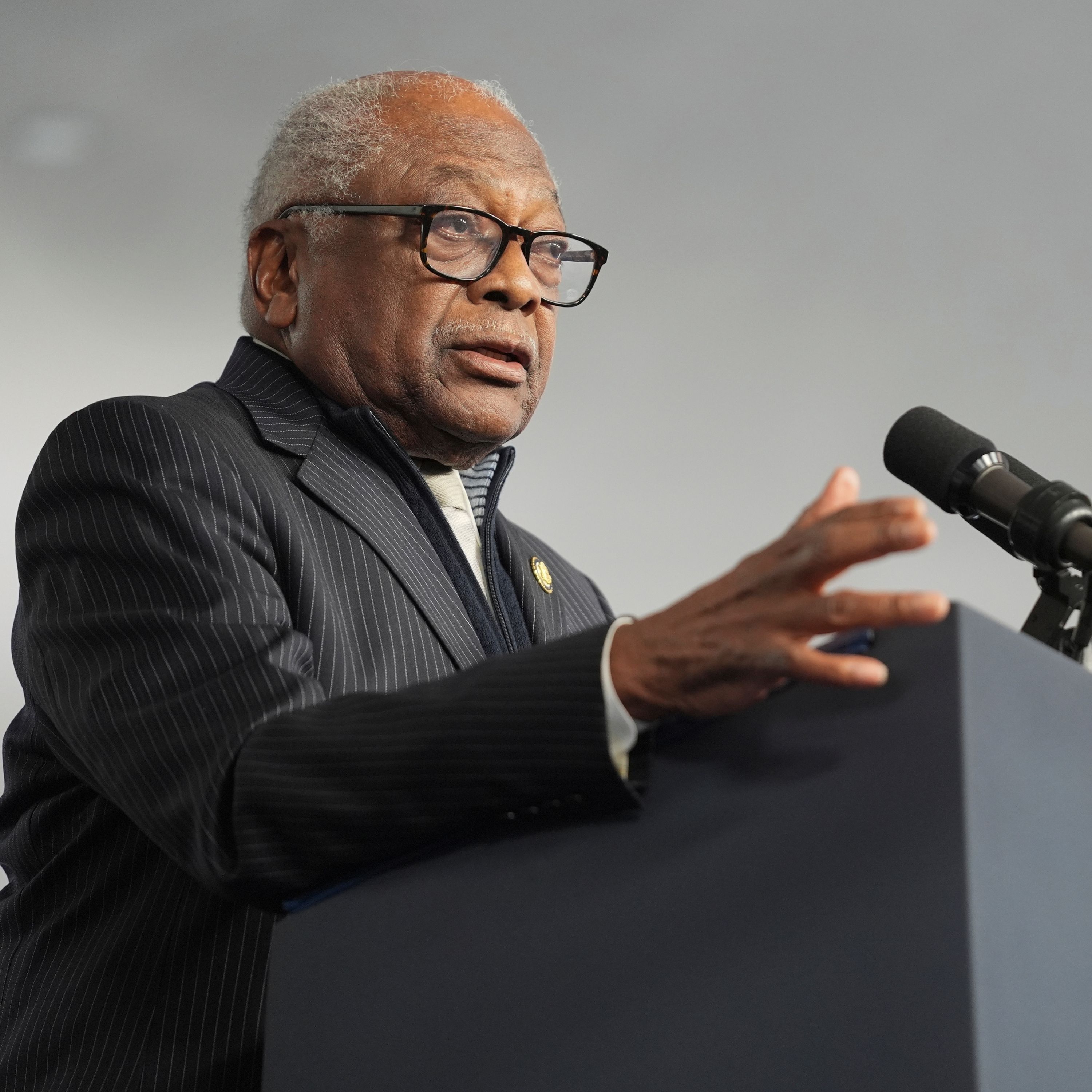
What A Day
Rep. Jim Clyburn Offers A Historical Warning
00:25:03
The Manhattan Institute, a conservative think tank, released a new survey this week in an attempt to figure out who, exactly, is a Republican these days. The takeaways? Newer Republican voters are more conspiratorial, more likely to be racist and antisemitic, and more likely to support the use of political violence. And they are pulling the GOP in their direction. This trend worries South Carolina Democratic Representative Jim Clyburn, who has written a new book, “The First Eight,” about the eight Black South Carolina Congressmen who preceded him in office. All of them were Republicans at a very different time for the party. Representative Clyburn became the ninth Black Congressman from the state when he was elected in 1992 – nearly a century after the last of the First Eight served in office. We spoke with Representative Clyburn about why it felt so urgent to write this book now. And in headlines, the Supreme Court allows Texas to use its gerrymandered Congressional map in the mi...
Loading summary
Transcript72 lines
- [00:03]
A
It's Friday, December 5th. I'm Jane Coastin and this is what a day. The show thrilled to see the US Institute of Peace, renamed the Donald J. Trump Institute of Peace. I'm looking forward to the openings of the Caroline Levitt School of Being Truthful and Not condescending and the J.D. vance Academy of getting offline and touching grass like a normal person.
- [00:30]
On today's show, President Donald Trump holds a photo op to tout peace in a region where there isn't peace. And the Supreme Court rules on Texas maps, falling in lockstep with its guiding the rule of law, according to Trump. But let's start with the Republican Party. I don't know if you've noticed, but the GOP has changed over the last decade. A lot. The Manhattan Institute, a conservative think tank, released a new survey on Monday, its attempt to figure out who exactly is a Republican these days. According to the data, the think tank separated the gop, or as it refers to it, the current GOP, into two groups, core Republicans, which it identifies as people who have voted for GOP candidates since before 2016, and new entrant Republicans who are recent first time GOP presidential voters, as in people who may have voted for former President Barack Obama but then voted for President Trump. The takeaways New entrant Republicans are more conspiratorial, more likely to be racist and anti Semitic, and more likely to support the use of political violence. And they are pulling the GOP in their direction, which worries me. And it worries South Carolina Democratic Representative Jim Clyburn. He's written a new book, the First Eight, about the eight black South Carolina congressmen who preceded him in office. All of them were Republicans at a very different time for the party. Representative Clyburn became the ninth black congressman from the state when he was elected in 1992, nearly a century after the last of the first eight served in office. When I spoke to the representative, he told me that it felt urgent to write the book now because the forces that caused that rupture are still visible and growing today.
- [02:06]
B
It's about those eight African Americans from South Carolina that served before me. But it's also about the 95 year period between number eight and yours truly, number nine, and what brought that about and how what is happening today is reminiscent of those events and what we ought to be doing to prevent it from happening again.
- [02:36]
A
Here's Representative Clyburn on his new book, the First Eight A Personal History of the Pioneering Black Congressman who Shaped a Nation. Congressman Clyburn, welcome to what A day.
- [02:46]
B
Thank you very much for having me.
- [02:48]
A
The history you cover in the first eight is one that I think a lot of Americans don't know nearly enough about. So let's start with some background. All of the first eight, which, unsurprisingly to people who know history, were members of the Republican Party. What did the party represent at the time, and how did that compare to the platform of Democrats, particularly Redeemer Democrats?
- [03:09]
B
Well, as you know, all African Americans were members of the party of Lincoln. It's just that simple. My mother and father were both Republicans. I grew up considering myself a Republican, went off to college, and all the way up to around 1960.
- [03:33]
That'S what most of us thought that we were. Now, this book explains some things that people tend not to focus on. It was Rutherford B. Hayes, a Republican who African Americans had voted for, who made the deal with the Redeemers to bring an end to Reconstruction. Lincoln was a great Republican president, but.
- [04:07]
He.
- [04:10]
Got assassinated, and the Republicans that came after him did not follow what he had started.
- [04:20]
A
In 1870, you discussed Joseph Rainey, who became the first black person to ever serve in Congress from any state. What should people know about his backstory?
- [04:30]
B
Well, he's the first elected, not the first to serve. The first to serve were two senators from Mississippi. But back then, Senators were not elected. They were appointed by their legislatures. But the first to ever be elected was Joseph Rennan. He was from Georgetown, South Carolina, was born enslaved, but his father was. Was a barber who earned enough money to purchase his family's freedom. And so Joseph Rainey became free by purchase in the first eight. I talk about how all eight of these people related to.
- [05:16]
The institution of slavery, and only three of them have been enslaved.
- [05:23]
One Rainey got his freedom purchased. Of course.
- [05:30]
Robert Smalls, the star of the book, so to speak.
- [05:37]
Escaped from slavery in a very dramatic way.
- [05:40]
A
I love how you write about Robert Smalls escaping from slavery, stealing a Confederate boat, pretending to be a Confederate captain, managing to properly imitate the Confederate horn call in order to deliver the boat to the Union with a white flag. And I love how you have that image from Harper's Weekly describing it as like one of the most daring moments in history. And you talk about how he lived the most consequential life, not just of the first eight, but of quote, any South Carolinian in memory. Can you explain how instrumental Smalls was in shifting the course of the Civil War, especially the role that African American soldiers played in the war?
- [06:21]
B
Well, to begin with, that ship, the planter, was A prize ship in the Confederate cause. When he took that ship, he took their biggest prize from them. And then he became the navigator for that ship once it was turned over to the Union soldiers. And of course, he won battles. He participated in 17 battles with that ship. And he won.
- [06:53]
All of those battles as far as we could tell. But the most consequential thing, I think, was six months after he escaped from slavery, General Saxton sent him.
- [07:11]
To appear to Washington to try to convince Abraham Lincoln to let African Americans fight in that war. Because the Union was losing. They didn't have enough manpower. They needed the manpower that was there at the time. Lincoln's good friend.
- [07:36]
Was trying to get him to allow blacks to fight. But it didn't happen. Not until Small sat down with Lincoln in August of 1862, convinced Abraham Lincoln to allow him to recruit 5,000.
- [07:58]
Formerly enslaved in that war. The number grew to many, many more after that initial induction. And after the war. Lincoln said that but for the freedmen, the Union would have lost that war. And the freedmen came in to service because Robert Smalls convinced Abraham Lincoln to let it happen. And so you can go through the history of every South Carolinian and look at the consequences that may have flowed from their lives. You will not find any that's more consequential than Robert Smalls.
- [08:45]
A
At the same time that black people were making advances in politics, there was an intense violent backlash among many white southerners, which included the resurgence of the Klan. Less well known is a section of Democrats known as red shirts. And you write about this, what echoes of the red shirts do you see in today's MAGA movement?
- [09:05]
B
Oh, I just saw something on TV this morning that reminded me of it, and so I'm going to march you through it. Back during the Revolutionary War, there were red coats. During the civil War, the aftermath of it, they wore red shirts.
- [09:26]
Today, the anti progressives, the redeemers, I call them. People who would like to redeem the south to pre Civil War days wore red shirts. Today, people who would like to redeem this country to what I call pre.
- [09:50]
1960 Civil Rights Act, Voting Rights act, they are now wearing red caps. So if you look at how these movements took place, how they took on things like uniforms, things like nicknames, you go throughout this whole period and you will see that one of the tools that was used back during the Jim Crow era to hang nicknames on people.
- [10:31]
George Washington, murder, who's number eight on this list, was nicknamed the Black Crow. These nicknames that hung on people back during Jim Crow, all are being resurrected today. And that's one reason I wrote the book the way.
- [10:54]
It'S written, because I wanted people to see the similarities in what's happened today and what happened back then.
- [11:01]
A
I'm glad you mentioned the Voting Rights Act. You note in the book that an amendment to the Voting Rights act of 1965 led to the redistricting in South Carolina that made your 1992 election to the House possible. Many court watchers think that the Supreme Court could gut Section two of the Voting Rights act this term. What are your biggest concerns if that happens?
- [11:21]
B
Well, I expect for that to happen. Everything that's going on today seems to be tracking what came after the Civil Rights act of 1866. These eight people, or at least those who were in office at the time, they are the ones who successfully fought and got the Civil Rights act of 1866. And the Supreme Court started with the slaughterhouse cases and going all the way up to Pleasant versus Ferguson, continued to reinterpret, reinterpret what that Civil Rights act really meant until they successfully neutered that act. The same thing is happening today. The Supreme Court is now addressing the Voting Rights act of 1965. After 11, 12 years ago, they made Section 4 and 5 of that act ineffective. Now they're aimed at Section 2 with the cases currently before them. And so I expect for them, the Supreme Court to track.
- [12:32]
As it did before. What we've got to do hopefully is respond unlike the response was before. And I think it's beginning to happen. I hope it holds. We saw it in New Jersey and Virginia, New York, Mississippi, Georgia. We're on course not have the same result that came after the gutting of the 1866 Civil Rights Act.
- [13:09]
A
What lessons do you want younger generations of activists and politicians to take from the stories of the first eight?
- [13:16]
B
I hope they were learn two important lessons. The first one is the power of one vote. I've heard too many people, young and not so young, lament about my one vote and whether or not it matters. Well, the Reconstruction period that was brought on by the Emancipation Proclamation came to an end by a vote of 8 to 7, one vote.
- [13:50]
Jim Crow became the law of the land by a vote in the electoral college of 185 to 184, one vote. So I want everybody to recognize that those two.
- [14:13]
Two of the most important events in the lives of African Americans, those two things were decided by a single vote. And the second thing I would want young people to know is something I got from my dad who said to me one day during the dark moments of the 1950s and 60s. I can't remember exactly what incident precipitated it, but my dad said to me, son, the darkest point of the night is that moment just before dawn. And that was his way of telling me, no matter how dark it may seem, you never give up the fight.
- [14:58]
A
Congressman Clyburn, thank you so much for joining me.
- [15:02]
B
Thank you so much for having me.
- [15:04]
A
That was my interview with South Carolina Democratic Representative Jim Clyburn. His new book is the First A Personal History of the Pioneering Black Congressman who Shaped a Nation. We'll get to more of the news in a moment, but if you like the show, make sure to subscribe. Leave a five star review on Apple Podcasts, watch us on YouTube and share with your friends. More to come after some ads.
- [15:36]
Why today is brought to you by Deleteme Deleteme makes it easy, quick and safe to remove your personal data online. At a time when surveillance and data breaches are common enough to make everyone vulnerable. Data brokers make a profit off your data. Your data is a commodity. Anyone on the web can buy your private details. This can lead to identity theft, phishing attempts and harassment. But now you can protect your privacy with DeleteMe. As someone with a very active online presence, privacy is really important to me for so many reasons. Have you ever been a victim of identity theft, harassment or doxxing? If you haven't been, you probably know someone who has. Deleteme can help take control of your data and keep your private life private by signing up for Deleteme now at a special discount for our listeners. Get 20% off your DeleteMe plan when you go to JoinDeleteMe.com wad and use promo code WAD at checkout. The only way to get 20% off is to go to JoinDeleteMe.com WAD and enter code WAD at checkout. That's JoinDeleteMe.com WAD code WAAD.
- [16:33]
C
This podcast is presented by the Netflix film A House of Dynamite from Academy Award winning director Catherine Bigelow, starring Idris Elba and Rebecca Ferguson. Not only are critics raving about the film, with Deadline calling A House of Dynamite exceptionally powerful and brilliantly directed, but policymakers, experts and scientists alike are weighing in, proclaiming that the film is required viewing. A powerful and thought provoking movie and a movie of our time worth watching, mulling and debating. A House of Dynamite now playing on Netflix for your awards consideration.
- [17:02]
D
Hey, Ryan Reynolds here for Mint Mobile. You know one of the perks about having four kids that you know about is actually getting a direct line to the big man up north. And this year he wants you to know the best gift that you can give someone is the gift of Mint Mobile's unlimited wireless for $15 a month. Now you don't even need to wrap it. Give it a try@mintmobile.com Switch upfront payment.
- [17:24]
A
Of $45 for three month plan equivalent to $15 per month required new customer.
- [17:27]
E
Offer for first three months only.
- [17:28]
A
Speed slow after 35 gigabytes if network's busy.
- [17:30]
E
Taxes and fees extra.
- [17:31]
A
See mintmobile.com.
- [17:34]
Here'S what else we're following today. Head of Lines.
- [17:40]
F
Let'S understand the Supreme Court the Supreme Court is marching side by side with Trump on most every issue. And here's another example where the Supreme Court simply said, okay, we'll go with Trump on this one.
- [17:52]
A
California Democratic Representative John Garamendi responded on CNN to news that the Supreme Court said it's actually a okay for now for Texas to use a redrawn map that would favor Republicans in the 2026 midterm elections, which is a major bummer. Last month, a panel of federal judges in Texas struck down the now infamous map, claiming, quote, substantial evidence shows that Texas racially gerrymandered the 2025 map. But SCOTUS disagreed. In an unsigned order, the conservative justices wrote the district court improperly inserted itself into an active primary campaign, causing much confusion and upsetting the delicate federal state balance in elections. The three liberal justices dissented. Basically, the wick on the nationwide gerrymandering stick burns ever closer to an explosion. Court battles are underway in states like Missouri and Florida, and others, including Indiana and Virginia, are weighing new maps heading into 2026. Whichever party wins the map wars could walk into the midterms with a major structural advantage. With Thursday's order, the Supreme Court has put that on hold until it delivers a final judgment in the case. Let the Cheating Olympics begin.
- [19:06]
President Trump hosted the leaders of Rwanda and the Democratic Republic of Congo at the recently and shamelessly renamed Donald J. Trump Institute of Peace on Thursday. The leaders of the two African nations officially signed a peace agreement back in June, but they traveled to D.C. to sign it again, this time for the Trump photo op. The deal was brokered by the U.S. the African Union and Qatar. It aims to end the years long conflict between the Congo and over 100 armed groups, the most powerful of which has been backed by Rwanda. Here's Trump speaking at the deal signing.
- [19:38]
F
They've spent a lot of time.
- [19:41]
Killing each other. And now they're going to spend a lot of time hugging, holding hands and taking advantage of the United States of America economically like every other country does.
- [19:53]
A
Leaving aside the hugging and hand holding and fake sarcasm, I think he means that the US Will now take advantage of Rwanda and the Congo economically because the Trump administration also signed a deal with the Congo in the hopes of gaining greater access to the country's critical minerals. And while Trump insists that this peace deal has brought an end to the conflict in the region, that's not really the case. The Associated Press reports that fighting between Congolese soldiers and Rwanda backed rebels is ongoing.
- [20:24]
The FBI arrested a man on Thursday accused of placing pipe bombs outside the headquarters of the Republican and Democratic national parties in D.C. a day before the 2021 insurrection of the Capitol. The bombs never detonated.
- [20:37]
F
Some of the evidence here, Tom, was particularly unique, especially the Nike sneakers that they found that this individual was wearing.
- [20:43]
A
NBC News is referring to Nike Air Max Speed Turf sneakers that may have helped lead to a breakthrough in the case. For years, the investigation confused law enforcement and spawned conspiracy theories. About January 6th. Apparently, agents filed subpoenas for credit card records from retailers that sold the shoes the suspect was believed to be wearing in an effort to narrow down potential buyers. The suspect was charged in connection with planting the bombs and is expected to appear in court today. Attorney General and contender for worst blonde ever, Pam Bondi held a press conference Thursday alongside a slew of other self important DOJ officials like FBI Director Kash Patel and Deputy Director Dan Bongino. They applauded one another for their hard detective work. Bondi said they cracked the case all on their own.
- [21:28]
E
Let me be clear. There was no new tip. There was no new witness. Just good diligent police work and prosecutorial work. Working as a team along with atf, Capitol Police, Metropolitan Police Department, and of course the FBI. We are working every day to restore the public's trust.
- [21:53]
A
Good luck with that.
- [21:57]
F
Here's the plan. We get the warhead and we hold the world ransom for.
- [22:05]
$1 million.
- [22:08]
A
In Austin, international man of mystery Dr. Evil wants to hold the world ransom for $1 million. But its henchman number two points out to Dr. Evil, back in 1997, a million bucks ain't what it used to be. And here in 2025, things are so upside down that even people making six figures figures are struggling to keep up. Dollar Tree underscored that crisis in an announcement this week. Of the 3 million new households who visited its stores last quarter, more than half earned more than $100,000. Later, in Austin Powers, Dr. Evil ups the ransom to $100 billion, which used to signal mega villain wealth. But I've got bad news for him and for us. Money doesn't mean what it used to, except for the ultra rich. Until recently, a $100 billion net worth put you among the world's wealthiest. Now, thanks to exploding AI and tech valuations, the bar has doubled to $200 billion. It's a textbook K shaped economy. The affluent are buoyed by rising markets while everyone else tightens their belts. The Swiss bank UBS reports billionaire wealth hit record highs this year. There are more billionaires than ever, and their fortunes have never been larger. So much for the rest of us. And in today's economy, Dr. Evil's $100 billion plan wouldn't even get him into supervillain territory. At $342 billion, that mantle belongs to Elon Musk. And that's.
- [23:51]
Before we go the Trump administration is using the tragic shooting of two National Guard members to justify cracking down on immigration and tightening restrictions on refugees and asylum seekers at a time when thousands are seeking safety in the US on the latest episode of Runaway Country, Alex Wagner breaks down what's happening, speaks with an Afghan aid worker who now fears for his family, and sits down with Joy Reid to reveal the bigger MAGA strategy at play. If you want to understand how these moves could affect immigration, civil rights, and the direction of the country, don't miss this episode. Tune in to runaway country on YouTube or wherever you get your podcasts.
- [24:32]
That's all for today. If you like the show, make sure you subscribe. Link Leave a Review Contemplate how the Pantone color of 2026 is white and tell your friends to listen. And if you're into reading and not just about how, okay. According to Pantone, the color is Cloud Dancer, which the company says represents, quote, opening up new avenues and ways of thinking like me. What a Day is also a nightly newsletter. Check it out and subscribe@crooked.com subscribe hi, I'm Jane Coston and it's white. It's like really white. It's egg salad white. It's Wagon Wheel white. It's white.
- [25:17]
What a Day is a production of Crooked Media. It's recorded and mixed by Desmond Taylor. Our associate producers are Emily Foer and Chris Alport. Our video editor is Joseph Dutra. Our video producer is Joe Johanna Case. We had production help today from Greg Walters, Matt Berg, Kaitlin Plummer, Tyler Hill, and Ethan Uberman Our senior producer is Erica Morrison and our senior vice president of news and politics is Adrienne Hill. We had help today from the Associated Press. Our theme music is by Colin Gilliard and Kashaka. Our production staff is proudly unionized with the Writers Guild of America.
- [25:48]
B
Easy.
- [26:04]
E
My uncontrollable movements called TD tardive dyskinesia felt embarrassing. I felt like disconnecting. I asked my doctor about treating my TD and learned about Ingreza, a prescription medicine clinically proven for reducing TD in adults. That's always one capsule or once daily and number one prescribed. People taking in can stay on most.
- [26:23]
G
Mental health meds in can cause depression, suicidal thoughts or actions in patients with Huntington's disease. Call your doctor if you become depressed, have sudden behavior or mood changes or suicidal thoughts. Don't take in allergic Serious side effects may include allergic reactions like sudden, potentially fatal swelling in hives, sleepiness, the most common side effect, and heart rhythm problems. Know how in grezza affects you. Before operating a car or dangerous machinery, report fever, stiff muscles or problems thinking as these might be life threatening. Shaking, stiffness, drooling and trouble with moving or balance may occur.
- [26:54]
E
Take control by asking your doctor about Ingrezza.
- [26:57]
G
Learn more at ingrezza.com that's I N G R E Z Z A dot.
- [27:02]
A
Com in Grezza.
- [27:07]
H
Amazon has everything for everyone on your list, like your sister who refuses to accept that she does not have a face for bangs. Get her a lovely hat. Amazon has a huge selection of fashionable gifts and with holiday deals you can save big on hats, home decor, even the hottest toys. Grab some barrettes while you're at it for that oh so awkward, sweep your hair to the side until your bangs grow out.
- [27:32]
A
Stage.