Loading summary
Transcript57 lines
- [00:04]
A
It's Thursday, April 2nd. I'm Jane Coston, and this is what a day. The show watching televangelist and spiritual advisor to President Donald Trump. Paula White, keep it super normal at an Easter celebration at the White house on Wednesday.
- [00:17]
B
Mr. President, no one has paid the price like you have paid the price. It almost cost you your life. You were betrayed and arrested and falsely accused. It's a familiar pattern that our Lord and Savior showed us. But it didn't end there for him and it didn't end there for you.
- [00:42]
A
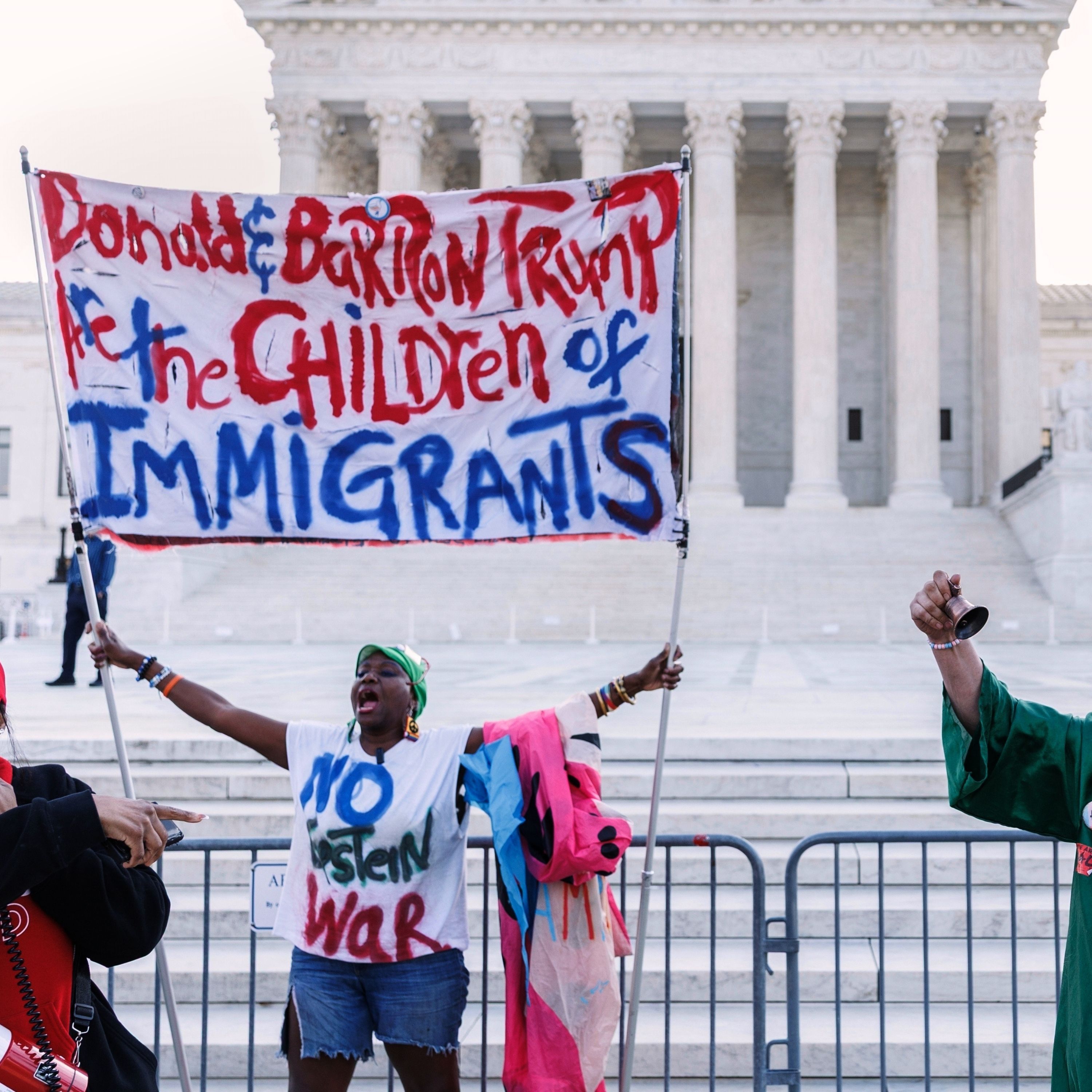
I may need to go back and check, but I don't think Jesus Christ was arrested for scheming to overturn an election. On today's show, Trump threatens to withdraw the US from NATO, something he can't actually do without congressional approval. And statues mocking our fearless leader keep popping up across the nation's capital. But let's start with birthright citizenship. The Supreme Court tackled a question Wednesday that most Americans probably thought was are the American born children of immigrants American? The Constitution seems pretty clear. I mean, Section 1 of the 14th Amendment reads in part, all persons born or naturalized in the United States and subject to the jurisdiction thereof are citizens of the United States States and of the state wherein they reside. But to Donald Trump, that's not clear at all. An executive order issued on the president's first day back in the White House said, quote, the 14th Amendment has never been interpreted to extend citizenship universally to everyone born within the United States. That executive order went on to say that under Trump 2.0, the US government would stop treating the American born children of undocumented immigrants or people in the US temporarily as citizens. Cue the lawsuits. Now, the 14th Amendment has been widely interpreted to say just what it says. But Trump, as you might guess, isn't a big precedent guy, which might be why he made the quick drive over to the Supreme Court to watch oral arguments in person. Here's Fox News giving a play by play. President Trump about to leave the White House. He just got into the motorcade there, the beast. And he will be going up, I think it's about a mile, maybe not even that much, from 1600 Pennsylvania Avenue up to the Supreme Court. He will be the first president in history to sit and listen to an oral argument. He didn't stay long, though, and wasted little time before rage posting on Truth Social, perhaps because the Supreme Court seemed mighty skeptical that the 14th Amendment means something other than what it says. So for more on the Supreme Court's swing at the birthright citizenship question, I spoke to Melissa Murray She's a professor at the New York University School of Law and co host of Crooked Media's Strict Scrutiny. Melissa, welcome back to what a Day.
- [02:59]
B
Thanks for having me. What a day indeed.
- [03:01]
A
Ahead of the arguments, President Trump seemed to expect that SCOTUS would not come down on his side of his executive order. Then it was announced that Trump would attend, which is unprecedented for a sitting president. But did his presence at the court seem to make any difference whatsoever?
- [03:17]
B
I think it gave the press corps a lot to talk about. It's not every day you see a sitting president roll up to the court. In fact, it's not any day you see a sitting president do that. So that was unusual. But it seem to face the justices, particularly the three Trump appointees about whom he's railed against over the past couple of weeks as they've delivered losses to the administration on signature issues like tariffs. So he's said that Amy Coney Barrett, for example, is a disgrace to her family. He's called some of them Rhinos, Republicans in name only. I mean, he's really given it to the court. So I think, you know, it took a lot of stones to show up in their house on Wednesday, especially since they didn't seem especially phase to have him there and certainly weren't in any mood to give him and his arguments any quarter.
- [04:07]
A
Yeah, I think if I were a Supreme Court justice and the president were making it very clear that he wanted me to rule in a specific way because he nominated me, I'd be a little annoyed. But who knows? I'm not a Supreme Court justice.
- [04:21]
B
But it's very Mafia like though, just to roll up.
- [04:24]
A
It's incredible. An incredibly mafia like action. Also a little funny because I'm like, it is walking distance, but not for Donald Trump. Speaking of things Donald Trump doesn't seem to understand, birthright citizenship is one of those things. And he demonstrated such by posting on Truth Social Wednesday, quote, we are the only country in the world stupid enough to allow birthright citizenship.
- [04:44]
B
Not true.
- [04:45]
A
Not true. Like it's also it's been not true for a really long time. The US is one of more than 30 countries that have unconditional birthright citizenship. Most are in the Western Hemisphere. But let's back up for a second. Can you walk us through what the administration's case is here that isn't true? True social posts.
- [05:03]
B
All right, so the 14th amendment, which I wrote about in my forthcoming book the Constitution, a comprehensive and annotated guide for the modern reader, comes out on May 5th. Not written entirely by me. James Madison had a little something to do with it. He's a little surprised that I'm now his co author, but, you know, things happen a lot. Gotta roll with it.
- [05:24]
A
It's true. It's true. It was time that James Madison had a co author and probably not the
- [05:30]
B
one he was expecting. I think he's probably like who taught her to read and write. In any event, Section 1 of the 14th Amendment says that anyone born in the United States and subject to the jurisdiction of the United States is a citizen of the United States and the state in which they reside. That's the basic grant of birthright citizenship. There are two exceptions that the Constitution and federal law have acknowledged. Individuals who are the American born children, children of foreign consoles or diplomats, are excluded because their parents are not subject to the jurisdiction of the United States. Native American tribal members whose American born children are in the United States were not initially covered by the grant of birthright citizenship because Native American tribes were understood to be sovereign nations within the borders of the United States. Later, in the 1950s, an act of Congress included Native American American born children in that grant of birthright citizenship. So it's pretty clear we've been pretty settled on it. It's very obvious what the citizenship clause was intended to do. And the Trump administration actually made an argument that isn't wrong on the history, but is wrong, I think, in principle. So they noted that the citizenship clause is a direct repudiation of the Supreme Court's decision in 1857's Dred Scott v. Sanford. That was the infamous decision that precipit the United States Civil War. And it said that African Americans could never be citizens because they had been descended from enslaved persons. So when it was announced, Dred Scott itself was a departure from the longstanding Anglo American tradition of birthright citizenship, a tradition that dated back to England and that had been adopted by the colonists when they became the United States at the founding. And Dred Scott really departed from that in the name of racism and white supremacy and all of the other isms. The 14th Amendment citizenship clause was a direct repudiation of that. Everyone understands that. The Trump administration, however, twists that history and says because it was meant to be a repudiation of Dred Scott, it means that the framers of the 14th Amendment, when they were talking about birthright citizenship, were only intending to confer birthright citizenship to, as the President puts it, the babies of slaves. That's not true though. Right. And anyone who can do some basic research, anyone who has read history, will Understand that even at the time the 14th Amendment was being debated and ratified, they were talking explicitly about questions of immigration because immigration was a fact of life in the United states. In the 1840s, there was a massive influx of Irish migrants because of the great potato famine. In the 1850s, the gold rush in California brought Asian migrants to the United States. When they were debating the terms of the 14th Amendment and that grant of citizenship, they did so with full knowledge that they weren't just thinking about how to bring in the formerly enslaved into the ranks of citizens, but whether they would also be doing so for individuals whose parents were not from this country.
- [08:46]
A
It's interesting, and I've seen this referenced online, that you're starting to see the Trump administration on this issue talking about how they couldn't have possibly seen mass immigration coming. Kind of sounding like people talking about gun rights in the Constitution and saying they couldn't have possibly seen AR15s coming.
- [09:03]
B
Well, that was an argument that Justice Alito made today. And frankly, I was shocked to see him make it because I expect better of him. I mean, I expect him to be a little craftier on this kind of thing. Not that I expect him to be better per se, but I expect him to be a little slicker in doing it. So he made the point that the founders could never have come, contemplated the possibility of undocumented migration. Therefore, you know, free reign, you can limit birthright citizenship to whomever you like. But that kind of logic I think he wants to cab into the citizenship clause in the 14th Amendment because that's the same logic that people have been using about the prospect of being able to regulate firearms without running afoul of the Second Amendment. And so called originalists, as Justice Alito suggests that he is, have always said, doesn't matter that we didn't have machine guns at the Founding, doesn't matter that James Madison never had an AR15. We have to actually look and see what the framers were thinking. If they wanted everyone to have a gun, then everyone should have a gun. And I think the same logic should hold here. The framers were clearly thinking that birthright citizenship would include everyone born in the United States, subject to those very limited exceptions that I just mentioned. And that's kind of how it's always been, and that's probably how it always should be.
- [10:26]
A
So besides Justice Alito, what were the key takeaways of the debate on Wednesday?
- [10:32]
B
Well, so one thing that stood out was it seemed that at least some of the justices were just a little shell shocked at Having to even parse this question. And, yeah, same relatable content. Because I, too, was surprised that in the year of our Lord 2026, we were literally debating whether we were going to strip citizenship from people whose parents were from another country in this nation of immigrants. So Justice Sotomayor, for example, just seemed a little put out that we were even talking about this. And again, the text of the 14th amendment is so clear. The history of the 14th amendment is so clear. This argument that the Trump administration is offering is so fringe. I mean, it was off the wall five years ago, and through careful stewards, they've managed to make it happen. I mean, it's a little bit like jeggings. Like, you know, like, we never would have thought about it five years ago, but you just keep wearing them, and eventually you wear it down, and all of a sudden, you know, jeggings, they're happening. That's what kind of happened here. They just kept pushing it and pushing it, and, you know, now it's in the U.S. supreme Court. So that was one thing that really stood out to me. It seemed that the justices on the main were quite skeptical of the administration's position. Although, again, I think Justice Alito, wide open and a little receptive. Justice Thomas may have gone either way. Some of his questions indicated that he might be receptive to the administration's faux originalist argument. Justice Kavanaugh was also a little hard to read, but I took great pleasure, and I think you might have as well, when Justice Gorsuch seemed to literally struggle with the fact that John Sauer, the Solicitor General, was making inane arguments and couldn't seem to understand how his argument would relate to the children of Native Americans in the United States at this moment.
- [12:25]
A
Yeah, I was really struck by that moment, because no one on the court cares as much about how the law can impact Native Americans as Neil Gorsuch. That's his sweet spot. It always has been.
- [12:35]
B
I mean, it is literally like going to the Supreme Court and arguing before Cookie Monster and being shocked when he's like, do you have a cookie?
- [12:41]
A
Yes, like, and then to have the Solicitor General not know how to respond to would Native Americans be citizens? I was like, dude, dude, what are we doing here?
- [12:53]
B
Yeah, exactly. I mean, to be clear, they just don't roll into court. Or at least to my knowledge, they don't just roll into court. Maybe this administration is doing a different thing. You know, there are serious moots and practice sessions where they think about every question that might come up. And so, to my mind, it was just incomprehensible that no one thought to ask this question that seemed ob he
- [13:17]
A
would ask this term. The President's apparent strategy has been to use the Supreme Court as a free pass to do whatever he wants. But the Justices, even the ones he appointed and then screams at more recently, have shown a willingness to disagree with him sometimes. How will this ruling either for or against the executive order, impact the President's relationship with the Supreme Court, which seems. He seems to think it really is a mafioso, you know, nice court, you've got shame if something happened to it kind of agreement.
- [13:48]
B
So I don't know how it will affect his relationship with the Court. I think it's very likely that he will lose before the Court, in part because the argument is so outlandish and the text and history is so obvious. But with that in mind, I think it needs to be made clear to listeners that when the Court rules against the President on this issue, we should not be big upping this court, because this will not be, I think, a unanimous decision. I think there likely will be some defectors from common sense here, and that will be a travesty, because this is such a straightforward, obvious question. There is precedent on the books. There are acts of Congress that are consistent with this understanding of birthright citizenship. This is the way we have always done it, and the history bears that out. So this should be unanimous. The fact that fact that it won't be is a travesty. And you should remember that when all of the other media are talking about how great this court is for standing up to Donald Trump, like, this was amazing that they did this. They stood up to him and they dealt him a loss. Of course they dealt him a loss. This was the easiest question in the world. The second easiest question was tariffs, and they gave him a loss there, too. And while we're talking about all the losses that they've given him, two big ones, we aren't talking about all of the wins that they've given him, the wins that have literally fulfilled, facilitated him, as he's dismantled the Department of Education, as he's encroached upon Congress's prerogative to disperse funds for federal programs as he's dismantled the administrative state. That's the stuff we should be thinking about. The winner here is this court, this court that gets to burnish this patina of independence that is undeserved, that we will all talk about, surely, but is totally undeserved, given the way they have literally midwife this administration into dismantling our
- [15:37]
A
government, I mean quite literally midwifed this administration with its decision that let Trump run again. Melissa, as always, thank you so much for joining me.
- [15:48]
B
Thanks for having me, Jane.
- [15:50]
A
That was my conversation with Melissa Murray, Law professor at NYU and co host of Crooked Media's Strict Scrutiny. We'll link to her forthcoming book, the US Constitution, a comprehensive and annotated guide for the modern reader in the show notes. Thanks for making the most important decision of your day listening to our show. If you enjoy our deep dives into Supreme Court activities, make sure to subscribe, leave a 5 star review on Spotify and Apple podcasts and share with your friends. More to come after some ads. What a day is brought to you by Nutrafol Good hair days do more than we give them credit for. When your hair feels healthy, you show up differently. You're more confident, more relaxed, and you're not constantly checking mirrors or adjusting your hair. Your hair becomes one last thing competing for your attention throughout the day. Nutrafol supports hair health from within, working over time to deliver results you can see and feel so your hair becomes something you enjoy, not something you stress about. Nutrafol is the 1 dermatologist recommended hair growth supplement brand and it's the 1 hair growth supplement brand personally used by dermatologists. Nutrafol's hair growth supplements are peer reviewed, NSF certified for sport and clinically tested. Let your hair be one last thing to worry about. See visibly thicker, stronger, faster growing hair in three to six months with Nutrafolin. For a limited time, Nutrafol is offering our listeners $10 off your first month subscription and free shipping when you visit nutrafol.com and enter promo code DAYTEN. That's nutrafol.com, spelled N u T R-A F o L.com promo code DAYTEN. This episode is sponsored by BetterHelp. Financial stress affects far more than our bank accounts. It can take a serious toll on mental health and relationships. With 88% of Americans feeling some form of financial stress at the start of 2026, money worries often bring anxiety, sleep disruption and even depression, and are one of the leading sources of conflict for couples. This month, we want to normalize the emotional weight of financial stress and remind people that struggling with money doesn't mean they've failed. Sometimes it's just about accessing the right kind of support. I know that money is one of my biggest anxiety triggers, but therapy isn't about financial advice. It's about managing the stress, shame or anxiety that can come with it Therapy can help people unpack their relationships with money, build healthier coping strategies, and feel less alone in the process. With over 30,000 therapists, BetterHelp is the world's largest online therapy platform, having served over 6 million people globally. And it works with an average rating of 4.9 out of 5 for a live session based on over 1.7 million client reviews. When life feels overwhelming, therapy can help. Sign up and get 10% off@betterhelp.com wad that's betterhelp.com wad
- [18:27]
B
with Verbocare. Help is always ready before, during and after your stay. We've planned for the plot twists, so
- [18:36]
A
support is always available because a great trip starts with peace of mind. Here's what else we're following today. Head of Lines Joining me is Crooked's Washington correspondent Matt Berg to talk about the big stories. Hey, Matt.
- [18:54]
C
Hey, Jane.
- [18:55]
A
So we are recording this before Trump's Iran speech on Wednesday night, But, you know, it's timeless, Matt. Marco Rubio contradicting himself to make Trump happy.
- [19:05]
C
Yeah, his past is coming back to bite him a lot these days, isn't it?
- [19:09]
A
Yeah. It's funny that we're just supposed to ignore his years as a senator or even his presidential run in 2016, but we won't get into that. But here's Rubio on CBS's Face A Nation in 2024 after co authoring a bill that requires the president to get the approval of Congress before pulling out of NATO.
- [19:28]
B
I wrote it with the belief that it's an important alliance.
- [19:31]
A
If NATO didn't exist, we'd have to create it. It's one of our strategic strengths that
- [19:36]
B
we have in the world because China doesn't have these alliances, for example, and
- [19:39]
A
neither do the Russians, for that matter,
- [19:40]
B
or the Iranians, for that matter. And I believe Congress needs to play a role in deciding whether we're going to remove ourselves from that.
- [19:48]
A
But this week, Rubio, assuming No One Remembers 2024, told Fox News Sean Hannity that figuring out the U.S. relationship with NATO is Trump's decision. Matt, is Marco getting confused because he has too many jobs?
- [20:00]
C
You can't rule that out. I think that the more accepted explanation is that he just simply has way too many things going on right now between a war and then Trump suddenly saying that he might want to withdraw from NATO. And that is exactly why Rubio's history is so important at this moment. I mean, Trump has threatened to pull out of NATO in the past, but the stakes are really, really high right now.
- [20:22]
A
Yeah, Trump wants NATO allies to help open the Strait of Hormuz, which Iran's military has successfully blocked since Trump started a war with Iran, which that could have been predicted. And those NATO allies have been mostly hesitant to join the US for incredibly obvious reasons.
- [20:38]
C
And that could also set up a big crash course with Congress. Even with GOP control. Pulling out of NATO would be a huge ask, and it's unclear if enough Republicans would even support that. And that's not the only. The only drama that Congress is dealing with at the moment. We're almost 50 days into the partial government shutdown, which day by day is becoming the longest ever. And now Trump is trying to raise the pressure on Republicans in both chambers to end it and fund dhs.
- [21:03]
A
Yeah. Trump posted on Truth Social Wednesday, quote, we are going to work as fast and as focused as possible to replenish funding for our border and ICE agents. And the radical left Democrats won't be able to stop us. I like it when he talks about himself being focused. He's not. He then gave Republicans a June 1 deadline to pass a bill which is several weeks away. So, again, not very focused.
- [21:27]
C
Yeah, I think that it's safe to say that the shutdown will. The record will get broken over and over for quite a few days. Now, Trump is basically supporting the plan that Senate Republicans tried last week, which you might remember House Republicans just shot down. So the first part of that plan would be a bill that funds all of DHS except for ICE and parts of customs in border protection. The second, which is much more complicated, would fund ICE and cbp.
- [21:54]
A
So that would allow the Republicans to fund ICE and CBP without any support from the Democrats.
- [22:00]
C
That's true, but as we know, there's a lot of infighting between Republicans in Congress right now about how to move forward.
- [22:06]
A
Yeah. Is this going to be another example of how terrible it is to be speaker of the House Mike Johnson, who has the worst job in the world, and. And all he does is herd cats who all hate each other. See, that's the one thing that does give me joy, is that whatever day I'm having, Mike Johnson is having a worst one. But thinking more about D.C. i lived in D.C. for 13 years, and there'd be random things happening that would always kind of surprise you, like fighter jets going overhead or there's a massive convoy of cars because the premier of China is here. But lately, something seems to be happening on the National Mall as statues protesting Trump keep popping up every other day.
- [22:45]
C
Yeah, it really does feel like something strange is going on and not necessarily in a bad way. I know that you're a runner too, Jane, so you understand this. In the morning I go on runs to the mall, and on Monday, I sadly did not run far enough to see that giant, you know, golden toilet purse on a marble statue in front of the Lincoln Memorial. But on Wednesday, I stumbled across a mannequin of Trump underneath a golden umbrella with rockets flying over his head.
- [23:11]
A
This is not a first term joke about how Trump called North Korean leader Kim Jong Un little rocket man, right?
- [23:17]
C
Surprisingly not. It poked fun at Trump's Golden Dome project, which is basically a giant space missile defense system which will take a long time to build and a ton of money. The statue is actually a fountain, which I did not get to see, but I saw some videos of it later. And the umbrella has holes in it so that water falls through. And the idea here is that Trump's Golden Dome project has holes in it.
- [23:39]
A
Ooh, highbrow. I have a lot of questions. Who is paying for these and who is making these statues? Also, how are they doing these so quickly? Is there like a warehouse somewhere in like Northeast D.C. full of Trump statues?
- [23:55]
C
Yeah. I don't have the answer to those latter questions, especially the one of whether people or how people bring those statues onto the mall, one of the most populated places, without anyone noticing. But when I saw this mannequin, I asked someone who's sitting nearby if she was involved in the project. She said no, but Ben Cohen of Ben and Jerry's fame is the guy who organized this specific project, and he posted a video on Tuesday taking credit for it. And I'm not sure if he's responsible for all the other shenanigans going on on the Mall, but there are a lot of people right now in D.C. who are mocking Trump, so you never know who's up to what.
- [24:35]
A
Which, honestly, given that I firmly believe Trump ran for president in the first place because Obama made fun of him at the White House Correspondents Dinner, must irritate Trump to no end. Matt, as always, thanks for hanging out.
- [24:49]
C
Thanks for having me.
- [24:50]
A
And that's the. Before we go, this week on Runaway Country, Alex is digging into how Trump's relationship with Saudi Crown Prince Mohammed bin Salman is shaping the war in Iran and what that says about who really benefits from U.S. foreign policy. Then Jon Lovett joins to break down the corruption behind it all and how it's driving Trump's decisions far beyond this conflict. Make sure to tune in to Runaway country every Thursday wherever you get your podcasts or on YouTube. That's all for today. If you like the show, make sure you subscribe, leave a review, honor the puppies learning to rescue people from avalanches and tell your friends to listen. And if you're into reading, I'm not. Just about how many ski resorts across the US have avalanche dog programs with dogs trained to help rescue people by using their amazing senses of smell. Like me. What a Day is also a nightly newsletter. Check it out and subscribe@cricut.com subscribe I'm Jane Coastin and all dogs are good dogs, but working dogs are especially good dogs. What a Day is a production of Crooked Media. It's recorded and mixed by Desmond Taylor. Our associate producer is Emily Foer. Our producer is Caitlin Plummer. Our video editor is Joseph Dutra. Our video producer is Johanna Case. We have production help today from Greg Walters, Matt Berg and Ethan Oberman. Our senior producer is Erica Morrison and our senior vice president of news and politics is Adrienne Hill. Our theme music is by Kyle Murdoch and Jordan Cantor. We had help today from the Associated Press. Our production staff is proudly unionized with the Writers Guild of America. Easy.
- [26:52]
C
This week with digital coupons at Safeway and Albertsons. Get beef rib roast for $7.97 per pound member price with minimum purchase of $50 or more in a single transaction. Exclusions apply. See Store for details and Broccoli, cauliflower or russet potatoes are 97 cents per pound. Member price limit 6 pounds plus selected sizes and varieties of Lucerne butter cheese or Philadelphia cream cheese are 197 each member price. Visit safewayralbertsons.com for more deals and ways
- [27:20]
A
to save Early Birds Always rise to the occasion for summer vacation planning because early gets you closer to the action. So don't be late. Book your next vacation early on VRBO and save over $120. Rise and shine. Average savings $141 select homes only.