← What A Day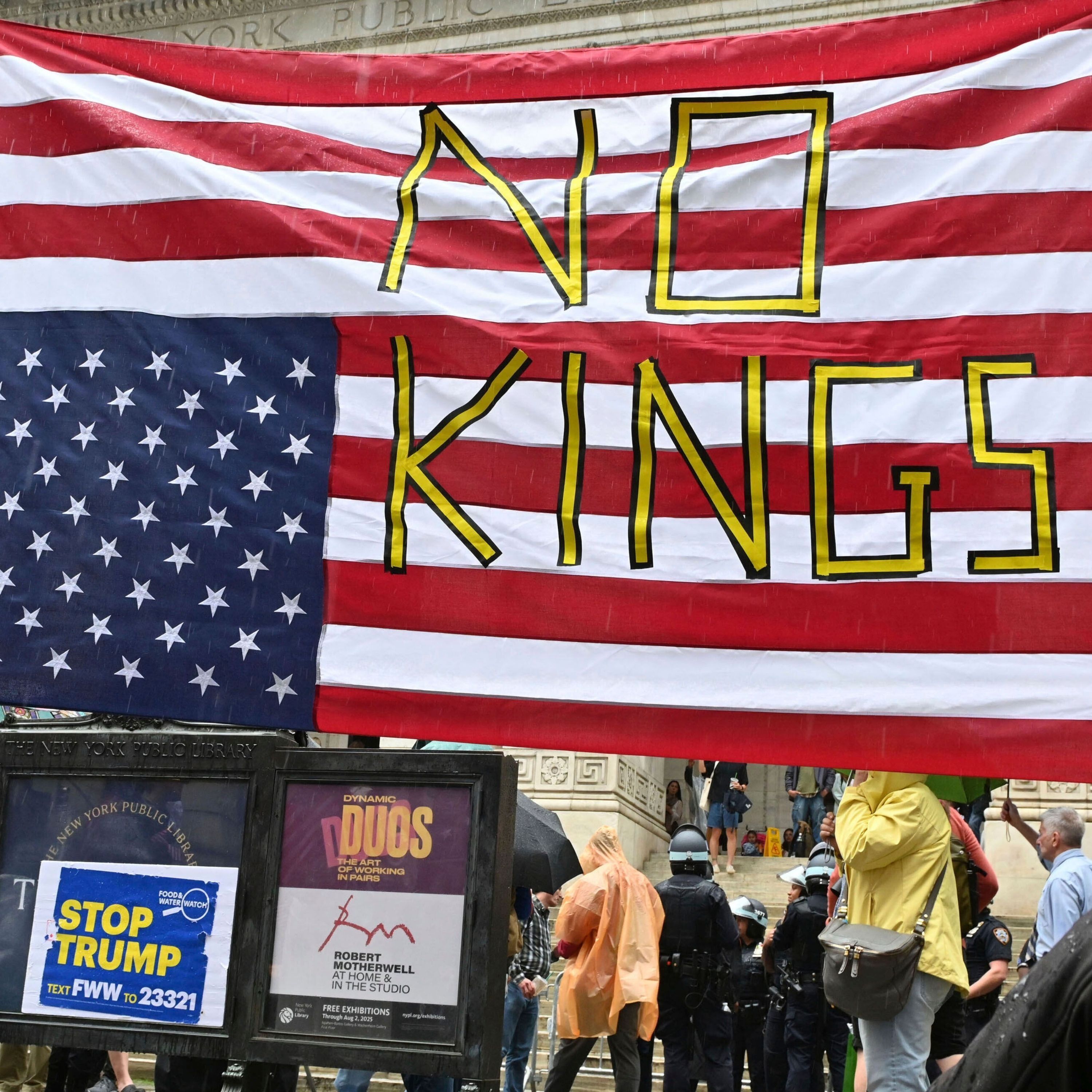
What A Day
Sustaining The Movement After No Kings
00:20:38
In towns and cities across the country, from blue cities to red states, from Idaho to Georgia and pretty much everywhere else, folks gathered to show their opposition to the Trump Administration. They were standing up against immigration raids with masked federal agents, to devastating cuts to Medicaid, to the President of the United States, quote-unquote “honoring” the United States Army with a birthday parade. If you marched this weekend with hundreds (or even thousands) of your neighbors, what can you do to keep that energy going? We asked Maurice Mitchell, the national director of the Working Families Party.
Loading summary
Transcript35 lines
- [00:03]
Jane Coston
It's Monday, June 16th. I'm Jane Coston, and this is what a Day. The show that wants to send a special message of support to the Fox News guest who was invited on to discuss President Donald Trump's military parade and did so very, very, very drunk. Look, it happens. You drink an entire bottle of champagne by yourself watching tanks, and before you know it, you're calling the president Dunarl tramp on live television. On today's show, the Trump administration proposes an expansion of the travel ban to include more than 30 additional countries. And lawmakers are on high alert after a deadly attack on Minnesota state legislators. But let's actually start by looking backwards to Saturday. More than 200,000 New Yorkers took to the streets for the no Kings march today. Organizers say the nationwide movement is in.
- [00:57]
Maurice Mitchell
Response to President Trump's immigration, immigration raids.
- [00:59]
Jane Coston
Military parade, and his defiance of court orders. And it wasn't just New York, not by a long shot. In towns and cities across the country, from blue cities to red states, from Idaho to Georgia and pretty much everywhere else, folks gathered to show their opposition to the Trump administration. They were standing up against immigration rates with massed federal agents, to devastating cuts to Medicaid, to the President of the United States, quote, unquote, honoring the United States army with a birthday parade. And they gathered in massive numbers. An estimated 5 million people attended a no Kings protest this weekend. That compares to the, well, definitely not 5 million people who attended Trump's military parade. In their defense, it was very humid, maybe too humid to give Vice President J.D. vance some enthusiasm. To the thousands of Americans who traveled.
- [01:51]
Maurice Mitchell
From distant towns and across state lines.
- [01:53]
Jane Coston
To be here today.
- [01:54]
Maurice Mitchell
This is your national capital. Welcome to Washington, D.C. we are thrilled to have you.
- [02:03]
Jane Coston
I got more excitement out of my childhood dance recitals. So now what if you marched this weekend with hundreds or even thousands of your neighbors? What can you do to keep that energy going? To find out, I talked to Maurice Mitchell. He's the national director of the Working Families Party. Maurice, welcome to Water Day.
- [02:22]
Maurice Mitchell
It's good to be here.
- [02:24]
Jane Coston
So there are credible reports that altogether, the no Kings rallies this past weekend attracted more demonstrators at once than any other action since Trump got back into office. Tens of thousands of people came out in Chicago, Louisiana, New York, Salt Lake City, tiny towns in Idaho. You know, a lot of people were showing up in Atlanta and elsewhere and 600 people in Casper, Wyoming. What does this kind of scale say about progressive or left leaning activism right now?
- [02:52]
Maurice Mitchell
Yeah. And you know, to be clear, and when everything is counted, this Might be the single largest day of protest in history. Right. That, that's the scale that we're talking about. And I think it's, it's a reflection of the fact that so many people across so many dimensions of difference are opposed to Trump and MAGA era policies that are hurting them and their communities, not just people in, quote, unquote, blue enclaves. Like you said, there were 400 people in Pentwater, Michigan, and it's a town of 800 people who protested. So to me, it's a demonstration of the fact that Trump and MAGA and this movement is deeply, deeply unpopular with American people. And the momentum is on our side.
- [03:42]
Jane Coston
Where were you on Saturday?
- [03:44]
Maurice Mitchell
I'm from Long island, so I went to a number of different protests on Long island and the vibes were really energetic. Right. There's a feeling that people who for the first time decided that they were going to get out and protest, especially coming from the sites that they saw in LA and other places of those really scary raids, you know, the military patrolling American cities, I think it's just been really alarming for people. And this Saturday provided an opportunity for people to take their alarm and that energy and do something very, very productive with it.
- [04:22]
Jane Coston
You've been involved in protests for a long time now, at least going back to Black Lives Matter, and you mentioned seeing a lot of new people at the rallies you attended. Did you see anything else new at the New Kings rallies you attended that you hadn't seen before?
- [04:35]
Maurice Mitchell
Well, I saw a lot of creativity. Right. You know, a good mark of a good rally is the, the organic creativity that you see with people's signs and the way that people are expressing themselves. I saw a lot of age and racial diversity. So what that shows is that the movement is broadening. I remember when we held actions on April 5, the hands off actions, they were very, very large. And still at the time, people were wondering if more and more people were gonna come out and if that was just a blip. And I think the answer is clear. That was not a blip. That was evidence of a growing movement. And, you know, yesterday it was larger, it was more diverse, there were more people, more places. And I think that that's going to continue as Trump and MAGA continue to accelerate their attacks on everyday people.
- [05:27]
Jane Coston
You mentioned the National Guard being brought into la, and Trump himself had threatened to arrest and detain protesters who would show up to his D.C. military parade, which is partly why there was no. No Kings protest in those threats. Do you think those changed how organizers approached These rallies, look, I think those.
- [05:46]
Maurice Mitchell
Threats actually just emboldened people. Right. And I think the juxtaposition of his weak birthday parade, the paltry sums of people that showed up there, and the millions of people that showed up around the country, to me, shows that the emperor has no clothes. It's the point of the. No, King's idea. The idea that in America, power comes from the grassroots up, not the other way around. And the whole idea of Trump's regime is the idea that he's some sort of king, some sort of American authoritarian leader. And on Saturday, to me, that put a big pin in that balloon of Trump's inflated ego and inflated sense of his movement. He was trying to present a lot of strength, and I think what he showed was a lot of weakness.
- [06:32]
Jane Coston
Now, I saw a lot of social media posts in the run up to these rallies, and people are mad in a lot of different directions. What do you think specifically, though, was the moment that really got people to come to these rallies?
- [06:46]
Maurice Mitchell
I think it's a combination of many things. People have been outraged by the negotiation of the tax bill and the transfer of trillions of dollars in SNAP benefits and in Medicare, in Medicaid, all transferred direct to the 0.01%. Right. I think people feel a deep disgust by the idea that some of the most powerful people would use their power in order to pass legislation that is uniquely designed to hurt poor people in the service of the wealthy and corporations. Now, on top of that, you have this brutal crackdown in LA and around the country of regular people just interrupting their lives because the Trump administration, Stephen Miller and Trump and Maga have a vendetta. And they have to prove that they could achieve these artificial numbers and show that they're tough and demonstrate that America is no longer a place that's hospitable to immigrants. They claimed that they were going to target criminal aliens, and people understood that to be hardened criminals and gang members. And they're coming for people waiting for them outside of schools. They're coming for people as they prepare food in restaurants. These are clearly people that we rely on every single day, people that we love and care about in our communities. And so I think the combination of those things have really. It's hit a chord. And it's not been a partisan cord. It's in a cord that is spiritual, that's cultural, because it cuts at who we are as people, who we are as Americans. And so I think that's why you're seeing so many protests everywhere after losing the last election.
- [08:36]
Jane Coston
A lot of top Democrats and progressives have been doing some soul searching. A lot of yelling as far as I can tell. And there's been discussion about the party's stance on immigration, with some commentators saying the party dismissed a nationwide swing against undocumented immigration in 2024. And yet I saw a ton of people and posts on social media that suggest, like, a ton of support for folks who are here and who are undocumented. Do you think that there's a disconnect between those who came out of these rallies and the broader public on this particular issue, or are we seeing that actually this issue is much more complex than the MAGA right would have us believe?
- [09:12]
Maurice Mitchell
Immigration is complex. Public opinion is complex, and public opinion isn't static. Just a few months ago, there was fear mongering on every single right wing television station. And the fear mongering was permeating social media around a Southern invasion. And this idea that there was unchecked lawlessness all over the place, that seeped into the consciousness of a lot of people to the point where Republicans were able to take advantage of. But just as they were able to swing in, in one direction, it could swing in a different direction. I think what we're seeing right now is the pendulum is swinging again as people wake up to the horror of what mass deportation actually looks like. So abstractly, maybe a few months ago, there were a number of people who, you know, in a yes, no, binary question on a poll, claimed that they supported mass deportation. That doesn't necessarily mean that they are in favor of federal agents that are masked stalking their neighbors outside of schools. Right. So when people are actually dealing with what it actually means, what this policy actually looks like in your community, how it might affect people who aren't necessarily hardened criminals, everyday people across partisan lines are now recognizing the error of these policies. And so I actually think that folks who are looking at some of that polling evidence from several months ago and attempting to figure out how to message today are missing the point. Public opinion moves and we can move it. And part of what we're doing by bringing people out is moving public opinion.
- [10:59]
Jane Coston
Now we are only four months into Donald Trump's second term, weird as that is. To think about what do you think the movement needs to do to keep up the pace and avoid burnout and kind of those internal arguments that can crack apart any movement?
- [11:15]
Maurice Mitchell
Well, I think it's important for our movement to be as expansive as possible and to remind people to find organizations. That means you're not just like an individual activist just hitting protest lines again and again and again and then going back home and going on social media and just kind of scrolling. That type of loop, I think will eventually burn people out. But when you're in an organization, you have friends that you could be accountable to, you have an organization that you could be accountable to. You have actions that are actually designed in order to have the most impact. So you could play your highest purpose. When you're playing your highest purpose and you're pacing yourself, then you could be kind of restored. And this is going to be a long, long struggle, Right? And if we're going to be victorious and be part of, I like to say, not just a resistance movement but an opposition movement, because opposition movements are designed to win, then find an organization that aligns with you. And if you can't find an organization, it might mean that you might need to build one. Right? Don't go alone. That's the number one way that you could burn yourself out. And organizations like Working Families Party, we're electing working class champions on the local level. We actually want to govern so that we could deliver for working people.
- [12:31]
Jane Coston
I think that that is among the most important pieces of all of this is a willingness to govern. Maurice, thank you so much for joining me.
- [12:38]
Maurice Mitchell
Thank you. It was great to be here.
- [12:40]
Jane Coston
That was my conversation with Maurice Mitchell. He's the national Director of the Working Families Party. We'll get to more of the news in a moment, but if you like the show, make sure to subscribe. Leave a five star review on Apple Podcasts, watch us on YouTube and share with your friends. More to come after some ads. Today's episode is sponsored by acorns. Acorns is a financial wellness app that makes it easy to start investing for your retirement because the sooner you start, the more of a chance your money has to grow. You don't need to be an expert. Acorns recommends a diversified IRA portfolio that can help you weather all of the market's ups and downs. And you don't need to be rich. Acorns lets you get started with the money you've got right now. You'd be surprised at what just $5 a day could do. Plus, sign up for Acorns Gold and you'll get a 3% IRA match on New contributions in your first year. That's extra money for your retirement on Acorns. Sign up now and join the over 1 million all time customers who have already saved and invested over $2.2 billion for their retirement with Acorns. Head to acorns.com wad or download the Acorns app to get started. Paid non client Endorsement compensation provides incentive to positively promote Acorns Tier one compensation provided investing involves risk. Acorns Advisors LLC and SEC Registered Investment Advisor. View important disclosures@acorns.com wad@eisenramper we are creative.
- [14:12]
Maurice Mitchell
Problem solvers that take a 360 degree approach focusing on you. We're an award winning firm with decades of experience. Experience Eisner Amber let's get you ready. USAA knows dynamic duos can save the day like superheroes and sidekicks or auto and home insurance. With USAA you can bundle your auto and home and save up to 10%. Tap the banner to learn more and get a'@usaa.com bundle restrictions apply.
- [14:40]
Jane Coston
Here's what you may have missed over the weekend Header lines.
- [14:47]
Maurice Mitchell
The Jewish state refuses to be a victim of a nuclear holocaust perpetrated by the Iranian regime. Now, as Prime Minister, I've made it clear time and again, Israel will never allow those who call for our annihilation to develop the means to achieve that goal. Tonight, Israel backs those words with action.
- [15:09]
Jane Coston
Israeli Prime Minister Benjamin Netanyahu on Friday laid out his case for a preemptive strike against Iran, namely to wipe out Iran's capacity to produce a nuclear bomb. Over the weekend, Israeli missiles and airstrikes hit nuclear fuel sites and energy facilities. Iran fired back at Israel with hundreds of missiles and drones, killing 10 people and injuring more than 100. On Saturday night. At our time of recording, airstrikes between the countries are still ongoing. Israel has reportedly asked the US to join the fight to wipe out Iran's nuclear weapons program. On Sunday, President Trump clarified on Truth Social that the US Was not involved in the attack on Iran, though he did threaten Iran, saying that if it attacks the US the full strength and might of the US Armed forces will come down on you at levels never seen before. You might recall that the Trump administration had been in talks with Iran to stop its nuclear weapons program. In fact, they had some talks in the schedule for Sunday. No surprise that those were called off. These are the most decent salt of the earth people who got in their jobs because they wanted to do good. And so my thoughts are with them and their families and making sure that their legacies, Melissa, who we've lost, will live on and making sure people know what they were about. Because now, all of a sudden, understandably, we're focused on a lot of other things. But that's number one. And then my second is catching this Madman. That's Minnesota U.S. senator Amy Klobuchar, conveying her dismay over political violence in Minnesota that started Saturday morning. Minnesota State Representative Melissa Hortman and her husband Mark were killed on Saturday. Police say they believe the same suspect also shot Minnesota State Senator John A. Hoffman and his wife multiple times. Local television stations reported that they were recovering from surgery on Sunday. Suspect Vance Belter was dressed as a police officer when he shot the Hoffmans. He'd used an SUV made out to resemble a cop car. Belter reportedly left behind what may have been a manifesto naming other local politicians and abortion rights advocates in his vehicle. Law enforcement officers say the vehicle had flyers printed with no kings. That prompted Minnesota officials to ask the public to avoid Saturday's protests against President Trump. Protesters gathered in the state anyway. Tens of thousands of them marched to the state capitol building in St. Paul. Our farmers are being hurt badly by, you know, they have very good workers. They've worked for them for 20 years. They, they're not citizens, but they've turned out to be, you know, great. And we're going to have to do something about that. We can't take farmers and take all their people and send them back because they don't have maybe what they're supposed to have, maybe not. Oh, really? Yes, you heard that right. That was President Trump telling reporters on Friday that his administration is rethinking how it deals with immigrant workers in agriculture and hospitality because his own policies are causing harm. And in fact, it seemed the decision had already been made by the time Trump spoke. The administration circulated a memo on Thursday that basically told Immigration and Customs Enforcement to stop going after undocumented workers at farms, hotels, or restaurants unless they're suspected of human trafficking, drug smuggling, or other crimes. No, this is not a glitch in the matrix. It's a big pivot from an administration that sought to deport 3,000 people per day, like 10 seconds ago. But why? Well, it seems his policies were costing him the support of executives running the farming and hospitality industries. It just goes to show that President Trump is a lot like your richest friend's Republican parents or the wealthy liberals they purport to hate so much. He simply believes that certain people are best for picking fruit and cleaning hotel rooms, and that the businesses that employ those people for low wages should be able to keep doing so, no matter what pesky policy the president has come up with. The U.S. state Department might add 36 countries to a travel ban that was announced earlier this month. The Washington Post and other outlets say they've seen a memo that cites national security concerns about identity documents and passports issued by those 36 countries. I'm sure it's a total coincidence that the vast majority of the roughly 50 countries on the expanding travel ban list are in Africa, Latin America, the Middle east, the Pacific region and Asia. The memo says travel from the 36 additional countries could be restricted if they don't meet, quote, established benchmarks and requirements within 60 days. Among those benchmarks accepting deportees from the United States. They have until Wednesday morning to give the State Department an action plan for meeting those requirements. And that's the news. That's all for today. If you like the show, make sure you subscribe, leave a review, Wish my dad a happy Father's Day and tell your friends to listen. And if you're into reading and not just about how, yes, I know Father's Day was yesterday, but I want to take a second to thank my dad for being the very best at the job of being dad. From making sure I know my World War II heavy bombers to caring for my mom in the final days of her life, just as he did for their 45 years of marriage. Like me, what a Day is also a nightly newsletter. Check it out and subscribe@crooked.com subscribe I'm Jane Costen and and I love you, dad. Thanks for everything. Why Today is a production of Crooked Media. It's recorded and mixed by Desmond Taylor. Our associate producers are Raven Yamamoto and Emily Foer. Our producer is Michelle Eloy. We had production help today from Tyler Hill, Johanna Case, Joseph Dutra, Greg Walters, and Julia Claire. Our senior producer is Erica Morrison and our executive producer as Adrienne Hill. Our theme music is by Colin Gilliard and Kashaka. Our production staff is proudly unionized with the Writers Guild of America East. Hey, I'm journalist Sam Sanders.
- [21:12]
Maurice Mitchell
I'm Poet Saeed Jones.
- [21:14]
Jane Coston
And I'm producer Zack Stafford. And we are the hosts of a podcast called Vibe Check.
- [21:18]
Maurice Mitchell
On Vibe Check, we talk about everything. News, culture and entertainment and how it all feels.
- [21:24]
Jane Coston
That's right, we talk about any and everything on our show, from real life issues like grief to music and movie critiques. And that barely scratches the surface.
- [21:33]
Maurice Mitchell
Yes, indeed. And it doesn't stop there. We have got a lot to say, so join our group, chat, come to life, follow and listen to Vibe Check wherever you get your podcasts.
- [21:48]
Jane Coston
Courage. I learned it from my adoptive mom. Hold my hand. You hold my hand. Learn about adopting a teen from foster care at adoptuskids. Org. You can't Imagine the reward brought to you by Adopt Us Kids, the U. Department of Health and Human Services and the AD Council.