← What A Day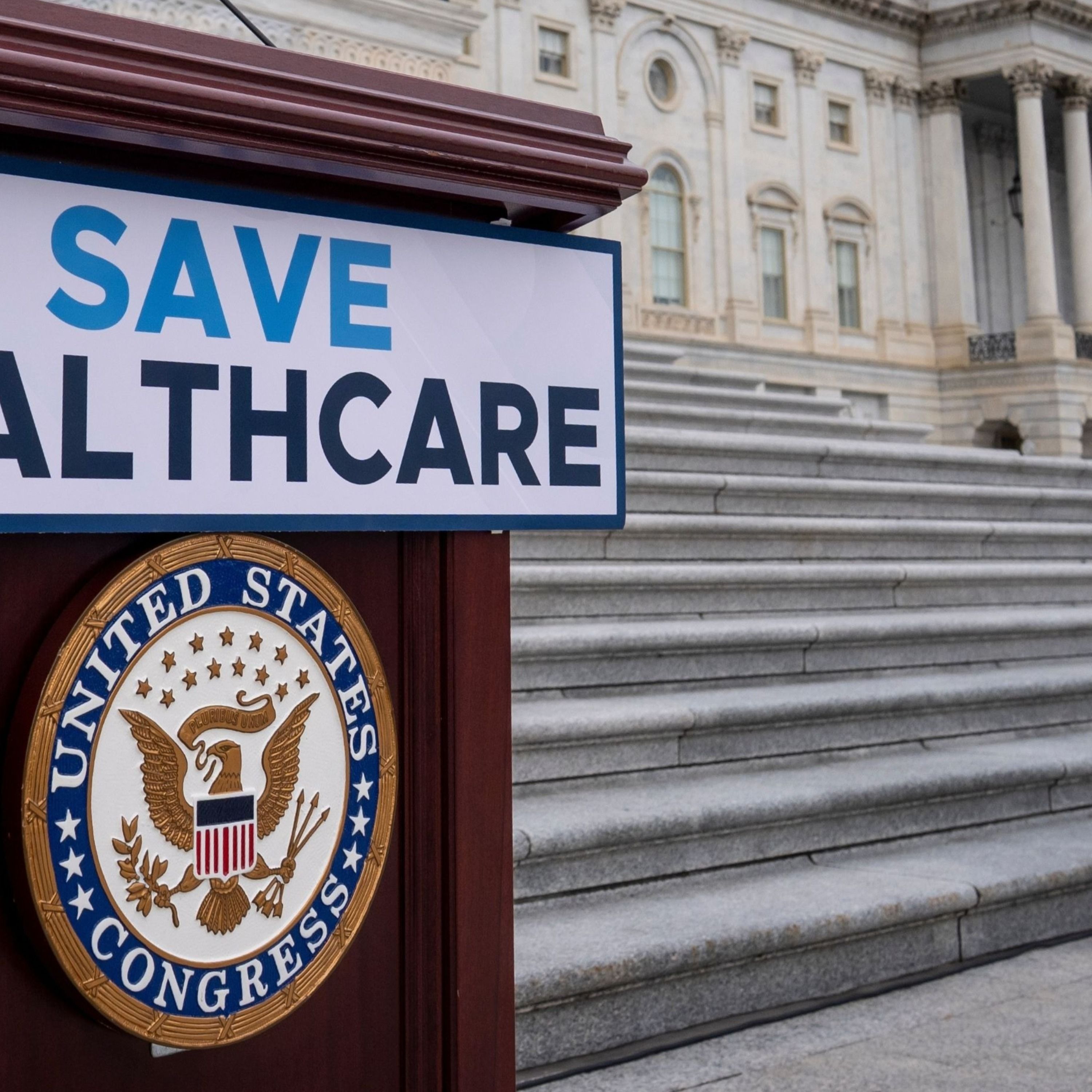
What A Day
The Price of Care: Fixing The ACA
00:22:19
The main issue keeping the government closed is healthcare — specifically, the enhanced Affordable Care Act subsidies that have been in place since 2021 and further lowered premium costs for Americans. Democrats want the enhanced subsidies extended, Republicans don’t. Without them, folks who rely on healthcare plans they bought on the exchange will see their premiums skyrocket. But there are other countries with private insurance options where healthcare doesn’t cost so much that people risk going without it. To find out what’s going on here and what America could do about it, we spoke to Mark Shepard. He’s an associate professor of public policy at the Harvard University Kennedy School of Government. And in headlines, the U.S. extends its trade deal with Mexico for several weeks, USDA confirms food stamps will not go out November 1, and a rag-tag group of former USAID workers band together to fund some of the shuttered agency’s most critical programs.
Loading summary
Transcript44 lines
- [00:02]
Jane Coston
It's Tuesday, October 28th. I'm Jane Coston and this is Whataday, the show asking why did President Donald Trump get an MRI at his last physical at Walter Reed National Military Medical Center?
- [00:14]
Donald Trump
I did. I got an mri. It was perfect.
- [00:16]
Jane Coston
Yeah, you know, typically one does not get an MRI at a physical, but maybe I'm just not achieving the same levels of stupendous health as our 79 year old president. On today's show. Like many of us, the president gets mad at a Canadian ad he saw during the World Series. Not like many of us, it's informing his statecraft and a ragtag group of former USAID workers band together to fund some of the shuttered agency's most critical programs. But let's start with healthcare, because the main issue keeping the government closed is healthcare. Specifically the enhanced Affordable Care act subsidies that have been in place since 2021 and further lowered premium costs. Democrats want the enhanced subsidies extended. Republicans don't. Without them, folks who rely on health care plans they bought on the exchange will see their premiums skyrocket. For example, the Chicago Tribune reported on Monday that Illinois residents could see their ACA plan costs increase by about 80% if the subsidies expire. And in New Jersey, health care costs on the exchange could rise by 175%. Some Republicans are starting to worry that doing absolutely nothing while millions of Americans either pay more for health care or lose it entirely MAA make it tougher to hold onto Congress in 2026. But what to do about it? Of course, Republicans could negotiate with Democrats to extend the subsidies and end the shutdown, but obviously they won't do that. House Speaker Mike Johnson tried one tested tactic to handle the issue on Monday. Lying.
- [01:54]
Doug Ford
What we're doing right now, what we have been doing, what we were already doing because we knew we were coming up to the end of the year. And we know that health care is a major burden for the American people. We've been working on it since day one of this Congress. We worked on it in the years prior.
- [02:08]
Jane Coston
Apparently cutting Medicaid by 15% now constitutes working on health care since day one of this Congress. And let's not even get into the in the years prior thing before I get too mad online. But health care really is a major burden for millions of Americans, especially the ever rising cost. There are other countries with private insurance options where healthcare doesn't cost so much that people risk going without it. So what's going on here and what could America be doing about it? To find out, I spoke to Mark Shepard. He's an associate professor of public policy at the Harvard University Kennedy School of Government. Mark, welcome to what a day.
- [02:45]
Mark Shepard
Thanks for having me.
- [02:46]
Jane Coston
So from the very beginning of the shutdown many moons ago, we have been hearing a lot about these enhanced Affordable Care act subsidies that expire at the end of the year. So to start, what are these subsidies and who gets them?
- [03:00]
Mark Shepard
It's a great question. And to answer that, you have to realize that America doesn't just have one form of health insurance. We have a complex system. And these subsidies are for people who we might call the missing middle of the American health insurance system. So they're not low enough income to get Medicaid, they're not seniors, so they can't get Medicare, but they don't work in jobs that provide health insurance coverage. And so if they want health insurance, Obamacare health insurance exchanges are what they need. That's the only form of coverage that's really viable. And what the subsidies are trying to do is they're trying to make sure that that coverage is affordable. So American healthcare are very expensive. That's not unique to Obamacare's health insurance exchanges. It's true everywhere. But because healthcare is so expensive, that coverage isn't going to be affordable unless the government steps in to provide some help to lower and middle income households.
- [03:58]
Jane Coston
So in short, the enhanced subsidies keep more of Americans in that missing middle that you referred to insured. But why would that matter to individual people who don't need to get their health insurance through the aca? What would happen if these subsidies expired?
- [04:14]
Mark Shepard
So I think the first answer is that there's no direct effect on people who get coverage, say through Medicaid or through employers. The main effect of this policy is on the 25 million people who get coverage in the ACA health insurance markets. There is, though, some indirect effects when people are uninsured, as more people will be if the enhanced subsidies expire. They don't stop getting sick. They still show up at hospitals, at emergency rooms, and someone has to pay the cost. And if they can't afford it, it's often hospitals, local governments, state governments who bear that cost. And ultimately that gets passed on in different forms to taxpayers and to others in the community. So it's not free. Subsidies for health insurance are designed to make sure people can afford access to healthcare. If you don't do it directly, you're going to end up providing some assistance for health care through indirect mechanisms.
- [05:12]
Jane Coston
So it seems like the main issue here is just how expensive it is to pay for health insurance in the US Why is it so expensive?
- [05:21]
Mark Shepard
I think there's no one simple answer. You can certainly look internationally. You can look at our healthcare costs compared to European countries, which tend to spend 50% or less compared to us. And when you do those types of comparisons, what you find is that America is expensive because we pay higher prices for similar amounts of healthcare, because ultimately there is less desire to keep costs low. So if you look at a place like England, England has a national health insurance program. They have government budgets that set how much funding there will be for the National Health Service. And ultimately that keeps the cost constrained because hospitals know that their budget is fixed. In America, we don't have fixed budgets. There are many different health insurers. None of them really has the power to be able to constrain healthcare costs, nor is there necessarily appetite to do so. I think in America, there's a greater emphasis on free competition, on innovation, and a concern that any type of cost control will ultimately result in lower quality of care.
- [06:29]
Jane Coston
So what, what do other countries that have private health insurance systems do differently that make those systems less expensive than ours? And could those things work in the.
- [06:38]
Mark Shepard
US So this is a great question, and what's important to first note in the question is that there are countries that have universal health insurance, universal access to healthcare through private health insurance systems. A great example is Switzerland, which is a system in which it's been described as Obamacare for all. Everyone in the country gets access to health insurance. They can choose among a set of competing health insurance plans. There are subsidies to ensure it's affordable, but ultimately there's choice and competition in the way it works. But there's really two important details for why what you would call private health insurance in Switzerland looks so much different and so much more affordable than in America. I think one detail is that it's mandatory and universal. We're not talking about a type of coverage that you can opt out, not talking about a coverage that needs to be free. It's financed by taxes. And so people ultimately have to be enrolled. That ensures that both healthy and sick people enroll, which keeps the overall average cost down. Right. If you don't have healthy people participating and only the sick participate, costs tend to be higher. Difference number two is that even though it's private health insurance, behind the scenes, the government still does a lot to regulate that health insurance, including regulating the prices that health insurers pay. Hospitals, doctors, drugs. So, for instance, in Switzerland, there's a central program to negotiate the price of drugs that helps Keep the costs low because the one national government can negotiate low prices with pharmaceutical companies. We don't do that in America. We ask each individual insurer to negotiate their own prices. And because no one has the bargaining power that a central government has, you're not going to get the same deals. And as a result, prices will be higher.
- [08:34]
Jane Coston
Now, there's a lot of differences between the United States and Switzerland, but what are the reasons why that kind of negotiation between the government and private insurers or any of these other factors that we see in Switzerland or in other countries that have that mix of private public healthcare, are there reasons why those would not work in the United States?
- [08:58]
Mark Shepard
I think they really rely on having an effective government that's centralized in America. We have a federalist system, 50 state governments. Each has their own power. Medicare is a federal program, but Medicaid, the second largest program by spending, is a state run program. The states regulate some health insurance, the federal government regulates other types of health insurance. It would be very challenging unless there were major reforms in our regulatory structure to implement that type of program in America. So I think ultimately we're kind of stuck with what we have. And the question is, how do you make it work as well as possible?
- [09:36]
Jane Coston
So to your point, what we have right now is the Affordable Care Act. Is it possible to lower health insurance premiums within our current system?
- [09:44]
Mark Shepard
You know, I think there's two policies that come to my mind. One is to introduce more public option type plans into exchanges. So imagine that you took a plan whose parameters were designed not by a private health insurance company, but designed by the state government. Those plans are still operated by private health insurers, but their parameters, including some of the prices that they might pay hospitals and doctors, are set by the government. That's why we call it a public option plan. It's a public plan, but it's just another option that you could choose and that could compete against private plans, potentially driving down the costs of healthcare. So Washington state has tried out a public option plan with some success. Colorado has had versions of this.
- [10:32]
Jane Coston
And you mentioned that there was another potential reform that could work. What was that?
- [10:37]
Mark Shepard
So if public option plans are more associated with the left, you might think about pro competition subsidies that would be associated more with reforms proposed on the right. And this is an area where Republicans, I think, have a point, that subsidies today are designed in a way that doesn't promote maximum competition among insurers. Today, health insurance subsidies in the ACA are set up in order to cover the full difference between the total cost of health insurance, what insurers set, and whatever amount is deemed affordable for households to pay. So, for example, say the full cost of health care is $6,000 a year. That's a typical number. If it's affordable for a household to pay $1,000, then the government covers the full difference. Well, what happens if insurers raise their prices? Still the government covers the full difference. What does that mean? It means that insurers, when they raise their price, they get bigger subsidies from the government and that weakens competition. So if you were thinking about reforming that, what you'd want to do is to shift more towards types of subsidies that encourage insurers to keep prices low, that don't have this link between subsidies and prices. You might think about fixed subsidies. You might think about shared savings schemes that encourage insurers and states to keep costs low. The ultimate goal is to make subsidies structured in a way that encourages competition as opposed to weakening competition.
- [12:07]
Jane Coston
In the meantime, open enrollment starts this Saturday, November 1st. And unless there is a miraculous deal coming our way, Americans are going to see much higher prices in the ACA marketplace. As someone who thinks about this all the time, do you have any advice for them?
- [12:22]
Mark Shepard
I think the first advice would be that health insurance is really important. The costs are going to hurt if enhanced subsidies are not expanded, but the cost of going uninsured could be even higher. So it tends to be worth it to find money to continue your health insurance coverage if you can possibly do so. Maybe step two would be encourage your representatives to vote for enhanced subsidies. These really have done a tremendous amount to protect lower and middle income households, to keep the cost of coverage more affordable, to ensure that younger and healthier people participate in the marketplaces. All of these things have gone up dramatically since enhanced subsidies were passed in 2021. And you know, Republicans often argue that the subsidies were meant to be temporary and just a Covid era protection. I don't think that's really correct. The enhanced subsidies are a way of ensuring that the coverage is truly affordable, given what households feel that they can pay. And if they go away, households are going to face more pain. Many of them will drop out of coverage, even though I would advise them not to. And ultimately, we're all going to pay the costs.
- [13:31]
Jane Coston
Mark, thank you so much for joining me.
- [13:33]
Mark Shepard
You're welcome. Thanks for having me.
- [13:35]
Jane Coston
That was my conversation with Mark Shepherd, Associate professor of Public Policy at the Harvard University Kennedy School of Government. We'll get to more of the news in a moment, but if you like the show. Make sure to subscribe, leave a five star review on Apple Podcasts, watch us on YouTube and share with your friends. More to come after some ads what a day is brought to you by Deleteme. Right now the headlines are chock full of data breaches and regulatory rollbacks, making us all vulnerable. But you can do something about it. Deleteme is here to make it easy, quick and safe to remove your personal data online. Deleteme does all the hard work of wiping you and your family's personal information from data broker websites. And Deleteme sends you regular personalized privacy reports showing what info they found, where they found it and what they've removed. DeleteMe isn't just a one time service. DeleteMe is always working for you, constantly monitoring and removing the personal information you don't want on the Internet. The New York Times Wirecutter has named Deleteme their top pick for data removal services. I have been really thrown by all of the data breaches we keep hearing about in the news lately. In a recent Coinbase data breach, a hacker obtained names, addresses, phone numbers and the last four digits of users Social Security numbers plus masked bank account numbers. Data brokers can vacuum up a lot of that data, create a searchable profile about you and sell it to whoever wants it. Thankfully, Deleteme can help remove it from those sites and keep your info from falling into the wrong hands. Take control of your data and keep your private life private by signing up for Deleteme now at a special discount for our listeners. Get 20% off your DeleteMe plan when you go to www.joindeleteme.com wad and use promo code wad at checkout. The only way to get 20% off is to go to www.joindeLeteme.com wad and enter code wad at checkout. That's www.joindeleteme dot com wad code wad@designer.
- [15:35]
DSW Announcer
Shoe Warehouse we believe that shoes are an important part of, well, everything.
- [15:40]
From first steps to first dates, from all nighters to all time personal bests.
- [15:46]
From building pillow forts to building a.
- [15:48]
Life for all the big and small moments that make up your whole world. DSW is there and we've got just the shoes. Find a shoe for every you from brands you love at brag worthy prices at your DSW store or dsw.com a better help ad.
- [16:06]
BetterHelp Announcer
October 10th is World Mental Health Day and this year we're saying thank you therapists. Behind every supportive moment and small win is the therapist who showed up and made a difference. BetterHelp has supported over 5 million people globally on their mental health journeys. With 12 plus years experience and the world's largest online network of qualified therapists, it's easy to match with the one that's right for you. See for yourself. Visit betterhelp.com for 10% off your first month.
- [16:36]
Jane Coston
Here's what else we're following today. Head of Lines.
- [16:42]
DSW Announcer
People are going to.
- [16:43]
Doug Ford
Be lined up out here to get food and we're talking about a damn ballroom. Don't lose the plot.
- [16:49]
DSW Announcer
Don't lose the plot of what's going on here.
- [16:53]
Jane Coston
Minnesota Democratic governor Tim Walz spoke at a food bank in the city of Eagan Monday, announcing $4 million in emergency funding for participants in the Supplemental Nutrition assistance program, or SNAP. Amid the government shutdown, the U.S. department of Agriculture posted a notice on its website saying SNAP or food stamps will not go out to the roughly 42 million Americans who rely on the program on November 1, and recipients may soon have to find other ways to feed themselves and their families. And in case you're wondering, isn't there a contingency plan for this? The USDA issued a memo Friday that the $5 to $6 billion in SNAP contingency funds can only be used for unforeseen disasters like hurricanes, contradicting a since deleted September 30 shutdown plan that claimed Congress intended those funds to sustain SNAP benefits during a shutdown because, of course, Virginia Republican governor Glenn Youngkin declared a state of emergency in anticipation of the cutoff. And California Democratic governor Gavin Newsom announced plans to call up the National Guard to support food banks. The US Extended its trade deal deadline with Mexico by several weeks. The deal covers a range of imports, including aluminum, the key ingredient in the can Trump's been kicking down the road most of this year. Trump set a Nov. 1 deadline to boost tariffs on some Mexican goods from 25 to 30%, targeting products not covered by the U.S. mexico Canada Trade deal. But Mexican President Claudia Sheinbaum said that she and Trump agreed that talks between the US And Mexico were going, quote, very well. Even on Trump sensitive topics like security and migration. Things were much frostier to the north, where President Trump said on Saturday that he plans to hike tariffs on imports of Canadian goods by an extra 10% because grandpa is yelling at the TV again. An anti tariff television ad aired by the province of Ontario during the World Series sparked Trump's Ireland. The ad used the words of former President Ronald Reagan to criticize U.S. tariffs. Trump spouted off about it on Air Force One on Monday.
- [18:50]
Donald Trump
They shouldn't have done it. They've apologized and they said we're going to take the ad down. Well, they did it, but they did it very late. They let it play for another two nights and now they took that ad down. So I don't know when it's going.
- [19:03]
Jane Coston
To kick in again. This is about an ad using the words of Ronald Reagan. Trump has reportedly terminated all trade negotiations with Canada because the mean ad hurt the president's feelings. On Monday, the Canadian premier of Ontario, Doug Ford, spoke of the debacle on cnn.
- [19:21]
Doug Ford
It was an ad to inform the people in the US and mission accomplished.
- [19:27]
Jane Coston
Mission accomplished, indeed. The Red Cross is joining members of Hamas in the search for the bodies of the roughly 12 remaining Israeli hostages in Gaza. Hamas officials say the remains have been difficult to find due to the mass destruction caused by nearly two years of Israeli airstrikes in the region. A mass burial was held in Gaza Monday for more than 40 of the 195 deceased Palestinians that Israel has returned to Gaza. The Gaza Health Ministry has opened an office to help identify the bodies, but doctors and aid workers say doing so is difficult. Many of the bodies reportedly show signs of torture, execution, possible organ theft, and being run over by tanks. Israel said the bodies belonged to combatants, though they provided no evidence to support that claim. The fragile ceasefire between Israel and Hamas continues to hold for now, but Trump posted on Truth Social over the weekend demanding that Hamas move faster to recover the bodies of the remaining Israeli hostages and implying he'd allow Israel to restart the war if they don't. Despite President Trump gutting USAID earlier this year, a network of former officials, nonprofits and private donors found ways to keep critical foreign aid programs alive. Folks, there is no bad news after the sentence. That's the headline. The Associated Press reports that after the Trump administration froze roughly $64 billion in U.S. assistance overnight, former USAID staff worked off the clock to identify about 80 high impact programs that could still be saved within eight months. Their ad hoc initiative, Project Resource Optimization, helped mobilize more than $125 million in emergency donations from major philanthropies and new donors alike. They fully funded all 80 programs. The effort's backers say the funding won't fully replace what was lost, but it's preserved programs in nutrition, disease prevention, and anti poverty work across the world. That is what good news feels like. Sit in it, breathe it in, and that's the news. That's all for today. If you like the show, make sure you subscribe Leave a Review Welcome Iceland, to our Mosquito Hell and tell your friends to listen. And if you're into reading and not just about how the island nation was reportedly one of the few countries to never have a confirmed sighting of a wild mosquito until last week. Like me, Water Day is also our nightly newsletter. Check it out and subscribe@crooked.com subscribe I'm Jane Coston and on behalf of Everywhere With Mosquitoes, Sorry. Iceland Whataday is a production of Crooked Media. It's recorded and mixed by Desmond Taylor. Our associate producers are Emily Foer and Chris Allport. Our video editor is Joseph Dutra. Our video producer is Johanna Case. We had production help today from Greg Walters, Matt Berg, Sean Ali, Gina Pollack and Caitlin Plummer. Our senior producer is Erica Morrison and our Senior Vice President of News and Politics is Adrienne Hill. We had help today from the Associated Press. Our theme music is by Colin Gilliard and Kashaka. Our production staff is proudly unionized with the Writers Guild of America east as.
- [22:49]
Yasmin Vesugian
The day wraps up, get the scoop on what's been happening with here's the Scoop, a new podcast from NBC News, with me your host, Yasmin Vesugian, along with Morgan Chesky and Brian Chung. We'll take a deep dive into the day's top stories with NBC News's trusted journalists. It's a fresh take that's sharp, thoughtful and it's informative, bringing you closer to the headlines and conversations that are shaping the our world. From the front page to the zeitgeist, all in 15 minutes or less, here's the scoop from NBC News. Listen daily wherever you get your podcasts.
- [23:20]
DSW Announcer
It's Cybersecurity awareness month and LifeLock is here with tips to help protect your identity. Use strong passwords, set up multi factor authentication and report phishing scams. And for comprehensive identity protection, Lifelock is your best choice. Lifelock alerts you to suspicious uses of your personal information and also fixes identity theft. Guaranteed or your money back. Stay smart, stay safe and stay protected with a 30 day free trial at lifelock.com Special offer terms apply.
- [23:50]
Holiday PSA from DSW this is your reminder that shoes are a gift.
- [23:55]
Literally.
- [23:56]
So unwrap something good, like boots that inspire your next big adventure, or cozy slippers that give you an excuse to stay in, or sneakers that feel like pure joy. Because shoes aren't just shoes, they're exactly what you wanted. Let us surprise you so you can surprise them. Find shoes that get you and everyone on your list at prices that. Get your budget at DSW stores or dsw dot com.