← What A Day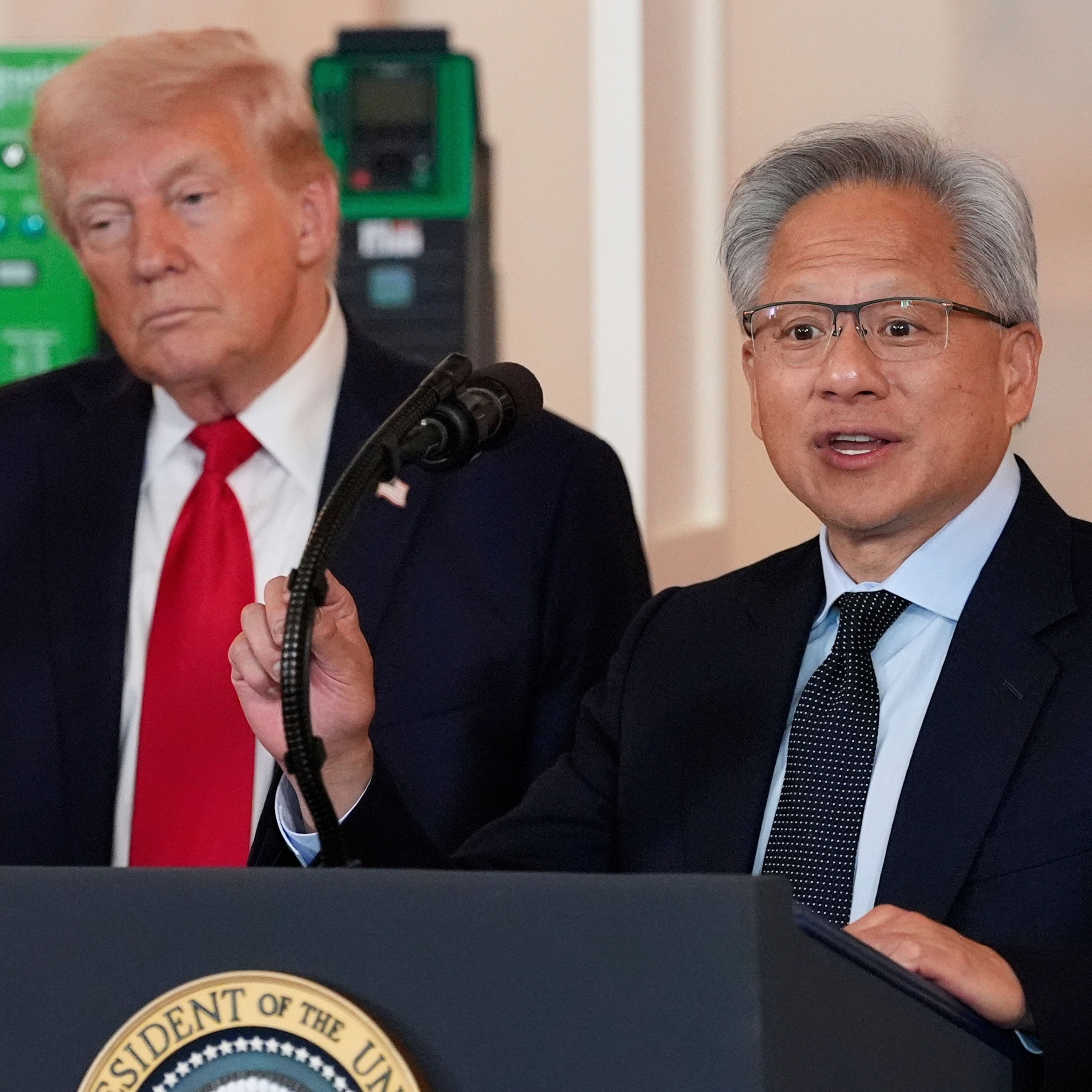
What A Day
The White House's Mob Boss Approach To AI Chips
00:23:37
Nvidia, a U.S.-based chip manufacturer that's now the richest company on earth, has agreed to pay the federal government 15 percent of its profits from selling its chips to China, in a deal that became public this week. Basically, the United States government is now a partner in not one, but two private companies that are selling AI technology to the country that is supposed to be our biggest competitor. White House Press Secretary Karoline Leavitt said the model could "expand in the future to other companies." But for critics, the deal is giving serious mob vibes, while also posing a national security risk. Ashley Gold, senior tech and policy reporter at Axios, explains what the deal does and why so many people — including some Republicans — are concerned about it. And in headlines: President Donald Trump and Russian President Vladimir Putin are set to meet in Alaska today, California Democratic Gov. Gavin Newsom unveiled a redistricting plan to go head-to-head against Texas Repu...
Loading summary
Transcript51 lines
- [00:03]
Jane Coasten
It's Friday, August 15th. I'm Jane Coasten, and this is Whataday, the show that watched part of the World Humanoid Games, which kicked off in Beijing on Thursday and said, absolutely not. Robots should not be doing martial arts or boxing. Has no one ever seen a movie? On today's show? The time has finally come. President Donald Trump and Russian President Vladimir Putin are set to meet in Alaska to talk about ending Russia's war in Ukraine. And California Democratic Governor Gavin Newsom unveils a redistricting plan to go head to head against Texas Republicans. But let's start with Nvidia. Nvidia is a company that makes AI chips. Because of that, Nvidia is now the richest company on Earth as of June of this year. And thanks to a new deal with the Trump administration. Nvidia. Nvidia, alongside fellow AI chip maker Advanced Micro Devices, or AMD, will be sending the United States government 15% of its profits from selling AI chips to China. Basically, the United States government is now a partner in two private companies that are selling AI technology to the country that's supposed to be our biggest competitor. Remember China Hawks? Hmm. And according to White House Press Secretary Caroline Levitt, this is a great idea that should probably be expanded. Here's what she had to say during a press briefing on Tuesday.
- [01:30]
Ashley Gold
Right now, it stands with these two companies. Perhaps it could expand in the future to other companies. I think it's a creative idea and solution. The legality of it, the mechanics of it is still being ironed out by the Department of Commerce. And I would defer you to them for any further details.
- [01:45]
Jane Coasten
That's one perspective. Others include conservative writer Jim Garrity, who called the deals, quote, light communism. But to me, the state, in this case, the Trump administration, telling two private companies that they could only get the export licenses they need to sell AI chips to Chinese companies if they kick back 15% of the profits to the state. Again, the Trump administration, well, that sounds less communist to me and more mob protection scheme. You want to do business? Pay up or you'll regret it. Fun how our government is working right now. So to learn more about Nvidia, its deal with the Trump administration, and how this sketchy deal came to be in the first place, I spoke to Ashley Gold, senior tech and policy reporter at Axios. Ashley, welcome to what a day.
- [02:33]
Ashley Gold
Thanks for having me.
- [02:35]
Jane Coasten
So let's start with the basics. I know Nvidia makes chips. I know that they are worth a ton of money. Can you explain why the chips Nvidia makes are so Valuable to the world of AI and to the world more generally?
- [02:52]
Ashley Gold
Absolutely. There's not a lot of global chip makers that make these chips that are necessary to power the AI and power the technology that's driving so much of the conversation today. And Nvidia is highly successful, has been for many years, and they've really sort of perfected the art of these chips. The CEO has been sort of a symbol of AI development throughout the world, and they are just a very hot company right now due to the conversation around AI and also just global export controls and global trade.
- [03:28]
Jane Coasten
The main AI chip competitor in China is a company called Huawei. Are Nvidia's chips that much more advanced or is this kind of like a neck and neck tech race between China and America?
- [03:39]
Ashley Gold
A lot of folks think that America has an edge, but it's only maybe a slight edge. And given a little more time and a little bit more ability to develop, China will surpass US Development on the chip. So the sort of national security hawks and the folks that really want America to have an edge over China think that our advantage isn't quite big enough for comfort.
- [04:02]
Jane Coasten
So how unusual is it for the President of the United States to make a deal with a tech company like this? Like we've mentioned, Nvidia basically had to agree to pay 15% of the money they make from selling their chips to China directly to the US Government. I've seen a lot of conservatives who are very worried about this because Trump is essentially making the federal government a partner in Nvidia's business. Has anything like this ever happened before in the tech world?
- [04:27]
Ashley Gold
No, no. It's entirely unprecedented. And I was going to say it's a unique way of doing business, but that's not usually what the government and companies are involved in doing together. In fact, there are constitutional restrictions on export controls. You know, congressmen, including Republican John Moliner from Michigan specifically said this. This appears to be unconstitutional. So this is very, very unprecedented.
- [04:54]
Jane Coasten
What stands out most to you? Because if you're a China hawk and the US Government is like, okay, this company can sell all of these chips to China to presumably get them ahead in the air race, but will get money from it, that seems kind of bonkers.
- [05:14]
Ashley Gold
It just, it casts doubt for when the US Government claims there's a national security concern. I, you know, I've been following the TikTok case as well, and there was a bipartisan bill that was signed banning TikTok from app stores in the US.
- [05:29]
Jane Coasten
The Supreme Court said it was fine.
- [05:32]
Ashley Gold
Supreme Court said It was fine. And TikTok continues to operate in the US because Trump has allowed them to even going as far as threatening app stores because they wanted to comply with the letter of the bipartisan law. So what I'm hearing from sort of tech policy wonks is this just makes it so whenever the government cries national security over some sort of high tech thing, they're not going to know who to believe anymore. And it's going to be harder to use national security as a justification to ban certain technology. And if it's a good deal for the government or it helps work out the greater trade deal with China as sort of what gets thrown in in the negotiations, then national security concerns kind of go out the window.
- [06:17]
Jane Coasten
What was the timeline in terms of licensing? Because we know Nvidia got permission to sell these AI chips to China, but the Trump administration didn't actually issue licenses to make those sales possible. And until Nvidia CEO Jensen Wang agreed to this 15% cut, the Commerce Department started granting licenses for AI chip sales just two days after the agreement was made. According to sources who spoke to the New York Times. That sounds a lot like Trump saying, hey, if you don't agree to do this, no license for you. Is that what happened here?
- [06:48]
Ashley Gold
I mean, I wasn't in the room, but it very much seems like that's what happened. These H20 chips, which is not Nvidia's most advanced chips, but is still a very competitive, useful chip, they had designed them to comply with Biden's export control regime. And then in April of this year, the Trump administration took away Nvidia's power to sell those chips to China. So Nvidia stopped doing it. They were complying with the Trump administration's own rules. And then in late July, they reverse themselves. They announced this deal. Sales can resume. Meanwhile, we're waiting for the Trump administration to establish what exactly its export controls for these high value tech items are at all. They scrapped the Biden era diffusion rule, it's called, which is about export controls. And me and my colleagues have been waiting to see what they're going to replace it with. But instead what we're seeing is what we end up seeing with the trade deals is these sort of piecemeal one off announcements. This can go. That can't go. So it's kind of all over the place.
- [07:54]
Jane Coasten
Right? Can you elaborate a little more on the potential national security risks? Because I, you know, I think that there was a National Review headline that was like, we are selling China the instruments of our own destruction. And I was like, oh, let's just, let's settle just a little bit. But like, what are the downsides?
- [08:10]
Ashley Gold
So there's a line of thought that if Chinese companies, Chinese engineers, have access to what is seen as like the crown jewels of American technology, they will use it against us for national security related things, or that it will help them develop their own AI technology using those chips backing that will then surpass our AI technology. So it's kind of this idea that you're sharing your building bricks with somebody that wants to make a machine to destroy you. So I've never really described it that way, but I guess it's kind of.
- [08:49]
Jane Coasten
Apartment you also mentioned some questions around the constitutionality of all of this. What kind of legal pushback could the administration see to this deal?
- [08:58]
Ashley Gold
They could be sued by outside groups. They could be sued by shareholders of Nvidia or amd. No one has sued them yet. And the traditional business trade groups that usually weigh in on this sort of thing, export controls, chips, China, they've been kind of silent so far. So unless they get hit with a lawsuit, nothing's really happened yet. And, you know, we've seen other things that are unconstitutional, you know, get kind of questioned by Republican lawmakers and they, maybe they write a letter, maybe they.
- [09:31]
Jane Coasten
Send and then nothing happens.
- [09:34]
Ashley Gold
That's kind of it.
- [09:35]
Jane Coasten
But they wrote their very strongly worded letter.
- [09:38]
Ashley Gold
Yeah, but are they going to cross Trump on something like that? You know, it's hard to see.
- [09:43]
Jane Coasten
Ashley, what are you most worried about in terms of the fallout of a deal like this and what it means for the independence of tech companies moving forward? I mean, we're already seeing Trump saying that intel should fire its CEO. Like, it does seem like all of these tech companies are so reliant on the Trump administration that the Trump administration gets a vote in where they work, who works for them and what they do?
- [10:07]
Ashley Gold
Yeah, it's scary. I mean, we are seeing a lot of corporate just sort of bending to what the administration wants. And with every administration, you have to do a certain amount of lobbying of jockeying and getting out in front of them to get what you want. That's not new. What's new is what's held over their heads if they won't do it. It's definitely not the traditional back and forth you see between private industry and the government from every administration up until now, even in the first Trump administration, things weren't this sort of blatant.
- [10:42]
Jane Coasten
Ashley, thank you so much for joining me.
- [10:45]
Ashley Gold
Of course. Thanks for having me.
- [10:48]
Jane Coasten
That was my conversation with Ashley Gold, Senior Tech and Policy Reporter at Axios. We'll get to more than it is in a moment, but if you like the show, make sure to subscribe. Leave a five star review on Apple Podcasts, watch us on YouTube and share with your friends. More to come after some ads what a Day is brought to you by Magic Spoon Magic Spoon makes high protein, zero sugar cereal and treats reinvented from your childhood. Every serving of Magic Spoon High protein cereal has 13 grams of protein, 0 grams of sugar and 4 grams of net carbs and they come in nostalgic flavors like fruity, cocoa and Frosted. And Magic Spoon's high protein treats are crispy, crunchy, airy and an easy way to get 12 grams of protein on the go. They come in mouthwatering flavors like marshmallow chocolate, peanut butter and dark chocolate. Both are great on the go pre or post workout or as a midnight snack. Get $5 off your next order at magicspoon.com day or look for Magic Spoon on Amazon or in your nearest grocery store. That's magicspoon.com day for $5 off my.
- [11:59]
Ingrezza Ad Voice
Uncontrollable movements called TD Tardive Dyskinesia felt embarrassing. I felt like disconnecting. I asked my doctor about treating my TD and learned about in a prescription medicine clinically proven for reducing TD in adults. That's always one capsule once daily and number one prescribed. People taking Ingrezza can stay on most.
- [12:17]
Mental health meds in can cause depression, suicidal thoughts or actions in patients with Huntington's disease. Call your doctor if you become depressed, have sudden behavior or mood changes or suicidal thoughts. Don't take in if allergic. Serious side effects may include allergic allergic reactions like sudden, potentially fatal swelling in hives, sleepiness, the most common side effect, and heart rhythm problems. Know how in greza affects you before operating a car or dangerous machinery. Report fever, stiff muscles or problems thinking as these might be life threatening. Shaking, stiffness, drooling and trouble with moving or balance may occur.
- [12:48]
Take control by asking your doctor about Ingrezza.
- [12:51]
Learn more@ingrezza.com that's in G R E Z Z A dot com.
- [13:00]
Andy Richter
Hi there, it's Andy Richter and I'm here to tell you about my podcast, the three Questions with Andy Richter. Each week I invite friends, comedians, actors and musicians to discuss these three questions. Where do you come from, where are you going and what have you learned? New episodes are out every Tuesday with guests like Julie Bow and Ted Danson, Tig Notaro, Will Arnett, Phoebe Bridgers and more. You can also tune in for my weekly Andy Richter Call in show episodes where me and a special guest invite callers to weigh in on topics like dating, disasters, bad teachers, and lots more. Listen to the three Questions with Andy Richter wherever you get your podcasts.
- [13:43]
Jane Coasten
Here's what else we're following today. Head of Lines.
- [13:49]
Donald Trump
We'Re going to find out where everybody stands and I'll know within the first 2 minutes, 3 minutes, 4 minutes or 5 minutes. Like we tend to find out whether or not we're going to have a good meeting or a bad meeting.
- [14:02]
Jane Coasten
Trump's long awaited meeting with Russian President Putin starts today in Alaska, and he led with this at his press conference Thursday.
- [14:08]
Donald Trump
We'll see if they can get along and if they can, it'll be great. You know, I've solved six wars in the last six months, little more than six months now, and I'm very proud of it. I thought the easiest one would be this one. It's actually the most difficult first of all, what?
- [14:26]
Jane Coasten
Secondly, so basically this meeting could end Russia's war against Ukraine, but it's possible it won't end the war either way. Trump is an expert at solving wars. What can we expect? Putin and Trump will meet one on one first, with only translators present before meeting with delegates, a Russian official said. On Thursday. There will also be talks about the US And Russia working together economically and a possible deal on nuclear arms control. Afterwards, the two leaders will host a joint press conference. And in yet another troubling sign for Trump's economy, new federal data showed that costs surged last month for producers and manufacturers. Or in plain speak, things got a lot more expensive for the people and companies who sell us the things we, the consumers consume. Which can only mean good things for our wallets, right? No. On Thursday, data from the Labor Department showed wholesale inflation last month rose sharply. The Producer Price index rose almost one full percentage point compared to June, the biggest jump in more than three years. And compared to this time last year, it was up more than 3%. The numbers were much higher than economists had expected. Most stocks fell on Wall Street Thursday in the wake of the bad economic news. So what does this mean? Well, it signals Trump's very sound tariff plan is very likely pushing up costs. And while higher prices haven't quite hit retail stores yet, it may just be a matter of time at this point. Dear Consumer, hopefully no one loses their job over a report the president doesn't like. Again.
- [16:00]
Donald Trump
It'S not good enough to just hold hands, have a candlelight vigil and Talk about the way the world should be. We have got to recognize the cards that have been dealt and we have got to meet fire with fire.
- [16:14]
Jane Coasten
California Governor Gavin Newsom laid out his vision to redraw the state's congressional map to counter the ongoing redistricting fight in Texas and other Republican states. The governor on Thursday floated a plan to create five new safe Democratic seats in California. Four more swing districts could also shift towards Democrats for a potential net pickup of nine seats. Newsom said the new maps could be released as soon as today. He stressed that they would be temporary and would apply to the 2026 and 2030 midterms, as well as the 2028 presidential election. Newsom spoke to Podsave America after the announcement.
- [16:48]
Donald Trump
We won't move forward. It's a trigger unless Texas or other Republican states move forward. It will be temporary. It will be done on an emergency basis. You it will also be done in a way that reinforces our commitment to nationwide independent redistricting.
- [17:05]
Jane Coasten
But there's a big asterisk to all of this. In order for Newsom to make his redistricting plan happen in California, he will have to put it to the state's voters first. Fifteen years ago, California handed over the congressional redistricting process to an independent commission, you know, to make the whole process less partisan. So Newsom's plans to circumvent that will now be put to the test in a special election scheduled for November 4th if approved by the state legislature. Newsom also said on Pod Save America that the stakes are too high for voters to reject the measure.
- [17:37]
Donald Trump
This is a big damn deal, because if the most un trumped state in America can't do this, we're in real peril as a nation. And our democracy, I really believe, may not recover if he rigs the midterms and gives him complete unfettered power with.
- [17:54]
Jane Coasten
No oversight into 2028 but never to be outshone. The Trump administration made sure to let its presence be known in California. Thursday. Immigration and Customs Enforcement agents were staged outside the governor's press conference in Los Angeles. Maybe. Maybe Trump wasn't being totally honest when he said he only wanted to be a dictator on his first day back in. Move over Grok. Meta AI is about to out horrify you. At least according to a review of an internal document by Reuters. The document laying out Meta Platform's chatbot regulations has allowed controversial, infuriating and disgusting behavior, including sensual discussions with children. Just what everyone wants in a chatbot. For your sake, we will keep this short and concise. Among all the truly wild revelations, Reuters reports the guidance for building and training the bot said, quote, it is acceptable to describe a child in terms that evidence their attractiveness. Your youthful form is a work of art. The standards also allowed for its AI to create false medical information and help users argue that black people are dumber than white people. Just remember, a team of real people approve this. Meta confirmed the document was legit, but it said after Reuters reached out earlier this month, the company took out the parts about chatbots being allowed to flirt with kids. Oh good, the bot won't flirt with kids. But what about the false medical information and the racism? That was okay for obvious reasons. This whole thing has garnered backlash on both sides of the aisle. Missouri Republican Senator Josh Hawley said on Twitter Thursday, quote, this is grounds for an immediate congressional investigation. And Democratic Senator Brian Schatz of Hawaii wrote, quote, meta chatbots that basically hit on kids that this is disgusting and evil. And that's the news. One more thing. Utah. The Beehive State home of Park City, Salt Lake City, Brigham Young University and a lot of great places to eat cookies. Also the home of Republican State Senator J. Stuart Adams. Adams is President of the Utah senate and in 2023 he had a problem. See he had an 18 year old relative who allegedly raped a 13 year old, normally a first degree felony in Utah, as in many places no one under the age of 14 can consent to sexual. His relative was facing up to 25 years in prison and would have had to register as a sex offender. But according to reporting from Robert Gerke at the Salt Lake Tribune, Adam stepped in and helped get the law changed. Now an 18 year old who rapes a 13 year old in the state of Utah, but does so while a registered high school student will face a third degree felony charge of unlawful sexual activity. They won't have to register as a sex offender and and they probably won't face serious jail time. I reached out to Gerke and via email he told me that Adams spoke to State Senator Kirk Cullimore who sponsored the legislation and told him about his relative situation, asking him if looking into changing the law would be appropriate. According to reporting from KSL.com, a Utah based news outlet, Adams told Cullimore that his relatives should not face years in prison because of a quote, stupid mistake. You know, allegedly raping a 13 year old. It was Cullimore who spoke to Adams relative's defense attorney who then actually helped write the legislation. In a statement to the Salt Lake Tribune, Adams denied changing the law to help his relative and said that the change wasn't intended to be retroactive, as in it wasn't supposed to change how a case that took place before the law changed would be adjudicated. But it did. Two months after the law was changed, Adam's relative got a plea deal. They would plead guilty to reduced charges, face no additional jail time, and not have to register as a sex offender during court proceedings. Adam's relative's defense attorney even told the judge, we all agree that's not retroactive, but the government did change their offer. Based on that, I think it's worth noting that Adams was one of multiple Utah Republican state legislators who issued a statement about a trans college volleyball player writing that the athlete's mere presence on the court was putting female athletes at risk. But when his relative allegedly raped a child, well, that's different. Before we go, the latest episode of Inside 2025 is out now. This week, Dan and John dive into the chilling effect Trump is having on media companies and how it's shaping the news we see. Or more importantly, don't they discuss the right wing media's powerful machine, why Democrats need to rethink their approach, and why abandoning outdated media habits is key to leveling the playing field. If you're into the future of political media and want to dive deep, this episode is for you. To hear the full conversation, subscribe to crooked on Substack, YouTube, Supercast, Apple Podcasts, or visit crooked.com friends to learn more. We're everywhere, so choose the platform that works best for you. And finally, I want to say a special thank you to producer Michelle Aloy. This is her last show before she goes on to another opportunity at which she will be fantastic. Michelle, thank you for making me sound like I actually know things. We will miss you so, so much. That's all for today. If you like the show, make sure you subscribe, leave a review, contemplate the wisdom of Hunter Biden and tell your friends to listen. And if you're into reading a not just about how when confronted with a retraction demand from first lady Melania Trump for saying that convicted sex offender Jeffrey Epstein introduced her to Donald Trump, the second son of former President Joe Biden responded as f that that's not going to happen. Like me, what a Day is also a nightly newsletter. Check it out and subscribe@cricket.com subscribe I'm Jane Coasten, and with that, see you next week because I've got nothing else. What a Day is a production of Crooked Media. It's recorded and mixed by Desmond Taylor. Our associate producer is Emily Foer. Our producer is Michelle Aloy. Our video editor is Joseph Dutra. Our video producer is Johanna Case. We had production help today from Greg Walters, Matt Berg, Gina Pollack and Laura Newcombe. Our senior producer is Erica Morrison and our senior vice president of news and politics is Adrienne Hill. We had help with the headlines from the Associated Press. Our theme music is by Colin Gilliard and Kashaka. Our production staff is proudly unionized with the Writers Guild of America. Easy.
- [25:21]
Ingrezza Ad Voice
My uncontrollable movements called TD tardive dyskinesia felt embarrassing. I felt like disconnecting. I asked my doctor about treating my TD and learned about Ingrezac, a prescription medicine clinically proven for reducing TD in adults. That's always one capsule once daily and number one prescribed. People taking in can stay on most.
- [25:40]
Mental health meds in can cause depression, suicidal thoughts or actions in patients with Huntington's Disease. Call your doctor if you become depressed, have sudden behavior or mood changes or suicidal thoughts. Don't take in serious side effects. May include allergic reactions like sudden potentially fatal swelling in hives, sleepiness, the most common side effect and heart rhythm problems. Know how in affects you before operating a car or dangerous machinery replacement support, fever, stiff muscles or problems thinking as these might be life threatening. Shaking, stiffness, drooling and trouble with moving or balance may occur.
- [26:11]
Take control by asking your doctor about Ingrezza.
- [26:14]
Learn more at inza.com that's I N G R E Z Z A dot.
- [26:19]
Jane Coasten
Com in.
- [26:22]
Ingrezza Ad Voice
Packages by Expedia you were made to occasionally take the hard route to the top of the Eiffel Tower. We were made to easily bundle your trip Expedia made to travel flight inclusive packages are at all protected.