← What A Day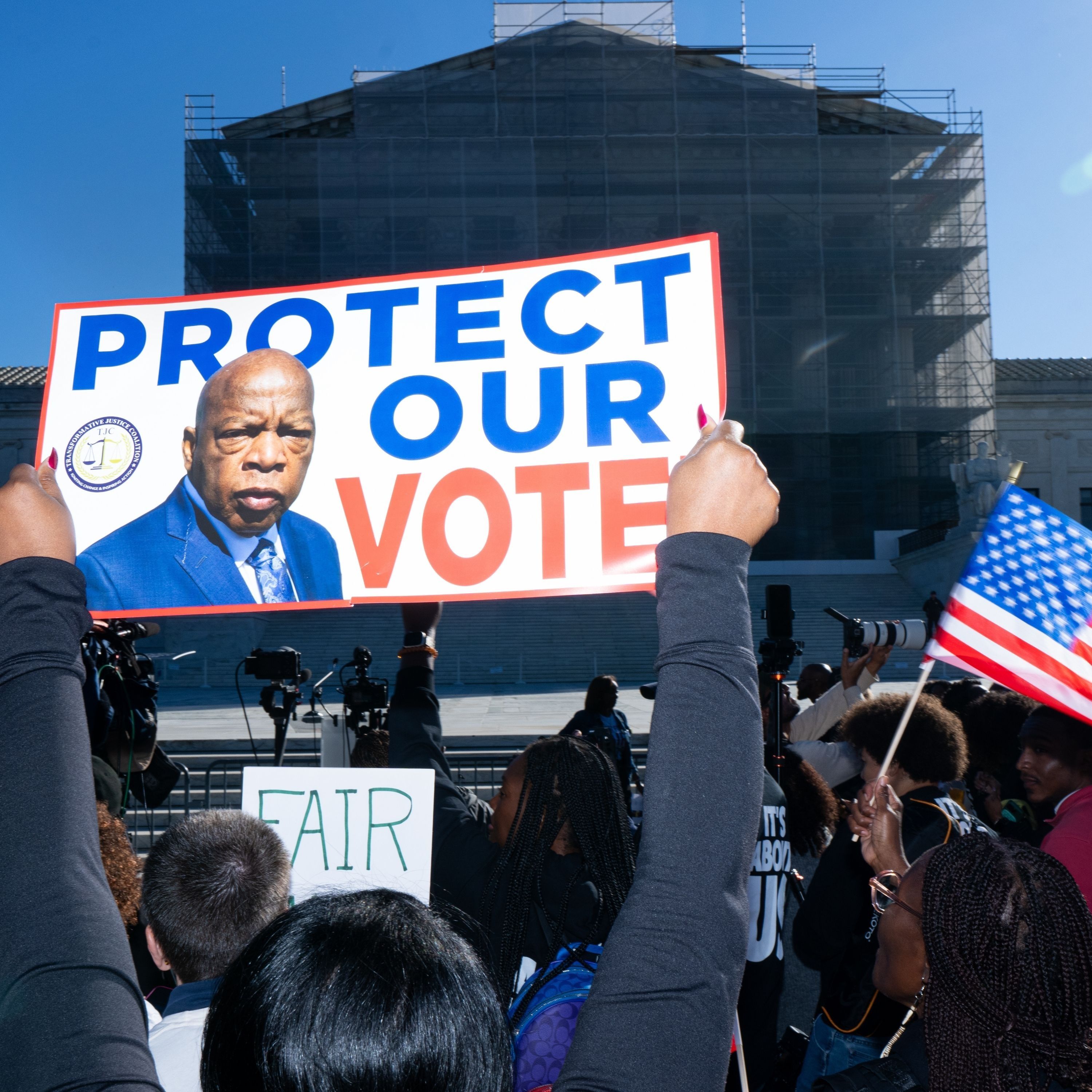
What A Day
This Supreme Court Could Change The Future of Elections
00:23:55
In two weeks, millions of Americans will be voting — but a Supreme Court case could change elections as we know them. Last week, the court heard arguments in Louisiana vs. Callais, a case that centers on Section 2 of the Voting Rights Act. Basically, the court is deciding whether or not states can use race to draw voting maps — and depending on what it decides, it could give Republicans the ability to eliminate at least six majority-minority districts and land about a dozen more seats in the House of Representatives. So we spoke to Stacey Abrams about the court’s deliberations. She’s the Host of Crooked Media’s Assembly Required and a New York Times Bestselling Author. And in headlines, Trump signs a critical minerals deal with the Prime Minister of Australia, universities publicly reject the Trump administration’s “Compact for Academic Excellence in Higher Education”, and House Speaker Mike Johnson, aka “Mad Mike,” yearns to be happy again as the shutdown heads into week three.
Loading summary
Transcript30 lines
- [00:03]
A
It's Tuesday, October 21st. I'm Jane Coston, and this is what a Day. The show congratulating Fox News host Laura Ingraham for doing business with President Donald Trump's family. And no, not like she does pretty much every evening on her primetime show. Ingraham is now a board member of a new special purpose acquisition company, or SPAC, led by none other than Donald Trump Jr. Because why would you make money loudly supporting President Trump when you could also make money quietly supporting all of the Trumps? On today's show, Trump signs a critical minerals deal with the prime minister of down on death. And House Speaker Mike Johnson, AKA Mad Mike, yearns to be happy again as the shutdown ekes into week three. But let's start with Election Day. In two weeks, millions of Americans will be voting, but a Supreme Court case could change elections as we know them. Last week, the court heard arguments in Louisiana vs Calais, a case that centers on Section 2 of the Voting Rights Act. Basically, the court is deciding whether or not states can use race to draw voting maps. In comments made after oral arguments last week outside the Supreme Court, Louisiana Solicitor General Benjamin Aguinaga described the battle as a difficult one for the state of Louisiana. I think what you heard and saw today in the courtroom was a bench that was fully aware of the difficulties that the states have been in under the court's voting precedents. If you know Louisiana story, you know that for the past couple of years, we have been struggling to find a map, a congressional map that satisfies the court's precedence. It's been extremely difficult. But voting rights advocates and Democratic legislators argue that the map that created a second majority black district was the solution to the difficult problem. In a statement last week, Louisiana Democratic Representative Troy Carter said that the second majority black district was, quote, about fairness, compliance with federal law, and ensuring that black voices in Louisiana are not silenced. And furthermore, invalidating such a big swath of the Voting Rights act could lead to Republicans eliminating at least six majority minority districts, giving them about a dozen more seats in the House of Representatives. So to talk more about the court's deliberations on a case that could alter elections for decades, I spoke to Stacey Abrams. She's the host of Crooked Media's Assembly Required. And a New York Times bestselling author, Stacey Abrams, welcome back to Whataday.
- [02:30]
B
Thanks for having me.
- [02:32]
A
Just to set the table for people who may not have paid close attention to this particular issue, the case that we're talking about is the state of Louisiana versus Calais, who is suing whom here?
- [02:45]
B
So this is a rehearing of a case that was actually heard last year. And the issue is that a group of white voters are suing the state of Louisiana because the state of Louisiana, when drawing its maps, neglected to account for the 30% of the state that is comprised of African Americans under the Voting Rights Act. Under Section two, that accounting for is required because we have a history in this country, especially in states like Louisiana, of disregarding the ability of voters of color to select a candidate of their choice. They tend to be put into districts where their voices will never be loud enough to overwhelm the decisions made by the majority. And so the Voting Rights act says, when that can happen, what we're going to do is require the state to intentionally draw lines that, when permissible, will, if not guarantee, then increase the likelihood that voters of color will be able to pick the candidates of their choice.
- [03:50]
A
Now, if you like me, read headlines about how the Supreme Court has handled voting rights over the past few years. There have been plenty that basically read something along the lines of the Supreme Court has neutered the Voting Rights act again. But lots of people have been pointing to this particular case as a potential game changer. Why is it so important?
- [04:10]
B
Okay, so let's do a really quick primer on the Voting Rights Act. 1965, America decided that black people, especially those in the south, should have full access to the constitutional provisions of citizenship.
- [04:22]
A
Crazy.
- [04:23]
B
I know. And while it was predominantly targeted at the south, it actually included a number of states. There were regions across the country that had a tradition of denying full representation and full citizenship to black people when it came to voting. And so the 1965 Voting Rights act said, We're going to do two really important things. One, we're going to look at all the states and the regions of this country that have not permitted full participation. And we're going to tell you that before you change any rules, you got to run it past us, because in the past, your behavior has led to people not being able to use their right to vote. That was one piece. The second part was, when you're doing this work, no matter who you are, you are going to be required to not be racially discriminatory in. In your drawing of maps. And more importantly, you have to take into consideration the fact that there's been, oh, I don't know, 200 plus years of history where we've done the bad things. So we're going to try to correct for 200 years of history. And so section five is the one that says you can't do it unless you ask. And Section two is the size that says you can't be racially discriminatory. And we're going to make you be proactive about doing right. Now, you had the Shelby v. Holder decision in 2013. That's what gutted Section 5, the section that said you've got to do the right thing and you can't do the wrong thing without asking. And within hours of section 5 being basically struck down, states like Georgia and Texas and Louisiana started to put in place very discriminatory behaviors, which we're still dealing with today. Then you had the Common Cause vs. Ruscio case. That was in 2016. That was the case where the Supreme Court said, not about the Voting Rights act, but just in general. You can gerrymander based on partisanship. You can't do it based on race, but it's okay if you do it based on partisanship, even though we know in the United States that race is the strongest predictor of political leanings. Okay, then you do the Branovic decision in 2021. That's the one that said, well, discrimination is bad, but you really have to prove that they really, really, really meant it. And so it changed the standard for how you could SUE under Section 2, the last remaining real section of the Voting Rights Act. What the Calais decision will do, if it goes the way we think it will go, which is against the Voting Rights act, it will essentially say that there is no longer the need to protect communities of color in the United States of America with regards to voting rights, because, well, racism gone.
- [06:53]
A
I hope everyone who yells at me on the Internet can find out that racism is gone. Yeah, big news. Big news for all of us. Now, I'm aware the job here is not to give people opium, but when you listen to oral arguments, was there anything that struck you as kind of like, okay, this is bad, but maybe it's not as bad as I may be expecting. Obviously, we don't know what the decision will be, but I'm just curious as to your thoughts.
- [07:17]
B
If you're Alito Kavanaugh or Thomas, you want the Voting Rights act to be dead, buried and gone. And you do not understand why black and brown people have the ability to be protected against the racism that has often visited how voting rights are accorded in the United States. So they do not want there to be protections, and they've been very explicit about the removal of any of those protections. Then you've got Amy Comey Barrett, and you've got John Roberts, and you've got Gorsuch. Amy Comey Barrett seems to be listing towards the side of, we want there to be democracy that's accessible, but I don't want to do the things we have to do that are hard to make it. So then you've got Gorsuch, who. Who has been surprisingly even handed. Sometimes it's been kind of weird, especially when it comes to access to the right to vote and access in general for Native Americans. He has actually been a pretty consistent vote that is always surprising when it arrives, but welcome when it comes. And then you've got John Roberts. John Roberts was the one who in the Shelby case said racism is dead. And Ruth Bader Ginsburg very famously said, that's like throwing away your umbrella in the middle of a rainstorm. He wants there to be a colorblind society. And unfortunately for a lot of us, he made his mark working for one of the people who caused the Voting Rights act to be strengthened in the 1970s when he worked for William Rehnquist, who was the architect in Arizona of that blocking of access to the right to vote. And so he has never been a fan of the Voting Rights Act. He has always been very skeptical of it. But two years ago, and this goes to the Hopium, in the Milligan decision, he actually sided with the Voting Rights act and said that the state of Alabama had unlawfully drawn its maps and needed to add an additional district to recognize the growing power of black voters. To reverse himself, for Barrett to reverse herself, for Gorsuch to reverse himself, they'd have to say, oops, we were wrong last week, that two years ago we didn't mean it. So here's the range of opportunity. There is the full sale striking down of Section two, which is what Justice Thomas, Justice Alito, Justice Kavanaugh absolutely want. There's the restriction on Section two, meaning you put in place tests that keep it on the books but make it almost impossible to use. That's where Gorsuch seems to be a little bit. And then you've got where we think Roberts might end up, which is maybe. I don't want to contradict myself, you know, since I two years ago said that exactly what they did in Louisiana is what every state should do. I don't know where they're gonna come out. I find it very unlikely, given how easily they have supported and suborned the erosion of democracy at a breakneck pace in this past 260plus days, that this will be the moment where they find their spines and their courage and protect black and brown voters. But I look forward to being surprised.
- [10:09]
A
Now, let's talk about action, which is something you're pretty into. You've committed yourself to protecting and expanding voting rights. If the court gives Louisiana and other states permission to redraw their congressional maps again, but without so many constraints around racial gerrymandering, how does your strategy change?
- [10:25]
B
Short term, it doesn't. It expands. I mean, we know what it takes and we know that this is going to make it a herculean task. But there is a short term treatment and then there's a long term remedy. Short term. We still have vast swaths of this country that are not registered to vote, especially young people. We talk about how young people don't vote. Well, part of the reason is they're not registered. And so one of our opportunities is registering more young people to vote, especially young people who are attending colleges in these states where we know this aggressive disenfranchisement is going to happen. So that's one piece. The second is that we have to expand the electorate among existing potential voters who simply do not show up because they don't believe democracy delivers. And so we've got to do the work of engaging those voters. It is an imperfect treatment because we do not have enough people. That's why they're so excited about these maps. The places where we live remain fixed. The lines can move. And the problem is that when you read all of those cases together that I laid out all those cases, allow them to move the map like an Etch A Sketch to keep us unfortunately precluded from full participation. And so I can't offer a lot of short term remedy other than we just have to be really loud and intentional. And we can reach out to those who may not be of our political persuasion, but may believe that it's the wrong thing to do to win elections by gaming the system so aggressively and so nakedly.
- [11:59]
A
So let's talk long term, because I think that a lot of the strategies that you're talking about would make a big difference in protecting voting rights, not just for 2026 or 2028, but for elections years down the road. But what other strategies do you think might make the biggest difference in protecting voting rights?
- [12:18]
B
We have a longitudinal problem in this country where we do not teach civics any longer. We also do not fully participate in the census. So if you're watching this administration, they are doing their best not only to change the maps now, but to change the census for next. The U.S. census is the most misunderstood and most powerful statistical tool in the arsenal. I founded an organization called Fair Count that's sole purpose is to get people engaged in the census. If we can get those numbers up, it is harder to draw maps to ignore us when they have to count us. And in the absence of being counted we can be ignored. But in our presence we then have the ability to actually force the issue. But it's not one or the other. It is all of the above. But I want to caveat one thing you said, which is this is not about Trump. He is an avatar. This is a 60 year project. People who have hated the Voting Rights act since its inception and people have been deeply disturbed about the participation of voters of color since we learned that we had the right to vote. He's going to be gone, but those who are architecting this are going to remain. And so we cannot make this a focus on what would Trump do or not do. It is what do we intend for our democracy to look like? Because if they're coming for us now, they're coming for you next.
- [13:47]
A
Stacey Abrams as always, thank you so much for joining me.
- [13:50]
B
Thanks for having me.
- [13:52]
A
That was my conversation with Stacey Abrams, host of Assembly Required and a New York Times Best selling author. We'll link to her book Coded justice in the show notes. We'll get to more of the news in a moment, but if you like the show, make sure to subscribe. Leave a five star review on Apple Podcasts, watch us on YouTube and share with your friends. More to come after some ads. What a day is Brought to you by Bombas Fall is here, kids are back in school, vacations are over, and Cozy season is officially on. You know what that means. Bombas season is also on. Bombas makes the most comfortable socks and slippers, all crafted from premium materials, perfect for this time of year. What to love about Bombas Absurdly comfortable materials like merino wool to keep you warm or cool Supima cotton that's soft and strong and classic Ragwool for that cozy fall vibe and their mission. It's the best part. Every item you buy means one donated to someone experiencing homelessness. Over 150 million items donated so far and with their happiness guarantee, if you're not 100% into what you got, they'll make it right. No risk, all reward. I low key hate socks. Don't ask, but I adore Bombas socks, which are always comfy and always perfect for any occasion. Head over to bombas.comday and use code day for 20% off your first purchase that's B O M b-s.com day code day at checkout. You know what? A girl's best friend is not diamonds.
- [15:26]
B
Her lawyers. From executive producer Ryan Murphy comes a fiery new legal drama.
- [15:32]
A
It's our own boutique women representing women you can't afford to miss.
- [15:37]
B
Make it ring.
- [15:38]
A
Showtime, ladies. Stand up straight, then breeze into that.
- [15:43]
B
Room like a storm no one saw coming. Hulu original series All's Fair premieres November.
- [15:50]
A
4Th on Hulu and Hulu on Disney. For bundle subscribers. Terms apply. Hi, this is Kirsten Gillibrand, your DSCC chair. Donald Trump and his MAGA agenda are tearing this country apart. But while Trump attacks our rights and our values, Americans are uniting. We're making our voices heard. And in every single state, we are taking a stand. If you're ready to fight with us, sign my petition today to stand up against Donald Trump. Add your name@dscc.org fight paid for by dscc dscc.org, not authorized by any candidate or candidates committee. Here's what else we're following today. Head of lines.
- [16:31]
B
It'S been fantastic, the.
- [16:33]
A
Contact that we've had together, the friendship that we've developed. And Australians love America, and I think Americans kind of like Australia, too. For the record, Americans do like most Australians, but we can't speak for Donald Trump. Australian Prime Minister Anthony Albanese and Trump touted a critical minerals framework at the White House on Monday as the US Turns its attention to Australia's rich rare earth resources. Albanese said it involves an $8.5 billion pipeline that's, quote, ready to go. Trump said it was an honor to sign the deal, which had been worked out over several months. In about a year from now, we'll have so much critical mineral and rare earths that you won't know what to do with them. I don't know what Trump is going to do with them. That's a whole other question. Timing is everything, of course, because earlier this month, China announced it's imposing tougher rules on exporting its own critical minerals abroad. The Trump administration says this gives China broad power over the global economy by controlling the tech supply chain. So naturally, Trump retaliated by threatening new 100% tariffs on China. But that doesn't mean there isn't room to make amends. Here's Trump talking to reporters in the Cabinet room Monday. I'm meeting with President Xi. We have a very good relationship. We're going to be meeting in South Korea in a couple of weeks, and we'll see what we can do The Supreme Court said on Monday that it will consider whether people who regularly smoke marijuana can legally own guns. It's a legal Showdown between the Second Amendment and the 420th. At issue in the case is a federal law that bars any person who is an unlawful user of or addicted to any controlled substance from possessing a firearm. The case marks another flashpoint in the application of the Supreme Court's new test for firearm restrictions, which says any restriction must have a strong grounding in the nation's history, meaning you must prove that a similar restriction existed in the early days of the Republic. Challenges to the constitutionality of the law have divided lower courts. The Fifth Circuit concluded that there was no historical justification for disarming a sober person who is not under the influence. Sure, there were founding era restrictions on gun possession by habitual drunkards, but when that drunkard sobered up, you gave him back his musket. The Trump administration is defending the restriction, arguing that people who use drugs pose a, quote, unique danger when armed, and that the ban fits within America's long tradition of disarming those deemed dangerous. Except for, you know, all the very dangerous people who get to own firearms, which technically means that Trump is advocating for gun control. Sheesh. I'll have what he's smoking.
- [19:11]
B
This is a political stunt, and it's.
- [19:13]
A
The first time it's been done. And it is the most costly, most.
- [19:18]
B
Selfish, most dangerous political stunt in the.
- [19:21]
A
History of the United States Congress. Ok? Mad Mike Simmerdam. That's House Speaker Mike Johnson on day 20 of the government shutdown. Normally even tempered, unless he's talking about no Kings protesters he believed to be secret Hamas super soldiers, he's now sounding way more stubborn and dug in, reflecting the GOP's refusal to negotiate with Democrats on healthcare to reopen the government. Johnson told reporters, quote, I don't like being mad Mike. I want to be happy Mike. Be whatever Mike you like, so long as it isn't Magic Mike. But with the shutdown nearing week three, the consequences keep piling up. States now warn that unless Congress acts soon, the Supplemental Nutrition assistance program or SNAP, may not issue full November benefits to the roughly 42 million Americans who rely on it. And on Monday, the Department of Energy's National Nuclear Security Administration began furloughing roughly 1,400 federal employees responsible for maintaining the U.S. nuclear weapons arsenal, which seem like the last people you'd want to furlough. That's real dark, but here's a bright spot, and bear with me, because it's Georgia Republican Representative Marjorie Taylor Greene. In an interview with Semaphore published Monday, she said health care should be the number one thing that we're working on. She continued to say, I can't see into the future, but I see Republicans losing the House if Americans are continuing to go paycheck to paycheck. I hope she's right, just not about the paycheck to paycheck part. The Monday, October 20 deadline has officially come and gone for universities to give feedback on the Trump administration's Compact for Academic Excellence in Higher Education. It requires colleges and universities to freeze tuition for five years, limit international enrollment to 15%, implement discriminatory policies against trans students, and bar employees from, quote, actions or speech related to politics, among other things. In exchange, colleges would get priority access to federal funding and partnerships. The document also threatens federal funding for schools that don't sign, though the wording and implementation of it all is super vague. The compact was initially sent to nine colleges, including the Massachusetts Institute of Technology, the University of Southern California, Dartmouth, Vanderbilt and Brown. Then, after MIT rejected it, President Trump extended the offer via Truth Social post to all universities that want to, quote, return to the pursuit of truth and achievement. So far, seven of the original nine colleges that received the compact have rejected it. Academics across the country have spoken out against the agreement, and the American Council on education, along with 35 other organizations, have issued a statement opposing it. Layla Hudson, a professor at the University of Arizona, which rejected the compact late Monday, told CBS's Face the Nation on Sunday that the compact violates the U.S. constitution in terms of trying to regulate the speech that indeed will violate not only the academic freedom that makes our universities great, but the constitutional rights of the university community. And that's the news. Before we go, if you're trying to keep up with the legal chaos coming out of the Supreme Court, strict scrutiny has you covered. This week, Leah, Kate and Melissa break down the Louisiana vs Calais oral argument that we discussed earlier. They're joined by Sam Spital from the Legal Defense Fund to unpack the stakes, the context, and what it all means for democracy. Listen and subscribe to strict scrutiny Wherever you get your podcasts. That's all for today. If you like the show, make sure you subscribe, leave a review. Read yet another racist Republican group chat, but one in which one guy is just way more racist than everyone else. And tell your friends to listen. And if you're into reading and not just about how Office of Special Counsel nominee and noted Andrew Tate fanboy Paul and Gracia had texts in which he described himself as having a, quote, nazi streak and makes comments so racist other Republicans in the chat call him out. Posted by Politico like me, what a Day is also a nightly newsletter. Check it out and subscribe@crooked.com subscribe I'm Jane Coston and do you know what level of bafflingly racist you have to be to make young conservative activists tell you, quote, you are coming across as a white nationalist, which is beneficial to nobody. Clearly Ingrazia is finding out what a Day is a production of Crooked Media. It's recorded and mixed by Desmond Taylor. Our Associate producers are Emily4 and Chris Allport. Our video editor is Joseph Dutra. Our video producer is Johanna Case. We had production help today from Greg Walters, Matt Berg, Kaitlyn Plummer, Tyler Hill and Ethan Oberman. Our senior producer is Erica Morrison and our senior Vice president of news and politics is Adrienne Hill. We add help today from the Associated Press. Our theme music is by Colin Gilliard and Kashaka. Our production staff is proudly unionized with the Writers Guild of America East.
- [24:56]
B
Streaming is changing the way we watch live sports and your Internet connection can be the difference between catching the game, winning touchdown as it happens or hearing about it from your neighbor's cheers. That's why Comcast is building the network of the future. Using cutting edge AI and edge computing technology, we're bringing fans closer to the action in stunning high definition with ultra low latency. It's not just fast, it's game changing. Learn more at comcastcorporation.com sports did you know that parents rank financial literacy as the number one most difficult life skill to teach? Meet Greenlight, the debit card and money app for families. With Greenlight, you can set up chores, automate allowance and keep an eye on your kids spending with real time notifications. Kids learn to earn, save and spend wisely and parents can rest easy knowing their kids are learning about money with guardrails in place. Sign up for Greenlight today@Greenlight.com podcast.