← What A Day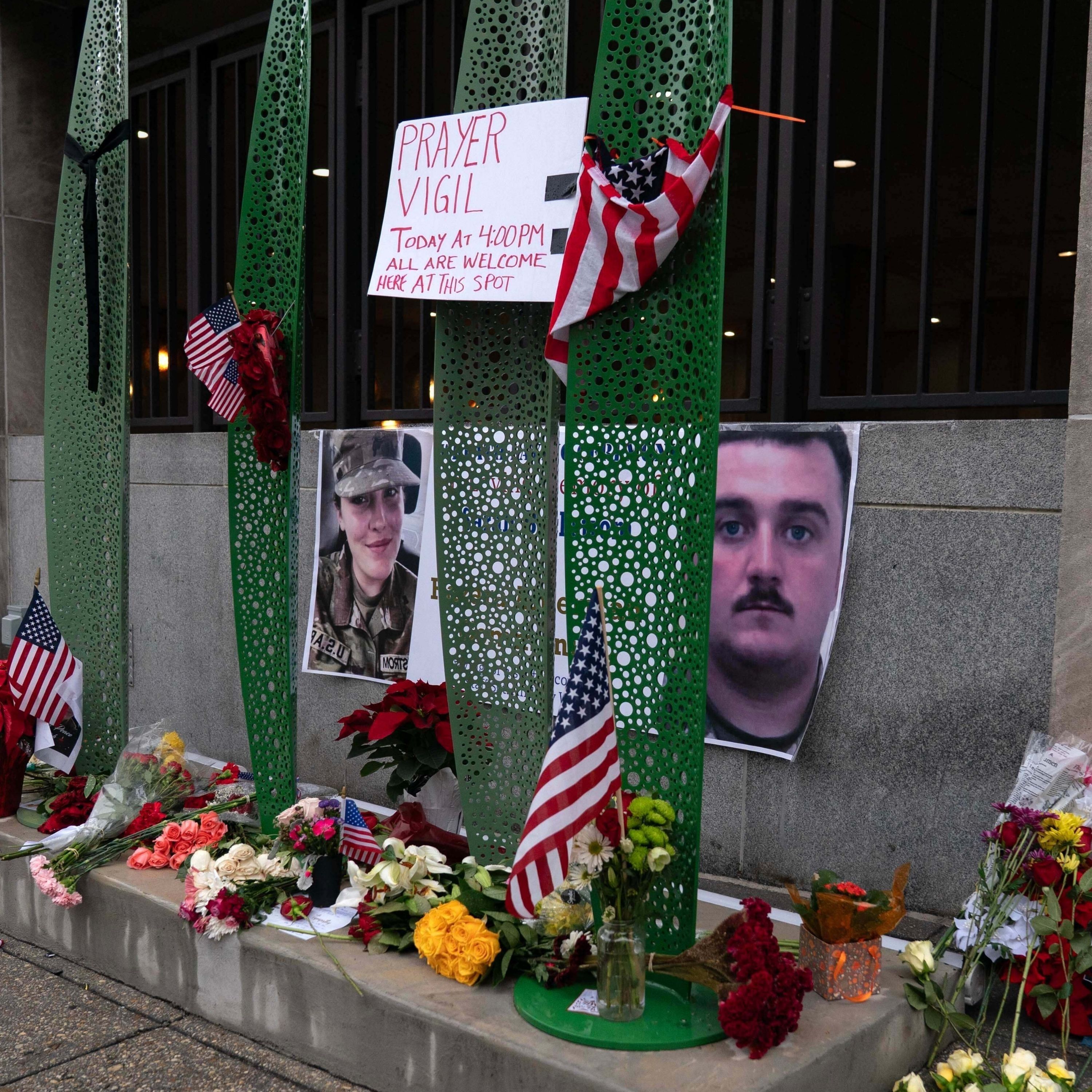
What A Day
Trump Capitalizes On The National Guard Shooting
00:25:46
Two members of the West Virginia National Guard were shot just a few blocks away from the White House, on Wednesday. One of the two shooting victims, 20-year-old Army Specialist Sarah Beckstrom, died of her injuries on Thursday. The alleged shooter is a 29-year-old man from Afghanistan who served in a “Zero Unit,” an Afghan military force that helped the US military. He moved to the United States in 2021 as part of a Biden-era program to help Afghan nationals who had assisted US troops. He was living in Washington State with his family before making the cross-country trip to commit the attack, and he’d reportedly been struggling with mental health issues for years. For more on what role, if any, mental health considerations might have in the judicial process and the overall effectiveness of the DOJ under U.S. Attorney General Pam Bondi, we spoke to Ken White. He’s a federal criminal defense attorney, former federal prosecutor, and the co-host of the legal podcast, Serious Trouble. ...
Loading summary
Transcript33 lines
- [00:03]
Jane Kostin
It's Monday, December 1st. I'm Jane Kostin and this is what a Day. The show that is working its way through Thanksgiving leftovers and wondering what else it could do with turkey, cake, ice cream, A ceremonial dance, perhaps? On today's show, Secretary of State Marco Rubio pursues peace between Ukraine and Russia at a lavish Miami golf club. And the person who drew Alabama's new state senate map is an 18 year old. But let's start with the horrifying shooting of two national guardsmen in Washington, D.C. last week and the blame game and legal fallout on Wednesday. Two members of the West Virginia National Guard were shot just a few blocks away from the White House. One of the two shooting victims, Army Specialist Sarah Beckstrom, died of her injuries on Thursday. She was 20 years old. The alleged shooter is a 29 year old man from Afghanistan who served in a Zero Unit, an Afghan military force that helped the US military. He moved to the United States in 2021 as part of a Biden era program to help Afghan nationals who had assisted U.S. troops. He was living in Washington State with his family before making the cross country trip to commit the attack. He had reportedly been struggling with mental health issues for years. In response to the shooting, the Trump administration halted all asylum decisions and stopped issuing visas to anyone from Afghanistan on Friday. The shooter's asylum claim to stay in the United States was approved just this past April. But on Sunday, Secretary of Homeland Security Kristi Noem seemed to argue that maybe former President Joe Biden was somehow responsible. I just want to be very clear about this because his asylum was approved in April of this year on the Trump administration's watch. So just to be very clear, was there a vetting process in place to.
- [01:55]
Ken White
Approve that asylum request?
- [01:59]
Jane Kostin
Yeah, the vetting process all happened under Joe Biden's administration. So was he vetted when he was granted asylum? Are you saying he wasn't vetted when he was granted? As vetting is, vetting is, vetting is happening when they come into the country and that was completely abandoned under Joe Biden's administration. The United States Attorney for the District of Columbia, Jeanine Pirro, said Friday that the DOJ is upgrading the charges against the alleged shooter to first degree murder. U.S. attorney General Pam Bondi has also talked about pursuing the death penalty if he's convicted. But I wanted to know what role, if any, mental health considerations might have in the judicial process. And I also wanted to talk about how the same Department of Justice that is focused on putting the alleged National Guard shooter to death has fumbled cases that might be a little closer to Donald Trump's heart. So for more on all of that, I spoke to Ken White. He's a criminal defense attorney and former federal prosecutor. He's also the co host of the legal podcast Serious Trouble. Ken White, welcome back to what a Day.
- [02:56]
Ken White
Well, thank you for having me back, Jane. I'm always happy to talk to you.
- [03:00]
Jane Kostin
There's been some preliminary reporting on the suspect's deeply declining mental health in the years before the attack, which is not exactly surprising for someone who's willing to commit this kind of act. And it's also something that seems to be a pattern in many of the high profile shootings we've seen recently. Does the DOJ typically take that into account when seeking the death penalty, or could that possibly be something that is a mitigating circumstance? Will that come up in trial? Where does mental health play in in these kinds of cases?
- [03:28]
Ken White
So it absolutely plays a role in a normal Justice Department's consideration of what charges to seek and whether or not to seek the death penalty. And it's even one of the regulation factors to be considered. Now, different departments of justice are more or less willing to take that into account when it comes to tr. It's absolutely a defense, the defense of insanity. That's the defendant's burden to prove, and the burden's quite high. You really have to prove at this point that you lacked the capacity to follow the law, that not only did you not understand the rightfulness or wrongfulness of your actions, but you were unable to conform yourself to the law. And this is a man who, in addition to all the indicia that he's recently mentally ill, came from a very harrowing background in Afghanistan, where lots of people were dying and lots of horrific things were happening that often generates different types of mental illness, ptsd, things like that. So it's a viable defense for him, but it's always an uphill struggle in America.
- [04:34]
Jane Kostin
And I just had a quick question on that matter. For that to be a viable defense in your experience? I'm aware. Every case is different.
- [04:43]
Ken White
Right.
- [04:43]
Jane Kostin
Does the defense need to prove that he was exhibiting signs of declining mental health for a long time, or could the defense argue that in that moment when he committed this crime, he was not in control of his senses?
- [04:58]
Ken White
So the answer is, Jane, he could absolutely try to make that argument, but it's very unlikely to appeal to a jury, particularly when this is a very sympathetic and appealing victim and an unsympathetic and unappealing shooter. There's really not any hook there that's likely to make a jury think, well, I'm gonna kind of give him the benefit of the doubt.
- [05:21]
Jane Kostin
As you've mentioned, this DOJ has set itself apart from the past on a lot of things, partly by prosecuting people who the president clearly perceives to be his enemies, like ex FBI Director James Comey and New York Attorney General Letitia James. Last week, a federal judge dismissed those cases, though they did so without prejudice, which means they could theoretically be refiled. And attorn General Pambandi has said she plans to appeal that decision. Is there any legal basis for that? Given what we know now about how the DOJ seems to have fumbled this.
- [05:52]
Ken White
Entire prosecution, there is a legal basis to appeal it. So the judge took the narrowest possible grounds to dismiss the case. And that's kind of what you would call traditionally judicial conservatism, not in the conservative versus liberal sense, but in the judge deciding the fewest things possible to resolve the case sense. So what the judge said was that under the law, Lindsey Halligan, the United States Attorney named by Trump, was not properly named, that the statute does not let you evade congressional approval of the U.S. attorney, and you can't just keep appointing interim ones because you don't like the last interim one. So what the judge said was that this person was not properly appointed. She is the one who handled the entire indictment, and therefore the Comey case is going to be dismissed, as is the Letitia James case. Now, the judges did not get to the far more juicy and difficult and complicated questions of vindictive prosecution, which I think these probably present some of the best cases for vindictive prosecution that I've ever seen in American history. But this is also, frankly, Jane, I think an opportunity for the administration to take a sort of soft way out so they could try to re indict with a real U.S. attorney. But that would simply put them back into the soup with all the problems with the case. Because if this kept on going with the litigation over the vindictive prosecution or the prosecutorial misconduct, then I think you're talking about a significant chance of a dismissal with prejudice and one that happens in a way that reflects much more poorly on the administration that starts getting into more embarrassing territory.
- [07:49]
Jane Kostin
Speaking of embarrassing territory, in the middle of all of this, President Trump has continued to hand down pardons I find alarming and concerning for people ranging from cryptocurrency billionaires to allies who supported efforts to overturn the 2020 election. Is there a logic or a pattern to whom the president is choosing to pardon.
- [08:09]
Ken White
Well, I think it's always problematic to try to attribute strategy to Donald Trump, but it seems to me that the main them are my friends and my allies I'm going to protect. So we saw that with all the January 6th pardons and commutations. Now we're seeing it with people who have backed Trump in the past, people who are sort of, I would call them class allies, you know, super rich crooks and people who are political or geopolitical allies, like pardoning a former president of Honduras who was deeply involved in the drug trade because he was a conservative. Right. Former president of Honduras. So all this stuff seems to be sending a signal, first of all, you look out for us, we'll look out for you. So do things, whatever you have to do to support us, and we'll have your back. And just, you know, I have the power now and I'm going to use it.
- [09:06]
Jane Kostin
As you mentioned about kind of class allies, news broke right after Thanksgiving that President Trump had pardoned a private equity executive who had served less than two weeks of a seven year prison sentence for defrauding thousands of people. What is next for the victims of that fraud? Like, what steps could his victims potentially take?
- [09:26]
Ken White
Well, it's notable that Trump has been sparing people from not just prison sentences, also from other consequences of their convictions, so things like restitution and fines. So in a lot of these cases, the victims were probably pursuing civil litigation as well as standing in line for restitution in the criminal case. So it's really going to be a case by case case, saying about whether or not they've got judgment, whether or not that judgment is still going to be enforceable. The President can't wipe out a civil judgment against somebody, but you can do a lot to render an uncollectible. And a lot of the time what victims will do is rely on the criminal process and rely on that restitution process, because that's much more muscular in most cases than, you know, your civil suit and civil judgment. You'd much rather have the United States government being your leg breaker, getting your money back than you would having your own lawyer do it.
- [10:23]
Jane Kostin
Something that's very strange to me is how the kind of MAGA right views Pam Bondi and the doj currently, they view them as being tremendous disappointments because again, Pam Bondi was brought in and so many people within the DoJ were brought in to prosecute Trump's enemies and to prosecute people whom Mag had been told were also their enemies. But there's also like the day to day work of being the US Attorney General. The DOJ is continuing to prosecute cases on all sorts of fronts all across the country. So with your experience in the DOJ and knowing that Bondi has been asked to fulfill both a ceremonial role and also do an actual job, what do you expect from her and the DOJ over the next couple of years?
- [11:11]
Ken White
More failure, more embarrassment, more incompetence. So I mean, it's not rocket science. Plenty of strictly mid people, people have been federal prosecutors or DOJ officials or things like that. But you have to know what you're doing, you have to have some experience. And if you approach it in a purely hackish way, then it's going to be very difficult to do. Right. So what you're seeing is a lot of systemic failure as they fire or chase out the smart and honest people, retain the hacks and partisans and go after things in a way that is very openly, nakedly bring down the hammer on anyone who disagrees with us. So you're seeing really unprecedented levels of grand juries rejecting cases, of regular juries rejecting cases of all these things happening whenever they're trying to flex their muscles. Particularly I'm thinking about all the various cases trying to prosecute people who were in protests against ICE or against the National Guard or that sort of thing. They are doing terrible numbers on that stuff. They're failing all over the place. And that's just because the way they're doing it is very sort of overtly thuggish and dumb. And even though grand juries will indict a ham sandwich there, there's some ham just too rancid to indict. And one of the most encouraging things of this presidential administration so far has been the resistance by judges. It has been the resistance by jurors and the resistance by citizens who are standing up for each other and looking out for each other in the face of this overwhelming federal power.
- [12:51]
Jane Kostin
Ken, as always, thank you so much for joining me.
- [12:53]
Ken White
Well, thank you for asking me. It's always a pleasure to talk to you.
- [12:56]
Jane Kostin
That was my conversation with Ken White, a criminal defense attorney and former federal prosecutor and the co host of the legal podcast Serious Trouble. We'll get to more of the news in a moment, but if you like the show, make sure to subscribe. Leave a five star review on Apple Podcasts, watch us on YouTube and share with your friends. More to come after some ads. What a day is brought to you by Aura Frames. If you're a last minute shopper, like me, you know the feeling. Shelves are empty and ideas are running low. You had ideas for presents two weeks ago, but now nothing. Well, Aura Frames is the solution with a gift that feels personal. There's unlimited photos and video. Just download the Aura app and connect to Wi fi and you can add photos before it ships and keep adding from anywhere anytime. You can't wrap togetherness but you can frame it for unlimited time. Save on the perfect gift by visiting auraframes.com to get $35 off Aura's best selling cover. Matte frames named number one by Wirecutter by using promo code WAUD at checkout. That's auraframes.com promo code WAUD. This deal is exclusive to listeners and frames sell out fast, so order yours now to get it in time for the holidays. Support the show by mentioning us at checkout. Terms and conditions apply. VRBO helps you swap gift wrap time for quality time. Go to VRBO now and book a last minute week long stay and save over $390 this holiday season. Book your next vacation rental home on VRBO. Average savings $396 select homes only what if you had two days to save big, really big. Save up to 50% on select cyber Monday deals right now at Best buy score smart TVs that bring binge watching to life, laptops that will take them to the head of the class, and headphones that let you get lost in the music. Plus, don't miss one day only. Doorbusters. We told you it was big. Hurry Cyber Monday deals and Monday shop now@bestbuy.com Best Buy Imagine that. Here's what else we're following today. Header lines.
- [15:12]
Ken White
Our goal here is to end the war.
- [15:14]
Jane Kostin
But it's more than just to end the war. We don't just want to end the war. We also want to help Ukraine be safe forever so never again will they face another invasion. And equally importantly, we want them to enter an age of true prosperity. On Sunday, Secretary of State Marco Rubio met with a Ukrainian delegation in Miami to continue negotiations on a Russia Ukraine peace plan. The meeting occurred in a location appropriate to high stakes statecraft, the Shell Bay Club in Miami, a golf club developed by US Special special envoy to Russia Steve Witkoff. Both sides discussed the 28 point peace plan Trump put forward, which has been described as a Russian wish list. Rubio said it was, quote, very productive, but much work remains. Ukraine Chief Negotiator Rustam Umerov called the meeting, quote, productive and successful, AKA they pretty much said nothing. What comes next for the peace negotiations today. Ukrainian President Volodymyr Zelenskyy will meet with French President Emmanuel Macron to support the discussion. And Steve Witkoff will jet off to sunny Moscow this week for additional talks with his Russian counterparts. Do you take responsibility for failing to stop this fraud in your state?
- [16:27]
Ken White
Well, certainly I take responsibility for putting people in jail. Governors don't get to just talk. Theoretically, we have to solve problems. And I will note, it's not just Somalis. Minnesota is a generous state. Minnesota is a prosperous state, a well run state where AAA bond rated, but that attracts criminals. Most people are going to jail. We're doing everything we can, but to demonize an entire community on the actions of a few, it's lazy.
- [16:52]
Jane Kostin
Minnesota Democratic Governor Tim Waltz appeared on NBC's Meet the Press on Sunday to defend himself after a New York Times report detailed a massive fraud targeting his state's social services programs. In 2022. Federal prosecutors began charging dozens of scammers who pulled off a sizable heist during COVID swiping hundreds of millions from a program meant to feed kids. But officials realized that additional schemes targeting Minnesota's expansive safety net programs were ongoing. Some of the suspects who have been charged are members of the state's Somali diaspora. Dozens of people allegedly built bogus companies and collected millions for social services they never delivered. 59 people have been charged so far for defrauding Minnesota of more than $1 billion. For scale, $1 billion is more than Minnesota spends per year to operate its entire prison system. Unsurprisingly, President Trump's nostrils flared at the scent of this potential race bait. Posting on Truth Social on Thanksgiving Day, Trump said, quote, hundreds of thousands of refugees from Somalia are completely taking over the once great state of Minnesota. To be clear, There are roughly 80,000 Somalis in Minnesota, according to the New York Times. Either way, Democrats are on their heels because Republicans want to take back the governor's office in the election next year. A federal judge has ordered Alabama to implement a new state Senate map in upcoming legislative elections. And guess what? An 18 year old says he's the one who drew the map. U.S. district Judge Anna Manasco ruled earlier this year that the state had violated the Voting Rights act by diluting the voting power of black residents in Montgomery. So Alabama needed a new map. After a lot of legal back and forth, members of the public were eventually allowed to submit their own proposals. A freshman at the University of Alabama, Daniel Digonato, says he wasn't expecting his proposal to be picked, but it was DiGonado explained to newsnations the Hill last month why he got involved in the redistricting process. I ultimately decided, well, if the court was going to have to pick a map, then I figured I would at least send in a map so that I would have the opportunity to at least shape that process. Didonado says he submitted proposals under just his initials because he's a minor in the state. This is me publicly revealing that I am the person who redrew the Alabama State Senate maps. The new map amends two districts in the Montgomery, Alabama area. In her ruling, the judge wrote that a new map was required to afford black voters there a, quote, equal opportunity, but certainly not a guarantee to elect senators of their choice. The state of Alabama is appealing the decision. Over the Thanksgiving holiday, Americans did what we do consume. This year, Americans were hungrier than ever. And no, I'm not talking about turkey. I'm talking about Black Friday, economic anxiety be damned. Americans spent a record $11.8 billion on Black Friday online, according to Adobe analytics. That's a 9.1% jump from last year. At peak times, $12.5 million was being spent every single minute. Although rising prices may be inflating the numbers, the most popular purchase categories, video game consoles, electronics and home appliances. And in a nod to our increasingly dystopian future, Adobe analytics determined that outlets powered by AI and social media particularly influenced what people sprung for this year. Of course, President Trump's year long tariff blitz has pushed up costs for businesses and families. And Salesforce found that despite higher overall spending, US shoppers actually bought fewer items on Black Friday, down 2% from last year. Online order volumes dipped 1% as average prices rose 7%. OK, I'm done with saying numbers. Retail experts say that the figures imply that Americans are thinking harder about what they buy in order to get the best deals. And underneath the holiday cheer, rising credit card debt, more missed payments, and a growing dependence on buy now, pay later, which allows consumers to kick costs down the road. And that's the news. One more thing. Let's talk about Secretary of Defense. I mean, war Piet Hegseth. He's been very busy lately. For one thing, he's investigating Arizona Democratic Senator Mark Kelly for making a video Trump didn't like. And for another, he's maybe potentially fomenting war crimes. Let me explain. On Friday, the Washington Post broke the story that Hegseth reportedly told SEAL Team 6 to, quote, kill everybody aboard a ship suspected to be trafficking drugs in the Caribbean back in September. Remember the strikes on boats allegedly carrying drugs that have killed more than 80 people. Strikes with no congressional authorization. Strikes I do. According to the Post, that order resulted in two strikes on the boat, one that hit the ship, one that reportedly killed two survivors who were clinging to the wreckage in response. Hegseth didn't deny the report about the second strike exactly. In a lengthy Twitter post, because that's how this administration rolls. He wrote, quote, as we've said from the beginning and in every statement, these highly effective strikes are specifically intended to be lethal, kinetic strikes. The declared intent is to stop lethal drugs, destroy narcoboats, and kill the narco terrorists who are poisoning the American people. Which must not have been the right answer because according to President Trump, Higseth told him there was no second strike. Here's Trump on Air Force One on Sunday.
- [22:28]
Ken White
Can you talk a little bit about.
- [22:29]
Jane Kostin
The strikes in the controversy around the secretary Defense said, I don't know anything about it.
- [22:35]
Ken White
He's just. He said he did not say that.
- [22:37]
Jane Kostin
And I believe it. The two men, the second strike. No, he said he didn't do it.
- [22:44]
Ken White
He said he never said, would you be okay with that if he did?
- [22:47]
Jane Kostin
He said he didn't do it, so I don't have to make that decision. In other words, Pete said he didn't do it, so he didn't do it. Though he did sort of say it was fine in that Twitter post. So sure already the strikes on alleged drug boats were legally dubious. And according to Conservative pundit Andrew McCarthy, writing in National Review, if the series of events detailed by the Washington Post are true, then they are, at best, war crimes under federal law. And Virginia Democratic Senator Tim Kaine agreed, speaking on CBS's Face the Nation on Sunday.
- [23:18]
Ken White
Well, first, if that reporting is true, it's a clear violation of the DoD's own laws of war as well as international laws about the way you treat people who are in that circumstance. And so this rises to the level of a war crime. If it's true. And the questions that we've been asking for months are, give us the evidence that the folks on board were really narcotraffickers.
- [23:43]
Jane Kostin
But here's the thing. Pete Hegseth has a deep and seemingly positive fascination with war crimes. As recently recounted in the New Yorker, when Hegseth was a Fox News host, he made an effort to highlight the stories of war criminals like Matthew Golston, a Green Beret who murdered a detainee in Afghanistan, then buried his body before allegedly unburying the body and burning it. Or Clint Lawrence, who ordered his soldiers to shoot two unarmed Afghan civilians and was sentenced to 20 years in prison. Hegseth praised both men for their actions, and both men, as it happens, were pardoned for their crimes by Donald Trump in 2019. Hegseth also thinks that the Geneva Conventions, which form the backbone of international law, are too restrictive. So if Pete Hegseth is indeed fomenting war crimes in his role as secretary of defense, my only question what took him so long? Before we go if you've had your eye on any Cricut merch, today is the time to get it for a great deal. Grab gifts on sale from new friend of the Pod hoodies to stocking stuffers, the whole site is 25% off and the sale ends today. Head to cricut.comstore to shop now. That's all for today. If you like the show, make sure you subscribe, leave a review. Remember that no one will ever hate you more than fans hate a college football head coach who just abandoned their very good team for another job. And tell your friends to listen. And if you're into reading and not just about how Ole Miss head coach Lane Kiffin has decided to take his talents to lsu, driving Ole Miss fans to a meeting at the airport to express their views on the subject. Like me, what a Day is also a nightly newsletter. Check it out and subscribe@cricket.com subscribe I'm Jane Coston, and no matter how hard your Monday has been, no one has screamed at you on the tarmac as you boarded your plane. What a Day is a production of Crooked Media. It's recorded and mixed by Desmond Taylor. Our associate producer are Emily Foer and Chris Allport. Our video editor is Joseph Dutra. Our video producer is Johanna Case. We had production help today from Greg Walters, Matt Berg, Kaitlin Plummer, Tyler Hill and Ethan Oberman. Our senior producer is Erica Morrison, and our senior vice president of news and politics is Adrienne Hill. We had help today from the Associated Press. Our theme music is by Colin Gilliard and Koshaka. Our production staff is proudly unionized with the Writers Guild of America East. What are you doing in a meeting? That could have been an email. That's right, you're losing interest. Don't let it happen to your money, too. Vanguard's Cash plus account can't help you at work, but we can help with your savings because Vanguard believes in giving you more. So how much interest could you earn? Find out@vanguard.com cashplus offered by Vanguard Marketing Corporation member FINRA and SIPC. Hey, what does all in one mean? The Caddy, the wand, the preloaded pad. There's a cleaner in there? Inside the pad. So Clorox Toilet Wand is all I need to clean a toilet. Revolution. Clorox Clean. Feels good. Use as directed.