← What A Day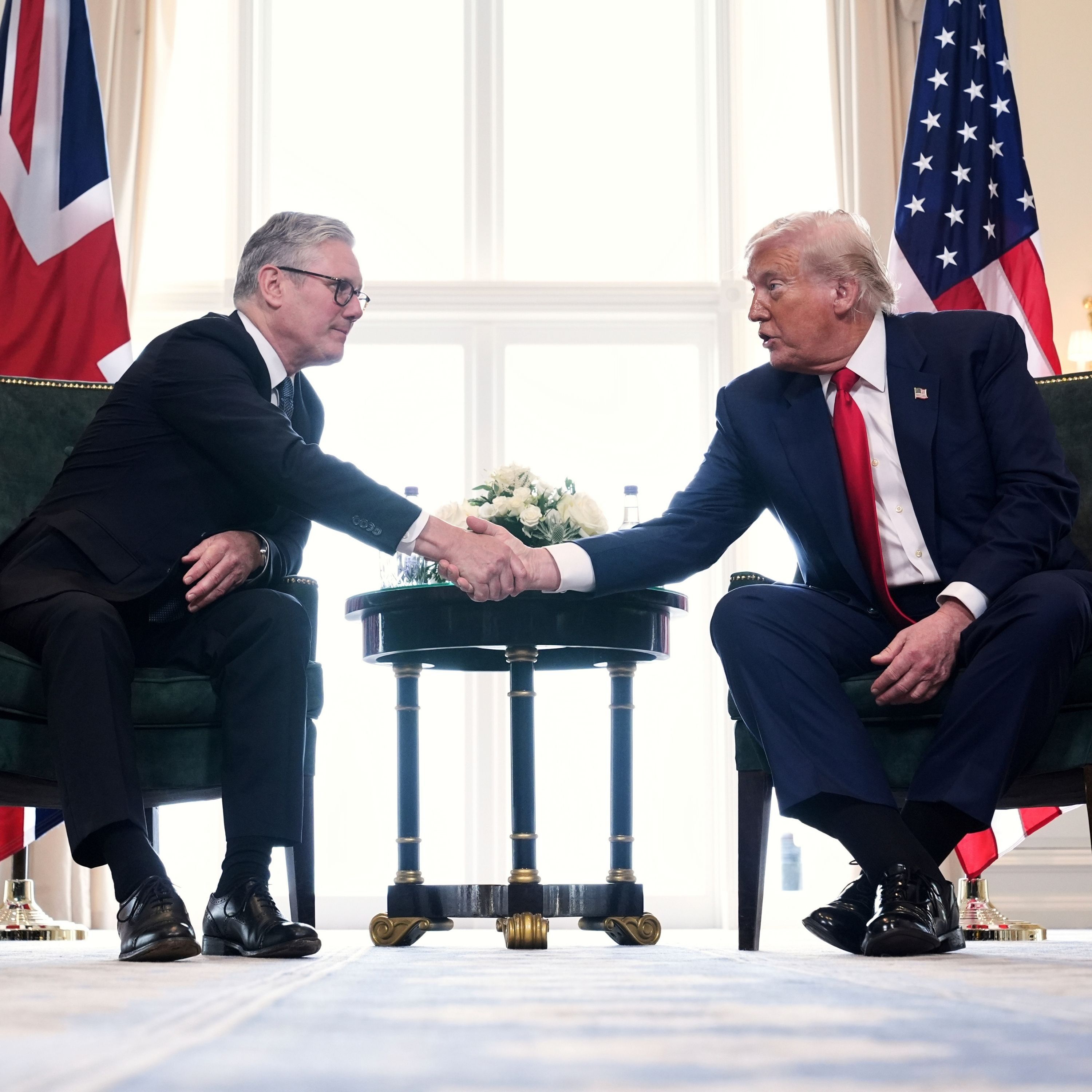
What A Day
Trump's Tariff Deadline Is Two Days Away
00:22:58
Friday is President Donald Trump’s alleged tariff deadline, the day when dozens of countries either have to reach a new trade deal with the U.S. or face the possibility of sky-high duties on their imported goods. Even an island mostly inhabited by penguins won’t be spared from the president’s economic demands. And while Trump has announced deals with major trading partners like the European Union and Japan, there are still a ton of unanswered questions about what comes next — hell, even what’s happening now! To help us understand what’s going on, and what we can expect come August 1st, we spoke with Alex Jacquez, chief of policy and advocacy at the progressive think tank Groundwork Collaborative. He also served as an economic policy advisor for former President Joe Biden and Independent Vermont Sen. Bernie Sanders. And in headlines, British Prime Minister Keir Starmer said the United Kingdom would recognize a Palestinian state in September if Israel doesn’t reach a ceasefire agree...
Loading summary
Transcript48 lines
- [00:02]
Jane Coaston
It's Wednesday, July 30th. I'm Jane Coaston, and this is what a day. The show that was filled with deep and abiding concern when it heard former Canadian Prime Minister Justin Trudeau was spotted having an intimate dinner with pop star Katy Perry. The messaging I'm choosing to take from this. Orlando Bloom is single and maybe ready to mingle. Single women who watched Pirates of the Caribbean in 2003 multiple, multiple times. Your time is now. On today's show, the head of the Environmental Protection Agency rolls out a plan to take the E out of the epa. And British Prime Minister Keir Starmer says the UK Will recognize a Palestinian state if Israel doesn't reach a ceasefire with Hamas. But let's start with tariffs. President Donald Trump has reached tariff deals with the European Union, Japan, and a host of other countries. At least we think he has. As you can tell by the CNBC interview with Treasury Secretary Scott Besant on Tuesday, it's sometimes a little unclear as to what deals actually exist.
- [01:08]
Scott Besant
The Vietnam deal that the president announced earlier in July, I don't think we've seen confirmation, or at least I haven't as I sit here now, from the Vietnamese government of that deal. Did we get confirmation from the Vietnamese government? Do we have an agreement with them? On paper, I didn't work on that deal, but I assume that we do because we've also done Indonesia and Philippines. So I would imagine that. But you haven't seen that paperwork. But Ambassador Greer, who is a seasoned veteran with an encyclopedic memory and knowledge of all this, keeps all that.
- [01:45]
Jane Coaston
So this is just all swirling around some guy's brain. Hmm. For all the countries that haven't reached a new trade deal with the administration, it's theoretically make or break week. Friday is Trump's purported deadline for tariff deals. After that, countries like India and Canada, and yes, an island predominantly inhabited by penguins could face tariffs of up to 35%. Some countries face even higher rates. Chinese and American officials have declared a temporary tariff truce until mid August. But American officials say the decision to end the truce lies with Trump. Great. Now, if you're anything like me, the tariff debate has been pretty confusing. We have heard multiple explanations from the Trump administration as to why we're doing this tariff war in the first place. Fentanyl. Bringing back American manufacturing. Punishing our sworn enemies, the Canadians. But the tariff deals don't seem to be tied to any overall strategy whatsoever. And here's what else is confusing. Whatever tariffs are supposed to be doing. Something I thought they'd definitely do is put the American economy in a headlock. And so far they haven't. And yes, a lot of the tariffs haven't actually gone into effect, but some definitely have. I'm a little lost. So to try to figure out what the hell is going on, I spoke with Alex Jquez. He's chief of policy and advocacy at the progressive think tank Groundwork Collaborative. He's also served as an economic policy advisor for former President Joe Biden and independent Vermont Senator Bernie Sanders. Alex, welcome back to what a Day.
- [03:16]
Alex Jaquez
Thanks for having me again. Great to be back.
- [03:18]
Jane Coaston
Okay, so obviously tariffs have been in the news a lot lately and it can get a little confusing. So can you give us some sort of broad sense of where the Trump administration is now in terms of which tariffs have actually been set actually and which are still upcoming?
- [03:32]
Alex Jaquez
It can be very confusing. There have been a lot of stops. So right now we have a number of tariffs that are paused. These are the reciprocal tariffs that he announced on quote, unquote, Liberation Day, as high as 50, 60, 70% on some of our closest trading partners. Of course, he backtracked on most of those. And what we have now that are currently in place are tariffs on China of about 30%. We have a baseline tariff of 10% that he has instituted and so called fentanyl tariffs of 25% on North American goods that are not compliant with our trade agreement. What we have threatened is a whole host of other tariffs, including as high as 145% on China, 50% on Brazil, and a number of others that he has either walked back or paused. All of those will allegedly go into effect on August 1st.
- [04:30]
Jane Coaston
Now there's a good chance Trump extends the deadline again, but let's say he doesn't. What happens then?
- [04:36]
Alex Jaquez
So what happens on August 1st, which is Friday, is that any country that has not reached a quote, unquote deal will be subject to the Liberation Day tariffs that he announced in April. There's a number of countries, South Korea, of course, large economies that he has not struck agreements with thus far and would immediately be subject to those tariffs. It sounds like for another deadline. August 12, China and the United States are working out yet another pause. All of this adds up to say that we have really no idea what is going to go into Place on August 1st. If you're a business or a consumer, it's not a great place to be.
- [05:17]
Jane Coaston
Let's get into President Trump's recent deal with the EU. Many products coming from the EU block will now see 15% tariffs, but it's half the rate that Trump was threatening. And meanwhile, the US doesn't seem to be losing very much of anything in the new agreement. What's your takeaway from this? What does this mean for American consumers and for the eu?
- [05:38]
Alex Jaquez
So for me, it's hard to understand what the larger strategy at play is. To try to strike a deal with broad tariffs across a number of products coming from the EU while doing nothing. To work with our partners in Europe to defend against countries like China that are undercutting both of our economies is a little puzzling to me. And it's, I think, pretty clear that what the EU has offered in return, $750 billion in energy purchases, liquefied natural gas, and $600 billion in investment, are simply made up numbers. They're not going to happen. They may not even be possible.
- [06:15]
Jane Coaston
Well, a lot of European leaders are not thrilled with this. Prime Minister Francois Beru wrote on Twitter. It's a dark day when an alliance of free peoples resigns itself to submission. Others seem thankful it wasn't worse. The head of the trade group that represents the German chemicals industry put it this way, quote, those who expect a hurricane are grateful for a storm. So, like, they're not happy about this. But what's your take on the agreement? Was it an act of submission or was it the only way for the European Commission to avoid a major trade conflict that could have made everything way worse?
- [06:48]
Alex Jaquez
That's exactly the calculus that the EU is making. And I think you saw them blink at the end. The fact of the matter is the United States is a larger economy. We are simply a bigger market. And that's what Trump is using to try to push our so called allies and partners around. And so at the end of the day, Europe concluded that they didn't want to start messing around with the playground bully and instead they would just acquiesce to this lower level and still kind of historically high tariff rather than get into a protracted and extended trade war.
- [07:19]
Jane Coaston
Do you see this as part of a larger trend of countries just acquiescing to the President's demands? I mean, Japan also agreed to 15% tariffs. Did you expect this many countries to just accept these higher rates?
- [07:31]
Alex Jaquez
Not just countries, Right? I think we've seen Paramount and Harvard, and it seems supplication is the name of the game here when it comes to the Trump administration. So far, I think where you have seen some toughness at least is from China. I will say those who have stood up to Trump have been rewarded for it. We saw Prime Minister Carney in Canada and we saw the Australian labor government. But on the whole, it really does seem like all the other countries here are just going to take what they're offered on tariffs and then wait for the negotiations down the line.
- [08:06]
Jane Coaston
Speaking of China, Chinese and U.S. officials agreed Tuesday to continue talks about tariffs under a 90 day truce. But there's still no deal. U.S. treasury Secretary Scott Besant told reporters that the remaining issues are small, but I don't buy it. Why do you think this deal is proving so difficult? Is it because China's the one country that we can't just bully into accepting our terms?
- [08:29]
Alex Jaquez
I certainly think that's part of it. And I think that our consumer economy is so intertwined with their production right now that that any sort of hard bargain that we would want to drive would be very difficult politically and certainly economically. They know where they have leverage. And in this case, I think the common adage is that China can withstand the pain far longer politically than a president here in the United States could. And I think that's mostly the reason why we haven't seen some more hardball out of the Trump administration is that they know that this is an economy that can really hurt us. And I think as a strategy, if we are, and I think we should be concerned with a lot of what's coming out of China in terms of excess production and excess manufactured capacity, we would want to work with countries like Canada, like blocs like the European Union, who are also struggling to absorb this excess capacity to work as a united bloc, a multilateral bloc, against these practices. But we're going at it alone, with every country all at once.
- [09:37]
Jane Coaston
Now, the president has said that part of the reasoning behind all of this, though, we've got, we've been given like 12 different reasons for higher tariffs is to bring back manufacturing jobs that have moved overseas. White House spokesman Kush Desai said that the quote Made in USA label is set to resume its global dominance under President Trump. But then a new report came out on Tuesday from the Washington center for Equitable Growth, and it found that these tariff policies could lead to wage stagnation, layoffs or even closures of manufacturing plants because a lot of these factories have slim profit margins and rely heavily on global supply chains. So overall, we have seen these two competing ideas that tariffs are good for American workers and tariffs are bad for American workers. What's your take on these? Two very different takes on the same economic information. Like, you know, is Trump's scheme working?
- [10:30]
Alex Jaquez
Here's my take, tariffs are an economic tool like any other. They can be applied smartly and strategically, and they can be applied stupidly in ways that make things worse for workers and businesses. I of course, think that President Trump is pursuing the latter. I think a smart and strategic trade policy would look at the areas where we are being unfairly undercut or where we want to ensure that US Production is competitive globally and in particular with China, and look at ways to target those sectors. And that is not what the Trump administration is doing doing. We are not distinguishing between a high capacity electric vehicle battery and a banana that we are never going to grow in the United States. And that is where I think this is really falling apart. We're not seeing investment. We are not seeing new construction of manufacturing facilities, but we are making things more expensive for consumers and for manufacturers all at the same time.
- [11:29]
Jane Coaston
The writer Derek Thompson has compared the American economy to Rasputin because no matter what you seem to do to it stays pretty stable. Even on Tuesday, new data showed consumer confidence rose slightly this month, though people are still concerned. So what does that tell us about the impact of the tariffs? Is it because they haven't really gone into effect yet, or does Trump deserve more credit? Like is his strategy of threatening higher rates and then making wild demands and deadlines, Is that working? What's going on there?
- [11:58]
Alex Jaquez
I think we're seeing a few things. First of all, we saw a huge run up in imports right before Liberation Day, before the tariffs took effect. This was businesses trying to get as much stock in their inventories and their warehouses as possible before they got hit with tariffs. Now you're starting to see businesses start to wind down that inventory. They're reaching kind of the end of their stockpiles and buildups. And we look at earnings calls at Groundwork Collaborative to see what CEOs are telling their investors. They'll lie on the press, but they won't lie to their investors. And what they're saying is that they are worried about Q3 and Q4. And in particular the holiday season takes a long time for these supply chains, for the prices to move throughout these complex globalized supply chains. And so we are seeing a lag on this data, but we are starting to see it come through. Inflation last month was hotter than it's been in a while. We've seen the labor market start to soften. And I think we are only going to continue to get these headwinds as interest rates stay higher because of the uncertainty that the Trump administration has introduced into the economy. Again slowing things down. All for what cause?
- [13:09]
Jane Coaston
Alex, thank you so much as always for joining me.
- [13:12]
Alex Jaquez
Thanks so much for having me, Jan.
- [13:14]
Jane Coaston
That was my conversation with Alex Jaquez, Chief of Policy and Advocacy at Groundwork Collaborative. We'll get to more of the news in a moment, but if you like the show, make sure to subscribe, leave a five star review on Apple Podcasts, watch us on YouTube and share with your friends. More to come after some ads Whataday is brought to you by Amnesty International usa. Here's what's up. Amnesty International has been defending human rights around the world for more than 60 years and they don't take money from governments for their campaigns and research. That means no shady strings attached. Right now they're calling out Trump's mass deportation campaign, which surprise, is violating human rights and ripping apart families. Want to help fight back? Go to amnestyusa.org help to donate. Your gift will be triple matched A.
- [14:07]
Eric Adams
Real Etsy buyer review for handmade home decor by a real Etsy seller. I could not be happier about the quality or the wonderful personal message supplied with it describing its journey into existence. Discover original items created by real people and loved by real people just like you. Special starts on Etsy Shop the Etsy.
- [14:28]
Scott Besant
App Amazon Pharmacy presents painful thoughts 20 more minutes to kill in the pharmacy before my prescription is ready. Maybe I'll grab some deeply discounted out of season Halloween candy. I never had a chocolate pumpkin with raisins before. Those were raisins, right? Next time use Amazon Pharmacy. We deliver. And no, those were not raisins. Amazon Pharmacy Healthcare just got less painful.
- [15:02]
Jane Coaston
Here's what else we're following today. Head of Lines.
- [15:07]
Keir Starmer
As part of this process towards peace, I can confirm the UK will recognize the state of Palestine by the United Nations General assembly in September unless the Israeli government takes substantive steps to end the appalling situation in Gaza, agree to a ceasefire and commit to a long term sustainable peace. Reviving the prospect of a two state.
- [15:35]
Jane Coaston
Solution British Prime Minister Keir Starmer outlined conditions Tuesday for the UK to potentially recognize a Palestinian state in September. He also reiterated demands that Hamas release all of the remaining hostages being held in Gaza and agreed to play no role in the government of the territory. Starmer's pledge came days after French President Emmanuel Macron announced that France would recognize a Palestinian state at the United Nations General assembly in September. Speaking to reporters after Starmer's announcement, President Trump said the matter did not come up during their recent talks in Scotland. He added, you're rewarding Hamas if you do that. I don't think they should be rewarded. The American people might feel differently, however. A new Gallup poll released Tuesday shows the U.S. approval rating for Israel's military action in Gaza at little more than 30%. It's the lowest since Gallup first started polling Americans on the question in November of 2023. It's also 10 percentage points lower than Gallup's previous polling in September of last year. Gallup also found that, as with pretty much everything these days, Americans were sharply divided based on their party affiliation. Just 8% of Democrats said they approve of Israel's actions in Gaza, compared to more than 70% of Republicans. There was one notable break within the Republican Party, though. Georgia Representative Marjorie Taylor Greene was the first member of her party in Congress to refer to the humanitarian crisis in Gaza as a genocide. In a social media post Monday night, she wrote, it's the most truthful and easiest thing to say that October 7th in Israel was horrific and all hostages must be returned. But so is the genocide, humanitarian crisis and starvation happening in Gaza. Well, folks, we are doing it. We're making America hot again. Probably making it even hotter, but not in the good way. Lee Zeledin, the administrator of the Environmental Protection Agency, announced a plan to gut the so called endangerment finding. That's the 2009 scientific conclusion that says greenhouse gases are a danger to public health. It's basically the CornerStone of the EPA's legal authority to limit emissions from cars, power plants, factories and more. So it's bad, but it was also expected. We did a whole episode of the show on this earlier this week and we'll link to it in our show notes. Zeldin previewed the announcement on a conservative podcast called Ruthless early Tuesday. He decried the existence of Americans who, quote, in the name of climate change are willing to bankrupt the country.
- [17:54]
Keir Starmer
What's the significance? How big is the endangerment finding? Well, repealing it will be the largest deregulatory action in the history of America, so it's kind of a big deal.
- [18:05]
Jane Coaston
Seldon made a more formal declaration of the news at a truck dealership in Indianapolis later in the day.
- [18:10]
Keir Starmer
We at EPA must choose to both protect the environment and grow the economy that it's not a binary choice.
- [18:19]
Jane Coaston
We will protect the environment by destroying it, apparently before the endangerment finding can officially be Revoked, though, the EPA's proposal must make it through a lengthy review process that includes public comment. The decision could also be challenged by environmental groups in court.
- [18:36]
Rob Bonta
This is our 35th lawsuit in 27 weeks. More than one a week because that's the pace at which this presidential administration is violating the law. Trampling over the Constitution.
- [18:47]
Jane Coaston
California Democratic Attorney General Rob Bonta announced yet another joint lawsuit Monday against the Trump administration. This time it's over food benefits.
- [18:55]
Rob Bonta
Alongside 20 attorneys general and and a governor's office. We're suing the U.S. department of Agriculture for demanding that we turn over deeply personal data about every single applicant and recipient of the Supplemental Nutrition Assistance Program, also known as snap, in our state, and for threatening to withhold funding unless we comply.
- [19:18]
Jane Coaston
35 lawsuits in 27 weeks. I just know this man is tired. Reminder snap, or what a lot of people call food stamps, provides benefits to low income people to buy food. Last year, the program served around 42 million people a month. Last week, the Department of Agriculture told states they had until today to hand over data for those enrolled in snap. The USDA has said the data would help combat waste, fraud and abuse. To which I say, hmm, because the coalition of states that filed the lawsuit Monday sees ulterior motives. The group fears the government would use people's personal data to aid Trump's mass deportation agenda because why else would the administration need it? Fonta called it a, quote, bait and switch of the worst kind. The Trump administration has been working tirelessly to gather private information on mostly lower income people who may be undocumented. It has also ordered the Internal Revenue Service and Centers for Medicare and Medicaid Services to share private information with the Department of Homeland Security.
- [20:20]
Scott Besant
We lost four souls to another senseless.
- [20:24]
Alex Jaquez
Act of gun violence.
- [20:26]
Jane Coaston
New York City Mayor Eric Adams gave updates late Monday about a mass shooting in midtown Manhattan earlier in the day. New York police say the assailant drove from Nevada to New York City, where he ultimately killed four people. The shooting took place at a huge office building that's home to the headquarters of the financial giant Blackstone and the National Football League, among other tenants. Police say the gunman walked into the building's lobby with an AR15 style rifle and immediately began shooting. A police officer died. Authorities say the man continued to fire into the lobby, then made his way up to the building's 33rd floor where he shot himself. Officials say the shooter was just 27 years old and according to New York City Police Chief Jessica Tisch, had a history of mental health issues. According to police, the gunman carried a three page handwritten note in his wallet claiming he suffered from chronic traumatic encephalopathy, or cte. That's the brain disease, has been linked to repeated concussions and has been found in athletes that played hip, heavy contact sports like football and hockey. The disease cannot be diagnosed before death. According to police, the shooter railed against the NFL in the letter and pleaded, quote, study my brain, please. Adams told MSNBC Tuesday that officials believe the shooter may have been targeting the NFL when he came to New York. And that's the news before we go. This week on Pod Save the World, Ben and Tommy track Trump's foreign policy threats from Gaza to Ukraine, break down the latest from Southeast Asia, and unpack what the left can learn from rising political movements abroad. Plus, a powerful interview with the director of the documentary 20,000 meters to Andriivka about chronicling war on the front lines. Listen to Pod Save the World every Wednesday, wherever you get your podcasts. That's all for today. If you like the show, make sure you subscribe, Leave a review, Give Pirates of the Caribbean a rewatch for Orlando Bloom and Orlando Bloom only. And tell your friends to listen. And if you're into reading and not just about how Bloom has been hinting at a possible reboot of the franchise like me, what a Day is also a nightly newsletter. Check it out and subscribe@cricut.com subscribe I'm Jane Coston, and seriously, it's 2025 and we're already staring down the barrel of an Austin Powers reboot. Maybe let Pirates of the Caribbean lie in Davy Jones Locker. What a Day is a production of Crooked Media. It's recorded and mixed by Desmond Taylor. Our associate producer is Emily Foer. Our producer is Michelle Aloy. Our video editor is Joseph Dutra. Our video producer is Johanna Case. We had production help today from Greg Walters, Matt Berg, Gina Pollack and Laura Newcombe. Our senior producer is Erica Morrison and our senior vice president of news and politics is Adrienne Hill. We had help with the headlines from the Associated Press. Our theme music is by Colin Gilliard and Kaushaka. Our production staff is proudly unionized with the Writers Guild of America EAS A.
- [23:55]
Eric Adams
Real Etsy Buyer review for handmade home decor by a real Etsy seller. I could not be happier about the quality or the wonderful personal message supplied with it describing its journey into existence. Discover original items created by real people and loved by real people just like you. Special starts on Etsy Shop the Etsy.
- [24:15]
Scott Besant
App.
- [24:18]
Narrator
How hard is it to kill a planet? Maybe all it takes is a little drilling, some mining and a whole lot of carbon pumped into the atmosphere. When you see what's left, it starts to look like a crime scene.
- [24:30]
Jane Coaston
Are we really safe? Is our water safe. You destroyed our tap.
- [24:34]
Narrator
And crimes like that, they don't just happen.
- [24:37]
Jane Coaston
We call things accidents.
- [24:39]
Alex Jaquez
There is no accident.
- [24:40]
Jane Coaston
This was 100% preventable.
- [24:44]
Narrator
They're the result of choices by people. Ruthless oil tycoons, corrupt politicians, even organized crime. These are the stories we need to be telling about our changing planet. Stories of scams, murders and cover ups that are about us and the things we're doing to either protect the the earth or destroy it. Follow Lawless Planet Wherever you get your podcasts, you can listen to new episodes of Lawless Planet early and ad free right now in the Wonry app, Apple Podcasts or Spotify.