← What A Day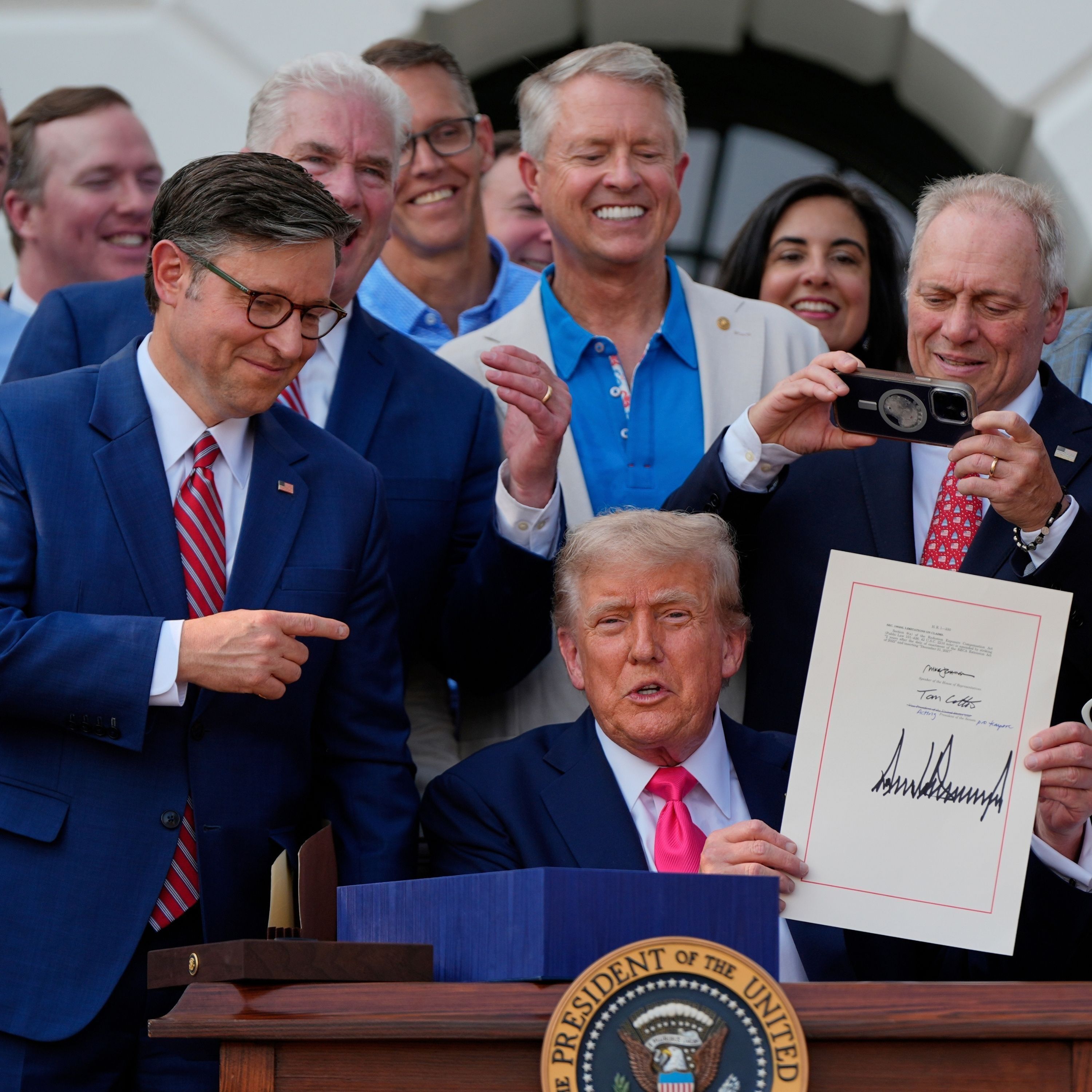
What A Day
Trump's War On The Poor
00:24:15
Despite months of handwringing and a litany complaints from dozens of Congressional Republicans, President Donald Trump scored yet another major political victory Friday when he signed his One Big Beautiful Bill into law, just like he wanted. The measure, stuffed with Republican spending and policy priorities, threatens to balloon the federal deficit by more than $3 trillion dollars over the next decade while kicking millions of poor Americans off safety net programs like Medicaid and food assistance. But the effects won’t be felt immediately. Jacob Bogage, Congressional economics correspondent for The Washington Post, breaks down the details of the new law. And in headlines: The death toll from the devastating flooding in central Texas topped 70 people, the White House sent mixed messages on the future of Trump’s tariffs, and Israeli Prime Minister Benjamin Netanyahu is headed to the White House again amid a renewed push for a ceasefire with Hamas in Gaza.
Loading summary
Transcript56 lines
- [00:02]
Todd Zwillick
It's Monday, July 7th. I'm Todd Zwillick in for Jane Coston. And this is what a day. The show that recognizes that Black Sabbath is dead, but Ozzy Osbourne is alive. Ozzy was never supposed to outlive anyone, really. So on a weekend when America celebrated shaking off the uk it's good to note that one British rocker is looking great and live to see his old band officially retired. On today's show, Israeli Prime Minister Benjamin Netanyahu comes to the White House, while Hamas considers yet another cease fire deal with negotiators in Qatar. Emergency responders and politics react to the tragic loss of life from flooding in Texas. But let's start with President Donald Trump's latest effort to make health impact and safety worse and reward the rich while doing it. Donald Trump signed his big budget bill into law on July 4, complete with a flyover from a stealth bomber. And if you rely on Medicaid or SNAP nutrition benefits or the Affordable Care act to pay for health coverage, that imagery is, well, right on target. Over the next decade, 17 million Americans are expected to either lose their health coverage or the federal subsidies that help pay for them. And yet, while polling shows that Donald Trump's big billionaire benefiting bill is wildly unpopular, it also shows that most people don't know a thing about it. How's that for a bomb delivered by stealth? Meanwhile, the new law makes immigration enforcement, including deportation, a behemoth, giving it a budget of more than $170 billion. And just last week, Trump borders. Our Tom Homan was excited. You think we're arresting people now? You wait till we get the funding to do what we gotta do. But who's affected first? How fast will benefits dry up and riches flow upward to the ultra rich as Trump moves America toward his second gilded age? How does all this actually work? To help answer those questions and more, I spoke with Jacob Bogage. He's a congressional economics correspondent for the Washington Post. Jacob, welcome to what a day.
- [02:24]
Jacob Bogage
Hey, great to be with you.
- [02:26]
Todd Zwillick
So, Jacob, throughout the entire process of negotiating, trying to pass this bill, all along the way, there were dozens of Republicans at some point or the other pledging, promising, either leaning no or definitely voting no. In the end, they didn't. And especially in the House right there at the end, before July 4th, there were 10, 11, 12 Republicans holding this vote open for hours and hours and hours. And eventually they caved. All but just a couple of them. So in the end, what did Trump, what did the Republican leadership do to get these steadfast Republicans on board.
- [03:04]
Jacob Bogage
Nothing. They didn't do anything. They waited him out. I mean, you know, the way that they presented this vote to the House was we're going to make you take a binary choice. We're going to make you vote yes to pass it or vote no to miss the President's self imposed arbitrary July 4th deadline, and we're gonna wait you out. And that's what they did. So, you know, some folks came out of meetings and said, oh, we've received these promises, you know, we'll get this policy or we'll get that policy. Well, Congressman, what did you get? Well, we can't share that right now, Jacob.
- [03:43]
Todd Zwillick
I saw one report where a White House official, I think in Legislative affairs was asked what concessions these Republicans got for their vote and the answer was, quote, fucking nothing. Is that about it?
- [03:56]
Jacob Bogage
Yeah, yeah. I mean, you know, when you come out of a, out of a negotiating session and you say the White House showed us new data that, you know, justifies our position in their position simultaneously, you didn't get anything. When you come out of a negotiating session and the White House says, we're planning future executive orders that you're going to like, but you can't share it with anybody, you didn't get anything. You know, they got rolled. Everybody knows they got rolled.
- [04:28]
Todd Zwillick
All right, let's get down to policy just for a moment. Now, we've heard that this bill, broad strokes, takes from the poor, gives to the rich. Robin Hood hanging from his ankles in Sherwood Forest. Finally, what we've all been waiting for, I guess, from American policy, but let's get a little bit more specific. Who are the big losers here? Who are the big winners?
- [04:50]
Jacob Bogage
Let's start big winners. Businesses big winners. Their tax rate was locked in. That wasn't going to change, and it didn't change. And on top of that, they got three big deductions that's going to make investing in R and D, buying new equipment, a lot more inexpensive. So businesses, big winners, great tax rate, new deductions, rich folks, big winners, they get to keep their tax break. And a lot of these tax breaks that we're seeing for something like a pass through deduction, great for rich folks. And a lot of the, like, what I call the goodie bag, the no tax on tips and a tax on overtime, the bonus for seniors in the standard deduction, the no tax on auto loan interest, those are really going to benefit rich folks. And let's talk about the auto loan interest deduction real quick as a great example of that. You can deduct up to $10,000 if you buy an American made car in interest payments. Who's doing that? Who's buying new cars? People with money are buying new cars. So it's very transparent who that is most beneficial to. You want to talk about losers in this bill? You talk about low income folks and working class folks, people for whom some of these social benefit programs like Medicaid, like snap, the Supplemental Nutrition Assistance Program that we used to call food stamps, those made a certain lifestyle possible. And there's going to be tremendous cuts to those programs or when they're not cut, just onerous requirements to remain involved.
- [06:36]
Todd Zwillick
Now, a lot of the savings in this bill come from just where you describe, deep cuts to social programs relied on by those very people. Jacob, about a trillion dollars in cuts from Medicaid, $200 billion from the Food assistance programs known as SNAP that you just mentioned. Low income people rely on this programs. Will the tax savings that they're getting in any way offset the damage to the programs that they relied on in the net? For somebody who you just described, what, what does this bill look like in a couple of years?
- [07:09]
Jacob Bogage
Yeah, that's a great question. And the answer is absolutely not. And we've spent a lot of time trying to do the math on that. And we've relied on a lot of experts of different ideological persuasions to do the math on it. And universally the answer is no, it does not net out in the positive for someone who is low income or someone who is middle low income. And the reason is that the benefit that they would get from a SNAP or from a Medicaid is redistributed up the income scale to pay for tax cuts or new deductions that are going to benefit people that make more money. And there's not just those redistributions from the social benefit programs. There's other things in this bill that's going to make it more difficult for those households. There's an excise tax on remittances. So if I am in this country and sending money maybe to family somewhere else, there's an excise tax on the remittance I'm sending. There are new fees attached to immigration status. So if I'm renewing my work authorization, if I'm renewing my asylum status, if I have temporary protected status, there are fees attached to all of that. It's just going to make life more expensive for folks toward the bottom end of the wage scale and directly redistribute those resources to the top end of the wage.
- [08:40]
Todd Zwillick
So so billions, hundreds of billions, redistributed from the very poorest to the very richest. What about where most people are, which is solidly in the middle? I don't know. Family of four, $90,000. Why not just pull that out of a hat? What about that family? This is an extension. 2017 tax cuts, are they like, sort of the same? What happens with a family like that?
- [09:03]
Jacob Bogage
They're sort of the same. They're going to net positive, especially if we're talking about a family that has children, they're going to collect on the child tax credit, which was expanded. The thing that you've got to be careful about, and we need to see other fiscal policy decisions down the road, is the debt impact of this bill. It adds $3.4 trillion to the national debt that already exceeds $36 trillion. That has cascading effects on the economy. It makes borrowing for a home, for a car more expensive. It makes business operations more expensive. So the consumer goods that you buy, groceries, electronics, prescription medications, it's going to make a lot of those items more expensive because of how much is being crowded out of the economy because we're taking on new debt.
- [09:54]
Todd Zwillick
Let me ask you about something super specific that's been happening since this bill became law. The White House and the Social Security Administration have both been trafficking and disinformation, telling seniors that Social Security benefits are now tax free. I'm just going to say it. That's false. Can you explain how and why it's false and why they're trying to confuse people?
- [10:16]
Jacob Bogage
Yeah. I don't want to climb inside their head and say why they're spreading this false information, these lies, but I can tell you how they're doing it. President Trump on the campaign trail said he wanted to end taxes on Social Security benefits. That is near impossible to do in the budget reconciliation framework that Congress passed. But what they did do instead was add to the standard deduction for seniors. So for people ages 65 and up, you get $6,000 more in your standard deduction. So if you made $50,000 last year, including Social Security benefits, take $6,000 and we're going to say you made $44,000. That is not exempting Social Security benefits from taxes or ending taxes on those benefits. It is changing your taxable income. Those are very different things. They're going to have very different economic effects and tax effects for.
- [11:18]
Todd Zwillick
Well, this law affects millions, tens of millions and hundreds of millions of people in all different ways. I just want to, before we go, choose one specific group of people, if you can. When will people start to be affected? Let's say if they're on SNAP benefits to get enough food or Medicaid to go be able to go see a doctor. I mean, if you live in Indiana or Texas, do they start throwing people off of Medicaid next week? When does this start?
- [11:47]
Jacob Bogage
That's a great question. So some of these things are going to be phased in between now and 2028. It's going to be up to states though, in a lot of cases to decide when they want to phase them in. What this law does is it sets a date that says you state must have taken this action by this time. If you want to do it sooner, you can do it sooner. And I expect a lot of Ruby Red states that have toyed with Medicaid work requirements or stricter SNAP work requirements previously to try to do that even faster. So think about Texas, think about Arkansas, Indiana. They might try to accelerate that because they've shown a proclivity to do it previously. But there's one group of people that we don't really talk about when we discuss this legislation, and that's immigrants, specifically immigrants from Spanish speaking countries. There are $170 billion in this bill for either border security or immigration enforcement and we're going to see that start right away. The Homeland Security Department's budget is a fraction of what it was given in this bill. And so if you think some of the immigration enforcement activities have been super visible to this point with raids at work sites or in certain neighborhoods.
- [13:15]
Donald Trump
They'Re.
- [13:15]
Jacob Bogage
Going to get a lot more visible and a lot more aggressive because of this funding. It's going to supersize the Department of Homeland Security and Immigration Customs Enforcement.
- [13:26]
Todd Zwillick
Jacob Bogage, Washington Post thanks so much.
- [13:28]
Jacob Bogage
Thanks for having me.
- [13:30]
Todd Zwillick
That was my conversation with Jacob Bo Gage, congressional and economics correspondent for the Washington Post. We'll link to his work in our show Notes. We'll get to more of the news in a moment, but if you like the show, make sure you hit subscribe, leave a five star review on Apple Podcasts, watch us on YouTube and share with your friends. More to come after some ads.
- [14:02]
Ad
Now.
- [14:02]
Is your time to get into a new Dr. Horton home by taking advantage of its national red tag sales event going on right now through July 20th. Stop by any of its participating communities and find select red tag homes at incredible pricing. So whether you're buying your first home or looking for an upgrade, you don't want to miss the red tag sales event going on right now. Discover the Dr. Horton Difference at drhorton.com Dr. Horton, America's builder and equal Housing.
- [14:30]
Opportunity builder Amazon Pharmacy Presents Painful Thoughts I read somewhere that the average American spends 13 hours a year waiting in pharmacies for prescriptions. Clearly I am above average. I thought being above average would feel better. Maybe I'll read some greetings cards next time. Use Amazon Pharmacy. We deliver. And here's to being anything but average. Amazon Pharmacy Healthcare just got less painful.
- [15:06]
Todd Zwillick
What a Day is Brought to you by bookshop.org now whether you're searching for an incisive history that helps you make sense of this moment, a novel that sweeps you away over the summer, or the perfect gift for a loved one, bookshop.org has you covered. When you purchase from bookshop.org, you're supporting more than 2,000 local independent bookstores across the country, ensuring that they'll be able to foster culture and curiosity and the love of reading for generations to come. I love my local bookstore. I shop at Lost City Books in Adams Morgan right here in Washington, D.C. if you find yourself on 18th street in Washington, visit Lost City. Those are my people. I love my independent bookstore. And Also big news. Bookshop.org has launched an ebook app. You can now support local independent bookstores even when you read digitally. I have been reading the old fashioned way on paper. This summer I'm reading World War Z, the classic by Max Brooks. Zombie Apocalypse. I just purchased at an independent bookstore a copy of spqr, the History of the Roman Empire. No, not a dude sitting around thinking about the Roman Empire. I bought it for my wife because we just got back from Rome. By the way, use WAD to get 10% off your next order at bookshop.org that's code WAD w a d@bookshop.org here's what else we're following today.
- [16:32]
Ad
Head of lines.
- [16:36]
And then there was first responders in the water pulling out like girls like sheets. I saw someone holding like a cloth from the water and there were huge trees ripped out of the ground and like their roots. And it didn't look like Camp mystic anymore.
- [16:56]
Todd Zwillick
That's an interview from a Dallas NBC affiliate reporting on the flash floods that swept through Central Texas on Friday and killed dozens of people, local officials said Sunday. Several girls from a summer camp on the Guadalupe river were among those still unaccounted for. Texas governor Greg Abbott said in a post on social media that the camp had been, quote, horrendously ravaged by the flooding. As people grapple with the loss, questions of accountability are swirling Reports have shown that key positions at the National Weather Service have gone unfilled. President Trump denied it had any impact.
- [17:33]
Donald Trump
I'll tell you, if you look at that water situation, that all is. And that was really the Biden set up. That was not our setup. But I wouldn't blame Biden for it either. I would just say this is a hundred year catastrophe and it's just so horrible to watch.
- [17:53]
Todd Zwillick
Trump signed a disaster declaration to free up aid for the area. Meteorologists and former weather service officials have defended the agency's forecasts. A spokesperson said it held forecast briefings for officials on Thursday and sent out warnings that evening and Friday morning.
- [18:12]
Ad
Do the tariff rates change at all on July 9th or do they change on August 1st?
- [18:18]
Donald Trump
What are you talking about?
- [18:19]
Jacob Bogage
Tariff rates, do they change on July.
- [18:20]
Ad
9Th or August 1st?
- [18:22]
Donald Trump
They're going to be tariffs. The tariffs are going to be the tariffs. I think we'll have most countries done by July 9th. Yeah, either a letter or a deal.
- [18:33]
Jacob Bogage
But they go into effect on August 1st.
- [18:36]
Todd Zwillick
Tariffs go into effect August 1st, but the President is setting the rates and the deals right now. It's tariff week, and once again, President Trump is changing his tune. Good thing Commerce Secretary Howard Lutnick was with him on the tarmac on Sunday to translate. Quick reminder, Trump announced his sweeping reciprocal tariffs in April. He got cold feet and put a pause on them very shortly after that with hopes of making 90 deals in 90 days. Earlier on Sunday, Treasury Secretary Scott Besant tried to make sense of these new dates, telling CNN's Dana Bash that President Trump is going to be sending out letters to our trading partners with a new warning.
- [19:20]
Scott Besant
We're going to send out probably 100 letters to small countries where we don't have very much trade. And most of those are already at the baseline 10%.
- [19:29]
Todd Zwillick
You said August 1st. You mean, do you mean what's going.
- [19:33]
Donald Trump
To happen in August?
- [19:34]
Scott Besant
So countries will get a letter saying that if we have not reached an agreement, then you will go back to the April 2nd level.
- [19:45]
Todd Zwillick
Starting when? On August 1st?
- [19:48]
Scott Besant
On August 1st.
- [19:48]
Todd Zwillick
Okay, so there's basically a new deadline.
- [19:52]
Scott Besant
It's not a new deadline. We are saying this is when it's happening. If you want to speed things up, have at it. If you want to go back to the old rate, that's your choice.
- [20:01]
Todd Zwillick
And what has the United States done in that time? So far, Trump has made a whopping two preliminary trade deals, one with Vietnam and one with the United Kingdom and a temporary deal with China. A deal with the EU is getting close. Reportedly this is what we talk about when we talk about tacko. Israeli Prime Minister Benjamin Netanyahu is scheduled to meet President Trump at the White House today. It's his third visit with Trump since January. The meeting will serve in part as a chance for the two to praise their attacks on Iran's nuclear facilities last month. But experts say Netanyahu might also be seeking assurances From Trump about U.S. support if and when his conflict with Iran continues. Will Trump try to humiliate the leader of Israel the way he did with the presidents of Ukraine and South Africa in the Oval Office? Stay tuned. An Israeli delegation traveled to Qatar on Sunday to once again negotiate with Hamas. The Associated Press obtained a copy of a 60 day ceasefire proposal. The terms include Hamas handing over 10 living and 18 dead Israeli hostages, as well as Israeli forces partially withdrawing from the Gaza border and allowing aid into the region. That aid would come from the United nations and other agencies, but not from the US And Israel backed Gaza Humanitarian Foundation. The proposal does not include a permanent end to the war, something Hamas has asked for, but it does envision permanent ceasefire negotiations during that 60 day period. Meanwhile, Israeli airstrikes killed at least 38 Palestinians in Gaza, according to hospital officials there on Sunday. And finally, North Korea's dictator Kim Jong Un has a new vacation destination for when the stresses of being aggressively clapped at get all too overwhelming. His country's opened a new beach resort along its eastern coast, state media says. The tourist resort stretches along 2.5 miles of beachfront property and boasts over 400 buildings, from high rise hotels to luxury villas. It can reportedly house about 20,000 guests and includes a water park, concert hall, restaurants, car dealerships and department stores. The new resort is just one of several tourist destinations built in recent years. North Korea has been trying to lure visitors from places like Russia and China to boost revenues that have been crippled by international sanctions on its exports. But don't get your hopes up. North Korea's border remains mostly closed to Western tourists, so your luxury trip to the Hermit Kingdom might just have to wait a little while longer. And that's the news. That's all for today. If you like the show, make sure you subscribe, leave a review, crank up some Sabbath, throw up the devil horns and tell your friends to listen. And if you're into reading and not just about the true history of Ozzy biting the head off a bat, True story. What a Day is also a nightly newsletter. Check it out and subscribe@crooked.com subscribe I'm Todd Zwillick and by the way if you're looking for the best Sabbath album, it's called Paranoid. Get it? Give Ozzy and the rest of the boys their due. What a Day is a production of Crooked Media. It's recorded and mixed by Desmond Taylor. Our associate producer is Emily Foer. Our producer is Michelle Aloy. Our video editor is Joseph Dutra. Our video producer is Joanna Case. We had production help today from Greg Walters, Matt Berg and Tyler Hill. Our senior producer is Erica Morrison and our senior vice president of news and politics is Adrienne Hill. Our theme music is by Colin Gilliard and Kashaka. Our production staff is proudly unionized with the Writers Guild of America East.
- [24:16]
Ad
The destruction is nearly incomprehensible unless you see it for yourself.
- [24:22]
Jacob Bogage
I found that my house was gone, as well as every house on my block.
- [24:28]
Ad
How could this have happened? And where do we go from here? LA is rebuilding. There is no doubt about that. Less clear is how we know the.
- [24:40]
Jacob Bogage
Faster we can rebuild, the faster we can heal.
- [24:44]
Todd Zwillick
There are kind of two separate conversations at a high level that I don't think we're having that we could have in this rush to kind of build things back as they were.
- [24:55]
Ad
I'm Kate Cagle, host of the new podcast Rebuilding LA from LA Times Studios. We will try to answer some of these questions as we assess the path forward. Rebuilding LA launches June 11. Find it wherever you get your podcasts.
- [25:18]
Amazon Pharmacy Presents Painful Thoughts I read somewhere that the average American spends 13 hours a year waiting in pharmacies for prescriptions. Clearly, I am above average. I thought being above average would feel better.
- [25:36]
Jacob Bogage
Hmph.
- [25:37]
Ad
Maybe I'll read some greeting cards next time. Use Amazon Pharmacy. We deliver. And here's to being anything but average. Amazon Pharmacy Healthcare just got less painful.
- [25:49]
I've never felt like this before. It's like you just get me. I feel like my true self with you. Does that sound crazy? And it doesn't hurt that you're gorgeous. Okay, that's it. I'm taking you home with me. I mean, you can't find shoes this good just anywhere. Find a shoe for every you from brands you love like Birkenstock, Nike, Adidas and more at your dsw store or dsw.com.