Loading summary
Transcript31 lines
- [00:00]
Nish Kumar
I'm sorry. I'm only laughing because it's a sort of incredulity of the tone of all of these questions. And all of the questions are essentially, what, why? How? Which is genuinely, like, you're really articulating how a lot of people are feeling in the United Kingdom right now. Like, it's kind of perfect.
- [00:24]
Jane Coston
I'm Jane Coston, and this is what a day. The show. Watching a podcast between two people who have clearly never met and definitely haven't formed an intimate bond of any kind. That's right. Today's special reader is my husband, Vice President of the United States Janie Vance. Thanks for joining us today, honey.
- [00:41]
Guest or Narrator
Of course.
- [00:42]
Nish Kumar
Good to see you.
- [00:46]
Jane Coston
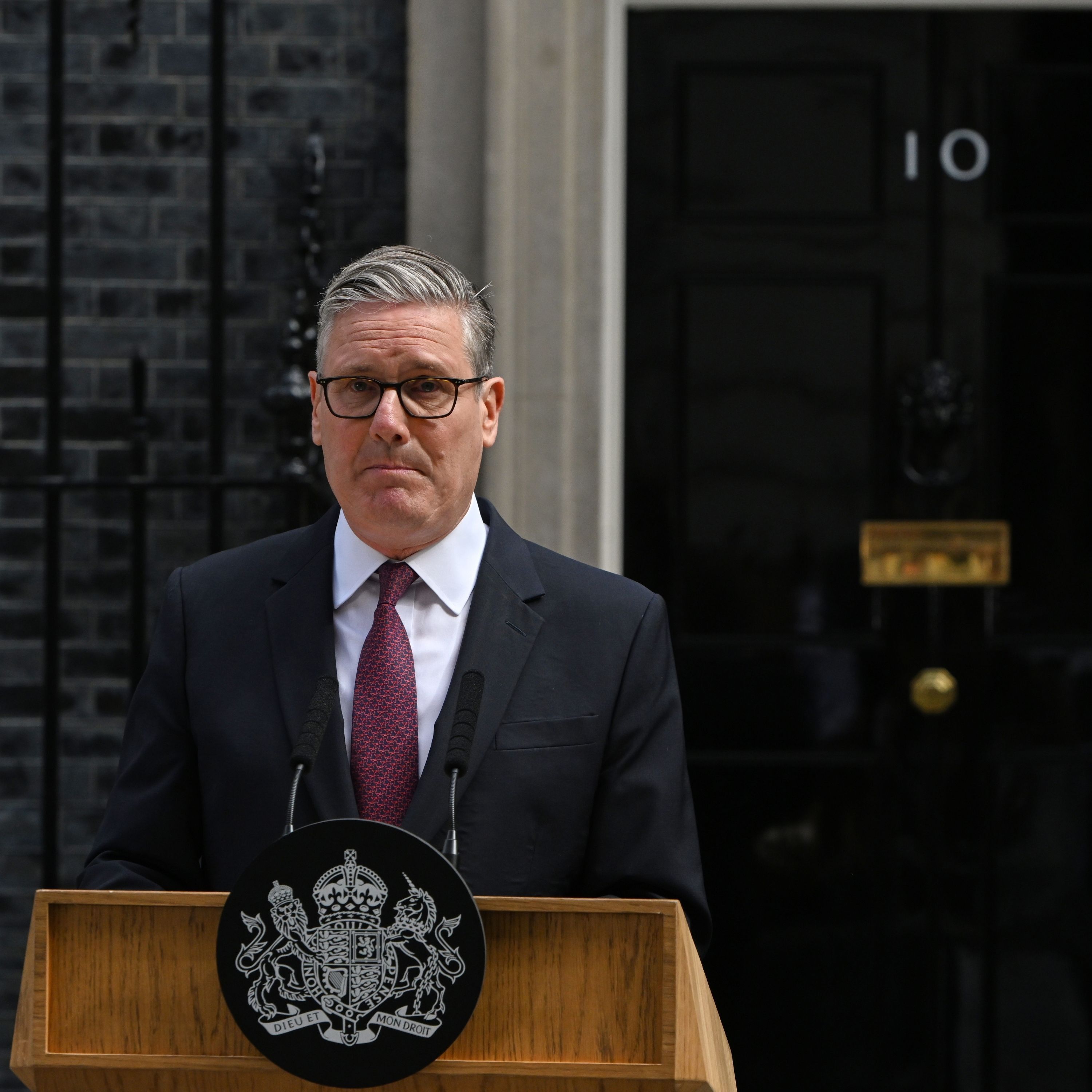
My mistake. That appears to be Vice President J.D. vance and his wife, Usha Vance. They have apparently been married for 12 years. On today's show, we talk about the resignation of British Prime Minister Keir Starmer in the wild world of British politics with pod Save the UK's Nish Kumar. Before we get into all that, here's what we're following today. Tuesday, June 23rd, the Iranians are saying
- [01:14]
Nish Kumar
there's no scheduled visit for the IAE inspectors.
- [01:17]
Jane Coston
Is that part of your agreement?
- [01:19]
Nish Kumar
They're wrong.
- [01:20]
Jane Coston
No, they're wrong. They know they're wrong. They told us inside, and we haven't done 100% inspection.
- [01:27]
Nish Kumar
And if they were right, I'd cancel the meetings right now.
- [01:30]
Jane Coston
President Donald Trump told reporters in Pennsylvania today that nuclear inspectors would be on the ground in Iran, quote, at the appropriate time, even though there's, quote, no rush. But there seem to be some conflicting claims over whether or not Iran is welcoming UN inspections of its nuclear sites. Vice President J.D. vance said Monday that Iran had agreed to let International Atomic Energy Agency inspectors back into the country. A spokesperson for Iran's Foreign Ministry, however, told reporters that no visits were scheduled for the UN watchdog to examine Iranian nuclear sites bombed by the US last year. The IAEA has not responded to the AP's request for comment over its possible role.
- [02:12]
Nish Kumar
Trump has turned the art of the deal into the art of the blunder.
- [02:16]
Jane Coston
You can say that again, Chuck Schumer. And the blunder isn't even over. The Pentagon has told senators it needs roughly $80 billion, mostly to cover the cost of Trump's war against Iran. FYI, Trump is already pushing for a rather large military spending boost. Earlier this year, the White House requested $1.5 trillion for the Pentagon. That's a nearly 50% increase over the current fiscal year's funding levels. There is no formal request out to Congress just yet. But Defense Secretary Pete Higseth was making the rounds on Capitol Hill Monday. And according to anonymous sources who spoke to the ap, a top deputy defense secretary told senators about the Iran funding request last week. So how's this all going over on the Hill? Well, House Minority Leader Hakeem Jeffrey certainly doesn't seem too happy about the request to pay for, quote, Operation Epic Failure in Iran. His message to Hegseth get lost. You know what else is getting lost? The name Donald, at least for newborns. According to Notice, the baby name Donald hit its lowest point of popularity in US history in 2025. Notice reviewed data maintained by the Social Security Administration. It says the agency received fewer than 400 Social Security card applications for wittle baby Donald's last year, thus making the name Donald Drum roll, please. The nation's 690th most popular baby name. This is tough news for Donald Glover and Donald Duck. And of course, we're following primary elections in Maryland, New York, South South Carolina and Utah today. Here's a brief. In Maryland, all eight of the state's congressional districts are holding contested primaries and Governor Wes Moore seeks the Democratic nomination for a second term. In New York, several Democrats are vying for the party nomination in District 12. No, not like the Hunger Games, including Trump critic George Conway. Yes, as in Kellyanne's ex husband and Kennedy family scion Jack Schlossberg. In South Carolina, Lieutenant Governor Pamela Yvette and state Attorney General Allen Wilson are in a runoff for the Republican nomination for governor. Trump has endorsed both of them. And in Utah, voters will nominate congressional candidates using a new map that created a Democratic friendly district in Salt Lake City. And that's the news. Let's talk about the United kingdom. It's been 10 years since the UK voted to leave the European Union, a decision with major political implications that most of the country regrets. Since then, neither the Labour Party nor the Conservative Party have been able to keep a leader in power. As we mentioned on the show yesterday, Prime Minister Keir Starmert resigned his post, becoming the sixth prime minister to quit in the last 10 years. For comparison's sake, the UK had just two prime ministers between 1990 and 2007. Remember Tony Blair? Brexit also exacerbated the country's economic woes, which have been brewing since 2007. Now its per capita GDP is just above the state of Mississippi. No disrespect to the Magnolia State, but that's not good. So what's going on in the UK and who's up next for Prime Minister. To find out, I spoke to Nish Kumar. He's the co host of Crooked Media's Pod. Save the uk. Nish, welcome to what a Day.
- [05:34]
Nish Kumar
Thank you very much for having me. It's a pleasure to see you. As always, when I'm summoned to be on other podcasts from the wider crooked family, it's never because my country has done something good. I'm never summoned by you or Ben Rhodes or Tommy Vitor because Britain has been excelling itself.
- [05:53]
Jane Coston
I wish we were bringing you on to ask why is the UK doing so great? But actually we're here to talk about UK politics. So Keir Starmer has had pressure on him to resign for months. What was the final straw that made him actually do it?
- [06:13]
Nish Kumar
Well, for the last sort of six months, everybody has been saying there was a set of local by elections, which are our equivalents of special elections that happened about a month and a half ago. And everybody for the last six months had been saying in the lead up, that will be a referendum on Starmer's leadership and. And he won't survive if the results are bad. The results were bad. And so that's now kind of started this sort of chain reaction that's led us to this point. There's also this kind of strange other element to all of this, which is there was no candidate from within the parliamentary Labour Party that was considered popular enough to actually take the job from Keir Starmer. And so we've been waiting for the man who was, until last week, the mayor of the city of Manchester, Andy Burnham, to leave that position. And then he, he was actually a special election was called because the MP in a constituency called Makerfield in the northwest of England stepped down specifically to allow Andy Burnham to run. And so the part of the reason that the Labour Party has let it go this long is that we've been waiting for Andy Burnham to actually be an MP so that he could run for leader of the Labour Party. So the question actually is more how has Keir Starmer survived to this point because of his kind of historic levels of unpopularity.
- [07:42]
Jane Coston
We'll get back to my conversation with Nish Kumar in a moment because there's a lot more British chaos to unpack. But if you like the show, make sure to subscribe, leave a 5 star review on Spotify and Apple podcasts, watch us on YouTube and share with your friends. More to come after some ads. What a day is brought to you by Smart Credit. Here's something most people aren't told about their credit score. It's not just about whether you pay your credit cards, it's when you pay them. Yeah, most people don't realize that, but Smart Credit's data experts understand how credit bureaus operate. So they created something called the Best Pay Down Date, built around how credit reporting actually works. So instead of guessing, you get a personalized strategy that shows you what to do and when to do it to help you maximize your score. And that matters because better credit can mean lower payments and more money in your pocket. And this is where it gets interesting. You can see your full credit picture in one place. Your score, what's affecting it. And if something needs attention, you can take care of it right there. So before you apply for anything, a car, apartment, refinance, it makes sense to start with SmartCredit. Go to smartcredit.com wad and try it for just $1. You might be surprised to see how many points Smart Credit estimates you can gain. That's smartcredit.com wade results vary. Cancel anytime what a Day is brought to you by Oneskin. You've probably heard me talk about Oneskin before. And whether you're someone who tries every new skincare product that hits the market or you've been using the same one or two things for years, at some point most of us realize our skin just isn't keeping up the way it used to. That's what Oneskin changed for me. It didn't just make my existing routine better. It actually works differently than anything else I've tried. As we age, some skin cells stop functioning the way they should. Longevity scientists call them zombie cells. And that's what's actually driving those visible signs of aging. The fine lines, the loss of firmness, the dullness that creeps in over time. And Wonskin's OS1 peptide was specifically engineered to address those. So you're getting everything you expect from great skincare with OS1 doing something most skincare was never built to do. If you're not already using sunscreen daily, Oneskin's Face SPF is the best place to start. It's got those same skincare benefits from the OS1 peptide while also giving you mineral SPF protection from UV exposure, which is a major factor in making us look older, faster. So with this, you're protecting against future UV damage while reversing the visible effects of past summers full of sun. That's been a game changer for me. And this isn't just my experience. One Skin's results are backed by four peer reviewed clinical studies over 10,000 five star reviews and they've been recognized by Bloomberg as a leader in skin longevity. You really don't need a complicated routine to get healthier, younger looking skin. Born from over a decade of longevity research, OneSkin's OS1 peptide is proven to target the visible signs of aging, helping you unlock your healthiest skin now and as you age. For a limited time, try one skin with 15% off using code WAD@OnSkinCo. Wade that's 15% off OnSkinCo with code Watt. After you purchase, they'll ask you where you heard about them. Please support our show and tell them
- [10:51]
Guest or Narrator
we sent you one Crunchy bite of a Hershey's Cookies and Cream bar and I'm taken right back to college Move in day I was a little overwhelmed by the newness of it all. Boxes were everywhere. I needed a break from unpacking. But just as I was able to take a breath and open my Hershey's Cookies and Cream bar, my new roommate Rachel walked in. I offered her a piece but she said no. Then after a beat she said, actually those are my favorite ones. We left, the ice was broken and we've been friends ever since.
- [11:21]
Jane Coston
Hershey's it's your happy place.
- [11:25]
Nish Kumar
Celebrate America's 250th with Dish. For a limited time, get an extra $250 off when you sign up. Call 888Add Dish or visit dish.com today and use use code DISH250 to claim your $250 savings. That's 888Add Dish. Offer ends August 12th. Terms apply.
- [11:54]
Jane Coston
Let's get back to my conversation with Nish Kumar. Starmer is the sixth prime minister to resign in 10 years, and that includes prime ministers from both the Labour Party and the Conservative Party, the two main political parties in the uk. Starmer came in as a result of a landslide election that got rid of the previous Prime Minister, Rishi Sunak, and now Starmer is exiting with like negative 42 popularity. What is going on? What is happening?
- [12:26]
Nish Kumar
It's kind of the Listen, that is kind of the perfect question for context. I'm 40 years old and in the first 30 years of my life there were four five prime ministers of the United Kingdom and we've had six in the last 10. So over 50% of the prime ministers of my entire life have served in the last 10 years. So it is obviously a historic decade of flux. Now a lot of the articles that are coming out of the sort of UK media at the moment are focused on this idea that Britain may well be fundamentally ungovernable, that the electorate wants too much, that because of social media it accelerated our tribalism and also decreased our patience for politicians and political parties. Also there is this kind of global reaction against a malfunctioning economic system. Globally we're seeing a reaction against capitalism because it's an economic system that is no longer delivering for the majority of citizens in countries like mine or in countries like yours. So there is this kind of discontent brewing and that discontent is either being channeled by leftist either political parties or fragments of major political parties or hard right parties into anti immigrant sentiment. So there are all these factors and I'm not disputing any of the articles that are being written, but I do think it is worth considering that there are specific contexts for each of the six people that have gone out of power. So the first two of those six, David Cameron, he was the Prime Minister who called the Brexit referendum so he had to step down when the side that he was leading lost that referendum. Theresa May was a person who'd campaigned for us to remain in the European Union. She then became Prime Minister and was immediately declared illegitimate by the people that had campaigned for Brexit. So that's two Prime Ministers that are basically taken out by Brexit. Boris Johnson then won a massive landslide in 2019 and there were articles being written at the time that we were looking at a decade of him as Prime Minister. Now obviously the pandemic happens, that complicates his plans. And so he was having parties during the pandemic and breaking his own Covid rules. So his collapse isn't really a systemic issue per se, it's really to do with his personal failings. Then the person that replaced Johnson, Liz Truss, was, I mean, I don't know how else to say this, a, I don't know, a weapons grade lunatic, you know, like an absolute she who, who tried to pass a load of budget reforms that had not been costed and would have been a kind of total collapse of our tax revenues. And because of that, the bond markets in this country became very spooked and it wiped so much value off people's pensions, it did huge amounts of dam the economy. So again, not really a systemic thing with her. It's kind of deeply personal flaws for Johnson and Truss that then brings Rishi Sunak into power. So again this, this is just the Conservative Party bringing in new leaders. Sunak comes to power and by this point the whole country has had 14 years of conservative rule they are sick of the party, they're going to vote them out. I don't believe that there is a single candidate within the Conservative Party that could have won the 2024 election because of the position that they were in. So again, not really anything specifically to do with Sunak. Now I will say these are all people for whom I have deep personal contempt. Right. But you can't just portray their failure as a specific kind of systemic flaw or flaw of the electorate. There are specific factors at work for all of these Prime Ministers that mean they didn't succeed.
- [15:54]
Jane Coston
So you mentioned, you mentioned Brexit, which pushed out two prime ministers. Today, June 23 is the 10th anniversary of Brexit, the day the UK voted to leave the European Union. How does that decision fit into the political turmoil we've seen since?
- [16:11]
Nish Kumar
Yeah, I think, and it's interesting, I love, it's why, you know, I like getting American perspectives and basically non British perspectives on what Britain looks like. Because if you actually hear and following the news, there's been a lot of articles because of the 10th anniversary about Brexit. But actually there hasn't been a lot of rhetoric coming out of our political leaders about Brexit. And I can imagine for people who've been following UK news for the last 10 years, it can feel quite disorientating that nobody really wants to talk about it anymore. Even Nigel Farage, who's still leading some polls in terms of who's going to be the next Prime Minister of the uk, a man whose whole political career was based on agitating for and campaigning for Brexit. He doesn't really talk about it anymore because I think the reality is that it has been a disaster for the United Kingdom. It's increased the cost of our grocery shopping, it's wiped percentage points off our gdp, which obviously then has a knock on effect in terms of our tax revenue. It also created years of stasis. Really 2016-2020 was a near half decade of total legislative gridlock in the United Kingdom as all of the major political parties squabbled about how to execute Brexit. And so there is that sort legislative inertia that cost us really half a decade of progress. Also there is this kind of, there was, there was just a legitimization of racist and xenophobic rhetoric that happened around the campaign. So there's the economic damage, but also there's the kind of societal damage and there, there is the legitimization of this us and them dynamic that exists between the white working Class and immigrants and immigrant communities and communities of color, which, again, our relationship with the European Union was quite a technocratic thing. It's a series of complex, interlocking trading arrangements. But the nature of the campaign and the way that it was fought has had much more scarring on our kind of social fabric than maybe you would assume, based on the fact that, as I say, it was a bunch of trade agreements, essentially.
- [18:25]
Jane Coston
Yeah. And I totally understand and agree about the way the rhetoric has been playing in, like, you know, and you're not getting any help from us or Elon Musk or anybody else, but. So Starmer has said he'll step down as soon as his party, the Labor Party, elects a new leader. You've mentioned the party has essentially cleared the way for the former mayor of Manchester, Andy Burnham. Why. Why is he popular right now?
- [18:50]
Nish Kumar
So he. Andy Burnham. I'm sorry, I'm only laughing because it's a sort of incredulity of the tone of all of these questions. And all of the questions are essentially, what, why? How? Which is genuinely, like, you're really articulating how a lot of people are feeling in the United Kingdom right now. Like, it's kind of perfect. Andy Burnham was a Labour MP for many years, and he's actually tried to run for leader of the Labour Party before. When the most recent attempt in 2015 was unsuccessful, he decided to step down as an MP and become the mayor of. Of Manchester. And he. He has been the mayor of Manchester until a couple of weeks ago, when he stepped down to take a seat in the House of Commons. The thing about Andy Burnham is that everybody has been able to project their version of politics onto him. So if you're a kind of centrist member of the Labour Party, you can point to the fact that he originally came into Parliament as part of Tony Blair's government. He works under Blair and Brown. And if you're maybe more to the left of the Labour Party, you might point to some actions while he was mayor in Manchester. He took all the operations of the bus system in that city back into public ownership. The. The really interesting thing is that during the COVID pandemic, he basically pushed back quite heavily against Boris Johnson's government. And he was giving these press conferences where he was essentially prosecuting the government's handling of the COVID crisis.
- [20:21]
Guest or Narrator
And.
- [20:21]
Nish Kumar
And it played very, very well. And it kind of reimagined his public Persona from somebody who, on a national level, was, you know, a kind of solid mp, had sort of tried to run for leader it hadn't really worked out for him then when he became mayor of Manchester. He was incredibly popular in Manchester, but the COVID pandemic is what made him into a UK wide political celebrity. And his approval ratings are now the highest of, I think, any politician in the United Kingdom right now. Certainly they're the highest of anyone within the Labour Party. Now the question is, what does Andy Burnham stand for? That's the really, really important question that I don't believe anyone adequately has an answer for at the moment.
- [21:05]
Jane Coston
Nish, thank you so much for joining me.
- [21:09]
Nish Kumar
My pleasure. I hope the next time it will be to discuss England winning the World cup and not any more examples of us shit in the bed.
- [21:18]
Jane Coston
Me too. That was my conversation with Nish Kumar, co host of Pod Save the UK before we go curious to hear more about UK politics, check out Pod Save the uk. It's a no bullshit, progressive conversation focused on the issues that matter most to Great Britain. It's also funny and in the words of the listeners, informed, accessible and irreverent, but not stupid. Sounds pretty good, right? See what all the fuss is about and tune into Pod Save the UK every Thursday wherever you get your podcasts. That's all for today. If you like the show, make sure you subscribe, leave a review, meet the loudest person on earth, and tell your friends to listen. And if you're into reading and not just about how the Guinness World Records honored an honorary town crier from Melbourne, Australia whose shout can reach 122 decibels. Like me, what areday is also a nightly newsletter. Check it out and subscribe@crooked.com subscribe I'm Jane Costen and we won't be playing a clip for you because 122 decibels is the same volume as a chainsaw. Or, I'd assume, whatever sound Elon Musk makes when he finds out a woman doesn't want to have children. What a Day is a production of Crooked Media. Our show is produced by Caitlin Plummer, Emily4, Erica Morrison, and Adrienne Hill. Our team includes Hailey Jones, Greg Walters, Matt Berg, Joseph Dutra, Johanna Case, and Desmond Taylor. Our music is by Kyle Murdoch and Jordan Kanter. We had help today from the Associated Press. Our production staff is proudly unionized with the Writers Guild of America East.