← What A Day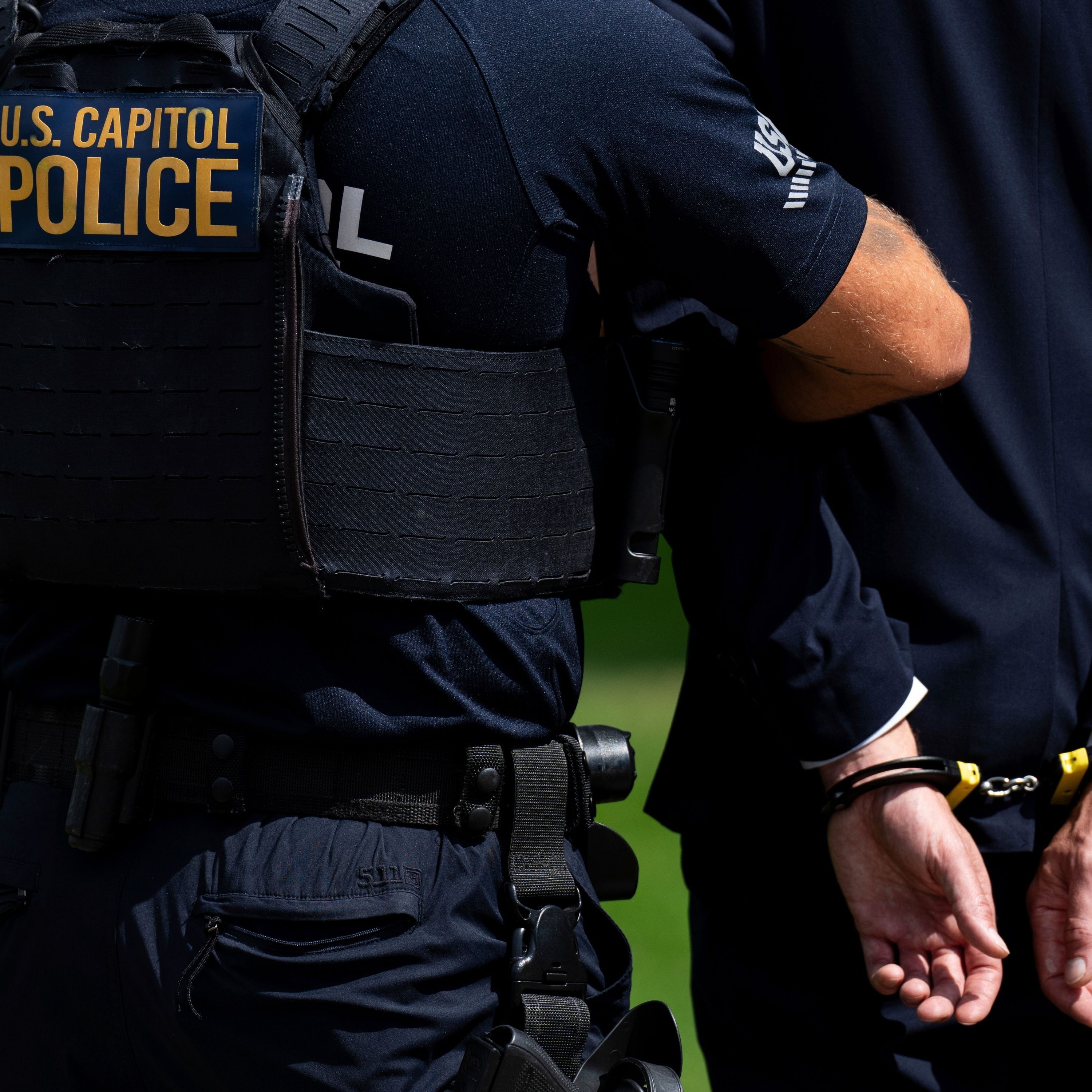
What A Day
What Did Trump’s DC Police Takeover Accomplish?
00:20:42
Memphis, Tennessee, is the latest city in President Donald Trump's Crime Takeover-A-Go-Go. On Monday, Trump signed a presidential memorandum establishing a "Memphis Safe Task Force" and announced that he would send the National Guard to the city.During a press conference detailing the decision, Trump said that he wanted to accomplish in Memphis – and everywhere else – what federal authorities did in Washington, D.C. But the question is…what exactly did the administration accomplish in D.C.? We asked Emma Uber, a reporter covering crime and criminal justice for the Washington Post. And in headlines, the suspect in Charlie Kirk's killing reportedly confessed to the murder in a Discord group chat, according to the Washington Post, Secretary of State Marco Rubio heads to Qatar, and a longtime federal prosecutor — who happens to be James Comey's daughter — sues the Trump administration over her firing.
Loading summary
Transcript45 lines
- [00:03]
Jane Coaston
It's Tuesday, September 16th. I'm Jane Coasten and this is what a day. The show reminding you as it learns of the discovery of the FJ King, a ship that sank in Lake Michigan nearly 140 years ago. Leave ghost ships alone. They are full of the disembodied spirits of the watery damned. We all know this. On today's show, the suspect and Charlie Kurtz assassination reportedly confessed to the murder in a Discord Group chat, according to the Washington Post. And Secretary of State Marco Rubio is in Qatar on the heels of a visit with Israeli Prime Minister Benjamin Netanyahu. But let's start with Memphis, Tennessee, the latest city in President Donald Trump's crime takeover. A go go. On Monday, Trump signed a presidential memorandum establishing a Memphis Safe task force and announced that he would be sending the National Guard to the city. He sure does love taking over states National Guards. During a press conference detailing the decision, Trump said that he wanted to accomplish in Memphis and everywhere else what federal authorities had in Washington, D.C. because he had solved all crime.
- [01:12]
Guest or Commentator
The crime has almost disappeared, maybe completely disappeared. I mean, Washington, they don't even know how to record it because it's down so much. You know, they've never heard. I heard 87% is down. I said, really? Who are the 13%? Because it's more than that. It's actually more hard to believe. Right.
- [01:30]
Jane Coaston
But the question is, what exactly did the Trump administration accomplish in D.C. because, well, yeah, Trump believes that he basically eliminated all crime in the city and everything's perfect. If you're anything like me, especially if you know a lot of people who live in dc, and even more especially if you live there, that's probably not how you experienced Trump's incursion in the nation's capital. The Washington Post looked into more than a thousand arrests that took place during the first four weeks of Trump's supposed D.C. crackdown, including nearly 500 that involved federal officers. And what they found was both surprising and to me, concerning. So to discuss the Post's reporting and what journalists learned about the federalization of DC's Metropolitan Police, I spoke to Emma Uber. She's a reporter covering crime and criminal justice for the Washington Post. Emma Uber, welcome to what a day. Thanks.
- [02:20]
Emma Uber
Thanks for having me.
- [02:21]
Jane Coaston
So just to give us some context, where are we with the federalization of the police in D.C. right now? Like, what's going on with that?
- [02:29]
Emma Uber
Well, that's a good question. I mean, as you know, the 30 day emergency that President Donald Trump declared on August 11th has ended, though he did fire off a late night Truth social post, threatening to, you know, potentially extend it even further because he's not happy that Mayor Bowser and D.C. police are seeking an end to immigration enforcement by city police. But there's still lots of law enforcement, federal law enforcement, out on the streets in D.C. just today when I got off the Metro to come to work, I saw some members of the National Guard standing alongside some members of the D.C. police Force. So even though that crime emergency has ended, there is a lot of federal law enforcement still in the District.
- [03:12]
Jane Coaston
So I'm going to ask you two questions back to back, because I was so interested in your reporting because I think that this is really important. So first, what has the Trump administration claimed it accomplished by federalizing the D.C. police, sending in federal officers and deploying National Guard troops?
- [03:28]
Emma Uber
Yeah, so the Trump administration has claimed that they have essentially eliminated crime in the District. And that is not true. There are still crimes. However, there has been a significant reduction of crime and violent crime in the District. So I believe.
- [03:46]
Jane Coaston
Yeah. I'm curious as to what you found in your reporting as to what actually happened. Can we break out out crime and violent crime? Like, what are we looking at? Did any types of crime go up? Like what. What are we seeing?
- [03:58]
Emma Uber
Yeah, crime in general is down. We didn't see much crime go up. And so crime across homicides, carjackings, and also minor crimes are. Are down. But we did see that a lot of the arrests made by federal law enforcement officers were more what you would characterize as minor crime. They're not really participating as much in the investigation of homicides or things of that nature. So some of our findings were that, you know, about 1 in 7 of the cases that specifically mentioned federal law enforcement as being involved in the arrest dealt with open containers of alcohol in cars or parks or curbside. Now, some of those escalated and those people ended up being charged with bigger crimes. Some of them stayed just minor open container.
- [04:43]
Jane Coaston
Yeah. You mentioned that about a third of the arrests you examined involved federal law enforcement, and you mentioned that in the piece. Yes. How did their activities differ from run of the mill policing before the administration sent in federal law enforcement?
- [04:59]
Emma Uber
So that's something that we actually set out to kind of examine. And what we learned is that it's not very different. Chief of Police Pamela Smith and Mayor Bowser have said that they've kind of been using federal law enforcement as just kind of force multipliers for D.C. police. We weren't sure if that was true, but a lot of this policing is Stuff that MPD was already doing. Many of the arrest affidavits even note, if they're written by a federal police officer, that the reason they were in that area was because D.C. police had told them that that area was a place that it would be useful for them to monitor. So there's that piece of it. A lot of the stops have been for really minor infractions. And so if there was a difference, I would say federal officers are maybe stopping people a bit more frequently for minor things, but they're in a lot of the same places making a lot of the same stops that D.C. police would be doing if they had more officers.
- [05:56]
Jane Coaston
I mean, let's talk about where these arrests took place. I mean, we'd seen pictures of the National Guard at union station in D.C. and on the National Mall, very high visibility places. And I was struck by how there was some reporting from folks living in Anacostia or other neighborhoods east of the river or in Trinidad or Noma that they weren't seeing anything. They were not seeing National Guard, they weren't seeing anybody doing anything. So what did your reporting show about where these arrests were taking place?
- [06:29]
Emma Uber
Yeah, we did not find that to be true. That is also a claim that we had heard echoed. And I think anecdotally, that's what a lot of people were saying is that these people were not going where the crime is. We found that the most arrests by federal law enforcement officers are being made in the highest crime areas of dc. Even in our piece, we have a map overlaid with the arrests that happened prior to the federal law enforcement. And they look really, they look really similar. So there was a strong federal law enforcement presence in high crime areas in D.C. and that was a finding that we thought was significant to include because to your point, that's not what much of the conversation has been surrounding federal law enforcement thus far.
- [07:09]
Jane Coaston
And your team noted during this timeframe, officers arrested many young black men. How did the arrest demographics for D.C. during this time frame compare to long term averages?
- [07:19]
Emma Uber
They look very similar. We noticed, you know, when going through our reporting that these are overwhelmingly young black men. Our numbers do not include juvenile arrests, so we're not sure how many juveniles were included, but overwhelmingly young black men. But then we kind of zoomed out and that seems to be looking at last year's data from D.C. police. It was also overwhelmingly young black men.
- [07:42]
Jane Coaston
Let's talk about how the day to day workings of the criminal justice system changed. While the feds were most active, you mentioned seeing a lot of so called pretext stops. What is a pretext stop? And why does it matter that D.C. saw more of them?
- [07:57]
Emma Uber
A pretext stop is when a law enforcement officer makes a stop for something minor. One example would be like tinted windows or. Or an expired license plate on a car. But they use that minor stop as an excuse to search for something more serious. So we saw a lot of stops for minor infractions that then resulted in seizures of guns or drugs. And that matters because it's a very controversial policing practice. It is legal. The Supreme Court has upheld that. It is a legal thing to do, but it leaves a lot of discretion on the officer's behalf. And a lot of studies have found that pretext stops can allow racial profiling or officers to kind of search people that they don't have a great reason to search. They just find them kind of off or fishy.
- [08:47]
Jane Coaston
Right.
- [08:47]
Emma Uber
And so that was a big conversation. And we talked to retired police officers and academics, some of which really disavowed them because of the potential of racial profiling and others who defended them as one of the strongest tools that officers can use to get guns, drugs, and other illegal substances off the streets before they're investigating more serious crime.
- [09:09]
Jane Coaston
There's been a ton of reporting talking about how the D.C. criminal justice system has been in trouble for a bunch of different reasons, like a lack of judges, the fact that you don't have a forensics facility that was certified until, I think, very recently. So what impact do you think that all of this is going to have on DC's criminal justice system moving forward?
- [09:29]
Emma Uber
Yeah, it's hard to say because this is pretty unprecedented, but the justice system right now certainly feels a little overburdened. One impact that's already happening is that courtroom C10, where all the arraignments happen, they've been going well, well past 5pm every day. I know that's something that we're monitoring, so it'll be interesting to see how it plays out. But the criminal justice system in D.C. is quite busy right now, and we're also looking at some overhaul of the DC criminal justice from Congress based on some of the bills being heard this week. So it's difficult to say exactly how it's gonna play out, but we're certainly at what I think is a pivotal moment for D.C. criminal justice.
- [10:09]
Jane Coaston
Emma Uber, thank you so much again for joining me.
- [10:11]
Emma Uber
Thank you for having me. It was a pleasure.
- [10:14]
Jane Coaston
That was my conversation with Emma Uber, a crime and criminal justice reporter for the Washington Post. We'll link to her work in the show Notes. We'll get to more of the news in a moment, but if you like the show, make sure to subscribe. Leave a five star review on Apple Podcasts, watch us on YouTube and share with your friends. More to come after some ads Whataday is brought to you by bookshop.org where you shop for Books Matters. When you purchase from bookshop.org you're supporting more than 2,400 local independent bookstores across the country, ensuring they'll continue to foster culture, curiosity and a love of reading for generations to come. And Big Bookshop.org has an ebook app now you can support local independent bookstores even when you read digitally. Use Code WAD to get 10% off your next order at bookshop.org that's code.
- [11:12]
Kleenex Ad Voice
WAD@bookshop.org When a cold has you down, it's the little comforts that lift you up. A warm blanket, a cup of tea and a tissue that actually feels good on your skin. Infused with aloe Kleenex Cooling plus Aloe provides a hint of cooling freshness to help your skin feel restored. So whether your skin is feeling dry, chafed or irritated, you're only one wipe away from helping it feel relieved. The next time you have a cold, get a hint of instant cooling relief with new Kleenex Cooling plus Aloe for whatever happens next, grab Kleenex at Maurices. We're all about great jeans. You know, the ones that fit you just right. The ones that go from work days to weekends and everywhere in between. The ones that simply make you feel good because you don't just just wear jeans, you live in them. With 25 sizes, five lengths and six denim brands, you've got options and fit experts in every store. To make jean shopping easier, find great jeans starting at $29.90 in stores and@marisa.com.
- [12:16]
Jane Coaston
Here'S what else we're following today. Head of Lines.
- [12:22]
Guest or Commentator
By the way, when I say that, that's my opinion, I think he was radicalized online based on what they're saying.
- [12:29]
Jane Coaston
Helpful President Trump addressed reporters in the Oval Office on Monday following a new report from the Washington post that the 22 year old suspect in Charlie Kirk's killing made an apparent confession in a group chat on Discord. It was me. According to the Post, the message was allegedly sent just two hours before the suspected shooter was taken into custody, and this conversation reportedly happened after the suspect had joked about his doppelganger being the shooter. In a different Discord chat, as reported by the New York New York Times the new developments come as political tensions are reaching a fever pitch in the aftermath of Kirk's killing. And with everything going on in the country right now, political violence, economic uncertainty, social division, it's comforting to know that Vice President J.D. vance is focused on what's important. Stepping in to host Charlie Kirk's podcast.
- [13:16]
Guest or Political Commentator
We have to talk about this incredibly destructive movement of left wing extremism that has grown up over the last few years. Few years, and I believe is part of the reason why Charlie was killed by an assassin's bullet.
- [13:30]
Jane Coaston
It's worth noting we know very, very little about the suspect's motive or ideology, but that didn't stop Vance from pouring gasoline on the fire during his two hour stint guest hosting Kirk's podcast at the White House. He was joined by a who's who of administration officials and MAGA World A listers including Stephen Miller, Caroline Levitt, Susie Wiles, Tucker Carlson, and Robert F. Kennedy Jr. And in this spirit, Miller, who is famously level headed and well adjusted, had this to say about so called left wing extremism.
- [13:59]
Guest or Political Commentator
The organized doxing campaigns, the organized riots, the organized street violence, the organized campaigns of dehumanization, vilification, posting people's addresses, combining that with messaging that's designed to trigger incite violence and the actual organized cells that carry out and facilitate the violence. It is a vast domestic violence, terror movement.
- [14:18]
Jane Coaston
Again, we know very, very little about what motivated the suspect. But I can't help but wonder if Miller feels as strongly about those on the right doxxing people for allegedly celebrating Kirk's murder or just quoting him. Does that also amount to domestic terrorism?
- [14:37]
Guest or Political Commentator
Your presence here in Israel today is a clear message that America stands with Israel. You stand with us in the face.
- [14:46]
Jane Coaston
Of terror, in the face of the.
- [14:48]
Guest or Commentator
Incredible, I would almost say Middle Age lies, Middle Ages lies that are directed against us.
- [14:55]
Jane Coaston
Israeli Prime Minister Benjamin Netanyahu and US Secretary of State Marco Rubio showed a unified front during a press conference in Jerusalem Monday. Unified despite the fact that Israel has been condemned by many countries for attacking Hamas leaders in Kutcher, a U.S. ally. And by the way, Trump said he wasn't thrilled about the strike either. Reminder. Qatar has been mediating talks to end the Israel Hamas war. Netanyahu said Israel's decision to strike Hamas leaders was, quote, wholly independent. Rubio added, he's focused on what happens now.
- [15:26]
Guest or Political Commentator
What role can Qatar play possibly in reaching an outcome here that leads not just to the end of this hostilities, not just to the release of all of the hostages, both living and deceased, not just the disarmament and elimination of Hamas, but also a better future for the people of Gaza, which isn't possible as long as Hamas exists.
- [15:45]
Jane Coaston
The State Department says Rubio will pay a quick visit to Qatar today. Rubio will then fly to London to join his dear leader, President Trump, on a state visit to Britain. Maureen Comey, a longtime prosecutor in the Manhattan U.S. attorney's office and the daughter of a certain former FBI director who you may have heard of, is hitting back at the Trump administration, firing her. She filed a lawsuit on Monday saying she was let go without warning or explanation. Comey worked at the Prosecutor's office for 10 years and commanded respect among colleagues. She led the trial of Sean Diddy Combs, and she handled the prosecutions of Jeffrey Epstein and Ghislaine Maxwell. And as one of the few people left at DOJ with deep knowledge of those cases. And the timing is, well, interesting since Trump's orbit is lighting itself on fire over his administration's handling of the Epstein files. So why give her the boot? Well, apparently nothing on her resume matters as much as who her father, James Comey, a Trump foe of nearly a decade. Her lawsuit hits this hard, claiming defendants fired Ms. Comey solely or substantially because her father is former FBI Director James B. Comey, or because of her perceived political affiliation and beliefs, or both. The suit also notes that Maureen had a target on her back from none other than Internet troll and Trump whisperer Laura Loomer. And she says that even her boss, Jay Clayton, the U.S. attorney for the Southern District of New York, couldn't come up with a solid reason for her termination. According to the lawsuit, Clayton said, quote, all I can say is it came from Washington. I can't tell you anything else.
- [17:20]
Guest or Commentator
We have a framework for a TikTok deal. The two leaders, President Trump and Party Chair Xi, will speak on Friday to complete the deal. But we do have a framework for a deal with TikTok.
- [17:38]
Jane Coaston
That was Treasury Secretary Scott Besant, a man who could not be more vague about the details of the agreement, made just days before another deadline that could have banned the app in the U.S. besent spoke from Madrid on Monday, where he met with a Chinese delegation to discuss ongoing trade tensions. When asked about the sticking point of who would control TikTok's algorithm moving forward, Besant said he wouldn't talk about terms because it was between two private parties. Which parties? Surprise, he wouldn't say. Also, didn't we ban TikTok already? I mean, in 2024, a rarely united Congress agreed the app was a security threat. Lawmakers wanted it banished from the US that is unless it was sold to a non Chinese buyer. The Supreme Court upheld that ban, but apparently it's not being enforced. And we're old enough to remember when Trump himself wanted to get rid of TikTok back in 2020. Could it be that Trump did a 180 on the app when Jeffrey Yass, a major stakeholder in TikTok's parent company ByteDance, donated millions and millions of dollars to the GOP in 2024 and to Trump's MAGA Inc. Super PAC in 2025? Or could it be when Trump realized that MAGA influencers like Charlie Kirk used TikTok to help him win re election, he addressed one of those things on.
- [18:52]
Guest or Commentator
Monday I use TikTok. I mean I have to admit it in the election and look how I did with you. No Republicans come close. I blew everyone away. You know, if you, if you look back not so long ago, Romney, he got like 7% of the youth. I got like eight times that amount. I got, I got tremendous numbers of youth. By the way, I want to say Charlie helped me and Charlie was the one get on Tik Tok. He used to say to me, get.
- [19:20]
Jane Coaston
On Tik Tok, making the subtext text. That's our president and that's the news. Before we head out, we need your help. We're doing something wild, radical even. We're asking you, loyal listener, what you want out of Crooked's Friend of the Pod subscription. Do you want more exclusive content? Better merch, fewer emails? More ad free shows? This is your chance to tell us everything. What you love, what you hate, what you pretend to love, but secretly don't. Take the survey now@crooked.com survey. That's all for today. If you like the show, make sure you subscribe, leave a review. Contemplate the sheer chutzpah of famous filmmaker and person of controversy, Woody Allen deciding that what the world needs now were his thoughts on how Jeffrey Epstein, quote, couldn't have been nicer. And tell your friends to listen. And if you're into reading, not just about how Allen told the Sunday Times that he met Epstein just after the convicted sex offender was released from jail after serving a sentence for soliciting a minor for prostitution and thought he was just a nice guy like me. What a Day is also a nightly newsletter. Check it out and subscribe@cricket.com subscribe I'm Jane Coastin and honestly, this is pretty much exactly what I think Woody Allen would say about Jeffrey Epstein What a Day is a production of Crooked Media. It's recorded and mixed by Desmond Taylor. Our associate producer is Emily Ford. Our video editor is Joseph Dutra. Our video producer is Johanna Case. We have production help today from Greg Walters, Matt Berg, Megan Larson, Gina Pollack and Jonah Eatman. Our senior producer is Erika Morrison and our senior vice president of news and politics is Adrienne Hill. We had help today from the Associated Press. Our theme music is by Colin Gilliard and Kashaka. Our production staff is proudly unionized with the Writers Guild of America East When.
- [21:44]
Kleenex Ad Voice
A cold has you down, it's the little comforts that lift you up. A warm blanket, a cup of tea, and a tissue that actually feels good on your skin. Infused with aloe Kleenex Cooling plus Aloe provides a hint of cooling freshness to help your skin feel restored. So whether your skin is feeling dry, chafed or irritated, you're only one wipe away from helping it feel relieved. The next time you have a cold, get a hint of instant cooling relief with new Kleenex Cooling plus Aloe for whatever happens next, grab Kleenex.
- [22:15]
DSW Ad Voice
Ah, DSW Earth. Place of the humble. Brag here. The shoes are so good. No one would ever know how little you paid if you didn't go telling everyone that is. And with never ending options for every single style, mood and occasion, all at really great prices, they'll definitely give you something to brag about. So go ahead, stock up on fresh sneakers from your favorite brands or try those boots you always secretly knew you could pull off. Find the shoes that get you at prices that get your budget at DSW stores or@dsw.com Let us surprise you.