← What A Day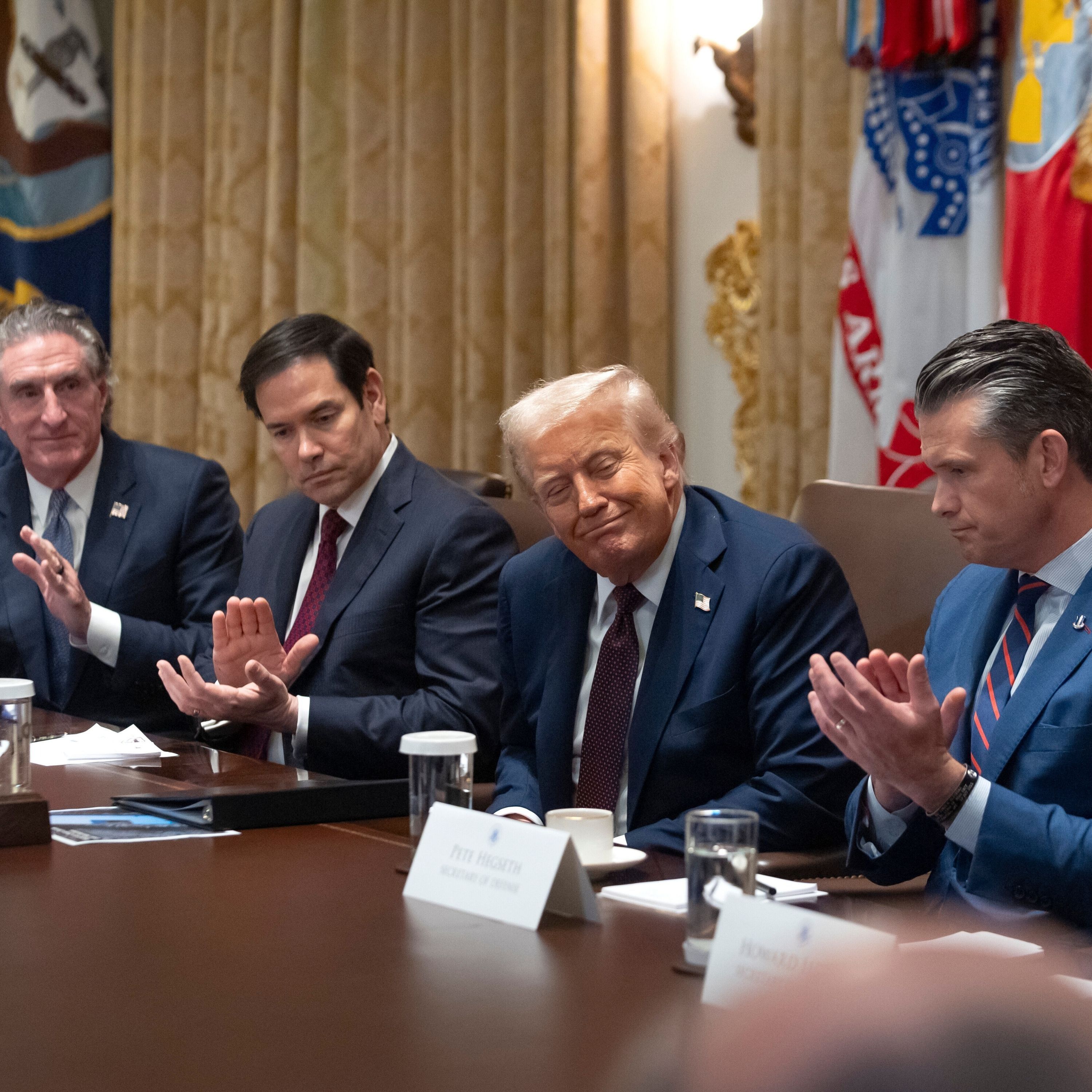
What A Day
Why Conservatism Is Dead In The Trump Era
00:20:06
President Donald Trump’s administration is full of sycophants. That was made quite apparent this week (if it wasn't already) during a three-hour-long televised Cabinet meeting. The lengthy meeting allowed for department secretaries to sing their lord and savior’s praises while the world watched on. The excessive fawning over the dear leader would raise more suspicions if it were taking place literally anywhere else. But it’s happening in the United States. And we are in trouble. We spoke with Bill Kristol, editor at large for The Bulwark, to find out what we can do to meet the challenge of the moment. And in headlines: the Department of Homeland Security now prohibits state agencies and volunteer groups from receiving federal funds if they help undocumented immigrants, an alleged sandwich thrower dodged federal charges, and the Food and Drug Administration approved updated Covid-19 vaccines.
Loading summary
Transcript49 lines
- [00:03]
Jane Coston
It's Thursday, August 28th. I'm Jane Coston and this is what a day. The show sending as much love and support as it can muster for the folks in Minneapolis, Minnesota, forced to reckon with another school shooting. On today's show, the Food and Drug administration approves updated COVID 19 vaccines with some caveats. And the alleged DC sandwich thrower dodges federal charges. But let's start with President Donald Trump and what Trumpism, whatever it is, is doing to us. Trump hosted a three hour long cabinet meeting this week and the entire thing can basically be summed up by the following 36 second montage, courtesy of CNN.
- [00:45]
Bill Kristol
It's an honor to do this job under the President's leadership.
- [00:48]
Donald Trump
You are the single finest candidate since the Nobel Peace this Nobel Award was ever talked about.
- [00:55]
Bill Kristol
Thank you for your leadership, for your.
- [00:56]
Andy Richter
Boldness, for your clarity, for common sense.
- [01:00]
Jane Coston
This is just such a great opportunity, really, to recognize your leadership.
- [01:03]
Bill Kristol
It's pretty great to celebrate Labor Day.
- [01:05]
Jane Coston
With a builder who loves labor. You have saved this country by making.
- [01:10]
KFC Narrator
It the best place in the world.
- [01:12]
Jane Coston
To do business again. You are really the transformational president of the American worker. Along with the American flag and President Roosevelt. I feel the overwhelming desire to wash my hands, but those are our cabinet secretaries at work. It would be obvious if it were another country, wouldn't it? The excessive fawning over the Dear Leader would raise more suspicions if it were taking place in Greece or Colombia or anywhere else. But it's not another country, it's the United States. And we are in trouble with a president musing on an almost weekly basis about how great it would be if he were a dictator despite being very unpopular. So what do we do now? I called up Bill Kristol. He's the editor at large of the Bulwark and someone who worked in Republican politics for decades before Trump came around. We talked about Trump, the gop, and what new coalitions can arise to meet the challenge of the moment. Bill Kristol, welcome to Whataday.
- [02:05]
Bill Kristol
Thanks, Jane. Good to be with you.
- [02:07]
Jane Coston
We are now many months into the Trump administration. Back in 2020, you warned the Republic would be tested by a second Trump administration. And you repeated that last year. Is it worse than you expected?
- [02:19]
Bill Kristol
Somewhat. I mean, I was always alarmed about Trump. People would say, oh, why are you so never Trump? You know, it was just the tweets. I said, actually, I think he'll really do damage to the country. We made it through the first term. I thought, okay, maybe, you know, back to certain kind of normalcy. January 6th, I thought maybe the Republican Party will finally turn on him, but I think it is bad. We're seven months in and a lot of people I think still want to say, well, we've probably seen the worst of it. You know, the Doge thing was kind of crazy and some of this other stuff, but that's not the right way to think about it. The right way to think about it is we're only seven months into a four year term and I'd say the pace of authoritarianism is probably accelerating, not decelerating.
- [02:56]
Jane Coston
Earlier this month you wrote, quote, the dangers to our free political institutions are clear, present and increasing in strength. Now, there's lots of stuff that Trump is pushing on or testing. What's the thing that you are most concerned about?
- [03:10]
Bill Kristol
I mean, I think the authoritarian project has different spokes and they do complement each other. So there's the internal consolidation and personalization of power in the federal government and politicization of everything that's pretty obvious. Doj, dod, dhs, Federal Reserve this week. And that's, you know, we have a big government and a big executive branch. And then if it becomes entirely a tool of the president, the way justice and FBI have, seem to seem to have become, that's very, very dangerous. If you combine that with the intimidation of outside institutions, that is to say, intimidating state governments and city governments, but above all, I'd say intimidating and coraling into your control Universities, law firms, business media, sort of the whole outside side, you might say, of the authoritarian agenda, combining the internal consolidation and personalization and the outside consolidation of power or exertion of power and intimidation is very dangerous. And then finally, I'd say the intimidation of people, let's call it the John Bolton side of things. So there's the Federal Reserve side of things. There's the universities, law firms, business side of things. And then there's the intimidation of critics, opponents using the federal government, the Justice Department to go after them. You put all those together, that's pretty bad.
- [04:27]
Jane Coston
Here's what's bothering me. You wrote accurately that Trump is not very popular and he is likely to become even, even more unpopular. And yet the courts and Congress seem totally fine with Trump wiping away their own spending decisions and even watchdog organizations. Trump is not popular. Why do you think our institutions are acting as if he is?
- [04:53]
Bill Kristol
I mean, that's a very good question and I think somewhat deep one and complicated one. First of all, he's not as unpopular as he could be or should be. And arguably, if he were, at 32% approval instead of 42%, we would see Congress behaving differently, the Republican Party behaving differently. And when we say Congress, we really mean the Republican Party, since it controls Congress and it's the one that's confirming all of his nominees and refusing to challenge any of his policies. Courts are a little more mixed, I've got to say, but they're probably not able to save us ultimately. But in any case, they're not doing as much as they could. Certainly not the Supreme Court. But I would say, I would extend your point to elites in general. I mean, one way of thinking about it, I think the public is actually better at this point than the elites. The degree of elite accommodation, including from liberal, central. Liberal central left elites, is really extraordinary and much greater. I'd say the public is actually put off by a lot of these things. And his numbers have gone down pretty consistently, only gradually, but maybe a point a month, but it's gone from 50 to 42. That's not nothing. I feel like the momentum is the other way with the business elite, with even people who don't like Trump personally. University presidents, some media big shots. We don't have an establishment that's willing to fight Trump. We don't have a center right establishment that's willing to fight Trump. We don't have a center left establishment that's really willing to fight Trump and to take risks in fighting. I would say, though, when you step back, the Republican Party has been key. I mean, if you think of Trump trying to do all the things he's doing as a solo actor without control of the Republican Party, which means, really, the Republican Party in Congress, with losing some of his nominees, getting overruled on tariffs, getting rebuffed when Kennedy tries to stop vaccines and so forth, it would be bad, it would be a mess, you know, but it wouldn't be this. He wouldn't have this ability to just steamroll things the way he's doing now.
- [06:43]
Jane Coston
Yeah, I think that that's something else. You know, Congress has not really stepped in to keep itself powerful, not even to check Trump, but to say, like, hey, we're in Congress, we do things. GOP representatives and senators are basically avoiding meeting their own voters at town halls, and they just cede all authority to Trump. As someone who's been involved in conservative politics for a really long time, does that surprise you? And how do you explain that?
- [07:11]
Bill Kristol
It surprises me some, though. It's been going in that direction for a while. I mean, party loyalty is trumping what was supposed to be the Institutional checks and balances, right? Congress is supposed to stand up to the president, according to Madison and the Founders, partly because they would have a self interest in doing so. It turns out that party loyalty, and especially party loyalty on the Republican side in the age of Trump, Trump's the normal institutional checks, which certainly operated when I got to Washington 40 years ago now. We had huge problems. I was there in the Reagan administration second term at the Education Department, then with Vice President Coyle in the White House. We had huge problems with the Republicans in Congress. They didn't think their first loyalty was to rubber stamp whatever George H.W. bush wanted or whatever Ronald Reagan wanted for whatever his great popularity. I mean, and so hyper partisanship followed by polarization of the country has obviously contributed to the collapse of Congress as a kind of real barrier to Trump. But I come back to the Republican Party. We would have much less of a Congress problem if we didn't have a massive Republican Party problem.
- [08:17]
Jane Coston
I think that you are actually an interesting example of what I'm about to ask, which is that we're in the midst of what I would call a crisis. Trump's second administration is a crisis. It's legally, politically, economically, I would argue also culturally, during a lot of crises, we see new political coalitions form to meet them. And I think that you're an example. I mean, the number of people I have seen who are staunch liberals and leftists who are like that Bill Kristol, he gets it. Are you seeing any other new coalitions coming together that give you any hope?
- [08:47]
Bill Kristol
Well, I think there is this broad pro democracy coalition, pro liberal democracy coalition, pro free society coalition. I don't want to overthink this. I mean, this is pretty simple in a way. The things that I think are being defended by everyone from conservative or maybe ex conservative never droppers all the way over to pretty left wing Democrats. I'm a little frustrated by some of my Democratic friends and I have many more Democratic friends than I used to. The centrists want to relitigate different fights with the left. The leftists want to re litigate different fights with the center. I'm not against that. They should obviously debate issues and go whichever direction they want to go. But you don't really have to resolve that now. We have to, you know, we could. It'll be good to elect Abigail Spanberger here in Virginia, where I live. If the New Yorkers wanted to elect, Mamdani wouldn't have been my first choice or second or third choice. But you know what, it's okay we don't have to have a heart attack about all that. And meanwhile, can we just focus on stopping Trump and not just final point. I've just been obsessed with this the last day or two. Everyone's the 2026 elections, we gotta think hard about that. We have to weaken Trump now.
- [09:49]
Jane Coston
I think my last question for you is that you are someone who, as you mentioned, came to D.C. in the midst of the Reagan administration. And I was thinking that one thing. I mean, sorry to make you feel.
- [10:02]
Bill Kristol
Old, because I'm used to it. You know, half my. Half my colleagues at the Bulwark do it every day, so that's okay.
- [10:08]
Jane Coston
I keep thinking about how for the young MAGA crowd, Ronald Reagan is as ancient to them as it would be during Reagan's era. To keep talking about FDR or to keep talking about Herbert Hoover, you keep seeing people being like, oh, you know, Reagan wouldn't have done this, or this other conservative wouldn't have done this. But, like, this era of Republicans clearly doesn't care. So what does conservatism fight forward for now?
- [10:35]
Bill Kristol
So I think your point about just the time is really key. Literally that Reagan is as far from where we are as FDR was for where things were when I came to Washington. And I've tried to stop actually using the Reagan tropes. I mean, of course, it's legitimate to say we haven't done this. And it's interesting historically to say, how do we get from here to there? Conservatism. I'm not sure conservatism means anything anymore. And I don't really call myself a conservative, partly because I have changed my mind on some things, partly because the point of American conservatism in the Reagan Bush way, in my view, was to defend liberal democracy in a way, to defend liberalism, to correct it and push it in certain directions where it might have gone off the rails. So I do think it sounds like a cliche. We need to have fresh thinking and leave some of these old categories behind. Except what one can say is, at the end of the day, Reagan and Mondale, Bush and Clinton agreed on certain basic things about what America should be and should do. Trump doesn't. And I do think at least an updated version of the, let's call it the Reagan Mondale agreement or the Bush Clinton agreement is far superior to where Trump wants to take the country.
- [11:47]
Jane Coston
Bill Kristol, thank you so much for joining me.
- [11:50]
Bill Kristol
My pleasure, Jane.
- [11:52]
Jane Coston
That was my conversation with Bill Kristol, editor at large of the Bulwark. We'll get to more of the news in a moment, but if you like the show, make sure to subscribe. Leave a five star review on Apple Podcasts, watch us on YouTube and share with your friends. More to come after some ads.
- [12:17]
Donald Trump
What.
- [12:17]
Jane Coston
A day is brought to you by Magic Spoon Magic Spoon makes high protein, zero sugar cereal and treats reinvented from your childhood. So so much nostalgia. Every serving of Magic Spoon High protein cereal has 13 grams of protein, 0 grams of sugar and 4 grams of net carbs. They come in nostalgic flavors like fruity, cocoa and frosted. Magic Spoon's high protein treats are crispy, crunchy, airy and an easy way to get 12 grams of protein on the go. They come in mouthwatering flavors like marshmallow, chocolate, peanut butter and dark chocolate. Both are great on the go pre or post workout or as a midnight snack. Get $5 off your next order at magicspoon.com day or look for Magic Spoon on Amazon or in your nearest grocery store. That's magicspoon.com day for $5 off.
- [13:03]
Nordstrom Rack Announcer
More perks, more value Join the Nordy Club at Nordstrom Rack to unlock extra deals on your favorite brands. Discounts just for you, even an extra perk on your birthday. Get app not for new in store arrivals and sales so you can shop them first. Plus Nordstrom credit card members get an extra 5% off every purchase at Nordstrom Rack. Great brands, great prices. Download the Nordstrom Rack app and join the NordicLub.
- [13:29]
KFC Narrator
Today, KFC presents a tale in the obsessive pursuit of flavor. Colonel Sanders spent decades perfecting his spicy wings and his fluffy potato wedges. But as soon as all of America fell in love with him, we took them off the menu. Yeah, it doesn't make much sense to us either. The Colonel lived so we could Chicken Backed by obsessive demand, the bold flavor of KFC's spicy wings and fluffy potato wedges. Come and get them.
- [13:56]
Bill Kristol
Prices and participation may vary. Only available while supplies last.
- [14:01]
Jane Coston
Here's what else we're following today. Head of Lines.
- [14:07]
Donald Trump
I like that their students come here. I like that other country students come here. And you know what would happen if they didn't? Our college system would go to hell very quickly.
- [14:17]
Jane Coston
President Trump made a surprising pivot Tuesday, expressing his gratitude for international students at American universities. It came just one day after he made another overture to foreign students, specifically those from China.
- [14:28]
Donald Trump
We're going to allow their students to come in. We're going to allow. It's very important. 600,000 students. It's very important.
- [14:35]
Jane Coston
A comment stand in stark contrast to his administration's recent restrictions on international students, especially those from China. In May, Secretary of State Marco Rubio promised to, quote, aggressively revoke all existing visas for Chinese students and vet new candidates even harder. A week later, Trump accused Harvard University of hosting and training members of the Chinese Communist Party. He also threatened the university's ability to enroll international students at all.
- [15:00]
Donald Trump
Look, part of the problem with Harvard is that there are about 31%, almost 31% of foreigners coming to Harvard. We give them billions of dollars, which is ridiculous.
- [15:11]
Jane Coston
However, as the US Trade negotiations with China played out this summer, China asked that its students be allowed at American universities. Trump's updated messaging didn't play well with the entire America first crowd. Trump's unofficial MAGA grim reaper Laura Loomer, referred to the potential new students as, quote, communist spies. At least 20 Federal Emergency Management Agency employees were put on leave Tuesday after signing an open letter criticizing the Trump administration. A non profit called Stand up for Science wrote the letter, and it marks the 20th anniversary of Hurricane Katrina. It says FEMA's current leadership has cut its budget, doesn't value staff expertise, and gets in the way of quickly addressing disasters. The letter was signed by almost 200 current and former FEMA employees. Most of them signed anonymously, but a few dozen used their names. Stand up for Science confirmed to NBC News that at least two of the employees put on leave were working in Kerr County, Texas, in response to July's deadly flooding. If that's not enough about fema, there's the Washington Post reported that the Department of Homeland Security now prohibits state agencies and volunteer groups from receiving federal funds if they help undocumented immigrants. Groups like fema, the Red Cross and the Salvation army will be affected by the change.
- [16:28]
Bill Kristol
The saying is that a prosecutor can get a grand jury to indict a.
- [16:33]
Jane Coston
Ham sandwich, but evidently you can't get an indictment for throwing a ham sandwich.
- [16:39]
Bill Kristol
In defense of democracy.
- [16:41]
Jane Coston
That was Norm Ison, chair of Democracy Defenders, speaking with Crooked Zone Jon Favreau. They chatted Wednesday about federal prosecutors recent failure to secure an indictment against a man who allegedly threw his sandwich at a federal agent in Washington, D.C. in case you've forgotten this barrage of news, the alleged sandwich tosser was Sean Charles Dunn, a then Department of Justice employee. The cold cuts collided with a Customs and Border Patrol officer earlier this month. Video of the encounter blew up online, as it should have, and Dunn was arrested for felony assault. This was the second time this week that federal prosecutors failed to convince a grand jury to indict someone accused of assaulting a federal officer. It's not yet known whether prosecutors will attempt to indict Dunn again or explore less serious charges. For more from Eisen and Favreau, head to crookedmedia.substack.com to watch their full conversation. We'll also link the exchange in our show. Notes the Food and Drug Administration finally approved updated COVID 19 vaccines, albeit with a lot of strings attached. So what are those strings? Well, the FDA limited the vaccine's use for many Americans and revoked authorization for one of the two vaccines available for young children. The big picture New shots from Pfizer, Moderna and Novavax are approved for adults 65 and older. But because there's always a but, the scope of eligibility for younger adults and children will now depend on if they have at least one high risk health condition. The new restrictions are a break from previous policy, which recommended an annual COVID 19 shot for all Americans six months and up, regardless of health. Health and Human Services Secretary Robert F. Kennedy Jr. Commented on the approval by writing on social media, the American people demanded science, safety and common sense. This framework delivers all three. Sure it does. The Centers for Disease Control and Prevention Vaccine Advisory Panel may give its recommendation on who should be eligible for the vaccine, which insurance companies watch closely when it's expected to meet in September. And that's the news before we go. America needs a hero right now, and we found it. If you're as obsessed as we are with the guy who allegedly threw a sub sandwich at a federal officer in D.C. we've got just the merch for you. The hero tee is in the Crooked Store now, and it's the perfect thing to wear if you relate to the feeling of being so pissed about Trump's military occupation that you're willing to throw away a perfectly good sandwich over it. Be a Hero shop now@crooked.com store. That's all for today. If you like the show, make sure you subscribe, leave a review, get ready to start your holiday shopping and tell your friends to listen. And if you're into reading not just about how Axios reported that because of tariffs, companies are going to start doing holiday promotions early while also raising prices. Like me, what a Day is also a nightly newsletter. Check it out and subscribe@cricut.com subscribe I'm Jane Costen, and haven't we all wanted to do our Christmas shopping in September? What a Day is a production of Crooked Media. It's recorded and mixed by Desmond Taylor. Our associate producer is Emily Foer Our video editor is Joseph Dutra. Our video producer is Johanna Case. We had production help today from Greg Walters, Matt Berg, Shawna Lee and Gina Pollack. Our senior producer is Erika Morrison and our senior vice president of news and politics is Adrienne Hill. We had help with our headlines from the Associated Press. Our theme music is by Colin Gilliard and Kashaka. Our production staff is proudly unionized with the Writers Guild of America east hi.
- [21:04]
Andy Richter
There, it's Andy Richter, and I'm here to tell you about my podcast, the three Questions with Andy Richter. Each week I invite friends, comedians, actors and musicians to discuss these three questions. Where do you come from, where are you going, and what have you learned? New episodes are out every Tuesday with guests like Julie Bowe and Ted Danson, Tig Notaro, Will Arnett, Phoebe Bridgers and more. You can also tune in for my weekly Andy Richter Call in Show episodes, where me and a special guest invite callers to weigh in on topics like dating, disasters, bad teachers and lots more. Listen to the three Questions with Andy Richter wherever you get your podcasts.
- [21:46]
Nordstrom Rack Announcer
New fall arrivals are at Nordstrom Rack stores Now get ready to save big with up to 60% off Vince, Kurt, Geiger London and more.
- [21:55]
Bill Kristol
How did I not know Rack has Adidas?
- [21:56]
Jane Coston
There's always something new.
- [21:58]
Nordstrom Rack Announcer
Join the NordicLub at Nordstrom Rack to unlock exclusive discounts on your favorite brands. Shop new arrivals first and more. Plus get an extra 5% off every rack purchase with a Nordstrom credit card. Great brands, great prices. That's why you rack.