← What A Day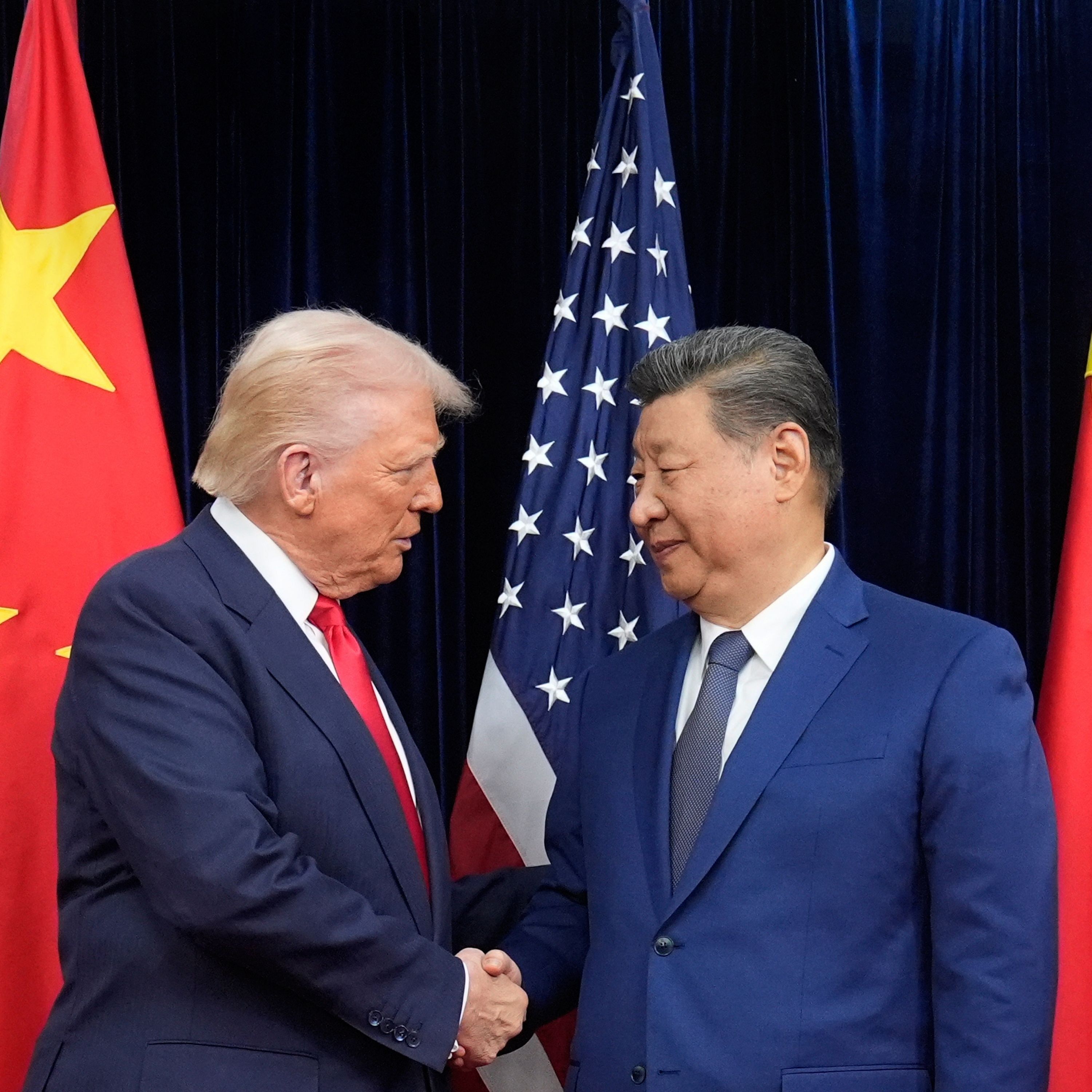
What A Day
Will Trump's Trade Truce With China Last?
00:22:57
President Donald Trump announced a trade truce with Chinese President Xi Jinping after a 90-minute meeting in Busan, South Korea, on Thursday. But what actually came out of the truce seems… less than meets the eye. According to Axios, Trump reduced tariffs against China in exchange for promises from the Chinese president to buy American soybeans and oil. However, the deal appears to be largely temporary, with few actual binding details that would make it any different from those made during Trump’s first term in office or even earlier this year. So for more details on the trade truce and Trump’s Asia trip, I spoke to Evan Madeiros. He’s the Penner Family Chair in Asia studies at Georgetown University with a focus on East Asia and US-China relations. And in headlines, Immigration and Customs Enforcement refuses to cease operations during Halloween festivities in Chicago, the Trump administration restricts the amount of refugees it will allow into the US every year, and Trump admini...
Loading summary
Transcript55 lines
- [00:03]
A
It's Friday, October 31st. Happy Halloween. I'm Jane Coaston and this is what a day. The show reminding you that actually it's very easy to avoid, obviously haunted homes, haunted forests, splitting up while running away from a serial killer, going to a camp haunted by a serial killer who may be undead, and literally any other horror scenario. If you're ever in a situation and think, wow, this seems like the start of a horror movie, just leave on today's show. Trick or treat. Or if you're in Chicago, tear gas. As Immigration and Customs Enforcement refuses to pause operations during Halloween festivities and the Trump administration is restricting the number of refugees allowed into the US Every year by a lot. But let's start with China. On Thursday, President Donald Trump announced a trade truce with Chinese President Xi jinping after a 90 minute meeting in Busan, South Korea. Following the meeting, President Trump said on Air Force One, it was the greatest meeting in the history of meetings.
- [01:11]
B
We're going to issue a statement on some of the details, but overall, I guess on the scale of from 0 to 10, with 10 being the best, I would say the meeting was a 12.
- [01:22]
A
But what actually came out of the truth seems less than meets the eye. According to Axios, Trump reduced tariffs against China in exchange for promises from the Chinese president to buy American soybeans and oil. However, the deal appears to be largely temporary, with few actual binding details that would make this agreement any different from those made during Trump's first term in office or even earlier this year. It's also worth mentioning that the decision by the Chinese government to stop buying American agricultural products came in response to Trump's Liberation Day tariff adventure in April. Notably, even Trump's optimism about his wonderful time with President Xi seemed to lack specifics. Here's some vagueness he shared with reporters on Air Force One about just how nice President Xi was.
- [02:08]
B
They congratulated me on the tremendous success that we've had because there's never been a country that has had so much money come into it for purposes of investment, for building, for auto plans, for AI. So he was very strong on congratulating me for that.
- [02:25]
C
But you didn't commit to any additional investment or outflow soon.
- [02:31]
A
So for more on what they did discuss and what the US May have gotten in a deal with China, I spoke to Evan Medeiros. He's the Penner Family Chair in Asia Studies at Georgetown University with a focus on East Asia and US China relations. Evan Medeiros, welcome to Whataday.
- [02:47]
C
Great to be here.
- [02:48]
A
So President Trump met with Chinese President Xi Jinping on Thursday and walked away with a one year trade truce. So what's in this deal? What did each country agree to?
- [02:59]
C
So this deal is very limited. It's full of a bunch of short term tactical concessions that essentially de. Escalated the trade war. Basically, we agreed to lower tariffs on China, we agreed to suspend some of our export control actions and, and in exchange we got China agreeing to buy some more of our soybeans and sorghum and other grains. And the Chinese sort of suspended their own export control action. So we're talking about pretty narrow, pretty wonky stuff. The most important thing to know about this meeting was that it opened the door to 10 months, maybe 12 months of very high level diplomacy. Trump said that he's going to visit China in April of next year and then subsequently Xi Jinping would visit the United States when we host the G20, a major multilateral economics meeting. So what that means is we will have a lot more deal making for the next next few months.
- [03:55]
A
But I'm curious, from your view, is this actually a good deal for the US? I've been seeing a lot of criticism from people basically saying that China got everything it wanted.
- [04:05]
C
China didn't get everything it wanted because China, for example, wanted access to very advanced chips.
- [04:12]
A
And when we're talking about chips, what are we talking about? Like AI chips?
- [04:16]
C
Exactly. The most advanced chips we have that are used for training LLMs. An LLM is a large language model, basically the kinds of things that allow us to do our research on ChatGPT, et cetera.
- [04:31]
A
And just out of curiosity, why do they want R chips? Because I was under the impression that they are also very advanced on that particular front.
- [04:42]
C
I mean, the Chinese want our chips because they're the best, they're the fastest, they're the most powerful, they're the most energy efficient. The Chinese can't build these chips. They're trying. But until they build them, they need our chips. China wants to be the world leader in AI because the Chinese are convinced that AI is the key to innovation and prosperity. But going back to a Biden administration decision From October of 2023, we're not selling the most advanced chips and we're not selling them the equipment to produce those chips. So what the Chinese really wanted from this was a major reduction in our export control so they can get more access to our technology. The Chinese wanted a reduction in some of their tariffs. They got that, they got a 10% reduction in tariffs. And bringing those tariffs down matters because it means Chinese exports to the US Start to become more competitive with the exports of other countries like Malaysia, Thailand, Vietnam, et cetera. So actually bringing down relative tariff rates, you know, really matters. And so the Chinese didn't get a lot, but we didn't really get a lot either.
- [05:52]
A
Does any of that surprise you, given how the President approached China during his first term? And actually, what was Trump's approach to China during his first term and how does his approach now seem to differ?
- [06:05]
C
Well, it both surprises me and it doesn't. It doesn't surprise me in the sense that Trump is not ideological on China. Trump is not a China hawk, either an economic hawk or a security hawk. And his approach to foreign affairs appears to be doing big deals with big leaders. Big leaders, meaning, you know, basically autocratic leaders. That's why he, you know, he likes Putin, you know, and he clearly likes Xi Jinping. So it doesn't surprise me from that perspective. But what does surprise me is in his first term, he basically wrote the first version of the script on strategic competition with China, and now he's basically flipping the script and saying, I'm not going to compete with China. I'm going to defund American science and tech, and I'm going to focus on just doing commercial deals with Xi Jinping. And by the way, I'm also going to pick fights with American allies and partners who theoretically should be critical assets in the long term competition between the US And China.
- [07:06]
A
Now, before his meeting with President Xi Jinping, Trump announced on Truth Social that he's asked the Pentagon to start testing nuclear weapons, quote, on an equal basis with Russia and China. What was your reaction to that news?
- [07:20]
C
I mean, to sum it up in three letters, WTF?
- [07:25]
A
Funny, that was my reaction too.
- [07:27]
C
Yeah. Since the US signed the Comprehensive Test Ban Treaty in the 1990s, it's been decades since we've conducted new nuclear tests. So if we start conducting nuclear tests, the Russians and the Chinese are going to do the same thing, which has the very high probability of initiating a nuclear arms race. I mean, the reality is, as of today, the Chinese are on track to pretty substantially increase the size of their nuclear arsenal, tripling, if not quadrupling it. And that's a huge problem for the United States. If we face a Russia that has 1500 nuclear warheads and a China that has 50 nuclear warheads, and we, under the current START agreement are capped at 1500 nuclear warheads. You know, if you think the US China relationship is complicated today as we compete on trade issues, supply chain issues, and technology issues, just imagine sprinkling nuclear weapons on the top and you have something that makes the Cold War look a bit like a garden party.
- [08:26]
A
I don't like that at all. During this trip, the Trump administration announced trade agreements or frameworks of agreements with several other countries, including South Korea, Thailand and Malaysia. What's new or notable about these agreements? Are there any patterns we should be paying attention to?
- [08:40]
C
Well, the agreements with Japan and South Korea are not new. They were essentially hammered out in bilateral negotiations a few weeks ago. And what Trump did was he sort of clarified one of the biggest dimensions of those trade deals, which is Japan's commitment to invest 550 billion in the US and South Korea's agreement to invest 350 billion in the US so wasn't anything new in those agreements. Just a clarification. With Southeast Asian countries like Vietnam, Thailand, Malaysia, it was about reducing tariff levels. So on Liberation Day, we imposed a certain level of tariff on all of those countries, and we basically negotiated it down based on what access they would give us.
- [09:26]
A
I'm curious, with regard to those tariffs, did the US Come out in a better spot than before the President's trip?
- [09:33]
C
I mean, now we face lower barriers to entry in those economies. Right. But you know, at the same time, we, we created this entire problem.
- [09:43]
A
Yeah, we did kind of invent this problem and then try to find solutions to it.
- [09:47]
C
Yeah, exactly. I mean, the bigger problem here is Trump's whole approach to trade is to basically use access to the US Market as a source of coercion. In other words, going to our trading partners largely in violation of the wto, and say, if you want to continue to have access to our market, we want to see X, Y and Z concessions from you. And if you don't, we're going to raise tariffs high. And that's what he did on Liberation Day. Right. He sort of imposed tariffs on all of these countries and said, if you want us to reduce this tariff, you know, if you want us to diffuse this ticking time bomb, you need to agree to enhanced market access. So it's, it's a very transactional and a very coercive way to get better access to countries markets. So, yes, the US Is doing better, but the question is, is what is the long term costs if the United States is constantly using these coercive measures? I mean, it creates incentives for economies in Southeast Asia to trade more with China than with the United States. That's the real problem that we face.
- [10:58]
A
What else will you be watching for next when it comes to US Relations with China and the other countries? Trump met with on his trip.
- [11:05]
C
Yeah. So the big things I'll be watching for, number one, does the US get everything that Trump and his team claim that we got? Right. There's ambiguity about how much agriculture the Chinese are going to buy. Trump tweeted that the Chinese had agreed to buy a bunch of American oil and gas. The Chinese haven't said anything about that. Trump said, we're not going to give the Chinese the Blackwell chips, the most advanced Nvidia chips, but the question is, are we going to give them second and third tier chips, which still will give them an advantage, and the fact that, that they can sort of turn on or off the spigot of whether or not they buy American grains as well. So on the outcomes, the deliverables from this meeting, there's actually quite a bit that needs to be followed up on. Number two are policy issues. Trump claims that he raised concerns with Xi Jinping about Chinese purchases of Russian oil, which helps the Russian civilian economy and feeds the Russian war machine. Is Trump going to be willing to follow up and try and put pressure on China to reduce its purchases of Russian oil? Trump said that Taiwan never came up, which is entirely possible, but it's hard for me to believe that the Chinese are going to just let Taiwan go. The worst kept secret in Washington is that Trump is at best ambivalent about Taiwan. He's much more interested in dealing with China, you know, as the second largest economy in the world. And so the question is, between now and the state visit, will the Chinese gradually bring up the Taiwan issue and sort of throw it in the mix and begin linking the Taiwan issue to things like commercial deliverables in the relationship?
- [12:46]
A
When you say the Taiwan issue, I assume you mean the fact that China thinks Taiwan is part of China and Taiwan says, no, it is not.
- [12:55]
C
That's correct. And even though the Taiwan issue didn't come up in this meeting, the Chinese are not going to drop it. So that's the other thing I'll be watching.
- [13:03]
A
Evan, thank you so much for joining me.
- [13:05]
C
Always great to be here.
- [13:07]
A
That was my conversation with Evan Medeiros Penner Family Chair in Asia Studies with a focus on East Asia and US China relations. We'll get to more of the news in a moment, but if you like the show, make sure to subscribe, leave a five star review on Apple Podcasts, watch us on YouTube and share with your friends. More to come after some ads. What a Day is brought to you by the Freedom From Religion Foundation. You know what's really scary? This Halloween not ghosts, not goblins, not even the candy corn. It's politicians trying to drag us back into the 1800s with something called the Comstock Act, a zombie law they want to use to ban abortion medication nationwide. Yet nothing says spooky season like resurrecting 19th century morality codes. That's why the Freedom From Religion foundation is out there with the metaphorical garlic and stakes keeping church and state separate so your rights don't vanish in the night. FFRF defends free speech, reproductive freedom, and public schools from religious overreach. Basically, they fight the real life monsters of Christian nationalism so the rest of us can sleep a little easier. If you believe in reason, science and actual freedom, become a member today by going to FFRF us boo or text the word boo that's b o o to 511511. Learn more and get involved at FFRF us boo. Go to FFRF us boo or Text the word boo to 511511. Text the word boo to 51151 one Help keep America from turning into a theocracy themed horror franchise. Join the Freedom From Religion foundation. Go to FFRF US BOO or text the word BOO to 5 because the only thing we should fear is theocracy itself. Text fees may apply.
- [15:01]
C
You know what? A girl's best friend is not diamonds her lawyers.
- [15:05]
D
From executive producer Ryan Murphy comes a fiery new legal drama.
- [15:09]
E
It's our own boutique women representing women.
- [15:12]
D
You can't afford to miss.
- [15:14]
E
Make it rig showtime, ladies.
- [15:17]
A
Stand up straight, then breeze into that.
- [15:20]
F
Room like a storm no one saw coming.
- [15:24]
D
Hulu original series All's Fair premieres November 4th on Hulu and Hulu on Disney. For bundle subscribers, terms apply.
- [15:30]
E
When a cold has you down, it's the little comforts that lift you up. A warm blanket, a cup of tea, and a tissue that actually feels good on your skin. Infused with aloe, Kleenex Cooling plus Aloe provides a hint of cooling freshness to help your skin feel restored. So whether your skin is feeling dry, chafed or irritated, you're only one wipe away from helping it feel relieved. The next time you have a cold, get a hint of instant cooling relief with new Kleenex Cooling plus Aloe. For whatever happens next, grab Kleenex.
- [16:03]
A
Here's what else we're following today. Head of Lines.
- [16:09]
G
No child in America should have to go trick or treating in fear that they might be confronted with armed federal agents and have to inhale tear gas. I honestly can't even believe that I have to make this plea.
- [16:23]
A
Illinois Governor J.B. pritzker appealed to Border Patrol Commander Greg Bovino on Thursday to pause ICE operations on Halloween. The governor also sent a letter to Department of Homeland Security Secretary Kristi Noem making the same request. And just when you thought the scariest thing on your porch was a decoration of a demented clown, Kristi Noem said, hold my pumpkin spice latte.
- [16:44]
F
We're absolutely not willing to put on pause any work that we will do to keep communities safe. And the fact that Governor Pritzker is asking for that is shameful.
- [16:55]
A
Is it? So Halloween will proceed with spooky figures roaming the streets and also all the kids dressed up in their Halloween costumes. Pritzker noted an incident last weekend in Chicago where Border Patrol agents reportedly used tear gas to disrupt a children's Halloween parade. In a statement to the Hill, Homeland Security accused Pritzker of, quote, going out of his way to smear the law enforcement officers of DHS who are attempting to clean up the rampant crime he facilitated. Honestly, it's understandable why ICE wants to take part in Halloween. It's the one night a year when it's acceptable to wear a mask.
- [17:30]
H
The SNAP benefits are on the chopping block. And you know, the lawsuit says in layman's terms, the federal government has money. Use it. That's the bottom line, right?
- [17:41]
A
Nevada Attorney General Aaron Ford spoke to what a day's Matt Berg ahead of a federal judge's decision on whether to fund the Supplemental Nutrition Assistance Program or SNAP with emergency federal funds. At the time of our recording Thursday evening, a ruling had not been issued. Roughly two dozen Democratic attorneys general and governors, including Ford, sued the Trump administration to keep SNAP funding flowing during the shutdown. The goal? To ensure millions of Americans don't go hungry just because Congress refuses to figure out how to reopen the government. The Trump administration tried to argue that it could suspend SNAP benefits for the first time in the food aid program's history because of the shutdown. And on Thursday, US District Judge Indira Talwani said in court, you are not going to make everyone drop dead because it's a political game someplace. She told lawyers that if the government can't afford to cover the cost, there's a process to follow rather than simply suspending all benefits. Even if the judge decides emergency funds must be used, some SNAP recipients might receive less money in November and that money could be delayed. When asked earlier in the day about funding, Vice President J.D. vance in part told reporters, we're gonna.
- [18:48]
I
Find out the hard way. With SNAP benefits, the American people are already suffering and the Suffering is gonna get a lot worse.
- [18:55]
A
So you agree the American people are suffering? What the administration did in the last 24 hours is corrosive not only to our democracy, but downright dangerous for our national security. Virginia Democratic Senator Mark Warner was fuming on Capitol Hill after Trump administration officials held a classified briefing on the president's escalating boat strike campaign and only invited Republicans. Lawmakers say the administration refuses to share its legal justification for the dozens of military strikes in the Caribbean and Pacific that have already killed at least 60 people. The white House claims the targets were, quote, narco terrorists, but Pentagon officials admitted they don't actually know who all the victims were, just that some might be connected to cartels, quote, three hops away from a known member. That seems like a lot of hops. Democrats say the partisan briefing violates laws requiring bipartisan national security oversight and undermines Congress's constitutional constitutional war powers. Even some Republicans were caught off guard. South Dakota Republican Senator Mike Rounds said he hoped Democrats would get the same intel, quote, because it was a very good briefing. So much for decorum, due process, not to mention rules of engagement. Basically, it looks like the Caribbean's got pirates again, but this time the flag they're flying is red, white and blue.
- [20:22]
I
Just because one person or 10 people or 100 people came in legally and contributed to to the United States of America, does that mean that we're thereby committed to let in a million or 10 million or 100 million people a year in the future? No, that's not right.
- [20:38]
A
Vice President J.D. vance shared his fascinating views on immigration at a Turning Point USA event at Ole Miss Thursday. The Trump administration is restricting the number of refugees it admits annually into the country to 7,500, and they will mostly be white South Africans, the Africans that most often pop to mind, you know, the white ones. No reason was given for the numbers, which are a substantial decrease from last year's ceiling of 125,000 set under Democratic President Joe Biden. The memo said only that the admission of the 7,500 refugees during the 2026 fiscal year was, quote, justified by humanitarian concerns or is otherwise in the national interest. Whose national interest? Well, that's up for interpretation, apparently. America's new motto is give us you're tired, you're poor. Actually, just give us white South Africans. And that's the news. Before we go, the latest episode of Crooked's subscriber exclusive series, Inside 2025 is out. Now. This week, Alex Wagner joins Dan Pfeiffer to unpack how the news media has changed and where it's headed. Alex shares what it's like reporting from inside the mainstream press and even recalls an awkward moment with one of Crooked's own hosts. Listen to the full episode by joining friendsofthepod@crooked.com friends. Subscribe by Sunday, November 2nd to get 20% off your annual subscription. You'll enjoy ad free episodes, bonus content like Polar Coaster and support Crooked's fight for democracy. That's all for today. If you like the show, make sure you subscribe. Leave a Review Introduce yourself to Andrew Mountbatten Windsor, previously known as Prince Andrew, and tell your friends to listen. And if you're into reading, I'm not just about how Buckingham palace announced Thursday that Prince Andrew has now lost the title of Prince on top of all of the other titles I told you he lost this week. Like me, Water Day is also a nightly newsletter. Check it out and subscribe@crooked.com subscribe I'm Jane Coaston and now Andrew Mountbatten Windsor is just some guy named Andrew with horrible decision making prowess. One of dozens what a Day is a production of Crooked Media. It's recorded and mixed by Desmond Taylor. Our associate producers are Emily Foer and Chris Allport. Our video editor is Joseph Dutra. Our video producer is Johanna Case. We had production help today from Greg Walters, Matt Berg, Sean Ali, Gina Pollack and Caitlin Plummer. Our senior producer is Erica Morrison and our senior vice president of news and politics is Adrienne Hill. We had helped today from the Associated Press. Our theme music is by Colin Gilliard and Kashaka. Our production staff is proudly unionized with the Writers Guild of America East.
- [24:00]
J
Hey everybody, it's Jon Lovett of Pod. Save America. Love it or leave It. And for a brief moment in time, Survivor on cbs. Understand reality TV is the key to understanding the current state of our politics. Trump gets it to your favorite Democrats? I doubt it. That's why I'm introducing a limited series on this feed called Love It Or Leave it presents Bravo America. Every week I'm going to sit down with my favorite personalities in reality tv. People like Dorinda Medley from the Real Housewives of New York, Orange county house husband and botched surgeon Dr. Terry Dubrow. Survivors black widow poverty shallow. Welcome to Plathville's Olivia Plath and more. Over eight episodes of Conversations will answer three big questions. What did my guests learn about reality TV? What did my guests learn about themselves? And what did they learn about politics and this great and perfect nation of ours? Through it all, I'm pushing to get people to talk more openly about all of this, including stories they haven't told and moments that didn't make it on screen. Love it or Leave it presents Bravo America on this feed every Tuesday for the next eight weeks. So check it out and be cool about it.