← What Next: TBD | Tech, power, and the future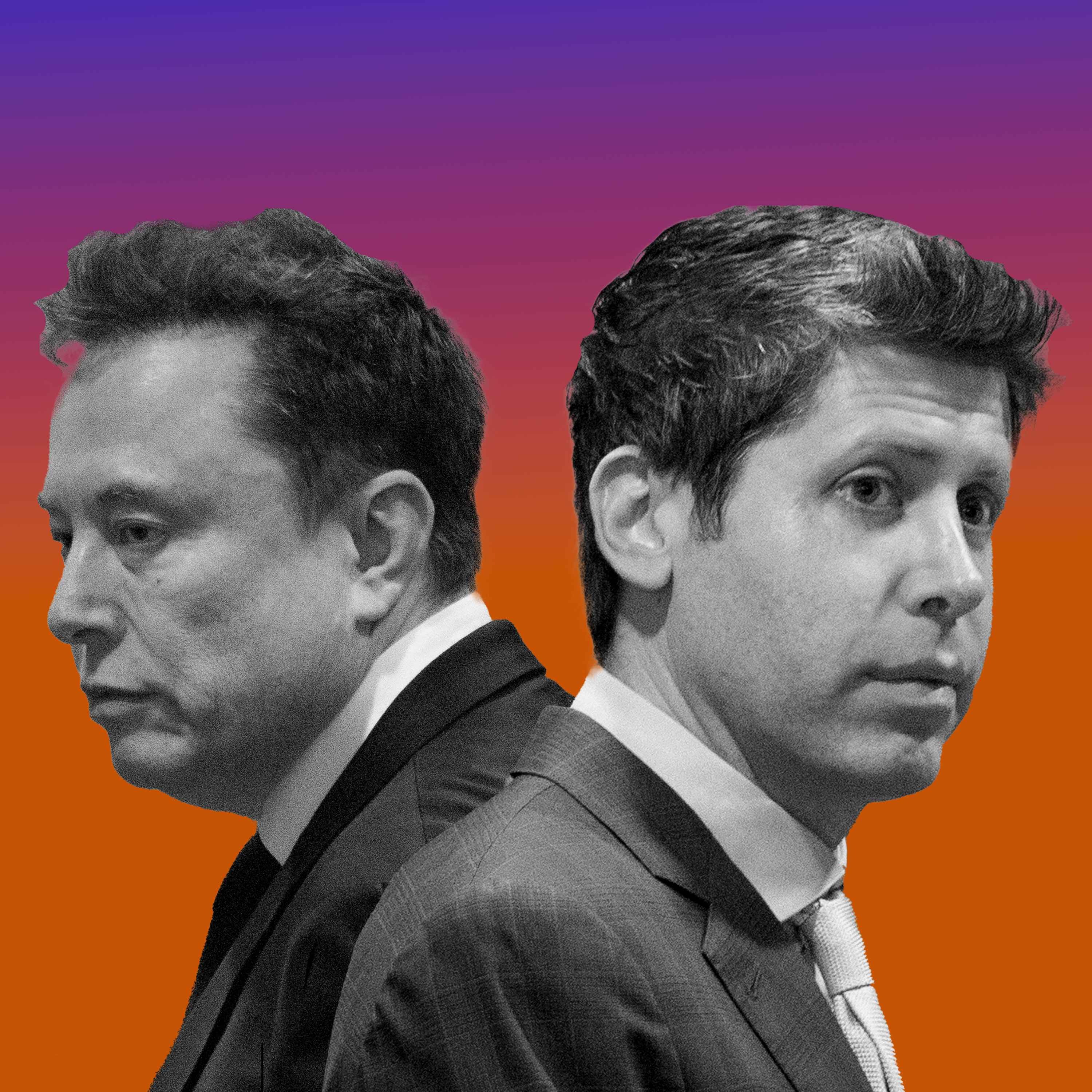
What Next: TBD | Tech, power, and the future
Musk v. Altman
00:24:08
Two tech titans face off in court with massive implications for the A.I. industry.
Loading summary
Transcript50 lines
- [00:01]
Lizzie O'Leary
We're lost. It feels like we're going round in circles. I'm gonna ask that man for directions. Hi there. We're trying to get to the state fairgrounds.
- [00:10]
T-Mobile Representative
Well, you're gonna take a left at the old oak tree at this here road. Nah, I'm just kidding. Let me get my phone out.
- [00:17]
Lizzie O'Leary
How is there signal out here?
- [00:19]
T-Mobile Representative
T Mobile and US Cellular are coming together so the network out here is huge. We get the same great signal as the city, so saving a boatload with benefits. And there's a five year price guarantee too. Okay, here's the turn.
- [00:31]
Lizzie O'Leary
Actually, can you pull up the way to a T Mobile store?
- [00:35]
T-Mobile Representative
America's best network just got bigger. Switch to T Mobile today and get built in benefits the other guys leave out. Plus our five year price guarantee. And now T Mobile is available at US Cellular stores in Hermiston. Best Mobile Network Based on analysis by Ooklo Speed test intelligence data second half of 2025 bigger network the combination of T Mobile's and US Cellular's network footprints will enhance the T Mobile network's coverage price guarantee on talk text and data exclusions like taxes and fees. Fees apply CT mobile.com for details
- [01:03]
Lizzie O'Leary
this episode is brought to you by Bill the intelligent finance platform that helps businesses and accounting firms scale with proven results. Here at what Next cbd, we know business, and in businesses across America, smart people are stuck doing the grunt work. You know the drill. Those hours when you could be brainstorming big ideas, you're instead filling in spreadsheets, filling out invoices, or hunting down somebody else's signature. Bill wants to change that. With AI powered automation, Bill removes the busywork from your account's payable workflow. They handle capturing invoices, routing approvals, and syncing with your accounting software so that your team can focus on growth instead of paperwork. Bill is so reliable, over 90 of the top 100 accounting firms in the US trust it to simplify and secure their bill payment processes. Bill's handled over a trillion dollars in secure payments and is ranked number one overall on G2's 2025 list of accounting and finance products. So stop the guesswork and start scaling with the proven choice. Go with a company whose financial infrastructure is trusted by nearly half a million customers. Ready to talk with an expert? Visit bill.comproven and get a $250 gift card as a thank you. That's bill.comproven. terms and conditions apply. See Offer page for details.
- [02:27]
Garrett Devink
Foreign.
- [02:34]
Lizzie O'Leary
On the phone Thursday evening, he was outside the federal courthouse in Oakland, where He'd been watching Elon Musk testify.
- [02:42]
Garrett Devink
Yeah, it's been, it's been pretty interesting. I mean, it's very, very rare that we get to hear directly, especially under oath, from Elon Musk.
- [02:53]
Lizzie O'Leary
Garrett reports on tech for the Washington Post, and he's covering this lawsuit in which Elon Musk is suing OpenAI and Sam Altman.
- [03:02]
Garrett Devink
First week of the trial is over and it's already been a pretty big deal. Lots of media here, lots of, you know, members of the public coming to see Elon and a few anti billionaire and anti AI protesters even out front. And so, yeah, it's been pretty eventful so far.
- [03:17]
Lizzie O'Leary
In an extremely meta moment, someone else outside the courthouse interrupted Garrett so that they could do their own recording.
- [03:25]
Garrett Devink
Sorry, someone just asked me to move because they're doing a podcast, which is crazy.
- [03:32]
Lizzie O'Leary
Oh, my goodness.
- [03:33]
Garrett Devink
I can literally see like four, four journalists doing it. And so I'm like, let me be okay. This might be a safer place.
- [03:45]
Lizzie O'Leary
Okay, so back to our interview. So far, this civil trial has been all about Elon Musk, even though he is the one suing over OpenAI, moving from a nonprofit to a for profit company. His personality came up in jury selection. The judge even said in court. The reality is that many people don't like him. But here's the thing. Whatever happens in this case has huge implications, not just for elon, but for OpenAI and the AI industry in general.
- [04:18]
Garrett Devink
If Elon Musk does win, you know, essentially what he's demanding, if he gets his way, would really upset and upend OpenAI. I mean, this company is planning to go public later this year or early next year. It is, you know, in a really high stakes business situation. It's spending billions of dollars building and running its AI. It's bringing in, you know, a lot of money and revenue, but it needs to keep growing and needs to get more investment. It can't have this kind of distraction. And if it were to lose its CEO, I mean, that would probably really mess up their plans for their business and where they go forward. And so, you know, that doesn't mean it's going to happen. And, you know, I think they're, you know, I've heard all sorts of different legal opinions. I mean, but I have talked to some lawyers. They look like Elon is kind of reaching here, that, you know, he has a pretty difficult case to make. And, you know, it's. I've definitely spoken to some people who are pretty skeptical that he will actually win, but the stakes are still pretty high. And you know there is a jury involved here. The jury actually will advise the judge and the judge will make the final decision. But you know, the judge said there's enough here to go to go to court and she's a very serious person. This is a very serious court. They don't just take on anything. So I definitely think there is a chance for this case to go either way.
- [05:41]
Lizzie O'Leary
Today on the show, Elon Musk versus Sam Altman in a courtroom under oath. I'm Lizzie o' Leary and you're listening to what Next tbd, a show about technology, power and how the future will be determined. Stick around. This episode is brought to you by Bill, the intelligent finance platform that helps businesses and accounting firms scale with proven results. Here at what Next cbd, we know business, and in businesses across America, smart people are stuck doing the grunt work. You know the drill. Those hours when you could be brainstorming big ideas, you're instead filling in spreadsheets, filling out invoices, or hunting down somebody else's signature. Bill wants to change that. With AI powered automation, Bill removes the busy work from your account's payable workflow. They handle capturing invoices, routing approvals, and syncing with your accounting software so that your team can focus on growth instead of paperwork. Bill is so reliable, over 90 of the top 100 accounting firms in the US trust it to simplify and secure their bill payment processes. Bill's handled over $1 trillion in secure payments and is ranked number one overall on G2's 2025 list of best accounting and finance products. So stop the guesswork and start scaling with the proven choice. Go with a company whose financial infrastructure is trusted by nearly half a million customers. Ready to talk with an expert? Visit bill.comproven and get a $250 gift card as a thank you. That's bill.comproven. terms and conditions apply. See Offer page for detail. Starting your own business is never easy. Starting your own podcast, that seems easy, but actually there are a ton of landmines to step on along the way. Finding producers, selling ads, and connecting to wi fi. Oh, does that sound straightforward? It's not. I'm talking about sitting in coffee houses for hours after buying one scone. I'm talking about sitting in hotel lobbies and pretending your backpack is luggage. It's torture. I spent so much time making my home office look professional, but my connection didn't get the memo. The last thing you want during a major interview is for your guest's voice to turn into a stutter when your bandwidth can't keep up with your ambition, your home office starts feeling like an amateur operation pretty fast. And for a podcast, the Internet is key because the Internet is how we talk to almost everyone. And no matter the guest, a laggy connection can ruin an exclusive interview. Great connectivity isn't a bonus, it's the whole game. An ATT business is here to help. They've got the tools, team and expertise you need for a stable network you can rely on. And when you can rely on the network, you can get back to thinking about the more important stuff, like nabbing that great guest and getting back to work at and T Business Built to Work. Get att business@business.att.com. This episode is brought to you by pebble. The TBD team is small, but we're mighty. And I know exactly how important hiring is. From combing through resumes to asking just the right questions to finally making that offer. I also know the last thing you want is to be tripped up right at the finish line. And when you're hiring overseas, that's where things get complicated. But that's where pebble can help. You can send offers in minutes to anyone in the world and get them onboarded fast. Pebble is an AI powered human resources platform built for founders and HR leaders and operators who are hiring and supporting teams around the world. Pebble helps you hire, pay and manage talent in over 185 countries with fast onboarding that can be done in minutes. Instead of juggling separate tools for contracts, payroll, benefits and compliance, pebble brings everything together with built in guidance and local expertise to support you. This is especially helpful if you're managing teams internationally or planning to grow. The fastest growing companies in the world use pebble to stay organized and reduce risk and founders use it to scale faster without feeling like they need to become HR or compliance experts. Bottom line, it simplifies global people operations so you can spend more time growing the business and supporting your team. Pebble's new standard discounted pricing at $399 per month per employee helps you contain costs. Go to HIPEBL AI to get a free estimate. That's HIPE AI for a free estimate. For listeners who haven't followed this closely in I guess the simplest way why is Elon Musk suing Sam Altman?
- [10:38]
Garrett Devink
OpenAI is a nonprofit and it was founded at the very beginning to sort of provide a counterweight to big tech companies like Google or Amazon or Facebook that were rushing to develop AI for their own purposes. And Elon Musk And Sam Altman and a few other people thought that that was concerning because they thought AI would be really powerful. They didn't want it concentrated in the hands of a private corporation. So they started a nonprofit. But very quickly they realized they needed more money in order to keep up with those for profit companies. And so OpenAI started a for profit. And, you know, there was some founder squabbles between Sam Altman and Elon Musk years ago. Elon Musk ended up leaving the company. And OpenAI has grown into the company that people interact with. ChatGPT. Today, it's worth billions of dollars. And Elon Musk is alleging that, you know, this was a nonprofit and now it's this company that makes billions of dollars. It's turning its employees and its founders into millionaires and billionaires. And I don't think that's fair. And I think that they essentially betrayed the agreement to be a charity and work for the good of humanity and not to enrich people along the way. And that's what he's alleging here.
- [11:52]
Lizzie O'Leary
Yeah, he said it's not okay to steal a charity, which on the one hand makes sense. On the other, how does that hold up in a court of law?
- [12:07]
Garrett Devink
Yeah, I mean, he's come in with a very elegant story, right, which is, you know, this thing was a charity and clearly it's a giant company. Now that doesn't make any sense. And I think people can find the logic there and they say, you know, that makes sense. If the Red Cross suddenly, you know, started, you know, went public and made a bunch of money. A lot of people who donated over the years might not feel so great about that. But you know, in the trial so far, OpenAI's lawyers have really kind of complicated Musk's, you know, very sort of white night clean message by saying, look, here's a bunch of emails showing that you were totally okay with opening I developing a for profit arm. You were involved in all these conversations. You even said that it was probably necessary for OpenAI to be able to continue and actually accomplish its mission of developing AI and needed more money. It needed to make a profit in order to attract investors. And oh, look, you found all these other companies, Tesla, SpaceX, those are for profit companies. They can improve the world, but they still make a lot of money. So there's not a consistency there. And you've also, in the meantime gone and built your own AI company that is completely for profit. And so they're really just sort of chipping away at his, his argument here. And I think it's going to kind of come down to, you know, whether the jury and then the judge think that, you know, Elon Musk, you know, a, you know, is truthful when he says that he feels, you know, that they had this verbal agreement and they were kind of like he was blindsided by it. And also just credible in terms of wanting OpenAI to be a nonprofit and, and focus on, you know, public good in addition to, you know, the money that it's making for. For its investors.
- [13:50]
Lizzie O'Leary
Yeah. From your reporting, it seems like Musk's time in court, both his testimony and then the cross examination, has been a little testy. How has that seemingly gone over?
- [14:04]
Garrett Devink
Yeah, I mean, it's, you know, Elon Musk is, you know, I would say he's probably not someone who has to answer questions that he doesn't want to answer very often. You know, he is usually the one giving the orders, I suppose. And so I think it's been an interesting situation that, you know, we have these powerful men who are essentially under oath. They have to answer these questions. And he's very much always during the testimony wanting to explain himself and say, well, actually, so a lot of the fighting with OpenAI's lawyer actually has been because OpenAI's lawyer is saying yes or no. This happened on this day. And Elon says, well, I can't just give you a yes or no answer. And then the judge says, please try to give him a yes or no answer. And then Elon is kind of making these comments saying, oh, the lawyer's trying to trick me. He's interrupting me all the time. And, you know, that's kind of the dynamic. I mean, we haven't necessarily devolved into a shouting match. So I don't necessarily want to, you know, exaggerate how dramatic the courtroom has gotten, but there's definitely been some very tense moments.
- [15:09]
Lizzie O'Leary
And the judge, if I'm right, has basically told everyone, knock off the posting. No posting through it.
- [15:15]
Garrett Devink
Yeah, because on Monday we had jury selection and, you know, we had posts from Elon Musk. Sam Allman's been posting about the trial as well, like leading up to it. And the judge, who is an extremely no nonsense person, says, hey, you guys, do not do this. It was really the first thing that she came in at the beginning of testimony, before anything even started, before the jury came in, and she said, I want an agreement from both of you. And so it is a little bit funny to see Elon Musk saying, yes, ma', am. Yes, your honor. And Just sort of nodding, agreeing not to post on Twitter, which we all know that he likes to do sometimes dozens of times a day.
- [15:54]
Lizzie O'Leary
How did Sam Altman's lawyers respond to Musk's testimony?
- [15:58]
Garrett Devink
They were really just trying to kind of chip away at his framing of himself as this kind of beneficial person who's just trying to make the world a better place, trying to create AI that benefits the world and someone who's focused on AI safety. One of his contentions is that by becoming leaning more towards the for profit side, OpenAI has kind of thrown out its concerns about safety and protecting people from the risks and harms of AI. And so OpenAI lawyers have tried to say, well, look, your own companies, your own AI is also questionable. We know that grok, the AI chatbot from Elon Musk's AI company xai, has been shown to sometimes have racist posts, sometimes sexist posts. There's all sorts of concerns from child protection advocates and parents. And so some of that has kind of been thrown out because the judge doesn't necessarily want this to become a, you know, a slug fest about. Well, you know, Elon Musk is a terrible person. Sam Altman is a terrible person. She very clearly wants to, you know, make sure that that is not what this become. But you see it sort of slipping in to some of the questioning.
- [17:11]
Lizzie O'Leary
Are we going to hear from Sam Altman in.
- [17:15]
Garrett Devink
We will hear from Sam Allman in court. We do not know when. Sometime in the next two weeks. And it's going to be interesting. I mean, Sam Altman as well, I mean, he is, I would say he does a lot of interviews. He's out there, he's speaking at conferences. I think he sees himself as someone who wants to be very open and transparent. But in a courtroom, it's just a very different, different situation. There's different rules. And, you know, we even saw today with a different witness, Elon Musk. Lieutenant Jared Virtual. He was being very evasive with the cross examination. He was saying, I don't recall a lot. He was sort of, you know, try not to answer these questions that look like. And the judge essentially just put her foot down and she started asking questions. She sort of took over the cross examination and that, you know, you can't just say, I don't recall to everything. You know, we were asking you to try to remember as much as you can about, you know, this thing that we're asking you about. And he was really cowed and had to kind of, you know, answer. And you can imagine something like that happening as well with some of these principal witnesses. And so it's definitely an environment that they are not used to being into. You know, Elon Musk has walked out of interviews with journalists before when he doesn't like the question. He can't do that here.
- [18:30]
Lizzie O'Leary
I think that's one of the aspects of this that is so fascinating because on the one hand, I think there are some people who have looked at this trial and thought, like, these are two rich guys who are suing each other. They're both still gonna be rich. Who cares? On the other hand, as you are saying, this is one of the few instances where they both must be accountable, and accountable both to the judge, but also to a jury. And I guess I wonder, when we look at the implications for both of these men and their companies, it seems like they could both come off poorly here if, you know, they do end up really going at it in the courtroom.
- [19:14]
Garrett Devink
Yeah. I mean, I think the accusation against Elon Musk from OpenAI is that he is sour that he lost out and left OpenAI before it became big, and he's simply doing this to harm OpenAI and Sam Altman. And at the same time, Sam Altman had. Although a couple years ago, he would be a lot more diplomatic about Elon Musk, a lot more vague. I mean, he's been more direct. Even I think it was today he was speaking at a conference in San Francisco. Someone sent me a video clip, and he was. He didn't mention Elon Musk by name, but he was sort of, you know, denigrating the idea of putting data centers in space. Do you think space data centers will provide a meaningful amount of compute for OpenAI in the next two to three years? Five years? No, 10 years. You just keep going, 10,000 years. I wish Evelyn luck. Okay. And so, you know, they can't really help themselves. And I do think that if you look at, you know, the world of social media, that kind of, you know, bombastic sort of, you know, talking a big game, making exaggerations. I mean, that is sort of the way that these people. And I would say, you know, companies, even the corporate world in general, is leaning towards that kind of communication. And I think it just doesn't work in this environment. And, you know, today the judge actually admonished Elon Musk for bringing up the existential risk of AI too many times. You know, several times during the trial, he would sort of take an opportunity to turn to the jury and. And sort of say that AI could kill all of us. And that we could have a Terminator situation if we're not careful about AI. And I think the judge was like, look, like, you can't just keep saying this. Trying to essentially, you know, she didn't say this explicitly, but the reading between the lines, to me it's like he is sort of trying to scare the jury and make the safety question a really big one. And she's like, look, you need to stop with this, these exclamations. There was another example of that where, you know, Elon Musk has been shown in court records and court documents, you know, hard data, hard pieces of evidence that he gave around $38 million to OpenAI, as in donations when the company was getting started. But on Twitter, he said over the years that it was 100 million that, you know, other, other numbers that he's kind of put out there. And he was directly confronted. He said, look, it's 38 million. But you said 100 million, like what? Explain that. And you know, he couldn't just say, well, you know, when I tweet, I make stuff up, you know, which is kind of what happened there. Right? And so I think some of this sort of, you know, the way that Elon Musk and I would say even Sam Allman talk in public is kind of being really, you know, kind of put on the stand here and they're being made to sort of say, okay, no, actually we don't want to hear the bluster. We want to, we want to hear what actually happened. And so, I mean, that's why I'm here and why I think a lot of the reporters are here to try to get that information.
- [22:24]
Lizzie O'Leary
When we come back. So does Elon have a case? This episode is brought to you by Capital One. Capital One's tech team isn't just talking about multi agentic AI. They already deployed one. It's called chat concierge and it's simplifying car shopping using self reflection and layered reasoning with live API checks. It doesn't just help buyers find a car they love. It helps schedule a test drive, get pre approved for financing and estimate trade in value. Advanced, intuitive and deployed. That's how they stack. That's technology at Capital One. Hey there. It's Wayfair here, where delivery and setup are as easy as a few taps on your phone. You're relaxing in an old hammock, scrolling Wayfair's app when you spot it. A brand new patio set. Next thing you know, Wayfair delivers it right to your patio and sets it up oh, you need a new grill, too. All right, Wayfair's got you covered. With Wayfair's room of choice delivery and fast expert setup on qualifying orders, life gets a little easier. Visit Wayfair.com or the Wayfair app.
- [23:33]
Garrett Devink
Wayfair.
- [23:33]
Lizzie O'Leary
Every style, every home. For all of the bluster, OpenAI did, you know, kind of abandon its initial charter as a nonprofit. Does Elon have a case?
- [23:51]
Garrett Devink
Yeah, I mean, it's tricky and it's a little convoluted. There is actually an element that I think is not directly part of this case, but I think it's interesting, which is that the attorney generals in California and in Delaware, which is, you know, OpenAI is registered in Delaware, it's headquartered in California. They've actually struck deals with OpenAI to say, we're okay with what you did, we're okay with the fact that you were a nonprofit. You created a for profit subsidiary in order to make money to fund the nonprofit. And then that for profit subsidiary became giant and started taking billion dollar investments from Microsoft and making billions of dollars in revenue and, you know, becoming one of the most important tech companies in the world. The attorneys general have said, we think that's okay. And OpenAI had to make some commitments. They actually were sort of trying to stop being a nonprofit completely, and they decided not to do that. So they are still technically governed by a nonprofit board that the for profit sends a lot of its revenue and profit to. And, you know, that's kind of the situation. So I think it's not necessarily a slam dunk to just say, well, they are now a for profit company, because technically they aren't. And so it gets a little bit murkier. And I think that makes Elon Musk's case a little bit harder to prove.
- [25:08]
Lizzie O'Leary
OpenAI is also trying to gear up for an initial public offering. I would imagine that the company's leadership does not want the world to see all of its dirty laundry. That must be awkward for them.
- [25:25]
Garrett Devink
It's awkward. And honestly, a lot of the dirty laundry is out there already. This lawsuit was initially filed two years ago, and there have been hundreds of court filings. There's been all sorts of wrangling about what can be in the public record, what can the jury see. And so a lot of these emails, documents, sort of detailing, you know, how this company was founded, the arguments that they had early on are all out there. And every day in court, we see new documents which, you know, include text messages between Elon Musk and Sam Altman. You know, we. Today we saw tax returns from Elon Musk, just the part where it showed how much money he gave in charity. I mean, I don't. The actual dollar was fine, wasn't there, but it was. You know, this is very private information for these people that they're very not used to getting out there. And so I do think some of the big Questions are on OpenAI's IPO, which is, you know, how is the business doing? How much money does this company make? How fast is it growing? Has that growth slowed down? We probably won't get any information on those major current business questions, because I think the judge will do a good job of keeping it out of the scope of the trial. But either way, it's still a distraction for the company. Sam Altman has been here every single day for at least a few hours. Every hour that he's in court is an hour he's not running his company and trying to prepare it for the ipo. And so I'm sure they're not thrilled that they need to deal with this.
- [26:51]
Lizzie O'Leary
Let's talk about the stuff that has come out in discovery and in the trial. I am torn between whether the thing that interests me most is whatever Elon did at Burning man in 2017 or him calling Jeff Bezos a bit of a tool. What is the most interesting communication that has come out in your mind?
- [27:15]
Garrett Devink
Yeah, I mean, the. The Burning man one, which, you know, I believe was about whether Elon Musk was maybe doing ketamine while he was Rhino Ketamine. Discussions about. Yes, rhino ketamine, which, because I did look this up as I was reporting on this, is, you know, a combination of ketamine and methamphetamines, which you can kind of. I'll leave that up to the imagination as to the effect what that might have on someone. And so, you know, that evidence is actually not being. Not allowed to be shown to the jury. The judge said, this is not relevant. We don't care. But there's all sorts of things, and, you know, there's definitely a lot of, you know, sort of details that are coming. I mean, these. These men were, you know, arguing and then kind of making up and then arguing again and then sending all these sort of snippy emails. And so there's a lot of that. And, yeah, I mean, it's also revealing some information about Elon Musk private life. Siobhan Villas, who is, you know, a business lieutenant of his, but also the mother of four of his children, he said in court this week that they actually live together right now. And she was his representative at OpenAI even after he left the company formally to focus on other AI efforts at companies like Tesla. And OpenAI is alleging that Siobhan Zillis was essentially spying for Elon Musk, that Sam Altman and the other people at Opening Eye didn't know that Elon Musk and Siobhan Zillis had a relationship, that they were having children together until later. And so there's definitely a lot of this sort of like, you know, almost telenovela, you know, character to some of the information that's coming out.
- [28:59]
Lizzie O'Leary
Perhaps not surprisingly, if you wanted to, you could go on prediction markets and place a bet on, on the outcome of this case. But I am a little more curious in terms of almost no matter the outcome, how much of an impact will the out the outcome of this case and really the kind of sordid nature of all the fighting have on the AI industry?
- [29:29]
Garrett Devink
The AI industry is barreling forward. And I think even if you had what I would say is like a worst case scenario for OpenAI, which is that Elon Musk wins. He gets everything he's asking for. The court orders that, you know, Sam Allman and Greg Brockman are kicked out of opening AI, they have to go into some sort of, you know, legal wrangling about how they're going to reform the company to, you know, empower the nonprofit once again. That would be bad for OpenAI. It would definitely rock the AI industry because OpenAI is, you know, sort of has definitely been the number one AI mover, I think, up until recently, when I think anthropic in a lot of people's minds have surpassed them in terms of momentum and growth and attention. But AI is not going to go away just because OpenAI has problems. Right? And, you know, OpenAI has had a lot of problems before, right? I mean, it wasn't that long ago that the board decided to fire Sam Altman right about, you know, 48 hours, if I remember correctly. And that company, it moved on from that very quickly, you know, and things kind of went back to normal. So I don't think this is the last we've heard of OpenAI, regardless of the outcome of this trial. And I think even if this company has a lot of issues, even if its IPO is disrupted, and even if some of the questions around its business turn out, you know, the answers turn out to be negative for OpenAI, there are other companies that are moving forward with technology. Google is all in, and we saw this week, Google earning that, you know, they are making tons of money from their AI offerings. And anthropic, as I said, is, you know, growing very quickly moving forward. There's all sorts of other AI companies. And so, you know, whether OpenAI is part of that future or not, it does seem to be happening.
- [31:20]
Lizzie O'Leary
Garrett Devink, thank you so much for sticking around and talking to us after a long day in court. Thanks, man.
- [31:27]
Garrett Devink
Of course. Anytime.
- [31:30]
Lizzie O'Leary
Garrett Devink is a tech reporter at the Washington Post. And that's it for our show today. What Next TBD is produced by Evan Campbell and Patrick Fort. Our show is edited by Paige Osborne, who is the senior supervising producer for what Next and what Next tbd. Mia Lobel is the executive producer of podcasts here at Slate. And TBD is part of the larger what Next family. We'll be back on Sunday with another episode. I'm Lizzie o'. Leary. Thanks for listening. We're lost. It feels like we're going round in circles. I'm gonna ask that man for directions. Hi there. We're trying to get to the state fairgrounds.
- [32:19]
T-Mobile Representative
Well, you're gonna take a look left at the old oak tree at this here road. Nah, I'm just kidding. Let me get my phone out.
- [32:26]
Lizzie O'Leary
How is their signal out here?
- [32:28]
T-Mobile Representative
T Mobile and US Cellular are coming together. So the network out here is huge. We get the same great signal as the city, saving a boatload with benefits. And there's a five year price guarantee too. Okay, here's the turn.
- [32:40]
Lizzie O'Leary
Actually, can you pull up the way to a T Mobile store?
- [32:43]
T-Mobile Representative
America's best network just got bigger. Switch to T Mobile today and get built in benefits the other guys leave out. Plus our five year price guarantee. And now T Mobile is available at US Cellular stores in Hermiston. Best mobile network based on analysis by Uclo Speed test intelligence data second half of 2025 bigger network the combination of T mobiles and US cellular's network footprints will enhance the T Mobile network's coverage price guarantee on talk, text and data exclusions like taxes and fees apply. C T mobile.com for details. If you work in university maintenance, Granger considers you an MVP because your playbook ensures your arena is always ready for tip off. And Grainger is your trusted partner, offering the products you need all in one place, from H Vac and plumbing supplies to lighting and more. And all delivered with plenty of time left on the clock so your team always gets the win. Call 1-800-GRAINGER visit grainger.com or just stop by Grainger for the ones who get it done.