← What Next: TBD | Tech, power, and the future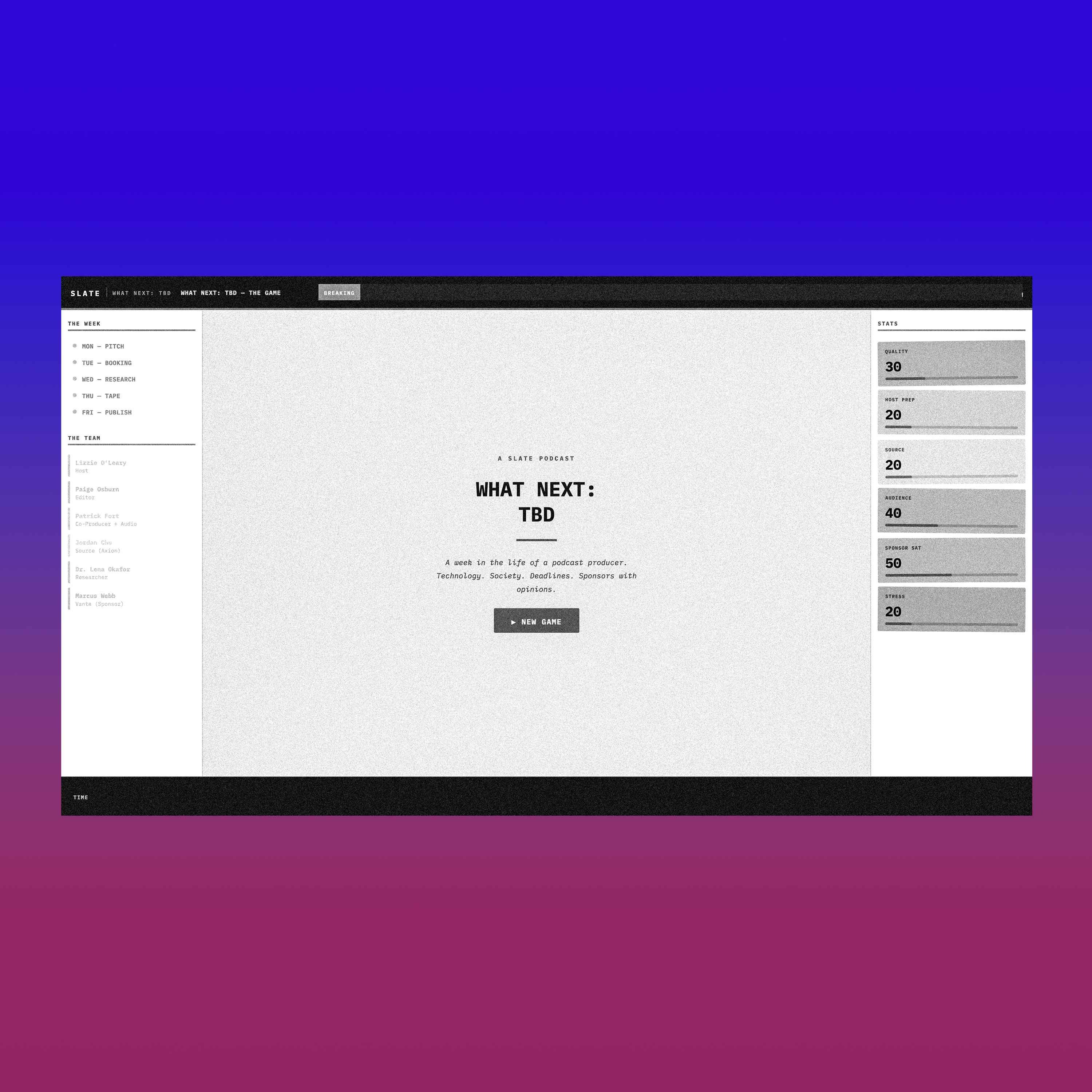
What Next: TBD | Tech, power, and the future
TBD Tries... Vibe Coding
00:31:16
No computer science degrees—just pure vibes and Claude.
Loading summary
Transcript113 lines
- [00:00]
Lizzie O'Leary
Every idea starts with a problem. Warby Parker's was glasses are too expensive. So they set out to change that. By designing glasses in house and selling directly to customers, they're able to offer prescription eyewear that's expertly crafted and unexpectedly affordable. Warby Parker glasses are made from premium materials like impact resistant polycarbonate and custom acetate. And they start at just $95, including prescription lenses. Get glasses made from the good stuff. Stop by a Warby Parker store near you.
- [00:30]
Paige Osborne
Hey, it's Paige from Giggly Squad. And if you've been thinking about tackling any home or yard projects lately, this is your sign. Lowe's Spring Fest is on. Lowe's Spring Fest is happening right now at Lowe's, featuring great deals to help you refresh your homes and outdoor spaces. Just in time for spring, we talked about airing out your home, and Lowe's is just taking it to the next level. You can save up to 40% on major indoor appliances and and help supercharge your chores. Springfest is happening now, and our best lineup is here at Lowe's, valid through April 22, 2026, while supplies last selection varies by location. See lowe's.com for details. Mulch offer excludes Alaska and Hawaii.
- [01:23]
Evan Campbell
Yeah, totally. Hey, what's up, man? Yeah, he's over there.
- [01:27]
Greg Lavalley
I know.
- [01:28]
Evan Campbell
Yeah, I'm not just talking to myself over here.
- [01:31]
Lizzie O'Leary
A few weeks ago, one of our producers, Evan Campbell, sat down with our colleague Greg.
- [01:37]
Greg Lavalley
You want me to go like this? Yeah, if you don't mind, I can do that.
- [01:40]
Evan Campbell
Just leaning in a little bit.
- [01:41]
Lizzie O'Leary
Greg is not just any colleague. His last name is Lavalley, and he is the Chief Technology Officer here at Slate. Evan wanted his help with a little vibe coding.
- [01:56]
Evan Campbell
So. Yeah, I was telling you before this, I have been trying to mess around with Claude code, and I don't really have any experience coding. I tried to learn C maybe like, two years ago, to mess around in Unity, and I gave up almost immediately.
- [02:11]
Lizzie O'Leary
Vibe coding suddenly feels like it's everywhere. It's the idea that anyone can. Even someone with no coding background can use agentic AI like Claude code to program for you. You could say, hey, build me a game, or, hey, build me an app that organizes my life. And theoretically, the AI can do it in a matter of minutes.
- [02:35]
Evan Campbell
And when I went to try and install Claude code, I thought it would be really easy. And I was, like, instantly turned off by the fact that I had to open up the terminal.
- [02:43]
Greg Lavalley
Yes.
- [02:44]
Evan Campbell
Put, like, a JS node. It was all just.
- [02:46]
Greg Lavalley
It's a Foreign language to me and to the, you know, to the software engineer. I know what all of these things are.
- [02:53]
Lizzie O'Leary
That's Greg again, an actual software engineer.
- [02:57]
Greg Lavalley
Claude code is specifically designed for people who already write software.
- [03:05]
Lizzie O'Leary
But the way it's marketed and the way everyone talks about vibe coding, is that some total dummies. And you can guess who the dummies are in this scenario, could work with AI to write code. So we roped Greg into taking on this challenge with us. We are, after all, the people who made a meme coin out of 40 bucks that was briefly worth almost $2 million. Could we, the TBD team, with almost no coding experience, very little time, and a terrible sense of humor, Vibe code our way to fame. Could we follow through on every tech CEO's dream of replacing human labor? That's what we wanted to find out. But to accomplish that, we needed Greg's help in getting set up. First, you gotta get into the computer terminal. That's where you're typing commands into the operating system.
- [03:57]
Greg Lavalley
Now we're in our directory where we want to make our projects. And now you should type Claude, because then you can give it access to the whole kit and caboodle. And then you're going to get some prompts, and I'm not sure what the latest ones are.
- [04:06]
Evan Campbell
This looks similar to what I saw before.
- [04:09]
Greg Lavalley
All right, choose dark mode.
- [04:11]
Evan Campbell
Do I just click it?
- [04:12]
Greg Lavalley
Yeah, I know. You hit enter.
- [04:13]
Evan Campbell
There's no clicking, no click.
- [04:15]
Greg Lavalley
Your mouse is gone.
- [04:22]
Lizzie O'Leary
After fumbling around with the terminal for 30 minutes, Evan successfully set up Claude code. At least the AI was interacting with the terminal, but Evan was a little out of his depth.
- [04:34]
Evan Campbell
Now it's asking. The git command requires the command line.
- [04:37]
Greg Lavalley
Developer tools. Okay. Oh, yeah, you're gonna have to install those. Okay, so. No, it's all right.
- [04:46]
Lizzie O'Leary
After another 20 minutes of fumbling, voila. Now it is time to pretend to be a real coder. All thanks to Greg. Again, an actual real coder.
- [04:56]
Greg Lavalley
And that's kind of it like, that's the thing is, like, we're all so used to using this to get around our desktops or laptops that we're very used to it. And so they kind of have an expectation of that existing level of, you know, knowledge.
- [05:10]
Lizzie O'Leary
But knowledge doesn't always seem to be enough to help engineers keep their jobs. 2025 was a brutal year to work in Silicon Valley. Some estimates say more than 150,000 people lost their jobs. And it's not just tech workers. Entire industries are being upended with each new development in agentic AI. There's talk of a white collar labor crisis with everyone from attorneys to accountants to, yes, journalists on the precipice of irrelevance. It's weird, it's scary, and if it's real, it might be revolutionary. Today on the show, TBD tries to vibe code. I'm Lizzie o' Leary and you're listening to what Next tbd, a show about technology, power and how the future will be determined. Style Stick around.
- [06:11]
Sponsor/Advertiser Voice
This episode is brought to you by Pebble. Hiring is hard to do. I've been there. From the hundreds of applications and dozens of interviews to the actual back and forth of onboarding, it turns out hiring new help is actually a lot of work. But that's where pebble can help. Pebble is an AI powered global human resources platform built for founders, HR leaders and operators who are hiring and supporting teams around the world. Pebble is designed to help you hire, pay and manage talent in over 185 countries. With fast onboarding that can be done in minutes, you can send offers to anyone in the world and get them onboarded fast. Instead of juggling separate tools for contracts, payroll, benefits and compliance, pebble brings everything together with built in guidance and local expertise to support you. This is especially helpful if you're managing teams internationally or planning to grow your business. Some of the fastest growing companies in the world use pebble to stay organized and reduce risk because you can use it to scale faster without feeling like you need to become HR or compliance experts. Bottom line pebble simplifies global people operations so you can spend more time growing the business and and supporting your team. Pebble's new standard discounted pricing at $399 per month per employee helps you contain costs. Go to HYPL AI to get a free estimate that is H I P E B L A I for a free estimate.
- [07:36]
Lizzie O'Leary
Today's episode is brought to you by Quo, spelled Q U O. Spring is here. That means it's time for some spring cleaning, including streamlining some of the messier parts of your business. Quo is the 1 rated business phone system on G2 with over 3000 reviews built for how modern teams work. That's why more than 90,000 businesses, from solo operators to growing teams, rely on Quo to stay connected, professional and consistently reachable. Your entire team can handle calls and texts from one shared number. No more missed messages or disconnected conversations. Everyone sees the full thread, making replies faster and customers feel genuinely cared for. It's easy. Calls, texts, voicemails, transcripts and contact Details all live in one clean view with full context at your fingertips. Your team communicates faster, stays aligned, and delivers a more personal experience. Make this the season where no opportunity, a no customer slips away. Try quo for free. Plus get 20% off your first six months when you go to quo.comtbd that's quo.comtbd quo. No missed calls, no missed customers. This episode is brought to you by Duck AI, a new product from DuckDuckGo. It's. It's 2026, and the news is full of AI. It can be a little overwhelming, especially because it's easy to wonder if what you are asking a chatbot is really secure. That's why DuckDuckGo built Duck AI. Duck AI is designed to let you chat privately with the same AIs you might already be using. You go to Duck AI and they promise you can chat privately with the same AIs you might already be using. And your data stays yours, not theirs. There's no signups, it's completely free, no subscriptions required. And it's from DuckDuckGo, the company known for protecting your privacy, not collecting your Data for nearly two decades. If you want to use AI but you're concerned about privacy, visit Duck AI TBD today. That's Duck AI TBD from DuckDuckGo, where AI is always optional and designed to be private.
- [10:05]
Evan Campbell
Okay, let me share my screen with Claude.
- [10:11]
Lizzie O'Leary
Code installed. Evan and I needed a project. I work in the New York bureau. He works in dc. So we met over Zoom.
- [10:21]
Evan Campbell
So my. My thought is that Sleep makes web games similar to, you know, a lot of different media companies. And when I think about Vibe coding and my lack of expertise or knowledge at all in. In code, I. I want to. I. I think of web games as a really simple sort of product that shouldn't be too difficult for us to create using some sort of, you know, AI agent or just via Vibe coding. So.
- [10:54]
Lizzie O'Leary
So we're gonna Vibe code again?
- [10:56]
Evan Campbell
Yeah. My thought is maybe we can Vibe code a game. Maybe we can present it to Slate. Maybe it'll be a hit. Maybe they'll love it. Probably not. Who knows?
- [11:04]
Lizzie O'Leary
But, like, maybe we'll create a new revenue stream.
- [11:07]
Evan Campbell
Yeah. Yeah, exactly. Maybe we can get some new subscribers or something.
- [11:12]
Lizzie O'Leary
So this is where I confess that the idea of Vibe coding a game was not wholly original. In researching this show, Evan talked with a lot of the engineers at Slate about how they use AI, and it turns out that agentic AI is really helpful for making games, which makes sense. Before Vibe coding, You'd have to write it out by hand, a highly technical process that might take weeks or months. It would take ages before you could even test whether your game was fun. But with Vibe coding, you can make a decent prototype in about an hour. If you have ever played the Slate game Pairs on our website, guess what? It began as an idea from writer Dan Kois, and the prototype was partially Vibe coded by Slate's CEO, Dan Cech. Good job. Various Dan's. So there was at least a chance that if Evan and I came up with something good, it might actually get made.
- [12:10]
Evan Campbell
I've been noodling on a couple ideas.
- [12:12]
Lizzie O'Leary
Ooh, please.
- [12:13]
Evan Campbell
The easiest one for us is to probably do some sort of like, what is it like? Like a game centered around us, like a. A week in the life of a TBD producer, you know, and just sort of like create some sort of like
- [12:29]
Lizzie O'Leary
Oregon Trail for podcasts.
- [12:30]
Evan Campbell
Yeah, quite literally, yes.
- [12:32]
Lizzie O'Leary
It helps to be specific when you are telling the AI what to do. So after a little discussion, we landed on our initial prompt for Claude, which
- [12:42]
Evan Campbell
was, I want to make a web game around the premise of being a podcast producer for Slate's what Next TBD podcast. The game should be a mixture of narrative and simulation and show what it's like to be a producer over the span of a week.
- [13:17]
Lizzie O'Leary
Okay, well, let's think about our workflow. We have a story idea, guests who could talk about that specific story, the logistics of trying to get those guests, and then the interview and production of that interview.
- [13:35]
Evan Campbell
Right, right.
- [13:37]
Lizzie O'Leary
That's like five specific tasks. Claude ingested our prompt and started working in the background. Every so often, it would give us a little anthropomorphized update.
- [13:47]
Evan Campbell
Now it's concocting.
- [13:49]
Lizzie O'Leary
Oh my God, I hate this. I got annoyed at the AI being cutesy, but we let it do its thing. Right now, this kind of scenario, but with much higher stakes, is playing out in industries all over the world. The future of certain jobs and companies might actually hinge on this. Let's say you want an app to organize your life. You could pay a monthly subscription to a software as a service company and use the platform that they maintain and update. Or you could tell an AI agent to make. Make you an app to organize your life that has X, Y and Z features and that would theoretically be free forever. I knew I needed someone to help us make sense of whether any of this is smart, ethical, or even any good. So we called journalist Clive Thompson.
- [14:42]
Clive Thompson
You'd be surprised. You'd be surprised how useful these Weird little tools can be.
- [14:48]
Lizzie O'Leary
Clive is a contributing writer for the New York Times and the author of the Making of a New Tribe and the Remaking of the World. Clive says the biggest selling point for using AI to help code is just time and saving it.
- [15:06]
Clive Thompson
Code is kind of doing the same thing over and over again. Most of it, you know, we think of it as being this kind of, you know, you're sitting down and it's these skull king, you know, amazing thinkers who are, you know, coming up with brilliant new algorithms. They only have to, very rarely do that. Most of the time they're kind of doing the same thing over and over and over again. They're doing the obvious thing, the thing that is right at the statistical average of what all code is written. And of course, that's exactly what large language models are really good at, doing the obvious thing. So they're very good at writing a lot of that code. And you basically say, well, you know, write a bunch of typical inputs that would go into this thing and what the expected outputs should be. And let's see if it, if it does that, like, you know, like, does it solve the problem right? Does it do the math right? Does it, does it. If you put in this text string, will the right text string come out on the other end? And if it doesn't do it right, you know, it'll, it'll produce some errors and the agents can look at those errors in this, in this really fascinating way. You literally have like four, they call it a swarm of agents all working at the same time. One of them's writing the code, one of them's testing it, one of them's looking at the errors that come out of the tests and another one is saying, okay, now you gotta fix that. And they'll sort of just work in the background, you know, for 10, 15 minutes or so until they'll say, well, it passed this many hundred tests and we think it's good. So it's quite amazing.
- [16:34]
Lizzie O'Leary
Clive says AI coding agents can do a lot of the grunt work. This then allows a software engineer to think about the big picture, like what purpose a piece of software really serves. In a recent piece in the Times, Clive said being a senior coder is now much more being an architect than builder. If you add to that an industry that was already shedding people post Covid, you have a new layer of uncertainty. Imagine you are 22, finishing up your computer science degree. You can write code, but you need real world experience to grow network and build something. You can show off, you need to start your career. But if Claude can do the work a company would give a junior programmer, that puts you in a very tough position.
- [17:22]
Clive Thompson
Eric Pinjolfsson, the Stanford economist, did a study where he looked at how exposed a form of white collar labor was to AI and whether it had had any layoff issues. And sure enough, it turns out that software developers are very exposed to AI. And there was 16% fewer jobs available for younger entrants, like people around the age of, you know, early 20s to mid 20s. But the people at the mid tier, the senior people, they had just as many jobs available. So that is exactly what you'd expect to see if you were perceiving the beginnings of a world where a company could say, huh, you know, our senior developers, we used to hire young people to do the grunt work for them, but now we can have these agents do the grunt work for much less money.
- [18:25]
Lizzie O'Leary
So what would the tech industry look like without junior programmers, the tens of thousands of people doing the job right now? We asked Clive to imagine that future.
- [18:38]
Clive Thompson
I can sketch out a couple of the plausible scenarios that people told me. One is exactly this danger where, where for the next 10 years the industry contracts in size because these companies just don't feel the need to hire new developers. In this vision of what happens, they have these senior developers and they can say, we can make them so much more productive that we don't need to hire as many junior developers. Now, I heard over and over again a completely competing version of that, which is that because agents make every individual developer potentially much more productive than they were before, that also makes it easier to hire new people, because one of the problems with hiring a new person is what they call the onboarding problem. They have to learn the way that the company works. There's this mystifying, huge code base that they have to be taught, what are its components? What does it do? I've heard the estimate that it takes $17,000 of senior developer time to sort of mentor and bring on board someone new. And I can tell you that having talked to companies that have brought new people on nowadays, they can just sit them down with a large language model and say, okay, ask the model how our code base works. Talk to it, tell it to, you know, look at this piece of code, explain this piece of code to me.
- [19:58]
Lizzie O'Leary
But then there's a third possible scenario, and Clive's pretty confident that this one's going to happen.
- [20:05]
Clive Thompson
There is a massive number of companies out there, smaller and mid sized companies, and when I say smaller, I mean they might be doing $70 million in business. Like they might be a concrete manufacturing company in Staten island here in New York City. And they are perilously underserved by customized software. They have two options. They can use a spreadsheet to run their entire firm and most of them do. They're using some spreadsheet on a version of a Windows XP machine that they're afraid to update from 15 years ago and that is running their third 50 million dollar year contract mixing company and they hate it. Right now they could hire someone. Like they could hire me, a hobbyist coder who could take Claude and say, okay, we're gonna tell me all your business specs and I'm gonna write some apps that do this for you. And you know, one person can now do that for them. Like they, they couldn't have that customized software because they would have had to hire five to 10 people to do it. Now they could hire one person, maybe even a part time person and they can get that.
- [21:01]
Lizzie O'Leary
But if that happens, what does it do to the value of a coder? Not just for individuals, the people who are getting good pay packages and benefits and roads to a solid career, but something more societal. Would we have to change our idea of the profession? Would the snarky line learn to code not mean anything anymore? But if anyone can do what Clive is describing here, why wouldn't they? And would programmers stop being special after the break? We put it to the test. We make our game and see what the coders here at Slate think.
- [21:51]
Greg Lavalley
AI is transforming customer service. It's real and it works. And with Fin, we've built the number one AI agent for customer service. We're seeing lots of cases where it's solving up to 90% of real queries for real businesses. This includes the real world, complex stuff like issuing a refund or canceling an order. And we also see it when Fin goes up against competitors. It's top of all the performance benchmarks, top of the G2 leaderboard, and if you're not happy, we'll refund you up to a million dollars, which I think says it all. Check it out for yourself. At Fin AI, taking care of your
- [22:22]
Lizzie O'Leary
eyes shouldn't be a hassle. That's why Warby Parker is a one stop shop for all your vision needs. Our prescription glasses and sunglasses are expertly crafted and unexpectedly affordable. Stop by a nearby store or use our app to virtually try on frames and get personalized recommendations. Did we mention we offer eye exams and take vision insurance too for everything you need to see, head to your nearest Warby Parker store or visit warbyparker.com today. That's warbyparker.com. By now you've been listening to this episode for about 20 minutes. That's roughly how long it took Claude to come up with our game. After thinking about it and running some mysterious functions in the background of the Claude app, it presented it to us.
- [23:11]
Evan Campbell
So now it's showing us this plan. It just spit out this plan for us in just like a normal text. Like I said, like a one page. And at the top of the the one pager it says context building, a brand new web game. And then it says within my finder in the folder that we've directed to. It's the same premise podcast producer for Slate's what Next dvd but with a different visual aesthetic, newsroom chaos and a bigger simulation layer. I'm adding time and slot management versus pure narrative branching. Then it tells us a little bit about the code stack, like plain HTML and CSS and JS and IBM Plex Mono and there's a local storage save key and the dev server that it's going to be on. And it's all gibberish to me, but
- [23:55]
Lizzie O'Leary
like that's the whole point of Vibe coding. We're not supposed to have an idea.
- [23:58]
Evan Campbell
Yeah, yeah.
- [23:59]
Lizzie O'Leary
We wanted our game to sort of represent the experience of working on this show. So we told Claude to make the characters in the game resemble us. Evan is the main character, Paige is our editor, Patrick is Evans co producer and I'm the host.
- [24:16]
Evan Campbell
On the left of your screen you're going to see a week calendar and a character roster. In the center you're going to see an action card grid with narrative scenes, day ending, ending screens. On the right of your screen you're going to see six sticky notes, stat blocks, a stress thermometer and a coffee meter. And at the top you'll see a day indicator, a scrolling news ticker, and at the bottom a slot budget meter and and day bud.
- [24:41]
Lizzie O'Leary
In the game we have a show sponsor, sources with whom we cultivate relationships, a few metrics for the Evan character to hit, and six unique endings based on what choices the Evan character makes for narrative tension. We decided to make the sponsor someone actively trying to meddle in our journalism. His name is Marcus and he runs an imaginary company called Vanta. We told Claude to amp up the conflict in the game. Here's what it spit out.
- [25:09]
Evan Campbell
Marcus Webb, the sponsor, isn't just a passive sponsor wanting mid roll placement. He actively has a problem with the episode being produced, he's heard about the angle. AI Whistleblower, apparently. Regulation critique. Which regulation?
- [25:23]
Lizzie O'Leary
You know, sure, what regulation.
- [25:26]
Evan Campbell
And is trying to intervene, calling Paige, sending notes, suggesting the episode be softened, threatening to pull the Vonta deal. The player must decide how to accommodate him. High sponsor sat now comes at the cost of editorial integrity, creating real tension with audience, audience trust and episode quality.
- [25:45]
Lizzie O'Leary
Should we make Paige, me, the Paige, be the bad guy?
- [25:47]
Evan Campbell
And we could say, paige, your editor is wanting you to balance or is. Is.
- [25:54]
Lizzie O'Leary
Your editor says, we need to meet our, like, quarterly revenue goals, and this sponsorship would do that. Just to be clear, this doesn't happen in real life. We do not change our journalism to make sponsors happy, and Paige would never ask us to. But a game needs tension. So sorry, Paige. We love you. At this point, we were happy with the plan Claude presented us. So we told it to start coding. After about 30 minutes of percolating and thinking, Claude spit out a functional game. It gave us screenshots and let us play with it in the app. And our game was not great.
- [26:34]
Evan Campbell
So I think it's about to show us the game that we've just made.
- [26:37]
Lizzie O'Leary
Do it, Claude.
- [26:40]
Evan Campbell
Oh, my God, that looks horrible. What is that? What is this part?
- [26:46]
Lizzie O'Leary
We told Claude to stop and remake the game in a more slatey aesthetic. It asked to access our browser. We said yes, which would definitely flunk us in any IT security course. And then about a minute later, it spit out a new design for the game that looked kind of slatey.
- [27:04]
Evan Campbell
Oh, there it is.
- [27:06]
Lizzie O'Leary
Next tv.
- [27:07]
Evan Campbell
Slate podcast. What? Next tbd. A week in the life of a podcast producer. And then it's, like, really hard to read.
- [27:13]
Lizzie O'Leary
It's extremely real on the left.
- [27:15]
Evan Campbell
I can't really make any of that out.
- [27:17]
Lizzie O'Leary
All right, I'm going to have to, like, what the is this? These are our stats.
- [27:22]
Evan Campbell
Yeah, it looks like we have stats on the right. There's, like, a source stat, an audience stat, a sponsor stat. I'm guessing this is just, like, opinion, or, like, if we're pleasing them or angering them, why don't we just start playing it? Let's just see how it goes.
- [27:36]
Lizzie O'Leary
The goal of the game was to make it through the week and hit various satisfaction scores in different buckets. It was functional. The various buttons and bells and whistles work. We had to try to keep doing journalism with the scary sponsor breathing down our necks. And we did. It was fine. At this point, it was time to pitch our game to someone at Slate. So we sent it to Greg to Get his verdict?
- [28:04]
Greg Lavalley
Yeah, well, I didn't read any of the instructions because we've also noticed that, you know, we have games on slate.com and I'm highly involved with the team that develops those games, especially in the prototyping phase ways. And no one reads the instructions. So if you really want to test a game, you shouldn't read them. So I didn't, and then I played it.
- [28:25]
Lizzie O'Leary
And what did you find?
- [28:28]
Greg Lavalley
It was kind of, you know, I wouldn't say the most exciting game to play. There's a lot of reading involved, and I clicked a lot of different things, but without really knowing what my goal was or what was going to happen after I clicked each of them. So I just went to play it again, but I have to use a different browser because it's kind of stuck on the me losing phase of the game. So now I need to play it again and try to win, but I should probably read the instructions to figure out what winning means in this game.
- [29:03]
Lizzie O'Leary
Okay, so not a ringing endorsement.
- [29:08]
Greg Lavalley
I think at the end of the game, what I got even by not winning was to understand that there's a lot more to it than even I realized. Having been at Slate 10 years, I had no idea what goes into making a podcast and what kind of research there is. Now, is somebody going to come away from that learning experience thinking that it was a fun game that they'd like to do again tomorrow? I'm not sure.
- [29:30]
Lizzie O'Leary
Greg is not wrong. Our game is bad. But in thinking of this as an exercise in learning how to Vibe code, we wanted to know if there was anything about the way we prompted Claude that could have made it better.
- [29:44]
Greg Lavalley
I mean, there was some stuff at the end that was great, which is just sort of like, how do I put this on the Internet? Which I love, because that's like, the kind of thing that I would never have to ask of anything. And it's always this funny thing of, like, Vibe coded things where when the person Vibe coding the thing has never published anything online, of course they're going to ask this question that to those of us that have been doing this for 20 or a long time are like, why would you possibly ask? It's like, how do I open a book? It's like, well, there was some good stuff, too. Like, I was. I was impressed at, like, how Evan knew enough to say, I already made a thing. Can you just take that thing and do something else with it? Which is what I kind of recommend to people when they're dealing with these is like, figure out where it stops being capable. But try everything first because you have no idea and neither do the people that make the black box sometimes what it's going to be able to come up with.
- [30:38]
Lizzie O'Leary
So we also sent you the code for the game. I don't know if you had a chance to look at that. I am curious, as someone who is an actual professional, what you thought of it.
- [30:51]
Greg Lavalley
Sure. Well, you know, given how my job is now, the first thing I did was ask Claude what had thought of it. Oh, you always have. The thing that wrote it, review it, which was really funny. I think I have to go find One of the things it said was like, wow, this is coded by a professional coder. And then I told Gemini that it should review it and that it was coded by Claude. And Gemini was like, well of course this was coded by a machine. Look at it. So it was great because they're also sycophantic and want to make you feel good. Yeah, it was interesting. So like if you take a look at this code, it wasn't to me the most readable thing. I think to a machine it would
- [31:32]
Lizzie O'Leary
be again, think of the junior programmers of the world who before AI would be in charge of reading and managing small parts of a code base. If Greg, who has been doing this for 20 years, can't read the code, what hope does an entry level programmer have?
- [31:49]
Greg Lavalley
We're entering this era where maybe only the machines will be editing the code and it doesn't matter whether I can read and edit the code in any way. The same way that I cannot read or edit machine code. I can read it in Python or SQL or JavaScript, but I can't read or edit the things that it's compiled to. So it may never be that I need to read Evans 3 file game, but I would expect it to be more than three files if I was using an actual programming framework or programming
- [32:20]
Lizzie O'Leary
language at the same time. Vibe coding means you can just try stuff constrained only by the computing cost.
- [32:29]
Greg Lavalley
We have a small number of full time software engineers at the company. They are mostly working on new features, trying to make sure that we increase membership, those sorts of things. If somebody came up to them with I have a fun idea for a word game that's not part of their existing roadmap or priority structure, but if somebody comes up to them with a Vibe coded prototype and says if we run this through the design department and the product department, we might be able to get this online in the next two weeks, I think now you're talking. So now, especially since the releases of Claude code in, I think, November, December of last year, I would say that we would be surprised if someone wasn't using it to prototype the game. And we've had some game ideas. Last week, one of the product managers asked, how do I get this in front of the games team? And our response was, Vibe, code it yourself in Claude and then put something on our calendar next week and we'll decide if it's interesting. Instead of get it on the roadmap, have the team estimate it, go to design team with mock ups. Now you can walk in and say, this is about what I think it should look like and just do it yourself. And that's. I mean, this is like a change in the last eight weeks.
- [33:44]
Lizzie O'Leary
It's that fast?
- [33:46]
Greg Lavalley
Yes, it's that fast. So things took us two weeks. People are doing in 10 minutes and they're not even engineers.
- [33:52]
Lizzie O'Leary
All of this is thrilling, confusing and scary. There's so much potential for upending our lives and we don't even really have time in this episode to get into the environmental questions around AI use, which are considerable. Remember, Greg is the chief technology officer at Slate. He's not some lowly junior programmer, no offense. I asked him how he thought about this question of programmers somehow becoming obsolete.
- [34:24]
Greg Lavalley
I'm not scared because I think that for the people that understand product development and design, this is another tool that will mean having to do what some would call, you know, the grunt work of making the thing. Now we get to focus on describing the thing and thinking about Edge cases. We also have a backlog of work so big at Slate, of the things that we'd love to have done, but rarely have the time or capacity to do that. It's possible this will free all that up and we'll spend our time actually doing those things that we never thought we'd get to.
- [35:07]
Lizzie O'Leary
With Vibe coding, ideas become cheaper. Any idea, no matter how dumb, can be made in mere minutes. Maybe you want to make the next web game for the New York Times or Slate and it's actually good. But not everyone is an ideas person, and not every idea is good. Millions of people don't want to mess around with AI and make something themselves. They want predictable work, stability, and a path to a rewarding life. No one knows what's going to happen to their jobs or whether the cost benefit analysis shows that Vibe coding is worth it. What I do know is that Evan and I still know nothing about code, but we made a game that lives online and that, yes, you can go play right now. If you're interested, we'll link to it in the show notes. Maybe we'll get better ideas and more time to work on them in the future. But for now, we're going to keep making shows as humans by humans, because at least so far, we can still do it better. Is there anything I haven't asked you that you think is important to note
- [36:22]
Greg Lavalley
for this story, other than Evan's readme that came with the game that I think said good riddance coders? Nobody asked me how I felt like that. Yeah, which is great. I'm glad that he was able to edit himself. I wonder. The computer probably feels the same way. It was probably very happy.
- [36:39]
Lizzie O'Leary
It doesn't have feelings, Greg. That's right, it does not have feelings. That is it for our show today. Special thanks to Greg Lavallee and Clive Thompson. What Next TBD is produced by Evan Campbell and Patrick Fort. Our show is edited by Paige Osborne, who is the senior supervising producer for what Next and what Next tbd. Mia Lobel is the executive producer of audio for Slate, and TBD is part of the larger what Next family. We'll be back next week with more episodes. I'm Lizzie o'.
- [37:13]
Sponsor/Advertiser Voice
Leary.
- [37:13]
Lizzie O'Leary
Thanks for listening. Now go online and play our stupid game. Foreign.
- [37:33]
Paige Osborne
Hey, it's Paige from Giggly Squad. And if you've been thinking about tackling any home or yard projects lately, this is your sign. Lowe's Spring Fest is on Lowe's Spring Fest is happening right now at Lowe's, featuring great deals to help you refresh your homes and outdoor spaces. Just in time for spring. We talked about airing out your home and Lowe's is just taking it to the next level. You can save up to 40% on major indoor appliances and help supercharge your chores. Springfest is happening now and our best lineup is here at Lowe's, valid through April 22, 2026, while supplies last selection varies by location. See lowe's.com for details. Mulch offer excludes Alaska and Hawaii hey
- [38:18]
Lizzie O'Leary
everyone, it's Farnoosh Tarabi from the Sew Money Podcast. If you're self employed or running a small business, tax season can feel overwhelming, especially if you're doing it all on your TurboTax. Experts for business is here to help. They match you with an experienced expert who understands your industry and works with you to save money by finding every deduction and maximizing your savings. They're there to help you every step of the way, virtually or in person to help you prepare and file your taxes. Plus, you get unlimited year round tax support at no extra cost, along with audit protection and seamless integration with other intuit tools like Quick QuickBooks. This tax season, skip the stress and get expert help. Learn more and find a tax expert in your industry@turbotax.com business.