← What the Fundraising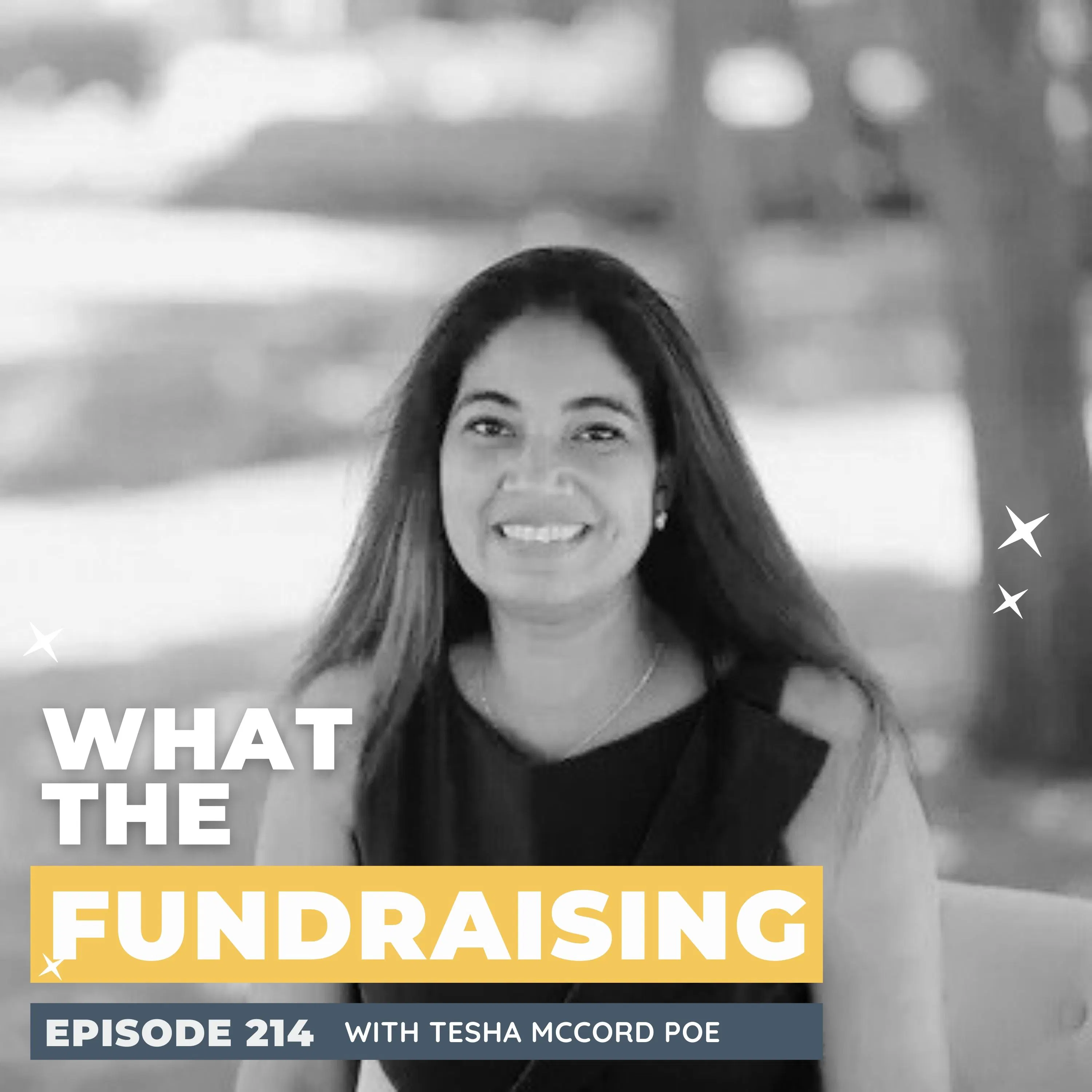
What the Fundraising
214: Fostering Hope and Joy in Fundraising and DEIB: A Conversation with Tesha McCord Poe
00:29:43
Loading summary
Transcript42 lines
- [00:05]
Mallory Erickson
Hey, it's Mallory. Before we jump into today's episode, I.
- [00:08]
Tesha McCord Poe
Just want to give you a name.
- [00:10]
Mallory Erickson
To look out for in 2025. It is rare that I come across a tech tool that's designed to help address fundraiser burnout by actually reducing our overwhelm and making actions easier to do. But I was floored when I saw the magic of Cadenza.
- [00:24]
Tesha McCord Poe
So I want you to keep an eye out for that name, Cadenza.
- [00:27]
Mallory Erickson
Make sure you're subscribed to the podcast and my email because we are going to have some fun Analys announcements coming in 2025 and if you just can't wait any longer, you can go check out what they're building@getcadenza.com that's getcadenza.com I can't wait to hear what you think.
- [00:48]
Tesha McCord Poe
What's important for me is always to dwell on the why. And so what's your mission? Because for one, everyone, all of your constituents have bought into your mission, so we can at least agree on that. So therefore, if everything that I'm doing, all our decisions are rooted, your mission, then have a chance at alignment with you. Have a chance that what I'm trying to compel you to do or buy into, you're more likely to because it's aligned with our mission.
- [01:19]
Mallory Erickson
Hey, my name is Mallory and I'm obsessed with helping leaders in the nonprofit space raise money and run their organizations differently. What the fundraising is a space for real and raw conversations to both challenge and inspire you. Not too long ago, I was in your shoes, uncomfortable with fundraising and unsure of my place in this sector. It wasn't until I started to listen to other experts outside of the fundraising space that I was able to shift my mindset and ultimately shift the way I show up as a leader. This podcast is my way of blending professional and personal development so we, as a collective inside the nonprofit sector can feel good about the work we are doing. Join me every week as I interview some of the brightest minds in the personal and professional development space to help you fundamentally change the way you lead and fundraise. I hope you enjoy this episode, so let's dive in.
- [02:14]
Tesha McCord Poe
Welcome everyone. I am so excited to be here Today with Tesha McCord Poe. Tesha, welcome to what the Fundraising.
- [02:20]
Thank you so much. I'm thrilled to be here too.
- [02:23]
Let's start with you just telling everyone.
- [02:25]
Mallory Erickson
A little bit about you and what.
- [02:26]
Tesha McCord Poe
Brings you to our conversation today.
- [02:28]
Yeah, it's scary when you ask people this question because they might go back to the beginning and I'll just start. The beginning I want to talk about is that I won the parent lottery, and I was born to two educators who believed that anything was possible for me. And so they encouraged me all along the way, and that included making sure that I had the best education that anyone could have. And then encouraged me. Anytime I was on a stage, they were, you know, in the audience. And I. When I early along, I wanted to be an actress, but I was painfully shy, and so that was mostly about putting myself out there. And that reminds me of when I started in fundraising. It terrified me, and I did it anyway. And so for a good part of my career, I worked as a frontline fundraiser raising money for small, independent private schools, mostly in the Bay Area, and sat on leadership teams, doing that often as the only person of color on the leadership team. And that was an amazing experience. I also happened to be a parent in those schools usually. And so I brought a lot of different perspectives to those experiences, which I think helped me as a fundraiser, actually, I could really understand what a parent might be going through when they were being solicited by the school, for example. And a couple of years ago, 2019, October 2019, I founded my consultancy, Joy Raising. And what we do is work at the intersection of fundraising and diversity, equity, inclusion and belonging, work to help organizations to raise more money joyfully. And I have several aims, two of which are to have more folks of color thriving in the nonprofit space, fundraising space, and the second is to have all of us to do that work more inclusively, particularly because a lot of the practices that have worked so far have been, you know, pretty exclusionary, problematic. And I think that we can disrupt some of that and create new ways that are even more successful than what we've done before.
- [04:30]
Yes. Okay, so let's actually kind of just start with your business name, Joy Raising. And let's talk a little bit about both of the things that you talked about, both the, like, fundraising side of things and the diversity, equity, and inclusion side of things. I'm not sure that joy is the first word that pops into people's head when they think about doing either of those sets of work, let alone bringing them together. But I think you and I share a lot of alignment on the critical nature of Joy. Talk to me a little bit about that.
- [05:05]
Yes, and thank you so much for asking. Joy is my middle name, so not only did I get great parents, but they also had a lot of hope for me, and so they actually, you know, intentionally gave it to me. And so that gave me confidence to claim the word because my whole life I've been associated with it at the risk of being dismissed because it was seemed not serious. You know, as a word, joy is not something that, as you said, people don't think about when they're talking about money and race and differences and things that are so hard. And yet when I step back and said, okay, you're going to bring these things together, what is it that you want people to have as a result of the fact that they've worked with you or that they've thought about things differently? And Joy was at the center of both of those. You know, I want people to feel a greater sense of belonging and acceptance and all of those things when we're talking about tib. And I want people to have real satisfaction as donors and real dignity as recipients of voluntary giving. And I want organizations to feel like this is not like a yucky thing for them to do. Often in these schools I was working in, it's like it's something that we do, but we don't really want to see it happening. We don't really want to talk about it happening and don't let it get in the way of the rest of what we do. And so I was trying to turn that on its head and show that no, in fact, when you invite someone to invest voluntarily in your mission, you are really creating an opportunity that brings value to them. And when you do this very strange, irrational thing of asking someone to give up resources when in return, what they're actually going to get is a really nice demonstration of gratitude. That's a kind of ridiculous thing to ask people to do. So if they're willing to do it, I always want them to feel good about having done it and always say, I never want a gift that someone doesn't want to give. You want joyful donors. And so joy was at the center of both of those raising is because as a consultant, it's really important to me that after we've done our work together, you can point to what has changed, whether that's your mindset, whether that's more money you've raised more, whether it's people that you've hired that you wouldn't have considered before, that there's something tangible that has been raised. And there's a dash in the middle of my name of the company. The dash originally was because the URL joy raising was not available. And so I pouted for about that for a few days. And then I remember the dash poem. Do you know it? Okay, that dash Poem. Look it up. It's great. I first heard it as a. At a funeral, which is when most people hear it and it says it it. And I can never remember the author, but it's easy to find that when we die on our tombstone is the year we were born and the year we pass away. And for most of us, we don't choose those years, but we do choose every day what's in the middle, that dash in the middle. And so every day, we should be choosing things that bring us reward, that are aligned with our purpose, that, you know, that bring us hope. And so founding Joy Raising is my dash. Being able to work with organizations that are trying to make the world a little better than they found it is their dash. And I didn't want to forget that poem. I didn't want to go to hear it again at another funeral. I wanted to wake up every day and have a reason to remember my dash.
- [08:28]
Okay, I love that I had no idea what I was sort of opening up there, but, gosh, just the level of intentionality. And it's interesting. I kind of can't stop thinking about the word that you used at the beginning of talking about maybe why some people don't adopt the word joy or even feel kind of dismissive of it, that it's not serious. And I've been kind of, like, sitting with that around, like. And you also talked about, you know, hope when you were talking about those things. And you're right that there's this sort of stoic expectation around whether or not we are taking something seriously. But what happens when what we're trying to, quote, unquote, quote, take seriously, actually requires. Requires hope and joy in order for people to take action. Right? Like, we want our donors to be seriously committed to our causes, and we want them to feel hopeful that they're in the right place for solutions. We want them to feel good and joyful in connection with us, like, all of those things. And we don't seem so capable always of, like, holding the nuance there. And I can't. I don't know exactly the date that this podcast is going to come out, but the case study around this, in my opinion, is going to be looked at for years and years to come, which is around what's happening in the 2024 election cycle now that Kamala Harris looks like the front were right before the last day of the, you know, dnc, but right before Kamala Harris is likely confirmed as the Democratic candidate. And we've seen this, like, massive eruption in the Last, an upheaval, really, around of political messaging, this complete 180 from fear and despair and dread to hope and joy and connection and what's possible. So what do you make of all that?
- [10:31]
Yeah, it's interesting. So I'm heading to Chicago tomorrow. I have a. I had a standing facilitation with the school that I couldn't change, so I couldn't get there yesterday when it started, but I will be there starting tomorrow just to be in the city from Chicago. And what I know is Chicago knows this moment of hope. And I think what is so shocking is how quickly we change from all the despair that you talked about and, like, bracing and readying for, you know, an election cycle that might be really tumultuous. It still might be, but in a different way to immediately this release, the shift of perspective in this release and this groundswell of hope. And what I hope that any, regardless of your politics, what you can take from that is that, oh, gosh, this is moving me. We mostly all have a well of hope that oftentimes we don't have permission to unleash, and it doesn't take much to unleash it. And so can you be in the business of helping people to unleash their hope? Right. I don't know why it's moving me so much, but just the idea of that, like, what if we had missed that? What if we had all been carrying that hope and never had the permission to unleash it, but instead we were going to be stoic? And we were. And if we take it back to, you know, fundraising, we're going to make our goals and we're going to have the events that we've always had. We're going to do it the way we're going to do it, because we're going to keep chipping away at that issue that we care so much about, regardless of what the issue is, but we're just going to keep, as soldiers moving forward towards the goals that we've established, rather than saying, but what if there's more. What if there's a different way to do it? What if instead, we tapped into the best of us, our greatest desires and worked from there, and that's what it feels like we're doing now. And so it's not about poll numbers and knowing what the outcome is. For me, it's more about just being in the space, which is why I'm going to Chicago. I just want to be in the space to breathe the air of all this hope. Right. And I feel like that's going to fuel not only me as a, you know, in this election cycle, but for, you know, just in general. Have you ever breathed the air of a stadium full of hope?
- [12:49]
Wow.
- [12:54]
Mallory Erickson
Hey, it's Mallory. I remember the frustration of managing multiple tools. Payment processors, spreadsheets, CRMs, all while syncing data manually. It was inefficient, prone to mistakes, and worst of all, created missed opportunities to connect with donors. But now there's GiveButter Plus. Designed to simplify your fundraising. GiveButter plus reduces tool management complexity, helps you save time, and most importantly, enhances donor experiences. I'm so excited about this because your time should be spent on building connected relationships, not juggling tools. Start your free 30 day trial today at givebutter.com Mallory.
- [13:39]
Tesha McCord Poe
I am also feeling like a little, I don't know if it's tender here or like, just sort of like that, like in my throat, you know, emotion. And I think it's so important for us to experience hope and possibility. I mean, for so many reasons, right? It's like we can only create the world that we believe is out there to be created, right? Like, no action comes from despair or dread or, you know, all of those things lead to, you know, oftentimes so much dysregulation that we're in states of paralysis, right? We're not taking steps forward. So many people were in this place of like, what's the point? You know, what. And, and we watched it in giving. I mean, we haven't even talked about the amount of money raised in the last month, right? Like, like think about what just happened. Like, everybody. And so I think what's also really powerful is like the, is like how good it feels, right? Like how good it feels to be hopeful, how good it feels to give, to hope. How good, like we think so often or we've seen so many sort of old school fundraising practices that are about fear and anxiety and guilt and like, you know, getting somebody to sort of feel bad enough in a moment that they'll feel better if they give. And so they, we soothe that anxiety, like in the moment. But what are we building? Like, anyone can get a one time favor donation or one time gift donation, but how are we building connection? And like hope is how you do that, right? Like these experiences are how you do that and the speed, to your point, Like, I think there's just something that I've never thought about before. So in my book, I talk about how one of the things that creates a lot of dysregulation for fundraisers and is known to create chronic stress in general is uncertainty. Right. And that's something that we experience in fundraising. There's no getting out of it like it is a part of the deal. And so I often think about, okay, what are the tools to manage uncertainty in our brain and body so that we can, we can handle that. But what you were just talking about, for the first time ever, I'm like, okay, like hope also seems like this antidote to uncertainty. It's not for sure, but all of a sudden we feel this momentum and comfort provided by hope, still about an uncertain future, but it feels so much more manageable with hope.
- [16:19]
Right, right. And okay, so if you think about, like if you said you start your year, you're going to launch your annual fund, and you say, well, what is the risk of not making our goal versus what is our hope for making our goal? It's the same question. The difference is what our expectations about those outcomes. And it would drive me nuts when we, you know, let's say the goal's a million dollars and we're at 500,000 and we're bemoaning the 500,000 we don't have versus the 500 that we do. $500,000 that have been, you know, given voluntarily towards something that we all agree in. You know, and so that's all that was always my orientation was like, it's not that you rest and you don't still have the million dollar goal. Absolutely, you still have the million dollar goal. But I think too often I encountered, you know, a spirit of, I want to say loss. But like, as you described, the anxiousness around what we don't have, what we haven't done yet versus celebrating along the way.
- [17:27]
Yes. And that, I mean, we know from like coaching frameworks and any sort of cognitive behavioral framework that like that orientation is going to create fear, resistance, a lack of action, tunnel vision, like, right. We're not going to see, we're not going to have clarity, we're going to feel that sort of like scattered. What do I prioritize first? Right. Like that's what fear does to us. And so it's like, you're right. It's ultimately the same question. But the way that we ask it of ourselves is what drives then how we or don't, how we do or don't take the next step.
- [18:08]
We're in the wake of the Olympics and I often think about, you know, they talk about the psychology of the silver place, the silver medalist versus the bronze medalist. And this is coming up for me as we're having this discussion. Like, the silver medalist doesn't feel as good as the bronze medalist because the silver thinks they should have. They're so close to the gold, and the bronze is so close to not being on the podium at all that they have gratitude for being on the podium and the silver has. Feels lost for not having the gold is. You know that. And you're the second best person in the world to have done it. Like, you know, it's. I know I'm not an Olympian, but my hope is always that any Olympian would really be able to. To dwell on how excellent they are, because their commitment to their craft, we all benefit from, you know, observing. And so. Yeah, but it does come to mind, like, you know, you can get so close and still have.
- [19:05]
Yeah. Oh, my gosh. That's so interesting. I hadn't heard that. I mean, it makes sense. Like, psychologically it makes sense, but. Yeah, that's so interesting. And to your point, like, there's like this. What to what you were saying before around that sort of like, million dollar goal and focusing on the 500,000 that has been raised. It's like, it's almost as if we think that celebrating success. It's almost if we think that celebrating success is going to, like, have us sitting back and relaxing on a beach somewhere, which, like, happened to no nonprofit person ever when they hit a goal. Right. But it's like we make it so we, like, kind of shame ourselves or each other or culture around celebration. Because to sort of what you said at the very beginning, it's like, it's almost as if we. We think that means we're not taking it seriously.
- [20:01]
Yeah.
- [20:02]
And what a wild expectation for us to just never need to celebrate the things that we have done to experience joy or hope, like, in so many ways we want to. Or we ask nonprofit folks to make things personal, to work overtime because it's personal, to work on weekends because it's personal, to take less pay because it's personal. But then these other ways, like, on the flip side, we're like, and here's where, you know, you should sever it from you.
- [20:39]
Right, right. I think that's pretty prevalent and it's. Yeah, it's pretty problematic, I think.
- [20:47]
Yeah.
- [20:48]
Yeah.
- [20:48]
What are things that you've seen or done with your clients to help them kind of integrate their whole self into their fundraising that then you've watched translate to how they create more integrated experiences for their donors?
- [21:04]
Yeah. Well, I think what's important for me is always to dwell on the why. And so what's your mission? Because for one, everyone, all of your constituents have bought into your mission, so we can at least agree on that. So therefore, if everything that I'm doing, all our decisions are rooted in your mission, then I have a chance at alignment with you. Have a chance that what I'm trying to compel you to do or buy into, you're more likely to because it's aligned with our mission. And so I do a lot of work around our why. And if it's not, what we're trying to do is out of whack with that, let's take a step back and say what happened? You know, because we shouldn't be out of line with our mission. And how do we take that to our clients? I think a lot about dignity in this process. And so I got a real lesson around my practice because three and a half years ago, I was widowed and it was sudden and tragic and awful and my daughters and I needed support. It was hard to receive the support that people were offering. And then I had to step back and I said, wait a second. Your career is around raising resources for people who need them. And you're expecting those people to accept those resources and be okay with that because you've worked so hard to get them and they're so well intended. It's coming from such a good place. But now when people with the, you know, out of just a sheer love for you are trying to support you, you're having trouble because you're in embarrassed or you have shame about the need. I was like, wait, wait, wait. You've got to make sure that the people that are receiving can have dignity in the receipt of it. Because shame is awful. Pity is a. I hate that. I hate being the recipient of pity. And so I needed in my own practice to make sure that I was not enabling pity. And that was really helpful. And so when you think about what am I doing with my clients, they're conversations like that, Right. Would you be willing to be the recipient on the end of the description that you've described of the need? Right. We are not saviors. We are people who care. And if we leave ourselves open to the fact that there may be come a day where we also need, it may not be money. It might not be things that we can point to, but we also have need. You have the humility to be willing to put yourself in their shoes. Truly not with the same issue, but with that you might have any. Because I think Often, you know, we talk about it. We talk about giving as a way, you know, we talked about it as a, like, antidote to guilt about what we have. That really problematic, you know, because so often there's so much privilege in the ability to give. And so, you know, deal with that for before you start bringing it over to someone else to have to carry for you.
- [24:03]
Gosh, there's something here around the relationship to what you're talking about right now, in my opinion, with that hope conversation too. Right. Is that hope driving investment in things, in changing systems, in supporting community members who have been inequitably disenfranchised from having access to the things that your kid has access to, that and recognizing the hope of what a community looks like that continues to address this problem. Like, it feels like those things can happen together almost that, like, hope can be such a powerful, like, framing that then becomes a more equitable framing.
- [24:49]
And I wish, like, again, going back to the speed at which we shifted, you know, this whole thing, I had a chance to speak to an organization that deals with the issue of food instability. And I actually sit on a board of an organization that wants to bring better food to more kids. And so one of the things that's so striking to me about this issue is that we actually have enough food in our country for no one to be hungry. But food instability is such a big issue. Billions of dollars that we spend trying to figure out how to, you know, and so I wish. And it's. It's very complicated and I don't want to presented as if it's a simple issue to solve, but at the core of it, it actually is a simple. We just need to have the will, we need to have the vision, we need to have the direction to solve it, but we have to have hope that it's solvable because otherwise we're going to spend money on it in ways that are never going to solve it.
- [25:49]
Right.
- [25:49]
And it's way bigger of an issue than I have, you know, the mental capacity to solve until we can collectively.
- [25:59]
Decide that we will, you know, and something you're saying that I'm hearing in that tell me if I'm right is like permission in that journey to change our mind, which I think is like, something that this election has also demonstrated. Right. Like, people are really digging their heels in around Biden. Like, I'm like, he's the candidate. I'm standing by. And we're seeing people, like, asking for this earlier. Like, everything was digging and digging and digging in and Then it flipped. And we are allowed to change our mind. We are allowed to change our direction. We are allowed to say, this thing we have been trying to get to work isn't working. And we see another path forward and to bring people along on the journey. And I hear that in what you're. You're describing, too. Yes, it's big, it's complicated, and probably there are a lot of people holding on to their way or what they said would solve it that they know isn't really solving it, but they said it would. And so what it really takes is, like, bold leadership and flexibility and the permission we need to give ourselves to change our mind, change our approach, and then bring people along.
- [27:06]
I think we also have the opportunity to really examine what are we fearing? Like, why are we so right? What do we fear? And if we allow ourselves to do that, then we can see that what we fear is actually not a truth and be okay with the release of that. It may have served, you know, some people for a long time really well, but it's really refreshing. Like her, her choice, her number, you know, her vice presidential choice is such a representation of that very issue. What do we do when we allow ourselves to release ourselves of our fear?
- [27:41]
Okay, that's the perfect note to end this on. Tell folks where they can go to learn more about you and your work and connect with you. I'm so grateful for your time today.
- [27:52]
I'm grateful, too. And, you know, we haven't known each other long, but it felt like lots of great synergy. So I'm looking forward to all that we'll do in the Future. I'm@joyracing.com I'm on Instagram and lots of activity on LinkedIn, and I do a few convenings. One is called the Academy. That's going to be September 27th. I don't know if it'll be done by the time this releases, but it'll be annual and then the summit, which is in Chicago for folks of color and in philanthropy. And I'm, you know, just really enjoying all the ways that I may have been able to connect with people who are interested and really opening the aperture of who we have in this space, thriving.
- [28:29]
Thank you so much for joining me.
- [28:32]
Yeah, take care.
- [28:39]
Mallory Erickson
I hope today's episode inspired or challenged you to think differently. For additional takeaways, tips, show notes, and more about our amazing guest and sponsors, head on over to Malloryerickson.com podcast. And if you didn't know, hosting this podcast isn't the only thing I do every day. I coach, guide and help fundraisers and leaders just like you. Inside of my program, the Power Partners Formula Collective. Inside the program, I share my methods, tools and experiences that have helped me fundraise millions of dollars and feel good about myself in the process. To learn more about how I can help you, visit MalloryErickson.com PowerPartners Last but not least, if you enjoyed this episode, I'd love to encourage you to share it with a friend you know would benefit or leave a review. I'm so grateful for all of you and the good hard work you're doing to make our world a better place. I can't wait to see you in the next episode. Hey you. I hope you're loving all the free value you're getting right now from our guest. And speaking of free value, I've raised millions in the nonprofit space without sacrificing my integrity or my alignment, and I'm sharing how I did it in my free webinar, how to Harness the Power of Prioritization to raise more without burning out. Go to mallorykson.comworkshop to register for the free training right now. I cannot wait to see you there.