← What the Fundraising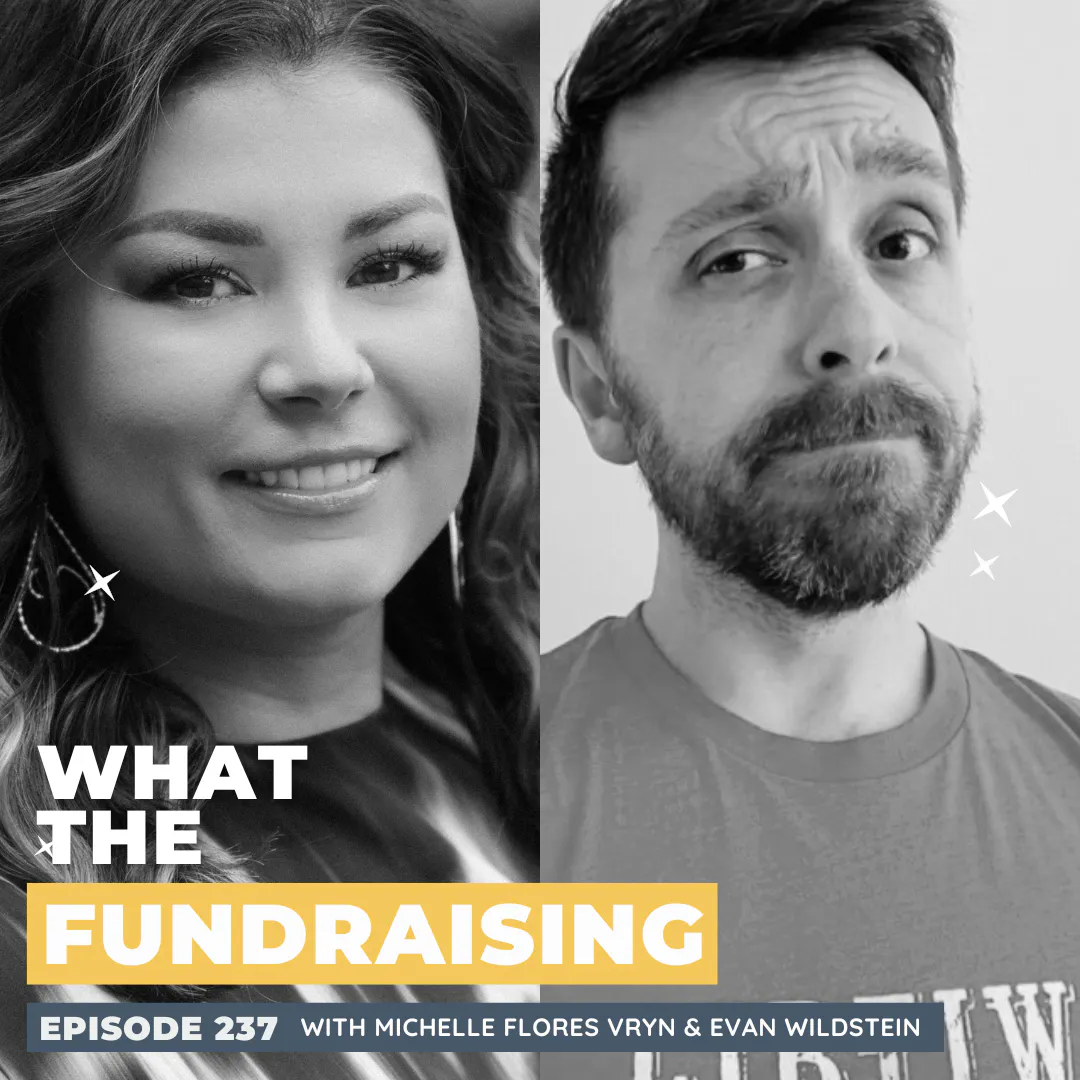
What the Fundraising
237: People First: Rethinking Growth And Retention In Nonprofits With Michelle Flores Vryn and Evan Windlstein
00:36:44
Loading summary
Transcript32 lines
- [00:00]
Evan
There are two of the nine things on your job description that are not serving you or the organization. Let's go back to your JD and you should do this every year. Decision makers and look at those things that are not serving the individual and the organization and the mission. Even though board member from 31 years ago still wants to do it. What the data I think show and I really have to thank Michelle for helping me uplift this in my brain is look for those moments of opportunity with your teams because a healthy staff and we for thinking on the fundraising side lead to healthy relationships with donors.
- [00:32]
Mallory
Hey, my name is Mallory and I'm obsessed with helping leaders in the nonprofit space raise money and run their organizations differently. What the fundraising is a space for real and raw conversations to both challenge and inspire you. Not too long ago I was in your shoes, uncomfortable with fundraising and unsure of my place in this sector. It wasn't until I started to listen to other experts outside of the fundraising space that I was able to shift my mindset and ultimately shift the way I show up as a leader. This podcast is my way of blending professional and personal development so we as a collective inside the nonprofit sector can feel good about the work we are doing. Join me every week as I interview some of the brightest minds in the personal and professional development space to help you fundamentally change the way you lead and fundraise. I hope you enjoy this episode, so let's dive in.
- [01:26]
Michelle
Welcome everyone. I am so excited to be here today with two people that I just adore and follow and listen to. Michelle and Evan, welcome back back both of you to what the fundraising. I want to start with you guys just introducing yourselves, your work and particularly what brings you to our conversation today and then we'll, we'll dig into it. Michelle, do you want to kick us off?
- [01:47]
Sure, yeah. So I usually introduce myself as, you know, a career fundraiser, but I actually started out nonprofit comms. So I have like this interesting mix of nonprofit communications and fundraising. I have a lot of affiliations but some that are, I think are important to this conversation include I am a community sec, Community Centric Fundraising Texas Chapter founder and current organizer. And I've been doing that for over four years. So very involved in the CCF movement and I also sit on the AFP Global Board of Directors.
- [02:19]
Amazing. Evan.
- [02:21]
Evan
Oh me now that's good. Hey, it's Evan, your friendly neighborhood Nonprofiteer, longtime listener, second time caller been is my 22nd year in this sector. I spent 99.99% of that in house as a practitioner about the first half of my career, career in programs and operations, the last half in and around philanthropy day job and the soul filling job is head of advancement for great Montessori School here in Houston. And the passion projects that I get to do nights, weekends and on the side with folks like Michelle and Tasha Van Vlack is uplifting the stories of what's working in nonprofits and what's not and what ought to be better. One such project is one that we'll get into today, I'm sure.
- [03:00]
Michelle
Yeah, we're going to get into it right off the bat. So you all have been leading this, you know, social impact staff retention project and do one of you want to start and just sort of give the kind of story behind it and what it is to frame it up before we dig into some of the results of it?
- [03:16]
Evan
I'll go this time because Michelle and I have the sort of trade off trade show when we get to talk about this project. But we're recording this. I don't know when it'll come out, but we're recording this the day before the full results will go live for 2025. So rewind back a couple years. I think it was 2022. 2023. The 2022. Michelle and I led a session for AFP Houston here on. You know, it was that moment in post pandemic, I use air quotes time when the field was talking very loud about staff wellbeing and staff care as like issue number one right at the forefront. At the time, Michelle and I were both in house practitioners on the philanthropy side. And in addition to just speaking openly and writing about this, we thought, wow, it'd be great to collect some data that didn't have a sales pitch at the end. What we found from a lot of peripheral partners, the consultancies, the coaches, the vendors that they're all collecting good data with the end result being we've helped you figure out that X is wrong. Hire us to help fix X. Nothing wrong with that biz. Dev is the thing everyone should do. But we felt if we could collect some great anonymous data from nonprofiteers in the US because that's a near 13 million person market, we'll get to Canada one day, we'll get to Europe one day. Don't hold me to that. But we'll work on it. We wanted to see what practitioners would tell us openly anonymous. I know that sounds weird, but it's. They could leave their email if they wanted to. But folks, starting in fall 2023, we collected data, told that story in 2024, late 2024, we collected data for 2025 and we're about to tell that story. So that's it. It's all freely available, open. We've had hundreds of people participate. So we have a really good sample group. And that comes from fundraisers, executive directors, marketing people, programs, people from all different corners of the nonprofit sector, all different years of experience. So we're tracking some really cool things and it's telling what we think is a very moving story that we hope you decision makers listening to this show and all the other shows will take into account as you're thinking about future years, future year budgets, et cetera.
- [05:15]
Michelle
So I remember when you, when you came out with the first report and my book was already in its like production mode, and I was like, oh my gosh, this is the data that I wish I would have put in the book. Obviously a lot of overlapping themes and concerns about the sector. And I'm curious, like, can you give us maybe Michelle, you kicked this off. Like, what is some of the high level, what are we learning from this? And you can talk about 2024 if you aren't ready to give us everything in 2025. Although, you know, we love a good teaser and this won't come out till after anyways. So. Yeah, tell us what's inside. What can we learn from this?
- [05:50]
Well, we love the what the fundraising audience. So we are fully prepared to share everything, all the hot off the press details with you. So I'll start with 2024. The top line was 7 in 10 people were in the following year that they took the. Let me make a clarifying point. The data is usually collected in the fall and then release in spring. And so in both years we had the same top headline, which was seven in 10 people were considering looking for a new job the following year. So seven in 10 in 2024. Seven in 10 in 2025. So unfortunately, that really hasn't budged between those two years. Going a little more deeper into 2025 results. You know, one thing that I think Evan and I really want to do is uncomplicate the data. So you can tell the way that we present it is very clear in the full report. And what we clearly see is people are leaving for three top reasons. The number one is they feel that they have too much responsibility and not enough support systems to reach that level of responsibility, which I'm sure there's some head nods from listeners right now. The number two reason as to why people are leaving is they feel like they don't have obvious or clear growth pathways in their career, which we can dive into more. But I'll round us off here on the third reason people are leaving is just unsupportive management or executive leadership. So I think, you know, the thing that's interesting when we pull these data is no one said like, wow, I'm shocked. I've never heard any of these things before. But I do feel like if we can really hone in on the relationality between these things, Too much responsibility, not enough support, no clear growth opportunities and their role, and then unsupportive management. It's almost like not three separate issues, which I find comforting. Right. Because I think when we look at this from a landscape view, it's like, oh, my gosh, everything is going wrong. And I don't believe that. I feel like there are some key leverage points here that we can manipulate to have a lot of positive downstream effects.
- [08:10]
Yeah. You know, it's interesting hearing you say that because I had a little bit of a similar experience with the book. Like when I correlated these results, like these staff burnout to giving declining. And I was like, this might sound like, wow, it's all bad news, but I was sort of like, actually, because I think they're related to the same thing, declines in giving. And, you know, because what is happening and how a fundraiser feels, there's just no question that that impacts how a donor feels. Right. And their experience with an organization. And that transactional fundraising and that lack of which, to me, transactional fundraising is the epitome of the high expectations, not enough support. Right. It's like, that is like, the. One of the ways that that really manifests that I think, you know, burn tons of people out and have them, you know, looking for what's next. And that's the same thing that's burning donors out, right. That donor, what feels bad to a fundraiser feels bad to a donor. And I remember when I first put this out there, somebody was like, oh, well, this is all really negative. And I was like, actually, but the great news is we can solve them together. Like, it's actually not like that it's all bad news. But if these things are correlated, that means that the solution to one can be the solution to the other. And, like, how hopeful that is. I'm curious, like, here we are, here we sit in the emergency of the moment for the sector. And I feel like since 2020, it's just kind of been like these wave, like crashing waves of like, you know, the next thing that, and maybe even before that too. But I feel like it's been more visible or vocal or a bigger part of our, the conversations that we're having around kind of the emergency that the sector is in at the moment and I fear almost with the current one, which is probably unarguably the biggest threat to the sector as a whole, that there's going to be this narrative around. Just hold on. Right here are people that care deeply about the, about the work that they do and you know, just hold on. We're just going to, we just have to get through this one thing and then it's going to get better. But the issues that you all are reporting on, that you're exploring with fundraisers, they are not new. They didn't start in 2020, they didn't start in 2022, although they maybe became a lot more visible and a bigger part of our conversation. And so like, how do you all think about that? Like the role that the illumination of these data points play plays in helping this or that you want in terms of the sector really digging into this, these challenges.
- [10:32]
Evan
Well, long dramatic pause because there's so much to say on that. I will point. It's not my natural bent, but thankfully I have Michelle as my counterpart, my co rabble rouser in this work that the data may look like it's weird, but the data have a lot of bright, shiny moments. And when we think about the fact that I am painfully, passionately, stubbornly a believer that none of the outward facing work can happen, well, if the people who are delivering on that work are suffering. Now, last conversation you and I had, Mallory, was around that bent of my book, which is a servant leadership and philanthropy bent. There is this misassumption that those who work in the sector should give of themselves entirely for the benefit of those they serve. That's why you have this national what is the retention rate for a fundraiser? 18 months, shrinking to 16 months. Although our survey data find that fundraisers are actually the third or fourth tier of people who are looking to leave most quickly, which I think marketing comms professionals are looking at a much higher click than the fundraisers. So it's interesting to note, but there's opportunities when we think about this. So if you're a board member listening to this and you're. You happen to know that people are departing at one person per month and you're like, why won't the ED is telling me it's all good and fine. Like there are a couple things that we find in the data that are helping to paint a story of optimism. Like in both years, around one third of the respondents said that if they're looking to leave that they were going to stick in the nonprofit sector. That leaves a wide swath of people who are either going to leave the nonprofit sector or they're unsure. This year, the 2025 data we're about to put out shows that 51% of people so over half of people are unsure there's optimism there because it's not like 51% of people are leaving. You've got that opportunity to focus on those workload, equity issues, growth opportunities. And growth doesn't need to be coordinator to associate to director. It could be looking at someone's job description and saying there are two of the nine things on your job description that are not serving you or the organization. Let's go back to your JD and you should do this every year. Decision makers and look at those things that are not serving the individual and the organization and the mission. Even though board member from 31 years ago still wants to do it. What the data I think show and I really have to thank Michelle for helping me uplift this in my brain is look for those moments of opportunity with your teams because a healthy staff and if we're thinking on the fundraising side, lead to healthier relationships with donors, lead to donors feeling more empathetic effectively and cognitively with the organization. They want to come on that journey more. None of this is its own island, all archipelagoed. I'll go back to fifth grade geology there.
- [13:06]
Michelle
Yeah. Michelle, is there anything else you want to add to that piece in particular?
- [13:11]
Yeah, I feel like inevitably knowing you two so well, this pathway of conversation will lead to a systems related conversation. And really us looking at the systems that have been our weight bearing pillars for decades and saying, you know what, Like I don't think these work so well. And this is all manifest of that acknowledgement we're feeling. But I think I just want to put like a real fine bolded point on this of like and I've been thinking about this too. When the solutions I'm using air quotes. When the solutions that systems uphold come at the expense of another's well being, are they really solutions? And I think we all know the answer to that question. So then we move into the space of if this isn't it, then what is? And I hope that you know, Evan and I like we are optimist and we are solution builders and seekers, you know, and there are people out there who really Want to answer that question. Like, okay, if these solutions using air quotes aren't getting us to where we want to go, how do we manipulate the system? The good news is we are the system. Like it is us. Like, you know, we're not separate from it. So I think that's a really interesting conversation. And one thing that Evan and I are trying to do more in year two with intentionality is to bring the data to executive leaders board chairs and have conversations. Because we can do this right? Like we can create something different. But I do think we have to point to the current system. We have to see it first before we can change it. We have to like label it. And I'm a big believer in like labeling things because once you identify it and give it contours, you can say, yeah, like okay, so not that, but maybe this.
- [15:03]
Yeah, that feels so important in related to a bunch of the things that you all have shared, but particularly that word support, right? Like when I hear, okay, people need more support immediately. When I would hear that as a burned out ed and who was way overworking, didn't feel supported by my own board, all those things I'm like, oh, they need more support, like from who? You know, like I'm already working 80 hours a week and had all my own like martyrdom and stories around that. And it always felt like, exactly to your point, that like it had to be at the expense of me or that the way that people were thinking about that increase of support was not without cost to somebody else. So I love what you're saying because I think that systems layer, that we're not just going to solve this problem with a band aid without looking at what that solution means to the organizational system, to the system as a whole is really important so that we're not just playing whack a mole with everybody's burnout story. And we're like, okay, we've like addressed it here, but now it did. That weight just went to somebody else. So when we think about then things like that, how do we get ourselves and others to think outside the box and maybe a little bit more creatively around solutions, looking to some of those bright spots.
- [16:22]
I mean, I think for me, I always start, you know, when we say let's set strategic priorities or like we can only do so many things, so let's do a strategic plan. Like those efforts are in vain. Like I like the structure of setting priorities and you know, we have limited resources so let's get real about what we can accomplish. I like that. But I think the conversations that happen within those spaces need to be a little more imagination based. And for me like where we focus our finite energy is really asking the question what is worth optimizing? And I think our answers to this so far have been so much around we're optimizing for scale, AKA organizational budget, AKA annual dollars raised. Right. Like so this I really do truly believe that is what has gotten us to where we are today. But I think we need to readdress the question what is worth optimizing?
- [17:22]
Okay, I love that question and it made me, I was like looking for paper because I was like, don't forget this, Mallory. But it also to me there's like maybe even a reflection before this round. What like exactly we said what have you been optimiz for so far? And does that reflect the values of what you believe you should be optimizing for? Like something I'll say a lot to organization is don't tell me what you care about. Show me how you spend your budget. You know, like I, it just one thing is just a, you know, vanity metric. Right. But how what's actually happening in practice behind this the scenes. And so I love that kind of reflection around how we have been focusing our optimization energy. And then what do we believe should be like optimized for and optimize for? Not in a like I don't know, this is this really weird tension. I'm really curious what you all think about this. One of the hardest things I faced in writing the book and I actually said this in the book was I was like, I hate having to make a business case around why we should take care of our people. That is just, I hate that. That's where we are. Right? We should take care of our people because it is the right thing to do. Because we don't want people to suffer inside this ecosystem. But I feel like from that lens nothing's happening. So I'm going to make the business case around why taking care of your people optimizes your organization. Because I felt like every other attempt was not leading towards change at that executive leadership level. And I'm curious like what you guys think about this in terms of. I think the data is really important to your earlier point, Michelle. Right. Maybe it's not. You know, nobody was shocked by it, but there's a level of accountability in seeing, hey, these are the top three reasons people are leaving. These are solvable things. And let's take some accountability for what people are saying. How do you all feel about that sort of like intersection. Even as we talk about optimization and productivity and human lives.
- [19:17]
Evan
Well, again, long, dramatic pause. I'll build on what Michelle was talking about. I think when we frame things in the system's perspective, like Peter Senge's fifth discipline, systems thinking, that can sometimes feel a little bit too big for people. And really, when we talk about systems, there's a couple things that folks ought to consider. Look at the unique events that happen within any structure. Events could be fundraiser keep leaving every 18 months, donor retention keeps dropping. We look at these things that they're all unrelated and they're unique events, but they're not. And so if you could rise up a little bit from that and say, okay, what are the patterns that interconnect between these events? And we say, okay, there is a correlation that when we have a solid, just using examples here, hypotheticals, when we have solid fundraisers who have been here long enough to feel comfortable talking about the programs, we see donor retention states, okay, evidence number two. And then when you have those events that rise up to patterns, then you can see the structure that makes up a system. Staff retention. Let's stick in the fundraiser side. We said, what is it, Michelle? About 2/3, 66, 67% of fundraisers told us in the survey both years, I think that they're looking to find new jobs. If the perspective of a board or executive management is, well, we're only going to have them for 18 months, let's get out of them what we can. You may not be able to change that narrative, but if that's the case, figure out what you can do in those 18 months. I think all three of us on this call would say, that's a shit perspective. Pardon my French. Hope I can drop a little of that on the show. But then let's look at everything we're doing. And I think a really interesting project management tool for people listening is something they call pop, which is, what do we have here? Purpose, outcomes, process. I think a lot of organizations start at the O, at the outcomes and say, okay, we're a $2 million organization, we want to be a $3 million organization. And then you get right to the process of what it takes to get there. What's the purpose of that additional million dollars? Is it going to grow people? Is it because funders said, we'll give you a one time grant of a million dollars, it's not renewable. You have to ask yourself those questions and then look at how you're putting your information out there. My favorite story on this is years ago, I took over fundraising. I'd look, it was 90% grant funded and I'd look at the grant proposals and he got sort of the overhead and the programmatic costs split out in the expense budget. And we talked in the narrative about having well cared for, managed intelligibly, staff. And you look at the budget, 100% of the expenses were tethered to the program and you had staff at zero. So if you're looking at the evidence of how we behave, we talk a lot about how this federal freeze on funding, all these sort of extrinsic challenges, like the house is on fire, there's a lot we do ourselves to ourselves. And so if you can't go back to the beginning and look at these unique events and like, what's the purpose of the reason we do these things, then you're never going to get your foot on the gas and moving forward. And I feel like that might have just been a whole lot of word vomit. But it's. I hope people listening can sit back and say, well, maybe if we can grow that fundraiser tenure from 18 months to 24 months or 36 months, and allow them the opportunity to lean into one or two projects they might not have had on their job description. That's like the fun other duties as assigned thing where you ask them to, not you're doling out work to them, but saying, what are one or two things you want to try that you think would serve this work? Go research. It will get you some PD funds to figure out how to do it. And let's see, that's that growth element, that second thing, both years that people say they're looking for growth. It's not just that they want to advance in their titles. It's that people do want to be skill built. And that's one of the issues we find in executive management nonprofits. They're fantastic at making the widgets. And then when they're in charge of the widget makers, they've not had that skill built across the pipeline. And that chasm is very broad. So it is really, if anyone listening takes anything away, see how interconnected all of this stuff is. We could give you staff retention data, but it's really just part of a larger narrative. I'm doing a lot of hand talking for people who are only listening to this. It's really entertaining, though.
- [23:15]
Michelle
The conversation is visual.
- [23:19]
Very visual. Very visual.
- [23:23]
Okay. Gosh, there's so much there in what you're saying. And you, you actually answered, you know, some of my next question. Which was like, what do you think folks mean? Or what are they telling you they mean by growth? And I feel like that's a really interesting component here because I'm thinking about the. The relationship to that metric with unfair expectations. Right. So you think about the JD that has like, 45 things on it, and the person likely can only do maybe eight of them. And then I think maybe as a leader, sometimes you're like, what do you mean, growth? Like, do one of those other 45 things that are on your list and, like, grow into that, you know, Or. Or what? I think we kind of, like, I don't know, oversimplify, maybe growth, and we just think about it as more respons. Or. I'm not finding the right word here. Right. But we're like, oh, growth. We're gonna support your growth by just giving you more responsibility without support, and that's how you're growing in your role. So can you all just, like, bust this myth and talk to me a little bit about what do you think? Growth. You gave one great example there, Evan. But, like, what are other things you feel like folks are looking for, not just in fundraising, but across organizations for when it comes to growth? Yeah.
- [24:39]
Evan
I'll say one thing up front, and Michelle, I know you'll. You'll be more intelligible with this, but Kim Scott, who's a great organizationist, wrote Radical Candor, a lot of other things, spoke in her book Radical Candor about something I couldn't quite put into words, but she did. When we think of growth, we have rock stars and we have superstars. Those are the two words she used. The superstar is someone for those who are listening and can't see that are want to move on that upward trajectory. They want assistant to associate to specialist to assistant director to director. That's one opportunity for growth. That's actually something the nonprofit sector is probably better at because, oh, we can't give you more money, but we'll. We'll make you a manager as opposed to a coordinator. It's like topical things that does matter for some people. But growth can also be rock stardom, which is going deeper, not steeper. That's. You've got people that just want to go work for the local university and be a prospect researcher for the 40 years of their career. That's all they want to do. They're so kick ass at it. But you keep thinking, what kind of mentorship can I get you? What professional service organization could I get you into? I don't want any of that. And this applies for Gen Z through the great generation. We've got five generations working together. There are some people who are in their 60s and 70s. I just want to work from home three days a week in office two days a week and I'll be the world's best prospect researcher. Please don't ask me to manage a team of prospect researchers. You have to be able to have that conversation with people and listen to them. And active listening means you have to do something with what they tell you. Say, yeah, yeah, yeah, I get that. But we have a spot open up and think you'd be great at this position. You're going to have a really apathetic person landing that role because you've given them no option. So you have to be willing to have that generative act of listening conversation because there are rock stars and they're superstars. You won't know some people. Like a guy on my team one time that really wanted to be a rock star, but I just knew he would be great over teams and so we worked at that. He got out of his own way and now he's at a different organization managing a big budget, a big portfolio and it's awesome. But you have to be willing to come to that table.
- [26:36]
Michelle
I love that. Michelle, what else do you think about in this kind of growth vertical of solutions?
- [26:44]
Well, I chuckled in your description, Mallory, because like what you're saying is like people label this a quiet promotion, like where you just like get more work but like no additional title or money. And you're like this, this is not what I want. So people are not looking for quiet promotions. I just want to plus one everything that Evan said. And I also had an experience to where I was managing a staff member who she was older than me, probably like 10 or 15 years and she had a PhD and I was in a conservation org and I always thought like, wow, like we could move her up from coordinator to this to that. And the reason I knew eventually that that's not what she wanted was because during check ins I set the intention to talk about career growth. And she, you know, was very kind. But she told me just during one check in, I really appreciate all this conversation about, you know, moving to other areas and taking on more, but I just want to do what I'm doing now and like nothing more. Is that okay? And I was like, that's absolutely okay. Like don't let me force you in anything that doesn't make you happy. But to be honest, I mean, I just assumed because she was she had a PhD, she could do so much science stuff. There was a need for that, that she would want to take that on. But just because she has a PhD in it doesn't mean that she, she wanted to and she was happy with what she was doing. So that's a real key tenant. In our solutions section of year one of the report. We talk about very tangible solutions. So if you don't have, you haven't read that report and want to download it for free, I encourage you to do so. But I'll share. One that's really important is Evan and I both use this template called All About Me, which is four questions that you can use with your team or with people you manage. It just talks about, for example, when I'm under stress. This is what I would like for you to do for me. Some people want to be left alone, some people want to be supported. You know, so it kind of gets to the point that both Evan and I are making is you have to know people and have deep conversations to understand where is it they really want to go. Because what you think may not be accurate.
- [28:46]
Yeah, okay. I could talk to you guys about this forever. We will make sure that the 24 report and the 25 report are linked in the show notes too, just so folks can check out all of that. Is there any question before we go that I haven't asked you that I should have asked you?
- [29:04]
Evan
Let me leave. Because we got really. And this is what I wanted us to do, get philosophical. But if you just want some stats to take back to your board committees and things like that. The reason we have a huge part of this survey that focuses on what's working well is again, thanks to Michelle. I came at it with my very born and raised New Yorker mentality of everything's on fire, let's figure out why. And Michelle said, not everything's on fire. Let's check in with people who are pleased with their work and sort of uplift those things that they're pleased about. And one of the big surprises for me, although it really shouldn't be, is that both years of the survey, eight in 10 people said that they're happy to stay because they have flexibility with their work. And that could be hybrid, that could be remote, that could be just acknowledging that there's really no such thing as work, life balance. It's life and work is part of that. And you know that conversation shift is going to take forever. But if you can provide for people flexibility that you might not be able to have otherwise. Provided in compensation. You know, work on the compensation. People can't be paid poverty wages. But if all those things are considered equal, if you can give them a day, a week to work off site or something, because life happens. We have a toddler. I mean, Mallory, you know what this is like life happens and you got to be able to get to it. The reasons people told us this year is that they've got that flexibility, they're strongly aligned with the mission. I mean, I think we all think that's obvious, but it's nice to hear from people and that 7 in 10 people find that they have a good and encouraging work environment. Again, a lot of this stuff, you mentioned this before, Mallory. Think of like the costs, the hard costs that come along with staff growth. A lot of this stuff is low or no cost. Like it might not necessarily cost you anything to allow people a half day or a full day. Remote work doesn't cost you any financial dollars if you don't want it to. To provide a good and encouraging work environment. One of the ways, I think anyone, if you've got a direct report under you to do that. If you've got standing meetings, one on one, weekly, bi weekly, turn that meeting over to the person that's no longer your meeting as the manager. Make that your direct reports meeting. It puts the onus on them to add things to the agenda, but also gives them power to be able to come to the table with things that are irking them. You know, then as your role as a manager or decision maker, you can help get hurdles out of the way and then you don't always have to worry. That's a great way for folks to grow. And again, low, no cost. These are things you can go do tomorrow. Tomorrow will be Wednesday. I don't know when people will listen, but it doesn't cost you anything except some emotional dollars.
- [31:26]
Michelle
I love that. I just was hiring somebody and we were talking about some of the flexibility pieces and you know, yeah, I have a, almost 6 year old and a 17 month old and in addition to all the illnesses and things like that, like now that we're in kindergarten, we find out the day before that there's an activity at school that parents should come and see their kids. And it is so stressful, right, to be like, like, oh my gosh, this wasn't on my calendar. I'm supposed to be here. And so she came to the interview like, you know, what's your. And I was like, oh my God, do it like what? Like I'm never of Course, like, go to that, you know, like, yeah, maybe once a while there's gonna be something super high stakes that's been booked for a long time beforehand. And then we're gonna, you know, we might have to figure it out. But like, in general, and yes, it costs no money to, like, let people's life integrate into work too. We ask ask work to integrate into life all the time. We ask people to take their work personally in every way that suits us as leaders. And so I feel like to put that on ourselves too and be like that means that the reverse also needs to be true is so important. Okay, Michelle, any other last kind of like tips or pieces here?
- [32:33]
I guess I can definitely provide a concluding thought which is always on my mind in these conversations that I have with Evan is a lot of what we're talking about is change management and finding new ways to do the work. And for us, like, I see nonprofits as not existing to perpetuate old systems, but we literally exist to reimagine them. So I really hope that we can lead into this work and say, like, let's pivot, let's adapt. Like, that's literally like our identity. That's why we exist, because outdated ways aren't working and we are the people to bring in new ways. And I don't think this is any different.
- [33:13]
Amazing. Thank you both so much for this conversation. You we're going to put your LinkedIn bios in the show notes as well, folks. You should go and follow them. They both put on hilarious Evan common content. And Michelle really like introspective and like, deep ways of looking at the intersectionality of some of the things that we talked about. And Evan, obviously you provide a lot of really good critical looks at those pieces too. And Michelle, you're also funny, so. But you should go follow both of them and because they're amazing and I just love watching practitioners leading in those spaces. So thank you both so much for your time for joining me for this conversation. It was such a pleasure as always.
- [33:55]
I loved it. Thank you.
- [33:57]
Evan
Bye. Bye.
- [34:03]
Mallory
I hope today's episode inspired or challenged you to think differently. For additional takeaways, tips, show notes, and more about our amazing guest and sponsors, head on over to Mallorykson.com podcast and if you didn't know, hosting this podcast isn't the only thing I do every day. I coach, guide, and help fundraisers and leaders just like you. Inside of my program, the Power Partners Formula Collective. Inside the program, I share my methods, tools, and experiences that have helped me fundraise millions of dollars and feel good about myself in the process. To learn more about how I can help you, visit MalloryErickson.com PowerPartners Last but not least, if you enjoyed this episode, I'd love to encourage you to share it with a friend you know would benefit or leave a review. I'm so grateful for all of you and the good, hard work you're doing to make our world a better place. I can't wait to see you in the next episode.