← What the Fundraising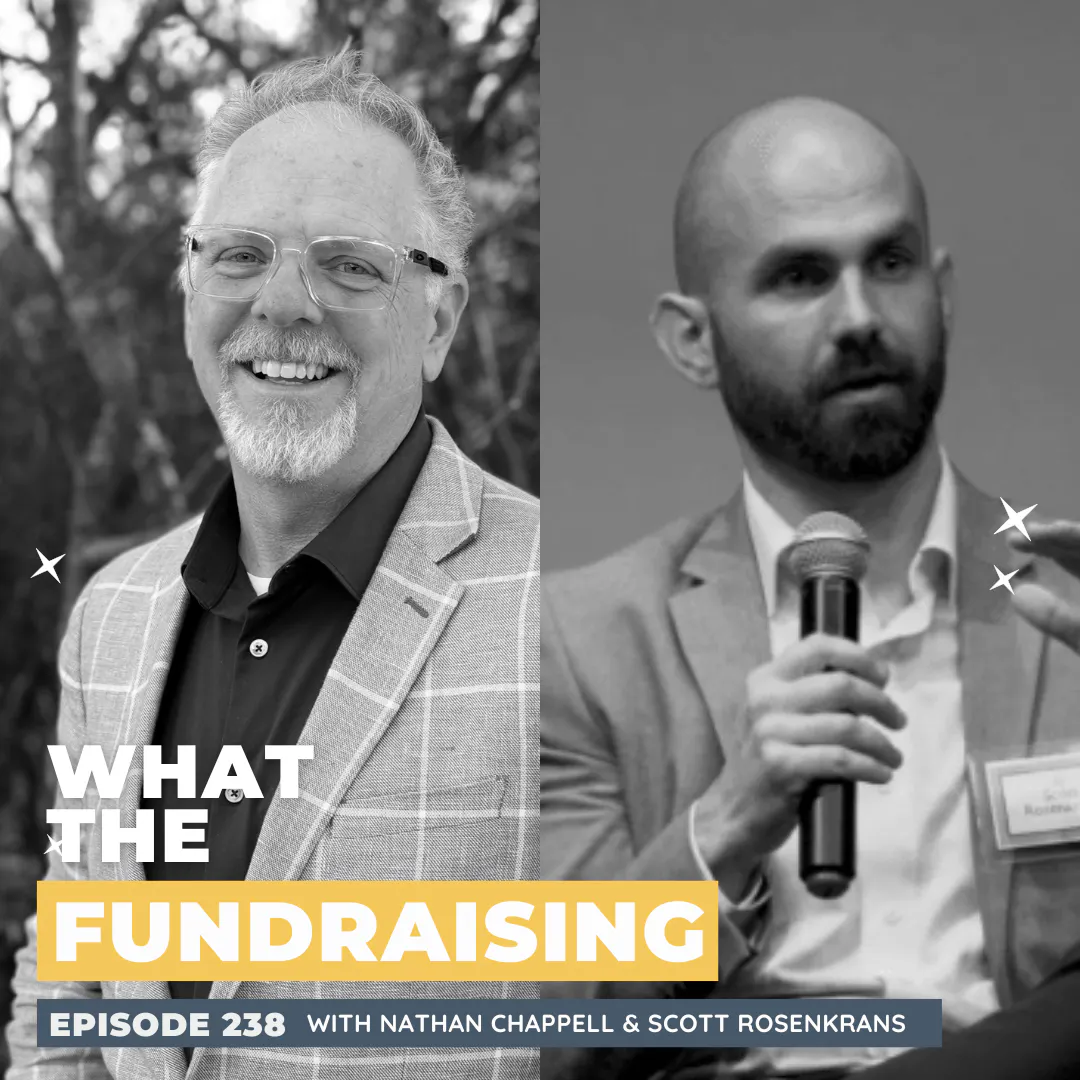
What the Fundraising
238: Harnessing AI To Amplify Nonprofit Impact With Nathan Chappell & Scott Rosenkrans
00:35:44
Loading summary
Transcript50 lines
- [00:00]
Mallory Erickson
Foreign.
- [00:04]
Nathan Chappelle
Nonprofit leaders mark your calendars Join me June 3rd and 4th at the free 2025 donorperfect community conference. It is all about connection this year and you are going to learn about connection in terms of donor engagement and learn proven strategies to drive real impact. Register now@donorperfect.com donorperfect conference. That's donorperfect.com donorperfect-conference.
- [00:39]
Scott Rosenkrantz
Most of our lives we've been told that subject domain expertise like to be an expert, to get the law degree to get the thing is how you advance and succeed in life and with when you have a tool that's completely democratized, that knows something about everything and much more than most people do, even if they spent many years in school to study something, it just knows so much more. The curious generalist outperforms every day because that's a person that it's not about being an expert in one area. A person that can connect dots.
- [01:09]
Nathan Chappelle
Hey, my name is Mallory and I'm obsessed with helping leaders in the nonprofit space raise money and run their organizations differently. What the Fundraising is a space for real and raw conversations to both challenge and inspire you. Not too long ago, I was in your shoes. Uncomfortable with fundraising and unsure of my place in this sector. It wasn't until I started to listen to other experts outside of the fundraising space, but I was able to shift my mindset and ultimately shift the way I show up as a leader. This podcast is my way of blending professional and personal development so we, as a collective inside the nonprofit sector can feel good about the work we are doing. Join me every week as I interview some of the brightest minds in the personal and professional development space to help you fundamentally change the way you lead and fundraise. I hope you enjoy this episode, so let's dive in.
- [02:03]
Mallory Erickson
Welcome everyone. I could not be more excited to be here with Nathan Chappelle and Scott Rosencranz to talk all about their new book. Welcome you guys to what the Fundraising.
- [02:13]
Scott Rosenkrantz
Great to be here, Mallory. So good to spend some time with you.
- [02:16]
Yeah, thanks for having us, Mallory.
- [02:17]
Mallory Erickson
Always, always. And our last podcast episode altogether was on the Fundraising AI podcast, and that was way too long ago, so a lot has happened since then, including writing this book. So why don't you both give a little introduction to yourselves and then we can dive into all the wisdom. Nathan, do you want to start?
- [02:35]
Scott Rosenkrantz
Okay. Well, I was going to pass it to Scott, but I'm happy to Mallory, it's so. I mean, it's personal for us to be here because you and I have Been on a journey together, but for those that don't know me, I kind of a similar path in a lot of ways to you in being a fundraiser, but also desiring for more designing for more innovation and different approaches to fundraising. I'm a technologist by trade, but then I, you know, became an accidental fundraiser in 2000, spent 20 years leading fundraising teams to then rediscover my passion for technology to drive impact. And so the last seven years have been around leveraging AI to inspire generosity. And so this book is kind of a natural conclusion of that journey and that work and a glimpse of the future.
- [03:18]
Great. I'm Scott Rosenkrantz. I'm. I've been in the nonprofit sector my entire career. Started as a prospect researcher, so kind of came in from the bottom up. I didn't know what fundraising was or prospect research was until I just kind of fell into it and then fell in love with data, been building predictive models, and fortunately crossed paths with Nathan about, and have been on quite the journey ever since, ultimately leading to this book.
- [03:39]
Mallory Erickson
So there's a lot of things you guys could both be doing right now, and actually a lot of things you are doing right now, but you prioritized writing this book. And so I want you to tell me a little bit about why this book and why now and what you hope it will bring to the sector.
- [03:55]
Scott Rosenkrantz
Yeah, well, I can share just a little bit of that origin story. So after writing the Generosity Crisis, went on the road pretty extensively and even globally, and just got to hear from a lot of people about what was working, what wasn't working, the appetite for change, and to be honest, became pretty concerned that while people heard the message that the need for innovation wasn't great enough, like the. The pain was not great enough to actually truly innovate. So we saw a lot of incremental changes and that, you know, became concerning for me, that's not going to get us there. And Scott and I and Brian Crimmins, the co author of Generosity Crisis, came together and we actually started writing a book called the Generosity Reboot, which was kind of the classic keyboard stroke. Control, alt, delete. Like, literally incremental changes are not going to work. Control, alt, delete is what's needed to really rethink some of the biases that we have in our sector. And we're about, I don't know, a third of the way done with that book. And then Wiley, the publisher, called and or emailed and was like, hey, why aren't you writing a book on AI? And I was like, well, because I assume. And this is middle of last year, I'm like, well, because I assumed about a million other people are like, why would we do that? And also there's a point of like, well, if you don't know how to use AI, just ask AI. And so they were like, no, like, people need a reference point. Like, they need a place to start. Either they're looking to amplify or they're looking to, like, just get off the horn and start doing something. And so we're like, okay, well, we're going to write a book on nonprofit AI or nonprofit and AI, what do we call it? Okay, let's just call it nonprofit AI. So probably the least creative decision that we could have have done. And. But to the point, moving out of just using AI for fundraising, thinking about it much more holistically. So the book is taking a departure from just the fundraising side and actually looking at all the ways AI can be used to amplify mission and so in all the ways that can be used creatively and with case studies and all kinds of things in it. And yeah, it came together. I don't know, Scott, about six months, we.
- [05:48]
Yeah, about six months. And I think another part of it is there's so much on generative AI, right. Ever since November 2022 that that's kind of like been the end all be all for. If you're talking about AI, you're probably talking about ChatGPT or Gemini or one of those tools, but you've been doing predictive AI for eight years. Right. And we know that for organizations to really move the needle, it's not just generative AI to draft an email or draft an employee handbook, but it's about finding the right people at the right time and then speaking to them. So it's putting the two of those tools together and then automation as well. So we wanted this book to be everything and not just gloss over the fact that predictive AI is this other machine kind of running behind the scenes and harder to access than generative AI.
- [06:26]
Tools and to show that all of this could be done within a responsible and beneficial framework. And I think while we acknowledge there are a lot of other books on AI and definitely a lot more in the private sector than the nonprofit sector, I don't know that any are written basically with a throughput or a through line of all of this. Every single consideration all the way through is what is in the best interest of the beneficiary or what is the best interest of the Donor. How do you use AI to preserve and protect trust? And that is loud and clear throughout the entire. The premise of the book.
- [06:55]
Mallory Erickson
Okay, I want to talk more about that, but I also want to say, you know, one of the things I really appreciate about the book is that it. The way it's organized is through the problems that nonprofits are trying to solve. Right. You aren't. It's not. The chapter is not like, generative AI tools. Right. It's like AI for program impact, and I'm probably misquoting that, but it's all about, like, what nonprofits are trying to do and then how AI can be applied to help them do that thing better. So talk to me a little bit about that reasoning, because we've had some offline conversations, Nathan, around, you know, kind of the shiny objectness of AI, leading inquiry and curiosity around AI with the technology first as opposed to the solution first. And one of the things I really like about the book is it's talking about solutions to problems that we know we're dealing with inside the sector. And AI just being one great innovative tool to potentially help us do that a lot faster.
- [07:52]
Scott Rosenkrantz
Thank you for picking up on that. We start out with a bit more of the why, like, why are we even talking about this? Because this is just another tool, and it's just fun. Then, you know, it doesn't have staying power. But we talk about the headwinds facing charitable giving. We talk about the need for innovation, you know, never been greater. We outline a bit of history and then context around the different forms of AI Because I think, again, to Scott's point, people hear, you know, the word AI Dateline or Oprah or whatever, they're just thinking ChatGPT or Gemini or Copilot and not recognizing that this technology has roots back to 1955. And it's been a long, steady progress to get to where we're at. And like any toolbox, there are some tools that are appropriate for some problems or some tools that are not. Like, you know, we talk about a hammer being something that can help build a house or. Or hang a beautiful picture on a wall, but it could also be used to harm someone, you know, and so using the right tool for the right thing is super important. And I think. And this is where. And Scott can talk more about this, but about a third or more of the book is actual practical case studies. And, you know, so program development, program evaluation. And so. And took the lead on that because he spends a lot of time every day with people who are actually Knees deep in the stuff.
- [09:06]
We've worked with so many organizations at all different shops, all different sizes, whether it's donor search or our earlier company or fundraising AI. And people have all different reasons for why they aren't moving further along in their journey. So we tried to address everyone. We address responsibility, beneficial AI, ethical AI, but also governance frameworks. How do you get the right team members? How do you identify the right use case? But then even to the point of what is a use case for? What is a prompt that I can provide to a generative AI tool? Or what are data points that I can use in a predictive model, what is that solution that I'm trying to solve for? Not just there's this tool, start using it. So we really wanted to kind of take any excuse for not moving ahead at least one step at some point in this book.
- [09:50]
Mallory Erickson
What's the relationship between the book and. Or like, as people are thinking about reading the book and one of the things we were talking about offline is like, this book really is for anyone at any entry point. And there's no doubt that reading the book will get people excited about the solutions that are possible with challenges. They've been. I mean, I think this has been true for me. Right. Things I was banging my head against the wall trying to figure out for years and years. Once I started to think creatively about generative AI, I was like, oh my gosh, Like, I can solve these problems now in a way that I've never been able to before. But I'm curious, like, thinking about the leadership, sort of like organizational leadership. And who reads this book? Like, what do you recommend for folks who read this book, get excited and want to bring people along?
- [10:36]
Scott Rosenkrantz
Yeah. This book is written and it's hard, right, With AI because it's so broad. Everyone knows how to spell AI now. And so it's so hard because you have some people that they use it three times before their first cup of coffee in the morning. And honestly, there was a day a couple weeks ago where I had an Internet issue or something and ChatGPT wouldn't load and I texted Scott and I'm like, well, I guess I'm taking the day off. Like, joking, not joking. Like, I'm not going to do it longhand and then others that are just a wait and see. And I had a great conversation with a chief development officer yesterday who is just asking all the right questions. Like, I'm not holding out because I don't believe the technology works. I'm holding out because I'M not sure that it can be done well. And so we have people at all walks of life. So I think this book does a really good job again of sharing lots of use cases and case studies of organizations that have not just used AI, but used it in ways that not only help them in the short term term, but also we're using it ways that align with our values personally and organizationally. And that's something that we talk about a lot in the book, is just that alignment to values and what that means for our sector is different than others. And so I do think it's a book that it's so cliche to say something for everyone, but it truly does when you start to realize like, oh wait, I'm not the only one that feels this way. There's other people at the same walk. And if I'm just willing, you know, use the word curiosity, which is, you know, my favorite word and you know, annoying to my family, I'm sure, is that if you're a curious generalist, everything is possible right now. And we'll talk about you in a minute because like, you are literally the manifestation of this book. Like there could not be a better example of someone who is has subject domain expertise and like really passionate about something. But you're not a technologist or a coder. You didn't grow up and you know, get a master's in computational data science. But you're inherently curious about can I take my domain expertise and the things I believe and my values, how can I amplify that work like massively to scale using technology? And that's just an incredible use case. And it just shows that anything is possible if you're willing to look forward and actually, you know, be curious, ask people around and talk to people around. And these are like real things that our sector needs and our sector deserves, frankly.
- [12:51]
Mallory Erickson
Yeah, I mean, I was saying before that, like, I feel like I benefited, you know, before the book existed from you talking me through all of these things for the last few years. So that got to like inspire and push me to like imagine all of these things and then create something that was solving, you know, one of the biggest problems I was facing in my coaching practice or that my clients I felt like we're facing. And, and I think it is. I think it's like I am the person who like, can't figure out how to send a mass email with issue. Like, you know, like I am the person who cries around technology all the time for things not working and feeling like I could Never. I mean, if you had told me five years ago I would be leading a technology company, I would have laughed you out. There's just no way. I mean, if you watch me try to post something on social media, I look like I'm 80 years old. Like, I just. This is not. But something about the possibility, like what generative AI opened up for me was this like permission that we all can interact with technology in a way that maybe it felt before we were talking about this related to something else. Like, I feel like we have to break down now that this technology exists. This idea of like experts and you know, because it is about curiosity and it is about figuring out how we solve these problems together. And we don't just need a bunch of AI experts, we need a bunch of nonprofit experts realizing and recognizing that they can solve the problems they've been trying to solution around for years with, with different tools that are accessible to them.
- [14:27]
Scott Rosenkrantz
It's a different way of thinking too. Right? Because most of our lives we've been told that subject domain expertise, like to be an expert, to get the law degree, to get. The thing is how you advance and succeed in life and with. When you have a tool that's completely democratized, that knows something about everything and much more than most people do, even if they spent many years in school to study something, it just knows so much more. The curious generalist outperforms every day because that's a person that. It's not about being an expert in one area. It's a person that can connect dots and can connecting dots in this day and age and being curious of like, why and being able to explain that, you know, why. I mean, you with practivated, I don't think you had the exact technical approach in the very beginning, but you're like, here's this thing that I do over and over and over and over and over again. And it's great and there's a lot of impact, but it's not scale. Like, I can't. I'm just one person. It's just not, you know, clone of Mallory. And at a certain point, practivated ends up being basically taking that ethos and that methodology all grounded in this responsible AI framework and amplifying it. It doesn't sleep, it doesn't eat, it doesn't. It just can be there to support the same way you could have done as a single human. You have now amplified that. And it's not again, because you were an expert in technology. You were just curious, like, what are the technologies that exist to do this, you know, and it's just so exciting to see. Yeah.
- [15:43]
And we had Cassie Kozakov from the, she was on the fundraising AI summit, but she said in a LinkedIn post a while ago that AI first companies are actually AI last. Right. They don't go in with, oh, we have AI, let's figure out where we're going to put it or where we're going to point it. They find problems that they want to address with an AI solution. And that's what you do with practivated. Right. You knew you had this problem and you said maybe we can point AI towards it to find a solution. That's where clients are not clients in model build phase all the time. That's where nonprofits are going to see success. Right. It's not just pick up this tool and find a way to use it and then just go crazy. But think about what your problems are, what your challenges are. Where are you, like Nathan said, where you need to scale, where you just, you can't move the needle enough. Then figure out how you can use AI to adopt that.
- [16:34]
Nathan Chappelle
If you are a fundraising professional or nonprofit leader, you won't want to miss the 2025 donorperfect community conference. I'm excited to be your host for this free event on June 3rd and 4th. It's all about building deeper connections with your donors, your team and your mission. You'll learn how to create lasting donor relationships, boost your digital presence and transform one time donors into lifelong champions of your cause. You'll walk away with practical strategies, fresh insights and a renewed passion for your work. Join me and Register today@donorperfect.com donorperfect conference. That's donorperfect.com donorperfect conference I cannot wait to see you there.
- [17:21]
Mallory Erickson
Okay. There's something really interesting sort of coming out in this conversation where, you know that piece at the beginning when you were talking about the other book and you know, we, we need to think bigger and be bigger and the incremental change piece, it isn't going to work. And what's really. But then you were sharing like my story a little bit and I was thinking in my head, like, oh my gosh, the technology I built or the thing I built eight months ago is not the thing that's happening today. Right. And there has been in a lot of ways a lot of incremental change within this really big idea. And so it's making me think about this marriage of innovation like because I think, you know, for some nonprofit leaders, they hear big sweeping change and like, they're like, frozen, right? They're like, yeah, like, especially right now, my budget is falling out from under me. Like, how do I change, manage through something really big? And I think one of the things I just want people to. One of the things that is so cool to me about technology and AI and where I'm like, oh, my God, I should have been doing tech forever. Like, it's so fun because you get to. You get to think really big, you get to innovate really big. But then there are actually ways to incrementally improve that technology that is still scaling as you improve it, which is like a wildly incredible opportunity, I think, for nonprofits because. Because when they keep changing things, when they get better, when they learn something new about how something's working, they can change it in the tech. They don't have to start all over. Like, you actually can continue to get better. And I only say that because I think, you know, like, I was really scared when I started practivated about the responsible and beneficial side there were. And I still hold a lot of fears around bias and ethics and what happens when you, like, let a bot talk to a human and you're not there to monitor it. Right? Like, I have a lot of fears. And I think it's been really important to me to say, this is the framework within which I'm building it. It's not going to be perfect. I'm not a technologist. I'm going to learn a lot along the way, and then I'm going to improve it, and I'm going to get better, and I'm going to make it better, and I'm going to find the people who do know exactly how to protect that thing or do that thing. And so I just want to encourage folks because I think in the book, you give so many great things to step into. And I want people to, like, let go of the need to understand exactly what it's going to look like to implement.
- [19:41]
Scott Rosenkrantz
You know, this is something. An epiphany that I had back in probably like 2018, when we started building our first machine learning model. And going back, you know, I spent 20 years always trying to reinvent the wheel. Like, you know, hire another company to build another model, hire another person to build a better model. And it was just like this vicious cycle forever. And it was like, 2017, we started building our first model. 2018, we got a model done. 2019, it took me until then to be like, wait a minute, like, we never have to build another model. Like this Model is iterative. It's going to improve itself, it's going to get better. And there was like. It was weird. It just hit me and I'm like, wait, I just got off the hamster wheel. Like, I. There's so much freedom in the fact that, like, for 20 years I was on this hamster wheel and I just got off it. Because even predictive models and machine learning, the operative word is learning. You know, something that Scott and I talk about a lot with people that were kind of guiding through AI transformation is that with AI, you're never ready, and you're also never done. And if you sit in the freedom of both of those things, like, I'm not ready, and I have all the questions that everyone else has, you know, and that's okay, but also, I'm never done. And there's so much freedom in knowing that this is going to continue and it's going to get better. And the technology is exponential. Like, the technology changes and advances faster than any other technology ever created in human history. It does mean there's winners and losers. And the winners and losers are those that use it and are curious and will continue to, like, figure out new and creative ways of using it. Those that don't, frankly, will just be outperformed and maybe find another job that doesn't require, you know, that type of curiosity. But, you know, at the end of the day, I think the needs in our sector are tremendous. They're not getting less. The organizations that serve our sector have greater need for resources than they've ever had. And at the same time, we're presented with a technology that is almost limitless in its potential to do cool things, to amplify, if you allow it, our work and our missions. And so, you know, while we spend a lot of time focused on the responsible side and making sure that we evaluate AI in multiple dimensions, we're really bullish on the idea that this is a moment, like an critical moment that will define the future of our sector, and that will be determined by those individuals that lean in, ask why, and then understand that this is just something that they can continue to explore and get better at over time.
- [22:01]
That's how we wrote the book. We want people to read the book, take at least one actionable next step, and then implement that, feel comfortable with it, and then go back and read the book again to see what can they do next. Because it is an iterative process and we intentionally excluded talking about any specific tools. I don't think there might be a reference to chatgpt as kind of like the blanket example. But we don't say you could use SORA or Runway or any of these. Hey, Gen. Or anything like that, because we know the book's gonna be in print and those tools could be gone in six months or there could be new tools. So we didn't want people to hone in on. It's this tool that's gonna solve me or solve my problems. But it's the mindset of applying this new technology that's gonna help you move ahead.
- [22:45]
Mallory Erickson
Yeah, it just gets to bust a lot of our beliefs about what's possible, how we do things, quote, unquote, best practices, which, like, we've needed to be shaken out of that for a long time.
- [22:57]
Scott Rosenkrantz
Yeah, it's not working. I mean, what we thought were best practices, if they were good practices, we wouldn't have rapid declines in people giving to charity. Like, their best practices are different than good practices. I mean, to your point, like, we literally need to flip the table and, you know, rethink all of these things. And fortunately, we're presented with those challenges at the same time that we're presented with a technology that can do those things. And, you know, Scott, and I love the fact in some of the use cases in the book, I don't forget the quote. But basically, where, you know, the. The root of innovation is necessity. And essentially, like, where we see the smallest, scrappiest nonprofits doing the most creative things and amplifying their mission the greatest. And of course, we think about Dan Kershaw, who's a good friend at Furniture bank, and how literally, not being a technologist, but being a curious generalist, Jess was like, could this help me? Like, I don't know. Let me just try. And then he kept on trying and kept on trying and has amplified his mission by, like, 20x and. And I look back at my start at the boys and girls, though, when I had, like, very limited resources, very limited people. And, you know, it's a grind. Like, we say that, you know, work in our work, like, a career in our field is not a job. It's way of life. And it is, because, like, a lot of times, it's thankless. And, you know, we work so hard, but we wake up every day believing in the power of what we do, and that's exhausting. And you, obviously, you're the queen of burnout. Not that you're burned, but that you talk about this and understand the brain science around it and this practice that you're adding with practivated it helps address that and some of the root causes of that. But if I look back and project back, if I was back in my early days in nonprofit career and had Generative at my disposal, I mean, it would give me new life. Like, it would just literally, like, spark, like, a ray of hope in my day, because I would be like, oh, my gosh. You know, I was never really good at one thing, but I was really good at asking questions. To be able to do that today, I think there's so much hope for the people who wake up every day and are just grinding it out because they believe they. If not them, then who. Like, this book is. Is for those people.
- [25:01]
Mallory Erickson
So appreciate that. And I think, you know, this brings me back to something you were talking about before around, like, this is also why it's so important that their problems and their challenges are front and center in how they're exploring this. Because if you just go in and you're like, oh, my God, this tool's so cool. Like, what could I do with it? Then you're down the rabbit hole of, like, yes, it's really cool. Like, that's a hobby, you know.
- [25:26]
Scott Rosenkrantz
Like, totally.
- [25:28]
Mallory Erickson
It's not solving your, like, actual work challenge, right? Like, maybe think that graphic design thing or that video thing is, like, super cool, but, like, what is the point of you playing with it? And I think what I love about this book is I feel like it breaks out of, like, the, like. Like, look at how cool it is. Not that it's not like, look how amazing this could be, but it's like, whoa, whoa, whoa. Like, let's talk about the things that you are trying to do and solve, and then we can talk about what the paths out of that challenges could be.
- [25:57]
Scott Rosenkrantz
Another thing that we talk about in the book is, and we've shared this stat many times, but 70% of successful AI adoption is not about data or models or use cases or any of that. It's about people, and it's about culture. And Nathan was talking about how some of the most successful adoption, again, Dan Kershaw, are the small, scrappy nonprofits who have no other choice but to find other, more efficient ways with their limited resources. On the flip side of that, some of the largest nonprofits that are well staffed, well established have a very hard time adopting this because their processes are so structured, they have so many team members built around one output that it has to go through all this different vetting and all these different opinions, and they just. They have such a hard. They get in their own way of actually adopting. And so that's what we want to address as well. If you have a hard time finding a use case, here's some use cases. If you have a hard time moving your people in the right direction, here's the way you do that. If you have a hard time about the data that's going on behind it and the ethical practices, we talk about that as well. So, again, really just addressing and breaking down every argument for not trying something.
- [27:00]
Mallory Erickson
Now, I love that I did a podcast episode recently with somebody where I literally was the naysayer. I was like, let's do a. Yeah, but, you know, like, where, like, she would tell me something to do and I'd be like, yeah, but it was all about calling donors, right? And I was like the really apprehensive fundraiser that at every read of the book to not pick up the phone. And so I love that, like, for folks like, this isn't just about you being ready and buying this book to, like, help walk you through, but it's like, if you're sitting there with like a. Yeah, but this. Get this book, right, and find that part of the book and walk through it and let it be kind of like your partner in figuring it out.
- [27:35]
Scott Rosenkrantz
And I love nothing more than, you know, going to a conference or speaking or something where, you know, there's a person with their arms closed, body language is closed off, and they're just, like, sitting there because they feel like they should, but not because they want to. And, you know, I've had many times where people come up at the end and they're like, I came here never using AI because of all these reasons, and I've just, you know, you said some things, and, you know, I got comfortable enough that I feel like there can be used. And then you see what we call the AI mindset in the book. And there's a lot of methodology around this, but the people that start small and they're just, like, a little bit curious. It's like, okay, I got past that. Like, I'm not going to use it because I don't know, to, like, I'm going to be a little bit curious and talk a lot about this in the book, actually, the curiosity quotient. But then all of a sudden, when you're spending a couple hours not just, you know, writing a poem about your dog, having a picnic on the moon, but you're like, well, how could this help my job in this way? Like, this part of my job I really don't like. And all of a sudden you're like, oh, wow, that just gave me the dividend time. It's something that Scott speaks on a lot as well. It's like, we're now given this opportunity to actually invest more time to go deeper into things that we're passionate about as we offload things that we don't like to do. So, I don't know, it's a really exciting time to be alive. Like, I mean, to be honest. And we don't have to think in those binary terms anymore. It's like, oh, what do you want to be when you grow up? Or what do you want to do when you're going to study college? Like, are you kidding? I have to pick one thing. Like, now, like, we have to remove that orientation, because now anything is possible. If you can connect dots, you're willing to be curious and you're willing to work hard. Like, it's taken you many, many, many, many sleepless nights. I know. To build practivated. But at the end of the day, like, you are now creating something that, like, can go global and impact the lives of so many people that are feeling that strain of, like, I don't know what success looks like. Help me be more successful in my job. And that's an amazing thing.
- [29:29]
Mallory Erickson
Yeah. I mean, I do really believe, like, we're the ones we're waiting for, you know, like, nobody's gonna. And I think for nonprofit leaders, like, you know, they undervalue their expertise and they undervalue the dots that they see, you know, like, if I could get people to, like, walk away with one thing, it's like, you see the interconnection, right? It's like, so much is just them not trusting their instinct that they know. Like, they really know. And I think we're in this environment where, again, like, there's this, like, expert model. And I just wish that they could, like, give themselves the credit and the space to be like, okay, wait, the. I'm watching these patterns, these things related. What if I started to explore that more? What would be a solution that could tackle both at the same time? Like, those were the types of questions that drove me down that path, was just like, this has to be solvable. But this is happening, and this is happening, but what about this? And, you know, many conversations with generative AI later and humans, right? It, like. So, yeah, I couldn't love it more. I'm so excited about the book. I'm so excited for it to be out there. I'm so grateful that you guys took the time and prioritized doing this for the sector. It's generous, which I know you both to be in every way, but I'm so grateful.
- [30:42]
Scott Rosenkrantz
Well, thank you, Mallory. And you know, for all you do for our sector as well, to really advocate for and to showcase. Not just advocate, you're not just advocating anymore. You're actually showing physical examples of how you can use AI for good. And the same technology that you're using and leveraging to do tremendous good can also be used for harm. And you're showing that there's a choice and that we have agency in that choice to do that. So we're excited. We're like on the same path here. You know, the book comes out May 6, so we're going to do pre launch a little bit right before that and we're just like thrilled to be on this journey with you and actually highlight you as a way to show, to give people hope of like, look, I'm like really passionate about this thing. You know, I just need a framework to think about a little bit differently. And by seeing you do that in real life and then hopefully by reading the book, giving them a sense of confidence to like just take that next step.
- [31:34]
Mallory Erickson
Yeah, I love that and I'm so grateful. Thank you for. I'm all of those nice things. I'm, you know, I have a hard time like that, but I, I have a little like trick for people when they get the book. I go by the book. Then when you get the book, open the book to the table of contents page and see what chapter sticks out to you first. My gut is that that's the chapter where you have the biggest challenges and you should read the first two chapters too. That frame everything up. But like that tells you something. Like if the first thing to is like program impact or the first thing you go to. Right. That's going to be a guiding light in maybe where you should start and where that you have the most energy and curiosity around solutions.
- [32:20]
Scott Rosenkrantz
Yeah.
- [32:21]
And it kind of is a reference guide. Like you don't need to read it front to back.
- [32:25]
Mallory Erickson
Right.
- [32:25]
Scott Rosenkrantz
You can pick it up and whatever is speaking to you at that moment or six months from then, like you can go through it, just open it up randomly and see what you can pull out of there. But the flow of the book is really like, why now? Why is this? Why is everybody talking about it? And then how do you use it? And then now that you know how to use it, how do you do it better and how do you do it responsibly and efficiently? Beneficially so again, like anywhere you are, you have something here. And I loved what you said about how you use practivated. Like you had AI help you build that tool, right? A hammer is not going to tell you how to use a hammer. So everyone has this resource immediately available to tell them how to use this resource that's immediately available. So leverage that if nothing else, totally.
- [33:05]
Mallory Erickson
Okay, Anything else you guys want to make sure people know as we sign off, we'll put the link to the book in the show notes and nonprofit AI go look it up, buy it. Anything else we want to make sure they know?
- [33:17]
Scott Rosenkrantz
Just that our website nonprofitaibook.com has lots of resources that are totally free and non gated. So Scott has built a pretty exhaustive prompt library for people just to use and copy specifically for the nonprofit sector. So that's special. And he and I actually were talking earlier today about adding some additional things. So when we come across new and interesting technologies that can be used in specific ways for nonprofits and we're like, oh, what if this applied to donor relations? Or what if this applied to the program evaluation? We'll put those examples. There also is not a marketplace where we'll monetize, but just as a way for to kind of shorten the learning curve a little bit.
- [33:56]
Mallory Erickson
I love that this is the way for Mallory's voice notes to be less boring to me.
- [34:02]
Scott Rosenkrantz
Well, I wasn't going to say that, but, you know, side benefit.
- [34:08]
Mallory Erickson
No. I'm so grateful. Thank you both so much. I can't wait to see people taking their photos with this book once it arrives at their homes. And I can't wait to hear what chapters you all start with and how it helps you innovate on the biggest challenges that you're dealing with. So thank you. Thanks so much for this conversation.
- [34:25]
Scott Rosenkrantz
Amazing, Mallory. You're the best.
- [34:26]
Thank you.
- [34:26]
Thank you.
- [34:32]
Nathan Chappelle
I hope today's episode inspired or challenged you to think differently. For additional takeaways, tips, show notes, and more about our amazing guest and sponsors, head on over over to Mallorykson.com podcast and if you didn't know, hosting this podcast isn't the only thing I do every day. I coach, guide and help fundraisers and leaders just like you. Inside of my program, the Power Partners Formula Collective. Inside the program, I share my methods, tools and experiences that have helped me fundraise millions of dollars and feel good about myself in the process. To learn more about how I can help you, you visit malloryerickson.com Powerpar Partners Last but not least, if you enjoyed this episode. I'd love to encourage you to share it with a friend you know would benefit or leave a review. I'm so grateful for all of you and the good, hard work you're doing to make our world a better place. I can't wait to see you in the next episode. Fundraising doesn't have to feel like a solo battle. My book what the Embracing and Enabling the People behind the Purpose offers practical strategies and frameworks to help you navigate the challenges of fundraising with ease and impact. And with our free discussion guide, you can deepen learning and collaboration with your team or book club ready to transform the way you Fundraise? Head to Mallorykson.combook to order your copy today anywhere books are sold and you can grab the guide there too.