← What the Fundraising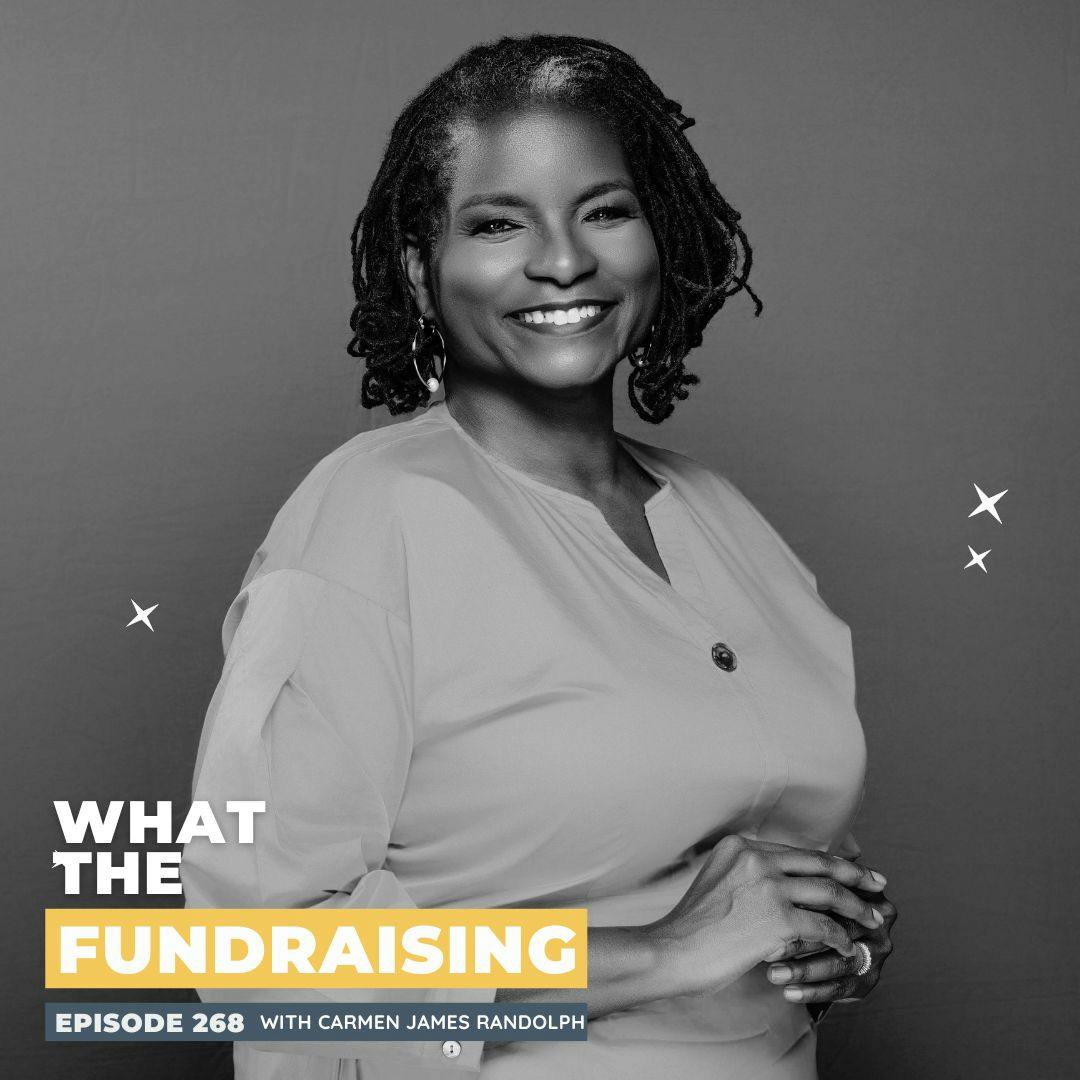
What the Fundraising
268: Strength in Sisterhood: Collective Leadership and Community Impact with Carmen James Randolph
00:26:21
Loading summary
Transcript18 lines
- [00:00]
Carmen James Randolph
Foreign.
- [00:04]
Mallory Erickson
This episode is brought to you by our friends at Zefy. I have been excited to learn about Zefy and what a game changer it has been for so many organizations. Plus, the platform is 100% free. They even cover credit card and transaction fees. You can set up donations, sell tickets, and manage your donors all in one place. And it only takes 15 minutes to get started. Start fundraising today at Mallorykson.com backslash zeffy that's Mallorykson.com z e f F Y.
- [00:39]
Carmen James Randolph
This is a moment for us to know who our friends are. It's important to know who your friends are and also for us to not have fear, to think through and sit down with friends, sit down with allies and look at what our respective strengths.
- [01:04]
Mallory Erickson
Hey, my name is Mallory and I'm obsessed with helping leaders in the nonprofit space raise money and run their organizations differently. What the Fundraising is a space for real and raw conversations to both challenge and inspire you. Not too long ago, I was in your shoes, uncomfortable with fundraising and unsure of my place in this sector. It wasn't until I started to listen to other experts outside of the fundraising space that I was able to shift my mindset and ultimately shift the way I show up as a leader. This podcast is my way of blending professional and personal development so we as a collective inside the nonprofit sector can feel good about the work we are doing. Join me every week as I interview some of the brightest minds in the personal and professional development space to help you fundamentally change the way you lead and fundraise. I hope you enjoy this episode, so let's dive in. Welcome everyone.
- [01:59]
I am so excited to be here today with Carmen James Randolph. Carmen, welcome to what the Fundraising.
- [02:06]
Carmen James Randolph
Hi. Thank you so much for having me. I'm excited to be here with you.
- [02:10]
Mallory Erickson
I'm excited to learn more about you to share more of your experience with our listeners. Why don't we start with you just giving a little introduction to to you what brings you to our conversation today and then we'll dive into everything.
- [02:24]
Carmen James Randolph
Okay? So Mallory, I'm Carmen James Randolph. I'm the founding president and CEO of the Women's foundation of the South. We are a public foundation. We're a public charity and we were exist. We were founded to support the health, wealth and and power of women and girls and gender expansive people in the south who are most impacted by injustice.
- [02:55]
Mallory Erickson
I can imagine right now that you have your hands quite full with everything that's going on in our country and I know we've had this scheduled for quite a while and the environment that we're in continues to get more and more challenging and dynamic. And, you know, one of the things that we had touched base about previously for this conversation was to talk about, you know, what is it like to build meaningful partnerships and to avoid burnout in building sustainable nonprofits and strategies. I feel like I'm super curious about your orientation to that, particularly right now, given the level of. Of sort of like stress and pressure that you're likely up against.
- [03:45]
Carmen James Randolph
Well, I would say that this is a time now more than ever, that one, we have to acknowledge that we need each other. And the we is the collectively. I think there is an incredible impulse and agenda that is about othering right now. And more or less, okay, the suffering is okay if it's them or it's those people who are being carted away or this is happening to them. But I think that what we may find is that we all are the collective them that's in danger right now, or that whose lives are being destabilized and challenged as structures and systems and supports are being changed. I mean, you cannot look at, for instance, just I was reading an article earlier about the defunding of the Corporation for Public Broadcasting and how many people have lost their jobs as a result of that. And then the ripple effect that that has for programming at the local level, for news delivery for all kinds of. I mean, I don't know about you, but I love listening to my local public radio station. And it's like, how are public stations being supported? If people, people. The collective. We do not see that, hey, there's an impact here. And you might not be able to listen to your favorite jazz station or get news and information that's about here, that's about the world, that can expand our worldview and our knowledge about what's happening right now in this time. So I think the point is that we need each other. That this is a moment where the sector, you know, so often we get caught up in the things that at this moment are not really important. And we have to be singularly focused, I think, on how we support each other through this moment, how we develop and lean on our collective strength and our collective power and move together through this moment. So now more than ever is a time to bring together those closest to you when you are running a nonprofit. And to me, that first line must go back to your board. And I have my board meeting in two days. And we have members of the advancement committee of our board that will be talking to our board members about how more Than ever. We have to get to 100% board giving. Now, we have been at 100% of board giving every single year that we've existed, but we have board members that give toward in that last quarter of the year. Well, this is a moment where we need those year end gifts to come in sooner than they have in the past. So how can we appeal to our board first and then engage board members and help in reaching out to their network as well as our network of donors to ask for those year end gifts and ask for those year end gifts to come in sooner rather than later. So I think drawing that first line to your board and saying, hey, we need help. This is the moment, if ever there was a moment for us to lean on you as a board member to ask you to honor your fiduciary responsibility and to make a meaningful gift to our organization to help us weather this storm and get through this moment. I think making a gift is important. Asking others to give and expanding your network is also important. Our board chair, for her 60th birthday this year, she did a 60th birthday campaign. I mean, had beautiful, beautiful tiles done for social media and just announced to her network that she was turning 60 and she asked people to please help her raise $5,000 for the women's foundation of the south by the end of July. And she raised over $7,000 and the gifts were coming in every week and people were saying, you know, I'm making this gift in honor of Shareese and just getting for us over 60 new donors, 60 people who had never given to us before and they've given to us out of love and honor for our board chair. Those are 60 new people that we have the opportunity to steward and to increase their gifts. So this is a moment where the board can be creative, where the board can really lean on the power of their network to support the work. And I think giving and being an ambassador, encouraging in a door opener and encouraging other people to give is one part, but the other part is the brain trust. Oh my goodness. I can only imagine some of our grantees. For instance, one of our grantees talked to US about almost 85% of their staff that was doing outreach was supported by AmeriCorps, and those dollars are gone. And this particular organization was providing birth services in rural communities in the south where there are no hospitals and where there isn't, there aren't birthing centers, there aren't places to give birth. And they were sending people out into communities, meeting with expectant people or birthing people and talking to them and making sure that they were getting access to. To prenatal care and support and doula services once they were ready to deliver, those services are gone. And for executive directors to be in this position of having to make hard choices, having to perhaps lay off staff or furlough staff, of thinking about what programs and projects are essential at this moment. I just came from Mississippi last week, and programs that provide family supports are feeding people, and dollars for programs to feed seniors were cut where senior citizens do not have access to food, where families now do not have access to food. And so in these moments, they're scrambling and seeking support from communities so they can provide support to make sure that families have the resources they need to eat and to live with dignity. And I think we're going to see more of this kind of suffering and more harm as these changes fully roll out. We will not see the impact of the cuts to. To Medicaid until November of 2026. So we're talking about communities that are going to be at a level of desperation that no one truly is prepared to handle. And in terms of the nonprofit sector, especially those that provide safety net services, they're struggling to get the resources that they need to operate and survive at this time. So we have to think about how do we as a sector, lean on each other, protect one another, and also be unified in a voice to stand for the safety of the sector at this time. So I think this is a moment where we can't, as nonprofit leaders, as a leader of a public foundation, we can't be reluctant to say, I need help, and I need my board and our stakeholders to join me in being a brain trust, because this is beyond me. And I know and I trust that together we can come to solutions and think of how we operate or we make it through this moment. And doing so is incredible. I have found people willing to help me and to connect us to, whether it's resources, whether it's to thinking of a different way of doing things, or to be there for our grantee partners. So that was a long answer to.
- [13:35]
Mallory Erickson
Your question, but no, there's so much in there. And I guess one of the things I'm wondering is something I'm hearing so much from nonprofit leaders and fundraisers right now is I feel like I've been asking for help for so long, or I feel like I've been saying unprecedented times for so for five years, and how do I make the case, sort of to your point, that, like, now really is the time and if not now, when they feel like they've been saying that or sending that message for a long time, how are you kind of inspiring your board or activating your board? And, you know, maybe in moments where they're feeling fatigued because they feel like. And, and I don't actually believe in donor fatigue the way that we think about it in this sector, but I just, I mean, fatigued, like our nervous systems are fatigued. Like we are exhausted by what's happening around us. People are feeling overwhelmed. Like, how do kind of keep people going? Maybe it's your staff and your team, maybe it's your board, maybe it's your partner organization. Given that folks have just been kind of hitting wave after wave of these, like, critical moments.
- [14:51]
Carmen James Randolph
I have a couple ways that I will answer this. 1. A woman who I deeply admire, who was working with me as a coach during the pandemic, I was working with her before the pandemic started and then during the pandemic, challenged me in the midst of the pandemic. And this was. I was not with the Women's foundation of the south at the time. I was working with the community foundation here in New Orleans. And we had, under my leadership, my team, I was vice president of programs, had increased our grant making by 165%. And in addition to putting out more money, we also were creating new programs and supporting individuals. And in this moment where the churn and the work and the demand seemed so great and we didn't understand what the other side of the, of getting through the pandemic would look like. Remember that? Those moments when we didn't, where there was no vaccine, we just didn't know what it would look like to survive that moment. She asked me, what's your vision of the future? What's the future you want to work toward? And I was like, how can she ask me about the future when the present is so scary scary and is so demanding and we're exhausted just getting through the present? And she said to me, the secret of surviving this moment is to have the vision for the future and the drive to move toward that vision of what you see possible in the future. So I've taken heart to that in this moment where I have not only focused on the immediate needs where we're asking our grantees, what do you need in this moment? How can we support you? But we have been simultaneously shaping a strategic vision for the foundation. What is the vision for this work on the other side of this? What do we see coming? And how can we meet that around the corner. What's the role for our foundation and for this work when we look into the future? So that is a place. And sharing that vision of the future and sharing parts of that vision of the future that we all deserve and that we need and we want is part of the inspiration. To say, hey, this is possible, this is possible, but to get there, this is what's required. Yes, it's tough, yes, it's hard. But we know how to build alliances, we know how to collaborate and work together differently. And this is the moment that we have to lean in and get there.
- [18:10]
Mallory Erickson
Many years ago I interviewed this woman, Miriam Neusrat, on the podcast who leads a gaming company. And I'm not, I'm not a big gamer myself, but she was explaining to me how, and I quote this a lot because it's just so aligned with what you're talking about here. She talked about the way that in video games a lot of the time your folks make decisions for the future, right? So they're making certain decisions and then the game will actually like build the world. And she was explaining that people will sit there and they'll watch this world building this like projection into the future of like what the world looks like because of those decisions they made in the present. And I think what you're talking about is so important like that right now, especially when things feel overwhelming and they feel so overwhelming in the present, present moment, that future visioning that what do we want? What could be imagination and, and that sort of gets me into, you know, maybe my like final question for you. At the very beginning you were talking about this sort of collective, what it looks like to really be a collective and to you know, push back against the othering and to recognize that we're really, we're, we're, we are all a part of the being othered in many ways. And also this is a moment that really requires a level of like community and collectivism that is in order to like find our way through. And so I'm curious, you know, the nonprofit sector is so interesting sometimes the way it can feel competitive because I think we're baked in this scarcity mindset of fine. And there are certain things that are finite of course, but I think scarcity mindset that layers a level of scarcity on top of an already resource scarce environment. Like it, it like doubles up on the challenges there. And so I'm curious, like if you have any recommendations for leaders maybe who are feeling that level of scarcity, want to be working more in community towards like, collective action. But maybe that's not their orientation or how their organization has always operated. Do you have any recommendations for how they start to build alliances and community and more of that, like, kind of movement generating activity?
- [20:38]
Carmen James Randolph
I would say that this is a moment for us to know who our friends are. It's important to know who your friends are and also for us to not have fear, to think through and sit down with friends, sit down with allies, and look at what our respective strengths are. There might be an area that you have strength, you have experience, you have knowledge. Like, for instance, we had brought together a group of our grantees and one of them was talking about doing research on particular policies that had been passed and what was supporting families and getting the data on how many families were such and such. And then another grantee said, hold on, I have that. We've already done that work. So sometimes we're spending time, effort, energy, resources that are so precious, doing something that if we are sitting with our friends and talking about what's needed in the moment, what we need to be able to do our work better, it might be that our friend or another organization might have full access to that, and it might be that you might have something that they might have. So we try to engage our groups in what we call needs and offers, where you talk about what you need and we see who's able to and who's offering what. So this is a moment where we all have varying levels of capacity, we have varying levels of strength. And you won't know who has access to what information or where you can find strength unless you're having those conversations. You know, this is a moment. People in philanthropy are saying, oh, several nonprofits will just close their doors in this moment. Should this be a time that we're talking about mergers and acquisitions and folks are saying, well, is this also a time that we talk about strategic partnerships? Because we know the need is. Is great now it's only going to become increasingly great. And if you're in this region and I'm in this region, how can we come together strategically to support what the greater good or the greater need? Maybe I have an incredible back office team, maybe you don't have a back office team, and I can provide back office support and you can provide this piece of it. So I think that we get through this by having those conversations, understanding what our needs are, understanding what strengths exist around us. Understand that we're not doing this, we're not doing the work alone, and we don't need to do the work alone, and it can be better if we partner strategically to get it done. Now, there may be organizations that are facing closure. I know there are organizations that have decided we're going to close our doors. But we have to be clear about what the needs are in our community and how we can align resources and align efforts to address those needs.
- [24:02]
Mallory Erickson
Thank you. Thank you so much for joining me today. And we'll make sure all of the links are below so folks can get in touch and follow up.
- [24:11]
Carmen James Randolph
Thank you. Thank you so much, Mallory for having me.
- [24:19]
Mallory Erickson
I hope today's episode inspired or challenged you to think differently. For additional takeaways, tips, show notes, and more about our amazing guest and sponsors, head on over to Malloryerickson.com podcast and if you didn't know, hosting this podcast isn't the only thing I do every day. I coach, guide and help fundraisers and leaders just like you. Inside of my program, the Power Partners Formula Collective. Inside the program, I share my methods, tools and experiences that have helped me fundraise millions of dollars and feel good about myself in the process. To learn more about how I can help you, visit MalloryErickson.com PowerPartners Last but not least, if you enjoyed this episode, I'd love to encourage you to share it with a friend you know would benefit or leave a review. I'm so grateful for all of you and the good, hard work you're doing to make our world a better place. I can't wait to see you in the next episode.
- [25:19]
Practivated Announcer
Fundraising is hard. Every donor conversation carries pressure and most fundraisers are expected to just figure it out through trial and error. That's why we built Practivated, the first ever AI powered donor conversation simulator made just for fundraisers. It's a safe, judgment, free space to practice your pitch, refine your storytelling, and build the confidence that drives real results for your mission. Because conversations move missions forward. With Practivated, you and your team can practice anytime, get real feedback instantly and walk into donor meetings ready, not rehearsed, but prepared. See how practice changes everything. Try practivated today at www.practivated.com and start building confidence one conversation at a time.