← What the Fundraising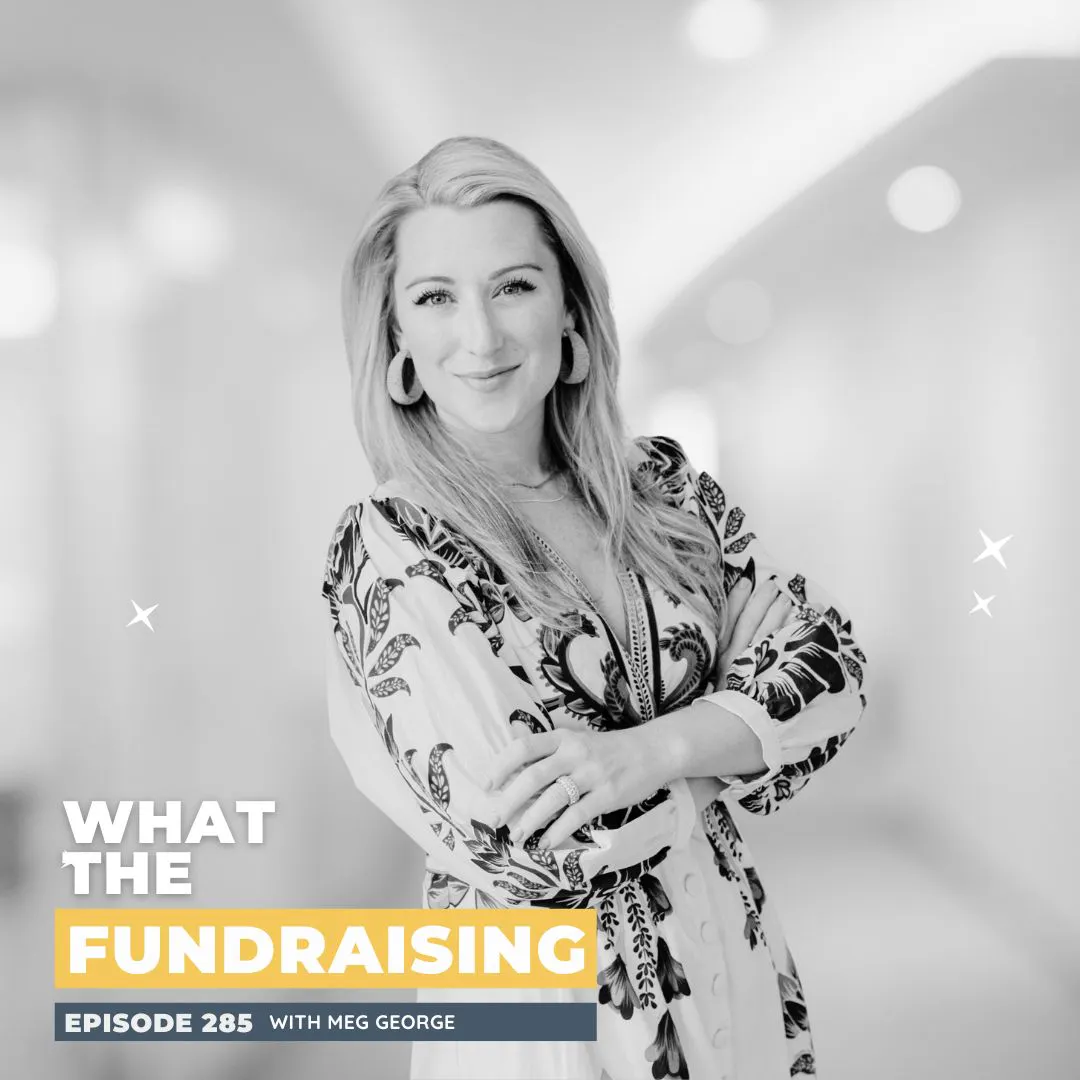
What the Fundraising
285: Shaking Up Major Gift Strategies Through Interdisciplinary Collaboration with Meg George
00:23:56
Loading summary
Transcript28 lines
- [00:04]
Podcast Host
Before we dive in, I want to give a huge shout out to donorperfect for supporting this podcast and the fundraisers who listen to it. They're not just a CRM, they're a partner in helping fundraisers feel more confident, aligned and supported. Learn more@donorperfect.com Mallory.
- [00:26]
Meg George
Just going out and building fundraising programs and hoping that our donors meet us where we are isn't going to work. So can we shake it up by saying all of these other sectors complement what we do and what we need to do and how we can do it way better? So instead of constantly meeting as fundraisers or nonprofit professionals or executives in philanthropy, let's go out and meet with the people who understand tax law, finance, psychology, technology, AI, all of things, and bring them to the table to solve these problems at scale. That's what I want.
- [01:06]
Interviewer/Co-host
Welcome everyone. I am so excited to be here today with Meg. George. Meg, welcome to what? The fundraising.
- [01:12]
Meg George
Thanks for having me. I'm excited.
- [01:14]
Interviewer/Co-host
I can't wait for this conversation and loved our first chat together. So why don't you just start by giving a little introduction into you and your work and then we'll go from there.
- [01:23]
Meg George
Okay, great. Thanks. I'm the co founder of a consultancy, George Philanthropy Group, and we only focus on the preparation for and execution of campaigns. So mostly in the education space, colleges, universities, private day schools, we really differentiate ourselves, I would say, by being excellent major and principal gift strategists. So we hang our hat on this idea that every institution needs to have a bold, aspirational, exciting vision and that has to be matched up with really excellent solicitation strategies. And so that's what our firm does. We have an office in New York and Florida, but I'm also a writer and a speaker and an advocate for all things generosity, particularly relating to kids too.
- [02:10]
Interviewer/Co-host
I love it. And tell me a little bit. I think one of the things I was so inspired by when we first talked was sort of your like, energy and enthusiasm for like mixing things up in the space and really pushing the sector forward and asking people to reconsider things that maybe they've historically thought, quote unquote worked that perhaps require a little like second layer of inquiry into like, how well is it actually working. So tell me a little bit about like kind of your goals beyond just like your individual clients goals in terms of like how you want to shape and change the sector.
- [02:52]
Meg George
Oh yeah, I love this question. When I first started working with a coach, our first day, she's like, let's write your obituary. You Know, how would you leave this world? And I'm like, I would leave this world in a considerably more generous place than how I found it. And I think all of the work that leads to that comes from putting the pieces of the puzzle together that are really realistic on changing the way that philanthropy is effective. What do I mean? Okay, Giving gifts straight up isn't solving our problems. The problems are outpacing our funding abilities. So how do we start working really, intimately, really intentionally with people in finance to really understand how we stack capital and make investments that go hand in hand with philanthropy, and not just philanthropic investments, as we call them in campaigns, but truly diving into the solutions that exist? So somewhere in between investing money just to make money and just giving our money away, and there are so many other ideas like that that have to do with psychology, like informing our children on generosity and the values and benefits of being philanthropic from the time that they're a few years old, so that we are raising people who become philanthropists in the next generation. Right? Just going out and building fundraising programs and hoping that our donors meet us where we are isn't going to work. So can we shake it up by saying all of these other sectors complement what we do and what we need to do and how we can do it way better? So instead of constantly meeting as fundraisers or nonprofit professionals or executives in philanthropy, let's go out and meet with the people who understand tax law, finance, psychology, technology, AI, all of things, and bring them to the table to solve these problems at scale. That's what I want.
- [04:48]
Interviewer/Co-host
Okay, I love that. And there's obviously, like, a lot of tension kind of in our sector, often about. I feel like sometimes we have people being a little bit too flippant about just being more like a business. And it's like, well, we're not exactly like a business. But then we see, like, the exact polar opposite of, like, there's nothing we can learn from businesses because we're so different. And I feel like we, like, oscillate back and forth between, like, between these, like, two very polar opposite kind of directives here. I hear you saying, like, with a lot more curiosity, what does it look like for us to learn from different types of thinkers and models to address the challenges that we're facing that maybe the solutions we've had at our fingertips aren't yet addressing? So how do you think about that? How do you think about kind of the. The uniqueness of nonprofits and donors? And I read this really interesting post yesterday about the different standards that Donors hold nonprofits to. When it comes to AI use versus companies, Right? Like, we do know there's different difference. There's certain differences, while also recognizing that, like, hey, we don't have all the answers inside this community. There's a lot we can be learning from folks in different sectors. Like, how do you kind of balance that?
- [06:08]
Meg George
I think we live in this sweet spot marriage of the emotional and the intellectual, because no one is going to give a million dollars and not receive a single dollar on return without having some soulful contemplation of the good that he or she wants to drive. And yet to solicit someone for that type of gift, you have to represent yourself as a business, and you need to have a business plan. And this needs to look like good money after good money. That's the intellectual. So the more that I speak at conferences about major gifts, the more I become a speaker on becoming an excellent conversationalist, becoming curious about the person on the other side of the table. And you and I talked even a little bit about this with the new tool that you launched. How do we practice getting curious in a sophisticated way and knowing how to extract that information and then set a deliberate next step that says, I heard you as a person and I heard you as a businesswoman, and then match those up for where we go, right? Like, no more rinse and repeat.
- [07:14]
Interviewer/Co-host
Okay, so talk to me about that. Like, tell me what you mean by how folks have been sort of historically rinse repeating something that quote, unquote works, and what this, like, personalization at sequel scale really changes both in terms of, like, what is happening in that conversation, but also how you and, like, your organization are preparing people for that.
- [07:37]
Meg George
Oh, yeah. So one of the slides that I have in one of my decks just says rinse and repeat is out. Because when I became a fundraiser, like everyone else, I was handed these more classically branded tool books. I mean, literally books about how you meet with a person. You need to have a certain number of visits before you ask for a gift. Or here's the three things you should always do with a donor next. It's like, all that is out the window. First of all, you can text donors. Now. The colleagues that you have at your organizations who are smart and don't have a fundraising title are like, the best partners in the world. To get them to copy and paste an email, record a video of themselves, thank people. I think that's why our team loves sitting around a table with clients to say, how can we leverage the social capital that we have and the intellectual capital that we have and the ideas and the exciting things and form a plan based exactly on what this person said he wants to do. I don't care about every element of your school. I care about access to education for kids who otherwise wouldn't have it. Okay, he just fed you this, like, invaluable information on what you can do with this person. So now you know you're going to the people who work in need based aid and you're going to the students who are success stories and you're going to their teachers or professors, Right? So by by posing even three or four questions at the first visit we ever have with people, we do two things. We establish this relationship right away that says, I want to get to know you on a human, human level, but I'm going to take you seriously. And I hope you take me seriously too. And you also learn where to go with this person so that everyone in your portfolio is going in a completely different place. Because if that's what you do, by the time you get to asking, that feels smooth, that's organic, like you've set yourself up well for that point. It's the early work we have to focus on.
- [09:40]
Interviewer/Co-host
I love that. I actually met with the chief philanthropy officer yesterday. We were talking about practivate and we were talking about exactly that actually, that like, but. But that it's like this kind of misconception of. Or it's the fear around that last conversation, which is in many ways the easiest conversation to have once you're actually in it. But it's the fear of that conversation that actually gets in the way of us being able to be like fully embodied and grounded and listening in those earlier conversations.
- [10:14]
Meg George
I think that's such a good point. I tell gift officers that take the pressure off of yourself by knowing ahead of time when you go in that you're going to try to find out like, how these people make their money, what their values are as families, individuals, what kind of outcomes they want to drive. You're going to try to find out some of these things. And because you work there, you and you do this for a living, you're going to know the 6, 7, 10 things you could be pulling from to do something with this person next. So your brain is going to do the work for you. It's going to go off and say, hey, you have an event coming up in a couple of weeks to meet students who received scholarships. And at the end of the visit, your only job is to recap what you learned and Say, would this be a fair next step? And if you have to buy yourself a day, say, would it be fair for me to email you tomorrow? A good next step? But it's like, we know how to do this. We know how to get through a first meeting by letting them do 70% of the talking. And we know how to get a second meeting in the first meeting. Because if we're constantly dreaming up the ways to engage people so thoughtfully and with intention, then the world is our oyster. We choose the next step that feels really good based on what we learned. I feel like that makes the work so much more creative, too.
- [11:30]
Interviewer/Co-host
Yeah, that's interesting. So what you're talking about now is something similar to, like, when I coach around in Power Partners, and. And what, you know, practivated is built for, too, obviously. But is, like, this difference between. Is this difference kind of between, like, strategy and intention? And I talk about this and what the fundraising a lot, too, around. Like, anybody can say that their strategy is to find alignment with a donor, but is that actually your intention in the conversation? Because if you, you know, you can send an email that says, we're looking to see, like, if we're aligned around X, Y and Z, but. Or you can even say that sentence, but if the donor can't, like, feel that that's your true intention, which also means potentially identifying that you're not aligned and being able to say like this, this might not be a fit because of X, Y and Z. So how do you. How do you think about that? And really helping fundraisers kind of, like, tap into being able to show up with that intention and not just strategically where in the back of their head and, like, in their body, they're thinking about just looking for those nuggets or, like, transition points where they could turn it into a transactional conversation.
- [12:43]
Meg George
Oh, I love that. I love that differentiator. Okay, so you have to be genuine for it to work. We all agree on that. And if you believe that you are good at facilitating a conversation whereby one party wants to give away some money, might consider it and probably has some goals on doing it, and another party could use more money, and you know that they can articulate why they need it and what the outcomes could be. And if you can literally imagine yourself as an excellent facilitator in the middle of that, then I feel like you can show up genuine and know that it's only so personal. Like, your first job is to build a relationship with this person on behalf of the institution. Your goal is that as the Relationship grows, really genuinely philanthropic support will grow too, because it's well aligned with what both of your goals are on either side of this. It's like, can we think of ourselves as people who facilitate something through conversations that go deep rather than transactional? Like, our industry has at least embraced this shift away from transactional fundraising to relational? But now being nervous about the relationship won't help you, Right? But knowing that you have, like, the space, space and the liberty to show up and truly be yourself in representing something and kind of representing them too, in this facilitation, I feel like that is. That's the way my brain likes to think about it.
- [14:20]
Podcast Host
There are so many lessons in this episode that are so critical to supporting your fundraising. But I know we can't capture all of the tips and tricks here, which is why I'm so grateful for our friends and sponsors over at Donor Perfect for, who've created a number of wonderful resources for nonprofits and fundraisers to help you improve your fundraising practices. Head on over to donorperfect.com Mallory to learn more about their CRM and click on the Resources section to grab all of their helpful information today.
- [14:55]
Interviewer/Co-host
Do you, when you think about the relationship between kind of like managers and frontline fundraisers, what are some suggestions that you have for managers to sort of ensure that their fundraisers, like, have that spaciousness? Right. Because a lot of one of the things I talk about with the fundraising is like, the way that pressure can be dysregulating and isolation, rejection, sort of this, like, perfect storm that comes into fundraising. So I'm curious, like, how you think about leadership's role in creating an environment for what you're talking about.
- [15:29]
Meg George
Yeah, that was so interesting to me when you mentioned that before, because psychologically, people have an instinct to say I hate asking for money before they realize that. Actually, you probably love talking to people, building relationship with them and learning about them so that you can align that with something you need. You probably do love that. But the idea of just blatantly asking someone for money feels very different to our nervous system. Like you said, I don't believe that saying to someone you have to raise $3 million this year motivates them to do that. And our firm works on this system and campaigns of ensuring that the activity is really intentional and that when it is, it will drive results. And if we can keep our KPIs, so to speak, to having 12 visits in a month, but making sure that a few of them are to qualify someone brand new, a few of them are Always to cultivate someone will be your part partners and what this next step has to be. At least a couple of them are in making the ask, like if that feels right, and a couple of them are in stewarding people. So if there's space from leadership to say you do have an expectation of meeting activity, but it needs to be done so deliberately around where someone sits in this like cycle of being brought to a solicitation, then I know that I feel much more inspired to go out and get the visits if they can fall between a few, three or four different kinds of categories, and that I actually have the space to learn about someone and thank someone. Besides that grind of getting them to an ask, getting a proposal in front of them, getting it signed and booked, which is the higher pressure work, I think people raise more money when their bosses say, in our next prospect moves management meeting, I want to talk about the last few people you qualified and make sure they have the tools and the confidence to show up genuine and pose the questions they need to to inform it going successfully for all of the other phases.
- [17:38]
Interviewer/Co-host
Okay, yeah. Can we talk about qualification for a moment? Because I feel like that is like I'm hearing more than anything one of the biggest challenges that fundraisers face face is like how to effectively and sort of accurately qualify a donor for deeper engagement. How do you. Which then to your point, sort of impacts everything else that's going to happen after that. So how do you think about qualification and what are some like, you know, maybe like two or three quick tips that you have for folks around, like what, what even is good qualification and what are you looking for?
- [18:15]
Meg George
Okay, good qualification means that you're leaving a meeting and you could call me on your drive back and you could say, this is what I found out about their money and this is what I found out about their affinity. So this intersection of capacity and affinity to give to the spot where you're representing means that you have to pose at least a few questions in the conversation around someone's business, around someone's favorite family, their values, the outcomes that they like to drive, and where else they've been involved or have given and what that experience has been like. So I want to know this is where like I people who are scared to use AI or don't even know where to start with ChatGPT or something. Hi, I'm meeting with two alums in Boston tomorrow. One runs a hedge fund, one works in private equity, one's this old and this old. Like, what are the headlines in their industry? What Kind of questions should I ask them? I'm hoping eventually to ask them for a gift for my business school campaign like help AI prepare you. If you're like me and you have a French degree and all of this jargon was way over your head and felt intimidating to meet with people, prepare for them in their industry. It's not you're going to show up and ask some complicated questions. You'd only learn in like advanced studies in business school. But to be able to hang and say to them, hey, I read online this is a third generation family business, that's incredible. What motivated your grandparents to start this? Tell me the story of how you came to be.
- [19:41]
Interviewer/Co-host
Right.
- [19:42]
Meg George
We can ask open ended questions where people share about who they are and how successful they are and they talk about their business and themselves because everyone loves to do that. So you can just ask a few simple questions to get people to do that. Listen for markers. Is the business going to go to the fourth generation? No, we're definitely going to sell it before then. Oh, no way. Do you have plans already to do that? We are looking at December 2027. It's not public information if I'm a gift officer. I'm clocking like my calendar. I know when this person's coming into money. Right. So you can see how some simple questions lend to useful information. And saying to someone too, like tell me a little bit about where else you're involved, where do you give, if anywhere, share the experience with me. You might get a mouthful about how someone came off of a board, really didn't enjoy it and you can learn from that, from what they say, didn't go well. You might hear nowhere. You're the first one to my office. Thanks for calling me. And you know you can really make the most of this person's energy because they gave you the visit. Right. So qualification is about leaving with an understanding of the kind of money and maybe philanthropic behaviors this person has and the impact that she, he or she wants to drive. And that only requires three or four questions. The more you practice, the more you're going to say things like, oh, I'm glad this worked out. I know I was bugging you the last few months. Were you traveling? Oh yeah, we always go to Aspen in the winter. Oh, no way. Do you have a place there? Right. Like I'm trying to constantly find out markers of this person's life that might inform for me to come back to them in like a more sophisticated way each time. So just ask questions, let them talk and be able to call someone on the phone afterwards and like, download on everything you learned.
- [21:36]
Interviewer/Co-host
Yes. Okay. I love that. And this is. That's actually exactly why we created so Tivi, our coach inside Practivated, has a phone number and which we just launched a few weeks ago. And mainly for this exact reason. Like, people want to be able to get in the car, talk through the meeting, debrief it, make sure it ended in the right sort of like notes and next steps and not lose all that. That info. So I love that because it's helping me think about, okay, what do we make sure that they can say kind of after the meeting to then kind of like upstream that, like, qualification training that we're working on. So, okay, I love all of that. I know we're almost out of time. Tell folks where they can go to connect with you, to learn more about your work, to work with you. Yeah. I'm so grateful for all the wisdom that you dropped in like 20 minutes.
- [22:23]
Meg George
Oh, my gosh. I'm so grateful that you asked me. Georgephilanthropy.com, we're always hosting things. Like we have a webinar coming up just on qualifying prospects, for example. We try to do those things a lot. We post on there, which conferences we'll be at. We're speaking a lot this spring on soliciting major gifts across different generations. I also write personal blogs about food, allergy advocacy, motherhood, being an entrepreneur on megt george.com and that is where I sell my book, my children's book called what's Philanthropy To Filamena too.
- [22:57]
Interviewer/Co-host
Love it. I love all of it. And I'm so grateful for the work that you're doing and the way that you're pushing the sector forward and shaking things up. So thank you so much.
- [23:06]
Meg George
Thank you so much for everything you're doing. And I'm very grateful to you, too.
- [23:18]
Practivated Sponsor/Announcer
Fundraising is hard. Every donor conversation carries pressure. And most fundraisers are expected to just figure it out through trial and error. That's why we built Practivated, the first ever AI powered donor conversation simulator made just for fundraisers. It's a safe, judgment, free space to practice your pitch, refine your storytelling, and build the confidence that drives real results for your mission. Because conversations move missions forward. With Practivated, you and your team can practice anytime, get real feedback instantly and walk into donor meetings ready, not rehearsed, but prepared. See how practice changes everything. Try practivated today at www.practivated.com and start building confidence. One conversation at a.