← What the Fundraising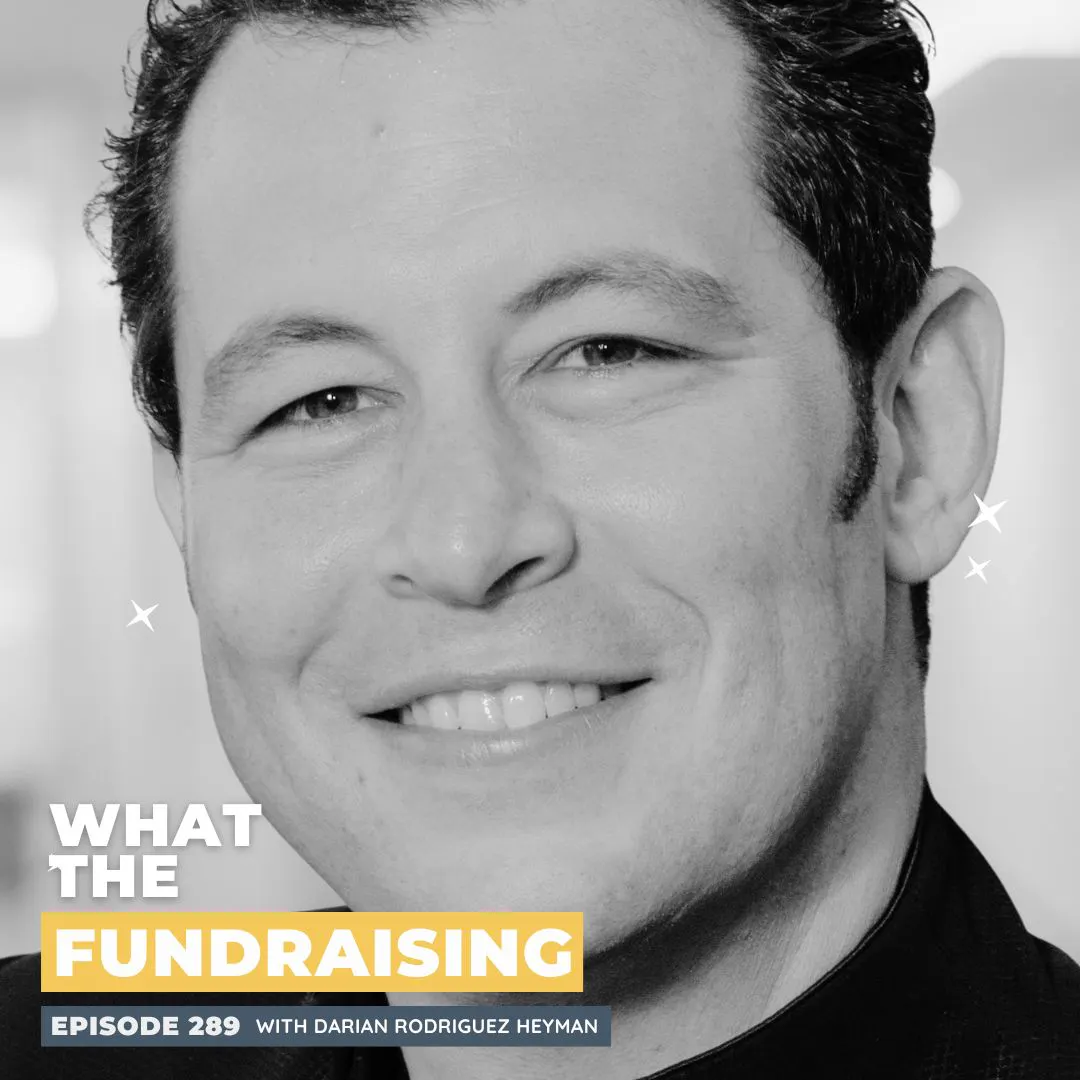
Loading summary
Transcript36 lines
- [00:05]
Mallory Erickson
Do you ever feel like fundraising is a little foggy? Like you have goals to hit, donors to connect with, and about 12 tabs or 47 open trying to figure out what actually works? The good news is that you don't have to figure it out alone. The 2026 donor perfect community Conference is a free virtual event designed to help fundraisers clear their vision, illuminate what's possible, and get glowing results. Join me and some other amazing speakers on June 2nd and 3rd for practical tools, real stories from nonprofit leaders, and a supportive community that truly understands the work. Because when fundraisers come together, we know that things start to look a whole lot brighter. Register now for the Donor Perfect community conference@donorperfect.com donorperfect conference.
- [00:57]
Darian Rodriguez Heyman
We are not the drinkers. Every single one of us. Whether we're working with the unhoused or, you know, people with barriers to education or intergenerational poverty or solving climate change, whatever your mission is, we are all here because we are the drink. We are the poorers. We are the nurturers of society. And what every nonprofit does in this global movement with a capital M is we connect people and organizations with resources to the change that they want to see in the world. And that's change that oftentimes they could not affect on their own. So we are a channel. We are a conduit for impact. Or as Kings Twinkle Grace likes to say, people don't give to you, they give through you.
- [01:39]
Mallory Erickson
Hey, my name is Mallory and I'm obsessed with helping leaders in the nonprofit space raise money and run their organizations differently. What the Fundraising is a space for real and raw conversations to both challenge and inspire you. Not too long ago, I was in your shoes, uncomfortable with fundraising and unsure of my place in this sector. It wasn't until I started to listen to other experts outside of the fundraising space that I was able to shift my mindset and ultimately shift the way I show up as a leader. This podcast is my way of blending professional and personal development so we, as a collective inside the nonprofit sector, can feel good about the work we are doing. Join me every week as I interview some of the brightest minds in the personal and professional development space to help you fundamentally change the way you lead and fundraise. I hope you enjoy this episode, so let's dive in.
- [02:33]
Welcome everyone. I am so excited to be here today with Darian Rodriguez Heyman. Darian, welcome to what the fundraising.
- [02:41]
Darian Rodriguez Heyman
Thank you so much for having me.
- [02:43]
Mallory Erickson
Let's have you start by just having you tell everybody a little bit about you and your work. And what brings you to our conversation today? Yeah, sure.
- [02:50]
Darian Rodriguez Heyman
I mean, I recently wrote my third book on AI for nonprofits and I've been I started a nonprofit under the same name underneath intense nonprofit fiscal sponsorship and have been working actively to build up the nonprofit sector's capacity around responsible AI adoption. But this is also building on about 25, 30 years of work exclusively in the social impact arena. I started in the tech sector. I co founded and sold one of the first digital ad agencies in the mid to late 90s, had a great experience there, even had 22 married couples come out of the company. But then as far back as 2001 I went on sabbatical and really made a conscious decision to devote my career to social impact. And that's all I've been doing really. Starting with my role as executive director at Craigslist foundation where I started their nonprofit boot camp. Have done a lot of work around climate and gender and worked on those two SDGs for the UN. Have done a lot of work in impact investing and started something called the Gender Smart Investing Summit, which is now 2x global. That's moved over $33 billion into women led businesses and funds, but have also just generally been at the intersection of technology and social impact over the years. Previously started something called Social Media for Nonprofits that was the world's first global conference series focused on social media for social good. Starting a mobile for good company now working deeply in AI and in my mind I think really looking at how do we leverage technology as a tool to support our needs, around fundraising, around marketing, around program delivery and evaluation and around back office operations. And so looking at the applications of technology instead of just getting caught up on what it is or how it works and more really thinking about what it can do for mission led leaders who are being faced increasingly with fewer resources and an increase in demand. And so they need to be able to do more with less and build more resilient and responsive organizations. And I think AI and technology in general can help.
- [04:40]
Mallory Erickson
So you've lived like 10 lives as you were going through all the things you've done. I'm like oh my gosh, who, How? How? But I'm so inspired by your journey and your commitment to this space. And maybe we start with given all of that sort of intersectional experience that you have. I actually want to start with something hopeful because I feel like I recognize how overwhelming this moment is in so many different ways and that while AI can be and technology can be a great enabler for A lot of nonprofit leaders, it feel, feels like another thing that they're overwhelmed about. So I'd be curious, I'd be curious to hear from you, like, what's something that gets you really excited right now or hopeful about the way that this new kind of emerging technology could kind of change the game for social impact?
- [05:32]
Darian Rodriguez Heyman
Yeah, I mean, I think I've been working in nonprofit fundraising and philanthropy for decades. And the panacea, the golden sort of opportunity has always been about taking a more relationship based approach to fundraising. A lot of my work is in fundraising just because no money, no mission. And it's the thing that most mission led groups struggle with. And so that intersection of money and meaning has become a lot of my career. And it's always been really challenging for these small resource strapped, understaffed organizations to invest in the necessary ways to build those true partnerships with their supporters instead of taking a more transactional approach. And I think that as we enter this age where we've, we've left the era of planning and entered the age of navigation and we have to build more resilient and responsive organizations to respond to an ever changing environment, I feel like responsible AI can absolutely help properly employed. And if we leverage it properly, it gets us a lot closer to that goal of mass personalization and audience segmentation and being able to have lots of individual discussions and relationships that we're properly nurturing and investing in. And that's one of the things that the robots can't really do without us. And so giving everybody in the nonprofit sector sort of a, you know, a jetpack that they can use to take the cause to higher heights, I think is deeply exciting.
- [06:59]
Mallory Erickson
Okay, so I love that you brought it right away to this moment of human connection and technology living side by side. Because I know that when people are overwhelmed and stressed, things can get really binary very fast. But I see a lot of chatter online around, you know, you're sort of either technology and AI forward or you care about human connection. And what I heard you say was actually was not that. So tell me more about how you think about the relationship between the. Those pieces.
- [07:32]
Darian Rodriguez Heyman
Yeah, I mean, I, I think that the reality is like we were overwhelmed before all the crap that's happening right now, like the world's kind of on fire. I'm not going to lie. I'm, I'm a San Francisco liberal, so I'll put that out there. But I'm concerned about the state of our country and the world as a whole for a variety of reasons. But you know, at its core, it's. We have this tremendous instability and turbulence right now. And so I get, if you combine that with the downward pressure on revenue and income for nonprofits and the surge in demand, you know, we're cutting food stamps and doing all kinds of other things that are going to increase the demand on nonprofits, people are even more busy and even more resource trapped than they were before. And so I absolutely understand if AI is this, like, new thing that is not really clear to you what it can do, and you're just, you know, you need to get involved because everybody else is doing it and you got to play catch up, that is not going to work. And that's really largely what we're seeing. As opposed to meeting organizations where they are, helping them see AI as a new tool that can be deployed in a way that's in line with their values, that advances their operational needs, that frees up staff capacity and allows them to invest that freed up capacity into building relationships, but also gives you the tools to build those relationships more efficiently. Like, I think we're a year or two away from you showing up to the office Monday morning and your robot saying, like, here you go, Mallory. This is your call list for the week. And these are the donors that are ready to be followed up with this week. These three are ready to be asked for money. These two are not. And it's just a touch base for the three that they're ready to be asked. We've framed it in personal language they care about and asked about the wife and kids and the weather in Topeka. We've also included an ask frame specifically on the program they care about that's at an appropriate level with the framing that resonates for them. And the younger donors getting the more uppity messaging and the older donors getting the more stodgy messaging and all the things, and it's like on a silver platter waiting for you. And I've taken the liberty of writing these five emails for you. Would you like me to send or do you want to make any changes? Like that is right around the corner. And for me, part of what's so exciting is even though the technology isn't totally there and we do have to wrestle with data security and hallucinations and all these other very real concerns that I think are going undiscussed, unfortunately, and that's a big part of the problem, the reality is for the organizations and the leaders who are willing to experiment and try, you know, build the plane while flying and try the new tools on it's naturally going to position them at the front of the line as these advanced functionalities roll out with agentic AI, with predictive analytics, with all kinds of other functionality that isn't totally there yet, but it's getting much better very quickly. And so it positions us to best leverage and take advantage of those innovations as the technology gets better and better, which it is doing exponentially. I mean, a couple months ago you tried to create an image in AI and it was full of typos and, you know, six finger people and all kinds of weird stuff. And they kind of fixed that and it happened quickly. And I think they're going to do the same with some of these other concerns.
- [10:49]
Mallory Erickson
Okay. Gosh. There's so many things that I want to talk to you about with what you just said, but I want to double click on one piece in particular, which is this sort of like intersection of concerns and adoption being related to our inability to talk about the complicated nuance or real social and environmental impacts of these tools and maybe not having the space or the language or feeling comfortable having these conversations so we don't talk about them and then how you see that impacting organizations and how we move through that.
- [11:28]
Darian Rodriguez Heyman
Yeah, and I actually think it's the opposite. Right. Like, I think it is because we are not directly addressing these very valid fears and concerns. They are remaining obstacles that are impeding adoption. Right. So let me just take a step back and say, because I know, you know, you were co founder of fundraising AI and I'm sure a lot of your listeners are drinking the Kool Aid and very bullish on responsible AI in the nonprofit sector, as am I. But I also think we need to be real with ourselves about the current state of the industry, which is it's kind of crickets. And for all the talk about AI for the. I just came from the Nonprofit Technology conference where just like every other conference I speak at, more than half the sessions have AI in the title. So there's this tremendous interest level. And if you look at the numbers, 92% of nonprofits are utilizing AI in some capacity. And you know the exact opposite. Not 92%, 8% of nonprofits actually have any kind of organizational strategy or policy in place. So the state of the union is everybody is using AI within their organizations, but none of us have taken the time to come up with a concrete and cohesive and integrated strategy and approach to create the guardrails. And it's because we're so busy and because we haven't wrapped our head around it. And we think it's easier to put our heads in the sand, but that actually creates some pretty significant liability and risk for our organizations and our clients if people are entering personally identifiable information in their prompts or doing other things, or just hitting copy and send AI outputs instead of having a human in the loop. Right? So people are making mistakes because it's this wild west BYO AI, you know, state of the industry. And even though, like I shared earlier, I think AI can absolutely help if it's responsibly deployed in line with our values. And yet for all of the talk, pretty much all of the value around AI that it's bringing into the sector is getting absorbed at the level of one or two employees within each organization that like, those are our AI people and, and everybody else is kind of maybe dabbling, but doesn't know what they're doing. And ask those two people what they think. But like, there's again, no organizational strategy or approach. And I think that that is a big problem for a variety of reasons. But ultimately, why is that happening? And I think your question is actually pointing out to one of the two reasons, which is that if you look at the data, people are more worried than excited about the future of AI. And that's true for the world as a whole. It's also true for our sector for nonprofit and foundation mission led leaders. No surprise, we're values and mission driven people in a sector that's mission driven. So of course I do a lot of environmental work and I'm currently working with the Goldman Environmental Prize and other folks. And there are deep concerns about environmental impact, deep concerns around data security, around hallucinations, around bias, around job loss, around all of which are completely valid. And yet there was no talk about that at the nonprofit technology conference or at any of the conferences that are out there. It's all about how AI is going to help you raise more money or solve climate change or cure cancer, and not about directly and clearly addressing people's fears and concerns and either demystifying those or actually providing strategies for mitigating them if they're not solvable. But either way, if we make people feel crazy for having personal and values driven concerns about AI that are valid, they're never going to engage and get serious about it. And they're going to continue to be reserved and held back and not adopted at an organizational level. And so I think we have to meet the sector where it's at. We have to directly speak to these fears and concerns, provide them with the strategies and the resources for mitigation. And so I think that's one half of the coin. And then the other side, Mallory, I think, is we are failing to talk about AI as a tool. And instead of talking about how it works in the history of AI and definitions of neural networks versus machine learning and all the other stuff like who cares? I'm busy. I've got a line out the door with my food pantry or my homeless shelter, my whatever it might be. How can AI help me? And so for the book for AI for nonprofits, we framed it around four, four principal use cases, which were leveraging AI for fundraising, for marketing and community engagement, for program delivery and evaluation, and for back office operations. And so whether it's building relationships with donors or doing more streamlined accounting and expense reports, or reaching monolinguistic communities that you couldn't reach before, but now you can hit a button and serve thousands more people, that's real for the nonprofits in the sector they're all wrestling with how do we do more with less? AI can help. And that's what we need to be focused on, is here's exactly how it can help. And by the way, that's only happening after we make sure that you're on board with this philosophically and from a values place of maybe we do need to make some accommodations, but what we can't do is just ignore those values driven concerns and expect nonprofits and mission led organizations to take their medicine because everybody else is doing it and they're falling behind. That's not working.
- [16:55]
Mallory Erickson
Yeah, I mean, I really appreciate hearing you say all of this and it's interesting, I'm, I'm reflecting on it in terms of some of the different, some of the things I've learned through the evolution also of fundraising AI. Right. I'm not a technologist and I got into that work with a lot of my own concern, like really with concern at sort of the center of my experience and a lot of fear. And the thing that's been really interesting in my own journey has been this, you know, one, I think, facing head on to your point as an individual, some of the, like, conscious choice that's required in using AI, which means wrestling with and grappling with the implications of the tool and the, to your point, the very real concerns and, and not shying away from that or not saying that, you know, I can't look at that or I can't touch this because there might be this other piece and sort of like forcing myself to figure out what is responsible AI look like for me also as an individual, I'm not inside an organization, you know, so I didn't have to do it organization wise, but align my own moral compass with my how I decided to use it. But then the other thing that's been really interesting for me as I was learning about the responsible use, was that I couldn't really understand what responsible AI until I was using AI. Like when I started to build practivated, you know, I started really from the fundraising AI framework. I was like, okay, I want to build this tool to help people practice donor conversations. I want to think about personalization at scale for fundraisers instead of donors. What could this look like? But it really required me to take two steps forward to then think about all the ethical issues or the bias issues. Right. I needed to have that first avatar conversation to be like, oh, well, well, the avatar definitely shouldn't say this, or if you say this, this shouldn't happen. And so it's been this interesting. You know, I feel like I came into the responsible AI space being like guidelines, frameworks, every hard conversation off the bat before you touch anything. And I feel like some of my own evolution has been like, how do these things walk side by side in a safe and responsible way so that we're able to have, to your point, the nuanced conversations around the environmental impact while we start to explore and be curious about how this tool could address this pain point while we're dealing with those internal infrastructure components around policy and responsibility. And I'm just thinking about, like, how do you think about that kind of sequence of things? Or what do you recommend? Organizations? How organizations kind of take bites of this apple?
- [19:47]
Darian Rodriguez Heyman
Yeah, great question, Mallory. I mean, so first of all, I just have to comment, like, I think it's awesome that, like, the badass tech CEO is the one saying, I'm not a technologist. Right. And I think everything that you're sharing is exactly in line with the nonprofit and foundation leaders with whom I work, which is most of them are not in the IT department or don't think of themselves as techies. I happen to have a tech background and I don't even think of myself as a techie, you know. But the point is it is a tool, right? And so it's a tool that can help you with donor conversations, tool that can help you with lots of other things. But what does that process look like to your question? And I actually think it's not. I think part of the problem is that people are thinking it can happen in parallel or that we can get to the values conversation down the road and let's figure out what it can do for us first. And no, like let's figure out what the KKK can do for us. That's not in line with my values. I don't want to work with them. I'm not interested in thinking of them as a partner or a tool. And that's where people are coming from. Or at least a good chunk of people. More than half as it relates to AI is you can't talk about responsible AI adoption until you talk about responsible. And what are the concerns about? Is this tool in line with our values to begin with? And given we're dealing with mission led leaders, that's table stakes. And we can't have the like, how could this tool be deployed in a way that would support our organization or in line with our values or any of that until we have the like, is this thing evil? Is this thing like a tool that is on the banned list or on the cleared list? And let's talk about that and let's put cards on the table and let's flag the items that there's some disagreement and there's different perspectives. Let's work through some items where actually that's a great concern and challenge and it's highly solvable or it's addressed through, you know, combating misinformation or it's totally valid. And here's how we're going to mitigate and minimize that. Because you're right, bias is baked into the tool. It's part of, you know, it absorbed human consciousness and it was created by a bunch of white dudes drinking too much, you know, Red Bull in Mountain View. And so it's going to have bias baked into the tool and there are ways to combat that. And so in some cases it's about being honest and direct and saying, here's what we are going to do and what other thoughts do you have? But if we're, you mentioned, you know, environmental concerns. If you're trying to talk to an environmentalist or an environmental nonprofit and say like, don't worry about the environmental concerns, let's just talk about how I might be able to help our fundraising. Like, no, I'm working in this sector in an organization because this is what I care about and I'm bringing my full self to this work as every nonprofit leader does. And so like, no, I'm not interested in using that tool unless and until you can dispel or address my fears and concerns. And then, okay, like we can talk about it. But so I think that is a critical point that we're seeing in the sector, because again, every conference I go to, I mean, thousands of people have bought the book. I'm doing keynotes all over the country, in the world, webinars, podcasts, and you name it. And there's. It's a very popular discussion, and it's oftentimes framed as like this. You know, you need to do it because you're going to fall behind. If not, it's happening. You can't unring the bell and put the genie back in the bottle. And so you might as well accept it. And I don't think we have to do it that way. I think we can genuinely address these fears and concerns. And once you do that, it creates the trust to enable us to have that group conversation about where do we want to point this thing? What's the lowest hanging fruit? What does a crawl walk run framework look like? So that, to your point, people can try it on for size and see what it can do, but they're only going to do that once their values and other fears and concerns are addressed.
- [23:47]
Mallory Erickson
I have to be honest, more than anything right now, people are asking me, just tell me what to do. I know that so many people are sitting down to work on fundraising and thinking, okay, where do I even start? You're juggling campaigns, emails, donor meetings, events, and about a hundred other things. And sometimes it can feel like you're trying to navigate it all in the dark. That's exactly why I love the donorperfect Community Conference and why it was created. This free virtual event is designed to help fundraisers clear their vision, illuminate what's possible, and get glowing results. On June 2nd and 3rd, you'll hear real stories from nonprofit leaders, learn practical strategies you can actually use, and connect with a community of people who understand the challenges of nonprofit work. Join me and some other amazing speakers, including Joan Gary, Clay Buck, and Julia patrick, for the 2026 Donor Perfect Community Conference. Register for free today at donorperfect.com backslash donorperfect-conference. I can't wait to see you there.
- [24:55]
Yeah. Okay, so I love what you're saying because it's interesting. I've. For years, I've been really frustrated when people tell fundraisers to not take it personally when somebody says no to them. Because I'm like, we tell fundraisers to take everything personally, right? We ask them to take it personally when we ask them to work an event on Saturday and late nights. And we're always Being asked to take our work personally, and then we find these convenient moments as leaders to tell people, not today. And it doesn't mean that it is personal, but it makes sense that it feels that way. And so I think what you're saying around acknowledging and validating how people feel, feel is such a critical part of their ability to be open to hearing what's next or curious about the, like, mitigation of risk. And the more that we sort of, like, gaslight over that, the less we're creating bigger barriers and more friction and these, like, camps of people that are making it even harder for us as a sector to move forward and. And find this, like, middle ground. So I. I just. I really appreciate what you're saying. I wonder, do you feel like the reason why folks are really hesitant to open up those conversations and we sort of hold them at arm's length as a sector is because we don't feel like we have the knowledge to talk about them or we don't have perfect answers because it is an imperfect answer, and there is unknown and uncertainty, and so we feel more comfortable just sort of glossing it.
- [26:30]
Darian Rodriguez Heyman
Yeah, I don't think it's the latter. I think it's more just a communication breakdown because we're. A lot of your audience are fundraisers, as am I, and I happen to have come from a sales and business development background in the tech world before. But maybe you saw, like, the Wolf of Wall street and he's, like, trying to sell somebody a pen and, like, it's features versus benefits, right? People don't buy a hammer because they need a hammer. They buy a hammer because they need a hammer and a nail. They buy a drill because they want to drill a hole, not because they want the drill. And this idea of, like, talking about the tool and how it works and where it came from and all the definitions, that's like, a mistake that most people make when trying to communicate something instead of focusing on the benefits of that tool and what it can do for. Do you need to sign this document? Well, this pen can help you do that. Or do you need to carry some clothes? This box can help you do that. Instead of. It's made of cardboard. It has these dimensions, like, people don't care. And I think it's a very common mistake that people make, especially when they're trying to communicate something that is multifaceted, that is moving quickly. That does bring up a lot of concerns. So I think it's less about, like, they don't know how to speak to environmental Impact or job loss or data security. And more about they don't recognize the critical importance of meeting a mission led sector in a conversation about responsible AI use with a starting point as table sticks around the responsibility and the values component. Until we do that like nothing else matters. And even then the other side of the coin, I would say that is the reason why we've got all the interest but none of the organizational level adoption. Aside from the fact that we're not having the values and the responsibility conversation. The other one is we're not having the tool conversation. And again, we keep getting into like how it works and the history and all the stuff instead of like, let me tell you what it can do for you and how it could help you serve more people more efficiently or deepen relationships and create vibrant career paths for your team and allow you to navigate these troubled times when you just got your funding cut or whatever it might be and really talk to people in those kinds of frames. And I think that that is something in particular in the nonprofit sector that we do all too often is we spend so much time trying to inspire audiences and we fail to recognize like this sector's already really inspired. I mean that's why we're here. And what I heard when I first took the reins at Craigslist foundation and did a huge listening tour and asked people what they needed that ultimately led to the nonprofit boot camp I started, one of the punchlines was like, enough with the inspiration. Like we're already inspired. We don't want more big ideas and abstract concepts. We want tactical, practical tips and tools. And do this, don't do that. Here's how to kind of content. And that's what's missing in the nonprofit world around responsible AI adoption is for all these big ideas and concepts, like let's put the tool to work, let's profile like how to use it for fundraising or how to use it with your board or so that's kind of what I did for each chapter of the book was within those four use cases of fundraising marketing programs in back office. Each one has like six or seven chapters based on a different interview with a different expert, including Nathan from Fundraising AI, you know, to look at applications and use cases, which is ultimately where the rubber hits the road. And so I think that's critical conversation that needs to happen. And I will just flag circling back to the question that I do think this is a little bit of a non sequitur, but I do think that it is not necessarily in conflict to say that even though we should take our work and our causes very personally. That means it should be impossible for us to not take those nos personally. I think there's actually a way to thread that needle and kind of connect those dots that is not inherently AI related. It's more like overall fundraising. And it's in my mind, speaks to, like, the single greatest challenge or failing that we have as fundraisers, that is holding us back from raising more money, feeling better about the funds we raise, and leaving our donors feel better about it.
- [30:46]
Mallory Erickson
Well, that is actually the focus of my book, is sort of how you can stop, how you can change how you feel in those moments. But I think it makes sense to me that people do have that initial reaction, I guess is what I was. Is what I was saying that, like, I think it's a normal human response, especially as you're first getting into fundraising, for it to feel that way. To your point around, like, where in this work, because we love people, because we love our mission, because we care so deeply about relationships and that openness and that connective tissue that gives us a lot of superpowers, also, in terms of the neuroplasticity, also can make us a little bit more, and I do not mean this word in any type of negative way, but more sensitive to the stimuli that can come in, like getting rejected and things like that. So, so, but I'm with you, and I absolutely believe there are ways to overcome it. But I think the burden often gets put on fundraisers who haven't been given support from folks to just feel differently.
- [31:47]
Darian Rodriguez Heyman
At the same time, though, I think that there's a failure of perception. Like, there's a misconception at the core of fundraising that I think is the underpinning for everything that you're talking about. There's actually a short story that every time I keynote and I'm talking about fundraising, I open share the story because I think it's so helpful. And I've literally had fundraisers tell me and change their life. Because, I mean, if you're throwing a party, right, you're throwing a cocktail party tomorrow. I'm throwing one for impact investors tonight. If somebody RSVPs. No, I'm not taking that personally. That, to me, is not a rejection. Right. And that to me is the way I think of as fundraising is like, instead of an ask, it's more of an invitation. And, like, I'm going to climb this hill whether you're with me or not. And if our goals line up, then great, you'll be happy to join and if not, that's okay, too. So I take this work very personally. I'm climbing that hill because I believe it needs to be climbed, and those people need my help. But it's a who's with me kind of thing. Right. And so the punchline here is that I think all too often the single biggest, like, fatal flaw in nonprofit fundraising is what I think of as sort of the begging for alms, or the tin cup approach to fundraising, where all too often nonprofit fundraisers feel like this sort of Oliver Twist. Please, sir, can I have some more? And it doesn't have to be that way. And again, like, to me, that's rooted in a failure perception that's best illuminated through a really short story that I'll share if it's okay.
- [33:12]
Mallory Erickson
Yes.
- [33:12]
Darian Rodriguez Heyman
Which was that this young man who would go on to become a renowned philanthropist and actor, when he was young, he was the first in his family to go to college. And he not only graduated undergrad, he went on to get a master's. While he was doing that, he was in a philosophy class. 200 students, hour and a half long class. Professor gets up in front of the class one day and he says, hey, class, is this glass of water half full or half empty? Hour and a half goes by. As you can imagine, these philosophy students don't solve the age old riddle. They talk in circles. This young man is incredibly frustrated. He and his family made all these sacrifices to put him through not only undergraduate, but now a graduate program. So he walks home huffing and puffing his way through the streets. He gets home and his grandmother Gertrude's there waiting for him. And she says, how was class today? I don't want to talk about it. He blows her off, but she presses him, as grandmas are prone to do. No, really, I want to know. Well, you got to know. We had 200 masters and doctorate students sitting around for an hour and a half, and all we did is debate if the glass were half full or half empty. And his grandmother Gertrude, with a second grade education, mind you, without missing a beat, says, oh, well, that's easy. It depends on whether you're pouring or drinking. Pouring or drinking, Right. And the premise and the idea here, Mallory, is that when we take that begging for alms approach to fundraising, it's rooted in this misconception that we are the drinkers. Because financially speaking, we do rely on the charitable contributions of people and organizations to do our good work. No debate about that. And in truth, at its core, nothing could be further from the truth. In fact, we are not the drinkers. Every single one of us, whether we're working with the unhoused or people with barriers to education or intergenerational poverty or solving climate change, whatever your mission is, we are all here because we are the drink. We are the poorers. We are the nurturers of society. And what every nonprofit does in this global movement with a capital M is we connect people and organizations with resources to the change that they want to see in the world. And that's change that oftentimes they could not affect on their own. So we are a channel. We are a conduit for impact. Or as Kingswinkle Grace likes to say, people don't give to you, they give through you. So I'm not raising money for myself and getting a personal rejection. I'm not even raising money for my nonprofit and getting an organizational rejection. I'm telling you that I'm climbing this damn hill and we're going to feed these people or educate these kids or whatever it is. And if that happens to align with your vision of a better world, then great. It will be natural and organic for us to work together. And if not, that's okay, too. I'm going to be throwing a party tonight, whether you come or not. Right. So that. It's a different way to think of it where there isn't. It is still highly personal to me. But that, no, that rejection, if you will, is not actually rejection. It's just a lack of alignment. And that needs to be okay. Otherwise we're not doing it right.
- [35:59]
Mallory Erickson
Yes, 100%. I'm going to send you my coloring book, too, because this is the kind of root of my program and the book. And so I. Yes. I'm like, people who are listening, who are used to listening to me, they're like, oh, my gosh, she paid him to say all of this. I did not. I did not. No. Yes. I could not agree with you more. And you know, I think something I've often done in board trainings, when board members will say, well, but I ask my friends every single year. I'll be like, well, do you get to your birthday party or like, birthday dinner? And you're like, oh, well, I asked them last year. I can't ask them again to come to dinner for my birthday this year. It's like, no, like, exactly to your point. Like, we have these baked in perceptions that give, that create this immediate kind of like power dynamic or assumed power dynamic. That isn't true. And our work is really sacred. And I think we also Forget sometimes in the sector that we get to live these really mission driven lives in the work that we do every single day and the channels that we give for people to participate sometimes are their way of realizing and creating the community in the world that they want to build, that they want to be a part of. And I think sometimes we take that for granted because it's such a big part of our lives how much people are looking for the opportunities and need the opportunities that we're giving them. So yes, yes to all of that. I'm curious, you know, because of this, because of your, like, dual experiences, both like boots on the ground in the nonprofit social impact space and on the funder side. We are talking about the technology and AI perceptions, but I'm actually curious about this piece of it as well. Like everything you just shared from your experience on the funder's side, how does that show up in terms of what they're looking for in relationship with fundraisers and organizations?
- [37:59]
Darian Rodriguez Heyman
Yeah, I mean, I think it's interesting because I've been doing a lot of work with tag, the technology association of Grant Makers, and looking at a lot of their research and other research that's been done by center for Effective Philanthropy and others. And the reality is funders are just starting to dip their toes in this water. I've been having a lot of conversations since the book came out. I'm seeing the philanthropic side of the social sector is significantly further along in terms of adoption. Not a huge surprise because they have the money, so they're in an easier position to actually, you know, try on some of these tools. But what I'm seeing is almost like a, a life cycle or sort of a, you know, a spectrum. And where foundations are for the most part is they're less likely than nonprofits to be in that like under 10% have thought about AI at an organizational level. They're further along than that. And the vast majority of them are what I would think of as like step two. Right. Step one is like the resistance when those needs get met. As we discussed earlier, what's this tool for? How do we overcome these values concerns? Once those are addressed, then the next step is to kind of eat your own dog food and try it on internally. So for the case of foundations, it's internal operations, grant making, back office, event production, social media, etc. And that's really been where the bulk of the conversations I'm seeing are within the foundation space. But it's a significantly higher percentage than in the nonprofit world. Then if you go Further upstream, you get into grantee capacity building. So for the groups that we've already supported, now we want to provide them with additional support around AI, working with Tipping Point and some other groups that are more forward thinking and really looking at their work through the lens of capacity building and technical assistance and helping to make their grantees more effective and impactful. AI can help. And so that's sort of a subset of the subset. And then the pinnacle is really field building and capacity building for the sector as a whole. And unfortunately that's a pretty small space right now. There's an effort called Fun AI. There's a couple other philanthropic networks that have been kind of roll ups where different foundations, Kapor and MacArthur and others, have kind of brought, you know, pooled their funds to be able to do some sector wide capacity building. McCormick. But there's like five to 10 foundations that are really leading that charge. And it's a pretty small group of enlightened philanthropists and funders at this point. And so I think it's further along, but they're still largely focused more on internal use cases. And hopefully some of the research that CEP and others have started to put out will really highlight the fact that not only do funders need to start resourcing this and funding it for their grantees and hopefully for the sector as a whole, but it also needs to include some coaching and training, access to the tools, etc. And so I think we're starting to see that and definitely further along on the nonprofit side of the coin.
- [41:02]
Mallory Erickson
Okay, really interesting. There's so many different things I want to ask you, but there's something that you've been mentioning. I want to ask you a question about the tool, the positioning of these products from tools instead of talking about features for a second. And I'm curious if there's a call in to technology providers here. And I'll give a little caveat as to why I'm asking this. So one of the things that's been really interesting, being on the technology side now, or building a technology product after spending my entire career on the other side, has been how to talk about our product in a way that doesn't sound the same as every other product, because so many products just talk about the outcomes. But it makes the tech sector look like it's this overlapping Venn diagram of tools. Like the amount of times we hear all in one platform with tools that do wildly different things, right? And so then as a buyer on the other side, it starts to get a little bit confusing around the landscape and what it does. And so there's this tension between, like, how do we talk? Because I'm a hundred percent with you. Like, we have to talk about we should be problem aware. We should be looking for tools that solve problems, not just trying to, like, buy some AI. Right. So I really like your framing there and something I've struggled with. So maybe this is a selfish question, but something I've genuinely struggled with is how are we honest about what our tool does and create, you know, transparency around the actual functionality so it doesn't just sound like all these other tools that promise the world with a shiny object, especially in the fundraising landscape, that give people no idea what the tool actually does, while also, to your point, like, talking about the solution as opposed to a feature. How do you, like, wrestle with that?
- [43:04]
Darian Rodriguez Heyman
Yeah, I mean, I think it really does vary from story to story. I do a lot of storytelling work and most fundraisers don't realize that part of the struggle with putting numbers on the board is around effective storytelling and creating and crafting a killer elevator pitch. And so, and oftentimes that really boils down to this, like, features versus benefit discussion of, like, I don't care. What I care about is right. And really leading with, like, solving that problem and being really clear about it. And so I think especially where the technology is at right now, that your instincts have practivated, which is like deeper versus wider. And instead of trying to be an all in one solution and all aspects of your fundraising and it's now going to be AI powered, what does that even mean versus, like, we are in the attention economy and getting on a philanthropist or a donor's very busy dance card and securing a call or a meeting is a huge deal and a lot of work goes into that. And the last thing you want to happen when you show up for that meeting is it doesn't go well because you weren't properly prepared or you didn't have your talking points straight. We help you fix that problem. Like, boom. You want to have better donor conversations. They start at practice. Like, that's what I see your positioning as. And to me, that is the right approach, which is like, here's your challenge or your need or the goal, and then here's how we're going to help you do that. But the how has to come second. Right? It's kind of that Simon Sinek of, like, starting with why, right? It's like, what's at the heart of your story and in the bullseye and. And it ain't the details of, like, how the tool works, where it came from. It's what can it do for you, given how busy you are and all the 18 million things you're trying to do every day, one of which is putting numbers on the board and raising money in the context of that individual donors. 86% of all fundraising. And people are busy increasingly, so they're distracted. When you have their attention, you better hit it out of the park, otherwise you're causing them to be around. So it's that, like, problem solution frame that I think we need to be better at. And again, addressing some of the fears and concerns in the process of that. That can be pivoting factors and obstacles that people can't even hear you unless you tackle this.
- [45:21]
Mallory Erickson
Yeah, no, I totally agree with that. And I was just curious, like, not as much on the. On the practivated side, although I was using that because that's the only example I have. Just around, like, how you would like to see other technology companies talking about their solutions in a way that made it easier for nonprofits to move into more of that tool solutioning language. And if there was any other, while also not creating confusion in the marketplace because we're using sort of like the same language to describe a lot of different things.
- [45:53]
Darian Rodriguez Heyman
Yeah. And I feel like the problem that I'm seeing is less at the provider level. Like, whether it's what Nathan's been doing with Virtuous or the folks over at Instrumentl or whatever. Like, the individual providers seem to be like, we can help you with AI powered bookkeeping or automate or streamline this process or help you with your CRM or whatever it may be. And I hear you that some of them are like, trying to be all things to all people and kind of diluting their efforts in the process. But I find in general that most of the platforms that have product marketing people on staff are telling the right story. It's more the nonprofits and the consultants who are generally the ones speaking at the conferences where I'm keynoting and I'm seeing who else is out there. And they're all talking about the pie in the sky and the world without cancer and the puppy dogs and kittens that'll be down the road and failing to address those fears and concerns and what can the tools do for you? And they're kind of talking about this utopian AI powered society. And that's really where I see more of the disconnect is like any nonprofit conference that you go to, whether it's A fundraising conference or a technology or board conference. There will be 50 plus percent of the sessions about AI in the title. And they will almost always talk about the, like, wonderful world of tomorrow and how everybody's doing it and you're behind and need to catch up and fail to address these, like, what can the tool do for you today? And let's talk about those fears and reservations.
- [47:23]
Mallory Erickson
Yeah, that's so interesting and Right. And both of those things are the things, as you were saying at the very beginning. So this will kind of just tie a nice bow so that those are actually the things that impact adoption today. Right. Like our belief in the utopia tomorrow doesn't actually really change our behavior today.
- [47:39]
Darian Rodriguez Heyman
Exactly. And that's a little bit further upstream because, like, the only way as a nonprofit fundraiser, I'm going to be like, I need practivated so we can have better donor conversations. Like, I need to be open to the idea of AI and open to what can the tool do for me? And, oh, I have goals with fundraising, including individual donors and which tools are out there. Like, we're like three or four steps down the process. But again, like, more than half of the nonprofit leaders aren't even getting to that point because they're like, afraid and not really interested in AI until we have the values conversation that kind of supersedes the productivated one or whatever the tool of choice is. Right. And I think it's super helpful to have this conversation in the context of like, real world applications and your business or challenges that your members are facing, your listeners, because that's really where the conversations get grounded in reality instead of the abstract and the theoretical, which is all too often the problem. I see. And so there needs to be like a primer coat on the Mona Lisa. So, like, what are we putting down on the empty canvas so that we can paint the masterpiece that is AI and we cannot skip that primer code. And I think that's something that we need to be doing a better job at at these nonprofit conferences, in books like mine, in these educational fora where we're really starting with the AI for good 101. Like, what is it, you know, like, what is the big deal here? And generally when we have that conversation, it's the big deal is, you know, we're going to unlock the utopia of tomorrow and no one will be unemployed and everyone will have food and there won't be any cancer. And okay, that's beautiful. But I'm a little concerned about how we get from here to there. And I'm not getting on the yellow brick road until I take my first step. And most of us are not ready to do that right now because of some of these gaps in the educational marketplace.
- [49:40]
Mallory Erickson
Yeah, no, that makes total sense and I really appreciate you breaking it down like that. Okay, so tell people. I think people are walking away with some really good like next steps also at an individual and organizational level. Like I love the advice to like address those concerns head on. And I appreciate the call to consultants and the education space to be doing more of that in conferences as well. Where can folks go to get your books so that as they're moving into more of that tool conversation, they can have that framework with those four primary buckets.
- [50:12]
Darian Rodriguez Heyman
Yeah, sure. So the book is called AI for Nonprofits. It's on Amazon and Barnes and Noble and all the big bookstores. If people want to get into with me, they can do that through my website, which is helping people help.com you can also go to AI the number four, np.org, which is AI for nonprofits.org and as I do anytime I give a keynote or a webinar or podcast like I'm happy to offer a free pro bono coaching session to any of your listeners. So people want to sign up for a slot in my calendar directly through the Helping People Help website. They can do that and I'll give them 20 minutes of kind of one on one time and free tips and advice. Point them in the right direction. If they go to the AI for Nonprofits website, they'll find information about different resources and tools for AI for good, as well as some upcoming learning labs and training events we're doing around the country. And then the other thing I would point them to on the Helping People Help website is we actually created a prompt engineering cheat sheet. So like a little one page flyer that you could put up behind your desk of anytime you're asking AI for anything. Here are five steps to like level up the quality of your outputs and how to speak AI basically. And so they can get that on the Helping People Help site as well. But that's also got my personal mobile phone and email there. I'm a pretty accessible person and I really value the opportunity to meet with grassroots and community led leaders and point them in the right direction, whether that leads to, you know, professional collaboration or just kind of gives them some free advice and resources. So yeah, I'm happy to be of service to your listeners and I think just in general as we're wrapping up, I want to thank not only you, Mallory for your good work in the sector and with the podcast. But I really want to thank your listeners, you know, not just on behalf of you and myself, but on behalf of the thousands of people that they collectively serve. And I'm hoping that they're leaving this conversation not just inspired, but inspired to action and if I can be helpful to anyone that they'll reach out through my website of helping people help and let me know what I can do for them.
- [52:05]
Mallory Erickson
Amazing. Thank you for being so generous and for everything that you do to support these leaders. I'm so grateful.
- [52:11]
Darian Rodriguez Heyman
Fall it's my pleasure. You take care and have a great day.
- [52:19]
Mallory Erickson
I hope today's episode inspired or challenged you to think differently. For additional takeaways, tips, show notes, and more about our amazing guests and sponsors, head on over to Malloryerickson.com podcast and if you didn't know, hosting this podcast isn't the only thing I do every day. I get coach, guide and help fundraisers and leaders just like you. Inside of my program, the Power Partners Formula Collective Inside the program, I share my methods, tools and experiences that have helped me fundraise millions of dollars and feel good about myself in the process. To learn more about how I can help you, visit mallory.com powerpartners Last but not least, if you enjoyed this episode, I'd love to encourage you to share it with a friend you know would benefit or leave a review. I'm so grateful for all of you and the good hard work you're doing to make our world a better place. I can't wait to see you in the next episode.
- [53:19]
Nathan (Founder of Practivated)
Fundraising is hard. Every donor conversation carries pressure and most fundraisers are expected to just figure it out through trial and error. That's why we built Practivated, the first ever AI powered donor conversation simulator made just for fundraisers. It's a safe, judgment free space to practice your pitch, refine your storytelling, and build the confidence that drives real results for your mission. Because conversations move missions forward. With Practivated, you and your team can practice anytime. Get real feedback instantly and walk into donor meetings ready, not rehearsed, but prepared. See how practice changes everything. Try practivated today at www.practivated.com and start building confidence. One conversation at a.