← What the Fundraising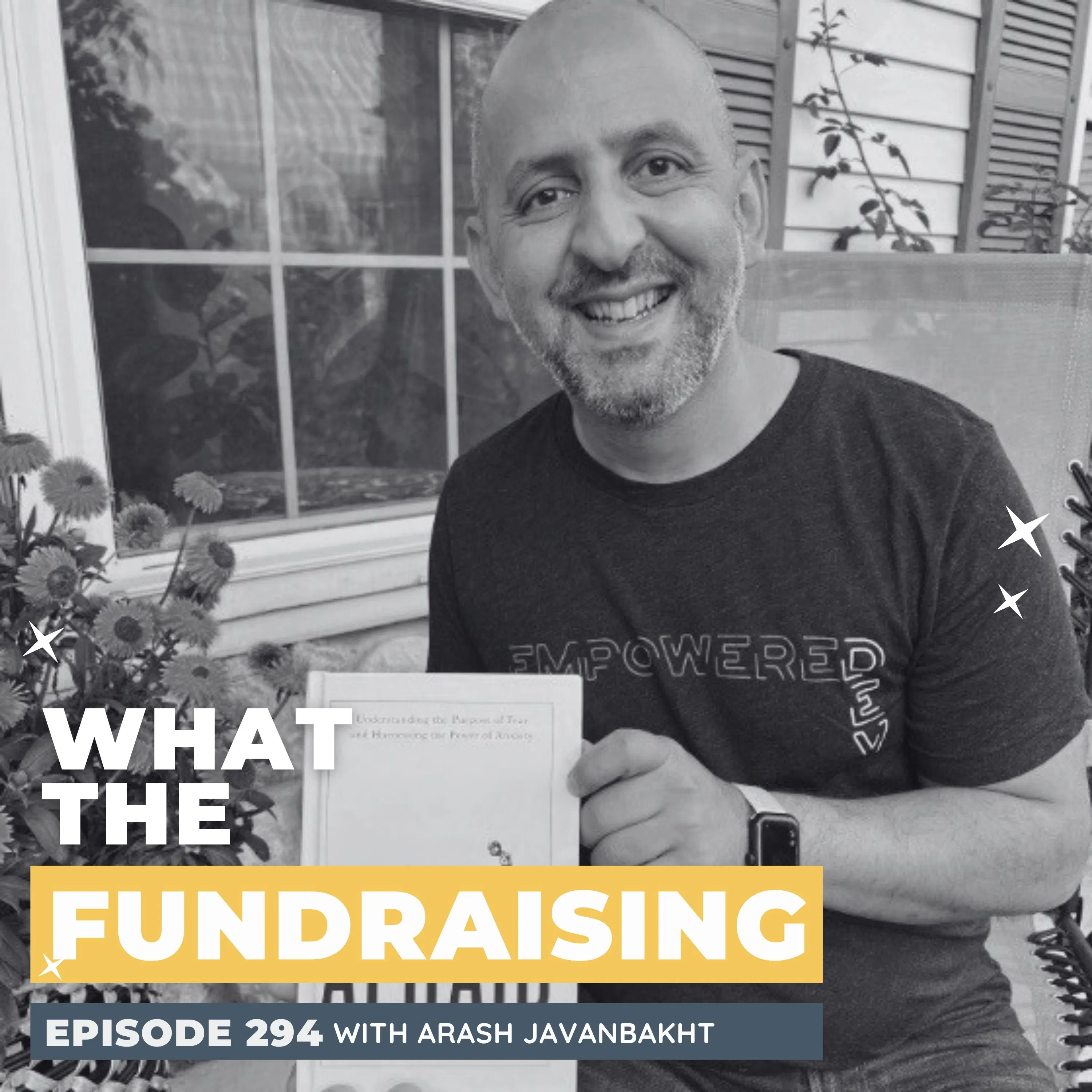
What the Fundraising
294: Navigating Fear: Insights from Neuroscience, Trauma Research, and Fundraising Challenges with Arash Javanbakht
00:39:38
Loading summary
Transcript32 lines
- [00:05]
Mallory
Do you ever feel like fundraising is a little foggy? Like you have goals to hit, donors to connect with, and about 12 tabs or 47 open trying to figure out what actually works. The good news is that you don't have to figure it out alone. The 2026 donor perfect community Conference is a free virtual event designed to help fundraisers clear their vision, illuminate what's possible, and get glowing results. Join me and some other amazing speakers on June 2nd and 3rd for practical tools, real stories from nonprofit leaders, and a supportive community that truly understands the work. Because when fundraisers come together, we know that things start to look a whole lot brighter. Register now for the DonorPerfect Community Conference at donorperfect.com DonorPerfect Conference.
- [00:57]
Arash Javanbakht
I think the more important part is to reduce the intensity of hurt by reminding myself of first, there's nothing personal here. If this funder did not fund me or did not return my email, it's not that I am an idiot. I am doing wrong or I am bad. No, this is the way this business works. If I go out on a date with someone and they don't like me doesn't mean I'm bad. Because 90% of people out there should not be a good match for me. And they will not like you. Same way I will not like you.
- [01:33]
Mallory
Hey, my name is Mallory and I'm obsessed with helping leaders in the nonprofit space raise money and run their organizations differently. What the Fundraising is a space for real and raw conversations to both challenge and inspire you. Not too long ago I was in your shoes, uncomfortable with fundraising and unsure of my place in this sector. It wasn't until I started to listen to other experts in outside of the fundraising space that I was able to shift my mindset and ultimately shift the way I show up as a leader. This podcast is my way of blending professional and personal development so we as a collective inside the nonprofit sector can feel good about the work we are doing. Join me every week as I interview some of the brightest minds in the personal and professional development space to help you fundamentally change the way you lead and fundraise. I hope you enjoy this episode, so let's dive in.
- [02:26]
Podcast Host
Welcome everyone. I am so excited to be here today with Arash Javambhat. Arash, welcome to what the fundraising.
- [02:33]
Arash Javanbakht
Thank you for having me.
- [02:35]
Podcast Host
Let's start with you telling everyone a little bit about you and your work and the book and then we'll dive in because there is so much here for nonprofit fundraisers.
- [02:45]
Arash Javanbakht
I appreciate that. So I'm a psychiatrist and Neuroscientist. I am founder and director of Stress Trauma and Anxiety Research Clinic at Wayne State University. I'm a clinician. As a clinician, I work with patients of all sorts of anxiety and trauma backgrounds. When it comes to trauma, survivors of torture, human trafficking, refugees, first responders, all sorts of trauma exposure. I also look at the what trauma and stress do to the human brain and the body over the time course, whether it's in refugees or first responders, we look at epigenetics, inflammation, autonomic correlates environment throughout the time, use some very cool mixed reality technologies, augmented reality technologies. You wear these Iron man goggles and you're in basically seeing digital humans walking in this room, interact with them. You have incorporated AI in those. You can write an AI brain for a human and communicate with that human automated way. And as you mentioned, I'm also involved in public education. One of the things that is very exciting these days in my life is this book that came out, Afraid, which is basically a comprehensive review of fear and anxiety from evolution to brain, body, why we love to be scared, how we learn fear, how we unlearn it. Is there any positive use for fear and anxiety? How can we utilize the energy of anxiety within ourselves, meaning politics, media, diseases, how we treat them. So, and comprehensive encyclopedia of fear from anxiety from different angles.
- [04:15]
Podcast Host
Okay, I don't know how I'm going to fit in all my questions into this interview, but let's start because there's just so much here. Let's start with you just explaining to everyone who might be new to this concept, how does fear work in our brains? We're going to talk about fear around fundraising in particular, but let's start with how does fear work in our brains?
- [04:38]
Arash Javanbakht
I always say this to my trainees and I think will apply to the concept, the subject matter we will be discussing now. To understand fear, we have to understand the context within which it evolved, which is the context of 50,0001-000003-00000 years ago. Very back old in the time. Basically, fear circuitry in the brain is so primitive that my colleagues in the laboratory look at the brains of rats and mice to understand how fear works in my brain. So this is a very, very old mechanism which was in us to protect us against destruction or losses. Right? But the losses and destructions and threats we are talking about 300,000 years ago are very different than the situations we have to deal with in this day and age that make us anxious. For example, 100,000 years ago, if I was talking to a group of my tribemates, and they didn't like me. Chances were high. In a matter of minutes, one of us could be dead or seriously injured. Right? But now I want to talk to a group of people, and I feel very anxious. My heart's pounding, My breathing is heavy, My hands are shaky and sweaty. But the reality is that that caveman now is looking at this group of people in front of me. In this current situation, the worst that can happen is that, I don't know. They will not like me or they will not invite me to talk again. But here, the caveman sees the threat, so it goes to the fight and flight mode. So back to your question. What happens in the brain when I'm afraid of something? The amygdala, which is a tiny part of the temporal lobe on both sides. Basically, the amygdala's job is what we call salience detection. It looks at what is out there and says, what is its emotional relevance to me? Should I attack it? Should I run away from it? Should I eat it? Should I have sex with it? Very basic human instincts. When it detects there is a danger, it goes crazy and sends signals to all parts of brain and body that we have to go to fight and flight mode. Amygdala is automatic. So if, let's say we put me in a brain scanner and show me a picture of scared face or a snake, the amygdala fires up. Even if I consciously am not aware of my emotional reaction. Then other areas of the brain. Walking, for example, hippocampus, which is involved in memory and context processing. I say, what else is going on? For example, hippocampus says, well, we are in a mri scanner. The context is different. Or I'm seeing this angry lion, but I'm not in African Sahara. I'm in a zoo. Reduces amygdala response. And then there are frontal cortexes, which are the human brains. We call them the civilized brain. The frontal lobe is more involved in cognitive processing of fear. I see the snake. You tell me, oh, this is my pet snake. It is okay. And frontal lobe reduces the fear response, but frontal lobe can also increase the fear response. I see a dog, I go to pet them. You say, hey, this dog bit someone yesterday, and I get scared. So these are very. In a very simplistic way, these are major areas involved in fear processing.
- [07:31]
Podcast Host
So I was listening to a podcast episode that you were on recently where you talked about memory and fear and sort of what happens in our brain brains when we experience something scary in a way that sort of slows down and cements that memory. And when you were sharing this story, I was thinking a lot about fundraising and how even the best fundraisers have bad stories. Right. Like I could tell you, I could describe in detail the worst fundraising experiences I have had in my life at the drop of a hat. I've had way more positive experiences than I've had negative experiences, but I can't remember them in the same way. And so then when I go would go to fundraise, right. All of my fear around fundraising was rooted to these very, very prevalent memories that I had that sort of overwhelmed what I believe to be true about my experience as a fundraiser in that moment. Can you talk us through that a little bit? What's happening? How does that happen? And do we have any ability to shift that?
- [08:38]
Arash Javanbakht
So I see two phenomena here. Number one is that when you are scared, fear becomes a top priority because danger is the most important thing you have to pay attention to. Let's say you go outside and it's spring and there are beautiful flowers out there. I mean, on your where you are, there are always beautiful flowers. When I'm in Michigan, there are beautiful flowers during this time. And then somebody tells me, hey, there's a gunman in the neighborhood. I will not see the beautiful flowers. My attention immediately shifts towards the negative, towards the threat, towards what could be dangerous. So one thing is that when there is possibility of fear of loss, let's say I'm at this event and I'm worried that, well, what if things don't go well? Then it automatically shifts my attention towards anything that could be negative and anything that could go wrong. At the same time, negative memories are easier to be recalled. But on the other hand, negative memories are also more strongly registered. And the more negative the experience, the tougher and the harder they are consolidated in the brain. And the reason is that again, 50, 80, 100,000 years ago, if I was attacked by a bear, the memory of that bear was something very important to register. Because next time I saw a bear, my brain wanted to be 100% sure I will avoid this animal and I will not approach so that negative memory would register and get become a top priority over. Let's say I saw a cute raccoon that came and, like, wanted food and didn't hurt me, because again, the threats become the priority. And that actually is one reason when you open the cable news and media these days, everything is negative and that grabs the attention. Now the question is, how can I readjust this, right? I mean, a lot of times, just knowing what is happening in my head and in my brain helps. Basically bringing up the cognitive awareness that, okay, this is the reason I feel more scared. This is the reason my hands are shaking. This is the reason I'm thinking more about this. The other thing is, as you said, you have had a lot of successful experiences. I would write them down, actually, for these situations. I have on my computer a document which basically where I've written all the positive experiences I've had before with, let's say, grant writing, because that's a very similar field. Right. When I submit the Grant, I have 5 to 10% chance the grant will be approved. So a 90% chance of failure, it's even lower a chance of success. So I have these doc, these notes from other people have complimented, let's say, my abilities, my skills, my peers, that when I am in those situations that I may have a negative attitude. I just look at these to remind myself, bring these memories back up to the front to remind me that, okay, I am not as bad. Basically have a more comprehensive understanding of my abilities. And of course, you know better than me, the more we do this, the easier it will become, right? Even when you fail. And I think the other thing that I always remind myself and others is that. And a parallel is first responders. First responders sometimes, like, go, have to do a cpr. And I work a lot with them, do a CPR on a child, and the chances of survival are very, very low on that cpr. But then they keep thinking about, oh, I failed this, I failed this, I failed reminding that, okay, what is the statistics? What is the chances? Same with the dating business, right? That's another parallel. I tell people every time you go want to go out on a date, you should remember the chances of failure are higher the chance than the chance of success because most people out there are not a good match for you. So when you have that in mind and you go out there, you got to remember and then the result is that result of this logic is, well, you want to increase your success rate, you got to increase your attempt rates. So you have to date a lot of people until you find that one person, which applies to your business also.
- [12:29]
Podcast Host
Okay, all right. I love all of that advice. And what you were talking about had me thinking about how fear manifests in fundraisers. I think in two ways, or at least two ways. And I'm curious how this relates to what you were talking about before around fight or flight, but then also potentially the freeze state. And I'm wondering If there are different tools we should be thinking about when we notice we're in fight or flight, fear versus freeze fear. So I'll give you two examples in fundraising to sort of, like, play this out. I think one of the places we see flight a lot in fundraising is when folks are starting to experience discomfort with a fundraising task. Maybe that's sending out cold emails, or they need to pick up a phone call to call a donor, and they get. Their system gets activated, they go into flight, they. And then they switch to another task, Right? And we call this sometimes in the sector shiny object syndrome, where we kind of bounce from thing to thing. But I see it as this avoidance of the fear and avoidance of the vulnerability that's coming up around one of their fundraising tasks. We also, you know, but then I think we also see this sort of, like, oscillation from that and this sort of, like, hustling that comes with that and bouncing from thing to thing and keeping ourselves busy, but never actually doing the really scary, fun fundraising stuff to then this, like, kind of perfectionism, paralysis. We can't take a step forward in our fundraising. And I feel like I see fundraisers kind of move back and forth between those states. And I'm curious what you think about that from, like, the neuroscience perspective and what might be happening.
- [14:13]
Arash Javanbakht
So I will go back to the origin of fear, right? And as you said, when I am afraid, it means there is something out there threatening me or threatening something that is mine, which is important. And then there are very complicated calculations happening in my head and any other animal deciding what I should do to reduce the risk and neutralize this threat. If I can run away from it, I will run away from it. If I cannot, I will attack it. Right? And that's the fight and flight. Or fight or flight. So now in this situation, if I have still time, there's no clear deadline. There is no serious pressure from outside for me to go and send that email. I may go to the kind of a flight mode. And sometimes, as you said, we justify and rationalize that flight with, okay, I have to do this thing. That other thing is the priority. Of course, a lot of people who talk about basically behavioral activation or behavioral approaches, okay, how can I prioritize these even difficult tasks, okay, in the morning, I will do this or setting up the deadline. Okay, now there is that deadline pressure. If I cannot do it myself, I will have my colleague or my boss, hey, can you set a deadline for this? I've had some of my colleagues say, hey, set this deadline for Me to make sure exactly by then you want. So that kind of a pressure, accountability. Basically the other fear right now I am afraid of not meeting my own perfectionist goals. I'm afraid of embarrassing myself in front of myself or others. So now we bring another fear to basically overcome. Sometimes we use that other fear as the opportunities that are lost. Okay, if I don't do this, imagine the number of kids which will not have the shelter or the food or this or that thing for this more number of days. If that is something that a charitable fundraising. Right? Whatever goal I have. The fear of loss of the. I mean, I'm in the process of writing all the time, right? I'm writing and one of the things is that if I don't write, all these words, all these things that I have to share with others would not happen. And if I hadn't written this book and I hadn't done that other podcast, I wouldn't be having this podcast with you. Less people would hear me before I die, right? And we all die. So that's another fear that can be used. What do I want to achieve? What is the impact I want to achieve during my lifetime? Now, the freeze reaction happens when the system decides we have no other option. Humans are based inherently predatorial animals, so rarely we have the freeze response mostly when it survives of torture, rape, assault. When the brain decides that the most logical course of action is not to do anything because I don't want to bleed. That's the freeze response. Because I've decided, okay, this is the safest for me to not make any motion, not do anything. That usually is a much stronger fear when the freeze response happens, because, as you said, I'm paralyzed. Part could also be when I am less motivated. A combination of motivation and fear, right? Or I have exhausted, exhausted myself. I burnt myself out. That a tiny bit of stress can impact me in a negative way because there's always a balance between the strength and the shield I have and the stress that is coming from outside. If there's two stressors, I can deal with them more easily than when there are 20 stresses. But the first step is reminding myself of why I am doing what I'm doing. And then the second step is to remind myself of the purpose of these reactions in me. What is happening in me is trying to protect me against something that most of the times doesn't exist. After when my heart is pounding, when my breathing is heavy, it means I have to get involved in a fist fight or run away on my feet, because that's the fear reaction to the threats for which our fear system evolved. But in the modern life, majority of the times this is a false alarm. The other thing I usually use with my patients is especially anxious people, which is a combination of anxiety and perfectionism. They can work with each other, right? If you're a perfectionist and you want 100% of the time to succeed, well, you have challenges with that. Remind yourself of, look in the past, because we have always, we have all done this over and over and over in the past. When I was having to, when I had to deal with this situation, how scared was I? And I now retrospectively, how scary was it? Then I remind myself, okay, it seems like habitually I overshoot for the threat detection. 10, 20, 50, 80%. Now I try to use my cognitive brain to reduce it. Okay, I know your heart's pounding, but remember, this is what's happening in you and usually overestimate the threat. This should be logically the real threat. And also reminding myself what is the worst. What is that I will lose if I send that email? And what is that I will lose if I do not send that email? Email. And please stop me if I'm going too long on long tangents because I have a tendency to just talk like a clergy.
- [19:14]
Podcast Host
No, I that advice right there at the end. I really want to double click on what is sort of at stake by taking no action at all. Because on the other podcast you said something around freeze when it's about, you know, kind of preventing when it's in our head, essentially. And that sometimes freeze happens because it's the best way that we can. Or it's a form of self preservation to not make a move if we don't know which move to make, essentially. And I think sometimes with fundraisers that becomes the reality, right? They're like, oh, if I reach out to that funder, you know, before applying to the grant online, maybe I'm going to ruin the potential for getting that funding, which represents a huge amount of money. The stakes are so high, then we can't do this program right there carrying the weight of the their organization on their shoulders. So sometimes when I ask them, like, what's the worst that could happen? They have very clear visuals of the worst that could happen. But I think that question around like, okay, but what happens when you take no action, right? That decision making in that moment around which is the right move sometimes is unknown. You just don't know until you make a move, like, unless it explicitly says, don't reach out to the Foundation. And it's not. There's no one way in which funders like to work with nonprofits. And so I see that kind of paralysis happen a lot there. And I'm wondering if there's any, any other strategies, you know, you would recommend that help people maybe take like a small step that allows them to reduce that fear just to move like a tiny bit forward.
- [21:00]
Arash Javanbakht
So there are two things that reduce fear significantly. One is knowledge, one is sense of control. What you are mentioning here is someone who is afraid that they will lose the full control to another entity if they do not. If they do act. Let's say I send this email and all the grant work I've done is totally going to be taken away from me by that other force which I've emailed or whoever didn't like this, right? So another example I see I have to go do an exam, I have to do a board exam and I think 90% of people fail and I'm terrified. Then I go do some research and I learned that 95% of people pass actually. So the anxiety significant reduces. So in these cases, the more I know about the situation because sometimes when I'm afraid, I keep even avoiding to know. I don't explore, I don't research, I don't want to learn that. Part of that procrastination is that I don't want to even go and investigate all different areas of it or reach out to someone who already got this grant before in the past if it is allowed, or even reach out to a program officer and talk to them and learn about it. A program manager for the grants organization. But the fact is, the more I know, either my fears will be reduced or become more realistic. So I go and explore and learn. I can even email and say, hey, is it okay if I share this and this and this with you? I have myself emailed like I had a grant under review for the nih and recently I emailed them a section. I have some news about some part of this. Is it okay if I share it with you or no? And then they say yes or no. So now I know more. And this applies to all the different areas of this work, right? The more I know most of the times the less scared I am because again, our fears do not match. I always say when I am dreaming, it's like I'm lost here. And I'm not. I'm basically someone else is running the show now when I am awake, that animal, human, the caveman in me is dreaming and is confused and lost And.
- [23:12]
Mallory
I have to be honest, more than anything right now, people are asking me, just tell me what to do. I know that so many people are sitting down to work on fundraising and thinking, okay, where do I even start? You're juggling campaigns, emails, donor meetings, events, and about a hundred other things. And sometimes it can feel like you're trying to navigate it all in the dark. That's exactly why I love the Donor Perfect Community Conference and why it was created. This free virtual event is designed to help fundraisers clear their vision, illuminate what's possible, and get glowing results. On June 2nd and 3rd, you'll hear real stories from nonprofit leaders, learn practical strategies you can actually use, and connect with a community of people who understand the challenges of nonprofit work. Join me and some other amazing speakers, including Joan Gary, Clay Buck, and Julia patrick, for the 2026 DonorPerfect Community Conference. Register for free today@donorperfect.com DonorPerfect Conference I can't wait to see you there.
- [24:20]
Arash Javanbakht
A lot of times when it comes to fear, it's the caveman making those decisions. Because realistically, logically, in most of these cases, you explained I don't need a fear response because again, what is the function of fear? Go fight someone or run away from someone or something. I don't need it. So when emotions get involved, a lot of the decisions could be primitive. A lot of actions will be primitive. We find some logics and some rationales for them to say, okay, I'm avoiding this, this thing because this, that, that. And then my friend says, well, that doesn't make sense. Sense, right? So that kind of knowledge helps. And then sense of control, whichever way I can increase and enhance my sense of control over the situation, and part of it is by taking action. Again, sense of control. How can I work, enhance this Grant? How can I work and make it stronger? Because another fear sometimes we have is that if I don't do anything and I fail, but I haven't done anything and I failed, but if I do everything I could and then I felt, well, I'm a failure because I did it and I failed. But then that again, is another primitive brain child mind making those decisions. Because if I were a child, whatever parents would tell me about it. But now I know this is a business of numbers. The more you do, the higher your chances are.
- [25:38]
Podcast Host
Okay, can I ask you one more question?
- [25:42]
Arash Javanbakht
You can ask me as many more questions as you want. And but with that, I also want to mention that I'm just talking about it from the perspective of an Expert in fear and anxiety. So some of the things I say may not make much sense because I'm not very familiar with the field.
- [25:57]
Podcast Host
No, actually what you're saying, all of it makes perfect sense. And I can only imagine the head nodding that is happening as people are going to be listening to this. And I think that piece that you said that is really interesting about the control piece, right. So sometimes I think people, fundraisers, I think this was true for me, didn't send out emails perhaps to donors about having a meeting, for example, because when I was not taking action, I actually felt a little bit more in control of the fact that, oh, I have this long list of people I can reach out to that might fund our organization. But the moment I would click send on that email, it felt like the control was gone and then it was all in the basket of the donor and I felt like I no longer had this control or ownership or possibility of achieving my goal. Is that what's happening a lot of times?
- [26:59]
Arash Javanbakht
And so when we have these fears, because they are not logic, fear is not logical. Fear is supposed to be fast. It's not supposed to be accurate. Let's say I metaphor. A fast big object is approaching me. I don't have time to sit and think philosophically. Is this a car? How big is the car? What brand is it? Who's driving it? Why are they doing that? What's their ideological thinking about the universe? No, fear just grabs me, pulls me out of the way. So fear doesn't understand much of the logic. And when fear comes up, we try to convince fear with things which may not be very logical. All of what you said in the context, in the mindset of fear, in the mindset of a primitive functioning, makes absolute sense, right? I have this sense of control. I don't want to give it. If I email this, it's. But when you bring pure logic to it, if whatever, 80% of those people on the list or 90% are not going to respond to me, it's better for me to know now because then I can go and look at my other options. Right. From a logical standpoint. And that brings us to a lot of magical thinkings that a lot of times we have. We do things as if part of our mind thinks we, like, I don't know, we use sacrifice to the, to the gods of Olympus, to Zeus, with an idea that now it gives us a sense of control over what happens in the world. Right? I sacrifice to this God and famine will not happen. But the reality is that I didn't have any control over the famine. I created a false sense of control to calm down my anxieties. But there's another way to reduce my anxieties related to control. To fully, completely accept and understand and comprehend that I have very little control. Because that is the truth. If we get in touch with that reality of life, life becomes much, much easier. If a parent understands that when the kid is an adult, they have very little control on that kid. Now, they know that that kid is going to make a lot of decisions they may not like and they cannot control. That helps. So now here in this field also, when I accept, there's a lot of things when I submit to. When I hit submit for my grant applications in that field, we overlap a lot. I do a lot of grant applications for my research. I know it's out of my hand. Now if I fully accept that I don't have any control over this, I will not even think about it. Because I know my thinking and worrying is not going to change anything out there. Because part of my mind, worrying, mind does believe that the act of worrying is going to do something there. And if I stop worrying, why can't we stop worrying? Because even if I say, how about you stop worrying for two hours, then go back to your worry, no, mind cannot stop because it feels like I'm doing something by worrying and somehow controlling the reviewers or reducing the chance of bad things happening to my grant. But if I accept the fact that I just have this much control, all my control is do all the research I can do, write the best grant I can and submit it, then go to the next job while this thing is being reviewed. This is not under my control anymore. That is also very liberating and helps in reduction of anxiety. And of course, the one thing which we didn't talk much about is the reward system. Besides, the fear system in the brain is a reward system. And I want to utilize this as much as I can. Reward system is the thing that gets people into addiction, right? It's a very strong thing, as if not as much near as strong to fear circuitry. Now, part of the involvement of reward secretary was that, okay, I'm increasing the chance of success. Imagine all the good things that can, because, yeah, you can worry about all the bad things that can happen. You can also worry about, think about all the good things that can happen if your grant application succeeds or the goals or the people you are wanting to serve with your fundraising, whatever cause, whatever ambition, whatever important thing, whatever that brings meaning to your life with this process, the meaning you have created for your actions. When I talk to a person who all these people with series of horrible traumas, that hurts me. But reminding myself of what is the purpose, how does this give meaning to my life? It helps a lot. So, and the other part is even tiny rewards. I want to eat that ice cream condition. I will condition it. I will eat the ice cream after I do this half a read right now, I'm Grant for the night. I will eat that ice cream after I've read one page of this Grant at least. So utilizing another part of the animal to help reduce the intensity of the other part of the animal function. So one important factor to remember also is the nature of this job. I mean, we talk about all these things about fear and anxiety. I don't want people to feel that anytime they feel anxious that, oh, why am I so weak and why am I so vulnerable? Why am I feeling scared? You are in a field with unknown and filled with rejection. And we are very sensitive to social cues. This is another part. We as humans are very sensitive to what society gives us. And that also has an evolutionary function. Again, if my tribe didn't like me or rejected me 50,000 years ago, I would be exiled and eaten by predators or they would kill me, or they would prison me, or they would punish me. Seriously, if we put any of us in the brain scanner and show us an angry face of a human, or it's rejecting face of a human, amygdala will fire up. Even if I'm not aware, if I'm just falling asleep in the brain scanner. Our brain, a fear system, our emotional system, is very sensitive to rejection. So knowing that also helps. Knowing you're in a field, which is not easy, which brings a lot of rejection, brings a lot of no answers. Knowing this is the norm of this business is also important. And then when these feelings happen in you, you don't feel you're weak or vulnerable. You know, this is a tough field, but you also know the log and you know how you can increase the chance of success.
- [32:57]
Podcast Host
Can I ask one quick follow up question to that? Is there a time frame or an amount of time that you would suggest a fundraiser takes? Perhaps like after they. One of the things that really strikes me about fundraising is that we go from having these experiences of being rejected or getting a no or, you know, having that experience and then we were expected to sort of jump right back in to another experience where we're being vulnerable and open and trying to connect really emotionally with someone. But we've been given sort of no time to, like, heal or process even the painful rejection we just experienced. Do you have any recommendations for, like, how we can do that, maybe in a more healthy way?
- [33:41]
Arash Javanbakht
I think the more important part is to reduce the intensity of hurt by reminding myself of first, there's nothing personal here. If this funder did not fund me or did not return my email, it's not that I am an idiot, I am doing wrong or I am bad. No, this is the way this business works. If I go out on a date with someone and they don't like me, doesn't mean I'm bad. Because 90% of people out there should not be a good match for me and they will not like me. Same way I will not like them. So I think the meaning we create for it is more important here. Here to remind myself. And I think sometimes if I am really hurting, then I want to go back, reflect on it. Even talking to others helps a ton. Because if I, I have issues with fundraising and I come to you, then you know better. It's like we all have a better logic when we are not in it. Someone else was in it, their emotions are involved. So talking to the peers, that can help. But if the hurt is not serious, I actually would say, yeah, go back to it, at it fast. Because then you just basically you're reminding yourself to get, this was not an important thing that happened. This was not a big loss. This was not a damage. This is. I'm going back to it. It's like, I don't know, I playing ping pong and I lose to this one and I go play with that other one. It's not a horrific loss to me in the ping pong game. Right the same way the first time I had the paper rejected, I remember I was a research paper rejected by a journal. I was a trainee and I was devastated and I felt that I'm not going to be able to be a good scientist for the rest of my life. Now, anytime we hear a rejection about the paper, the immediate answer is, how can we use the reviews to make this paper better? Because they sometimes send you the reviews, right? And why are we submitting this next? We don't even think about, oh, this is a bad thing, or this is a sad thing. Now it has become the nature of this work. So the more we do it, the thicker the skin gets. Just, it's important to remember there's nothing personal. It's not about me. It's about limited amount of dollars, so many applications.
- [35:48]
Podcast Host
Okay. Is there any other question I didn't ask you that I should have asked you?
- [35:52]
Arash Javanbakht
No. But what I want to finish with is the meaning again is very, very, very important. When I see a totally devastated, traumatized person and hear their horrible stories, that hurts me. Sometimes I'm like, why am I even doing this? How long more can I do this? Maybe I should leave this job. But then what helps me is reminding myself of why I do this. Remember that in a matter of weeks or months, this person will be feeling much better. And that truly galvanizes me against these hurts. So I think having that compass and reminding ourselves of why I'm doing this, what is my purpose? If I don't have a true strong purpose, then maybe I want to make adjustments to my career. But if I have a real sense of purpose, it's even have it somewhere, have it written on a note somewhere to remind myself what is my purpose and also remind yourself of your success. These are the things I've done. Because when I fail, as you said, a lot of times I forget all the good things I've done in the past.
- [36:54]
Mallory
Thank you.
- [36:55]
Podcast Host
Okay, I want to end with that advice because I think that is so, such an important piece and there's so much possibility and opportunity and hope when we think about things through that lens of what might be possible if, or what will be possible when, as opposed to, you know, the, all the, the fear piece. But I also just want to double click on that line you said, which is that fear is supposed to be fast. It's not supposed to be logical. And I think to your point around, we often try to use logic maybe to calm our fear, but I think we also, in fundraising often use our fear to try to make a logical point. Like I'm afraid of this thing and now I'm going to create a logical story around why I shouldn't reach out to that donor because of the fear that I'm experiencing. And so I just think I'm going to be sitting with that, with that quote for a while. I think it was so helpful tell folks where they can go to learn more about you, about your work by the book. I'm so grateful for your wisdom in this conversation.
- [38:02]
Arash Javanbakht
I appreciate that. So my research clinic is Stress Trauma and anxiety research clinic stark lab.org Stark is with C, not K. The book Afraid is basically actually I want to mention in this book, I've also talked a lot. I have a whole chapter about how to utilize anxiety and fear, how we can even use it to motivate us because there's things like optimal window of arousal. I shouldn't be too unscared. A little bit of anxiety helps motivate me and energize me and focus me and bring my attention onto the task. I also a lot of times post tiny videos or content on Instagram for basically about practical ways of dealing with fear and anxiety. My first and last name Arash Javanbacht J A V A N B A K H T and that's these are places I can be found.
- [38:54]
Podcast Host
Thank you so much for joining me today.
- [38:56]
Arash Javanbakht
Thank you for the important work you're doing and thanks for having me Foreign
- [39:05]
Mallory
I hope today's episode inspired or challenged you to think differently. For additional takeaways, tips, show notes, and more about our amazing guest and sponsors, head on over to Mallorykson.com podcast and if you didn't know, hosting this podcast isn't the only thing I do every day. I coach, guide and help fundraisers and leaders just like you. Inside a My Program the Power Partners Formula Collective. Inside the program, I share my methods, tools and experiences that have helped me fundraise millions of dollars and feel good about myself in the process. To learn more about how I can help you, visit MalloryPartners. Last but not least, if you enjoyed this episode, I'd love to encourage you to share it with a friend you know would benefit or leave a review. I'm so grateful for all of you and the good hard work you're doing to make our world a better place. I can't wait to see you in the next episode.
- [40:05]
Arash Javanbakht
Fundraising is hard. Every donor conversation carries pressure and most fundraisers are expected to just figure it out through trial and error. That's why we built Practivated, the first ever AI powered donor conversation simulator made just for fundraisers. It's a safe, judgment, free space to practice your pitch, refine your storytelling, and build the confidence that drives real results for your mission. Because conversations move missions forward, with Practivated, you and your team can practice anytime. Get real feedback instantly and walk into donor meetings ready, not rehearsed, but prepared. See how practice changes everything. Try practivated today at www.practivated.com and start building confidence. One conversation at a.