Loading summary
Transcript1 lines
- [00:00]
A
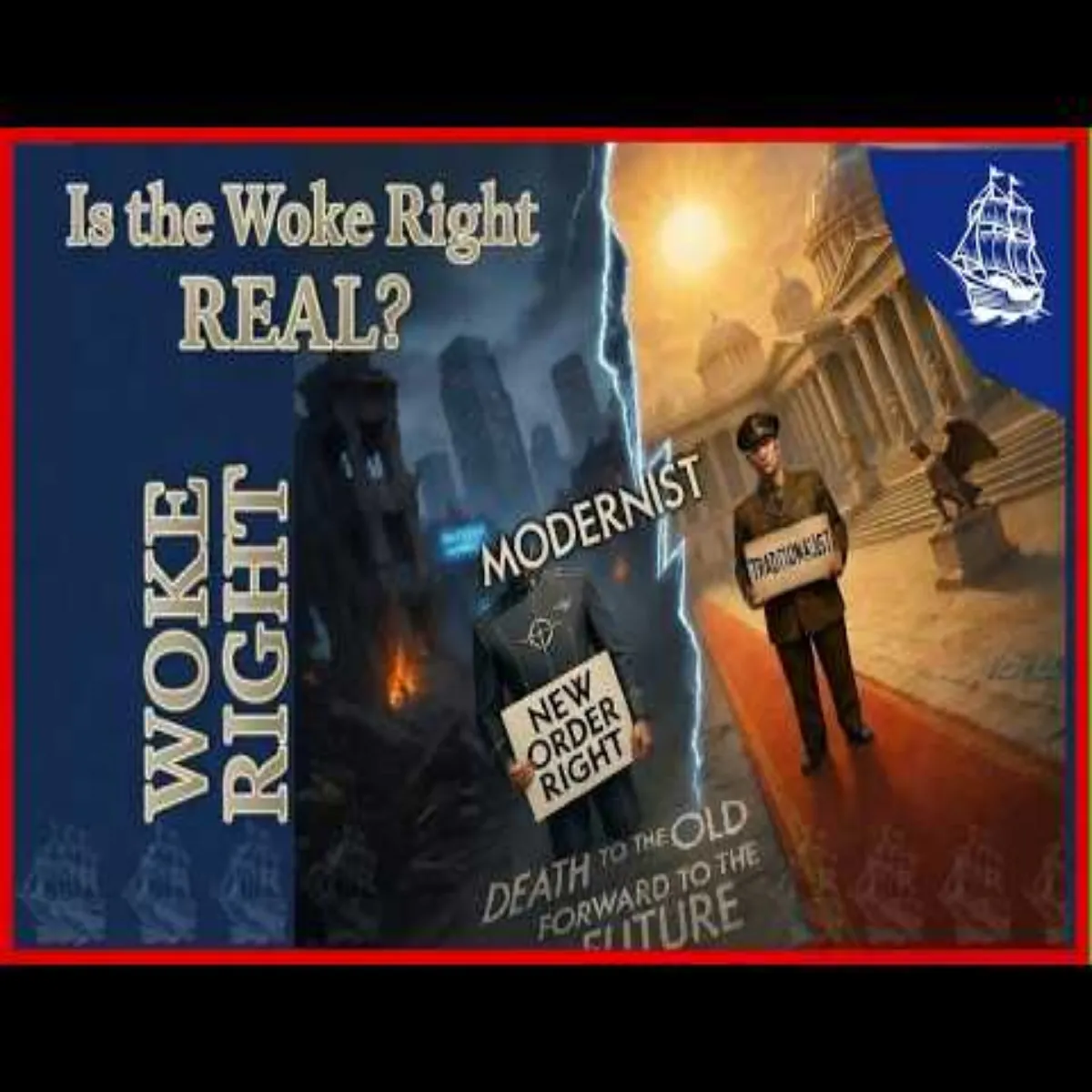
James Lindsay created this concept a year or two ago called the Woke Right. The idea is roughly that once you get far enough to the right, you start seeing traits loop back to the radical left. This includes collectivism, totalitarianism, a racialized worldview, anti free markets or other things. This idea has caught on like wildfire among the digital chattering classes. It's paralleled by the rise of a new right wing faction totally opposed to the old boomer cons we had grown so used to over the last lifetime. However, almost everyone in this discussion is on one side of the aisle about whether the Woke Right should or should not exist rather than if it does, it feels impossible to get a clear headed unbiased answer above all the smog. I feel compelled to make this video since firstly, I truly do not care whether the Woke Rite is real and secondly, I'm enough of an insider on the Digital Rite where I know enough of the players involved in this saga, either personally or are one step removed from them. This video will be my investigation of if the Woke Rite is real and in the process to find the soul of the new rite. What will the world after the Woke even look like? Will it just be another form of Woke or can we actually be free? We live in uncertain times and the managerial systems that we're dependent on are starting to wear down. New ways of doing things will be needed and we should be ready to look for a new future now. With zcash you can just do that. Zcash is unstoppable private money. It's like bitcoin but encrypted, giving you the freedom to transact without surveillance, debasement or permission. It's the machinery of freedom, money that lets builders build and dreamers dream even when states decay. If you want a future of infinite frontiers, if your soul craves freedom, you need money that resists control. You need Zcash. Some are saying privacy might be the last 1000x in crypto because seen wealth is seizable wealth. The best way to get started with zcash is by buying and storing unstoppable private money using Zashy wallet. Download Zashi on your mobile phone today. Part one the Right Wing Backlash A few years ago around when I was moving to Texas, I made a video called the Coming Right Wing Backlash about how I thought that the right was on the verge of a huge explosion of far right sentiment that would completely unbalance the political overton window of society. This was one of my better predictions where that's very clearly happened and you can just go on X to see an easy example. As of now, there's been a total normalization of topics that a few years ago were completely taboo to ever even broach. Indirectly. You have enormous figures on the right with huge platforms talking about fairly overt antisemitism, which has been totally normalized in discourse. Discussions about differences in biological race and sex used to be totally taboo, but now have been completely normalized in the right wing collective discourse. The blank slate is already totally dead, and it's hard to remember a world where it was taboo to say that trans women aren't real women, or that a Guatemalan can't be expected to immediately become an Iowa born American. Something to keep in mind is that this radical shift in worldview has occurred predominantly since COVID which in itself is something of genuinely historic scale. This is something that will be written about in history books thousands of years from now, since it signals a profound shift in worldview of the world's dominant civilization or the West. And you can't put these ideas back in the bottle once we know that they're true. It's insane to see how so many leftists have started operating inside these right wing frames since they see it's the only way to keep up in the constant attention battle that is Internet politics. Gavin Newsom's sort of fake plays to the right are an example of this. The left's worldview itself is on the defense, and the question is whether or not the left can evolve from There's a few different threads I need to tug at here to give this topic justice, the first being that there's grown a huge, almost continental barrier between the boomer cons and the zoomercons. For those that don't know, the boomers are those born between roughly World War II and JFK's death. They've dominated the global system for decades and are growing older and highly decadent in their old age. Meanwhile, Gen Z are basically those who are in their 20s now and I'm Gen Z or I'm 24. It's so funny that when I talk to older conservatives they tend to put me into the hard right box in that I'm more right wing than almost all older conservatives. At the same time, in right wing youth circles I am consistently seen as a very moderate person. It speaks to an enormous generational gulf. Older conservatives tend to still believe in the blank slate through their actions, in that they still treat men and women largely as the same. Or don't get how cultures outside the west are vastly Lower trust. They don't even understand half of how evil and suicidal the left is. They're quite foreign policy hawkish, seeing the American empire as an innate good, generally being pro Zionist and the Zoomer Khans are isolationist. There's this hilarious meme that shows a 110-year-old senator who's craving to destroy Iran before he dies and his great grandson who wants mass remigrations. Those are pretty accurate comprehensions in my opinion. To look at the core failings of groups for the boomer cons. They are nearly universally loathed outside their age group for their complete and utter complacence. They are frequently called controlled opposition for the left, where even if they are given a complete deck of cards, they will not roll back the leftist order. They won't actually stop immigration, the woke takeover, the demographic issues or any of those things. The fact is that the left has dominated the west for the entire lives of most baby boomers and they're too scared to fight the left since it destroy their entire comfortable reality. I'm going to use my channel as an example for this demographic shift that's occurred among predominantly young right wing men since COVID My channel got big a little bit after Covid, and for the first few years the top criticisms of me was that I was a right wing nutjob, an apologist for imperialism or a racist. After that it morphed into calling me an autistic incel loser, which is the most insane criticism of me you could make if you know anything about my life. Now people call me a Jew lover, a white traitor, a shabos goy, and I get significantly more criticism from the right than the left. As of now, there's a sort of ritual where a bunch of big hard right Twitter accounts have periodically taken turns sh t on me and that's happened like five times. For a frame of reference. I have a worldview much like what the founding fathers did. An educated person before World War I or a fusion of Aristotle, Plato in the Bible. My worldview would best fit into 16th century Renaissance Europe since one of my passions is medieval philosophy, which has really rubbed off on my entire perception of the world. I am vastly more conservative than these guys who are trying to hearken back to Nazi Germany. My worldview makes you look like a child. We were being based for centuries before your parents even considered conceiving you. You want to return to Nazi Germany? I'm trying to become the Duke of Saxony. These are not the same. I was talking to a friend of mine who runs a right wing youth organization with hundreds of members. And he said, rudyard, we really appreciate that you've consistently anti Nazi this entire time. You've never buckled under it. To which my reply was damn, things are really that bad? It used to be common sense that the Nazis were morally wrong. What happened to good sense and taste? To start this question about the woke right, there is one great point which I think will simplify this whole discussion. Remember that when an equation looks either too complex or too simple to be engaging or comprehensible that you're looking at it wrong. You need to either zoom out or change the details you're looking at. The world is is always engaging, you just need to know where or how to look the core themes I will give here is that almost no one on the youth right actually has serious political views. For the Zoomercons where this radicalization is concentrated, although it has still very much spread to older people who end up sort of spiritually connected to the Zoomercons in their digital algorithms and hearts, is that this is all a very chaotic or slapdash process. In a healthy society you have sort of cultural narrators like the media, fiction, historians, religious figures or artists who supply the conscious internal monologue and vocabulary so that the people in that society can understand and live in their environment. What's happened since COVID and I cannot overstate how rapid this shift has been has been a total loss of faith in this narrating class. This means that almost no one actually understands what's happening to them in their daily lives, since politics does very much manifest in people's actual lived experience. This is especially true for young people who are more dependent on the society because they have to get work and meaning and mates, while the older people can silo themselves with their pre established wealth and connections. This exacerbates a pre established social meaning crisis that goes back centuries with the death of God. That means that people cannot psychologically orient themselves in the world in general. In some ways, psychological disorder is harder on people than physical pain, which is why most histor societies prized religion so deeply since it created a frame for humans to face suffering with meaning that allowed their societies or peoples to grow and thrive. Since life is innately chaotic these days, young people are suffering profoundly for a litany of reasons I frequently talk about in my videos between the skyrocketing cost of living or rent, the dating crisis, the west suicide, the horrifying psychological issues among young people and a doz other things. However, they have no mental framework for how to process any of this. They were told they'd live in the wealthy John Hughes Simpsons America where they just have to show up and work hard and then they could get a white picket fence and a beautiful wife and a solid life and all of that was taken from them. This means that young people just suffer, and it's suffering with no sense of clarity, which hits very hard. At the same time, they've been totally betrayed by their entire society. Where every major social institution in America has betrayed young people. Between mass importing immigrants, AI killing jobs, the narrator classes going insane, inflation, and many other things, they're generally not smart or wise enough to construct their own coherent worldview by themselves. To be fair, that is a profoundly unreasonable and unrealistic expectation to put on them, and society even expecting them to do that was a betrayal. Normal social connections are also very weak now, so these young people normally don't find communities where they can process or talk through their own worldview or daily lives. Most people are also quite reserved and closed off where they won't or don't talk about their own private struggles, even with their friends. This means that people have these enormous internal monologues of emotional chaos that stem from pretty crappy private lives which the society will not even acknowledge. Stuck in the fantasies of the John Hughes Simpsons America. And they know they can't trust anyone. What this does is it forces them to doom scroll on radical content of one variety or another as the sole outlet for their repressed fear or resentment. When you see the horrors of the Internet today, how moderate mainstream leftist streamers frequently call for political murder or horrifying bigotry, you need to zoom out to imagine the horror or pain that went into the anonymous souls you see online. What they're doing still isn't okay. Where even in the deepest horrors of life it's still your duty to behave correctly, but you can at least understand what's going on. Imagine some young person living in their horse stall of an apartment that they still can't afford without their parents support, with no real friends, haven't had sex in years, no sense of self, a school system that taught them nothing useful but ritually flagellated them every class for things outside their control and no one around them is ever willing to move past the fake broken smile of the positivity cult. Then they go online for the sole little bit of fake freedom they can still pretend to have. That's who you're talking to. That's the person behind the anime profile picnic. Remember, in this world there will Always be far more losers than winners. One of the things my father would say to me growing up is that most people do not have clear visions of the world while they look for confident leaders to take away their anxieties about living. If you stand on a hill long enough screaming, you will eventually get people to follow you. My father said that people were generally scared to take responsibility, so you should do so and then show why you're better than the competition. He also said that the way to make money was to keep accumulating useful skills until someone paid you for one. A close historic parallel to this is mob rule and Caesarism, where the mob will radically change its politics based on who's dominant at the moment. You can see this with the constant fluctuations of different factions in the French Revolution grabbing power and then the mob will immediately shift from one highly complex, different political position to another without a second thought. I can't forget how the left during Russiagate changed their position on Comey like four times and no one noticed. This was all over the span of a few months too. One of my new favorite authors is the 19th century French thinker Gustave Lebon with one of his best books being on the crowd. He says that the crowd doesn't actually understand rational arguments since it exists several million years less advanced neurologically than individuals. That since the crowd allows the abdication of responsibility and consequence, the crowd only understands the world through dominance, social norms and symbols. It changes its opinions based on those. You can't see a lot of the radicalism today on both the left or the right as actual political issues. They're human issues in our society. For some reason. Politics is one of the few topics people are socially allowed to have dissenting positions on, at least sometimes. And people tend to drop all of their psychological anxieties into politics. People don't discuss religion, history, culture, art or any other potential points for social discussion. But we do shove all of our sort of social and media points into political discourse, especially for the president and national politics. This means that politics becomes a manifestation of the resentments of the entire society. So when you're having a political argument, you're not actually talking about the thing you're talking about. You're talking about their entire built up life of resentment, which is just manifesting in politics. I find that people today are profoundly scared of vulnerability and non conformity to a degree that doesn't seem to actually make sense logically. There's lots of sort of subconscious agreements to life in the west today where you're not supposed to act like you're better than others. You don't disagree with the left even indirectly. You don't sexualize women publicly or don't disagree or voice your personal life and traumas. It's exhausting to keep up especially. Especially if you don't care. And it's really a wonder how a not particularly smart society can memorize all of these highly complex stupid social rules. We really put a lot of social effort into training people to act like this. People should be talking about politics since politics truly does matter. But they also should be talking about living. Whether you are happy from all the science we have is not really a political problem. A lot of third world peasants are happy. We shove all of our mental energies into politics while we should also be talking about the breakdown of culture, community, people going broke, how terrible our diet is, our lack of knowledge about how the world really works. However, people don't since it's seen as vulnerable or weak in our culture, admitting deficiency is seen as weak or taboo. Which is pretty insane for a society whose whole point is claiming to help victims. It's since we're stuck at a height school level of emotional development. The point I'm trying to make here is that when you're seeing the woke right, you're not seeing a political issue. You're seeing a cry for help by desperately hurts people. When Gen Z is screaming that they love Hitler and want minorities to die they don't actually care about those topics. I know from what they say that the vast majority don't even know the slightest thing about World War II history. And there's a joke that all far right guys have a Latino or an Asian girlfriend. Their trying to scream for help to a society in the only way they think it will hear. They've already said all the words they could to show their pain. And the olders didn't listen. They knew the older people really hated the Nazis and loved minorities they've never met more than their own children. So they said they were Nazis and they hated the minorities. Just to show how angry they were. They blamed the Jews for destroying the west since they couldn't emotionally process the reality. Reality that this was done by their own people, Their own leaders made the decision to destroy their own nations and civilization for reasons that don't actually make any sense. It had to be insidious foreigners. Most people are too irrational and weak for their words to mean the words they say. What I mean by that is that when an intelligent or strong person, someone who in the pre modern culture was called called a higher man says something they've gone through effort to parcel out whether this is the most articulate way to convey their point while separating their emotions or intentions from the nature of the situation. Most people just say it though, rationalizing their emotional state, and this is very much borne out by the statistical evidence. That means when you're seeing these insane political opinions, if you actually drilled them for why they believe them, they were wouldn't even be able to explain what those political positions even factually are. I've seen Internet crowds be aghast when I say that Hitler openly wanted to genocide the Slavs and Jews. That was a long standing motivation of the Nazi party, completely in line with Hitler's public speeches or Mein Kampf. These people have lived comfortably enough for their entire lives that they cannot genuinely process the reality of a society's collapse or a slide into the total state where they have no freedom. It's just edgy words for them. However, this is always how freedom dies from the foolishness of the public Factions of the right. I have some experience with conservative coalition building and right wing politics today. If you want, I can make a video about everything I've learned about the New Right from it. However, one of the very interesting things is that there are so many different subtypes of people on the right, right? There was this really cool chart that went viral online about how the right has so much more intellectual diversity to it to a truly vast degree than the left does. I wonder if the researchers who made that watch my videos since that's been something I've been saying for years. On the right I see a wide Overton window of people between genuine Nazis, fascists, theocrats, libertarians, classical liberals, neoconsult Boomer cons, nationalists, Christians and so many other groups. I stand by my video where I split the right into four factions which I explain in this text wall. The right is hugely intellectually diverse now and is in a place of chaotic indeterminacy. I wanted to say creativity, but as of now I don't think that's true since the Internet rewards group thinks so much. But there is a huge potential, potential for enormous creativity since no new consensus has formed due to the loss of trust in the boomer cons. This is opposed to the left which has a single dogmatic line where they punish their own dissenters to their own madness more than they do the right. The right as of now doesn't have any intellectual lines or principles. What the Nazi stuff showed is that very few people in the youth right have any genuine grounding in real conservatism. That since the Nazis in most cases have more in common with the left than they do with old stock conservatives. The Nazis were modernist atheists who hated Christianity. They were totalitarians who did not believe in the free market and thought that everyone should be a slave to the state. They were enemies of almost all of the values of Western civilization and thought that humans don't have souls or life doesn't have meaning. The Nazis are very, very different from what normal Western conservatives stand for. The people who keep on saying that the real conservatives are Nazis don't actually understand anything about what real conservatism means. Part of the blame for this falls on the left's complete seizure of the social narration for decades, meaning that the incredibly advanced culture or philosophy that went into building Western civilization, which modern conservatives pull from, has not been passed on to the next generation, while at the same time the Boomer Khans really cucked out for living memory. Keep in mind that before the world wars, all of the West's elites for thousands of years were raised in the classical tradition and the Bible, which created a vastly richer, deeper and more complex worldview view that we just lost over the course of the 20th century. What all of this adds up to is that the entire culture, including the right, exists in opposition to the left. These people pretend to be Nazis since they don't understand any of these things and the left told them that the Nazis were so bad, the right is so weak, they weren't able to put up a fight against a framing the left built to make the right look as bad as possible, that since the left has called people who are ostensibly moderate classical liberals Nazis for decades, they gave the name Nazi enormous emotional power, and lots of people like to live in that strawman due to the power attached to the name. I have several different designations I've found from dealing with young right wingers. The first being that there are generally three ways people get into conservatism. The first being ethnic conservatives, the second being book conservatives, and the third being Internet conservatives. I'm a mix of all three, but I'm predominantly ethnically conservative, or this was something I was born into, since both of my parents are right wing as of now and I grew up in rural Pennsylvania in an area that was pretty strongly culturally conservative at the time. The book conservatives are the rarest these days, where they would read Thomas Sowell, Milton Friedman or Carlisle, and it changed their and how the world worked then. The Internet conservatives are the biggest now, where their political Views are formed by the algorithm. This is a really dangerous demographic since their political views are formed without any reference to reality or common sense. The thing I'm about to talk about took me a while to figure out in that I grew up in a fairly culturally dense society. I was told about what the appropriate sexual roles for men and women were, social class and how to relate to it, my ethnic identity, my nation's position in the world and my genealogy. I was given a religion and a code of politeness. In other words, I inherited a cultural framework from the world as a child, which I didn't even think about as I became an adult. It was only as I became an adult and traveled more around the world in the country that I realized this just wasn't true for everyone around the world. It seemed really strange that city people just often seem to not have a culture culture. They just went to their job, bought stuff and tried to date. That seemed completely incomprehensible to me and it took me a while to figure out how this was even possible. Keep in mind I have a background in history and this sort of thing is very historically rare. Another designation I've built is between red state and blue state conservatives. Blue state conservatives, especially in the Northeast, have a reputation for being completely insane, often far right Nazi. The New York City right wing youth scene is known as a harbor for trans furry Nazis when with periodic scandals like the recent Signal group chat leak. By the way, just as a social rule, what happens in group chat stays in group chats. And leaking group chat is a staggering violation of the bro code that should not be socially tolerated. Blue state conservatives are often insane since they're just getting conservatism from the Internet. Internet, but not a coherent living culture like what you'd get if you grew up in a red state. This means that the only thing they know is opposition to the left that they hate. The blue states have gotten really bad. I'm always horrified when I hear news from them. Whereas the thing I have coined, Lynch's Law, states the left is always more mentally ill than you think. Meanwhile, red state conservatives tend to be profoundly naive and complacent since although conservatism was a culture they grew up in, in they have no concept for how much the left radically loathes them and wants their entire world to end. This was something that really shocked me when I went to California or big cities on the East Coast. I was called a redneck a lot, which is just utterly insane since I'm from the greater Philadelphia area and My parents are both well educated. I was told Pennsylvania is flyover country while we're on the East Coast. I found a lot of hostility for no reason that I could discern. We very much resented when Obama said rural Pennsylvanians were holding on to guns, tradition and religion since they feared progress. Progress entailed our state's complete social collapse due to deindustrialization. By the way, we didn't know any of this was happening and are unclear why you hate us so much. Much what happened however, the elite coastal circles have boxed out almost all Americans from their world order. The entire population is going crazy now, which includes both the right and the left. Modernity has had a critical failure of socialization in that the entire society is falling through the cracks of change that was too rapid for our society to adjust. The population has gone utterly insane, all the major institutions have failed. Our own elites are trying to murder their nations, the currency will soon be worthless, people don't have children or even date, no art or culture is produced anymore and the major cities are breaking down. The sole reason for this is that our culture was not able to adapt to the rate of change and so people became isolated, mentally ill and broken. Broken. Meanwhile, we exist in a very short sighted and petty culture where no one will ever say that they're broken. The funny irony is that literally everyone from the richest to the poorest today is broken. That includes me. I'm broken. But I'm also going to win and I do want to continue to live and grow. So to pull back to the stated topic, if the woke right exists, it would be a highly specific sub demographic. It wouldn't be the boomer cons or the older conservatives in power who are profoundly moderate in the grand scheme of things. Calling Trump far right is insane given 99% of humans in history were more right wing than him. Meanwhile, red state conservatives aren't as susceptible to this stuff since they're part of a distinct culture which taught them traditional American values, Christianity and how a normal society works works. The thing I really dislike about the woke right is that they're completely opposed to traditional American values, which is what being an American conservative means to me. The book conservatives aren't Woke Right either since none of the books they read support this idea. The woke right is made up of a subsection of the Internet based right who entered conservatism without any cultural immune system system for it. Part 3 what is the Woke Right? One of the core sticking points of this debate was James Lindsay saying Orrin McIntyre was woke right. I know Oren personally and I've read his work and he has a worldview fairly identical to what a lot of America's founding fathers had. It seems strange to call that woke right, since that would basically be saying that America's founding or the thing our social institutions and culture were built on on would be radical. That sounds very much like the sort of thing a leftist would say if you're watching this. James Lindsay, hi. I see you as an ally and I admire a lot of the work you've done. Your work on the Fabians, Gnosticism and critical theory have been great. If you disagree with me here, let's please have a respectful discussion rather than devolving into name calling on Twitter. My take on this topic is that there is a woke right? However, I would avoid using that frame personally, but I don't think the boundaries are what James Lindsay or most of the people who are arguing for this paint them as there are multiple types of conservative. And I agree with Lindsay that a lot of the hard right ends up circling back around to have very strong similarities with the Marxist woke left. This is just undeniable for the Nazis. This is for reasons I spoke about earlier in this video, while at the same time the Nazis just openly say it. Mussolini was a former Marxist and Hitler called his movement National Socialism since he saw it as an improved, better version of socialism. They stemmed from the same radical social clubs in the 19th century, while British socialist Fabians like Shaw supported the Nazis. Nazism was just another iteration of the modernist totalitarian atheist managerial program, the same as communism. The place where I draw the line is by calling older stock conservatives woke right. What you've done from that position is cut out 99% of humans over history without thinking and demonizing everyone on the right who is not a liberal. It's what a liberal, not a conservative, would say. If we look at Sargon of akkad or Oren MacIntyre, two people who have been called woke right, they all support the radical weakening of central authority, the managerial class, or the modernist project. They want a society that radically limits the ability of people in power to control the population. If people of this stripe support authoritarianism, which I don't think either of these guys do, it's normally a function of limiting the reach of power power and that pre industrial monarchies were vastly less powerful than the total state of even democracies today. In the world before 1800, practically no governments made up more than 5% of their economies and often 1 to 2% or less than that in the industrial world. Governments making up a majority of the economy, including in the supposedly free world, is totally normal. In America it's 40%. Bertrand de Juvenal, Orrin McIntyre's favorite writer, who I've also read, and he's great, splits governance into society or the collective aggregate of social interactions created by community, religion, social class and capitalism versus power or top down authority from the state. What de Juvenal says is that modernists, including frequently liberal liberals, are just saying that we should give the state more power, even if they hide it behind words of freedom. This always comes at the expense of the society policing social interactions, which is what pre industrial political philosophy's main focus was. In the pre modern philosophic tradition, they were trying to limit the power of government and increase the power of society. If you're arguing for church, community, regional identities or free associations to take the place of the state or bureaucracy, you're just not a modernist. My concern with this line of reasoning, whether or not this was Lindsay's intent, is that this is very easy to use to police all conservatives who don't have politics acceptable in a post World War II 20th century Overton window. My political views belong in the 19th century and I'm a classical liberal by any definition. Definition, I'm clearly not woke right since for me the Nazis are the enemy, since they're modernists. I exist in the vein of Churchill, another classical liberal conservative who also fought against the Nazis for years. I just have a pre modern worldview in a society where that's not socially acceptable, since I believe it to be the factually accurate understanding of the environment. I resent being conflated with the Nazis since I share practically nothing in common with them. They want to genocide the Jews. I want to use alchemy to ascend the tree of life to become the Duke of Saxony. We are not the same. Your motivations are racism, mine are glory. You think going back a century is edgy? I think that's an amateur move. I will not agree with any framework that puts me in with whatever ideology Nick Fuentes is. The only framework framing where that makes sense is not one from the right, but rather looking at the right from the left, which muddies over the enormous differences between conservatives. The reason I'm fighting back is the Nazis would also put me in a camp. I would classify the woke right as those who share the same fundamental assumptions as the woke left, that the world is innately built out of oppressor oppressed dynamics. You can cleanly divide the world by stuff like random race, that the collective matters more than the individual, that humans don't have souls, that we should use the state to reach utopian goals, in this case racial not leftist. In short, I would put the Nazis as woke right, not old stock conservatives. Hitler would be woke right while Evola, who based his worldview off schizo hermetic archetypes desiring a return to ancient Greece's politics would not. I would say Nick Fuentes and his gripers are a very clean example of the woke right. As a side example, I have no idea why anyone still listens to Nick Fuentes. You could listen to Nick Fridas who is another right wing pundit who is superior in every conceivable way and is also a Nick with a Latin last name starting in F. Nick Fuentes supported Kamala over Trump and Gavin Newsom over Vance. He's been caught watching gay porn a lot five which he blamed on Mossad. Destiny has practically confirmed that they had gay sex together. Nick Fuentes also supported the Muslim immigrants in Britain against the native British alongside over the last three years saying that his movement should ally with the Muslims, Marxists and blacks. I've said before that I think he's a fed and a compromised agent. I think at this point he's basically just goading his own audience since he's getting tired of this guy gig and he's waiting to see who notices. You guys might say I'm going too far by saying that, but when the information's going to come out about this a few years from now, it will turn out I'm right. He says so many overtly ridiculous and silly things while he's intelligent enough to know what he's saying is silly, his followers must be truly gullible sheep and I cannot imagine what they still see in him. Him on top of his overt Nazism, authoritarianism, racism, sexism and anti Semitism. What virtue do you see inside him? I think the reason he's popular is because he's an unthreatening catty gay guy who does not express enough manhood to be threatening to a hyper feminized society built off complacency. As a funny story here, I once showed my dad Nick Fuentes clip and his reply was was huh? You said this guy's a fed, he's clearly a homosexual and his argument is gibberish. My test for the woke right is if oppression narratives are the main core element of their worldview and I think James Lindsay agrees with that. This would put them comfortably within what I would call the woke category. And that woke ideology is based around the idea that white men are oppressing other groups and taking from them them, rather than the reality that white men just generate more stuff than other groups. The woke right are groups which blame all their issues on Jews, like Candace Owens and Jake Shields. You could also talk about right wingers who blame the government or deep state for everything. The problem is that's actually true enough. It's hard to draw the line between paranoia and reality, but some people do get way out there fare far too much into paranoia. I would make the line when you think the state is operating outside of what is in their direct self interest or what they could reasonably pull off with their capabilities. Keep in mind the thing people get wrong about the CIA and their conspiracy theories is they assume they're vastly more competent than they truly are. The CIA cannot be truly competent, and Cuba is still a Marxist nation. What I will say is that I will concede that even if the woke right framing fits with certain elements of the Right, I would personally not use this framing, even though I can understand why someone else would that, since I want to avoid framing the right inside the left's terms at all costs. When playing chess, if you're responding to your opponent's moves, that gives them an enormous strategic advantage with the ability to drive the battle's direction direction. The woke right conceptualizes the right in terms of similarity to the left. I think this is profoundly dangerous given the core issue the right has so far is being stuck inside the left's frame. For example, how it was a popular argument that the left are the real racists. That might be true under certain contexts, but if you're operating inside a leftist moral frame that racism is the the worst possible social evil that we should care about before any other, you're playing to the Left's advantages in their ball court, not ours. Same thing with the Boomer cons being willing to fight the left on some things, but being totally unwilling to fight the left on the core issues of them killing the west, the mating crisis, young people's failure to launch, the sheer corruption of the elite elites, or the insanity of dei. In each case, the Right could go for the Left's jugular to destroy their entire order and yet chooses to play the games that the Left picks. The thing is that calling this demographic woke right is that it blots out all the other things that makes the Right distinct as a movement, choosing to isolate the singular traits they share with the Left rather than allow the Right to see how it exists independently from the left left. This may seem like an unimportant detail, however this is actually the main variable in this entire equation. A lot of our success hangs on just this. If we are solely unified by dislike of the left, then we'll be incapable of actually forming a real movement or winning. Since you need the shared ideology, identity and leadership to get anything done, we will never be able to capitalize on our victory victories or act in our own right. You can see this very clearly in the After Trump and Elon amassed what I thought was a pretty powerful coalition for this last election between the right angry ex leftists in the tech world, you saw that since it lacked a coherent inner character, it was incapable of driving the left out of the institutions or the main vectors of power. This means that the left is still capable of carrying out the west suicide side, even though the conservatives hold the whole trinity of American power between the executive branch or the presidency, the legislature or Congress and the Supreme Court. That since the left has a coherent ideology, institutions and a base of support I'm willing to use the term Woke right to talk about the modernist conservatives like fascists, since I frankly just do not think modern material should be called conservatives. In many cases they have more in common with the left than with us and so including them in the coalition is a betrayal of our values. In that at my core I am an anti modernist. However, for the right as a movement, I think identifying as the woke right is very dangerous since it stops us from forming our own identity. If James Lindsay asked if I was woke right right, I'd say no in that I am a classical liberal. An important thing to keep in mind is that as you keep going further right, you don't get Nazism at the furthest edge, you get feudal monarchy. If you want to become more radical, don't look to Hitler, look to the pre modern world. One of the things I really hate about the WOKE rights framing is that it doesn't allow conservatives to pull from any many of their other stronger traditions. Between monarchy, classical liberalism, the Greco, Romans, libertarians or aristocracy which have real meat to their bones or cultures going back thousands of years, that's a lot deeper than a dozen years in a relatively small country on a different continent, the right desperately needs to form an identity in order to survive. We need it in order to carry out our plans since we need a coherent leadership, ideology and organization that can only stand from shared values in which those who do not share those values get kicked out. The worrying thing is the right doesn't seem to be trending in this direction, although we can make a decision now out of our personal agency to do so. The Boomer cons are profoundly complacent, while the Zoomercons are obsessed with petty online status games. Part 4 Is this serious? I was following the neuroscientist Ian McGilchrist's work about how schizophrenia is a largely modern phenomena which stems from an overuse of the rational mechanical side of the brain to understand the highly complex subjective nature of being a human in reality. In effect, the answer answer to the schizophrenic is to not take their own mind so seriously and to turn down the evil voices in their internal monologue. What the rational mind would do in a schizophrenic is try to listen and then logically interpret those voices. The reason that schizophrenia didn't exist in the pre modern world is they just interpret this as listening to evil spirits which were trying to tempt evil you. This is true in a sort of symbolic way we don't like in our society. The sub personalities inside you are trying to manipulate you as a sort of evil spirit. This really struck me since it made me realize I can choose not to listen to people and follow my own internal monologue. In the same way that you wouldn't listen to your own schizophrenic monologue, you wouldn't listen to those who lack wisdom. It made me realize that the vast majority of discourse course or the use of the Internet in general today is profoundly not worthwhile. I will choose only to listen to things of value. This was a huge shift in my life since as I ignored details that don't matter, social life became way easier and more fun as I stopped overanalyzing everything people would say rather than just focusing on the core of the argument. Since I just stopped caring, I realized the way I lead or speak changed and with it the outcomes I got out of my life. I realized that this is what aristocratic cultures were trying to reach or a life cultivated away from the base or the stupid. There are certain questions that by answering it is an insult to your honor because you should not open up this line of discussion as a principle. As Sam Hyde said, feeling the need to debate an Indian about America's identity is a law boss. By allowing that frame to just exist, that the Indian gets to determine your identity. Having the US government enable Latin American gangs through our weak police and law system just emboldens them more. European decolonization chose to ennoble a generation of brutal tyrants like IDI Amin, the Khmer Rouge, Gaddafi or Nayirare out of wheat weakness. As a society, we have some ridiculous concept that if we give the bad people more stuff, they'll stop being bad people. The reason as a culture that we're plagued by idiotic mental illnesses like Trans is that we're honoring things we never should have. We should have never accepted. This frame. Is the Woke Right real? It could be, if we chose to take it seriously, but it also could be a flash in the paint can. It's an attitude that will depend on how we choose to take this situation from now on. In Celtic mythology, Will o' wisps were spirits that would tempt travelers into bogs to get them lost and die to take their souls. A lot of these political radicals are sort of will o' wisps. The only thing they actually care about is popularity or attention. If you don't provide them that, they'll keep changing their opinions until they get those things again. Again. As of now, the Right is pregnant in that it hasn't evolved into what it will obviously be a few years from now. In historic retrospect, we can still change the outcome. The Woke Right could rise to leadership, but that would involve them getting a capable leader or cultural force behind them that they just don't have. Now. Keep in mind that in lots of ways, Hitler was not a serious person person, and he was a homeless vagabond for a lot of his life. A silly Woke Right could hypothetically win, but it's a harder thing to pull off. The kinds of people who could make the Woke Right work are the type who just want their nation and culture to survive. If a reasonable, traditional or moderate right wins, the type of people who could get the Woke Right to win would side with them. People on the right tend to not be too picky. Since we've all had to live to the Left's ideological tyranny. Everyone reasonable understands how desperate the situation is, that practicality gives us a degree of freedom and openness that it would be a sin to waste. The Right is ideologically pregnant and something will come out of this or we will die as the Left destroys our civilization. Is the Woke Right real? That's still being determined.