Loading summary
Transcript199 lines
- [00:00]
Commercial Announcer
This is an iHeart podcast guaranteed human
- [00:04]
Jacob Goldstein
Being a small business owner isn't just a career, it's a calling. Chase for Business knows how much heart and effort go into building something of your own. Manage all your business finances, from banking to payments to credit cards, all in one place with their digital tools. Plus access online resources designed to help your business thrive. Learn more@chase.com business chase for business Make More of what's yours the Chase Mobile app is available for select mobile devices. Message and data rates may apply. JPMorgan Chase Bank NA Member FDIC Copyright 2026 JPMorgan Chase Co. Eczema is unpredictable,
- [00:48]
Commercial Announcer
but you can flare less with Epglis, a once monthly treatment for moderate to severe eczema. After an initial four month or longer dosing phase, about four in 10 people taking Eglis is achieved itch relief and clear or almost clear skin at 16 weeks. And most of those people maintain skin that's still more clear at one year with monthly dosing.
- [01:04]
Pharmaceutical Advertiser
Hempglis Lebricizumab, LBKZ, a 250mg injection, is a prescription medicine used to treat adults and children 12 years of age and older who weigh at least 88 pounds or 40 kilograms with moderate to severe eczema, also called atopic dermatitis, that is not well controlled with prescription therapies used on the skin or topicals, or who cannot use topical therapies. EBGLIS can be used with or without topical corticosteroids. Don't use if you're allergic to Epglis. Allergic reactions can occur that can be severe. Eye problems can occur. Tell your doctor if you have new or worsening eye problems. You should not receive a live vaccine when treated with Eglis. Before starting ebglis, tell your doctor if you have a parasitic infection.
- [01:38]
Commercial Announcer
Ask your doctor about eglis and visit ebgliss.lilly.com or call 1-800-lilyrx or 1-800-545-5979.
- [01:45]
Pharmaceutical Advertiser
If you're a maintenance supervisor at a manufacturing facility and your machinery isn't working right, Grainger knows you need to understand what's wrong as soon as possible. So when a conveyor motor falters, Grainger offers diagnostic tools like calibration kits and multimeters to help you identify and fix the problem.
- [02:02]
Ben Christensen
With Grainger, you can be confident you
- [02:04]
Pharmaceutical Advertiser
have everything you need to keep your facility running smoothly. Call 1-800-GRAINGER clickranger.com or just stop by Grainger for the ones who get it done.
- [02:21]
Interviewer (Host)
Pushkin. Today's show is about wood.
- [02:27]
Jacob Goldstein
Wood literally grows on trees, or it grows in trees. Or maybe wood is trees. Anyway, my point is we treat wood as this ubiquitous, worthless thing all over the country, all the time. Wood just falls to the ground, stays there, and rots. And yet, at the same time, there is this vast industry devoted to growing trees, cutting them down, and selling them as lumber. This combination of facts suggests a profound possibility that is both very simple and very hard to realize.
- [03:04]
Interviewer (Host)
What if we used more of the
- [03:05]
Jacob Goldstein
wood that falls to the ground so we didn't have to cut down so many trees?
- [03:21]
Ben Christensen
Jacob.
- [03:22]
Jacob Goldstein
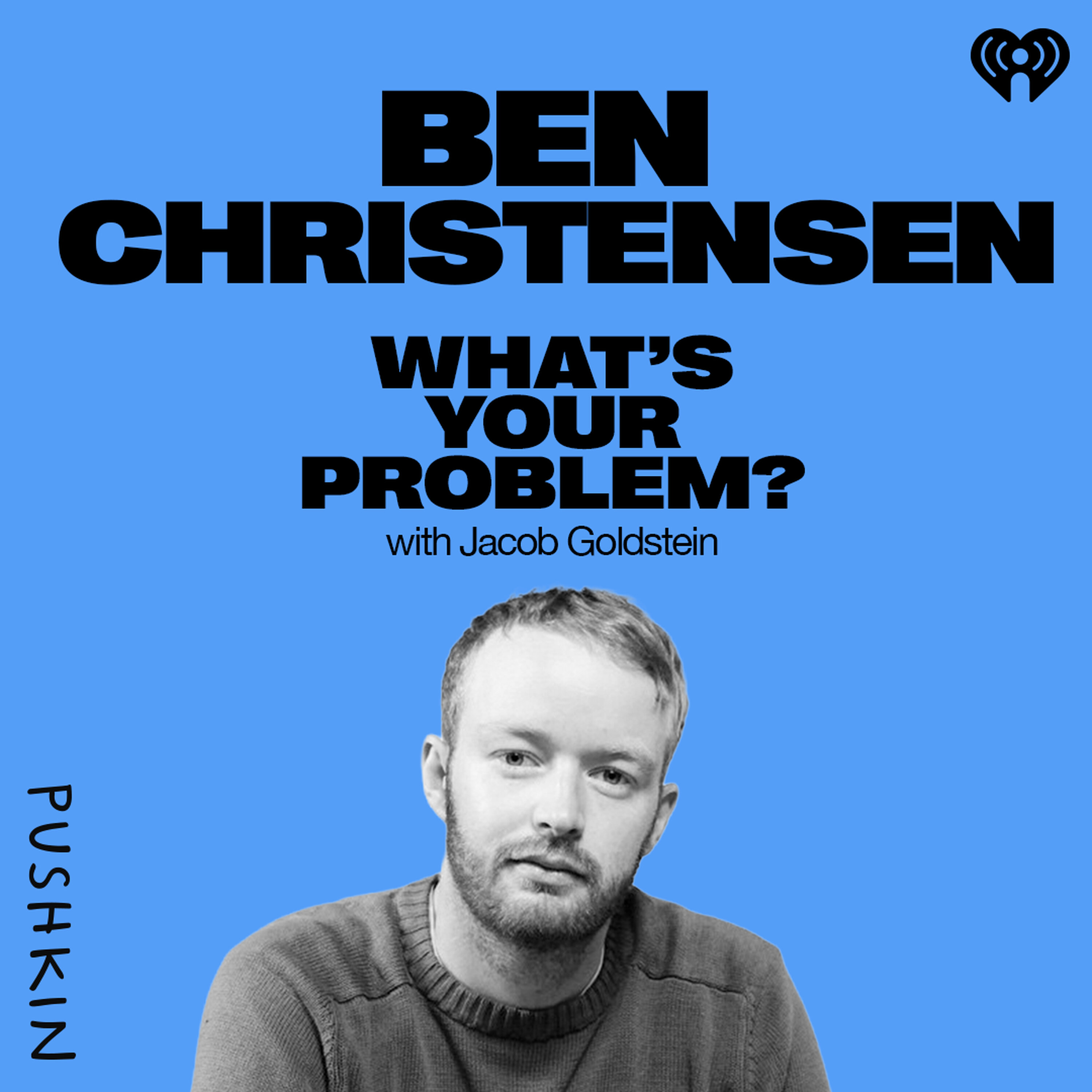
I'm Jacob Goldstein. This is what's yous Problem? My guest today is Ben Christensen. He's the co founder and CEO of Cambium, a company that is the largest seller of salvaged wood in America. Ben's problem is this.
- [03:35]
Interviewer (Host)
How do we take the wood that is literally falling to the ground all
- [03:38]
Jacob Goldstein
around us and sell it so that people can use it to build things? In our conversation, Ben and I talked about wood, and we talked about technology, about software and AI, and also about whether local wood actually matters or is just vibes.
- [03:54]
Interviewer (Host)
And side note, we Talked about running
- [03:57]
Jacob Goldstein
131 miles without stopping, which is a thing Ben has done. Ben grew up in New Mexico in a house without central heat, where he had to chop wood for the fireplace. In grad school, he studied forestry at Yale. All of this to say that he has been into wood for a long time. To start, he told me about the moment several years ago when he was back home in New Mexico, and he had this epiphany that inspired him to get into the salvage wood business.
- [04:27]
Ben Christensen
It was a hot summer day. Was going into a grocery store and saw a bunch of firewood out front. And I thought, huh, you know, I just left a big pile of wood a quarter mile away. I wonder where this firewood is coming in from. We're in Albuquerque, New Mexico, and the firewood was being shipped in from Estonia.
- [04:45]
Interviewer (Host)
And.
- [04:45]
Ben Christensen
And I thought, that can't make sense. What is missing? The fact that you've got less than a mile apart, all of this wasted material, and all this material that is getting shipped in from Europe. What's missing? And so that was a starting spark moment of diving in.
- [05:02]
Interviewer (Host)
I mean, I will say certainly what you're saying is it makes common sense. There's a common sense resonance to it. On the other hand, globalization is amazing and amazingly efficient. And so contrary to what common sense might suggest, it might actually make sense to send firewood from Estonia To New Mexico. Even when there's wood in New Mexico, like, things like that happen all the time. And often when you look into it for good reason.
- [05:32]
Ben Christensen
Yeah. I mean, I think there's truth in that. The most validating piece of that is somebody was doing it.
- [05:39]
Interviewer (Host)
Right. And it was probably cheap. Right. It was probably weirdly cheap to get that bundle of wood, whatever that is, 7,000 miles across an ocean and two thirds of a continent.
- [05:48]
Ben Christensen
Exactly. And we can talk about maybe what is left out in the value of that at a different moment. But the high, high level point there is somebody's doing it.
- [05:56]
Interviewer (Host)
Yeah.
- [05:56]
Ben Christensen
And also there's a reason that people weren't using that waste material. And that's, that's obviously what we're focused on solving, is taking what is this huge waste problem and really tying it in, bringing in the technology and the tools to do that, creating the markets to do it. There's a lot of different reasons and a lot of work you have to do to really use that waste material. And there's a reason why it's been a waste historically.
- [06:18]
Interviewer (Host)
So, okay, so you had this idea of why can't we use the wood
- [06:22]
Jacob Goldstein
that is just sitting here in New Mexico in the U.S. whatever, rather than, say, flying it in from Estonia? But that's kind of like a big abstract idea. Was there some moment when you realized how it could actually work in a meaningful way at scale?
- [06:39]
Ben Christensen
Yeah. So we started to realize, and this had always been my intuition, I grew up in this industry, is that our goal started to become to create the fundamental technology for the industry. So when you think about wood, there's eight to 10 different steps. A lot of people have to touch it before it ends up in your kitchen or ends up in an office building. At each of those steps, there is a transaction, people are working and there's no connective tissue. And that's really what we saw in the salvage space first, because that's why it's being wasted. That's. You have a spot that is half a mile away from a grocery store. There's no connection there. There's just no connectivity between those two worlds. And so what we saw is there's an opportunity to create the fundamental data layer. But to do that, you have to create demand. And so that's something I've always believed is you're going to bring software, you're going to bring AI, you're going to bring tools into this space. You have to create value by creating demand first.
- [07:36]
Interviewer (Host)
So how do you do that?
- [07:38]
Ben Christensen
You sell wood and that's the kicker.
- [07:44]
Interviewer (Host)
So like what does that mean for you? Like what does that mean in the case of your business?
- [07:48]
Ben Christensen
Yeah, basically starting with the demand is selling a material to the end customer. And so we sell into large commercial buildings. Think like data centers or fulfillment centers. We sell into large furniture companies like Ruben Borden Steelcase. We sell into, you know, large corporates when they build new stores. We do a lot of different work there.
- [08:09]
Interviewer (Host)
So what is the business now?
- [08:11]
Ben Christensen
So we sell wood. So we make it easier for people to buy wood that has sort of the best price in the market, that has the best sourcing in the market. So you buy a million dollars worth of wood and have no idea where it came from, no idea when it's going to show up. You know, really sort of limited QA qc. And so that's what our platform really allows. Well, we sell wood, that's basically what we do to the end customer. And then we are building the supply chain, full stack, supply chain tool upstream. So we essentially are bringing AI transactions and payments into the industry for all of those steps that go into producing wood that is then sellable.
- [08:47]
Interviewer (Host)
So those are sort of two different businesses. Right. And we can talk about them in turn. We sell wood is Carbon Smartwood. Right. There is a, a brand of wood that one can buy called Carbon Smart Wood. That's the wood that you sell, is that right?
- [09:03]
Ben Christensen
So we sell our own brand. You know, there's no real brands in wood. It's a trillion dollar industry and no one cares really if you buy it from this or that.
- [09:12]
Interviewer (Host)
It's a commodity, Right? It's like oil or corn or something.
- [09:15]
Ben Christensen
Right, Exactly. But we don't think it has to be that way. And you know, by bringing in the Carbon Smartwood brand, we're really doing that storytelling, you know, creating a lot of value for customers and loyalty around that.
- [09:27]
Interviewer (Host)
It's like conflict free diamonds or something. Like trying to differentiate the commodity.
- [09:32]
Ben Christensen
Exactly, yeah. Basically being able to understand where did this come from? It came locally, it was salvaged, it was reused. All of those things are things that our customers care about. And this makes it really easy.
- [09:42]
Interviewer (Host)
How big is that business?
- [09:44]
Ben Christensen
It's been growing really rapidly. We basically will do over 8 million board feet of material this year. So really large scale compared to where we started. So it's great. We're sourcing nationally now. We just expanded into Canada and are doing salvage at a really large scale. And we're now the largest salvage wood company in the country.
- [10:05]
Interviewer (Host)
So I don't know how to contextualize 8 million board feet. Like, I actually don't know if it's a lot or a little.
- [10:13]
Ben Christensen
Yeah, so it's both a lot and a little. You know, when you think about 8 million board feet, you could basically think about that as like essentially call it 10 large scale buildings. So if you think in your mind you're looking at, you know, hey, these are really big, large scale, like warehouses. That's essentially the volume of material you'd have.
- [10:35]
Interviewer (Host)
So that seems like a little for America.
- [10:37]
Ben Christensen
It is, yeah. We're definitely still in the early stage.
- [10:40]
Interviewer (Host)
60 billion. Is that the right number of board feet America consumes a year.
- [10:45]
Ben Christensen
We're coming back to that word scale, which is there is so much room to grow here.
- [10:49]
Interviewer (Host)
So, so small. So very small. And I mean, presumably part of that is because you're a young company. Part of it is because I imagine there's a, there's a price premium. Like how, how much more expensive is it?
- [11:01]
Ben Christensen
Yeah, there's, there's largely not. So wood is different in every region, but generally we are price competitive with the market.
- [11:08]
Interviewer (Host)
Interesting. So what is the, what is the constraint on your growth at this point? Why only 8 million? I'm sure 8 million is hard and I don't mean to be sitting here in a room saying why only 8 million? But like. But also why only 8 million?
- [11:22]
Ben Christensen
Yeah, absolutely. I mean we 5x last year, so we've been growing like crazy. We're continuing to really see that.
- [11:28]
Interviewer (Host)
Will it be 40 million this year?
- [11:31]
Ben Christensen
It should be close to that, yes.
- [11:32]
Interviewer (Host)
Yeah. Wow.
- [11:33]
Ben Christensen
So we are growing really, really quickly. We have a huge volume of demand. But the truth of this is demand is it takes time. Right. You're building buildings, you're building products. Those are over several year time spans. Yeah. And when somebody's going to use material again, we supply wood. Wood from a material perspective. You know, white oak from US vs White Oak from somebody else is going to be very similar. But when they use a new supplier, there's always, you know, you got to test it. Right. They, they're always going to want to see proof points. That snowball's taking off. Right. We can point to really large buildings, we can point to really scaled products with national vendors. So we've got that now. But it takes some time to really get people to believe in the material.
- [12:16]
Interviewer (Host)
Is it hard to scale the supply side when you need a sort of reliable, consistent product?
- [12:23]
Ben Christensen
There's so much volume out there. We are supply chain constrained in the sense that who is going to use it, making sure. That you have the right relationships in the right regions. All of that is what our software platform manages. But the actual volume of material is not really the constraint.
- [12:39]
Interviewer (Host)
So you've mentioned the software platform a couple times and I want to read a quote to you from one of your investors. You probably know what it's going to be, but I'm going to do it anyway. And it's about the software side of the business. Right. The quote is it's critical for Silicon Valley investors because we don't want to invest in a wood company. We don't want to invest in a construction company. We, we want to invest in a software company. Old school vc, I feel like new school VC wants to invest in wood. But a classic vc, they love software. No marginal cost. You're never going to be supply constrained. Great business. So tell me about the software side of your business. Also, are you a wood company?
- [13:20]
Ben Christensen
Yes. Yes is the answer.
- [13:22]
Interviewer (Host)
I won't tell the investor.
- [13:24]
Ben Christensen
It's okay, you can tell them. They know, they know.
- [13:28]
Interviewer (Host)
They can pretend like you're not. But there is a kind of classic story where a company starts out to do a thing and then they build software to do the thing. And it turns out the software is what everybody is, the great business. I mean, Amazon Web Services isn't exactly that. Amazon is a good company in many ways, but it's kind of that. Right. Like Amazon Web Services is a very good business that was built to help Amazon sell stuff that's actual stuff. Tell me about the software side of your business.
- [13:57]
Ben Christensen
Sure. So basically what we are trying to build is the data layer for wood. So if you think about those eight to 10 different businesses, you have wood that is at the tree stage. Wood that is logs on a truck, it's got to go to a sawmill, it's got to be dried, it's got to be cut, it's often dried again. Then you have a dry board. Those boards are going to get somewhere to be manufactured or shaped. Usually there's a couple of steps there. Then you have wholesalers and distributors who are going to sort of manage that inventory and then ultimately bring the commodity to market. Yeah, there's a lot of different steps. Right.
- [14:29]
Interviewer (Host)
And in each of those steps, is it a different company? Is it not a vertically integrated business industry?
- [14:35]
Ben Christensen
So there are a couple of, you know, really large vertically integrated players. You know, folks like Warehouser, Georgia Pacific, Sierra Pacific, these really large players. Fundamentally we're trying to be vertically integrated from a data perspective. So there's about 45,000 smaller businesses out there that kind of sit as the other half of the market compared to those really large publicly traded, you know, big market cap companies.
- [14:59]
Interviewer (Host)
And so that's like a guy with a sawmill or something to be crude about it.
- [15:03]
Ben Christensen
It's bigger than that. You know, thinking. Think about businesses that are going to be 20 to 150 people that are, you know, sort of core. It's your local sawmill, it's your local distributor. It's. It's businesses that are very real, more than mom and pop, but they're kind of in that, that SMB space.
- [15:22]
Interviewer (Host)
And so they, they are just getting some product in the middle of the supply chain from some heterogeneous set of suppliers and then selling it on to somebody else still in the middle of the stack or some heterogeneous set of buyers. And that's the universe that you are trying to bring information to.
- [15:41]
Ben Christensen
Yeah. And what you're touching on there is, you're talking touching on the lack of sort of macro transparency. And this is the reason why the big players are vertically integrated because they both exist at the demand stage and then they exist all the way back up to the tree stage. When you look at how the rest of the market operates, that's not true. You kind of know who's above you and you know who's downstream of you, but you don't know two people above you and you don't know who's actually buying it at the end of the day. And that leads to a lot of inefficiency. There's a lot of opportunities, particularly around having and holding inventory that you don't need to hold because you're trying to hold it so that when somebody calls and says, I need wood tomorrow, you're ready. If you actually work at the front end of that project, you know that they're going to need wood in nine months and you can have that delivered just in time. So that's a big part of what we do.
- [16:26]
Interviewer (Host)
And so just to be clear, like it's costly to hold inventory, right? A bad use of capital if you can avoid it in a consistent way.
- [16:35]
Ben Christensen
Correct.
- [16:35]
Interviewer (Host)
Do you know Flexport? Weird question, but I talked to Ryan Peterson when he was, not long after he'd started that company. And it reminds me a little bit of what you're talking about. He talked about they do freight forwarding and he talked about trying to start a little business importing something from, from China and being shocked that like shipments of stuff going around the world on giant tankers. It's like a guy at A port with like a pad of paper is actually how that business worked. Reminds me a little bit of what you're talking about.
- [17:09]
Ben Christensen
Absolutely right. And the similarities with Flexport. You know, we had. We had somebody on our team who was working with one of our suppliers who literally, they were like, I gotta go to my office and get you a, you know, a slip. And their office was a porta potty. And they came out with the slip, like, happened like two weeks ago. You know, this is one of those
- [17:27]
Interviewer (Host)
things that is like a piece of paper, an invoice or something. A bill of labor.
- [17:31]
Ben Christensen
Exactly. Whatever. Yeah, yeah, it's a scale slip. So just giving, like, this is how much wood I got, so.
- [17:36]
Interviewer (Host)
Right. So that porta potty is your opportunity.
- [17:39]
Ben Christensen
Exactly. There's our new marketing campaign, for sure. So the basics of it is there's a lot of these different steps. And so to your question of how does this work from a salvage perspective? Well, there's a lot of steps. There's a lot of steps in traditional forestry, there's a lot of steps in reusing material to coordinate that effectively. It's a data question. And to really use data well, you have to get it onto your platform very efficiently and then you have to make it connect, you have to make it interoperable so that at the end of the day, when we deliver wood to the end customer, we know exactly where it came from. We know all of those steps. I mean, the way to think about it is salvage wood was our starting point. What we do now is we want to be looked at as the future of wood. We want folks, when they're buying wood, to buy it in a way that is modern, that is better sourced, and that gives them the type of optimized pricing that everyone is looking for in the market. And so we are always going to be, you know, have, you know, this sort of core ethos around salvage, around reuse, around resiliency. And also we've expanded beyond that very significantly. So somewhere around 55 ish percent of the total material will move this year is going to be salvaged. You know, the other, you know, of that is going to be sustainably harvested is part of, you know, the bigger piece there. And, and the real theory of change here is that when you look at actually changing how we manage our forests, making that better, making that better for our planet, making that better for communities, whoever you're optimizing for. Yeah, it's very difficult to go to somebody who's managing that forest or to a logger and Say, hey, do better. Right. They are interested and really driven by market dynamics. If you are the buyer from them, if you are purchasing from them at scale, you can then really update and control and say, hey, we need you to do better if you want us to keep buying from you. And so that's that theory of change in which we've expanded from just salvage into forestry and wood products much more broadly.
- [19:34]
Interviewer (Host)
And in the current system, or in the system absent your software, the buyer typically doesn't know what forest it's coming from. So they can't have any lever for change. That's the sort of problem that is
- [19:45]
Ben Christensen
being solved generally, yes.
- [19:48]
Interviewer (Host)
And what's an example of a better foreign forestry practice that a buyer might want?
- [19:54]
Ben Christensen
Yeah, definitely want local. Local is often a big driver. You know, they're going to want things that are really optimized for forest health. So what we really are focusing on is making sure when we're working with partners who are harvesting that they're doing that really, really well.
- [20:12]
Interviewer (Host)
Is there a specific example of a way that some forest was better managed because the buyer could see through to the source via your platform?
- [20:24]
Ben Christensen
Yeah, I mean, there's tons. I'll give an example. I can't name the buyer yet, but I can talk about the sort of scale. So Hurricane Helene came through recently in the southeast, knocked down tons and tons and tons of material. That wood, all those knock down trees is in a lot of different, different spots. It's not all in one place.
- [20:45]
Interviewer (Host)
It seems like the kind of challenge of salvaged wood. Right. It's on at least a superficial level. It feels less efficient. Right. I suppose you don't have to grow the trees in the first place, but getting the wood when it's knocked down and getting the right kind of wood to the right place seems quite hard. Seems like a fundamental hard thing about your business.
- [21:01]
Ben Christensen
Yeah, it's a coordination challenge. So there's all of this wood. You know, in this case we were focused mostly on southern yellow pine and there's, you know, hundreds of thousands of trees down. And we were able to do that coordination, that complicated work in a lot of different communities to get that material to be processed, to be saved. As soon as material comes down, there's a clock on it. You know, if you think about wood that comes down, it's eventually going to rot. It's going to be, you know, not usable. It also is going to off gas into methane. So there's a lot of sort of, you know, negative impacts there. We were able to do that we were able to coordinate that. We were able to use it. And the reason is because we had a large buyer who was ready to say, we will use this wood at the end. Go do this coordination for us. We want to buy it and we're really excited to use it. And so we were able to save, you know, hundreds of tons there.
- [21:51]
Interviewer (Host)
That's a great case study. Tell me more about it. Like, was it across several states? Like, where was it? How do you get people to go do it? Why does the buyer want it?
- [22:02]
Ben Christensen
Yeah, so a few things. It's across several states. You know, lots of different sort of players there. And this is a thing that we really believe as a company is there's all of these great, amazing businesses already. It's the truck drivers who can move logs. It's the sawmills who can process them. So we work with all of those folks. They already, you know, have, you know, they're, they already know the region, they already have the tools. Largely what they need is they need coordination. And again, they need to be told, hey, this is where the material is. We've got a market for it, go do it. We'll pay for it. We'll take on some of that risk in the process in order to actually kickstart and manage that supply chain.
- [22:42]
Interviewer (Host)
Tell me about the buyer. Like, why would somebody want to buy that wood?
- [22:45]
Ben Christensen
People love it. People love the story of your reusing material. It becomes a very charismatic thing. It's the thing they talk about on other projects. It's a great PR story. It's something that matters. But it better be at least an equivalent price, if not a better price. And this is a place where you're starting to see like, oh, this is how salvage wood can work, probably in a way that it's couldn't have worked 15 or 20 years ago.
- [23:12]
Interviewer (Host)
So.
- [23:12]
Jacob Goldstein
So wait, why is it that salvage
- [23:14]
Interviewer (Host)
wood can work now in a way that it couldn't have worked 20 years ago?
- [23:18]
Ben Christensen
So there's this really amazing new technology called cross laminated timber.
- [23:21]
Interviewer (Host)
Okay.
- [23:22]
Ben Christensen
Which is basically you can think about having a bunch of boards and then you take those boards and you're finger joining them. So you're cutting these little, you know, sort of connections between them and you're making really long boards between those boards.
- [23:35]
Interviewer (Host)
Okay. You're putting your fingers together so that your fingers are interlocking on your left and right hands. That's what's happening with the wood. Okay.
- [23:44]
Ben Christensen
So you're interlocking those joints and then you create these big sheets of wood, right? So now you've got a huge sheet of usually two by fours that are, you know, laying there and then you are laying another sheet where everything is perpendicular. So it's cross laminated. So you've got essentially like a waffle pattern from, you know, the orientation of the boards where that's sitting on top of it. And you make a bunch of these layers and so you've got a very thick panel and from that panel you can replace concrete and steel in a build. And there's a few different things that are really important about that. So you've highlighted some of the challenges of using salvaged wood. You know, it's a little less consistent. You know, you're pulling it from different places. This is a great example of a new technology that's perfectly suited for that because it doesn't matter what the wood looks like, right. You're just putting it directly into it. So you're able to use a much larger spectrum of that waste. That's where you start to get better unit economics. That's how it starts to scale. So those new technologies are a big part of how we're able to use this material in bigger and bigger ways.
- [24:51]
Interviewer (Host)
So was some significant chunk of the Hurricane Helene wood cross laminated timber.
- [24:56]
Ben Christensen
So that whole story I just told you all went into clt.
- [25:04]
Jacob Goldstein
We'll be back in just a minute.
- [25:14]
Chase for Business Advertiser
Being a small business owner isn't just a career, it's a calling. Chase for Business knows how much heart and effort goes into building something of your own. That's why they make your business growth their priority. The team at Chase takes the time to understand your mission, where you are now and where you want to go. Their broad range of solutions is designed with you in mind so you can bring your ideas to life. From banking to payment acceptance to credit cards, you can conveniently manage all your business finances all in one place with their digital tools looking for tips and advice. Their online resources are always available to give you the solutions you need to help your business thrive. See how your business can get stronger and go farther with Chase for Business. Learn more@chase.com business chase for business make more of what's yours the Chase mobile app is available for select mobile devices. Message and data rates may apply JPMorgan Chase Bank NA Member FDIC Copyright 2026
- [26:11]
Commercial Announcer
JPMorgan Chase Co. Eczema is unpredictable, but you can flare less with EBGLIS, a once monthly treatment for moderate to severe eczema. After an initial four month or longer dosing phase, about four in ten people taking mglis achieved itch relief in clear or almost clear skin at 16 weeks, and most of those people maintain skin that's still more clear at one year with monthly dosing.
- [26:33]
Pharmaceutical Advertiser
Empglis Lebricizumab LBKZ a 250mg per 2ml injection, is a prescription medicine used to treat adults and children 12 years of age and older who weigh at least 88 pounds or 40 kilograms with moderate to severe eczema, also called atopic dermatitis, that is not well controlled with prescription therapies used on the skin or topicals, or who cannot use topic EBGLIS can be used with or without topical corticosteroids. Don't use if you're allergic to ebglis. Allergic reactions can occur that can be severe. Eye problems can occur. Tell your doctor if you have new or worsening eye problems. You should not receive a live vaccine when treated with ebglis. Before starting ebglis, tell your doctor if you have a parasitic infection.
- [27:07]
Commercial Announcer
Ask your doctor about ebgliss and visit ebgliss.lilly.com or call 1-800-lilyrx or 1-800-545-5979.
- [27:14]
iHeart Advertising Announcer
Run a business and not thinking about Podcasting? Think again. More Americans listen to podcasts than ads supported streaming music from Spotify and Pandora. And as the number one podcaster, iHeart's twice as large as the next two combined. So whatever your customers are into true crime, sports, comedy, culture, they'll hear your message. Plus, only iHeart can extend your message to audiences across broadcast radio. And all this reach means everything. Just think about the universal marketing formula. The number of consumers who hear your message times the response rate equals the results. Now let's get those results growing for you. Think podcasting can help your business? Think iHeart streaming radio and podcasting. Let us show you at iheartadvertising.com that's iheartadvertising.com or call 844-844 iHeart. One more time, call 844-844 iHEART and get podcasting working for you.
- [28:16]
Interviewer (Host)
You mentioned that one of the things that buyers, you know, the kind of final buyers want often is local wood. And I get that from a kind of vibes standpoint, but from a sort of fundamental kind of environmental footprint standpoint, it's not so clear to me that that is meaningful. I mean, on a superficial level, I get that there's some amount of carbon footprint of driving the wood, whatever, across the country, but I would Imagine in the sort of arc of the project that's not that significant. Like, is it vibes, or is there something more than vibes to wanting local wood?
- [28:51]
Ben Christensen
Yeah, I mean, there are, for sure vibes, and they're great vibes.
- [28:55]
Interviewer (Host)
Fair. Okay. Fair. No, I get it. And, like, especially if you can see the wood. Right. If it's framing, then it's like something. But if you can see it and it's like, here is this beautiful wood. That is whatever, a wood floor. Like, I get that one. But that, again, seems back in the kind of artisanal, not scalable. Like, I like it when you're in a commodity business and price competitive. Right. Like, if I want you to succeed, I want your wood to be indistinguishable from all the other wood and maybe a little cheaper. Right. Like, that seems like the dream.
- [29:22]
Ben Christensen
Absolutely.
- [29:22]
Interviewer (Host)
Yeah.
- [29:22]
Ben Christensen
Which is what we are doing. And again, this is where we have, you know, a bunch of different products with room and board, where nationally, you can walk into any room and board and you can source. You can buy, you know, a chair or a console made with, you know, salvaged material. That's the scale.
- [29:38]
Interviewer (Host)
Well, I mean, that seems like a good kind of. That's like the Tesla Roadster one. Right. Like, room and board is a relatively expensive furniture store. Some universe of people who are already paying a lot for a chair might get a warm feeling from having a salvage chair like that. That is understandable. Like, that seems like a good ad for what you're doing. Right? A good kind of wedge.
- [30:02]
Ben Christensen
Yep. And we're doing that with more and more furniture companies today. So that's been growing really rapidly. And I want to go back to what we just said there, which is it's definitely vibes. And when you say vibes, you mean how does it make you feel? Right. And there's some real power in that. I think the main thing to emphasize that what we're trying to really push is you can have, again, the right supply chain if you have the data, and sometimes it's going to be more efficient to do it locally. And, you know, a good example is we were working with a company in Philadelphia. They were sourcing their logs also from Eastern Europe. So, you know, actually shipping them in. We were able to get them material from, you know, very sort of close within 50 miles. And that was much more efficient. And, you know, their customers loved it. It was like a very, very easy yes for them. That's a great example of, like, an optimization. We also sometimes, you know, not every species Grows everywhere in this country. Right. If you want to source southern yellow pine, you can't do that in the Pacific Northwest. You use a different species up there. Use Doug fir instead. And so you have to optimize the supply chains. So the point, if you can have the data, you can then make those choices that are closer to right every single time.
- [31:16]
Interviewer (Host)
Yeah. Good. So what are you working on now?
- [31:19]
Ben Christensen
So we're really leaning in and scaling our technology. So part of what we've uncovered here is there's such a fundamental gap in bringing in AI at scale into this industry and bringing in payments and bringing in transactions. So we're really building out that full data layer and, you know, verticalized servicing there. So that's big for us. A lot of scale.
- [31:39]
Interviewer (Host)
You mentioned AI. What are you doing with AI?
- [31:42]
Ben Christensen
So do a lot of things, you know, back to that main point. A lot of steps in this business. A lot of data that comes in on paper or in different forms, we make that interoperable, largely using AI. So you can take a picture of it and you can scan it, and then you can actually use that data. The second thing that I think is the big opportunity which we're building a lot more of is a lot of folks who we work with are not folks who want to necessarily be on a screen. They want to have a conversation. So our truckers folks are driving a skid steer around a sawmill. When they need to get something done, they pick up the phone and make a call. That's how they want to get it done. What AI allows you to do is it allows you to take that sort of verbal piece and then actually connect it to software so you can have a conversation. Conversation about, hey, where do I need to drop off this log? Or I need to fill out this piece of paperwork? Let's have a conversation. And I just filled out that piece of paperwork rather than I need to actually go fill out that piece of paperwork. And so that's a big way that we get more and more data in.
- [32:43]
Interviewer (Host)
Like the calling an AI on the phone, calling an AI agent. Like, how's that working for you? And how was it working for you six months ago? Like, is it not quite working yet, but, you know, it'll be working in six months or where is that?
- [32:56]
Ben Christensen
Yeah, it's in process. I think that the way to think about it is specific use cases today. And what we're moving towards is something that is more ubiquitous, but that's not where it is today.
- [33:08]
Interviewer (Host)
Yet that's one that I can imagine people getting frustrated by like the guy who doesn't want to enter something on a computer, I can imagine. Really doesn't want to call an AI.
- [33:19]
Ben Christensen
Yes. And we also see a lot of people starting to adopt it. Right. So there's there's some real opportunity there. There's also some resistance. You know, where we're bringing in these new tools, and this has always been our thesis, this goes back to starting with demand is that if you can create real value and you are a buyer or you're actually really driving revenue, then you can start to bring folks onto those tools in much bigger ways.
- [33:44]
Interviewer (Host)
Oh, it's like, hey, we're going to give you a bunch of business. All you got to do is call our AI and you got the business to you. Yeah, fair enough.
- [33:53]
Ben Christensen
Exactly.
- [33:58]
Interviewer (Host)
We'll be back in a minute with the lightning round.
- [34:11]
Chase for Business Advertiser (Alternate)
Being a small business owner isn't just a career, it's a calling. Chase for Business knows how much heart and effort go into building something of your own. That's why we make your business growth our priority. Our team takes the time to understand your mission, where you are now, and where you want to go. Our broad range of solutions is designed with you in mind so you can bring your ideas to life. From banking to payment acceptance to credit cards, you can conveniently manage all your business finances all in one place with our digital tools. Looking for tips and advice? Our online resources are always available to give you the solutions you need to help your business thrive. See how your business can go farther with Chase for Business. Learn more@chase.com business chase for business Make More of what's yours the Chase Mobile
- [34:49]
Ben Christensen
app is available for select mobile devices. Message and data rates may apply. JP Morgan Chase Bank NA Member FDIC
- [34:54]
Interviewer (Host)
Copyright 2026 JP Morgan Chase Co. Eczema
- [34:58]
Commercial Announcer
is unpredictable, but you can flare less with Epglis, a once monthly treatment for moderate to severe eczema. After an initial four month or longer dosing phase, about four in 10 people taking Ecliss achieved itch relief in clear or almost clear skin at 16 weeks. And most of those people maintain skin that's still more clear at one year with monthly dosing.
- [35:16]
Pharmaceutical Advertiser
MGLIS Lebricizumab LBKZ a 250mg per 2ml injection is a prescription medicine used to treat adults and children 12 years of age and older who weigh at least 88 pounds or 40 kilograms with moderate to severe eczema, also called atopic dermatitis that is not well controlled with prescription therapies used on the skin or topicals or who cannot use topical therapies. Epglis can be used with or without topical corticosteroids. Don't use if you are allergic to Epglis. Allergic reactions can occur that can be severe. Eye problems can occur. Tell your doctor if you have new or worsening eye problems. You should not receive a live vaccine when treated with ebglis. Before starting Ebglis, tell your doctor if you have a parasitic infection.
- [35:50]
Commercial Announcer
Ask your doctor about eglis and visit ebgliss.lilly.com or call 1-800-lilyrx or 1-800-545-5979.
- [35:58]
iHeart Advertising Announcer
Run a business and not thinking about radio. Think again. Cause more people are listening to the radio on iHeart today than they were 20 years ago. And only iHeart broadcast radio connects with more Americans than TV, digital, social, any other media, even twice as many teens than TikTok. And that reach means everything. Just think about the universal marketing formula. The number of consumers who hear your message times the response rate equals the results. Now let's get those results growing for your business. Radio's here now more than ever. And iheart's leading the way. Think radio can help your business. Think Iheard streaming, podcasting, and radio. Where the reach is real. Let us show you@iheartadvertising.com that's iheartadvertising.com or call 844-844-iheart one more time, just call 844-844-Iheart and get radio working for you.
- [36:59]
Interviewer (Host)
Let's finish with a lightning round.
- [37:03]
Ben Christensen
Great.
- [37:04]
Interviewer (Host)
Tell me one great tree fact.
- [37:06]
Ben Christensen
Yeah, I mean, one of my favorite trees is Pando, which. Have you ever heard of Pando?
- [37:13]
Interviewer (Host)
No.
- [37:16]
Ben Christensen
Are you familiar with the aspen tree?
- [37:18]
Interviewer (Host)
Presumably that's like many, many trees. It's like a giant grove. That is one organism.
- [37:24]
Ben Christensen
Exactly. So they're all a single organism. And Pando is the largest one. So the largest organism in the whole world. And it's like the size of a valley, which is pretty unbelievable. I mean, just to, like, think of a single living entity as that.
- [37:40]
Interviewer (Host)
It's one guy. It's one guy that's miles and miles big.
- [37:45]
Ben Christensen
Yeah. And there's some debate on age, but we're talking, like, potentially 40,000 years old.
- [37:50]
Interviewer (Host)
4, 040.
- [37:52]
Ben Christensen
Pretty crazy. Yeah.
- [37:54]
Interviewer (Host)
Wow.
- [37:54]
Ben Christensen
It's wild.
- [37:55]
Interviewer (Host)
It's funny because when I was thinking about this, I was thinking of the. Of the, like the bristlecone pines, you know, on the California Nevada border that I always thought of as the oldest but those are like 4 or 5,000. I had those ready to go in this conversation.
- [38:11]
Ben Christensen
This is a real Ship of Theseus moment, you know, is like, is it the same organism that is alive? Like, you know, the bristlecone? That tree has been there for that amount of time. That's why they're referred to as the oldest.
- [38:23]
Interviewer (Host)
Yeah.
- [38:23]
Ben Christensen
But also the tree Pando has been there for that amount of time. But was it the same tree? Was it. You know, that's the debate.
- [38:31]
Interviewer (Host)
Yeah. Well, it's not a tree the way we would say a tree. Right. If you look, it would look like an aspen grove. Right. To the untrained eye. But the issue is it's all genetically identical, right? Yeah.
- [38:43]
Ben Christensen
And connected. Yeah.
- [38:44]
Interviewer (Host)
Yeah, and connected. And it's been there for 40,000 years. Same guy.
- [38:48]
Ben Christensen
I mean, depends on who you ask.
- [38:50]
Interviewer (Host)
Oh, because you can't just take a core because the trees sticking up out of the ground have not been there for 40,000 years.
- [38:55]
Ben Christensen
Exactly.
- [38:56]
Interviewer (Host)
So how do they estimate?
- [38:58]
Ben Christensen
I'm not sure how they date it. I don't know.
- [39:01]
Interviewer (Host)
I have an old friend who's a dendrochronologist who I have not talked to in years. I'm going to ask him.
- [39:06]
Ben Christensen
Good reason to make a call.
- [39:09]
Interviewer (Host)
I know that you run ultramarathons. Many of the interviews with you seem to be mostly about the ultramarathons, which I get. But I am interested in wood. But I want to talk a little bit about ultramarathons. I heard you say that you give yourself a little mantra, something to repeat to yourself as you're running each time. And you mentioned Joy in Darkness as one. You did. I like that one. What are some other mantras you've used in long runs?
- [39:37]
Ben Christensen
That's a great question. I have a number. I think one is when you are in the moment, and this is always the case with the mantra is, can you make it accessible? That has to be like when you feel, you know, you're 80 miles into a run and you're feeling not good. Usually. You're usually not feeling good. It has to be like something that you can actually access and that you can pull up. One of. One of my favorites is do not despair. You're not here to win. You're here to create beauty. And that is always possible.
- [40:10]
Interviewer (Host)
So that is one seems long for mile 80. Seems like a lot to remember at mile 80.
- [40:15]
Ben Christensen
It. It maybe is a little earlier in the race, but it's a. It's a good one. Another one that is. Is constantly coming up for me in the space is like, you earned this in the sense of this being the spot. And this is always a critique. And I think a reasonable one of ultra running is you are choosing to put yourself in this position, which is obviously a choice. And so when you think about, wow, I'm feeling really bad right now, connecting that back to why I put myself in that position and really tying it back to that.
- [40:50]
Interviewer (Host)
Tell me more about that one.
- [40:52]
Ben Christensen
So what I mean there, this is the one that I often feel comes up, especially in the darker moments is being like, hey, this sort of reason, the bigger existential why in doing ultra is to understand the sort of expansive parts of who I am and what I'm capable of. And you don't do that on mile eight when you're feeling good and you just had a snack. You do that when you're in it. And so again, to this point of view, oh, do I view the thing that I'm going through as a thing I'm trying to run from or do I view it as the whole reason I am there? And the point is to experience that and to move through it in a real deep way and to learn from what that can teach you.
- [41:35]
Interviewer (Host)
So it's. I chose this. This is freedom.
- [41:37]
Ben Christensen
Exactly. Yeah, exactly.
- [41:40]
Interviewer (Host)
Yeah, this is freedom is an interesting mantra in many settings, right? In many settings. What's the farthest you've ever run?
- [41:50]
Ben Christensen
I did 131 miles continuously this summer. And then I also did just under 160 miler across the Sahara a couple years ago. But that one involved sleeping at night, which is different.
- [42:05]
Interviewer (Host)
Is there some distance you think no one should run?
- [42:10]
Ben Christensen
You know something that I've become profoundly afflicted by is this belief that you kind of go exactly as far as you think you can go. In the sense that the first time I ran a marathon, I thought, yep, no way, no way I would go further. First time around a 50 miler, I remember thinking like, I literally could not go another step. And then it just keeps going and going and I just got into the Moab 240, so I'm going to attempt 240 miles this fall. That's way further than 130. I don't know if you're quick at math like that, but it's a lot more, it's a lot further. And so we're going to have to see how it goes.
- [42:46]
Interviewer (Host)
So you're going to try and run 240 miles all at once?
- [42:50]
Ben Christensen
Correct.
- [42:51]
Interviewer (Host)
How long is it going to take you?
- [42:53]
Ben Christensen
I mean, we will see Definitely a big extension. The cutoff is just under five days.
- [43:00]
Interviewer (Host)
Wow, that is so wild. Like, what's the longest? I don't know. I'm sure there's niches. I'm sure you can't even ask what's the longest continuous ultramarathon. But what's the longest continuous ultramarathon?
- [43:13]
Ben Christensen
I mean, the one. And again, this is where you're like the orders of magnitude are just totally transparent.
- [43:18]
Interviewer (Host)
And remembering that A marathon is 26, right?
- [43:21]
Ben Christensen
Oh, yeah.
- [43:22]
Interviewer (Host)
As it gets bigger, it's like it's so many marathons. You're run nine marathons in a row. Right.
- [43:28]
Ben Christensen
It's unbelievable.
- [43:29]
Pharmaceutical Advertiser
Yeah.
- [43:29]
Ben Christensen
I mean, the longest one is there is this thing called the Self Transcendence 3000, which is a 3000 miler and it's around a city block in New York and It takes people 60 days and they just run around and around and around, which I love that it's around one block.
- [43:45]
Interviewer (Host)
That's actually so good.
- [43:48]
Ben Christensen
I mean, the whole point is, you know, it's not about where you are, it's. It's what you're doing.
- [43:53]
Interviewer (Host)
Yeah. It's not about what's going on outside. Well, good luck in Moab.
- [44:00]
Ben Christensen
Thank you.
- [44:07]
Jacob Goldstein
Ben Christensen is the co founder and CEO of Cambium.
- [44:12]
Interviewer (Host)
Today's show was produced by Gabriel Hunter Chang. It was edited by Lydia Jean Cott
- [44:17]
Jacob Goldstein
and engineered by Sarah Brugiere.
- [44:19]
Interviewer (Host)
You can email us@ProbleMushkin FM. I'm Jacob Goldstein and we'll be back
- [44:25]
Jacob Goldstein
next week with another episode of what's yous Problems?
- [44:38]
Zepbound Advertiser
Are you looking for support in your weight management journey? Zepbound Tirzepatide may be able to help. Zepbound is a prescription medicine used with a reduced calorie diet and increased physical activity to help adults with obesity or some adults with overweight who also have weight related medical problems to lose excess body weight and keep the weight off. Zepbound is Approved as a 2.5, 5, 7.5, 10, 12.5 or 15mg injection. Zepbound contains Tirzepatide and should not be used with other Tirzepatide containing products or any GLP1 receptor agonist medicines. It is not known if Zepbound is safe and effective for use in children. Don't share needles or pens or reuse needles. Don't take of allergic to it or if you or someone in your family had medullary thyroid cancer or if you've had multiple endocrine neoplasia Syndrome Type 2. Tell your doctor if you get a lump or swelling in your neck, stop Zepbound and call your doctor if you have severe stomach pain or a serious allergic reaction. Severe side effects may include inflamed pancreas or gallbladder problems. Tell your doctor if you experience vision changes before scheduled procedures with anesthesia. If you're nursing, pregnant, plan to be or taking birth control pills. Taking zepbound with a sulfonylurea or insulin may cause low blood sugar. Side effects include nausea, diarrhea and vomiting, which can cause dehydration and worsen kidney problems. Talk to your doctor, call 1-800-545-5979 or
- [46:04]
Osvaloshin from Tech Stuff
visit zepbound.lilly.com this is Osvaloshin from Tech Stuff. Now a quick break, switching topics to one of our favorite sponsors, Vital Proteins. Vital Proteins just launched their new collagen sparkling waters in three crisp, refreshing flavors, Strawberry blossom, lemon, lime and Blood Orange. Each can includes collagen peptides that improve skin health in as little as 30 days when sipped daily with 0 grams of added sugar, no artificial sweeteners, and a full daily dose of vitamin C. It's an easy, enjoyable way to support your wellness goals. Get 20% off your next order at vitalproteins.com with promo code TECHSTUFF20 at checkout.
- [46:45]
Radio Campaign Advertiser
Are you running for office and have a message you want every voter in your district to hear? Well, that's where radio comes in. Radio is your direct line to morning commuters, midday grinders and late nighters. Radio puts your message right where your voters are. Plus, it's one tenth the time and cost of video. Don't just campaign. Connect with millions all over the country, even thousands in the smallest communities. With radio, call now and be on air in just 48 hours. 844-844-IHeart. That's 844-844-iHeart.
- [47:16]
Commercial Announcer
This is an iHeart podcast. Guaranteed Human.