← White Horse Inn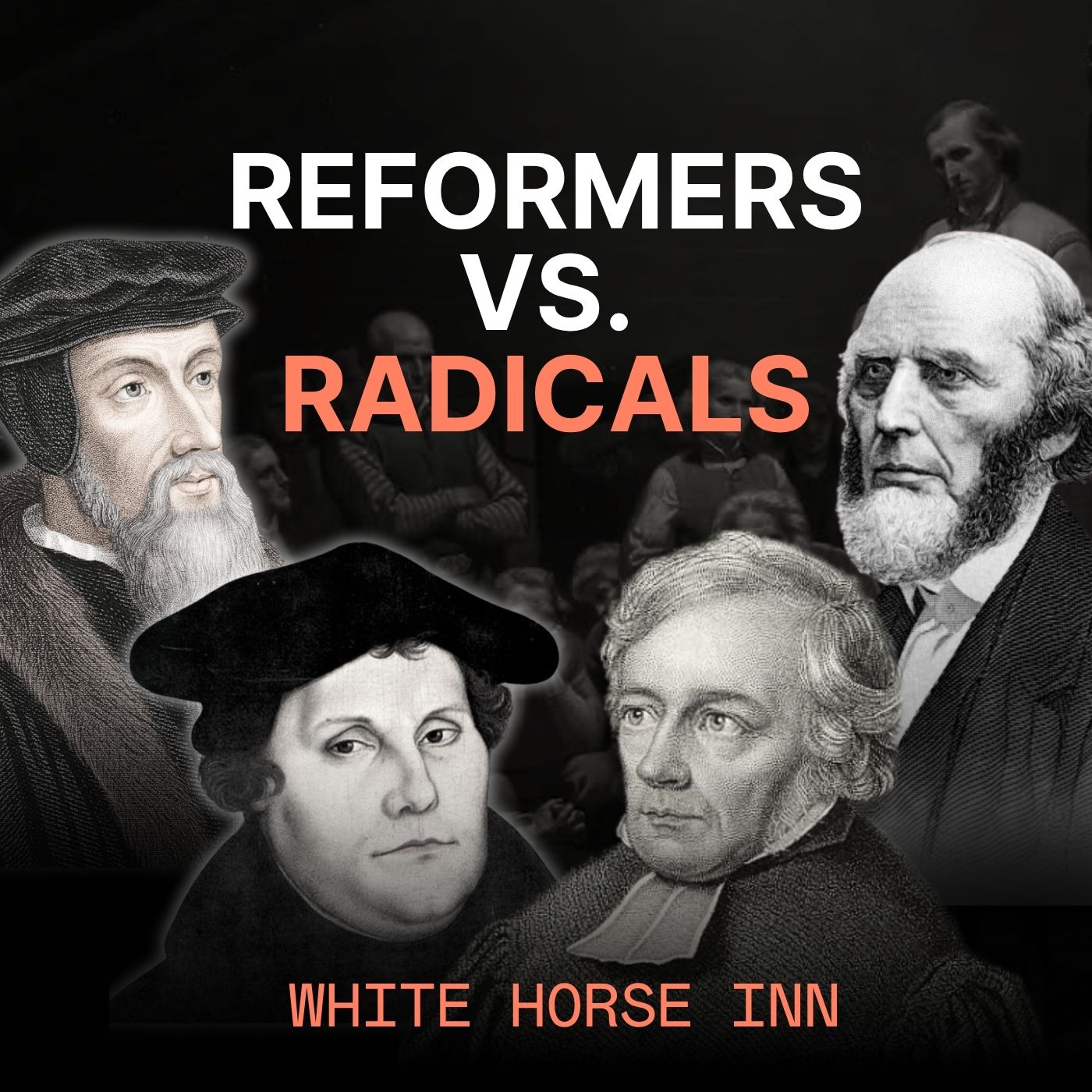
White Horse Inn
Compromise and Resistance: Theology's Battle with Liberalism in the 20th-Century
00:52:21
Loading summary
Transcript86 lines
- [00:00]
A
We often look for God in the spectacular, but Advent reminds us that our extraordinary God came in the ordinary, in flesh and blood, to dwell with us. This Advent reflects on the wonder of the Incarnation with Heaven Came Down, A new devotional by Dr. Michael Horton. Published by Sola Media over four weeks, it explores how the Almighty veiled himself in flesh, not to terrify us, but to save us. Your support helps us bring the good news to more people. Consider requesting a copy for your own Advent Reflections or as a gift for someone who needs hope this season. Get your copy with a donation of any amount to support our work@solarmedia.org offers.
- [00:49]
B
They wouldn't give him an actual professorship, but honorary professor of Reformed Theology. He said I had never read Calvin's Institutes. I had never read the Heidelberg Heidelberg Catechism or at least studied it. I didn't know anything about Reformed theology. I found myself staying up at night, every night before I was going to give a lecture and found myself just couldn't stop reading the Reformed Orthodox. And he said, calvin and Reformed Orthodoxy. He said reading Calvin was like being in the Himalayas with a waterfall washing over me. It was an exotic experience for him, reading Calvin. And then he, he said I started reading the Reformed Orthodox. And he says dreary on every page. It's like reading logarithms. But the more I read it, the more I realized, cutting through the method, how rich it was. He said, I found myself visibly for the first time in the realm of the Church.
- [02:02]
A
Applying the riches of the Reformation to the modern church. This is White Horse Sin, a weekly roundtable discussion about theology and culture.
- [02:24]
C
Welcome to another episode of White Horse Inn. We're currently in a series called the Reformers versus The Radicals. So far we've explored pietism, the rise of Frederick Schleiermacher known as the Modern the father of modern theological liberalism, the burned over district of New York, and the emergence of various sectarian religious groups, including the notable and somewhat theologically infamous Charles Finney. And now we're in the 20th century and there's some important answers to questions that this history has raised. And we'll see some answers from J. Gresham, Machin and the Black Church, Karl Barth and Neo Orthodoxy. So that some of the questions that we'll answer here today are are these responses to theological liberal liberalism orthodox? And had these doctrinal skirmishes that happened some 100 years ago impacted us in the Christian America today? I'm here to answer these questions and many more with my good friends Mike Horton, Bob Hiller, Justin Holcomb and I'm Walter Strickland. To begin, there were these variety of responses to liberalism in the 20th century. But let's start by exploring Neo Orthodoxy. Let's get some historical context for this movement and sort of bat around some seminal figures of this movement as well.
- [03:35]
D
Well, Neo Orthodoxy built in has something about focusing on orthodoxy, getting back to the right teaching. And the neo is kind of like, okay, so a little hint there. But you have from the late 1800s up to the World War I, you have German liberal Protestantism, from Schleiermacher, who again a few episodes ago to Ritual Harnack. So you have this focus on religious experience and ethics, the historical critical method. And then you have this shift. You start having, well, you have a world war, you have a bunch of bodies on barbed wire. Basically the summary of liberal Protestantism is we're getting better and better every day in every way. And then reality is saying not really, that's not happening. And so you have, you know, you have Karl Barth, who 1919, I believe 1920, writes the Romer Brief, you know, his commentary, his reflection on Romans about God being wholly other. God's not just this imminent, you know, pawn who's just kind of hanging out in some type of, you know, radical imminence, just supporting humans in whatever they want to do. God is different, known by revelation. And the gospel arises. He would say divine judgment and grace. There's some problems with Barth, but he's basically saying no to all of this. Everything's a revelation. He didn't like natural revelation. Nein n e I n is the thing like no?
- [05:06]
B
Because the German movement, the German Christian movement was using that to say that God reveals himself in our heart of hearts through the revelation of Jesus and through the public movement of history and culture in the Fuhrer.
- [05:27]
D
That's natural revelation and that's where it leads. So you have this emphasis on God as holy other and talk about creator, creation, distinction. It was there. That's in the Romer Brief. And then he writes later on Church Dogmatics, the multi volume Church Dogmatics, where he actually talks about revelation and Jesus Christ Christocentric. If you want to know about God, look to Jesus Christ. God's revelation is Jesus Christ and then there's some scripture and how that relates. So the big picture is a significant shift in where's the starting point? Is it your feelings, is it your intuition or is it revelation? And so that's a know, two minute summary. There's more to say but we'll start.
- [06:06]
E
What he's doing is. What he's doing is he's putting back in order, which Schleiermacher got out of order. So Schleiermacher makes the subject and the object confused. Bart puts it back the way it's supposed to be. God is the source God, I mean. And there's a certain sense in which he's just trying to get back to biblical categories of creator versus creation. God is not in everything. Theology doesn't bubble up from within. Inside of us. Doctrine is not self expression. He's just trying to correct that. Now I think he overcorrects it a little bit, but nonetheless he's at least pushing us back in a proper direction.
- [06:41]
B
And he said later that he did overcorrect. He said, I know that in that first edition, the Roemer Brief, I not only distinguished but pitted God and humanity against each other. It's not just that he turned from the subjective to the objective, but he almost lost the subject completely.
- [07:03]
E
Right, right.
- [07:05]
B
And the turning point for him really was World War I. Well, actually before World War I, the policy of the Kaiser of Deutschlands Germany overall, that German imperialism. He was an evangelical socialist. He was in those early years very much opposed to German imperialism, of course being Swiss. And he was appalled to open up his newspaper and find that almost all of his theology profs had their signatures to the policy of Germany overall. And he said, if this is where it leads, history is on the march towards progress and that progress leads to the German triumph over everything that's not German. If that's where we're at, were going to that kind of utter exclusive humanism, then count me out. And then he began preaching sermons in this little hamlet of Saffinwill. They're often called his socialist sermons. They weren't really socialist, but they were proclaiming the kingdom is not marching and advancing God is not the unfolding of historical progressivism. The kingdom comes into history like a meteor and judges us and calls us to account. Who do you want in this pulpit? He tells his poor parishioners. He says, nowadays we say that a preacher is our employee. And so he just says whatever we want him to say. Well, I'm not going to do that. And then he just starts, who told you you're not going to hell? I mean, it's like Jonathan Edwards, sinners in the hands of an angry God. And from then on his motto is let God be God.
- [09:08]
D
So the rewrite, this is important because the rewrite was the first one, was 1919. He talked about, like, the organic growth of God's work. So the Romer Brief had that kind of language. He rewrote it. I think he said, I left. No stone is in the same place in 1922. And he said, I think his phrase is straight. God's vertical in breaking is straight down from above. The rewrite followed more of actually Romans, because the first Romer Brief was kind of like Romans became a springboard to kind of launch into whatever he wanted to do. Then the second one became more reflections on actual Romans.
- [09:42]
B
And that's why even early. Early on, and it gets a little better later, but especially early on, and it never really left. He downplays history. If the liberals upplayed history, history is just the unfolding of the kingdom of God. Then he emphasizes this vertical inbreaking, falling, like a meteor, breaking up history, challenging history, upsetting and uprooting history. He always had this kind of undertow of downplaying the creature, downplaying the creaturely, downplaying the historical. Not because he was a liberal, but the very opposite, because he hated liberalism.
- [10:24]
D
World War I, going back to what Mike said was huge because it exposed how naive liberal Protestant optimism was. And he said, in the rubble, religion as morality was too thin to answer. Guilt, evil and death. I mean. And so. And people said that his Romer Brief was like a bomb being dropped on the playground of Protestant liberalism. Who were. They were trimming miracles and emphasizing ethics. And he was saying, no, this is a crisis moment. You make a decision. This was a. A significant, severe shift in how theology was being done.
- [10:56]
B
And that's where he said he turned back to the Reformation. And then he even said he started reading the Reformed Scholastics. He was teaching at the University of Gottingen, which was. It was a Lutheran territory, very Lutheran territory, where he said the Reformed Church had no more standing than a millennialist sect.
- [11:22]
E
It's a wonderful place.
- [11:23]
B
You should live there. Bob.
- [11:27]
D
In his heart, he's there all the time.
- [11:29]
E
All the time.
- [11:30]
B
But an American Presbyterian group wanted to set up a Reformed chair of theology at University of Gottingen. And Barth said the only thing that they hate more than the Jews are the Swiss. And he took the job as they wouldn't give him an actual professorship, but honorary professor of Reformed theology. He said, I had never read Calvin's Institutes. I had never read the Heidelberg Catechism, or at least studied it. I didn't know anything about Reformed theology. I found myself staying up at night, every night before I was gonna give a lecture, and found myself just Couldn't stop reading the Reformed Orthodox. And he said, calvin and Reformed Orthodoxy. He said Calvin. Reading Calvin was like being in the Himalayas with a waterfall washing over me. It was an exotic experience for him, reading Calvin. And then he said, I started reading the Reformed Orthodox. And he says, dreary on every page. It's like reading logarithms. But the more I read it, the more I realized, cutting through the method, how rich it was. He said, I found myself visibly, for the first time in the realm of the church.
- [12:57]
D
He actually ended up teaching a class on Reformed dogmatics and wrote the Goninga Dogmatics. And you can actually. There's a few volumes. It was before he wrote his Church Dogmatics, which is really a fascinating thing if you want to dive into art studies.
- [13:12]
E
Herman Sassa, who's one of our. If you want to find the Lutheran guy who actually does okay in the 20th century in Germany. Hermann Sassa is about as good as it gets from our end. And he says that Barth was so effective. There's a lot of people who spoke out against, like Schleiermacher and the uprising, liberalism and all this. But he said Bart was so effective because he was brought up in it. And so he knew exactly what he was going after. So he's bred in this thing. And what is his line? They created their worst enemy or something like this, that Barth just decimated them.
- [13:46]
B
He hated pietism. He hated it. He said, all of this comes from pietism. It's interesting, too. Years ago, long time ago, I happened to go to the World Council of Churches offices and met with the secretary and also the secretary of the World alliance of Reformed Churches, had lunch with them together. And I'm coming from America. My background is conservative evangelical, then becomes Reformed. So I'm sitting there and asking them questions about the situation there. And they said, everything changed with Bart. I said, what do you mean, everything changed with Bart? And of course, in my context, that meant everything changed for the worse. And they said, well, you have to realize that before Barth came along, most of the Swiss Reformed churches were Unitarian.
- [14:42]
E
Oh, wow.
- [14:44]
B
They were Socinian. Not even Armenian. They were Socinian, totally taken over by the Enlightenment and by Protestant liberalism. And so in Switzerland, if you say that you are Bardian, that's tantamount to saying you're a fundamentalist.
- [14:59]
C
Yeah, it is interesting because there's this. There's this line that Barth was trying to walk in between, pushing away from all that we've said of liberalism, but then also in many ways critiquing the sort of over intellectualization of fundamentalism. And so he's depending on where you are, you'll hear Bart valorized, or he's a champion of a more helpful trajectory of the church. And so I think that's very interesting about him. So I'm grateful for the summary because a lot of us get him wrong because he becomes the foil for, for our own theological interests.
- [15:34]
B
Yeah, I think most of the, most of the points at which we would disagree with Barth are points where people think that he didn't come out of liberalism enough. Whereas I think the greatest problem with Barth was that he overreacted against liberalism. If liberalism made God totally imminent in the world, Barth practically had no ongoing place of God in history and in the world. If they would make history the unfolding of God's very being progressively realized in the liberal consciousness, then Barth would take God completely out of history or not have any kind of intersection between God and history. Now that's exaggerating, but that was the tendency of his thought. If anything creaturely could be associated with God, even the Bible, then Christ is not the only incarnation of God. So he had no real place for something that is the word of man and the word of God. Only Christ is the revelation of God. Therefore the Bible can only be a witness to revelation. That's not because he was a liberal. That's because he had an insufficient appreciation for nature, for creation as a site. In fact, he even said that human beings have no natural capacity for God. Well, that's not what Reformed theology teaches. That's not why Catholic theology teaches. We agree with the whole history of the Christian tradition that man does have a natural capacity for God. It's that the fall has corrupted that capacity. And we're morally incapable of choosing the right apart from grace. Not naturally incapable. Naturally we still have free will, but morally we're bound to sin.
- [17:51]
E
His other problem is his law. Gospel distinction is almost, oh, obsolete.
- [17:56]
C
Terrible little article, backwards.
- [17:58]
E
Yeah, he calls it gospel law and. But if you think about it, this makes sense with his doctrine of revelation, God really has nothing to do with us unless he decides to show up. And so if he shows up at all, that must be good news. It doesn't sound like great news for those he's coming to punish, but okay.
- [18:14]
B
But he's not going to punish anyone because he believes in universal election.
- [18:17]
C
Really?
- [18:17]
E
Oh, I didn't know that.
- [18:18]
C
Yeah, he does.
- [18:20]
B
Oh, now he's not convenient. Someone asked him, do you believe in universal Salvation. He says, no, I believe universal election, but everyone is elect in Christ. But yeah, Christ is the one reprobate and elect man. Everyone interesting is in him. But he stopped short. Someone said, you believe everyone will be saved? And he says, no, I cannot say that because I don't want to violate the doctrine of the sovereignty of God. And boy, you look at that and you say, now wait a second, Orthodoxy on this point, you can know you're elect by looking to Christ in this scenario. Now, you might look to Christ or you might not look to Christ, but you're still elect. But there's still this open possibility that God is so sovereign he could damn you anyway.
- [19:17]
E
This is the problem that happens when, like you hang so heavy on a doctrine that you just start to ignore the scriptures. Like, you just. You're not letting the text tell you exactly what it's going to happen.
- [19:26]
D
This is when you need Article 17 of the 39 articles on predestination.
- [19:30]
E
So then what do you do if he's talking this way? So when Jesus talks about the resurrection of the just and the unjust, like, so what does he do with something along those lines, like the resurrection, everybody.
- [19:43]
B
Is elect, redeemed and justified, but they just don't know it. So we have to go proclaim it to them, we have to tell it to them. And Emil Bruner here was so brilliant. His reformed colleague who is also part of the the Neo Orthodox. He was part of the same working group with Barth. They were good friends for a while, then they had this debate. First of all, Bruner said, you don't know the history of the Reformed tradition. You constantly misdefine natural revelation. In the Reformed tradition, you put the Gospel before the law instead of the law before the gospel. This is Reformed as well as Lutheran. You devalue history. And then he also said, at the end of the day, Carl, there's only one problem with your view of universal election and salvation, and that is that it's not taught in the Bible. But it's a very large problem. Big deal.
- [20:50]
C
Interestingly enough, we're talking about Barth's relationship to the Scripture. And so we know that his preaching at a local church is what drove him back to a more meaningful engagement with Scripture. Exegesis is important if you look at the church dogmatics, but the Bible is not objectively, it seems to me, God's word. So if nobody reads it, it's devoid of being God's word because it takes somebody reading scripture for it to become the Word. Of God to us.
- [21:22]
B
Yeah, and so it's an event. Yeah, it's an event.
- [21:25]
C
And so what we have here is that the problem with this doctrine of Scripture is that it drives a wedge between the Bible and revelation and it creates a lot of problems adjudicating the actual meaning of the text. I'm grateful for his sort of more rigorous return to scripture, even tradition and things like that. As far as his engagement with scripture goes, it's still a little bit problematic if we're trying to root our doctrine in exegesis.
- [21:51]
B
Yeah, it's very problematic. And again, because everything is vertical, it all happens like this. Everything is an event, a crisis event. And so you can't have a history of revelation. It's these events that happen. For God to reveal Himself is to reconcile you to Himself so he doesn't distinguish between revelation and reconciliation. It all happens. It all happens. And so you have this revelation event where through the scriptures, through especially preaching, you do have this encounter with God in judgment and grace. But the Bible itself can't be identified with that revelation because revelation by definition can only be an event and by definition a personal event. And that person is Jesus Christ. It can't be about Jesus Christ. It can't be, that's only witness. It can't be the words of Jesus and the apostles. It's Jesus himself who is revelation. And that happens in an event through the Scriptures when they kind of come alive. But he did end up in the Church Dogmatic saying, the first volume that the, my, my doctrine comes very close to that venerable theory of verbal inspiration.
- [23:19]
E
Interesting.
- [23:20]
B
So there's a, there, there's a, a real tension in Barth's theology that some could take back towards old liberalism to his chagrin, or it could take in the direction of a more kind of conservative Bardian emphasis that you, you really find throughout the 20th century.
- [23:45]
A
At Sola Media, we're committed to helping Christians deepen their faith through clear, Christ centered teaching rooted in the riches of the Reformation. Every podcast, article and resource we produce is offered free of charge and it's only possible because of generous monthly supporters. When you become a partner Today, you'll receive two remarkable books as our Rediscovering the Holy Spirit by Dr. Michael Horton and Praying with Jesus by Pastor Adriel Sanchez. We believe these books can guide you into a clearer understanding of the Spirit's work and a richer prayer life. To become a partner and receive these two books, visit solarmedia.org partner.
- [24:38]
E
All right, so this is kind of what we're seeing happen on the continent in response to the theological liberalism moving into the 20th century. But what is happening in America? And I'd be very curious, Walter, because you wrote a wonderful book called Swing Low. You guys should all check that out. It's a phenomenal book. What is the impact of this sort of. These movements we've been discussing, especially like revivalism and liberalism? What kind of impact is that having on the black church at this time in America?
- [25:09]
C
For sure, if we're. If we're thinking about leading into the 20th century, revivalism is the moment when many African Americans came to know Christ as Lord. There's a variety of reasons for that, but that's when the numbers really just begin to jump up. So we now we enter into the 20th century, there's all this debate going on about evolution and Darwin's Origin of Species and its implications, about hierarchical readings of the scripture, about, you know, just a lot of these ideas that are coming across the pond. But the. The grace is in some ways in a. In a very much a Joseph way. What was meant for evil, God meant for good. African Americans weren't even in the institutions where this kind of liberalism was taking hold. So the idea of preparing for ministry was really more of the father in the ministry model, where they would go and basically be an apprentice with a pastor, and that pastor would teach them exegesis, that pastor would teach them what it means to shepherd a flock, do visitation, a lot of those practical things, marrying and burying, counseling and things like that. But that was all outside of these environments where liberalism and modernism were really beginning to, in some ways, rule the roost. So also going on at that time, you had the emergence of Pentecostalism with William Joseph Seymour. Many of us are aware of the Azusa Street Revival from. Was it 1906 to 1909 in Los Angeles. And this is a fairly theologically orthodox movement. Granted, many evangelicals would quibble with some of the emphasis on miraculous gifts and the Holy Spirit, but it was very theologically conservative. That was the desire, I think, some of the excesses that we see in a new work of the Spirit sort of superseding the written text. That's not what William Joseph Seymour was doing. He would actually encourage the people at the Azusa Street Revival to not focus on the miraculous or the expectation of the miraculous, but to focus on Christ. There was this insistence that he had there. So that was a movement that began. And interestingly enough, Bishop Mason came, and he was the father and the one who began the Church of God in Christ, and this is Kojik is the acronym. You guys might have heard that. So he goes from his church in the south, comes to Los Angeles, attends the Azusa Street Revival, takes on some of these doctrines that he has learned there, and then he goes back to his church. He then the story kind of goes, depending on who you talk to. He gets kicked out or he leaves, takes some folks with him and he starts the Church of God in Christ. I mean, and they're very theologically culturally conservative. However, this is one of those sort of new streams of African American Protestantism that really begins to rule the roost in many ways as far as growth goes. And then simultaneously you have what we call black fundamentalism. And this is a. A group that would not necessarily want to take on the nomenclature fundamentalists because of the racism that was bound up in fundamentalist institutional life and their institutions of education and many of the mission boards that were associated with fundamentalism. But theologically they were. They would affirm, you know, the fundamentals as we would kind of remember them as they were published in the early 20th century. So there's also, however, in addition to the rejection of fundamentalism because of racism in the institutions, there's also this hesitancy with fundamentalists because there's a lack of the social concern of the gospel. And as we well know, there's a lot of desire for the implications of what it meant to be in the imago DEI to be asserted in public space for African Americans. Because a lot of what was going on was denying the image bearing capacity of African Americans. And so there's a lot going on here. And so there's on the one hand, exclusion from the major institutions that were promoting and sort of debating the ideas of Protestant liberalism. There was this Pentecostalism in the line of William Joseph Seymour, continuing through the Church of God in Christ movement. There was black fundamentalism. And there's a quote I want to read by Jonathan H. Frank. He was the editor of the National Baptist Review, and he's just talking about to the people that he was writing to about the skirmish that was going on theologically in the beginning of the 20th century. He says, thus far, colored folks, African Americans, are not engaging in the unholy task of explaining away the Scriptures because of scientific thought, so called. And then he continues later, he says, in the spirit of modern progress, which he would call a new religion, which, I mean, I wonder how much of mention he was there, he called it a new religion. I mean, this is so they were so the theological leaders Were very much aware of what was going on and were translating it to these bivocational preachers that were just in regular pulpits, many of whom were beginning to become more and more literate over time. He says colored folks, he continues, are not ready as of yet to discard Christianity for civilization. Thank God. And that civilization.
- [30:49]
A
That's a good one.
- [30:50]
C
Yeah. That sort of civilization idea is him saying, like, we're not getting ready to sell the faith just to be culturally relevant. You know, we're not trying to appease people to be. To affirm modern science and higher critical methods of interpretation, to understand the Bible. So anyhow. So that's. That's sort of a snapshot of the early 20th century. And then I think Justin had a question that we can move to the middle of 20th century.
- [31:14]
D
The Russian Bush social gospel. How does that play in. And you may. Yeah, you mentioned it and kind of addressed. I just want to make sure for listeners and for me, because just really quickly, I don't want to.
- [31:26]
C
Yeah. Interestingly, there is a movement called the black social gospel, but it's not rooted in the Rauschenbusian social gospel. This is who they would call Daddy King. This is Martin Luther King Sr. He and others would call themselves black social gospelers because, I mean, Cesar Blackwell is amongst this movement who was a leader in Alabama as well. They would say, there is a gospel. We were dead in our sins, we're alive in Christ. And there's implications for individuals, but also beyond that. And you say, so we are the ones who are taking this gospel of Jesus Christ into the social realm. And it's for the sake of creating an environment where the parishioners can flourish not just in the church house, but outside of the church house.
- [32:16]
E
Interesting.
- [32:17]
C
And so the gospel's social implications. So it's called the black social gospel, But I think sometimes when people initially approach it who are familiar with Rauschenbusch, they would sort of superimpose Rauschenbuschian categories on it. But they're very orthodox in their theology.
- [32:34]
D
As soon as you told me black social gospel, I was like, oh, okay. And then you describe the opposite of Rash and Bush's.
- [32:40]
E
Who is Rauschenbusch? Can you guys define that for us?
- [32:43]
C
Oh, that might jump back in.
- [32:46]
B
He was the. He's generally considered the founder of the social gospel movement, which was, you know, again, this idea from Hegel and Kant before him of the. The kingdom of God being a progressive unfolding in history of spirit. And it reaches its climax for Hegel in religion, in Christianity and in culture, in Germany particular, democracy in general. But John Dewey, for example, would be an American humanist who was very Hegelian in his thinking, that Hegel himself said, the place probably where this will reach its millennial kingdom, its apogee, isn't Germany, but America. And some people.
- [33:44]
E
And we're like, sign us up, we're ready.
- [33:45]
B
Yeah, some people took that to heart. So really briefly here, the social gospel movement didn't divide between conservatives and liberals. It's not Republicans and Democrats. It was really American Protestantism from the. To the right. That was part of, in one way or another, the social gospel movement before the modernist fundamentalist controversy, and again, a lot of it coming out of Finney and post millennialism. But Josiah Strong was one father of the social gospel movement, who wrote at the turn of the 20th century, actually just before the 20th century, that the plan of God is preparing the Anglo Saxon for the final conquest of all the weaker races. Already, he says, we are seeing the subordination of the darker races to the Anglo Saxon, especially in his American form, who is ideally suited with all of his prowess and power to exert its influence over all the world. If I mistake it not, we will soon see the Anglo Saxon race streaming from America down first to Mexico and then to. Anyway, he goes on and on. You can see where that goes. President McKinley was a new school. Oh, by the way, he was catapulted to this General secretary of the Evangelical alliance after that. And Teddy Roosevelt made him his court preacher. William McKinley. President McKinley was a new School Presbyterian. And he just shook his head and said, oh, man, I want to win the Nobel Peace Prize. But what are we going to do about the Filipinos? Well, I guess we're just going to have to go over their. Christianize and civilize them. And so that was the Spanish war in the Philippines. And Mark Twain, I think, was more Christian when he said, I fail to see how millions will accept the gospel at the point of a bayonet. And so you had this. What's interesting is the formative figures in the social gospel movement were American imperialists all the way up to World War I. And the radical call for the warmongering was particularly on the liberal left. It was, America has this role of Christianizing, educating, spreading capitalism and its system of life over all the other nations, because an American civilization is a Christian civilization. This all came from American Protestantism, from the left to the right. And only with Darwinian evolution and the Scopes trial and so forth, was there this divide between the modernists and the fundamentalists, higher critics on one side and people who accepted scripture on the other. But the fundamentalists were as much heirs of this movement as the rest. The difference is the social gospel mainliners remained post millennial, and after World War II, the fundamentalists became premillennial. But today the most vocal Christian nationalists are on the right. And so that's what just. It's very interesting.
- [37:53]
E
That's an interesting question, Walter. Within the black church movements then, is it a post millennial? Is it an amillennial? Is it premill? What is their view of the eschaton in their efforts?
- [38:07]
C
Yeah, it's very interesting. There's not a lot of discussion about eschatology. There is in a kingdom sense, as far as the beloved community. Let's aim towards that. There's a lot of ethics that are derived from the eschatological reality of the.
- [38:27]
B
Kingdom, but it's part of the old spirituals.
- [38:30]
C
Yeah, well, the old spirituals, yeah, they would definitely have a lot to say about the kingdom of God. And there's a lot of dual purpose in the language there that someone like Frederick Douglass would say. There was the initial sort of explanation of the spirituals to the master, which was say it's all for the sweet, by and by. But then there is the already implications that they knew about, but they later were able to articulate after emancipation. So there certainly was an already not yet dynamic, but there wasn't a bunch of engagement with the sort of ordering like pre post, you know, and millennials and things like that. So, so it's, it's, it's very interesting. And I, and I'll say this last thing real quick. There were black liberationists who, some of which, especially James cone, he sort of pushed away the discussion of eschatology at all because he saw it wielded against African Americans to say, you know what? Sure, we own your body now. You should look to the sweet by and by, to your freedom. So you should become Christian so that one day you can be free then. So cone was like, well, forget all that. We want to be free now. And so someone like a liberationist who is beyond the pale of orthodoxy, especially a James cone, would completely cast it aside, while others emphasize an already not yet, or just the kingdom reality and the ethics that emerge from it.
- [39:58]
E
Now this, I don't want to take us too far off, but I am curious, like, where would you put Martin Luther King Jr. In those categories? And the reason I asked this question is because I think of the. I have A dream speech. And it does have. I don't. I don't think he's like calling for a utopian world, but he is saying, like, a better world is possible. So where does he fall into that category?
- [40:21]
C
Yeah, I know Mike's very opinionated on this as well. So my take on King is this. He was a figure almost like Bart, who is theologically sort of moving a lot in his life. I mean, he ended his life at 39. And so, I mean, we can definitely talk about where he was in snapshots of time with the things that he wrote. But if we zoom back looking at his life, he grew up in a home where he was born, Michael King Jr. To his dad. Their names were changed after his dad visited Wittenberg to Martin Luther King. There you go. To acknowledge the theology and the sort of the ethos of Martin Luther and the Reformation. So that sort of gives you some inkling to his theological moorings. He was raised in a black Baptist context, which at that time was very much rooted. I mean, they had the creeds as their doctrinal statements of faith for the denomination at the time. And so. So we see him going to Morehouse, being then confronted by liberalism for the first time. He was drawn towards the intellectual life and the exploration of those figures. And so he. He himself would say, I was sort of wooed away from the faith of my father. But over time, he saw their. Their excess of optimism. And then he began to see how it was sort of bankrupt and in many ways that we would talk about a Bart in that regard with liberalism. And then he began to work his way back towards his father towards the end of his life, as he was in the pastorate. In his I have a dream speech in 63, there was certainly that sort of pointing and gesturing towards eschatological realities of the fact that there is that every tribe, tongue, people and nation, it is rooted around a declaration of Christ. I don't think he was going towards a utopian society now, but I think he saw it as a driver towards a community that doesn't exist.
- [42:24]
E
Yes.
- [42:25]
C
And as a bearing witness to a better reality and perhaps even through Christ.
- [42:30]
B
Walter, would you say that so helpful the more. Dr. King moved from his father's black church, traditional kind of theology and background and was focused especially on the freedom that is coming. Justice will be done, even if it's not done here. It should be more here on earth than it is. But even when it's not, there is a final justice up ahead. Do you think that his movement or his wrestling with that and a more imminent perspective of the beautiful society here on earth was due in part to his influence not from the black church, but. But at Rochester, Colgate and, you know, where he was studying under Protestant liberals.
- [43:44]
C
Yeah. So I think that there, because he did grow up with his father and people who were in the tradition of Caesar Blackwell and that black social gospel reality, there was an eye towards the faith's implications for people. Yes, spiritually, but also, what does this do socially? I do think that he was wooed in the direction of a more rash and bushy and understanding of this. But then as he was working his way back, he departed from that with personalism, which was a more ethical system that really began to reinforce some of the categories that he was seeing emerging from that black social gospel tradition that was based on the value of the human person. And I say it that way because Edgar Brightman wouldn't really talk about imago dei, but just the value of the individual. But then he sort of read back into that, oh, that's imago dei. So that was a sort of formalization in some ways of the sort of value of the individual then as it's expressed in society. And so I think he definitely saw liberalism shortcomings. And so he said this quote, liberalism's superficial optimism concerning human nature caused it to overlook the fact that reason is darkened by sin. And it failed to see that reason by itself is little more than an instrument to justify man's defensive ways of thinking. And so he began to see that the intellectual rigor as he saw it coming out of his very feedistic background of liberalism was a lot more hollow than he thought it was when he first sort of looked out into this pasture that looked green initially, but he found was bankrupt in the end. And then I think he began to sort of move his way back.
- [45:32]
B
And so is there a common theme here of Barth and King? I mean, for all their differences, certainly that they both kind of rethought things when they were disillusioned by what liberalism actually led to.
- [45:48]
E
Yeah, that's interesting.
- [45:49]
C
Yeah. Yeah. I think someone to write that book. I. I really do. Because.
- [45:55]
E
If only we knew someone, Walter.
- [45:58]
B
Justin and Walter should write that.
- [46:00]
E
That'd be a great book.
- [46:01]
C
Yeah, we should call it that Bad Boy. Because really, there. There's. I mean, granted they started in different places, but they. There are definitely a lot of parallels because when they got into a pulpit talking to real people, they're. They're. The liberalism failed them. And so, yeah, there's there's certainly parallels. Maybe the, the. The minutia would, Would, would differ a little bit, but in broad swaths. I would say that they're very parallel in their trajectories.
- [46:28]
B
I'll stop, but I'm really intrigued by all this. Would you say, Walter, that we're really misled if we force the black experience in America, which is to say the black Christian experience in America should be understood as being influenced by white culture, whether theologically left or theologically right of center? So we're always asking basically, where do blacks fit in with the white story? Rather than recognizing the continuities and discontinuities within the black tradition as its own tradition.
- [47:14]
C
That's it. I think you're exactly right there, because there's a sense in which there are some commonalities because, you know, there are African Americans, so there is. There's a similar context there, but there's also some very distinctive uniqueness. So, you know, one way of saying this is that, okay, one of the things that's very consistent in evangelical circles and even neo evangelical circles is political conservatism and theological conservatism. But amongst African Americans, you see a lot of theological conservatism, but they're not politically conservative in the same way. Because if we look back to the middle of the 20th century, if we were to conserve society, that's not a society that any African American would want to conserve. But what we're seeing now, since the middle of the 20th century into now the first quarter of the 21st century, is that we're seeing that there always has been a unsettledness with some aspects of the political left for African American Christians. But now they're becoming so unsettling that they're being ignored far less. And so there always has been a political homelessness for the African American Christian. And it's never been a really comfortable place. And so a lot of those ways in which some of the angle categories of looking at and assessing faith are thrown off because of the African American sort of theological tradition, it just tracks on different. It rolls on different train tracks. One thing that I also think is that in the sort of broader American Christian tradition, the litmus test for where theology is is the scholars. And so, yes, we can see the diversity of scholarship in the middle of the 20th century. Okay, early 20th century, we have Barth, which is a response. Later, we have people like Harold Auchingay, and then we have a Carl F H Henry, who were trying to sort of balance out this sort of perspective. With other sort of liberals. But for African Americans, those who have the power of the pen are those who are in the academy, who are the ones who are influenced by liberalism, which they are writing a theology that is completely incoherent with what's going on in the average African American. That's really interesting, and that's really one of the thrusts that I try to chase down and swing low, that it's one of the first times that there's been a comprehensive writing of the story that is ecclesiastically focused and not academy focused. And when we do that, we get a completely different story and we see that the liberationists are the ones who deviated from what has always been going on. And the liberationists speak for themselves, not for the African American pew.
- [50:09]
D
Fascinating.
- [50:10]
E
That's really interesting.
- [50:11]
B
If folks want to see the black church get its due treatment, swing low is something they got to go up, pick up. And he also has an anthology.
- [50:21]
D
Of.
- [50:21]
B
Writings to go with it. So you can follow along and read primary sources too.
- [50:30]
C
The first one is a theological narrative, and the second one is the receipts, as we say these days, the primary sources. So I do thank you all for joining us on Today's journey through 20th century responses to theological liberalism. From Karl Barth's challenge to Modernism to the theological resistance of African American Christians to Machen's stand. We didn't talk about him a ton, but he was there. To his stand at Princeton and the development of Westminster Seminary and also the rise of evangelicalism. These moments, they remind us that theology is never done in a vacuum. We must be vigilant to understand how both history and the present try to shape us into its mold. I remember the words of Romans 12:2, do not be conformed to this world, but be transformed by the renewal of your mind, that by testing you may discern what is the will of God, what is good and acceptable and perfect. May we be formed by the faith that's once for all, delivered to the saints and be ambassadors for Christ in God's world, for the truth that sets us free. Who is Christ? The hope of glory.
- [51:44]
A
Here at Sola, we encourage disciples and equip disciple makers by drawing on the riches of the Reformation to apply historic Christian theology to all of faith and life. Our work is only possible thanks to the generosity of thousands of supporters across the world. In order to keep our resources free, we need your support. Will you prayerfully consider a donation to help us equip and encourage even more people to grow in knowing God and seeing everything in his light? If so please visit solarmedia. Org. Donate.