Loading summary
Transcript75 lines
- [00:02]
Sarah Kaelin
Acast powers the world's best podcasts. Here's a show that we recommend. Hi, I'm Cara Berry, host of Everyone's Business But Mine. If you don't know me, think of me as your new friend and fellow busybody as I talk about everything under the pop culture sun, from the best way to detect a celebrity breakup or pregnancy to recapping your favorite reality TV shows from the housewives cinematic universe wealth into Plath, Phil, Summer House, Sister Wives and so much more. Check out Everyone's Business But Mine, airing multiple times a week everywhere you listen to podcasts. ACAST helps creators launch, grow and monetize their podcasts everywhere. Acast.com previously on who Took Misty Copsy?
- [01:00]
Sean Robinson
Detectives never found Misty's remains, and they have not been able to tie those genes or any evidence to any suspect. This whole thing about finding the clothes out by the Mud Mountain dam.
- [01:10]
Sarah Kaelin
What are the odds?
- [01:11]
Sean Robinson
I don't believe she was wearing those clothes.
- [01:14]
Sarah Kaelin
I think it's so hard to try to even make sense of looking at a lot of the unsolved cases because there are so many predators to choose from. A reporter for the Tacoma News Tribune.
- [01:24]
Sean Robinson
Newspaper made a public disclosure request to the Puyalla Police Department for the case file about Misty Copsey. They released the entire case file.
- [01:34]
Sarah Kaelin
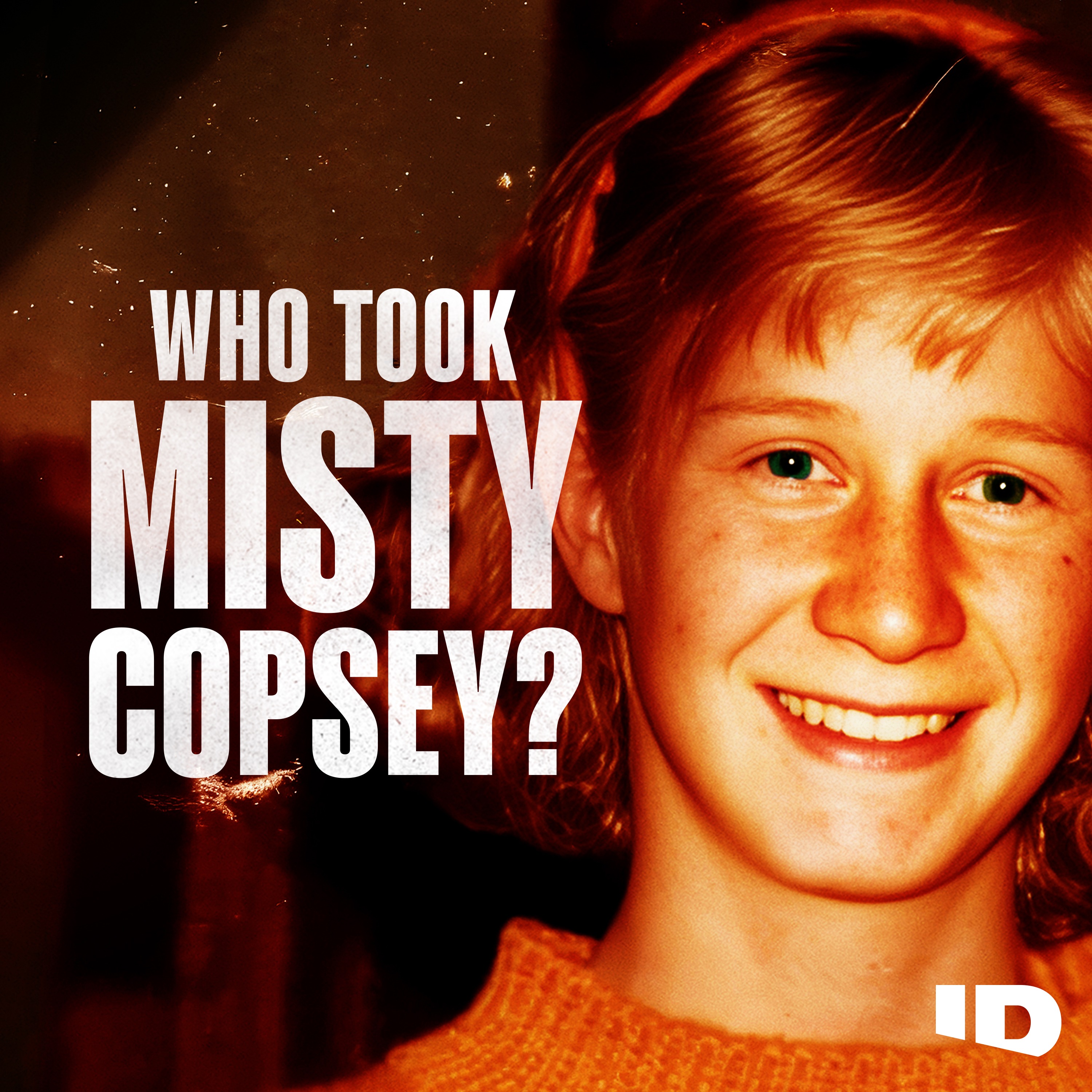
From ID and ARC Media. I'm Sarah Kaelin and this is who Took Misty Copsey. I've been on the ground in Washington for about four days, and already the mysteries surrounding Misty Copsey seem to be morphing and evolving. It's one thing to start a case trying to figure out what happened. It's another to arrive on the scene and learn that the only known evidence may not actually be related to the case. A week ago, I thought I knew one thing for certain, that the only physical evidence ever discovered in Misty's case was a pair of baggy, stonewashed jeans with a pair of socks and underwear in one leg found in a ditch along the side of Highway 410 about five months after she disappeared. But now the person who first told me about this case, former detective Cloyd Steiger, has told me he doesn't think those were Misty's jeans. I need to get to the root of this. It's crucial for me to move forward. That's why I'm heading to meet with local journalist Sean Robinson. In 2009, Shawn published an investigative series on Misty's case. With unprecedented access to the Puyallup Police Department's entire case file. Cloyd was shocked that the City gave Shawn that access. He feels like putting so much info into the public eye compromised any future investigative efforts into the case. On the other hand, the case was 17 years old when Shawn published his story. And while the police repeatedly said it was an open investigation, they had done shockingly little to advance it in all those years. So, personally, I'm on Shawn's side here, and I cannot wait to find out what he knows. My producer Tessa and I hop in the car and head south to meet Sean at a local university in the Tacoma area where he teaches journalism. I'm starting to get pretty familiar with the network of highways that connects Tacoma, where I'm staying, with the surrounding areas. Hi, I'm Sarah. Nice to meet you. Thanks so much for doing this. Sean greets us outside wearing a baseball cap and a bulky fishing vest with dozens of pockets, though apparently he's not much of a fisherman.
- [04:03]
Sean Robinson
I hung out with photographers for a long time, and they would always wear these. And I'm like, well, this is good. And it's because I can put my chucket here and walk the dog and do that. I have extra pockets just handy. Yeah, my wife hates it.
- [04:19]
Sarah Kaelin
As a devoted dog mom myself, I appreciate this commitment. In addition to teaching, Sean still works at the News Tribune in Tacoma. He's been there about 25 years. He spent 20 of those as an investigative reporter. Nowadays, he's an editor. In all those years, Sean tells me, the longest thing he ever published was the Stolen Child, a three part series diving into the case of Misty Copsey, a case that had gained almost mythical status at the Tribune offices.
- [04:54]
Sean Robinson
It was kind of newsroom lore. Other reporters, other colleagues of mine, had worked on it from time to time because it was this lingering missing persons case that had never been solved.
- [05:06]
Sarah Kaelin
In 2007, Sean decides to take a swing at it. He makes a public records request for the Puyallup PD's case file and manages to make a virtually unprecedented deal.
- [05:20]
Sean Robinson
So they basically allowed me brief access to the entire investigative file, and they were willing to do it in part because they just had gotten nowhere.
- [05:30]
Sarah Kaelin
The case is 15 years old at this point. At first, Puyallup denies Shawn's request, claiming that Misty's case is an active investigation. But Shawn keeps pushing, and finally, city officials veto the police department's denial. They grant Shawn exactly eight hours to sit in a room and look through the entire Puyallup PD case file and pick which documents each he wants copies of. Then Sean gets to work. In May of 2009, he publishes his Explosive series.
- [06:07]
Sean Robinson
The story I wrote was not meant to say, here's the killer. That's not what I was doing. What I was doing was saying what happened and why couldn't they solve it? And here are some things that these files reveal about what they did at the time and the decisions they made, which in hindsight, at times, they looked bad. They looked bad. They made some bad assumptions. They waited too long, and a lot of information that could have been gathered was lost because they didn't believe it.
- [06:49]
Sarah Kaelin
Didn'T believe that Misty was anything more than a runaway. Sean's story details some major failures in the original investigation, which we'll come back to soon. But Sean says the story was about a lot more than that.
- [07:04]
Sean Robinson
Part of the problem of that story was habeas corpus, right? There's no body. They have never found her. And so it's a story without an ending. Even with hints about possibilities. You still do not have the body, so you cannot be sure.
- [07:25]
Sarah Kaelin
Instead, Shawn focused on the part of the story he was sure of. Misty's mother, Diana.
- [07:32]
Sean Robinson
This is what this is about. It's not about you cops. It's not about serial killers. It's about this person and this person's grief that will not stop.
- [07:45]
Sarah Kaelin
Shawn developed a close working relationship with Diana.
- [07:49]
Sean Robinson
I talked with her for a year. Almost every day. We would talk, and I drove around with Diana, talked to her on the phone. I went to all these kinds of places with her, all the key spots. I went to the place where the jeans were.
- [08:02]
Sarah Kaelin
On one of these many trips, he and Diana stopped for a coffee.
- [08:06]
Sean Robinson
And we're sitting there in the parking lot, and I looked to her, and I said, do you ever drink until you cry? And she nodded, and that was my lead sentence. Sometimes Diana Smith drinks until she cries, and then she calls up the Puyallup Police Department and tells them what she thinks of them, which she did. But that was where I wanted to locate that story at the center of her this grieving mom whose daughter is gone and who latches onto anything she can find and in the process of desperation, latches onto someone who is both energetic but toxic.
- [08:57]
Sarah Kaelin
That person was Corey Boebert. As Shawn explains, Corey plays a critical and complicated role in Misty's case, specifically a huge role in why and how those genes were found in the first place. So understanding Cory Bober himself is the first step to determining the validity of that evidence. Shawn spoke with Cori Bober at length.
- [09:25]
Sean Robinson
Over and over and over and over and over again. Lots and lots and lots of Times.
- [09:30]
Sarah Kaelin
In the early 90s. Corey Bober is sort of an OG armchair detective. A guy in his mid 20s, a contract subscription salesman for the News Tribune, living with his mother in Puyallup. He had a few run ins with the law for drug charges. Even spent a bit of time in jail. He's an analog web sleuth, a true crime junkie. Before that was really a thing. He once told Sean that he had, quote, a touch of obsessive compulsive disorder. Not full blown, but there. End quote. Something that was apparently noted in some of his drug charges. He'd fixate on stories in the local news, especially about crime. As of 1992, the thing in the local news that he is deeply obsessed with is the Green River Killer. A faceless serial killer active and at large in western Washington.
- [10:26]
Sean Robinson
Corey had a long standing theory that he would propound over and over and over again to anyone who would listen. From reporters to public officials, all the way up to state officials about who he thought the killer was.
- [10:42]
Sarah Kaelin
Corey thought the Green River Killer was a guy named Randy Oxinger. Randy was apparently an acquaintance of Corey. And when Corey decided Randy was the Green River Killer, he would not let it go. He gave mountains of what he claimed was evidence to the Green River Task Force. And they listened. They looked at Randy Oxager pretty intensely. But in the end, eliminated him from the suspect pool. Corey still wouldn't let it go. Even Fast forwarding to 2001, when the Green River Killer is definitively identified as a man named Gary Ridgway. Corey continues to insist they got the wrong guy. He is obsessive like that, like a dog with a bone. Once he gets an idea in his head. And a lot of the time there is really no merit to his obsessions. Still, no one can completely dismiss Corey and his theories.
- [11:43]
Sean Robinson
Corey, in spite of his erroneous thing about who the Green River Killer was, was just really good at ferreting information out of people. He did things that were just. You couldn't believe it. And the reason you would keep listening to him on the phone and taking him seriously was because he'd get something right. He wasn't always right, but sometimes you're like, God, he's right about that. I can't, you know, damn, he's right about that.
- [12:09]
Sarah Kaelin
As a quick example, Sean tells me that one time, through his uncanny ability to, quote, ferret information out of people, Corey uncovered a shocking scandal involving an elephant at the local zoo.
- [12:24]
Sean Robinson
He discovered that the zoo people had inadvertently sent the remains of Cindy the elephant to the landfill and they had to apologize and it was an embarrassment and Cory found it. Corey was right. So he would have little triumphs like that where you're like, okay, I can't not listen to you because damn.
- [12:46]
Sarah Kaelin
To be clear, Corey had no investigative background, no law enforcement experience whatsoever, and as far as I know, no connection to the zoo. He just had a knack for digging up weird hidden nuggets of information. Sometimes important ones. Question is, does Corey have legitimate detective skills or is this the kind of thing where even a blind squirrel finds a nut once in a while? Maybe the distinction doesn't really matter because either way, sometimes Corey gets onto something and sometimes he's just right again. In 1992, the thing he's fixated on is the Green River Killer. Specifically two Puyallup girls who Corey is convinced are among the Green River Killer's victims.
- [13:39]
Sean Robinson
There's two sets of remains in the area where Misty's jeans were discovered on Highway 410. Delang and Chabetnoy.
- [13:50]
Sarah Kaelin
15 year old Kim Delang and 14 year old Anna Chabetnoy, both young women.
- [13:57]
Sean Robinson
Both killed, both found very near each other in an area off of Highway 410. Highway 410 is this long straight strip and you come to these different areas that are owned by a timber company. Some of those areas even now are blocked off by these kind of metal gates. And 410, in addition to Delang and Shebetnoy, was a place where there were other confirmed Green river victims dumped.
- [14:27]
Sarah Kaelin
Corey believes that the Green River Killer must be responsible for Kim and Anna's deaths. He points out that both girls disappeared from the HIHO shopping center in Puyallup. Both found about 24 miles away in the same clearing off Highway 410. Then Corey notices something about the timing of their cases. Kim disappeared in July of 1988. Anna in August of 1990. Two years and one month apart. Based on this, Corey predicts that another girl will go missing from Puyallup in September of 1992. Corey wrote about this in his journal in November 1992. Sean included several journal entries in his reporting. One says, I was looking at and comparing the victims, checking where they were last seen, when they were last seen, where they were found, when they were found. I thought, oh my God, I'm sure he's going to kill soon. He killed in July 88 and in August 1990 and both girls came out of Puyallup. It was time. September 92, another girl will disappear from Puyallup and maybe he'll put her too, on the same highway 4 10, near the other two girls as a clue informing a three person pattern. He wrote this entry two months after Misty disappeared. But Corey claims he had called in a tip as soon as he made the connection. He says he warned authorities that a girl might go missing and then Misty did.
- [16:11]
Sean Robinson
So he had that theory in his mind before Misty disappeared and then when she disappears, he's like, ah, you know, I have it. Proof. Aha. Eureka. And then he tells Misty's mom while the Puyallup cops are dismissing her and saying, nah, she's just a runaway. She's just a runaway. She's just a runaway. Which. And they were wrong. That's how Corey meets Diana is he calls her up and says, I think I know what happened to your daughter.
- [16:41]
Sarah Kaelin
Unfortunately, serial predation is not this straightforward. Serial killers operate in cycles, but their cycles of violence and cooldown don't move this way. And I've never heard of someone killing on a strict schedule dictated only by the calendar. Even if someone did, no one can really draw a pattern from two points. I know this after years of studying serial predators, but for Misty's mother Diana, who hasn't studied serial predation, someone who is desperate for any help in finding her missing daughter, I can see why she took Corey's theory seriously. According to Shawn, Diana was initially skeptical of Corey. Sean writes that Diana ultimately formed a, quote, uneasy alliance with Corey. He would call her and spout his theories for hours and she would fall.
- [17:43]
Sean Robinson
Asleep talking to him on the phone and she'd just be like, phone on her chest, cordless phone on her chest. And he's just still going and going and going.
- [17:52]
Sarah Kaelin
Corey journaled about the moment he heard about Misty. On October 4, about two and a half weeks after Misty disappeared, Corey's mom told him she'd seen a flyer in the window of a Downtown Puyallup 7 11. He reached out to Diana and from there he just didn't quit. With the police ignoring her, it's hard to blame Diana for turning to the only person who seemed to take her seriously. To be clear, Corey had no previous connection to Misty or Diana. There have been rumors over the years about Corey and Diana having a romantic relationship, but she denied that. And there seems to be no basis for it other than his obsession with her daughter's case. The only connection is Corey's theory that because of the timing, two years and one month apart, Misty must have been killed by the same person who abducted and killed Kim Delang. And anna chabetnoye. And that leads him to believe that Misty's remains must also be near where Kim and Anna's remains were found, out on Highway 410, about 25 miles from the fairgrounds in puyallup.
- [19:07]
Sean Robinson
And so he was leading diana, who again, was getting no traction from the cops at this time. I'm gonna help you find your daughter, and I'm gonna help you find your daughter's remains. He took, you know, the killer took her out here to 410. Let's go. Let's take a group to this particular gate by this particular dirt road along Highway 410.
- [19:29]
Sarah Kaelin
In November of 1992, Corey organizes two search parties along the north side of Highway 410. The search parties don't find anything. Afterwards, Corey realizes Kim and anna's bodies were found on the south side of the highway, so he plans another search, this time on the south side. In February of 1993, five months after Misty's disappearance, Corey, Diana, her sister, and about a dozen volunteers gather at a spot along Highway 410, just about a half mile from where Kim and Anna's remains were found. At the intersection with a dirt road around mile marker 30, one of the searchers starts poking around in a ditch along the side of the road road. And suddenly everything changes. Diana later describes the moment in a series of news segments. This kid boy scout was digging through the ditch with a stick, and he caught hold something, and he flipped it up on the road. And I looked at it, and it was her jeans. I really didn't expect to find anything, you know, what did you find? Her pants, you know, her socks and her underpants. Held out hope until we found her jeans up on Highway 410. Diana says she is sure these clothes belong to Misty. This discovery of a pair of jeans, underwear, and a pair of navy blue socks Marks a massive turning point in the case. Misty's mother, Diana, seems to recognize the significance of the jeans Found crumpled in a ditch right by the side of Highway 410.
- [21:26]
Sean Robinson
King county comes out. The sheriff's office green river task force. The he key Green river detective Jim doan comes out. And that's really when the true, more substantive investigation begins.
- [21:41]
Sarah Kaelin
It is this discovery that finally pushes investigators to look into Misty's disappearance as anything but a runaway case. This clothing, the jeans, socks, and underwear, is, to date, the only physical evidence that has ever been found in Misty's case. This is why these genes are so key to everything we know about Misty's disappearance. Unless, of course, they are not Misty's jeans at all. Retired Detective Cloyd Steiger says the pants were the wrong size, that he believes Misty was a size 4 and the jeans found were a size 16. He may have been rounding, but either way, he felt the size discrepancy was significant. I disagree. For starters, I don't believe he has any idea what size Misty was. Not because he's ignoring anything, but because in my experience, the average man wouldn't know how the sizing of women's clothing works and likely could not guess a girl or woman's accurate size. I don't mean it as an insult, but women's sizing is wild, and it can fluctuate drastically between brands. Even we can barely make sense of it a lot of the time. Besides the size discrepancy, Cloyd also questioned why the killer would toss them on the side of the road. Why not put them in a dumpster or bury them with the body? I can see some scenarios that might explain this, but Sean Robinson raises an even more troubling idea.
- [23:27]
Sean Robinson
There's some not unwarranted speculation. You know, oh, Corey planted the genes to try to get people to react.
- [23:36]
Sarah Kaelin
Corey Bober easily could have known what Misty wore to the fair based on his many conversations with Diana. So I have to consider the possibility that Corey might have planted this evidence, an act of a man desperate for people to take seriously his theory that Misty was taken by the same person who killed Kim DA Lang and Anna Chabetnoye. There is also speculation that Corey was actually involved in Misty's disappearance. Even Diana was suspicious of Corey, as Shawn described in his investigative series. Well, Shawn says that the police did briefly consider Corey a suspect, but ruled him out. No one seems to think Corey is a physically dangerous person. And for his part, Sean doesn't think there's any chance Corey was involved.
- [24:29]
Sean Robinson
I do not. I have spoken with him so many times, and I know a lot about how he thinks and works. I don't think Cory is a killer. I don't think Cory ever killed anybody. And I always thought that was sort of ridiculous. Here's this obsessive guy who has an idea, who has the wrong idea. But his energy and his indefatigability and stubbornness keeps this thing alive when it would not have been. And in that sense, he did a good thing.
- [25:06]
Sarah Kaelin
But as Sean's story made all too clear, Corey's contributions were not all good.
- [25:15]
Sean Robinson
I called that thing the Stolen Child as a reference to an old poem by William Butler. Yeats actually Come away, O human child, to the waters in the wild for the world's more full of weeping than you can understand. And in stealing the case and stealing it from the mom, he made Misty his case instead of hers and stole it from her, which I always thought was pretty sad and she just wanted someone to care.
- [25:47]
Sarah Kaelin
I've spent a lot of time trying to decide what to make of Corey and more importantly, what to make of the clothes that were found on a search that Corey organized. Sean spent a lot of time with Corey. I trust his judgment and his belief that Corey is not a killer. Based on what I've read and heard about him, I don't think he is either. I can't disagree with Cloyd Steiger's skepticism that Corey would be the one to stumble upon the only piece of evidence ever found in Misty's case. As Cloyd said, what are the odds? It all brings me back to the same questions. Is that evidence legit? Are those Misty's genes?
- [26:37]
Sean Robinson
The genes are like a metaphorical crossroads. If they're hers, then it's something. If they're not, you know, what is it?
- [26:48]
Sarah Kaelin
If the jeans are not Misty's, then all we know is that Misty was last seen by a Puyallup bus driver around 9:20pm from there, she vanished into thin air. But if they are Misty's, then I've got questions like, is Misty's case connected to those of Kim Delang and Anna Chabetnoy? Also, who would know this network of roads well enough to know that this remote stretch of Highway 410 is a good place to dump some evidence? Throw a rock from the Puyallup Fairgrounds and you'll most likely hit dense forest, land of some kind. Who would have a reason to be all the way out in that place? Particular direction? And another question. Why the jeans, underwear and socks? Why nothing else? What happened that night that led to these items being separated from any other evidence? I need to get out there and see for myself. My producer Tessa and I get in the car and plug in the pinpoint on the map where the jeans were found. Sean gave us a handy Google Maps tour of the area before we departed. It's about an hour away. As we drive, we discuss the cases of Kim Delang and Anna Chabetnoy. Their remains were found almost practically on top of each other other. Which does make you think it's like two women who go missing from the same place. But it's a mall, so that could be a coincidence. Two Bodies who get disposed of in the same place, but it's in the middle of nowhere in the Pacific Northwest. That could be a coincidence, but both. That feels like a pattern. And I mean, dumping bodies almost on top of each other when there's so much. When there's so much, what are the odds? And. And we also know that serials love a dumping ground. Serial killers love a dumping ground. For lack of a more delicate way to state it, a huge part of the pathology in serial predation involves a significant aspect of fantasy. There is a lot of fantasizing about the sadistic desires and plans before an act is committed, and also revisiting what they have done in fantasy after a killing through the memories of it. This is why we see so many serial killers collect souvenirs. The souvenirs are a way for them to relive the experience more viscerally with something they can see and touch. For some, it means actually going back to the bodies to heighten that visceral experience. And for some, like the Green River Killer, that includes acts of necrophilia. Spending time with remains like this is critical to many of them. So having a safe place where they know they can go back again, sometimes over and over without being detected, makes it simply logical to use the same location repeatedly. Tessa brings up something we noticed on Sean's map. The fact that these girls and Misty's genes were found on fire. 410 where? When you look at a map of Ridgeway victims, it's like right there. Yeah, there are. There's a good handful of confirmed and presumed victims of Ridgeway on 410. Like in the woods off of 410 south of Enumclaw. I mean, the exact same area. Looking at the map, the spot where the jeans were found is almost due east of the fairgrounds, ever so slightly south on Highway 410. When I compare this to a map of the green river victims, four points land along the 410 route. These points are east and west of the jeans. Two of them are in the woods directly north of the jeans. Yeah, I mean, it feels like you can't count him out as a suspect. No, no, I don't think you can. With my understanding of the significance of dumping grounds and knowing that a number of proven Green River Killer victims were found Nearby in the 1980s, I am not willing to exclude him until I have something more concrete than simply she doesn't seem like one of his victims. About 20 miles east of Puyallup, where the fairgrounds are, we pass Through a string of small towns. Buckley, then Enumclaw. Are we still on 410? Yeah. I see. Yeah, we are. Past Enumclaw, the landscape starts to change. The road narrows to a two lane highway, and small towns give way to dense, dark woods. Yeah, it's pretty thick woods out here. I mean, this is far. It is far. It feels like we're way out now. Way out in the opposite direction of Misty's house in Spanaway. Which makes me realize something. If Misty did catch a ride from someone who offered to take her home, it would be very clear they're going in the wrong direction. Like, you wouldn't have to go very far out of Puyallup to know. Like, wait, we're not going near Spanaway. We're going the other way. So I feel like you could not drive with her, like, fighting this whole way. And so whatever happened, it feels like she's either unconscious or already dead when they're coming down. 4, 10. It's unpleasant to talk about or even think about, but it helps me paint a picture of what might have been happening in the hours after Misty's last known interaction. 28. Okay, two more miles. Okay, finally, we hit mile marker 30 and the intersection with the dirt road where the jeans were found. We pull over and get out of the car. Okay, so these are timber roads? Is that what he was saying? If you look at it on a map, Highway 410 cuts a narrow trench into the woods with many gravel access roads branching off it. In the early 90s, these access roads and much of the land around them were owned by the Weyerhaeuser Logging Company. They allowed the company's trucks to transport massive tree trunks out of the woods. Anyone who lives around here would know about these access roads. They'd know that 410 itself is too busy a road to discreetly dump a body. But no one pays much mind to these cutouts. They fly right past, going wherever they're going. In this particular cutout, set back a little further from the road as well, a locked gate. I haven't been able to confirm if the roads were gated in the early 1990s. Regardless, when I first researched this case, I saw posts online suggesting that someone connected to Werhaeuser might have killed Kim and Anna. This theory was based on the idea that only WE employees had keys to the gates on these access roads. How else would their killer or killers have accessed the roads? But again, I have not confirmed that there were gates in the early 1990s. Plus some recreational permit holders have access, so a connection to a warehouser employee seems far fetched. Still, it's on my mind as we drive down the access road where the genes were found. We park the car. There's not a lot of distance between us and the cars rushing past when we get out, but we want to look closer at the ditch we've heard so much about. So, yeah, just like right off this road, like, really feels like you could just throw something out of a car. Exactly. I mean, clearly people have thrown some garbage out here. There are some food bags and crumpled cans littered in the ditch. Seeing this in person, I feel even more sure. The clothes were hastily chucked out a passing car window. Sean had photos of the jeans from when they were found before police collected them. The jeans were kind of balled up, like they'd been taken off in a hurry. One of the legs is pulled half inside out, and the socks and underwear are caught up in a pant leg. There's like, something about it that's bugging me. Like the way it was, like one leg pulled inside out. The underwear's in there. There's a sock. I mean, this is. This feels like jeans at the scene of a sexual assault. The way it's all pulled, like just kind of stuffed in there and stuff and that. You would just throw the whole thing out and it would stay exactly like that. Stuffed is probably not the best word. The socks aren't in the pants. They're just kind of caught up with them. Like they were definitely all together, not just two separate incidents of random clothes dropped in this spot. When it comes to the question of whether the genes may have been planted, I really don't think so. It's unlikely someone like Corey Bober would have had the foresight to plant them looking just like that. It's too specific. You would never think that way. Right. So then it's like they're either hers or they're another sexual. They're somebody else's, but I don't think they're somebody else's. Yeah, I think they were hers. Unfortunately, despite Misty's mom, Diana, identifying the genes as belonging to her, the investigators didn't reach the same conclusion. Shortly after the genes were found, authorities decided they were most likely not Misty's. Puyallup PD Detective Herm Carver, was asked about the discovery of the jeans, socks, and underwear. On a news segment, he said, quote, it was not helpful, end quote. Authorities solidified this position in the wake of Shawn's reporting. Even today, they maintain that they can't.
- [37:44]
Sean Robinson
Prove that the genes were hers because they could never find any verifiable traces. They could never establish conclusively that the genes were on misty's body.
- [37:58]
Sarah Kaelin
In 2009, after Shawn published the Stolen Child, Puyallup PD ran DNA tests on hairs found on the genes. The results showed that the hairs were not a match with either Misty or Diana. And as of 2011, according to local newspaper reports, there were no matches within DNA databases. Cloyd told me he recommended m vacing the genes, the latest and greatest in DNA technology. It allows investigators to pull the smallest quantity touch DNA samples off old evidence. M vacing the genes might reveal a suspect DNA profile or determine if the genes are actually Misti's. This would tell us more than testing hairs. Did the Puyallup PD follow Cloyd's recommendation? I don't know. They have never discussed it publicly. If they didn't, it's a major failure. Without conclusive testing for touch DNA on all three items, of course, I can't 100% say they are Misty's. But despite what Cloyd Steiger and the Puyallup PD may think, I feel strongly that these jeans were the ones Misty wore to the fair that night. I came out here in the hopes that seeing this part of 410 where the clothing was found would help me determine the likelihood that they were Misty's. And it has. I think these are Misty's jeans, socks, and underwear. Is there any chance Diana wanted answers badly enough to misidentify the jeans? Not intentionally, but out of desperation, yes. But I don't think Diana misidentified them. Diana was able to say where and when she purchased the the jeans. She said she bought them the summer before Misty disappeared at a store on Pearl street in Tacoma, A busy thoroughfare running north from the heart of Tacoma directly into Point Defiance Park. The police cataloged the jean. The catalog lists a brand called Ethics. According to what I found, at least one store in the area sold Ethics jeans in the early 1990s. It's called JC Jeans, and back then, it was on Pearl street in Tacoma. This makes me further inclined to believe Diana. So why were investigators so quick to dismiss Diana, who was saying this from day one? It has to be about more than the DNA. Now that I've seen a photo and the location of the jeans for myself, I'm much more certain the jeans were the ones Misty wore to the fair. I believe Misty's mother, Diana, who told police those were her jeans, which Misty borrowed And Misty's socks and underwear, which Diana had purchased for her 14 year old daughter. So why do the Puyallup Cops think otherwise? Why did they question Diana's identification of the genes? Sean said something in our conversation that could help explain this. It came up when he was telling me about preparing to release his 2009 series on Misty's case.
- [41:34]
Sean Robinson
Before we published that series, we brought them in, meaning the Puyallup cops to let them read it pre publication. And if there are any factual errors here, we'll fix them. If there's things you. You question here, we'll fix them. And basically, for the most part, they kind of sat there looking grim because we had it. We had everything in there. And some of it did make them look bad because some of the things they did were not good. That's how that went.
- [42:07]
Sarah Kaelin
Some of them were deeply up.
- [42:13]
Sean Robinson
Do you want me to go there?
- [42:15]
Sarah Kaelin
Yeah.
- [42:17]
Sean Robinson
Part of the problem was, I'm going to say class based in the sense that they looked at Diana and they said, okay, well, you're a trailer park mom, you're not a good parent, and your kid probably ran away because that's what happens most of the time. We're just gonna wait and for her to turn up and blah, blah, blah. That was the first mistake at a time contextually in this region when we had scores of missing young women. Now, Misty was not a sex worker. She went to the fair, missed the bus, and never came home. That's what happened. She didn't run away. That was not the case. And they didn't look and they didn't check and they made some assumptions about mom that were just bogus. And they didn't go down the really obvious roads that they should have gone down right away and lost access to potential evidence permanently at the beginning, that could have been the answer. I'm not saying it was the answer. But they lost.
- [43:27]
Sarah Kaelin
Is infuriating to hear what the Puyallup police did, or more accurately did not do in the days, weeks and months following Misty's disappearance. And it's gut wrenching to imagine what that time must have been like for Diana. Broad sweeping failures to act by the only people who could have acted. That could mean those missing answers are lost to time. The First 48 is a giant cliche. But sometimes cliches are based in reality. The steam you can gather at the very beginning is now lost forever. The police did not try to speak to a single witness for almost six months. Not one person, not until the genes were found in February of 1993. Only then do they interview Misty's best friend Trina, with whom she had gone to the fair. When police finally talk to Trina, Trina says that Misty called her friend Reuben Schmidt for a ride. She says Misty started calling him around 8pm and called about five times.
- [44:40]
Sean Robinson
She calls him from this phone booth. Trina was there and heard her make the call. And Reuben says he can't come because he doesn't have enough gas because he never had enough gas and this shitty car. There's a back and forth.
- [44:54]
Sarah Kaelin
Misty tries to convince him and according to Trina, Misty even tells Reuben how to break into her house to get some money from her piggy bank to pay for gas.
- [45:05]
Sean Robinson
Diane always had a problem with this and she would get mad when I would raise this point that Misty gave Reuben directions to her house to go get the money from her piggy bank, money stash or whatever so he could buy gas for his car. And Diana was like no, Misty wouldn't do that. Misty was perfect and purist like no, I think she did do this because she was desperate. Here are the directions to my house to get my money.
- [45:31]
Sarah Kaelin
Trina says that even this information didn't change Reuben's mind. He insisted that no he couldn't come pick them up.
- [45:40]
Sean Robinson
Trina offered to have her her boyfriend come and pick them both up and that was Michael Reiner.
- [45:51]
Sarah Kaelin
Trina was 15 years old. Her so called boyfriend is 22 year.
- [45:57]
Sean Robinson
Old Michael Reiner hanging out with 14 year olds.
- [46:01]
Sarah Kaelin
Now Trina tells the cops she and Michael were just friends, that they were not involved. Sean has a different impression. Whatever the nature of their relationship, a 22 year old man hanging around with 15 year old Trina is a giant red flag for me. But according to Trina's statement to the police, when she calls Michael to ask him to pick her up, her call gets disconnected. Misty and Trina then walk to the bus stop. Misty calls Diana from a payphone. Misty says they've missed the bus. Diana is upset, so Misty says she'll figure it out. She'll either get a ride from her friend Reuben or take the bus later. This is all tricky. What Trina says to police is slightly different than what Diana told Sean Robinson. Diana said the girls plan to get the 8:40pm bus. Knowing how I was as a teenager, I'm inclined to think Trina knew more details. It sounds like they might have had a plan that they never shared with Diana. And when it fell through, they fell back on the bus story. Either way, according to Trina's statement, when Misty calls Diana, Misty doesn't seem to mention the earlier calls to Reuben. She says she'll call Reuben, and if Reuben can't pick her up, she. She'll take a bus. Diana gets upset, but says, okay, as long as Misty gets home. In reality, Misty and Trina are stranded. Misty lives about 11 miles southwest in Spanaway, much too far to walk. Trina lives closer, though not close. About three miles east, with darkness descending, the two girls sit on a bench and come up with a plan. Trina tells the police, quote, at that time, I made my decision of walking home, and she said she would take the bus. The last words that I said to her were, be careful. And she turned around and told me the same, and we walked off in different directions. Trina's statement raises so many questions for me. What if Misty tried Reuben again and he changed his mind? What if Michael Reiner got Trina's calls and came to get them after all? In a later statement, Trina adds more details. She says that when she called Michael, Misty didn't approve.
- [48:41]
Sean Robinson
So Misty's like, I don't like Michael. I know what you and Michael are going to do.
- [48:47]
Sarah Kaelin
In that second statement, Trina also tells police that she left Michael an angry message and that as she was walking home, Michael showed up and gave her a ride. So if she left those details out the first time, I have to wonder, what if Trina isn't telling the whole truth.
- [49:09]
Sean Robinson
I tried many times in many ways to reach Trina. You know, I didn't stalk her, hound her or anything. I tried to reach out via standard forms of contact, and she did not want to do it. And I understand because I think she feels enormous guilt and enormous sadness and probably unfairly blames herself for something someone else did. And I understand that, and I don't think it's her fault.
- [49:41]
Sarah Kaelin
As he says this, Shawn leans in towards the microphone, almost as if he's trying to speak directly to Trina. Unfortunately, I'm not sure I'll ever be able to ask Trina my litany of questions. Trina has never spoken to anyone in the media, including Sean. Trying to talk to her seems like a long shot, but one I absolutely have to take. She is one of the first people I tried to find when I started working on this. This case. But I can't seem to track her down, like, anywhere. She's kind of vanished. While I'm in Washington, I decide to ask Misty's brother Colton, if he has had any contact with Trina. He has not. But he's willing to help us try to find her. And we set a time to meet. We'll discuss the case and we'll try to find Trina. Because ultimately we all have the same question. What does Trina know? Coming up on who took Ms. Tikopsy?
- [50:46]
Sean Robinson
Trina eventually made it home from school. Called my mom. My mom asked her, where is my daughter? Do you know where my daughter is? And she says, I don't know. We debunked some things that were documented in 1993 that were just not true. Did not happen the way they were.
- [51:01]
Sarah Kaelin
Said to have happened. Happened.
- [51:02]
Sean Robinson
That my mom would say from time to time, she knows more than what she's telling us. I know she knows more than what she's saying.
- [51:09]
Sarah Kaelin
I think she just drove by us. Are you kidding me? Who took Misty Copsey is produced by ARC Media for id. You can follow our show wherever you get your podcasts. We'd love it if you could take a second to leave us a five star review on Apple Podcasts Podcasts Acast powers the world's best podcasts. Here's a show that we recommend. Hey guys. Welcome to Giggly Squad, a place where we make fun of everything but most importantly ourselves. I'm Paige Desorbo. I'm Hannah Burner. Welcome to the squad. Giggly Squad started on Summer House when we were giggling during an inappropriate time. But of course we can't be managed so we decided to start this podcast to continue giggling. We will make fun of pop culture news. We're watching Fashion trends pep talks where we give advice, mental health moments and games and guests. Listen to Giggly Squad on Acast or wherever you get your podcasts. Acast helps creators launch, grow and monetize their podcasts everywhere. Acast.com.