← The StoryBrand Podcast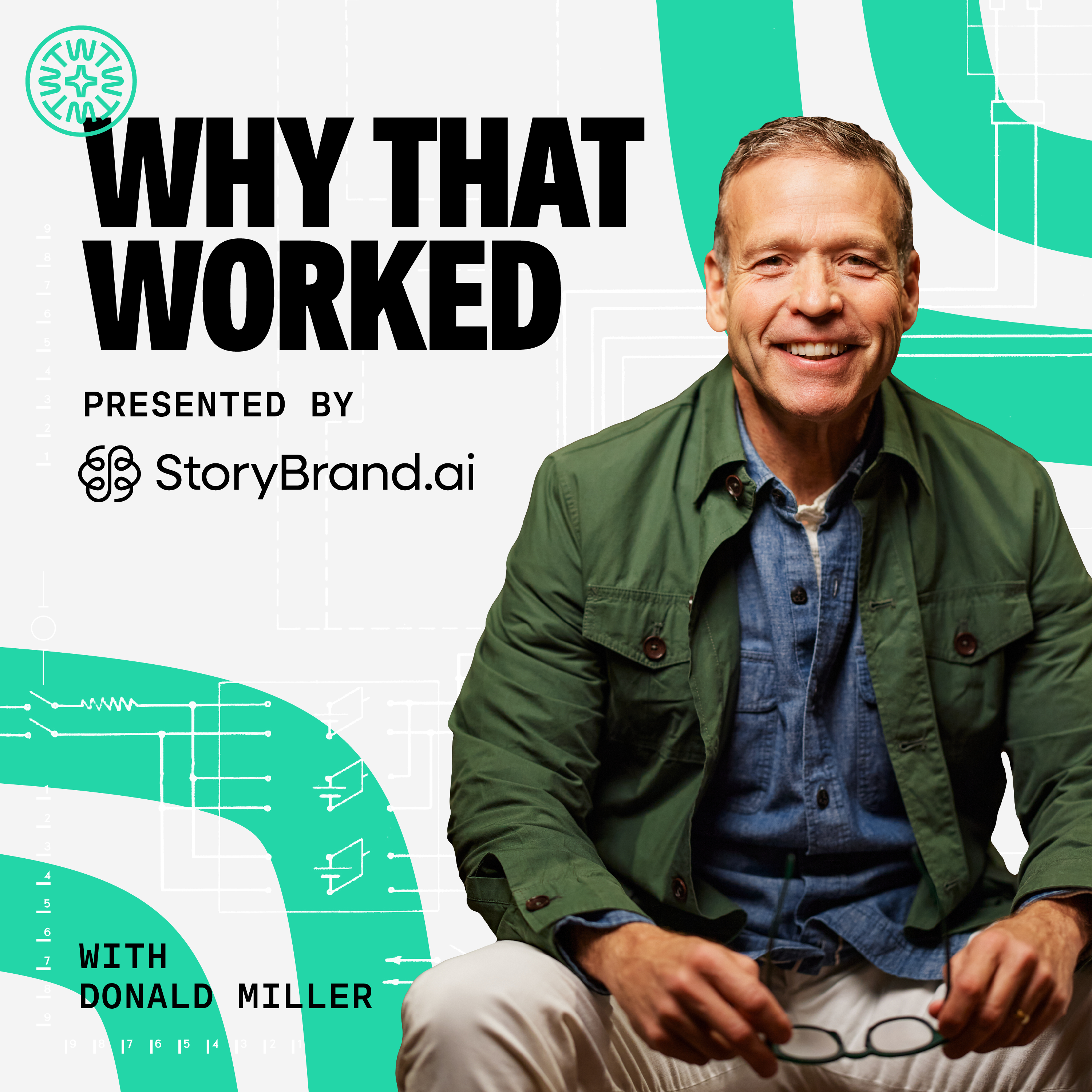
The StoryBrand Podcast
#3: Thought Leaders—How Innovative Thinkers Build a Following and Shape Modern Culture
00:24:36
Thought leaders influence the way we see the world, solve problems, and make decisions. But what makes someone a true thought leader? Are they original thinkers with unique worldviews, or can they be curators sharing their opinions and amplifying...
Loading summary
Transcript125 lines
- [00:00]
Donald Miller
Foreign.
- [00:05]
Kyle Reed
You're listening to the why that Work podcast presented by StoryBrand AI. If you've ever wondered why certain brands, trends, or cultural phenomena find success while others don't, you're in the right place. Every week, we unpack why something worked, then give you actionable insights that you can use in your own life. Now let's dive in with your hosts, Donald Miller and Kyle Reed.
- [00:26]
Donald Miller
Kyle, who. Who are you listening to right now in terms of thought leaders? Before you even define what a thought leader is, who. Who's got your attention?
- [00:34]
Chris Williamson
Yeah, a couple guys I like a lot. Chris Williamson from Modern Wisdom.
- [00:38]
Donald Miller
Love Chris Williamson.
- [00:39]
Chris Williamson
Love his podcast.
- [00:40]
Donald Miller
I would contend later in this episode that he's not a thought leader. Okay, he's something else, extremely valuable to society. But I would contend he's not a thought leader.
- [00:47]
Chris Williamson
Well, I love his podcast, Hermosi. I like a lot. I just like the way he thinks Alex is brilliant. Yeah, yeah.
- [00:52]
Donald Miller
And he actually, before he got mega famous, we zoomed one.
- [00:55]
Chris Williamson
Really? Yeah. Did he have his.
- [00:57]
Donald Miller
All of it.
- [00:58]
Chris Williamson
Okay.
- [00:58]
Donald Miller
I mean, it's not a shtick. And he was just unbelievably generous and kind.
- [01:04]
Chris Williamson
I guess when you ask me who, it's really a subset of people who. They think differently, and then they're willing to share why they do something. Those are the people I listen to.
- [01:14]
Donald Miller
They think differently and they share why and probably how a little bit.
- [01:20]
Chris Williamson
Yeah. Yeah. I like people who don't give just traditional, do X, Y and Z. Instead, they go, here's why I'm doing what I'm doing. Here's why I think about things.
- [01:30]
Donald Miller
Did you find that it was kind of difficult to actually define in your mind in order to research this episode what a thought leader even is?
- [01:37]
Chris Williamson
Not until I started thinking about it, because I think everybody, maybe I don't want to make an assumption here, but people listening to this or watching this might automatically when they hear word thought leader, it pops in their head, you know, who that person is. But when you really start to think about, well, what does make a thought leader or are they really a thought leader? Then I start to go, you know, I sort of ask myself, what is a thought leader? Yeah, you know what, What. How does that work?
- [02:02]
Donald Miller
What's interesting about the idea of thought leaders is it's. It's exploded. Used to, there were two or three, maybe four thought leaders. Now we're not talking about leaders. There's a difference between leaders and thought leaders. There's thousands of leaders, and now there are thousands of thought leaders. But back in the day, there weren't that many thought leaders.
- [02:23]
Chris Williamson
Yeah. And it was. Do you think it was my premise on that is media was just controlled far more so there was not outlets.
- [02:30]
Donald Miller
There weren't as many outlets.
- [02:30]
Chris Williamson
Yeah.
- [02:31]
Donald Miller
And somebody who was really brilliant and had a worldview and had ideas to share, didn't have a way to share them, and now they actually do. And so you're seeing, you know, you're seeing brilliance kind of people just turn on their camera and they share their thoughts. And now we kind of divide up into these followers of this thought leader and this other thought leader.
- [02:51]
Chris Williamson
Yeah. One of my, the earliest thought leaders for me was Gary Vee. Gary Vee has always been someone for.
- [02:56]
Donald Miller
Me who I would say he's a thought leader.
- [02:57]
Chris Williamson
Yeah. Who I've always, even back, you know, 15 years ago, just consumed everything he said.
- [03:04]
Donald Miller
What about you? Why was that, though? What was it about Gary Veal? First of all, he was dropping the F bomb and nobody was dropping the F bomb in professional settings.
- [03:12]
Chris Williamson
It's to my premise of he's a guy who wasn't giving traditional answers. He was practicing.
- [03:19]
Donald Miller
He had a blue collar perspective on a white collar industry.
- [03:22]
Chris Williamson
That's right. He brought down the veil. He showed you behind the scenes. He was a practitioner.
- [03:27]
Donald Miller
There was also just for entertainment value, there was contrast. He was talking about wine like a truck driver.
- [03:33]
Chris Williamson
Yeah, yeah, yeah, that's right.
- [03:35]
Donald Miller
So there was entertainment value to him too, actually. Let's go back to Chris Williamson, Modern Wisdom. By the way, if you're not subscribing to that podcast, it's a great podcast. He curates some of the great minds and he asks great questions and he gives great feedback and all that kind of stuff. I wouldn't call him a thought leader because I don't know that. He may have a worldview, but he doesn't exist to espouse that worldview.
- [03:58]
Chris Williamson
Yeah.
- [04:00]
Donald Miller
He's a curator of information, but not an originator necessarily of information. So I don't mean that to dismiss him because I listen to him all the time.
- [04:10]
Chris Williamson
It's a good thought.
- [04:11]
Donald Miller
Yeah. But I think that's the difference when we're trying to define what a thought leader is. There's a difference.
- [04:15]
Chris Williamson
He's almost a curator of thought leaders. He's bringing thought leaders into a room to discuss. But you're right.
- [04:21]
Donald Miller
And he's not a dumb dude. He's actually brilliant. When you hear him pontificate and throw the ball back and forth, he can throw it back and forth with a bunch of different Thought leaders.
- [04:31]
Chris Williamson
What about you? Who's some thought leaders you enjoy?
- [04:33]
Donald Miller
Well, when I think about, like, I mean, the thought leaders that I'm listening to right now are Peter Attia on longevity, Andrew Huberman, you know, those are the guys. Because I'm 53 and I really want to live to be 85 or 90. And so I'm listening to those. So specifically, you know, I try to think, why are we drawn to thought leaders? And I came up with four reasons. The desire for innovation. We want what's new, we want what's current, and whatever the newest trick or thing is that's going to help us accomplish X, whether it's cooking or relationships or business or health or parenting. Dr. Becky we want that. That's part of it. Then we want guidance. And this goes into the stuff I get into building a story brand. The idea that every human being identifies as a hero in a story, and every hero in a story, he needs a guide who has been before us, conquered our trouble, and gotten us out of it. So if we gotten themselves out of it, now know how to get us out of it. So as heroes, we are looking for guides. Therefore, thought leaders position themselves as guides just naturally, intuitively, and we choose them. Another one. And this may be the. This is the second biggest reason. I'll get to the first biggest reason next. Simplicity. We want somebody to simplify a complex idea and we don't have time to research it and do it ourselves. Yeah, yeah, we're not. I'm not going to sit there and figure out, you know, atoms and cells in my body and, you know, deteriorating, whatever over time. Peter T. Is going to do that for me. And so it simplifies ideas. And this is the number one. This is going to get really contentious here. Confirmation bias and tribe building. Yeah, we are drawn to thought leaders who confirm our biases. And listen, this is what I wrote down. We are designed for survival, which means two things. One, we want to identify threats, and two, we want to join a tribe that will defend us from those threats.
- [06:34]
Chris Williamson
Yeah, that's interesting because I came into this conversation, little behind the scenes is we come up with a topic and then we don't really discuss, we don't.
- [06:42]
Donald Miller
Talk to each other about it.
- [06:43]
Chris Williamson
And so we kind of come in with some thoughts. And one of the things I wrote down was we outsource our thinking.
- [06:51]
Donald Miller
I've heard you say that before, and it's so true.
- [06:53]
Chris Williamson
And we let people curate our thinking. But it's interesting you bring up that last point.
- [06:59]
Donald Miller
Confirmation bias.
- [07:00]
Chris Williamson
Yeah. Because I didn't add that into my equation. And you're right, though, because I outsource my thinking to people who think like me. It's very difficult for me.
- [07:09]
Donald Miller
Who justify your thoughts.
- [07:11]
Chris Williamson
Yeah, absolutely. And it's even to you.
- [07:14]
Donald Miller
We all do it, by the way. People are just. People are probably listening, going, well, I don't do that. No, you absolutely do. You do it with different thought leaders who contend with the other popular thought leader.
- [07:22]
Chris Williamson
I remember in my 20s, part of my struggle was I was always looking for the next video or book to give me the answer. I always thought kind of the first point of, maybe they have the answer that I just haven't found yet. And if I just listen to that episode or if I just read that book, I can discover what I'm missing. And there's kind of that feeling of, if only I can just find what the truth is here in this latest episode, then I will be happy. And so some of that, though, was my kind of confirmation bias of like they had something I didn't know I needed, and I was letting them kind of tell me, what did I need to do next? Kind of, again, back to that. Outsourcing my next steps in life. But that's the thing I haven't contended with, is you're right. The tribal nature, we naturally gravitate to one side or the other. Just naturally right or wrong to groups of people. Absolutely. It's a survival nature.
- [08:20]
Donald Miller
And the way studies show over and over that you think what your friends think. In other words, you think you're being objective, but you're actually not. Your subconscious brain is convincing you that this group of people is right. Because if we all agree with each other, we feel safe in a group, which is fascinating.
- [08:40]
Chris Williamson
It is.
- [08:41]
Donald Miller
In other words, you could actually take yourself out of your current environment and put yourself in a different environment. And about three years later, you probably would believe what that group believes at least a lot more than you used to. Just because you don't want to be an outlier. Yeah, because it's dangerous to be an outlier.
- [08:59]
Chris Williamson
I'm from St. Louis, and I moved to Nashville 15 years ago. And I remember when I moved here, I very quickly realized the clothes that I wore in St. Louis are different than the clothes. And I started to change through the group. To your point, to the group I was in, kind of subconsciously, but realized I was even outsourcing my. You know, how do I fit in? To some degree. Now, here's an interesting thing. You're a thought leader. I would say. And I would say you are.
- [09:28]
Donald Miller
I'm content with that a little bit. I would say I'm a hybrid.
- [09:30]
Chris Williamson
Really.
- [09:31]
Donald Miller
I would say Chris Williamson is not a thought leader.
- [09:33]
Chris Williamson
Okay.
- [09:34]
Donald Miller
Joe Rogan is a hybrid.
- [09:35]
Chris Williamson
Yeah.
- [09:36]
Donald Miller
Jordan Peterson is a thought leader and I'm a hybrid.
- [09:41]
Chris Williamson
Okay. So. Okay, let me rewind then. Because one of the things I got from your definition of a thought leader, it seems to be for you, is someone who goes away and does the work and then kind of comes back and presents that like Huberman Attia.
- [09:54]
Donald Miller
It depends on whether the work is original thinking.
- [09:57]
Chris Williamson
Okay.
- [09:58]
Donald Miller
And it's coming from a worldview that is your own or a curator of other people's original thinking, supporting perhaps a worldview. And I would say that's the camp that I fit in.
- [10:12]
Chris Williamson
Got it.
- [10:12]
Donald Miller
Because if you look at building a story brand, which is probably the, you know, if there's anything that I've done that is thought leader, like, it's that book. And so it's a business thought leader about inviting people into a story. You know, that stuff is based on Plato. It's based on obviously Joseph Campbell and Pathways to Bliss and the Hero's Journey. It's based on Robert McKee's story. It's based on Christopher Booker's the Seven Basic Plots. It's based on Blake Snyder's of Save the Cat. And it applies those thoughts, curated thoughts, best practices amongst ancient narrative structures in marketing. So that's where I innovated. I brought something that existed to. And I don't know that I could. You could say, well, that's a thought.
- [11:00]
Kyle Reed
If you don't communicate clearly, all your emails, your website, social media posts, everything you're communicating will be ignored. Storybrand AI is like the world's best communication expert writing it for you. Imagine having the world's best communicator writing your tagline. Just type in the name of your company, answer a few prompts, and voila. Hey, that's a good one. Use it to write your social media posts, website, wireframe emails, lead generating PDF, product or service descriptions, anything you need for your business. What would happen to your revenue if every word that left your business was crystal clear and worth paying attention to. StoryBrand AI is your competitive advantage. So you'll know you'll say it clearly. Try it right now and let us write your custom tagline for free at StoryBrand AI.
- [11:57]
Chris Williamson
See, okay, because that's what I'm curious is, you're saying you're a hybrid. I would say that is a thought leader because you took, I think, one of your skills. And I'm specifically thinking about here on a mission, building a story brand, even coach builder, to a degree. Your secret power is to take thoughts and simplify them and put it into a system or framework, which we've talked about that. And put it into something and then teach other people why this matters.
- [12:26]
Donald Miller
Agreed. But I would actually say, isn't that leadership? Which, by the way, I'm not diminishing myself for saying I'm a hybrid. Let's say I'm a hybrid between a leader and a thought leader.
- [12:35]
Chris Williamson
Would you say you're more of a cultivator of culture in a sense? Like, if you call Rogan a hybrid, we're getting, like, nitty gritty nerdy. You call him a hybrid. I would say Rogan shapes culture. He's got the biggest podcast there is. He shapes the direction of culture, I believe. I mean, I'm holding the latest version of building story brand. One million copies sold. Like you've shaped marketing. That, in my eyes, then, would put you as. That would be a definition of a thought leader.
- [13:08]
Donald Miller
Well, you know what? And we're being subjective, right? You and I can walk away with two different definitions of a thought leader. I would say I'm putting thoughts in people's heads. I'm not sure that they're original or my. You know, a thought leader is the one who led with the thought. And I guess that's where I'm getting into semantics. Right? So when I think about the most influential thought leaders who were obvious thought leaders, here's what comes to mind. They're going to be really weird. Karl Marx. Right. Communism, Marxism, socialism. That is a thought leader. And by the way, I'm going to get a bunch of hate mail on this. Marxism is a really, really, really good idea that doesn't work because it doesn't take into account human nature.
- [13:52]
Chris Williamson
Yeah. And a utopia society.
- [13:53]
Donald Miller
Yeah, yeah. Vacuum. It works fantastic. You know, you be a dentist and you be a. And screw you with whatever you wanted because this is what's best for the state. It doesn't work.
- [14:05]
Chris Williamson
We forget the whole human nature thing.
- [14:07]
Donald Miller
That's exactly it. And I don't mean that is by what a beautiful thing that Karl Marx thought. We were all so generous. You know what I mean? It's not a bad fault to have. Okay, here's one that's going to be out of left field. DOT leader, Dr. Atkins, the Atkins Diet. He thought differently, based on some science and propelled a completely different worldview into our modern lexicon. The Atkins diet, the modern lexiconin. Now it's ketogenic diets and carnivore diets. That's all Atkins. That's what that stuff is. So I would say he led with the thought. And then I remember growing up in Houston, Texas, there were things called Rush rooms. And basically, you could go to lunch at a restaurant with 50 other people in the restaurant eating lunch. Nobody would talk to each other. You know what they would do?
- [14:58]
Chris Williamson
No, what?
- [14:59]
Donald Miller
They would listen to Rush Limbaugh.
- [15:01]
Chris Williamson
Rush Limbaugh.
- [15:02]
Donald Miller
See, like, so the Sizzler down on Broadway would say, we got a Rush Room. And it means, don't talk. Come here and eat. Bring your friends. Don't talk. Just listen to Rush.
- [15:10]
Chris Williamson
And people would do that?
- [15:12]
Donald Miller
Oh, yeah. Oh, my gosh. Hundreds of thousands of people in Houston.
- [15:15]
Chris Williamson
Would do, sit in a room quietly.
- [15:17]
Donald Miller
And listen to Rush. And, you know, this is pre podcast man. This is pre, like, conservative media. This is pre Fox News. He was a leader. Not saying I agree with him, but you talk about confirmation bias and tribe building. Rush Limbaugh was the first guy to do it.
- [15:34]
Chris Williamson
So one of the things I'm hearing you say is a thought leader is someone who has an original thought and moves.
- [15:39]
Donald Miller
I would say not just original thought, a worldview.
- [15:42]
Chris Williamson
Okay.
- [15:43]
Donald Miller
A view of the world, which is different than a curator. Right. Karl Marx had a view of the world. Dr. Atkins had a view of the human body and the world, how the world worked and the body interacted with the world and food and all that stuff. Rush Limbaugh had a view of American politics. He really sort of defined and became a bullhorn. I mean, politicians followed him. Right. He didn't follow them. And he was also just kind of like, wildly entertaining, which has nothing to do with being a thought leader, but it is super, super helpful. But I would say all three of those completely unrelated industries. Sigmund Freud, thought leader. Right. Carl Jung, curator.
- [16:27]
Chris Williamson
Interesting.
- [16:28]
Donald Miller
But Carl Jung was a thought leader. Maybe Alfred Adler was less of a thought leader and more of a curator of personality theory. But Sigmund Freud was a thought leader. Right.
- [16:39]
Chris Williamson
Okay, I see where you're going.
- [16:40]
Donald Miller
See what I'm saying?
- [16:41]
Chris Williamson
Yeah, yeah.
- [16:41]
Donald Miller
Like, the thoughts are. The thoughts are curating thoughts. Fairly original. And they're dramatically affecting and shaping culture when they come out.
- [16:51]
Chris Williamson
So it sounds to me there's more curators than there are thought leaders. Yeah, yeah. I'm thinking about everything you're saying right now. Processing. We're at an interesting inflection in time because as we talk about the rise of thought leaders. And I even would add an addendum in this. The rise of Curators.
- [17:07]
Donald Miller
Bullhorns.
- [17:08]
Chris Williamson
We're at an interesting time where now more than ever, you said bullhorns. There's more noise, there's more opportunity. There's more opportunity for people on all kinds of different mediums to get their thoughts out there. And maybe they're not their thoughts. Maybe they're more curating thoughts. Yeah.
- [17:23]
Donald Miller
Like Alex from Rosie would be a curator.
- [17:25]
Chris Williamson
Okay.
- [17:26]
Donald Miller
He definitely is. Brilliant.
- [17:27]
Chris Williamson
Yeah, go tell me more about that.
- [17:29]
Donald Miller
If I said to you, what is the original worldview that Alex Hormozi brings in, you'd have trouble articulating it, right? If I had Sigmund Freud, you'd say, oh, we are hardwired by nurture and nature in our upbringing. And various traumatic and sexual orientations based on. He was explaining why people did things in a different way than anybody ever. What Alex Hormozi is saying is, here's some fricking awesome curated ideas and strategies on growing a business that's hard to even call it a thought leader. And that is not to diminish me or him or anybody else. There is leadership.
- [18:05]
Chris Williamson
Yeah.
- [18:05]
Donald Miller
We're getting into semantics, right?
- [18:07]
Chris Williamson
Yeah. Well. And I think.
- [18:07]
Donald Miller
But I think we have to define what a thought leader is.
- [18:09]
Chris Williamson
Yeah. No, I think that makes a lot of sense. It's kind of even, you know, got my head spinning a little bit on this idea. You're right, though. Thought leaders more. It just seems like the thought leader sees the world differently and.
- [18:21]
Donald Miller
Yes. Puts out a thought and makes more revolution and I would say is a giant leap in progress.
- [18:28]
Chris Williamson
Okay, Don, So someone listening to this, including myself, I'm sitting here wondering, how could I ever become a thought leader?
- [18:34]
Donald Miller
Do you want to be one?
- [18:35]
Chris Williamson
Yeah. And what. I mean, why not? Why not? Yeah. But I don't. But now that we're talking about this, I'm wondering what are the steps that I or someone listening to this would even take, and is it possible now to become a thought leader?
- [18:47]
Donald Miller
I think we would all have to agree that some people have a proclivity to become a thought leader more than others. They're just originators of ideas. I'll tell you who's a thought leader and a lot of people don't think of as a thought leader is Elon Musk. Elon Musk is actually a thought leader in. Especially in the areas of how. In the area of how to run really big organizations. Yeah. I have issues with him being involved in our government in some ways, because there are so many freaking government contracts that he has, it's kind of a dumb idea to put him in charge. And yet I'm like, but if we can get some of that, how to fricking do this thing better than NASA ever did it? I'd like that. And cheaper, with less people and less idiocracy that we have. Or idiocy, I should say. Idiocracy is, by the way, great movie. It's a thought leader movie if there ever was one. But I think Elon Musk is that way. So I think that first of all, I think certain people have a proclivity to do it. I think if you wanted to become a thought leader, here's step one. It's a three part step and you need to define a villain, cast a vision that defeats that villain or usurps that paradigm in culture, and then actually define the values that will make that vision happen. The sort of people we need to be in order to embody those values. So a villain, a vision and values just happens to be three V's. But I think once you establish that you would want to establish expertise in that area, you really want to dive deep into the villain, the vision, especially the vision. Don't spend too much time on the villain and the values that it would take for us to accomplish that vision. And then you got to start creating original content around that and start sharing that. Now a lot of people think, you know, in order to be a thought leader, I need to go on YouTube and start saying smart things. Yes, but smart things about why this villain is no good, why this vision is where we need to head and why these values are what's going to get us there. And then stay in your lane as long as you possibly can and go deep into that expertise. Whether it's like why the stock market doesn't work or why we should be supporting Ukraine, or why globalization is a bad idea, which, by the way, I don't think it is. Why the US military should not be policing our shipping channels, which, by the way, they should. You gotta come up with your area of the world and please, mine is. Mine is. I'm an enneagram3. I'm a high D on the disc test. It's success. It's not just marketing and messaging, clarification of messaging. That's what I'm for, why people succeed. Which is why I love this podcast. You know, I'd love to go deep in, but I'm really more of a curator. Right, but there's a vision there and we're establishing values. And then I think you have to stay committed to long term learning about that for a really long time. The mistakes that you can make are one, you're not an expert, you're a fake. Right. You're just curating information, repeating other people's ideas and trying to sound smart. You haven't identified a vision for the world. Your vision is you being smart. That's a joke. And we don't need you. There's no core values that are building toward your vision or you're not disciplined getting up every day and doing some writing and some content on this thing. That's kind of how somebody would need to become a thought leader. It's hard to imagine anybody doing that strategically rather than just intuitively.
- [22:24]
Chris Williamson
Well, this has always been a premise of yours is there's something that each person in this world knows more than.
- [22:30]
Donald Miller
Someone else or has a proclivity to try to understand.
- [22:33]
Chris Williamson
Yes. And if they can just put it into some sort of framework or structure, they can teach that they can teach. And that's the biggest thing I'm walking away with is a. We've kind of defined what a thought leader is, hopefully. Yeah, I think we have. And then also we're seeing like, okay, how do you curate those thoughts and how do you grab that and then teach that?
- [22:49]
Donald Miller
And.
- [22:49]
Chris Williamson
And then there's a way, if you want to go out and start to share that these are the things to follow.
- [22:53]
Donald Miller
Yeah. And also, listen, I think we've hopefully, and maybe even more importantly than anything else, we've uncovered a little bit or at least shared some insight on why they exist, both good and bad. They simplify our thinking. They to some degree curate our thinking. They originate new thinking, they innovate. However, we are biased toward our own confirmation. And a lot of times we think people are out to get us, and they're not out to get us because we are here to survive. And so in other words, a thought leader can actually hijack a whole culture to do really evil things.
- [23:28]
Chris Williamson
Yeah, definitely.
- [23:28]
Donald Miller
And you got to be really careful with that.
- [23:30]
Chris Williamson
All right, so why do thought leaders work?
- [23:33]
Donald Miller
I would just go back to. Because every hero needs a guide. It's a human need to have somebody else telling us how to do it, why to do it, when and where to do it. And that's never going to go away. And listen, if you, if you are a good person with a good heart and want good things for the world, your ideas are good, then God bless you. Just, just, I hope you become a thought leader.
- [23:59]
Kyle Reed
Thanks for listening to the why that Worked podcast presented by StoryBrand AI. If you like the show, follow wherever you get your podcasts. And if you're Enjoying this on YouTube, hit that subscribe button and leave a comment letting us know what you think and what you want the guys to talk about in a future episode. Curious about how StoryBrand AI can help you create clear, effective messaging? Well, you can try it out right now and create a free customized tagline for your business. Just go to storybrand AI. Thanks for listening and we'll see you next time.