← Windows Weekly (Audio)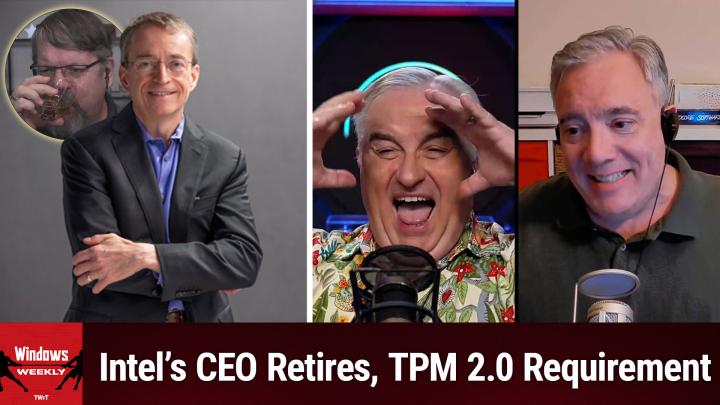
Windows Weekly (Audio)
WW 910: Intel Outside - Pat Gelsinger's exit, FTC investigation, Dia browser
02:44:28
Pat Gelsinger's exit, FTC investigation, Dia browser
Loading summary
Transcript874 lines
- [00:00]
Leo Laporte
It's time for Windows Weekly. Paul Thurad and Richard Campbell are here. What happened at intel and what does the future hold? We'll talk about that. No insider builds last week, but Patch Tuesday is going to be a big one. Paul explains. And then it's a trip down memory lane. Richard Campbell tells the story of doers, which involves Thomas Edison, the father of jfk, and more. All that coming up next on Windows Weekly. Podcasts you love from people you trust.
- [00:36]
Paul Thurrott
This is twit.
- [00:44]
Leo Laporte
This is Windows Weekly with Paul Thurat and Richard Campbell. Episode 910 recorded Wednesday, December 4, 2024. Intel outside. It's time for Windows Weekly, the show we cover the latest news from Microsoft. Episode one after 909, featuring Mr. Paul Thurot@therot.com. hello, Paulie.
- [01:07]
Paul Thurrott
Hello, Leo.
- [01:08]
Leo Laporte
Hello, Paul. And Richard Campbell from RunnersRadio.com. he's joining us from his home in Madeira park where it is a beautiful day on the lake.
- [01:18]
Richard Campbell
It's not true. It's foggy. It's very foggy. Oh. Barely even see the islands. Yeah.
- [01:23]
Leo Laporte
You know, there's a Vision Pro background that looks like that. Yeah, you should take it.
- [01:28]
Richard Campbell
They stole it from my place.
- [01:33]
Paul Thurrott
You've been sure lucked.
- [01:35]
Leo Laporte
It's too bad there's nothing really to talk about today, but it's been another quiet week. Something. Yeah, we'll find something. So, Paul, you want to kick us off with the top story? The intel blockbuster news.
- [01:48]
Paul Thurrott
Yeah. Apparently they announced new GPUs. Everyone's been looking forward to these and dear God, I'm just kidding, who cares? So what do I.
- [02:00]
Leo Laporte
Big news.
- [02:01]
Paul Thurrott
Yeah. Well, yeah, apparently on Sunday, the Intel board of directors gave Pat Gelsinger a no win situation. You could retire or we'll just fire you. So.
- [02:14]
Leo Laporte
Yeah, because he said he retired as of now. As of right now, which usually is a sign, Right.
- [02:20]
Richard Campbell
A real retirement has a replacement in place.
- [02:23]
Leo Laporte
You know, I have a cardboard box with all my things in it and I'm retiring.
- [02:28]
Paul Thurrott
Bye. Bye. Yeah, exactly.
- [02:30]
Leo Laporte
So this is actually, I think it is kind of sad because Gelsinger was brought in just a few years ago. He is a designer. He's been there. He was under Andy Grove back in the day, knows he's an engineer, knows Intel's business and charted, I think, the proper course, which is separating this and this is what Ben Thompson's been talking about all the time on strategy, this integrated business into Fab and Foundry.
- [02:52]
Paul Thurrott
Yeah.
- [02:53]
Leo Laporte
But I guess it wasn't moving fast enough for the.
- [02:55]
Richard Campbell
Well, I don't think he's the one capable of doing it. It's a disruptors play.
- [02:59]
Paul Thurrott
Right.
- [03:00]
Richard Campbell
And really there's only two outcomes here for intel now. She's one outcome. They get dismantled.
- [03:06]
Paul Thurrott
Yeah, I mean you get dismantled.
- [03:08]
Richard Campbell
Are you going to keep the name or not? That's it.
- [03:10]
Paul Thurrott
He seemed to think that, you know, intel was better together. Right? Yeah, but well that's the wonder. Yeah. I think we're going to learn more about this over time. I don't think we've seen the full story here yet. They did or there's been, I think Bloomberg, somebody reported that this transition was or this recovery was happening more slowly than hoped for. But yeah, I mean intel made some major strategic mistakes over the years that led to such things as, you know, Apple choosing ARM for its iPad, which that could have been an intel business.
- [03:48]
Leo Laporte
Incidentally, we talked about this yesterday on MacBreak. What a brilliant move it was for Apple to say hey we gotta find something besides Intel. The same thing they did with PowerPC in years past. There was an interview with the chairman or not interview, it was his autobiography, the chairman of TSMC who said we started this conversation in 2011 with Apple.
- [04:07]
Paul Thurrott
Yeah, no, I mean Intel. From my perspective on the Windows side of the fence, the big intel crime which has been ongoing for 20 years is ignoring repeated pleas from Microsoft mostly to create more efficient CPUs for computers to make these things at a time more device like yeah, they did. And that sort of proves my point. The low power chips they made are and were garbage. So that was the beginning of Apple's transition away from Intel. Intel compared to the Power PC consortium like the Motorola, IBM, whatever it was at the time, you know, was well done and the right move at the time. But then Apple saw that intel wasn't keeping up with where it wanted to go.
- [04:55]
Richard Campbell
Yeah, look, Microsoft has analysis on this that you needed the mobile market to justify the cost to modernize your fabs. Right. Yeah. To go to extreme. Intel, which is incredibly expensive, but they didn't really scale.
- [05:10]
Leo Laporte
Right, but scale fails.
- [05:12]
Richard Campbell
Yeah, they sell billions for that to make sense.
- [05:18]
Paul Thurrott
They tried to get it. They had wireless chipsets for a while. They had ARM chipsets by the way, for a while which I think XSCALE might was xcal ARM chipset or not? I don't remember. Maybe not. They tried different things but it was always kind of half hearted. They were always like look, more megahertz. The biggest innovation that they've had in the past decade most likely was their, you know, move from two to four Cores for the base core chipsets, you know, like. Which was nice because it didn't impact the battery life at all, but was not.
- [05:49]
Richard Campbell
They only went multi core back in 2000 because the P4 was such a disaster. Right. And it was the. The Israeli mobile chip set. Their version of the P3 was outrunning the P4 anyway.
- [06:00]
Paul Thurrott
Yeah, no, this is, you know, that's.
- [06:02]
Richard Campbell
Where Corduo came from.
- [06:04]
Paul Thurrott
Right. So the. Look, at least they had something to fall back on. They owned this little company in Israel. They had a good new architecture, it worked. They got lucky. But they got outmaneuvered by AMD with the move to 64 bits. Were embarrassed by and enraged by the fact that Microsoft adopted x64 and then they had to put it into their own chips, which didn't like to see that. But then the next 20 years happened. I mean they just haven't kept up and I.
- [06:34]
Leo Laporte
The irony is the board probably cares more about intel being kicked off the DAO than any of that.
- [06:39]
Paul Thurrott
Well, I mean it is you pretty.
- [06:41]
Richard Campbell
Gotta fire the guy who got you who kicked off the Dow.
- [06:43]
Leo Laporte
Yeah, that's like.
- [06:44]
Paul Thurrott
But he. Okay, Pat, but was he or was it not his predecessor or two. Right.
- [06:49]
Leo Laporte
That led to this. This is a few years ago.
- [06:52]
Paul Thurrott
He adopted a mess. Right. So maybe you guys will have a better example than I do. But the only thing I can think of that's like this where once proud big company failing in a big way and they bring in a fixer. Nokia with Stephen Elop and Yahoo with Marissa Meyer. And in both cases those did not go well. Yahoo was sold to Verizon. Could have probably succeeded as a smaller company, but didn't. And then Nokia. What happened to Nokia? Nothing. So no, I mean they're still around, but who cares? So look, this is what happens sometimes you get disrupted. But you know, the parallels between Microsoft and Intel are super strong. Microsoft had this other thing to turn to when what used to be their primary business started stagnating and then declining, which was in their case the cloud. And intel should have and could have made that transition as well and didn't. And they weren't there for mobile and they're not there for IOT. And remind me what else is? That's everything.
- [07:54]
Richard Campbell
AI made Ms. AI.
- [07:55]
Paul Thurrott
Well, which is data center slash. Yes. I mean so right now intel is still through inertia, the big fish in the smallest of platform ponds. There is the PC and that market's not going anywhere. It's just. Sorry.
- [08:12]
Richard Campbell
Their approach, which is the vertical indication approach, makes Sense, because they started it. They basically invented this business back in the 70s and 80s. But vertical integration only makes sense if you are continuously innovating.
- [08:26]
Paul Thurrott
Yeah.
- [08:26]
Richard Campbell
And the one thing you can say about intel is they've been innovating is.
- [08:29]
Leo Laporte
That what happens really is they got out, innovated. Is that really bottom line?
- [08:32]
Richard Campbell
Well, because they haven't innovated at all. Right. They really just keep on trying.
- [08:36]
Paul Thurrott
I just said four cores. How is that not so? I.
- [08:41]
Richard Campbell
No, just kidding. Yeah.
- [08:43]
Leo Laporte
You could argue they. The troubles go back. Titanium, right?
- [08:48]
Richard Campbell
Yep.
- [08:48]
Paul Thurrott
Yes.
- [08:48]
Leo Laporte
And they were saved by the little Israeli sk. Skunk works.
- [08:53]
Richard Campbell
Yeah. The beauty guys.
- [08:54]
Leo Laporte
The core guys.
- [08:55]
Paul Thurrott
Well, first they were. Yeah, they were forced by Microsoft essentially to adopt that Dave Cutler wrote his.
- [09:02]
Richard Campbell
Windows on Windows paper that basically said this is the way.
- [09:07]
Paul Thurrott
Yep.
- [09:07]
Richard Campbell
You know, and that was the end of that debate. You know, nobody argued.
- [09:10]
Paul Thurrott
That was my, my entry into this world. Well, one of my, one of my entries, I guess was in 1998. I went to what was then the NT 5.0 Beta 2 workshop in Seattle and I asked Yousef Mehdi, who was on stage setting up or whatever at the time before the show, before the event, you know, hey, where's Dave Kalter? And he was working on. He said 64 bit stuff. It was like 64 bit stuff. And at the time it was digital. What was the digital chip? Oh boy, I can't remember. Well, digital before they were acquired was where it had a 64 bit chip. It was one of a few that Microsoft was looking at attainable. I know. Is that the Alpha?
- [09:52]
Leo Laporte
Alpha, that's it.
- [09:54]
Paul Thurrott
Alpha, yes.
- [09:54]
Richard Campbell
Thank you. NT before Windows 2000, supported Intel Alpha.
- [10:02]
Paul Thurrott
Power PC and Power PC.
- [10:04]
Richard Campbell
Right. With the hardware.
- [10:05]
Paul Thurrott
Yeah. No, it was multi architecture. Even the software itself, the front end was multi architecture. We're supposed to have multiple personalities. Was a POSIX Environment, OS2 Environment, Windows Environment. And then by the time it kind of came out, they were like, well, you know, Windows. But yeah, it was always designed to be this thing, you know, this thing that was not what Windows was. And then it became Windows. But I don't know. I don't know what. There are too many missed opportunities here for intel and too many people, they.
- [10:38]
Richard Campbell
Got punished every time they tried to innovate. Right. Like the Itinium was a train wreck.
- [10:43]
Paul Thurrott
Yeah, but that was just a bad design.
- [10:46]
Richard Campbell
I mean, I'm with you, but you know, the other spin on this is every time we try and paint outside the x86 lines, we get spanked for it.
- [10:55]
Leo Laporte
Yeah, yeah.
- [10:56]
Paul Thurrott
Well, I mean One of the, you know, I'm going to get the story a little bit wrong, but at the time there was a Microsoft engineer who had gone to intel, they were working on the titanium stuff and they said, hey, how long do you think it will be before this will be small enough that we could put it inside a laptop? And they were like, oh, that's. It's never going to be that small.
- [11:14]
Richard Campbell
That's not a thing.
- [11:15]
Paul Thurrott
They were like, that will never happen.
- [11:16]
Richard Campbell
Why would you ever want 64 bits?
- [11:17]
Paul Thurrott
And then they're like, why are we working on this then? I don't understand. Like, that should be the point. Right. You know, the world at that time they could see was heading toward, you know, mobility. And that's really been the thing for Intel. I think it's been a lack of mobility or, you know, their inability.
- [11:31]
Leo Laporte
Companies failed over that. Right. That missed the switch to mobile and by missing that, really missed the next generation of computing.
- [11:42]
Richard Campbell
Yeah. But, yeah, this deeper point that Thompson made about how much it costs to switch to extreme ultraviolet and that unless you've got a billion chips to sell, it's just not worth it.
- [11:53]
Leo Laporte
That's what TSMC did. Right?
- [11:54]
Richard Campbell
And that's what TSMC got by winning that contract.
- [11:57]
Paul Thurrott
Right. But see, the big difference. Well, not the big. One of the many differences is that intel was going to blame Apple.
- [12:05]
Richard Campbell
No, they went for the best chip they could buy, right?
- [12:07]
Paul Thurrott
Yeah. No, they did the right thing. That's not the issue for intel, though. Packels and Japan, like Leo, I believe it was the right approach for the company, given the kind of cards he was handed. The one issue. I see that. One of the issues. I keep saying one issue. One of the issues I see is that intel would have been put in this position where they were partnering with their competitors for this thing to work, its competing chipmakers, designers would have to come to it to build their chips. That's not true of companies like tsmc. I mean, I guess it's technically true of Samsung, but that's an awkward position. Like, to be like, hey, md. Hey, buddy, how would you like to give us your designs? And we could, you know, put them. We can make them for you. You're like, oh, I don't know. I don't. That doesn't sound safe. Like, you know, like, oh, no, this is a Chinese wall. I mean, it's just maybe those need to be separate companies. Right. And when you look at intel as it is today and you split it into those two obvious halves, it's pretty obvious which has the Bigger potential. It's the foundry business, assuming they can get it right. And that's the company that, you know, the part of the company that got the chips, you know, award and is the future of this thing. So there's a lot of talk now about getting the platform right, meaning x86. But that's a small thing. I mean, fundamentally, it's the bigger thing is the Foundry. And I man so much investment, so much money, and I don't know that they're ever going to get there.
- [13:36]
Richard Campbell
No. And so then the question is, you got to. You're going to cut up the business. The question is, are you going to do this, you know, in 1980s junk bond style where literally just going to sell it off for parts or are you going to create. Is there some piece that's going to hang onto the name? Is the name valuable still?
- [13:53]
Paul Thurrott
Yeah. And what you're describing is not a technical discussion or issue, and it's why.
- [13:58]
Richard Campbell
You have the wrong CEO.
- [13:59]
Paul Thurrott
It's just business.
- [14:00]
Richard Campbell
You know, a professional corporate finance CEO needs to take charge and make serious financial decisions. I always, you know, assets that are left.
- [14:09]
Paul Thurrott
I. I'm in this business or this industry because I care about technology. I care about the hardware and the software and the. All that stuff. Right. But because, I mean, I've been around for a long time. You have to deal with the company side of it, the business. I report on earnings every quarter for multiple companies. And I can tell you just like kind of anecdotally, from my own perspective, you don't hear a lot from the board of directors unless something has gone horribly wrong.
- [14:32]
Richard Campbell
Yeah.
- [14:32]
Paul Thurrott
Those guys are like a shadow society. Right? Like, in other words, they're like the star chamber in the background. Yeah. No, but I mean, for them to come out publicly, for you to actually get quotes from chair people.
- [14:42]
Richard Campbell
Yeah.
- [14:43]
Paul Thurrott
Oh, you. This. Something has hit the iceberg. Like, it is just Leo is supposed.
- [14:48]
Richard Campbell
To be the representative of the company. The board is supposed to hold their feet to the fire, and when something's gone wrong, is the only time you're.
- [14:54]
Paul Thurrott
Going to hear from them. Yeah, exactly. So that's very interesting. It's sad.
- [15:00]
Richard Campbell
Although it can go either way. I've also been in a situation where it's like the board is backing the CEO on this move. We know it is, you know, controversial, but we're with him.
- [15:10]
Paul Thurrott
Yeah, yeah.
- [15:13]
Leo Laporte
Is Gel Singer's replacement going to be able to save Intel?
- [15:19]
Richard Campbell
Well, there isn't one right now.
- [15:20]
Leo Laporte
Hold on.
- [15:20]
Paul Thurrott
We got Marissa on the line. What do you think?
- [15:23]
Leo Laporte
Marissa could you find somebody that could. I mean, it seems like this is a done deal.
- [15:29]
Paul Thurrott
Yeah, I know.
- [15:30]
Richard Campbell
Well, what do you mean by save?
- [15:33]
Paul Thurrott
Right, right.
- [15:34]
Leo Laporte
So I'm thinking about General Electric as an example, which was one of the biggest and best companies in the United States in the recession. It started to collapse. They brought in Jeff, what was his name, but he, what he did is sold everything off. GE is now called GE Aerospace, by the way. They sold off most of the divisions, maintained. Just the aerospace division.
- [16:03]
Paul Thurrott
Yep.
- [16:04]
Leo Laporte
And it's a, you know, it's a shell of its former self, but it survived and it's. And actually I think it's doing very well.
- [16:10]
Paul Thurrott
So well.
- [16:12]
Richard Campbell
And there are other divisions. Right. Like I worked with ges, with a team at GE that did steam turbines. Right?
- [16:18]
Leo Laporte
Yeah. They did locomotives, they did light bulbs. I mean they were in. It was when Intel.
- [16:23]
Richard Campbell
Intel could have been a ge. Right. They had a good SSD group, they had a good NUC group. They had sold it all off.
- [16:30]
Leo Laporte
Yeah, right.
- [16:30]
Richard Campbell
Because all of those things are low margin business or killed them. Right? Yeah. Well, that's. The whole thing is as soon as you turn it into a commercial product, then it's about the lowest price. And they've never been good at that. Their product is a high margin product, the cpu.
- [16:48]
Paul Thurrott
Intel made two big moves this year that I think previewed this situation. The first was pulling Foundry out and operating it as if it were a separate business. They would report those financials separately from the rest of Intel. That business lost several to tens of billions of dollars a quarter, by the way. But they. Okay, but the other one was just. I don't even know how to say this. I. The other one was basically Pat Gellinger saying, look, for this thing to make sense as I see it, these two things have to stay intact. And I actually think that the future of this is what we saw when Qualcomm tried to acquire them. And it was like, no, no, no, no, no, we don't want that. And I think for the money focused people on the board, it was like, well, hold on a second. Yeah, actually, you know, whatever. Oh, I'm sorry. But the bigger of the two was actually when they wrote down all of the kind of like, I forget what they. It's like real estate associated cost or just asset associated cost of all of their physical assets. So in other words, they have all these fabrications. There's a huge cost of trying to upgrade these things or build new ones. But they also are sitting there not doing anything or not doing very much. And they're losing value.
- [18:10]
Richard Campbell
Underutilized.
- [18:11]
Paul Thurrott
Yeah. So they wrote that stuff down in the quarter, which was one of the reasons why it looks so bad. But he did that in a very transparent and I thought responsible way. But I think it also sets it up for the future where if they do have to divest, whomever is part of the company doesn't get the debt.
- [18:28]
Richard Campbell
All the ingredients in place for the dismantling of the company.
- [18:32]
Paul Thurrott
Right. They did the x86 foundation or whatever with AMD and others.
- [18:37]
Richard Campbell
AMD? Yeah.
- [18:38]
Paul Thurrott
You know, the whole time it's like, no, no, no, we're not breaking up, we're not breaking up, we're not breaking up. While taking concrete steps to make that breakup more viable.
- [18:50]
Richard Campbell
The only future I see for the name intel is like ARM. It's the owner of the licensing of the X86.
- [18:57]
Paul Thurrott
So if you were to walk into a Walmart, I don't know, maybe not in the United States, but somewhere in the world you would find a Polaroid DVD player. Polaroid does not exist really as a company, but it is a brand that has some remote value. And I'm sure they're sticking that name on little Insta cameras now too because what the heck, that's what they're known for. But I hope it's not that sad.
- [19:22]
Richard Campbell
But Polaroid is what, you know is to cameras what intel is to processors. Right. They had the digital camera before everyone else, but it was going to eat into their film business. So they just. Kodak.
- [19:34]
Paul Thurrott
Kodak had Kodak. Yeah. Kodak was very late to the game with digital photography for this reason.
- [19:38]
Leo Laporte
No, Kodak was first to the game. That's the irony of. Kodak knew it, they saw it coming, but the business model didn't work.
- [19:45]
Richard Campbell
They had innovators dilemma.
- [19:47]
Leo Laporte
The innovator's dilemma. They made so much money in film and processing that digital just couldn't support them. But Kodak bought O Photo. They had one of the first digital cameras. They were early to digital. It didn't save the company. But that's. I think that's very different from what happened at Intel.
- [20:04]
Paul Thurrott
Intel made too many bad choices. I.
- [20:06]
Leo Laporte
This is the Gelsinger. According to Thompson Gelsinger, when he, the board was going to hire him, said, look, if, if you want to, you know, split it up, you should get a different guy. I'm not your guy. Yeah, what I want to do. And he gave, laid out the strategy that we just talked about. Having a design ARM and a fab arm, but keep it all under the Same roof. The board, he says 100% supported it.
- [20:31]
Paul Thurrott
I bet that. And I'm sure they work. That's all I'm sure they.
- [20:34]
Richard Campbell
The numbers come in and then it's like.
- [20:35]
Paul Thurrott
And then three years go by and it's like, well, this isn't working.
- [20:38]
Richard Campbell
We haven't done anything.
- [20:39]
Paul Thurrott
Y. Yeah, they haven't. They talk a lot about hitting milestones, but I don't really see them hitting a lot of milestones as far as these new process technologies and so forth.
- [20:50]
Richard Campbell
I think you're setting up for an activist board and for a financial CEO that's going to make some unpleasant choices.
- [20:57]
Leo Laporte
Now you get the PE guy. Now you get the guy who's going to split it up.
- [21:00]
Richard Campbell
Yeah, yeah.
- [21:01]
Leo Laporte
It's going to be a chainsaw. Al Dunlop in there.
- [21:04]
Richard Campbell
Yeah, right.
- [21:07]
Paul Thurrott
Hey look, it's still firewood, right? I mean, come on, it's worth something.
- [21:11]
Richard Campbell
But the point here is the longer you go, the less that brand is worth something too.
- [21:15]
Leo Laporte
Right. So all the more. Didn't we have the story it was a few months ago that Qualcomm was looking at buying Intel. Last week they said, yeah, they were.
- [21:23]
Paul Thurrott
Like, yeah, just kidding. No, we don't want a lot of companies, but by the way, this may smooth that to happen again. In other words, these smaller or these parts of the company which are by themselves smaller and more edible or whatever may make more sense for another company. Right. I mean the foundry business by itself may make more sense for some smaller company.
- [21:46]
Leo Laporte
Well, I remember when IBM was going through similar struggles, Dvorak, I said, oh, this is over. IBM is gone. Dvorak always said, no, no, the patents they own are worth. And I'm sure this is true for intel to make them worth something no matter what. Even if all the fabs. And by the way, they just got more than $8 billion from the Chips Act.
- [22:07]
Paul Thurrott
Yeah, well, this was a good investment. But listen, that part of the company might be too big to fail. That part of the company might become maybe it's. Chrysler was in the 1980s. Right.
- [22:20]
Leo Laporte
All they do is build.
- [22:21]
Paul Thurrott
Yeah, the 811 if you include the military part. Well, actually it's a huge number and it's almost eight plus three. Well, the seven point whatever is to build fabs in the United States. Yes. And build and improve existing fabs. But they also got a military contract. Right. Which might actually be partially or mostly even about chip design. They would want those things to be built in the United States as well. But actually that one might benefit intel proper if you Will.
- [22:54]
Leo Laporte
So point being, intel has assets. Intel is not going to dissolve into the ether. There's something there.
- [23:01]
Richard Campbell
Yeah. And they might be under different names.
- [23:04]
Leo Laporte
Right. That's what happened with ge. They have an aerospace division, they have a health division, which is not division anymore. There's three separate companies.
- [23:11]
Richard Campbell
Yeah, yeah. Which is also like good for reporting and good for a bunch of other things. Like this is the thing is, I think a leadership finance guy has to come in and reorganize the company into the 21st century.
- [23:24]
Paul Thurrott
And by the way, so in a PC market in which there are, I don't know, I'm going to call it 250, maybe 300 million at most, units sold in a year and intel outsells AMD by what, 5 to 1 or something like that. If you look at the part of AMD that is their PC business, which is for a long time has been the biggest part of the company. But now they're making this push into cloud computing. And by the way, AMD has their eye off the ball in x86 right now because of that. You have a company that is not intel sized, right? Not as we know it, but still a reasonably sized company with a, with a reasonable future, et cetera, et cetera. So maybe once you pull that part of it out, that thing could exist on its own. But it's impossible not to believe that the biggest opportunity here is the foundry, because if it works, it could serve.
- [24:15]
Richard Campbell
So generally they're dated foundries and they're not used particularly efficiency. One of the problems with vertical integration is that you can tie up a foundry with bad design for quite a while, but if your foundries cares about making its own money, it just won't put you in the pipeline until you have a design that works. So integration works against you in that scenario.
- [24:34]
Paul Thurrott
Yep, yeah, it's. This is, there's a lot of unknowns here. I, the timing of this is rather incredible. It's not clear why they would do this right now.
- [24:46]
Richard Campbell
The part of this is the money they got from the chip stack they don't actually have because they haven't delivered on what they said they were going to do. Right. Like, and all of that puts more pressure on them as well. The board's like, we, you've gone to this length to get this stuff now, right? You're not making your, you're not making your, your milestones, you're not going to get the money.
- [25:04]
Paul Thurrott
Well, okay, I, my understanding is that it was awarded like that. That was the announcement, the seventh point When.
- [25:10]
Richard Campbell
But they, yeah, the awarding means you are now in a set of tranches based on milestones. We don't just write you a check for 8 billion bucks. It's like, okay, how much are you going to need to make this step? Okay, we'll give you that for this step. When that step's done, then it's the next step. Right?
- [25:24]
Leo Laporte
It's.
- [25:24]
Richard Campbell
It's tranche based.
- [25:26]
Paul Thurrott
Yeah. Okay, well, they're screwed then because they're.
- [25:33]
Leo Laporte
Never going to make.
- [25:33]
Paul Thurrott
No, they're never going to hit those milestones. They're not going to hit those milestones. There's been no indication whatsoever of them making any meaningful progress, unfortunately. And not that's. I'm not trying to be unfair to Intel. It's difficult. And they were starting from very far behind. And by the way, TSMC didn't hit pause button and say, we'll just wait till you catch up. I mean, they're already talking about more efficient 2 nanometer processes at a time. When intel is. What are intel chips now? 7, 10 nm. Somewhere in there somewhere, depending on the chip. But, you know, I don't know, they.
- [26:03]
Richard Campbell
Pushed push duv as far as I go. They need to go to extreme ultraviolet and those are expensive processes that need training on. And it makes sense to do that in the US if you're going to go commit to all of that, commit to it on a new site instead of an old site. But it also makes sense to carve that off into an entity that has to live on its own. And so it gets a lot more efficient.
- [26:22]
Paul Thurrott
Yeah, I agree. I mean, this was always the. I mean, I always have to compare this to Microsoft and they were going to be broken up by the government. Remember there's the App Office side and the Windows side. And what would that look like? And a lot of people would see doom and gloom in that. But a lot of people also see the opportunity. It's like, well, hold on a second now the Office team can work with these other platforms and maybe the world changes now because Office and Windows don't have that lock on each other. You know, that could be true of the Foundry, I guess. I mean, we'll see. But I feel like the market's spoken on this.
- [26:59]
Leo Laporte
Like, I feel like, can we call the days of Wind tell history. Is it over? It's so interesting to see the ads that Microsoft's putting on. All the big football games are ads for Qualcomm based. They say that Snapdragon, they say the fastest computers ever made things like that it's pretty clear despite the flaws of Windows Unarm, that that's where Microsoft sees its future.
- [27:25]
Richard Campbell
Sure.
- [27:25]
Paul Thurrott
I'm going to disagree with no flaws. So I. Look, you could argue that Windows and ARM needs that marketing, that the safe choice is to buy this thing that sounds like a jet engine and has 4 hours of battery life, but at least it's compatible with that stupid game you have to play.
- [27:43]
Richard Campbell
But which is why your batteries running down that fast.
- [27:47]
Paul Thurrott
Yeah, I mean, so this kind of shift requires some marketing. But on the other hand, I have.
- [27:54]
Leo Laporte
To point out though, if you're setting up a server or even a gaming desktop, you're almost always going to look at AMD first. Right? Not Intel. Right.
- [28:02]
Paul Thurrott
Well, so I depend on whether you're.
- [28:03]
Richard Campbell
A Ryzen guy or you're an RTX guy. Right?
- [28:05]
Leo Laporte
Okay, that's true.
- [28:06]
Richard Campbell
Part of the debate.
- [28:07]
Leo Laporte
And actually somebody in the. One of the.
- [28:09]
Paul Thurrott
Or an Intel Arc B series guy now because that's happened, somebody in the.
- [28:16]
Leo Laporte
I think the YouTube chat was saying, well, if Intel's so crappy, how come they beat their technology? Whatever it was, ESS beats fsr. Now, I don't know what any of that means, but I think it's a gaming thing.
- [28:28]
Paul Thurrott
No, that's ridiculous. So look, this story will be written, but parts of it already have been written. So one of the things I've been.
- [28:39]
Leo Laporte
Working on, X is so much better than fsr, says Steven Anderson.
- [28:44]
Paul Thurrott
That's fantastic. So anyway, yeah, and the Amiga is still the best gaming PC. I get it.
- [28:49]
Richard Campbell
It's true.
- [28:50]
Paul Thurrott
Yeah, it is true. Multi processing in the 1980s would have thought of it.
- [28:53]
Leo Laporte
Incredible.
- [28:55]
Paul Thurrott
Look, Intel, a big part of their story is that they were big enough that they could just pay companies to keep using their stuff and not to use competitors stuff. And there's a big amount of inertia still occurring. And by the way, so just this year we told the story about the Qualcomm launch thing in May back at Build and how intel had to be ushered off of the campus. Remember they showed up after being disinvited, they took away their badges and said you have to leave or we're calling security. Yep, that is so cool. Intel has done everything they can to get in the way of Qualcomm and AMD actually. But Qualcomm, since we're talking about it, they pre announced Lunar Lake that week because of this, so don't forget. Oh and by the way, Intel, I mean Qualcomm, I'm so proud that they're on like 20 something different computers. Well, we're going to be on 100 and something different computers when LULE comes out later this year. And then they've spent all this time since then overspending on this garbage chip set that's super unreliable, the performance is terrible, doesn't match what AMD is doing. And stood up at IFA like they were the kings of the world and that whole thing came crumbling down. It's a nightmare. This is how bad Lunar Lake is. Meteor Lake suddenly looks pretty reliable by comparison. It's pretty good, you know, and that thing was a piece of crap. So this is a problem. And yeah, if you look if x64 is it for you and you're never going to think about ARM, okay, congratulations. I would say at least that the AMD Zen 5 stuff is fantastic. So that is there. It's a happy middle ground.
- [30:37]
Richard Campbell
And I build a Copilot plus PC with it.
- [30:40]
Paul Thurrott
Yes, you can.
- [30:41]
Leo Laporte
You can. Really? It doesn't have to be Snapdragon.
- [30:44]
Paul Thurrott
No, no, no, no. That's all changing. In fact, I've already gotten the first screenshot from someone and this Guy did have AMD, but like we'll say an X64 base copilot plus PC where it's like, hey, congratulations, you get those features now. So that's actually starting to happen.
- [30:59]
Leo Laporte
Right, interesting.
- [31:00]
Paul Thurrott
So that's, you know, this, it's a slow boil, but it's happening. You know, Microsoft is, I don't them advertising copilot plus PCs right now. I get it. But on the other hand, the people you need to convince aren't going to care about a Super bowl or football ad or whatever because they're the 2/3 to 3/4 of your customers that are businesses that immediately dismiss ARM because it doesn't work with the one thing that maybe they care about or the just general fear and uncertainty and doubt over a new platform. And we don't, you know, we're gonna make sure we always give our employees like an inch and a quarter thick Dell laptop with a removable CD ROM drive or whatever because, you know, we've been doing that since the 1990s and they seem to work fine and so convincing those guys, that's the trick. Yeah, I think so. We'll see. I don't, I don't know. I don't know. I don't know what to say there. I think for most the people we're going to talk about this in my tip, actually the people listening to the show by and large are technical and they're you know, they're very set in their ways, you know, so you. It amuses me but also distresses me that we collectively as a community have spent the last, I don't know, 10 years or more ringing our hands over arm and how come we don't have ARM and how come we don't have arm? And then it finally happens. They're like, oh, well, it doesn't run like this DOS game from 1997. I have to run. I have this really esoteric serial adapter hardware thing I do. Or I'm a musician and I need this exact. It's like, guys, come on, you don't represent the mainstream. I think for my wife, Leo's wife, or anyone's wife, or my brother who's just a normal person, these things are categorically better. They just are. This platform is categorically better, but it does. Yeah. Even though the support this year has been incredible, hardware, drivers and software natively, it's still.
- [32:56]
Richard Campbell
Yeah, I'm not going to play transport tycoon from 1988. I'm not going.
- [33:02]
Paul Thurrott
I hear you. For me. Yeah. For me it's like half life too. But yeah, same thing. I mean.
- [33:07]
Leo Laporte
All right, let's take a little break. We're going to. We have. This is called Windows Weekly, so. Not Intel Weekly, so.
- [33:13]
Paul Thurrott
Well, no, but this is. Intel is inextricably entwined. Intel is outside now, isn't it?
- [33:20]
Leo Laporte
It's such an interesting story.
- [33:22]
Paul Thurrott
This next year is going to be crazy. I don't. I'm willing to.
- [33:24]
Richard Campbell
Because this year.
- [33:27]
Paul Thurrott
Well, I mean, in this, in this, we'll see what happens. I. Yeah, I don't know. We'll see what happens.
- [33:32]
Leo Laporte
We'll see what happens. Windows. Coming up on Windows Weekly with Paul Thurot and Richard Campbell. Our show today brought to you by the good folks at 1Password now, you know, 1Password, as the password manager, did you know they acquired Collide, one of our longtime sponsors and together now they've created something very exciting called 1Password Extended Access Management. And why do you need this? Well, I can answer that question with a question. Do your end users always work on company owned devices on the lap that nice thick Dell that you provide them with a CD ROM or the phone, the BlackBerry you've given them, do they always work with those devices and IT approved apps? They were put their own stuff on there. Of course. Of course they do. With this is. We live in the era of byod, right. So how do you keep your company's data safe when it's Sitting on all those unmanaged apps and devices. That's why you need extended Access Management from 1Password 1Password Extended Access Management helps you secure every sign in for every app on every device. It literally solves problems traditional IAM and MDM just don't even address because IAM and MBM think of your company's security as like the quad of a college campus. Nice brick paths, beautiful green lawn, the buildings ivy covered in brick. The paths lead from building to building. Those are the company owned devices in the IT approved apps and the managed employee identities. And then as on every college campus, there's the little muddy paths that they're actually the shortcuts worn through the grass. The actual straightest line from building A to building B. Cause people are people, right? They're always gonna do that. They're always gonna bring in their own devices, they're gonna use shadow IT apps, they're gonna, they're gonna always be non employee identities on your network. I mean contractors was a, there was a big breach. I remember some time ago where the hacker used the H VAC guys access the contractor's access to get into the network and then travel laterally through the network. And see, that's because most security tools only work on those happy little brick paths. But the security problems take place in the real world where those muddy shortcuts live. 1Password Extended Access Management is the first security solution that lives in the real world. It brings all those unmanaged devices, all those apps, all those identities under your control. It ensures every credential is strong and protected. Every device is known and healthy, every app is visible. It's security for the way we really literally do work today. Now the good news is it's generally available to companies that use either Octra or Microsoft Entra as their authentication technology. It's in beta right now for Google Workspace customers. So if you're Okta Entra or Workspace, this is for you. Check it out@1Password.com Windows Weekly that's the number. 1p a s s w o r d.com Windows Weekly Security for the way we really work today. 1Password.com Windows Weekly we thank him for supporting the show and you support us by going there. That way they know you saw it here. Make sure you do the full thing. 1Password.com Windows Weekly back to the show. Paul Thurat. It was, I guess everybody went home for Thanksgiving at Microsoft. Yes. Oh, you're muted.
- [37:18]
Paul Thurrott
I realized halfway through the ad. There I was typing away with it though, muting Myself. Okay.
- [37:22]
Leo Laporte
We enjoyed it. It was fun, actually. Using modern hacking techniques. I could tell you were writing a letter.
- [37:28]
Paul Thurrott
You could actually tell what I was writing. Nice. No, nice. Those are some. Those are some highly trained ears. Yeah.
- [37:36]
Leo Laporte
What was I watching? Oh, there was a movie called the Conclave where it's the. It's the Papal Conclave where they're electing a new pope and they. They have the security guys blacking out the windows of the Sistine Chapel. They said, yeah, because hackers now can use lasers to tell what you're saying inside. It's true. By the vibrations on the glass. It's. I mean, that. That made it into a movie is hysterical to me. I guess it's a real deal. Anyway. Go ahead. Sorry, I didn't know. I don't know what you were typing. I have no lasers. It's.
- [38:09]
Paul Thurrott
I was. I was in the discord.
- [38:12]
Richard Campbell
Neo Laporte. Now. Laser free.
- [38:13]
Leo Laporte
Laser free. Windows. What's the Windows news?
- [38:17]
Paul Thurrott
Last week, we didn't really have anything going on with the Windows Insider program. Thank God. It was a nice week off. And then this week, rather just today, there was a new Canary build which only has one kind of new feature, which is that. I didn't know this wasn't the case, but Microsoft has loosened the rules of the Microsoft Store inside of Windows so much that you can pretty much deploy anything through it. But I guess if you had a Win32 desktop app, the updating would just happen. However, you updated that app, like, outside of the store. But now they're supporting Win32 app updating through the Store, which is actually, you know, is probably the best and most efficient way to do this. So that's something that will be happening, you know, out in public sometime in the future, separately from this, Microsoft had a post. Not about anything new with the store that just happened, but rather all of the changes they've made to the store this past year. And I have to be honest, this thing, when it started as a store in Windows 8, as the windows Store, was pretty sad, right? It was a great collection of farting apps and also apps written by what appeared to be children. But as far as high quality, that.
- [39:37]
Richard Campbell
Stretched from 2011 to 2012, between the beta and the final. Like, everybody at Microsoft was whipping everybody they could find to put apps in the store.
- [39:47]
Paul Thurrott
People forget this, but at the. I want to say it was the consumer preview, which, you know, we would call a beta or something like that. Maybe it was the least preview. I don't remember. But sometime that year before Windows 8 came out, they had an event where they highlighted all the new apps that were in the store, and they were all written literally by interns. And they were sort of bragging about, like, it's so easy, even our interns can do this. And it was like, guys, you're not selling it. You know, I mean, if you could have had like, I don't know, Spotify, Netflix, Instagram, you know, that would offer.
- [40:18]
Richard Campbell
Was Win JS apps.
- [40:19]
Paul Thurrott
Right.
- [40:20]
Richard Campbell
Like, that's what you were supposed to write.
- [40:21]
Paul Thurrott
So.
- [40:22]
Richard Campbell
Yeah, well, yeah, you know, the regular Windows developers going, I don't know what that is. And the JavaScript people are like, I don't know what that is either. So.
- [40:30]
Paul Thurrott
Yeah, right, right. I appreciate what they were trying to do. They were opening this new app platform to as many developers as possible.
- [40:38]
Richard Campbell
Yeah, well, really, they believed that JavaScript was the lingua franca and it was the only language that mattered. And that's what they were pushing on in 2011. And by 2011, I mean, you.
- [40:47]
Paul Thurrott
You look at the annual Stack overflow survey of most popular programs, you're like, I guess we got to target JavaScript, you know, and it's like, well, yeah, but those guys aren't targeting your stupid native app platform. They're writing things that run everywhere. Right. Which was the problem with that thing. So they, you know, they try. It's very similar to the intel story. We just talked about that, you know, Terry Meyerson and that team kind of picked the spa up and ran with it, and they were given the, you know, the cards they were dealt and they tried to do what they could to improve that over time. Also didn't work too well. But, you know, here we are. So it's many years or 12 years later. Right. And actually the Microsoft Store in Windows is in pretty good shape. If you haven't looked at it recently, strongly recommend it. One thing I do is because I review so many laptops, I have this install script for winget that installs from the store or the. The winget repository, depending on the app. But I always try to get the store version because of this quality where they, you know, they keep the apps updated and all this stuff. You don't have to have these separate routines running, mostly about controls. Yeah, it's actually pretty nice. So if you, you know, correctly sort of DISMISS this thing 10, 12 years ago, I would just say, you know, maybe take a look at it again. It's gotten.
- [41:58]
Richard Campbell
But you're also pressing against a struggle that's happening inside of Microsoft about updates between Consumer machines and enterprise machines too, because they've, they've made too many flavors of things. Right. Windows Update servers. Now they're trying to, they've deprecated that. They're trying to go with the business services through Azure. Like it's a, it's a big wrestling match. And the store push is interesting. The question is, are they going after the enterprise market and going to complicate that as well, or is it just for consumers?
- [42:27]
Paul Thurrott
Yep. So I would argue that the existence of winget for that, you know, can handle the store as a repository, suggests an interesting future for businesses where this more reliable mechanism occurs in the background and, you know, maybe can and should be used. I. Microsoft has done something in Windows that both Apple and Google have done with their respective mobile platforms, which is, I don't want to call it componentizing, but kind of moving things out of the core operating system and putting them into a different upgrade path. Usually the store, but not always. Right. So they have these things, you know, this is how you update these core OS components outside of the every year feature update kind of a thing. Right. It's, you know, the Project Reunion Windows app, SDK dismantling of UWP was a version of that where it doesn't make Sense to have APIs tied to a very specific version of Windows because now there are like six of them out in the world at any given time and you can't guarantee that those features are going to work everywhere, et cetera, et cetera.
- [43:31]
Richard Campbell
Don't deploy SDKs with infrastructure. It's missing.
- [43:35]
Paul Thurrott
Yeah, right, Right. So that was, you know, all of the big three companies that make client platforms all arrived at the same decision, which was let's pull stuff out that we can and update that stuff outside.
- [43:49]
Richard Campbell
By the way, the Linux people had this nailed forever ago. Core is core. Everything else is extra.
- [43:57]
Paul Thurrott
Yep. Yeah. I mean, look, Microsoft was basically playschool compared to Unix or whatever back in the day. So they, you know, we came from different back, you know, histories. But I think I'm trying to think if there's any exceptions, the big exception I can think of that's sort of an Inbox app is Edge, which like Chrome because it's based on Chromium and like other web browsers, has its own kind of updating mechanism. Right. For some reason that one app is. Well, not for some reason, it's cross platform. Right. So they don't update that one through the store. And they also have this notion of like OS components or even the AI components that are part of Copilot plus PC that are updated in different places, sometimes through Windows Update, sometimes not. You know, I don't know. So it's a complicated little world we live in. But anyway, the store app looks like it's kind of a big goofy consumer looking thing, but like I said, if you haven't looked at it, I mean, honestly, it's.
- [44:53]
Richard Campbell
Well, and it speaks to an interesting path because it's another attack on potential exploit vectors too. You could be locking your network down where the only way your machine gets updates is through the store. And that means that most malware is just not going to be able to do stuff.
- [45:06]
Paul Thurrott
Yeah, there you go.
- [45:08]
Richard Campbell
There's some angles on this, right, that can help people in the future, but I just don't feel like there's been a coordinated message says, hey, we're trying to solve these big problems. And so these tools are going to be focused on.
- [45:22]
Paul Thurrott
So this is tight.
- [45:23]
Richard Campbell
It seems like they just do this under. Like they're fighting amongst themselves to achieve this without telling anybody. That's what they're trying to find, trying to solve.
- [45:30]
Paul Thurrott
Right. Last week, and we'll talk about this again in a few minutes, I talked about the two sides of Windows. Right. There's that foundational part, the back end stuff that started with NT and was server for a while and was pulled back into the client group under Steven Snosky and is now part of Azure. And then there's that clown card that does all the stupid new features they throw at the wall and you never know what you're going to get and it's a nightmare.
- [45:54]
Richard Campbell
Lost in search boxes.
- [45:56]
Paul Thurrott
Yep. So pilot icon here.
- [45:59]
Richard Campbell
No, here.
- [46:00]
Paul Thurrott
No, here please. I know at 178 screenshots later, I think we're going to change it again. So. Yeah, so my last year has been great, but yes, because of Microsoft's security push, now they're starting to kind of talk about that back end stuff a little bit more. I think one of the untold stories of 24H2, which gets undermined by all the reliability problems we've experienced, is that they actually changed the foundation of the OS pretty significantly. If you look at it just from the back end, this thing's Windows 12. Like this is a new thing. It's a weird way to do it. Yeah, it's very strange, the fact.
- [46:38]
Richard Campbell
And it's also experimental. This would be the first time they've done this.
- [46:42]
Paul Thurrott
Yeah. Usually a change like this is accompanied by a big UI change. And this time they did the UI first. Yeah, yeah. So I think that's kind of interesting. We'll see what the next year brings, as we keep saying. But patch Tuesday is next week. One might make an argument that the update we get next week, next Tuesday will be the 24H2 that Microsoft was trying to hit for the bunch of.
- [47:13]
Richard Campbell
People'S Christmas is going to suck.
- [47:15]
Paul Thurrott
Yes. Yes. Yeah. The timing's tough because Microsoft typically is gone for the second half of the month. So they ship this thing on the 10th, and hopefully it isn't accompanied by all the problems we've seen over the past few updates, because it's been pretty ugly ever since 24H2 was finalized. So we'll see.
- [47:36]
Richard Campbell
But no, it's an. It's a service pack. 0os in disguise. Right. Like, that's what's really happening here. And we're having SP0 effects.
- [47:46]
Paul Thurrott
Yep. Yeah, somebody. So we'll talk about this in a moment again, but I had written this thing today about this duality, this kind of weird paradox of the Windows team, or teams, I guess, Windows as a product. And someone said, you know, you keep talking about how great the foundational stuff is, but we have had all these reliability problems. How do you know it wasn't caused by that? And it's the nature of the problems, frankly, because it's always these stupid changes. Like, you know, it's not a foundational issue in Windows 11 that when I open a menu in File Explorer that it goes up instead of down and goes off the edge of the screen and I can't see it. That's a problem in File Explorer. More specifically, it's a problem in the File Explorer ui, which for some reason Microsoft has been screwing with constantly for the past two years. So it's the clown car, it's not the adults. We could go through each one of the problems and kind of come to a similar conclusion, but that's why. So I do think it's rather incredible. We'll see. Fingers crossed and all that. But so far, despite all these big changes under the covers, it seems like, you know, it comes up, looks the same, works the same, but, you know, updates actually will happen much more quickly in the future, which is fantastic.
- [49:00]
Richard Campbell
That means they're many, many versions.
- [49:03]
Paul Thurrott
You know, that's always the thing.
- [49:04]
Richard Campbell
No reboot. No reboot.
- [49:05]
Paul Thurrott
Yeah. So anyway, it should be quiet for the rest of December, barring any reliability problems. We'll see. I'm kind of hoping that that issue I mentioned with File Explorer is actually fixed next Tuesday, but that might be a January problem. I don't know, we'll see. So there's that. Microsoft, because Windows 10 is going out of support next October unless you pay for extended support.
- [49:32]
Richard Campbell
Or they change their minds again.
- [49:33]
Paul Thurrott
Or they change their minds again. Yeah, published an article about TPM 2.0 being a system requirement of Windows 11, which is kind of weird because Windows 11 came out like three years ago. Why are we still talking about this? Right. So I looked this up.
- [49:47]
Richard Campbell
They tried to make it a requirement when they put 11 and got so much pushback that they did the requirement.
- [49:53]
Paul Thurrott
So here's what I found, reading my own stuff, and I had forgotten about this, which was in 2015, Microsoft revealed the system requirements for Windows 10. Right. And at the time, what they said was TPM 1.2 or 2.0 optional, but one year after the system RTMS, we're going to make TPM 2.0 a requirement.
- [50:20]
Leo Laporte
Right.
- [50:21]
Paul Thurrott
So they actually said that in 2015. So this was six years right before they actually did it in Windows 11. But you might notice that they never actually did make it a requirement. They never discussed this. I never found any instance of them saying, okay, this is what's going to happen. There was a lot of stuff with Windows 10 where they said something like, we're going to make Windows 10 a free upgrade for Windows 7 and 8. If you have a product key, you'll be able to use that from a previous version of Windows. It will activate, you'll be fine. You can do a clean install of Windows 10, but that's going to work for one year and then two years and five years and seven years went by and they never put a lock on that. They eventually did, by the way, but that just happened, I think last year. But for a long, long time. They just, they said something and then they didn't do it, you know, And I think the rationale there, because they'll never say this, is that they really wanted to get people off Windows 7 because no one was using Windows 8. And those who were hated it. And they wanted to make Windows 10 as viable for everyone as possible. So they didn't change the system requirements. They talked about it. They knew this was the right thing to do. TPM2 has actually been around since 2014, by the way. It's not a new thing. Yep. The famous thing or infamous thing about Windows 11 and the system requirements, remember this is 2021, was that you basically had to have a 8th gen Intel Core processor, a newer or the AMD equivalent. These are basically 2017 parts. I mean, TPM 2.0 has actually been sort of a shadow requirement of Windows for a long time. So when Windows 8.1 came out, Windows 8 had adopted something called. What was it called? The connected standby. Right. This was the device like experience where you pick it up and it lights up and comes on. It doesn't really go into that deep sleep, but it also doesn't kill the battery. And while it's sleeping, your email's still going and you're doing all that stuff. In 8.1, which, and this is like 2013, 2014 timeframe, they actually made it a requirement for PC makers that you had to have TPM 2.0 in the device. So even though it wasn't technically a requirement for Windows for you to make a new PC and sell it and get the certified for Windows 11 Smart 10 sticker hardware, you actually had to have TPM 2.0. Right?
- [52:47]
Richard Campbell
Yeah. You can't buy a motherboard without TPM 2 on it.
- [52:50]
Paul Thurrott
No, that's the thing. Right. And so I suppose that there is a world of PCs out there that have TPM, whatever. It's not enabled for some reason. I know for a while their gamers would say, hey, I disable this because it slows the system down somewhat or something. And I guess I understand that. But yeah, I don't know if it was true.
- [53:08]
Richard Campbell
It was blamed for a lot of things that had.
- [53:10]
Paul Thurrott
I know it's hard to say. It's hard to say. So in Windows 11, 24H2 and in these copilot plus PCs, and now with this Windows Resilience initiative, or whatever they're calling it, Microsoft is starting to talk about this new bit, not a baseline, but these new security technologies that if you have a certain set of components, you have an even better or more effective security solution in the PC. And I would imagine that those things are going to become the baseline, you know, in some future version.
- [53:44]
Richard Campbell
Right.
- [53:44]
Paul Thurrott
We talked about Copilot Plus PC becoming just PC, but they published this thing about TPM 2.0, and I thought to myself, obviously, they're going to talk about this new stuff. They don't. They're having the same conversation they had in 2021, but now they're having it with businesses which is like, look, you're going to have to look at your computers. They almost certainly have tpm, make sure it's enabled. And if you're using a computer that is so old that it doesn't have TPM 2.0, we're not going to.
- [54:14]
Richard Campbell
It's a decade old. Right. That's an old.
- [54:17]
Paul Thurrott
We're not doing it. And I wish. I like this language. I have to say I felt that at the time in 2021, that some of these requirements were a little arbitrary. Right. It felt like they were trying to get people to upgrade, like maybe we can goose PC sales a little bit or whatever. Yeah. Today it's a different story. It's three years later. There's really almost no excuse not to have a TPM 2.0 whatever in your computer.
- [54:39]
Richard Campbell
You have it. Just a question.
- [54:40]
Paul Thurrott
You have it. Yeah, that's the thing. I mean, for most people, you have it like it's just there. Right. And they referred to this as non negotiable, which is such a beautiful term. And it like, look, this is.
- [54:53]
Richard Campbell
We really mean it this time.
- [54:54]
Paul Thurrott
Yeah. I mean, they started. It wasn't called TPM in the beginning, but Microsoft started talking about this notion of a security chip that became TPM in 2003. Right. At the Longhorn PDC, I think. Right.
- [55:08]
Richard Campbell
No, it's the fallout of Trusted Computing. Right. Which was 2001.
- [55:13]
Paul Thurrott
Yep, that's right.
- [55:14]
Leo Laporte
And all mobile devices have some sort of secure enclave.
- [55:17]
Paul Thurrott
Yes, that's the thing. And you get this kind of consistent security and authentication experience that involves biometrics and secure enclaves and whatever the security chip is called on different types of devices. And this is why we're going to have portable passkeys. And, you know, this is like our world's going to get better. And it's weird to me that in 2024 we're still having this conversation, but.
- [55:41]
Richard Campbell
Just on the quote unquote, legacy platform. Right?
- [55:45]
Paul Thurrott
Yeah.
- [55:45]
Leo Laporte
Well, that's the issue if you're using Linux, for instance. I mean, Linux doesn't even in most cases pay attention to it. I remember when it was proposed, there was a kind of huge.
- [55:59]
Paul Thurrott
This is being done to prevent Linux. Yeah. Because part of the. One of the things you get with TPM is the secure Boot process. And Secure Boot was going to not include Linux bootloaders. Right, Right. But we've solved that longer solved this problem, of course. Yeah. By the way, the Microsoft of that day. Yeah. I think they were a little antagonistic. I think that might have been part of it. I think it might have been.
- [56:22]
Richard Campbell
Oh, that's bad for Linux.
- [56:24]
Paul Thurrott
Oh, well, yeah.
- [56:25]
Leo Laporte
I can't think of any reason you wouldn't want tp.
- [56:27]
Paul Thurrott
Windows ain't done until Linux can't boot, you know. But that's not the world today. We don't live in that world anymore.
- [56:34]
Leo Laporte
What does amd, do they have a pseudo kind of tpm?
- [56:38]
Paul Thurrott
Well, they have a. They have a tpm. And amd, all three of the big chip makers have all adopted Microsoft's Pluton security chip set, which is kind of a superset of TPM 2.0, but it's something that has to be integrated into the SOC. Right?
- [56:54]
Leo Laporte
Okay.
- [56:54]
Paul Thurrott
So all the copilot plus PCs have that. It's one of the things that makes Windows a low ess possible. Right. So nothing wrong with that. And by the way, they didn't talk about that in that post either. Why would they mention Pluton? Like, it's kind of weird. But anyway, so I. We're going to head into like an interesting year, as I keep saying. So we'll see what happens when Windows 10 goes down the line, if anyone blinks. But I haven't written about this yet, but I saw a story on ZD about this. There's a Microsoft support document that talks about installing Windows 11 on unsupported PCs. And this is something, this is, this was a compromise I'm going to call that Microsoft made in mid-2021. So they announced the system requirements June timeframe. A lot of people looked at it and said, whoa, I get a lot of PCs that are on 7th gen Intel. Like, surely this thing could run Windows 11 without any problems. Right? And sure enough, a lot of people have done this since then. And Windows 11 runs fine as it would. It's the same thing as Windows 10. Right. So Microsoft's compromise was like, look, we're gonna, we're gonna block that normally, but we're gonna allow enthusiasts to work around it. Right. And we're not gonna do anything. At the time they threatened to put like a watermark on the desktop, and then they never did. Right. It was sort of like the Windows 78 keys working to install Windows 10. It was like something they said, but then it was like, yeah, you know, don't worry about it. Yeah. Except that sometime in the past 2448 hours, that support document that's been around since June 2021 was updated to say, we are going to put a watermark on your desktop now. So I don't know if this starts with 24h2 or maybe it's some future update, but they are now once again threatening to put a watermark that says this PC is unsupported down in the corner. Like you would have a watermark if you were running like an insider build or whatever. So, yeah, when I wrote the first version of the Windows 11 field guide. I had a tip about removing this watermark, but I never saw it. So, like I knew where it was in the registry, but I never actually saw it appear. And so I actually got rid of it. It's not in there anymore. Hasn't been in there for a couple of years.
- [59:10]
Leo Laporte
But put it back.
- [59:11]
Paul Thurrott
I'm going to have to put it back. We'll see. I'm going to wait. I have a couple of pieces that are unsupported, so I'm going to, I'm going to look for that. But I think this is, you know, with this security push that they're doing now, I think they're. And the amount of time that's gone by, they can look back and say, look, if you're running a PC that doesn't support this, you should not be running this. Those are old. So we'll see and we'll see if there's any pushback, et cetera, et cetera. But it was June 2021, Microsoft came back and said, look, we heard the complaints, we're going to reevaluate these system requirements. And then in August they came back and said, yeah, we're not changing anything, but we will allow you to do that if that's what you want. And I think they added. That's when they grandfathered it in a couple of very specific systems. Like one of the ironies or hypocrisies or whatever it is of that day was that the Surface Studio had like a 7th gen or whatever, maybe even 6th gen chip and they allowed that to install Windows 11. Right. They made a couple of exceptions. So we'll see. But I can't wait to see this watermark appear because I know it's going to be some reader or someone on Twitter or something will be like, look at this thing that just appeared on my freaking computer.
- [60:24]
Leo Laporte
Well, if you don't have a TPM2, is it. Are you going to see it then?
- [60:28]
Paul Thurrott
Yeah, yeah, yeah. That's part of the real issue, which.
- [60:31]
Richard Campbell
Is all this is well and fine right up until your machine doesn't work. Right, right. Like, yeah, but it's a little annoying.
- [60:37]
Leo Laporte
I think people, you know, there are a lot of OCD people in the computing world.
- [60:40]
Paul Thurrott
Did you. No, I've never. What do you mean? Give me an example.
- [60:45]
Leo Laporte
And they're not going to like that little thing in the lower right hand corner.
- [60:48]
Paul Thurrott
Yeah. If it was Apple, it would like animate. It would just like bounce up and down, you know. Can you. Do you see me now? Do you See me now. Let me know when this gets annoying. I don't know.
- [60:58]
Leo Laporte
All right, let's take a little tiny, teeny weeny break. We got lots more to talk about, including sliding PC sales. Love that you're watching Windows Weekly. Paul Thurat, Richard Campbell. Richard warned us there is a detailed brown liquor segment.
- [61:15]
Paul Thurrott
Would you call it a magnum opus?
- [61:19]
Richard Campbell
You know, we've had a few of them where it's been about something else. And a whiskey.
- [61:23]
Leo Laporte
Yeah, I love that.
- [61:24]
Richard Campbell
This is one of those.
- [61:25]
Leo Laporte
It's story time.
- [61:26]
Richard Campbell
It's a story.
- [61:26]
Leo Laporte
All right. Get ready for story time.
- [61:28]
Paul Thurrott
Gather around the fire, kids. Don't get that whiskey too close to the fire.
- [61:32]
Leo Laporte
You're watching Windows Weekly. We thank our club members, by the way, for making this show possible. 7 bucks a month ad free versions of every show. Access to the Discord. Great. Hangs in there. Lots of special events. We've got a Stacy's Book Club coming up. Chris Markowitz, photo segment. We are going to schedule a coffee tasting soon. Every night at 9pm Pacific, midnight Eastern. I've been staying up late and coding with the advent of code and some of our great coders in the club. It's. It's just a great hang. A great social experience. I agree with Paul. I do it because I like having some friends in the community around the geeky stuff we love. If you like that and you want to support us and you want us to keep doing what we do into the new year, we need your help. Just go to Twit. TV Club Twit, Twit, TV Club Twit. Or scan the QR code in the upper right hand corner of your screen. There's Richard. I don't know why the QR code is. There it is. There it is. Upper left hand. Thank you. I'm a lefty, so it's for me, the right.
- [62:38]
Paul Thurrott
Nobody's perfect, Leo. Nobody's perfect.
- [62:44]
Leo Laporte
Our show today, brought to you by those good folks at Melissa. We love Melissa. They are the trusted data quality experts since 1985. We've been talking about them for almost a decade now. It's a way to keep your address data clean, your customer data, your supplier data. Because you know what? It goes bad. People move names change phone numbers and emails change. Melissa keeps it all up to date. And with Melissa's launch of the new Melissa address validation app in the Shopify App Store now Shopify plus merchants can get all that critical data quality right there in their Shopify, which is so cool directly from the address expert. Key features include real Time address validation. So when a customer, you know, this is really the first place the data gets screwed up. Customers transpose a number or enter something wrong. So with the real time address validation in your Shopify store, customers are immediately notified if the address they enter contains errors or needs correction. That's great because now you don't ship to the wrong address. You don't have shipping delays, you don't have return rates. It really is a must have. Plus, I have to point out, Melissa is a global company. The app validates addresses in over 240 countries and territories and it standardizes them according to local postal regulations, not U.S. postal regulations. So that's important. You know, if the zip code goes before the county or whatever, all of that will be done automatically by Melissa in your Shopify cart. I love it. Or, you know, your E Commerce. You also get enhanced data correction. Even if Google Auto Suggest is enabled, Melissa's app can correct and standardize addresses. It'll actually know what's better than Google, right? Adding missing components like postal codes, ensuring compliance with local formatting rules. It's CAS and SERP certified, so the address engine certified by the United States Postal Service and Canada Post. So you're getting absolutely reliable validation for North American addresses. You also get smart alerts. So Melissa inside Shopify plus provides a warning on the thank you page if there's a potential issue with a shipping address. So customers, it says, hey, that zip code doesn't seem right. And that will give customers a chance to fix it before you process the order. Love this. Shopify plus merchants can easily install the Melissa address validation app to improve customer satisfaction and avoid the costs associated with returns and redeliveries. With Melissa, you get secure encryption for all file transfers. An information security ecosystem built on the ISO 27001 framework. They treat your data as gold. Get started today with 1000 records clean for free at melissa.comtwit M E L I S S A melissa.com Twitter we thank them so much for their support of Windows Weekly. And we thank you for supporting us by using that URL so they know you saw it here. Melissa.com twit thank you, Melissa. All right, let's talk about PC sales. It's been a great year. Sorry, maybe not. Maybe not.
- [66:02]
Paul Thurrott
Yeah, it's been, you know, it's been a year. I don't know. So last week we talked about, I think it was Dell and hp, you know, published their result, their financial results for the quarter. And I think in one of those cases, for their fiscal year 1 to 3% growth, you know, Lenovo, 3% growth. They were doing great, you know, comparatively speaking. And so I went back and looked because these things don't always come out at the right time or at the same time. But Gartner and IDC had both weighed in on the quarter earlier. And when you average those numbers, as I do, not very good, 1.5%, pretty much confirming what the PC makers are seeing. And I think the big story here is just we've been waiting for this kind of upgrade bump to happen and we're still waiting and it looks like now they're saying late 2025, which of course is when Windows 10 goes out of support. So we'll see. But as we said, I think last week, you know, these AI slash copilot plus PCs, you know, haven't triggered much of a.
- [67:14]
Richard Campbell
Least of all on the business side of things. For sure.
- [67:17]
Paul Thurrott
I think that's why. Yeah.
- [67:19]
Richard Campbell
You know, last year was a year with the financial concerns we're sort of pushing on maybe by extended warranties, hold off on new hardware this coming year. I, you almost make the case again that, you know, hardware does start to fail as it gets to a certain age.
- [67:35]
Paul Thurrott
I bought more computers this year than I bought in 10 years easily. I know, you know, personally. Yeah, I'm a freaking weirdo. I don't know what it's about, but yeah, PCs are tough. I don't think most people like them. I think most people think see them as a work related thing. Right. It's not like a fun thing for most people. Right. It's for us. I mean like we play games or whatever maybe or. But I mean, you know, like if you're doing Facebook on a PC, I mean you're old, you know, like it's, you're not really, you know.
- [68:06]
Leo Laporte
Yeah. That those times have gone.
- [68:09]
Paul Thurrott
Yeah, I mean I write software code. It's not very good software code, but I, you know, I use the PC for things that are not really possible or particularly.
- [68:18]
Leo Laporte
Yeah, you don't want to do your coding on a phone or tablet.
- [68:21]
Paul Thurrott
Dude, I can't even. I don't want to, I don't want to buy an, like a. I'm trying to think of something small. Like I don't even want to buy something small on a, on a phone. I want to like there's a bigger screen.
- [68:30]
Leo Laporte
Remember that?
- [68:31]
Paul Thurrott
Yeah, I think like the bigger the purchase, the bigger the screen. You know, like if I'm going to buy like a plane ticket, I want to have a desktop computer. With like 27 coding I've been doing.
- [68:38]
Leo Laporte
In my late night live coding. It's on a 55 inch. It's giant, huge. You want to see everything.
- [68:45]
Paul Thurrott
Yep.
- [68:47]
Richard Campbell
So icons the size of your fist.
- [68:50]
Paul Thurrott
Exactly. I want, yeah, I want, I want this to be like a one to one. The icon, like the round icon should be the size of my head and if it's a person's face, it should look like the same size as my head. Yeah. So yeah, that's me. But I don't know. Anyway, yeah, I think, you know, and look, this is kind of ironic. We were just talking, or maybe hypocritical. We were just talking about reliability issues with intel chipsets of recent years. You know, PCs, by and large, they were a lot more reliable than they were for a long time. So I think it's. We're in a weird spot where they last longer, but people still have this knee jerk sort of memory of like, oh, it's terrible doing a new computer or upgrading a computer. I don't want to touch it. You know, and they kind of just go to it when they have to.
- [69:36]
Richard Campbell
You know, lots of folks when they, when they, when you're doing your IT thing, you're like, should I get a new computer? It's like, now that you're committing to considering that, let's wipe and let's just wipe your machine as is. Because I bet you if we just.
- [69:48]
Leo Laporte
Flushed and rebuilt like new. Yeah, I've gone through this with my.
- [69:52]
Paul Thurrott
Wife a lot actually, where she's like, oh, I don't know what's going on. It's really slow. And I'm like, it might be the 127 processes that are starting up every time you get your computer. Because I don't know, you installed Spotify and of course it just added itself. Like, I ranted about this on Twitter, X whatever the other day. Like, I want to live in a world where that never can't happen. Like, I don't want to run teams of the Xbox app as two examples and have them just add themselves. Like, now you must want to run us all the time.
- [70:24]
Richard Campbell
And you want all of our notifications all of the time. Oh, you shut all the notifications off. We had an update. All your notifications are turned on again. Thank you.
- [70:31]
Paul Thurrott
I think most of the people who run these apps are like, oh, God, what is that? And then they turn it off. But now it's running with your PC every time you boot up. And it's like, guys, you got to ask people that Stuff. Anyway, yeah, there's all kinds of reasons why your computer goes south. And by the way, this is an unproven hypothesis, but another reason why ARM is so important. There's a lot less legacy cruft. And there's a very good chance that these things will be more reliable over a long period of time.
- [70:59]
Richard Campbell
I gotta say, one of the things that's been tough with Moving to Pixel 9 is getting all the notifications set correctly again.
- [71:04]
Paul Thurrott
Yeah, that's the toughest thing of moving to any phone.
- [71:07]
Richard Campbell
I tried to turn all notifications, notifications off. You'd be amazed how much software is really sad that its notifications are turned off every single time you click on it. All of them, all it's saying, you know, notifications turned.
- [71:18]
Paul Thurrott
Don't you want to hear from me? I do duolingo every day and it's always like, come on, man, you want notifications? Come on, we'll give you some points, you know, and it's like, stop to stop.
- [71:30]
Richard Campbell
I don't need. I got.
- [71:31]
Paul Thurrott
So I go through, I do the reverse, which is not efficient. But of course I hate myself. This is the way I do things. I. I leave it the way it is and then I turn them off one by one until in the end, I have nothing running. And I could be. I don't care if it's an iPhone and Android, doesn't matter. This thing will make a sound or a vibration and I want to kill it. Like, it's always like, ping. And you look and you're like, google Photos says you have a memory from 2016. Die. Die in a fire. Like, seriously, what do you like? Seriously?
- [72:01]
Leo Laporte
That's actually the best tip for mobile users is turn off notifications.
- [72:07]
Richard Campbell
Well, so that is harder than you think.
- [72:09]
Paul Thurrott
It's incredible. And by the way, Windows, this is a problem too. So the big Windows notification everyone would have seen unless you turned off OneDrive is it will pop up and be like, hey, you have a memory on this day? And you're like, that's fascinating. I hate that thing.
- [72:23]
Leo Laporte
I hate it.
- [72:23]
Paul Thurrott
I hate it so much. And I review so many computers. It's all day long, right?
- [72:27]
Richard Campbell
So I need a checkbox of never interrupt me again.
- [72:31]
Paul Thurrott
This is not a thing in Windows. This is Windows. So the problem with this notification is Windows has options. You can click on that notification banner and one of them is like, just never show me a OneDrive notification again. You do not want to choose that. Actually, if you use OneDrive, there might be things happening you want to know about. You actually have to go into the app and find the notifications thing and setting and just turn off that one kind of notification, which by the way, you can do on mobile with a lot of apps too. And what am I doing with my life again? Like, why am I spending this much time on this?
- [73:02]
Richard Campbell
Have you seen your.
- [73:03]
Paul Thurrott
That's. I know. Yes, yes, I have. Speaking of unmanageable messes. Yeah. Anyway, all right, so we talked about what you do with PC sales. Terrible.
- [73:14]
Richard Campbell
What about Dex?
- [73:15]
Paul Thurrott
Dex, yeah.
- [73:16]
Leo Laporte
So this is so sad. Well, nobody used it, obviously.
- [73:21]
Richard Campbell
Yes.
- [73:21]
Paul Thurrott
Yeah. The reactions to this, this is very typical for our community or for our world. They're all over the map. There are people like, oh my God, I use this every day. And you're like, really? What's wrong with you? Or you have the people like, well, it must not have been very good. I've never even heard of this. Like, okay, I have heard of it. I have tried it. I've always been fascinated by this idea of a hybrid device that can do two things. We did this with Windows Phone briefly. Remember, you plug this thing into a dock, keyboard, mouse, big screen, it becomes sort of a computer. This is a desktop environment. But my issue with Dex, aside from the basic latency performance issues, was always, this needs to come from Google. Right. This needs to be a feature of the operating system, you know, So I appreciate the work that went into this. I sort of see what you're trying to do here. I like it. But this should be coming from Android and it hasn't to date, by the way. They're working on that right now. So we talked about these rumors about Google maybe switching Chrome OS to Android a little bit last week and that might be part of it. I have two devices here now that have a little bit of a Android desktop environment if you want to enable it with a taskbar and a start menu looking thing and floating Windows and okay, maybe on a tablet or a bigger device this might make some sense. So it is coming to the operating system, but separately from this. Samsung, of course, has this partnership with Microsoft. So the phone link stuff is built into their flagship phones now. You don't have to download the app. You can open phone link on your computer and they'll just kind of sync up and they kind of work and they have additional features that aren't offered on other phones. And basically what Samsung is saying, and I don't know that this is the full story, but they feel that they don't really need Dex anymore because of this phone link thing. So if you have a Windows PC. You can access your apps from your PC. You can obviously do the messages and phone and stuff all this stuff through your computer if you want to.
- [75:19]
Leo Laporte
But that's not what Dex was, really.
- [75:21]
Paul Thurrott
No, it's not. That's my thing. It's like it was kind of exactly what it was, you know?
- [75:24]
Leo Laporte
Yeah. The idea was you would have a monitor and a Dex dock and a keyboard and a mouse at the office, a monitor, a Dex dock, keyboard, and a mouse at home, and it became a computer as soon as you docked your Samsung device on either side.
- [75:38]
Paul Thurrott
This is the dream, right, that you have this one device, one thing that does multiple things, right?
- [75:43]
Leo Laporte
Yeah.
- [75:44]
Richard Campbell
We buy lots of things.
- [75:46]
Leo Laporte
Yeah. Nobody ever wanted this, I think.
- [75:48]
Paul Thurrott
Yeah. So, I mean, 10 or 15 years ago, I was flying on a plane. I had a. I think it was a Palm TX or something like that, or Sony something that was a Palm device and one of those little folding keyboards, and you put the thing on, like, a little connector, and I'm typing away, and the plane bumped, and the phone, like, 1 millimeter off. The thing froze up. I lost whatever I was working on. Right. So I was like, all right, I'm done. That's it. I've been trying. Jerry Pernell used to always have those Windows C, remember the handheld PCs the size of a keyboard, like, short screen. Love that stuff. He, like me, spent a long time trying to find that hybrid device that made sense. He actually did a lot more than I ever did because I was always really disappointed. But at the time, I wrote an editorial called the right Tool for the Job, you know, and my whole thing was like, look, I'm a big guy. I can carry a laptop, a tablet, and a phone. It's. It's okay. Each one of these does something really well. I'll just use them for what they are.
- [76:49]
Richard Campbell
So it'll be fine. You know, I'll be happy.
- [76:50]
Paul Thurrott
Yeah. And it has been fine. It's worked fine. But, yeah, I mean, I still. But I still get it. Like, I get it. Like, I understand the appeal. You know, it would be cool if you had a phone and you got on a plane, as an obvious example, and there was a screen and you plug it or whatever, it does connect somehow. You have, like, a virtual keyboard on your tray or whatever, and your stuff is there, and maybe you're online, and I like it. I like the idea.
- [77:15]
Leo Laporte
Maybe this is the Microsoft thin client that just maybe that's what you want. I mean, it doesn't have to be NUX sized. It could be a phone.
- [77:26]
Paul Thurrott
Yeah, that's true. Yep. Yeah. No, There's a Windows 365 app for your phone. I mean, you could do that. I can't tell you. It's been a while, but several years ago, I was at a. Probably a Microsoft Ignite or similar conference, and someone showed me their phone and how they had remote desktop into their PC. And it was like these stupid little.
- [77:44]
Leo Laporte
Icons, and I was like, yeah, it's.
- [77:45]
Paul Thurrott
Like, what is wrong with. How much time did you spend on this? This is ridiculous. But, like a.1.
- [77:50]
Richard Campbell
No, it works.
- [77:50]
Paul Thurrott
One pixel. Yeah, it works. It's a start menu and everything. No, I get it. But, like, I don't know. So, anyway, like I said, I like it conceptually, but I think the first step is it has to come from the company that makes the platform. Right?
- [78:06]
Richard Campbell
Yeah.
- [78:07]
Paul Thurrott
So, okay. I don't know. It's an interesting idea, but it's over, so that's happening. And I think January is the time frame for that. It's pretty quick, so it's going away.
- [78:22]
Richard Campbell
So much for that.
- [78:24]
Paul Thurrott
Yeah. Sorry. This one is incredible to me. So you may recall, I think it was back in October, Microsoft lashed out against Google for what they called a shadow astroturfing campaign against them in Europe, where they tried to get a bunch of European cloud vendors to rise up and complain to the European Commission. And Google actually came back with a pretty good response to this. Like, everything we've done has been public. I'm not sure what you mean by shadow campaign. It's been kind of an overt campaign, frankly. But anyway, there's still, you know, whatever. Just kind of not in keeping with the whole Brad Smith, Kumbaya, you know, vibe we've had for 20 years now. And this week there was a similar complaint. Same woman, by the way, deputy. A deputy general counsel for Microsoft on LinkedIn, because that's where you post things. Said. Hey, remember last week when Bloomberg published a story that the FTC was investigating us for antitrust violations? Remember that? Yeah. That's how we found out about it. We read about it in Bloomberg.
- [79:34]
Leo Laporte
What?
- [79:35]
Paul Thurrott
They have never contacted us about this. They've never served us with a legal filing of any kind. And when we went to them to ask about it, they were like, yeah, we don't have any comment on that. So. Interesting.
- [79:47]
Richard Campbell
Nice.
- [79:48]
Paul Thurrott
So here's the thing. So they have accused the FTC of ethics violations using their own internal ethics rules. They've asked the FTC inspector General to investigate. They'd like to know what's Going on. Because when Bloomberg, and then later the New York Times and I think also the Financial Times all report citing multiple sources, the same exact thing. This could only come from within the ftc. No one else would know about this.
- [80:13]
Richard Campbell
Right.
- [80:14]
Paul Thurrott
So they believe that this is part of a campaign from what they call FTC management. Read Lina Khan to leak information about investigations to convince companies to try to do the right thing, I guess. And apparently the guy who is the, what do you call, Inspector General of the FTC publicly complained about the rising number of these incidents under this agency's current management.
- [80:46]
Leo Laporte
So it's Lina Khan kind of acting unilaterally.
- [80:50]
Paul Thurrott
This is the thing. We can't say that. We can't actually say Lina Khan. They'll say FTC management. I don't know how you could prove this. Like, in other words, imagine there's an investigation, right? And they come back and they're like, look, yes, it's pretty clear someone or someone's within the FTC leaked information about this investigation publicly and other investigations, apparently not just this one. But how can you prove it was her? Right. Unless you find emails or something, or you find witnesses who say, yeah, no, she used to stand in my office story all the time and be like, did you leak it to Bloomberg yet? Like, unless you have that, it's just kind of speculation, but not helping matters. I think. You know Lisa Khan. I don't know if you know, this is a little controversial.
- [81:35]
Leo Laporte
Well, she's probably gone. Although she's definitely jd. Vance really likes her, so I don't know.
- [81:40]
Richard Campbell
Yeah, she's gone, actually. I think she's.
- [81:42]
Paul Thurrott
Yeah, it's unclear anyway. So I. This is. This is interesting. And it's also like a really aggressive in your face kind of accusation. Right. It seems like a weird thing to say, unless you were pretty sure this is what was happening. But apparently the Bloomberg.
- [82:01]
Leo Laporte
Right. The Times and the Financial Times both.
- [82:03]
Paul Thurrott
Yeah, Bloomberg was first, but then, yes, there were others who cited their own sources. Right.
- [82:08]
Leo Laporte
That's enough to make it real.
- [82:10]
Paul Thurrott
I could imagine the New York Times sitting there, be like, just wait for someone else to publish, and then we can go live with it.
- [82:14]
Leo Laporte
Yeah, yeah, we heard.
- [82:15]
Paul Thurrott
Like, I don't want to be first.
- [82:16]
Leo Laporte
Don't want to be first. Yeah.
- [82:17]
Paul Thurrott
Don't want to be first.
- [82:18]
Leo Laporte
What an interesting story. I did not realize that they've. The FTC has not confirmed it.
- [82:24]
Paul Thurrott
Right. Well, so apparently when there's an internal investigation in the ftc, they don't have to make it public.
- [82:30]
Richard Campbell
Right?
- [82:30]
Paul Thurrott
I didn't Put this in the article.
- [82:32]
Leo Laporte
But that makes sense.
- [82:33]
Paul Thurrott
But apparently when there is information that goes out in the public and a company has been accused of something, the company has the right to come back and say, okay, now you need to let me know what's happening. And they're like, we don't have anything to say. It's like, okay, so we read in Bloomberg that you were investigating us and I was just curious, you know, can we get a, you know, a rough idea of what it is we did wrong? Nothing. No. Okay, I'll just keep reading Bloomberg, I guess. I mean, it's kind of a weird, It's a weird situation.
- [83:01]
Leo Laporte
So it's also probably makes no difference because we're only two months from an inauguration of a new administration and that's. Well, I throw everything out.
- [83:10]
Paul Thurrott
I don't know about that though. I mean, I know that's. Yeah, I will see. Right? I mean I, I feel like a lot of the anti anti trust stuff will stick, you know.
- [83:20]
Leo Laporte
Well, unless you're Apple contending factions, some of them say big tech's terrible. Whatever they do, we're going to go get them. And then there's people who say, including the President Elect. Yeah, but they're American. This is the defense that Tim Cook's used. It's the events Google's using.
- [83:37]
Paul Thurrott
Right.
- [83:37]
Leo Laporte
Trump actually said Google scares China. That's a good thing. The defense is, hey, these are strong, big, great American companies. Don't you like America?
- [83:48]
Paul Thurrott
Yeah, I mean, maybe they cheated to become dominant and I think that's something they appreciate. So I don't know. We'll see.
- [83:56]
Leo Laporte
No, I didn't say that.
- [83:58]
Paul Thurrott
I said it.
- [83:59]
Leo Laporte
I was thinking.
- [83:59]
Paul Thurrott
So, you know, we'll see, we'll see, we'll see.
- [84:03]
Leo Laporte
I bet it's. I bet it doesn't matter. That's important to make the distinction between actually filing a case and investigating internally. Yeah, and I'm sure they investigate a lot of stuff internally. It's not necessarily important.
- [84:16]
Paul Thurrott
Yeah, fair enough. I mean there's been a lot of action at the FTC over the past two months for some reason. So.
- [84:21]
Leo Laporte
Yeah, it's like trying to get everything done clear that.
- [84:23]
Paul Thurrott
Yeah, it's like the final days of the Third Reich over there. Like I don't know what's going on. It's like.
- [84:26]
Leo Laporte
Exactly.
- [84:28]
Paul Thurrott
Yeah, it's a little strange. But anyway, not just the way the FTC is handling this, which I find a little odd, but also just Microsoft's response. I mean.
- [84:38]
Richard Campbell
Yeah, that is interesting.
- [84:39]
Paul Thurrott
It's a weird way To. Yeah, it's just a weird. I think rising above it has worked for them for a while, but now they're getting a lot more, you know, oversight. Not oversight, but, you know, agencies are looking at them. They've finally gotten through all the big Google and Apple complaints. Like, what's, oh yeah, Microsoft. Remember those guys? Are they still around? Yikes. You know, like, like, yeah, they're doing great.
- [85:06]
Richard Campbell
Smarting over the whole Blizzard thing because they really did show their butts.
- [85:11]
Paul Thurrott
Yep.
- [85:12]
Richard Campbell
With that.
- [85:13]
Paul Thurrott
Well, that's another example of an. Like, historically, I don't believe this has ever happened. Not one time. But they lost. And historically the FTC drops their internal move on case. This one time they're like, no, we're going forward with it. And it's like, what are you doing? You were, you didn't just lose, you were embarrassed. Like, what are you doing? But I don't know. I don't know. Anyway, so kind of strange. I normally wouldn't report on Spotify wrapped, but like YouTube music, like Apple music, they do this year end wrap up thing. And this year is actually pretty cool. If you're a Spotify user, you should go look at this. There's a bunch of stuff, but one of them is a personalized podcast about your year using that Note Notebook LLM product that Google has. So it's the two, the two hosts and they're like, hey Paul, you had a great year. You really listened to a lot of blah, blah, blah. Like it's, it's really interesting. It's, it's, you know, three to four minutes long. It's not a big thing. But you obviously get the playlist. You get the thing with, you know.
- [86:14]
Leo Laporte
Apple just does a slideshow with all that content.
- [86:17]
Paul Thurrott
Yeah.
- [86:17]
Leo Laporte
It's kind of a cool idea to turn it into a podcast all about you.
- [86:20]
Paul Thurrott
It's only, the podcast is only one part of it. There's a whole. If you use Spotify, definitely look at the app. It's crazy how much there is and there's all these animated things going on and whatever. But like, it's fascinating. First of all, I think the Notebook LLM stuff is pretty cool. It's surprising how good it is. And then to listen, it's short. It's like I said, I wish you.
- [86:43]
Leo Laporte
Posted yours because I don't use Spotify, so I don't know.
- [86:46]
Paul Thurrott
So I don't actually use it that much either. So they were like, like, they were like, man, you were killing it in August. You know, it's like, yeah, I have A friend who, like, shared a playlist with me so I could add some songs to it. So I actually did listen then. But it's like, there's some song by the Pretenders that I actually can't stand that they're like, oh, you're like, this is one of your favorite songs. Like, you listen to it. I'm like, oh, it really isn't. But it's.
- [87:10]
Richard Campbell
But that's the playlist.
- [87:12]
Paul Thurrott
Yeah, yeah, yeah, yeah. No, but it's. It's. It's. I think people are going to like this a lot, you know?
- [87:19]
Leo Laporte
Oh, yeah.
- [87:20]
Paul Thurrott
There'll be versions because it's all about you. That's what I mean. It's. It's kind of neat. It's like two people talking about you.
- [87:26]
Leo Laporte
About me.
- [87:27]
Paul Thurrott
And not the way they would normally talk about me, like in a kind of complimentary way. Yeah, yeah. They're like, my podcast would be like. But you said, you know, like, they're like, in August. You said that. And that is September.
- [87:39]
Leo Laporte
You said we should use Notebook LM to make the best ofs for all of our shows. Why don't we think of that?
- [87:45]
Paul Thurrott
It's a lot of data. I don't know how you would do that.
- [87:48]
Richard Campbell
It's a lot of munging, for sure.
- [87:49]
Leo Laporte
That's why we ask our audience to go to Twit TV Best of and submit your.
- [87:54]
Paul Thurrott
Yeah.
- [87:54]
Leo Laporte
Candidates for the best segment from the year.
- [87:57]
Paul Thurrott
Yeah. Kevin was asking about this, and I was like, dude, I don't remember what I had for breakfast. How am I going to remember what happened on a show?
- [88:03]
Leo Laporte
They really kind of have to go through the whole.
- [88:04]
Paul Thurrott
I say all kinds of stupid stuff. I don't remember anything.
- [88:06]
Leo Laporte
That's. Yeah.
- [88:07]
Paul Thurrott
But anyway. Yeah. I can't.
- [88:09]
Leo Laporte
Kevin, this is the last time. Next year we'll have Notebook lm.
- [88:13]
Paul Thurrott
Yeah. There you go. Thank you.
- [88:14]
Leo Laporte
Make it easier.
- [88:15]
Paul Thurrott
Paul and Richard were really clicking in 2025.
- [88:18]
Leo Laporte
Really? Seriously?
- [88:20]
Paul Thurrott
Yeah, it really is like that. It's. It's fascinating.
- [88:22]
Leo Laporte
Like I said. Remember Mitch White?
- [88:24]
Paul Thurrott
He wrote.
- [88:24]
Leo Laporte
Just sent me.
- [88:25]
Paul Thurrott
Yes, of course I remember Mitch.
- [88:27]
Leo Laporte
Was he your publisher, too?
- [88:28]
Paul Thurrott
No. Well, a little bit.
- [88:29]
Leo Laporte
I published a lot of computer books.
- [88:31]
Paul Thurrott
He did the Delphi Super Bible. Right. That was way quick. Press. Right.
- [88:33]
Leo Laporte
There you go.
- [88:34]
Paul Thurrott
So he. He contacted. The first time he contacted me was to write a book about Windows Millennium Edition. And I was like, I think I'm going to pass on that one.
- [88:43]
Leo Laporte
Great guy. Really got into birding. I think he's pretty much semi retired or retired.
- [88:48]
Paul Thurrott
Yeah. Sorry.
- [88:49]
Leo Laporte
He sent me an Email. I just, I just read it actually saying that because I interviewed him eight years ago to talk about his. He has an Apple one and he wants to sell it.
- [89:01]
Richard Campbell
Oh, jeez.
- [89:02]
Leo Laporte
And he, he decided not to do. He decided to do a private sale rather than a public auction, which other people have done. But by the way, those Apple ones working. Apple ones selling for hundreds of thousands.
- [89:13]
Paul Thurrott
Let me ask you a question though. Can you. What kind of AI are we talking about on these things? Like what's the TPM?
- [89:19]
Leo Laporte
There's no. There's not a copilot plus PC. I'm sorry.
- [89:23]
Paul Thurrott
0001 Anyway, he.
- [89:26]
Leo Laporte
He said somebody had taken the interview I did with him and fed it into Notebook. Lm. I could. I could actually. I wonder if I could play a little bit of it. Two people, he says, two people discussing me in the third person, which is hysterical.
- [89:42]
Paul Thurrott
Yeah, that's what it does, right? I mean, that's what it does. I mean how they talk about it like it was an event or whatever.
- [89:47]
Leo Laporte
Yeah. He says it's an excellent example of where AI is going. Here, I'll play a little bit of it. So you sent me this really fascinating collection of articles and interviews about this guy, Mitch Waite. Yeah. You're clearly interested in, I guess, the intersection of technology and entrepreneurship. And I mean, I know, it's crazy. It bugs me a little bit. It almost sounds like they're making fun of us.
- [90:14]
Paul Thurrott
No, but you know what? If you listen, the thing, the thing that would get old here is if you listen to 10 or 20 of these, you'd be like, man, they like everything exactly the same. Yeah. There's a real but, but, but when you first hear it, it's like, oh my God, that sounds like people. Yeah. You know?
- [90:31]
Leo Laporte
Yeah, well, it does. It sounds very much like people.
- [90:33]
Richard Campbell
That's why the sample is good. The subscription not so much.
- [90:37]
Leo Laporte
Yeah. Still great idea on Spotify. For Spotify to turn your, you know, year end summary into a.
- [90:43]
Richard Campbell
It's super easy. For Spotify has become plumbing. Right. This is a way for you to think you care about a brand that should just be serving you music and not bothering.
- [90:51]
Leo Laporte
That's a really good point. They don't want to be plumbing.
- [90:53]
Richard Campbell
Nope.
- [90:54]
Paul Thurrott
Right.
- [90:54]
Richard Campbell
And then to race the bottom.
- [90:56]
Paul Thurrott
Their animated feed would disagree with you. Richard, why would you not want to be bothered all the time?
- [91:03]
Richard Campbell
You want to turn on notifications. You really do.
- [91:06]
Paul Thurrott
Yeah. You know what, we're just going to turn.
- [91:08]
Leo Laporte
You know, I was listening to Richard Campbell talk about notifications and I thought he's such a smart guy. I wonder why he doesn't turn on notifications. You know, notifications are really great thing.
- [91:19]
Paul Thurrott
Yeah. Mary, what do you think about notifications? I love notifications. I don't know why we don't all use notifications, actually.
- [91:26]
Leo Laporte
Did you say OpenAI is going to put advertising in?
- [91:30]
Paul Thurrott
Yeah. You knew this was coming, right? Well, look, people are like, oh, certification. It's like, well, look, online service. Yeah. There are two models here, right? Free ad support, paid.
- [91:44]
Leo Laporte
I mean, now I pay for OpenAI, so I guess I won't see those ads, right?
- [91:49]
Paul Thurrott
I would hope so. You know, those are the worst subscriptions when you pay for and still have ads. Yeah, but I. I don't have a problem with this, I guess. No, we're assuming they do it right.
- [92:00]
Leo Laporte
If we can get somebody.
- [92:02]
Paul Thurrott
But here's the thing. If you thought Google was unethical about when it comes to, like, advertising and following you around the Internet, you know, we've all had that creepy moment where you searched for sneakers or something, and then that was the only ad you got for the next six days or whatever.
- [92:17]
Richard Campbell
Every time we go to lunch, I would say a random word in his car. When we went by lunchtime, it was in his Facebook.
- [92:24]
Paul Thurrott
It's unbelievable, right?
- [92:26]
Richard Campbell
I've been looking at radial arm saws, Right? You have radial armsaw ads.
- [92:30]
Paul Thurrott
Like, hey, Bob, what do you think about radial arm saws? I really like radial arm saws. Richard seems to have a really positive attitude about them.
- [92:37]
Richard Campbell
Become the challenge to come up with an original term you've never said to them before just to see if they can find an ad for it.
- [92:43]
Paul Thurrott
Yep. Yep, they can. So OpenAI is going to make Google look like the Amish when it comes to that kind of thing. Like, I. They have no morals whatsoever.
- [92:52]
Richard Campbell
Yeah. So you're going to miss Google. I'm telling you, Google's going to be.
- [92:57]
Paul Thurrott
The good old days, you know, so we'll see what happens. But, man, I don't know. Open AI and ads, it's like, ooh, I don't know. It makes me a little nervous. You thought it was bad when they're ripping off New York Times stories. Wait till they're ripping off New York Times ads. And then. Did you guys follow this? The browser company came up with a video where they did three or maybe four demos of features that will most likely be in this new AI browser that they're calling.
- [93:25]
Richard Campbell
So it's not arc, right? This is.
- [93:27]
Paul Thurrott
Yeah, this is the successor to arc. You know, the simpler well, you know, actually it's simpler. Yes. But to me this is a lot like Arc Search, but for a desktop. Right. It will probably have traditional browsing capabilities. I'm sure you'd be able to load web pages and do that kind of thing. But I have to say I feel first of all, I think the ideas they have are good. They look interesting. I like the idea of turning the mouse cursor into a prompt, basically, especially in 24H2 because you can't see it anymore. But they'll fix that, I'm sure, and they're thinking around it. But I also look at this and I think to myself, they make it this case that you have to have re architected this web platform the way that they did for this to make any sense. But I'm like, I don't know, I could see Google adding this to Chrome, you know, like it seems like the type of stuff that we're going to see other browser makers do as well. It's maybe a more integrated way of doing. Instead of the side by side thing like Microsoft talks about with the Copilot, Pain and Edge or whatever, it's more of an integrated approach that I think.
- [94:34]
Leo Laporte
Claude announced it was going to do something like this. I think even open, we're going to.
- [94:37]
Paul Thurrott
See lots of things like this.
- [94:39]
Leo Laporte
Auto browsing is what they're calling it for.
- [94:42]
Paul Thurrott
Yeah. Which is. Auto browsing is. Let me. What is it called on Arc search? It's called something like that. It's called let me browse for you. Right, Browse for you or something. So yeah, I mean, yes, I like the idea that you've. It's a little bit like recall in Windows where you are researching a gift for someone. You have multiple tabs to Amazon open whatever it is, you've looked at different versions and then you write your wife or whomever and you say, hey, I was looking at these things. Tell me, which one do you think is the best gift for my sister or whatever? And it uses the information it has about your browsing history to know that you were looking at these things. And it makes a list for you with all the URLs. That's pretty cool. That seems like a resource.
- [95:24]
Leo Laporte
So what we're watching, the computer's doing the actual clicking and moving around.
- [95:28]
Paul Thurrott
Yes. The purple cursor is the computer, the AI or whatever moving this thing.
- [95:32]
Leo Laporte
That is wild.
- [95:33]
Paul Thurrott
Yeah. It's basically it's automation. Right. In other words, you probably have to train it to do this one time and then it sort of knows how to do this type of thing. And this is the look, this is the promise of computers. Right. That it will make these kind of tasks easier. It's kind of interesting. They're a quirky company.
- [95:56]
Leo Laporte
I will watch with interest. There's a huge amount.
- [95:58]
Paul Thurrott
It's worth watching.
- [95:59]
Leo Laporte
Upset going on, of course, because if you go to the browser, the Arc browser subreddit, everybody's peeved, freaking out.
- [96:07]
Paul Thurrott
Yeah.
- [96:07]
Leo Laporte
Because it looks like they're abandoning arc. I don't know if they are.
- [96:11]
Paul Thurrott
I don't. I mean, yeah, it's a power user tool. We said this before, right? There's this.
- [96:18]
Leo Laporte
I love ARC. I use it.
- [96:19]
Paul Thurrott
Yeah. That's what happens. It's one out of 10 people, or whatever the number is, looks at it and goes, oh, my God, where's this been all my life? And the other 90% are like, this.
- [96:30]
Leo Laporte
Is only one out of 10.
- [96:31]
Paul Thurrott
There's a lot of change here. Yeah, it's very strange. So it depends. It depends on what you like. I mean, they say they're not getting rid of ARK and whatever. Maybe they could add this functionality to ARK as well and have kind of a power.
- [96:46]
Leo Laporte
I'm going to keep using Ark until it becomes abandonware.
- [96:49]
Paul Thurrott
Yeah. There's no reason not to. I mean.
- [96:52]
Leo Laporte
All right, let's take a break. We've got our Xbox segment coming up, our brown liquor segment, a whole lot more. You're watching Windows Weekly with Paul Thurat and Richard Campbell. Our show today, brought to you by Veeam. I just saw Veeam is now valued at triple its valuation. They just took a big investment now worth $15 billion. I'm not surprised, because Veeam solves a problem that every business has. How do you survive a ransomware attack? Ransomware attacks the most important part of your company, your data. Without your data, your customers trust just turns to digital dust. So Veeam's data protection and ransomware recovery ensures that you can secure and restore your enterprise data wherever and wherever you need it. And no matter what happens, Veeam is the global market leader in data resilience. I mean, they. They've just got a big vote of confidence from their investors. Veeam is trusted by over 77% of the Fortune 500 to keep their businesses running. 77%.
- [97:57]
Richard Campbell
Wait a minute.
- [97:59]
Leo Laporte
More than 3/4 of the Fortune 500 uses Veeam to keep their businesses running when digital disruptions like ransomware strike. You don't want to be the victim of ransomware. Of course not. But you also want to survive it if it happens. Veeam lets you backup and recover your data instantly across your entire cloud ecosystem. That's part of the challenge, isn't it? Your data is everywhere. Veeam doesn't just assume you're going to get attacked, you know, going to get ransomware. They proactively detect malicious activity as well. So very often they can block it. And this is another part that I think is so important. Veeam automates your recovery plans and policies. Do you have a recovery plan and policy? How effective is it? Veeam makes it simple. So you remove the guesswork. You know, we've got a plan for when the worst happens. And of course, Veeam is there all the time to back you up. Real time support from ransomware recovery experts. Nobody wants to get bit by ransomware. But most important is if you do get bit, to be able to survive it without paying millions of dollars to a hacker, without getting in. Splashed across the headlines, data is the lifeblood of your business. You need to get data resilient with Veeam. V E E A M VEEAM, go to veeam.com to learn more. And do us a favor. If they ask you, where'd you. How'd you hear about us? You say, oh, I heard it on Windows Weekly. Veeam.com look, it's gotta be good if more than 3/4 of the Fortune 500 uses it. All right, Xbox, they do a year in review too, don't they?
- [99:36]
Paul Thurrott
So I looked this up during an earlier ad and it was like under maintenance. I'm thinking, oh, man, I'm not going to be able to. No, it's back, it's back.
- [99:43]
Leo Laporte
Oh, good.
- [99:45]
Paul Thurrott
So my numbers are fascinating. Okay, so, yes, so Microsoft, Xbox, like Spotify, I guess, does a year in review. This thing will be available through sometime in January. This is where you find out if you have a video game addiction, I guess. And yeah, I have had ugly, you know, results in the past, but now things are a little different. Things are you.
- [100:10]
Leo Laporte
You took a year off.
- [100:11]
Paul Thurrott
Yeah, I took a year. I took a year and a half off. Really? I mean, other than, you know, whatever, but. So, yeah, things look a little different than they used to for me. So.
- [100:22]
Leo Laporte
And then is this yours or is this just.
- [100:24]
Paul Thurrott
Yeah, I'm looking. That one that's in the shot is generic. I just looked mine up now. So. I apparently played 80 hours of video games this year.
- [100:33]
Leo Laporte
That's nothing.
- [100:34]
Richard Campbell
It's nothing.
- [100:35]
Paul Thurrott
I know, I know. But for me, that's a lot because last year I can assure you it was like two hours. Well, 10 hours or whatever. But 14 games preferred platform PC. Interesting.
- [100:46]
Richard Campbell
Wow. Join the Master.
- [100:49]
Paul Thurrott
Busiest month was November, and I think that might have been because of a little indie game called Call of duty Black Ops 6, in which I have prestige, by the way.
- [100:59]
Leo Laporte
Oh, congratulations. That's.
- [101:01]
Paul Thurrott
Thank you. It's. It's a personal. Anyway, so.
- [101:04]
Leo Laporte
He's back, baby.
- [101:05]
Paul Thurrott
I'm back. Not really, but I'm trying to make top achievement Rush Hour. I don't know what that means. Okay. I guess it's because it's an achievement that only a few people have gotten. I don't know.
- [101:17]
Leo Laporte
Number two, game boy.
- [101:19]
Paul Thurrott
Number two game. Shinua's Saga Blade 2.
- [101:23]
Leo Laporte
Okay.
- [101:24]
Paul Thurrott
Doom Eternal. That doesn't surprise me. I've also played Stalker 2, Tomb Raider, Rise of the Tomb Raider, Doom Eternal, and Battle Mode, Hell Let Loose, which I hated. Doom and Doom two. The classics. Quake two. Yeah. I did a lot of classic. I'm surprised. Oh, because this is Xbox. I bet I've spent more time in Half Life 2 than in most of these games. Resident Evil 2, Flight Simulator, Blight Simulator. 2024. Very good. Anyway, it goes on from there, but yeah, kind of. It's an interesting thing. And then there's a personal message that's not personal at all from Phil Spencer. So you got that going. I was subscribed to Xbox. Game Pass. Yeah, it's not that person. It's not at all personal. It's impersonal.
- [102:06]
Leo Laporte
Hi, it's Phil. Hello, Paul.
- [102:10]
Paul Thurrott
So this is like. I guess this is a game pass statistic. So I was on Game pass the entire year. I have had 88 lifetime months on Game Pass.
- [102:20]
Richard Campbell
Wow.
- [102:21]
Paul Thurrott
I know. Most of those. 77 of those didn't play a single game. 29 games played over Game Pass. 4800 minutes in game. I don't know what that means. 9500 lifetime. I don't know what that means. Okay. Points earned. I don't care about that. Blah, blah.
- [102:40]
Richard Campbell
You're playing too many games.
- [102:42]
Paul Thurrott
Yeah.
- [102:42]
Leo Laporte
I feel like this is a risky thing to tell people.
- [102:44]
Paul Thurrott
So in 2022, I saw this for an intervention. Yeah, that's what I. No, I looked at. I looked at my year in review of 2022, and I was like, oh, I might have a problem because I don't remember the numbers.
- [102:57]
Leo Laporte
But that was stimulated, your year.
- [103:00]
Paul Thurrott
It was definitely part of it where I was like, yikes, that's good. Yeah, it's not good. So, yeah. Anyway, it's live, so that's There. If you're so inclined, you can know.
- [103:12]
Leo Laporte
Your dirty little secrets.
- [103:14]
Paul Thurrott
Yeah.
- [103:15]
Richard Campbell
Video habit.
- [103:16]
Leo Laporte
Game habit.
- [103:16]
Paul Thurrott
It's not that. It's pretty much, yeah, Microsoft.
- [103:18]
Leo Laporte
So why shouldn't you?
- [103:20]
Paul Thurrott
That's right. And it is December suddenly. November, gone like that, you know, that's how it happens. But that means we have more Xbox game pass games across all the platforms to look forward to. And the big one, of course is that new Indiana Jones game. Which is coming when? Pretty soon, I want to say. Do we have the date?
- [103:41]
Leo Laporte
It says first half of December here, right?
- [103:44]
Paul Thurrott
Yeah. Somewhere. Yeah. Sometime soon. Yeah. So I'm sure. Well, I'm not sure. I suspect this game will be pretty good. Maybe. I've only seen one shot of his face in the game where I was like, yeah, that looks like Harrison Ford. The rest of them have been like, we're going to market with that. Huh? Like it does to me. It looks a little off. It is coming to the PlayStation 5 in 2025 at some point. Blah, blah, blah.
- [104:11]
Leo Laporte
Is this Unreal Engine? Probably is, huh? Yes, gotta be. Yeah.
- [104:15]
Richard Campbell
That's the future, right? That's the way things.
- [104:17]
Paul Thurrott
Yeah, but I. When they show his face, it's like.
- [104:21]
Leo Laporte
I don't do a lot of it.
- [104:23]
Richard Campbell
A little uncanny valley.
- [104:24]
Leo Laporte
There he is. That's sort of.
- [104:26]
Paul Thurrott
That's not though, right? Like I. To me, that doesn't look like him.
- [104:30]
Leo Laporte
Well, maybe they don't have the rights to his face.
- [104:32]
Paul Thurrott
No, they definitely do.
- [104:33]
Richard Campbell
He would not go for that.
- [104:34]
Leo Laporte
He's notoriously cranky about those things.
- [104:37]
Paul Thurrott
Yes.
- [104:37]
Richard Campbell
So.
- [104:38]
Paul Thurrott
Oh, they didn't use. Okay, that's fascinating. Why would they make a game with those?
- [104:42]
Leo Laporte
Okay, well, because he's wants millions, right?
- [104:46]
Richard Campbell
Yeah, but how do you do it without him suing? That's, you know.
- [104:50]
Paul Thurrott
Yeah, well, see, close enough.
- [104:52]
Leo Laporte
Indiana Jones.
- [104:53]
Paul Thurrott
No, no, look, if you saw the Steve Jobs movie and that actor Michael Fassbender looked nothing like Steve Jobs. If you could watch that movie and be okay with it, you're going to love this game. But I don't.
- [105:05]
Leo Laporte
It's beautiful.
- [105:07]
Paul Thurrott
It looks great. Maybe. And maybe it's a good game. Apparently it's being built with the ID tech engine. Tech. Interesting.
- [105:14]
Leo Laporte
Okay, so that's. That's a Doom engine or Quake engine.
- [105:16]
Paul Thurrott
Yeah, Quake or whatever they call it now. Yeah, yeah.
- [105:21]
Leo Laporte
Would you. Kevin, as long as you're googling things. I started feel like Joe Rogan here. Would you look up.
- [105:28]
Paul Thurrott
Just asking questions.
- [105:29]
Leo Laporte
Is Harrison Ford licensing this or is.
- [105:32]
Paul Thurrott
He says they did not license someone in the Paxton. So what they did Was they found. No, they found that Bill Paxton is passed.
- [105:43]
Richard Campbell
I know.
- [105:43]
Paul Thurrott
So there's a state, but maybe like estate. I bet they probably found like a guy who was.
- [105:48]
Leo Laporte
His stunt sort of looks like him. Yeah, yeah.
- [105:50]
Paul Thurrott
In the 1980s. And they were like, hey, you need money, right?
- [105:53]
Leo Laporte
So they did not license his likeness. That's why. Yeah, yeah.
- [105:57]
Paul Thurrott
That stinks.
- [105:57]
Leo Laporte
Feels like you should really.
- [105:59]
Paul Thurrott
I know I do.
- [106:00]
Richard Campbell
I just said no, and there's nothing you can do when he says no.
- [106:03]
Leo Laporte
He says no. He says no.
- [106:04]
Richard Campbell
He says no, and you really want to do it.
- [106:07]
Leo Laporte
I can see him saying no.
- [106:08]
Paul Thurrott
I think to me, this is the problem with the game. It's like, eh. Just a look. Like you see his face. Like. I don't know. All I see is articles saying Indiana Jones great circle nails its Harrison Ford impression. And why does he look so real and stuff like that? Really the opposite of your. Well, I will just say to anyone watching this, you're seeing the video. I mean, do you think this looks like him at all?
- [106:31]
Leo Laporte
It doesn't look like him at all.
- [106:32]
Paul Thurrott
No, I don't think so.
- [106:33]
Leo Laporte
You know, it's kind of sort of like him.
- [106:37]
Paul Thurrott
Yeah. So. Exactly.
- [106:38]
Richard Campbell
Right.
- [106:39]
Leo Laporte
You see that TV all the time, right? They say. Well, sort of.
- [106:43]
Paul Thurrott
Well, it's like the Mark Hamill or Luke Skywalker character that was in that Was it andor or whatever TV show that was.
- [106:51]
Leo Laporte
Oh, yeah.
- [106:52]
Paul Thurrott
Where it's like. Yeah, it looks a little bit, you know, like sort of.
- [106:54]
Richard Campbell
Yeah.
- [106:54]
Leo Laporte
You just have to suspend disbelief and go with it.
- [106:56]
Paul Thurrott
That's the thing.
- [106:57]
Richard Campbell
The Mandalorian when he comes in.
- [106:59]
Paul Thurrott
Yeah. Like if I wanted to suspend dislief, I'd play like Atari 2600 baseball. Like, I don't understand, you know, Like, I mean, we have. We have the capability. You know, we can make it look exactly like this guy.
- [107:12]
Leo Laporte
Like we have the means.
- [107:14]
Paul Thurrott
I think people are more nervous about Troy Baker using or Troy Baker imitating Harrison Ford's voice. Yeah, yeah, I could see that.
- [107:24]
Leo Laporte
There's Bill Paxton. He's a good voice actor, right? Yeah.
- [107:31]
Paul Thurrott
You know who does a great Harrison Ford voice, by the way, is Mark Hamill.
- [107:34]
Richard Campbell
Yeah.
- [107:35]
Leo Laporte
Oh, yeah.
- [107:36]
Paul Thurrott
Listen. Listen to his imitation of Harrison.
- [107:39]
Leo Laporte
Yeah, sure.
- [107:41]
Richard Campbell
The question is, are you playing the game because you want to look like Indiana Jones? Are you playing the game because.
- [107:46]
Paul Thurrott
Yeah, yeah, yeah, yeah.
- [107:48]
Leo Laporte
Because I want to be Indiana Jones.
- [107:50]
Richard Campbell
You don't. You don't look at yourself while you're doing it.
- [107:52]
Paul Thurrott
Just.
- [107:53]
Leo Laporte
Yeah. I wonder how long it'll be before you could have your own image, your own Likeness.
- [107:59]
Paul Thurrott
That's right. Yep.
- [108:00]
Leo Laporte
That would be kind of cool.
- [108:01]
Richard Campbell
It's definitely a path we're on.
- [108:03]
Paul Thurrott
If you're a sports fan, like one thing I've been calling for for easily 20 years is instead of the terrible announcers that are always on tv, you could tune into like an alternate audio channel where it's maybe like local guys, like basically podcast guys. And you could find one where you're like, oh my God, I love these two guys, or whatever it is. And they're hilarious and it's funny and are interesting, whatever. And I don't understand why we don't do that. Like, we have that capability too. But you know, this is.
- [108:30]
Richard Campbell
There. There's one of the games that's popular on YouTube, World of Warships, which is a play to win, pay to win, play to free to play game.
- [108:38]
Paul Thurrott
Okay.
- [108:39]
Richard Campbell
And one of the popular YouTubers on is an older guy who's ex Navy and is notoriously crap at playing these games. And so they actually, by the way.
- [108:47]
Leo Laporte
That'S the role I'm going to have in retirement.
- [108:50]
Paul Thurrott
Yeah.
- [108:51]
Richard Campbell
So you know, when you play the game, your ship captain says things to you about what it sees and so forth. And so his voice was put in there, except everything he says is wrong.
- [109:02]
Paul Thurrott
I love it.
- [109:02]
Richard Campbell
And people love it. Right? I love it. That's the kind of thing you want, is the voices that make you happy doing the things you would want them to do, that airing character with them. That's brilliant.
- [109:18]
Paul Thurrott
Well, there are other games I'm told coming this month, but who cares? Most of them are just this one. There's a new Forza Motorsport coming on today. Actually, it's on today, so that's good. But then the rest of these, I'm like, yeah, maybe, I don't know. But I think the big one is Indiana Jones, which is the ninth, by.
- [109:40]
Richard Campbell
The way, when it comes to.
- [109:42]
Paul Thurrott
What is that? Tuesday, Monday, Monday or Tuesday. So there you go. Cool, cool. What else we got? Oh, yeah. So I don't want to use the term crash in this context, But Flight Simulator 2024 has not gotten off to a great start. Unfortunately. Microsoft released the first major hotfix for these problems, I think a week or 10 days ago, whatever that was. They've since released a bunch. I love this quote. It was like the guy in charge of Flight Simulator said that they have increased reliability above 99.999%. Oh, and also we have two other big patches planned apparently for the other 0.001%. I guess, I don't know. But okay, fair enough. I think the reliability comment had to do with the online performance, not the actual game itself, but the week. I think we will see a hotfix this week sometime and then next week there's going to be a really big patch. But for now what they're doing is freezing previous gen flight simulator add ons from working in the new game because some of those are causing problems and they're going to allow people to individually enable them in time. But for now they're just going to help with the reliability. Just kind of stop that because obviously you know, people spend a lot of money on this stuff, they want to bring it forward if they can. But apparently the engines are different enough that it's causing some issues so they'll get there. I did try it. I tried it actually I tried it two ways. I tried it with game cloud gaming which is streaming and I tried it with installing it locally. I will say this thing beats like the hell out of a PC. Like I have those AMDs and five laptops that run like Call of Duty Black Ops 6. Wonderfully full res, high to ultra high specs, et cetera. This thing brings those laptops to their knees like it is brutal. The system, yeah, it's actually it has pretty serious requirements so I could see that being a problem. Nintendo is expected sometime by the end of its fiscal year, which ends in March to surpass the sales of the DS with the Switch making it the best selling console it's ever made. And I don't apropos of nothing, Sony said, hey, by the way, we've sold 150 million PlayStation 2s right? So we actually have the best selling console of all time. 154.02 million units to be specific. Okay, no, sorry, that was for the ds. I think what they're trying to say is even if the Nintendo Switch beats the ds, it will still be in second place. But we might have talked about this last week, I can't remember but the Switch will be in market for the rest of the year and maybe longer. So obviously buying places.
- [112:43]
Richard Campbell
PlayStation 2.
- [112:45]
Paul Thurrott
None. Zero. Yeah, so yes, the Switch is going to come out ahead but it was, it's kind of like just came out of nowhere. It's like hey, remember us? We also make a. We made one that was really popular.
- [112:57]
Richard Campbell
To remember popular three versions ago.
- [113:01]
Paul Thurrott
Yeah, I mean I don't know what the. I don't remember the number for the PS4 but I know the PS3 sold, you know, 88 somewhere in there. 89 million PS4 was probably better, probably 120 somewhere in there. And then they just announced PS5 numbers. I don't remember. They're good given where we are in time, but could very well end up being the worst selling PlayStation of all time. So they're like, yeah, we used to be. You remember we used to. Really?
- [113:30]
Richard Campbell
Yeah. But we're selling is like tens of millions still, right?
- [113:34]
Paul Thurrott
Yeah, come on. I know. So it was kind of a weird.
- [113:38]
Richard Campbell
Thing to come out of.65 million PlayStation fives and we'll call it the worst selling.
- [113:43]
Paul Thurrott
Yeah. So I haven't written this up yet, but I just wanted to mention if you're into game preservation, which seems to be like a big thing all of a sudden.
- [113:51]
Richard Campbell
Right.
- [113:51]
Paul Thurrott
So we know that good old Gamesgog.com is doing their own kind of initiative and they're certifying older games to run on modern hardware and they're doing the work to make that happen, et cetera, et cetera. There's a lot of other work occurring in this area. One of them is like the classic original versions of Tomb Raider. There are open source products or product projects to bring that stuff forward to modern PCs. There's also one for the original Medal of Honor which had two add ons as well. The Medal of Honor team was what went on to make Call of Duty. They left that company and then made the first Call of Duty and then probably Call of Duty to at least. And there is an open source project that just hits some major milestone where you have to own the game, but you can buy the game for like 10 bucks on gog.com or whatever and then you can run it through their installer or their front end and it allows this game to play on modern hardware. And I gotta say I think that kind of thing is really cool. That's really neat.
- [114:56]
Richard Campbell
So it's always good, all that nostalgia drive on gaming.
- [114:59]
Paul Thurrott
Yeah, well I. But I also think it's kind of important, like these are good games, like they're still fun to play and it's neat when there's a company like Valve that supports that. They do like Half Life and Half Life 2 and they do these anniversary editions. They, you know, bump up the graphics and they do all this stuff. There's a project to bring ray tracing to Half Life 2 for example, which is I'm really looking forward to. But it's neat to see like the community kind of take control of this in a way where they have to like where things have just been abandoned or there was a story where the original Unreal And Unreal Tournament 1, the OG versions are just like out there and free. Like they're just, you know, like just Epic's like, yeah, just go nuts. Like, we're not gonna. We're not going after you. You can do whatever you want with these. I think that stuff is kind of cool. So.
- [115:41]
Richard Campbell
No, I think it's. And I think it's smart too. It's like, how do you really be loyal to fans even though you have nothing left to sell them?
- [115:48]
Paul Thurrott
Right, right, exactly. Yeah. That's the thing. Like these companies kind of. And there are people like, hey, this is still a good game. Like, I bet there's a lot more of this to come. I know. Like Atari is doing a lot of this work. They're buying up companies like they bought most of Intellivision, for example, and they're.
- [116:07]
Richard Campbell
Really big into anyone.
- [116:09]
Paul Thurrott
Anyone? Yeah. Well, I'm hoping for news there. So we'll see, we'll see, we'll see.
- [116:19]
Leo Laporte
All right, we're going to prepare ourselves gird our loins for a lengthy brown liquor segment.
- [116:25]
Paul Thurrott
What does this mean? Do I have to. Do I need to go get a drink? What's going to happen?
- [116:28]
Richard Campbell
We might. I know I'm gonna have one.
- [116:32]
Leo Laporte
Obviously. Watch with interest.
- [116:34]
Paul Thurrott
Oh, it's. Oh, you're doing. You're going off screen.
- [116:37]
Leo Laporte
If you get. Ever, ever get a, like whiskey year and review from the whiskey makers of the world.
- [116:42]
Paul Thurrott
Yeah, right.
- [116:43]
Leo Laporte
That'd be good, wouldn't it?
- [116:44]
Paul Thurrott
I could feel like your liver. Coffee. Yeah, it has some. It has some problems.
- [116:49]
Richard Campbell
Problems.
- [116:50]
Leo Laporte
We'll be back with more of the back of the book coming up in just a bit on Windows Weekly with Paul Thurrott and Richard Campbell. Our show this afternoon, this evening, this morning, depending when you're listening, brought to you by US Cloud. Us. Do you know them? They're the number one Microsoft Unified support replacement. Actually. If you've been listening to Windows Weekly for the last few months, you've heard a lot about US Cloud. It's pretty exciting what they did. I had a great conversation with them a couple of weeks ago. They're the global leader in third party Microsoft Enterprise support and they're very popular. They support 50 of the Fortune 500 right now, partly because they save a lot of money. Switching to US Cloud could save your business 30 to 50% on a true comparable replacement for Microsoft Unified Support. I would submit that it's not just the price. They're faster and they're better. US Cloud supports the entire Microsoft stack 24, 7, 365 days a year. But they do respond faster and resolve tickets quicker for clients all around the world. And you're always going to talk to real humans. Not just real humans, but really good humans, expert level engineers. When I talked to them, I said, well, how do you get these guys? They said, we offer them great benefits, a great work environment. Their engineers have an average of 14.9 years experience for brake fixer DSE. They're all located in the US, 100% domestic teams. That's good for, you know, one reason your data never leaves the us, right? And they do something Microsoft will not do. They do financially backed SLAs on response time, they stand behind it. Initial ticket response averages under four minutes. And when everything's going wrong, when your network's down, every minute counts, right? In 2023. But you do also get all of that for less. In 2023, 94% of US Cloud's clients reported saving 1/3 or more when switching from Microsoft unified support to US Cloud. We're talking every kind of company, from Fortune 500 companies and large health systems to major financial institutions, even federal agencies. U.S. cloud ensures that vital Microsoft systems are working for over 6 million users globally every single day. And the brands, you could see it on the website, but I'll just give you a handful. US Cloud used by Caterpillar. HP uses US Cloud, Aflac, Dun and Bradstreet, Under Armour keybake. Here's one. Even the IT folks at Gartner have chosen US Cloud for their Microsoft support needs. Save money, get better support faster. What, what more do you need? A director of Information technologies told us quote, here's the direct quote. And within an hour, US Cloud responded with, I want to say four engineers. So not only did they bring the right guys to the call, but they brought the cavalry. I felt like, wow, that was amazing. That was unlike anything I'd experienced with Microsoft in my eight years of being with Premier. We made the right choice. You should make the right choice. When it comes to compliance, no one gets it better than US Cloud. ISO, gdpr, esg, absolutely compliant. And they take it seriously. It's not just they're adhering to regulatory requirements. They see this as a strategic imperative that drives operational efficiency, legal compliance, risk management, corporate reputation. These standards foster trust and loyalty among customers and stakeholders. They attract investment and they ensure long term sustainability and success in a competitive global market. I'm saying all that because they told me that they said this and I appreciate their commitment. I think that's really fantastic. You will appreciate what they do for less. Visit us cloud today uscloud.com book a call, find out how much your team can save. That's us cloud.com book a call today and get faster Microsoft Support for less uscloud.com and do us a favor when we thank them for supporting us. But when you go there and if they ask you, say, hey, I saw it on Windows Weekly. Uscloud.com Time for our back of the book. Let's kick things off with Paul Thurott's Tip of the week.
- [121:10]
Paul Thurrott
It's been a couple of weeks since I've mentioned Steven Stofsky's book, so I'd like to just mention it again. So I probably reread this book like six or eight times now. It's kind of amazing. But in the section about Windows 8, he makes a reference to something that I have to say I really associate with, mostly because he actually mentions me in this section, which is a little bit like the thing when Richard was out and I was like, it's kind of weird being me. Sometimes I'm reading this book and I'm like, yeah, yeah. And then like, oh, what? Then he talks about me for a second. I'm like, oh, that's weird. But during the Windows 8 timeframe, they got a lot of complaints, as they would about Windows 8, and a lot of them were coming from this group of people that are the people who are listening to this podcast, the people who read my website, these technical experts who can't stand for anything to change because it undermines their expertise. You move the cheese. And now I'm not as important as I used to be. What are you doing? And I don't know if we ever talked about this, but there's a term for this group inside Microsoft that it was at the time called the Basement. And it's based on a scene from the least of the Die Hard movies, which is the one with Jason Long, where they go to this wizard, the super technical guy that is played by filmmaker Kevin Smith, who lives in his mother's basement, of course, even though he's like 45 years old. And it's, you know, it's, it's, it's like this thing that Microsoft, like any tech company has to deal with. Like, your most passionate fans are the ones who know the most and are more invested in the product than anybody and do not want anything to change. You know, it's kind of a weird, it's almost a paradox. You know, it's like I see this in the pushback against Windows and arm. I just. I saw this. I. I don't know if I talked about this early in the show, but I just saw this online. You know, it's like wanting and wanting and wanting this thing to happen. Then it happens. You're like, yeah, but you move the chin. It doesn't do this one thing. It's like. It's like, guys, come on. Like, I was. I had this kind of interaction with this guy on Twitter the other day or today about how terrible Windows and ARM is. I'm like, what are you talking about? It's great. And he's like, well, there's no software. And I'm like, I. Here's a website that lists, like, 11,000 apps that are run data. What are you talking about? He's like, well, it doesn't have this interface I need for this musical instrument I use in a recording studio. And it's like, okay, so you're not talking about a computer. You're talking about a specialized device that, like, you know, like.
- [123:53]
Richard Campbell
And the one thing you need.
- [123:55]
Paul Thurrott
Yeah, it's like, guys, listen, here's the thing. You have to kind of step outside of your little bubble, you know, like, and admit that you don't represent the mainstream, you know? Like, I just. I wish we could get past this. Like, I find that a lot of my interactions now are just people who are like, I just crap on this thing. That's what I do. It's my job. Like, I just don't like things. And it's like, dude, like, I would like to think, like, when I rant about something, it's fun, but it's also pointless and a waste of time, you know? Like, it's like spinning wheels for no reason, you know? Like, I. If you have. If you're so technical or have such a specific need, I bet you have two computers, you know, just keep one for that.
- [124:46]
Richard Campbell
Yeah, you can be on the edge.
- [124:48]
Paul Thurrott
And it also. I also feel like the people who complain the most about things are the ones who have used those things the least. You know, like, the people just show up and, like, I would never buy anything from Apple makes. You know, it's like, well, have you ever tried anything that they make? No, I would never. I would never. Well, what are you talking about?
- [125:04]
Richard Campbell
You know, why qualify for an opinion?
- [125:06]
Paul Thurrott
Years ago, my friend's wife. I have a friend who lives in France, and his wife said, you know, I opened whatever ThinkPad I had at the time, and she's like, oh. She goes, windows is terrible. I can't believe you use Windows. Like so many problems, are so buggy and you know, blah, blah, blah. And I'm like, when was the last time you used Windows? And she's like, I don't know, like six, eight years ago. I'm like, your opinion is useless. Like, what are you, like, what are you talking about? Like, I like. Okay, I mean, so maybe it was terrible then. I don't know. But like, why do you have such a strong opinion about this? You know, I wish we could. I don't know that my tip is almost like just mental health. Like, we got to get past this. Because it's just you're preventing forward progress. I don't know. The world would be such a better place, our world, our silly little world, if RM was a first class citizen, that was a viable alternative. X64 if those things, if you could just evaluate those things, they're on that path.
- [126:02]
Richard Campbell
I mean, they really.
- [126:02]
Paul Thurrott
They're on that path. That's the thing. We should be celebrating what happened this year.
- [126:06]
Richard Campbell
I think in my space, it emulates amazingly well.
- [126:10]
Paul Thurrott
Yeah. And it. But increasingly. Yeah. So well that you don't know what's happening. That's the kind of the point.
- [126:17]
Richard Campbell
Yeah.
- [126:18]
Paul Thurrott
And I just, you know, I use this thing for days at a time. The battery goes forever. The performance is fantastic. I have multiple instances of Visual Studio and browsers and whatever going. Never have any problems. And then I get on my site and someone's like, I would never use this thing. It's a piece of crap. And it's like, but your computer sounds like a jet engine. What are you talking, what are you defending?
- [126:39]
Richard Campbell
Yeah, no, it's like, that's the old Liberace line. I was crying all the way to the bank. You know what? You don't have to use that machine because I am. And I'm kicking your butt.
- [126:53]
Paul Thurrott
Maybe that's what my computer needs is a candelabra.
- [126:56]
Richard Campbell
There you go. I wish my brother George was here.
- [127:02]
Paul Thurrott
Anyway, okay. Speaking of Windows and arm, a couple weeks ago, maybe mid. I don't remember, sometime in November, Google quietly finally released Google Drive for Windows on arm, in beta, or in preview, whatever they're calling it. And this is the first or the only rather major blocker for me. And I've been using it ever since. It's fantastic. And I have started transitioning all my stuff back to it. I cannot.
- [127:27]
Richard Campbell
I'm so happy you're gonna D1 drive yourself.
- [127:30]
Paul Thurrott
I am. Yep.
- [127:31]
Richard Campbell
And I, I can't wait to see how much your machine pleads at you to use OneDrive.
- [127:37]
Paul Thurrott
Yeah. So actually this will be something good for me to experience because one thing I never did in the past was like, uninstall or dismantle OneDrive and I might actually try that. We'll see. Although I still use OneDrive for some things. But yeah, just working.
- [127:53]
Richard Campbell
When does Office break down on you because you're not using OneDrive and you're forced to.
- [127:58]
Paul Thurrott
Yeah, so that's actually an interesting thing in my experience. If you don't have OneDrive or and.
- [128:05]
Richard Campbell
You know, the Surface, how is AutoSave going to work?
- [128:08]
Paul Thurrott
It won't. They will not work. Yeah, that's true. You will not autosave. That's a limitation Microsoft built into the product on purpose to be anti competitive.
- [128:15]
Richard Campbell
But anyway, why did you say that sentence in one breath? That's pretty epic.
- [128:20]
Paul Thurrott
But I don't use Wondrous. I don't use Office, so who cares? So anyway, Google has now made this available to Workspace users as well. So if you have a business account, you can use Google Drive on Windows and arm. And what a weird little configuration that is. A Windows 11 on ARM PC Plus. Google Workspace. Who are you? What are you. What are you doing, man?
- [128:41]
Richard Campbell
Can I interest you in a book?
- [128:43]
Paul Thurrott
Yeah, exactly. Anyway, so it's out. Yeah. So you get that now.
- [128:47]
Richard Campbell
All right. I think the. The ongoing saga of you being one drive less is going to be like. We're going to call that 2025.
- [128:55]
Paul Thurrott
Yeah, well, I did it from. I did it for the first half of 2024, but then Windows Unarmed Snapdragon happened and I had a. I had a. You know, it was just like the mob. You keep pulling me back.
- [129:06]
Richard Campbell
Yeah, you're back.
- [129:07]
Paul Thurrott
Well, so now. Now I'm leaving again.
- [129:10]
Richard Campbell
We'll leave the gun. Take the canal.
- [129:11]
Paul Thurrott
So far so good. So far so good.
- [129:14]
Leo Laporte
Okay, let's talk about run as radio, Mr. Richard Campbell.
- [129:18]
Richard Campbell
Well, one of my favorite shows of the year I've been doing. This is the sixth one of these that I've done with Rick Kloss and Joey Snow. This one we're calling.
- [129:27]
Leo Laporte
Is that their real names?
- [129:29]
Richard Campbell
Yeah. If I'm going to do a Christmas gift show, I should do it with Clause and Claus. Wow. Yes, Very funny. These are the two that make the podcast patch and switch. Both Microsoft employees. Known them for 220 years now. And a few years ago, we were talking about making a show about how hard it is to find a gift for us to submit, and that turned into a Very popular show. So I try and get it out around the Thanksgiving timeframe. We got this out this week because it's the show you share with your loved ones, say, here's the gifts. And it's become a competition between the three of us, too. We literally keep notes all year round on gadgets. And then we literally. The show is just round robining between the three of us, you know, which fun. And each of us has a cheap one. Each of us has an expensive one. Each of us has a horrible one. Like, you name it. Like, I pulled out my horrible one was Baby's first vlogging kit.
- [130:25]
Paul Thurrott
Oh, God.
- [130:27]
Richard Campbell
Oh, it's horrible.
- [130:27]
Paul Thurrott
Oh, my God. What is happening?
- [130:29]
Leo Laporte
Baby needs a blog.
- [130:30]
Richard Campbell
Yeah.
- [130:31]
Leo Laporte
Baby's got new shoes. Baby needs a blog.
- [130:33]
Paul Thurrott
Oh, God, that's amazing.
- [130:35]
Richard Campbell
Yeah. But anyway, it's super fun for us to do. I think you get the laughs from it, but it really is a pretty good list of, you know, 30 something things that maybe. Maybe your. Your tech family member that you cannot buy for might like. Yeah.
- [130:50]
Leo Laporte
Very nice. Very handy.
- [130:52]
Richard Campbell
Fun show.
- [130:53]
Leo Laporte
Run as radio dot com.
- [130:55]
Paul Thurrott
Yeah.
- [130:55]
Leo Laporte
Those guys are 961.
- [130:57]
Richard Campbell
Yeah.
- [130:57]
Leo Laporte
I can't believe that's their real names. I thought that was like. Those are like pseudonyms.
- [131:01]
Richard Campbell
Those are not. That's their names. Yeah.
- [131:03]
Leo Laporte
It's wild.
- [131:04]
Paul Thurrott
It's increasingly ludicrous as they hit middle age, but honestly, Claus and Snow, they're great.
- [131:10]
Leo Laporte
Holiday gift guy.
- [131:11]
Richard Campbell
They are. Yeah.
- [131:13]
Leo Laporte
All right. You said you have done some. You said, you said.
- [131:18]
Richard Campbell
Listen, it's, you know, and it's not like I set out to cause trouble.
- [131:22]
Paul Thurrott
No, it just comes to you.
- [131:23]
Leo Laporte
We were also. I remember I mentioned last week that my son, Lisa's son, who likes drinking Coke with his mixed drinks, had found the Clonakilty and was drinking Clonakilty and Coke. So I said, why don't you just use that Malibu rum? I think you'd like it better, frankly.
- [131:45]
Paul Thurrott
Yeah, exactly. Captain Morgan, maybe.
- [131:47]
Leo Laporte
Yeah. I actually went through the cabinet trying to find a whiskey, but there was, like, Angel's Envy and Lagavulin. There wasn't anything that I wanted him to mix with Coke.
- [131:57]
Richard Campbell
You got to keep a bottle of Red Label or Jack around.
- [132:01]
Leo Laporte
Yeah, that's what I was looking for.
- [132:02]
Richard Campbell
Jack and Coke is legit, man. That is a nice drink. It's just like a crown and ginger.
- [132:07]
Leo Laporte
Yeah.
- [132:08]
Paul Thurrott
It's also good for babies. Just kind of put it up around their gums. If they're teething, it's fine. Yeah.
- [132:12]
Richard Campbell
You know, and two fingertips.
- [132:15]
Paul Thurrott
Bye.
- [132:16]
Richard Campbell
Bye.
- [132:17]
Leo Laporte
But you have found something really unusual that might actually go very well with Coca Cola.
- [132:23]
Richard Campbell
Well, yeah, maybe I don't. You know, this is probably, this is probably a mixed drink whiskey. So I found this in the shop and it made me sad so I bought it because car, you know, as soon as they put the word smooth on a whiskey, you should be concerned.
- [132:36]
Leo Laporte
Well, the to combine Caribbean and smooth.
- [132:39]
Paul Thurrott
I know this is the thing.
- [132:41]
Leo Laporte
What is Caribbean smoke smooth Scotch.
- [132:44]
Paul Thurrott
So the rum, it's a rum finish. Right, but what does that mean? What is what you have to explain what that means.
- [132:51]
Richard Campbell
Well, and now you get into why the story got a hand because I've talked about doers before and I never but I didn't really tell the story of doers. And it is a blended whiskey and blended whiskies have what's called marrying cast. So let's start at the beginning. So this is from doers and John Dewar is one of the most famous blenders of the industry ever. Born in 1805 to a poor family, he falls in with a wine and spirit merchant by 1828 as a 20 year old from a family relation, guy named Alex McDonald. So they're selling wine and spirits and he's so successful at it, within a few years he becomes a partner. They rename the company McDonald endure. And then he, you know, nine years after that, in his 40s, he breaks up the partnership to form John Dewar and Sons in Perth, Scotland. Specifically focused on whiskey blending. He was had a knack for combining whiskeys together. And I gotta remember this is the mid-1800s, single malts are not really a thing. Certainly they're not sold specifically and people don't tend to age for a long time. Barrels are more for storage than for aging. Like that sort of pattern hasn't happened. And so the whiskeys that are coming out of the barrels are quite harsh. But. And so whiskey blending was a way to try to take the edge off. But more importantly, the coffee still had happened over in an coffee over in Ireland had made this column continuous still. That meant distilling grains became cheap. And those grain distillates were a lot lighter, they weren't as harsh as the barley based barreled malt whiskeys. And so blending which was the most popular form of making whiskey then and by the way is now today too, that's still 90% of the market was a combination of both grain and single malt whiskeys. And this is what John Dewar figured out and so made a better tasting whiskey by blending it. He Called it Dewar and Sons, because he had two sons, John Alexander and Thomas, who were at times literally kids behind the counter at his blending shop.
- [134:56]
Leo Laporte
Back in the day.
- [134:57]
Richard Campbell
Now, the whiskey industry changes in 1860 with the Gladstone Spirit Acts, which act, because it. The main thing it did with blended whiskeys is it allowed them to be stored under bond. So what the heck am I talking about? When you're back in those days, if you were going to blend whiskeys, you had to buy the barrels, and when you bought the barrels, you had to pay the tax on them. And so what you now have was expensive inventory because you'd already coughed a bunch of money, you haven't sold it yet. But with the Gladstone act, you are now allowed as a blender to have a bond house. So in behind your retail outlet, you have a warehouse with specific rules around it, and only when you take the barrels out of there to sell them do you now have to pay the tax on it. And that sort of breaks open the business and it. And business kinds of takes off for whiskey then. Whiskey was doing all right locally, but wasn't particularly popular in the rest of the world until 1870, because in 1870 there was a Filzera infestation in France. So this is a microscopic sized aphid that was common to American wine grapes. And some clippings had come from America back to the uk. This is the Victorian era. They were big on this. Unaware that this aphid existed, it infected the wine grapes in the UK and then made its way to continental Europe. And so between 1870 and 1880, wine is essentially wiped out in France. And that also includes cognac, which was the popular spirit at the time. Wine and brandy and cognac were the big sellers, is what the fancy drink was. And suddenly it becomes rare. Now, it's not like this stuff is stored in barrels for a long time as well, so it doesn't disappear overnight. But as the wine production disappears, which means the brandy production is disappearing, those barrels become more and more precious and the price goes through the roof. And so whiskey popularity takes off hugely in the 1870s. By 1880, the John Dewar seniors passed away. His sons take over, and it turns out they're a dynamic duo. So John Alexander is the meticulous one. He has the education, he's running the facility, he's all about the blending and actually starts to get into making their own whiskey. So he hires a master distiller and so forth. But Tommy, Tommy is the marketer, and so he tries to make it his first Gig leaving Perth is to go down to London to try and make some deals. Both those deals go completely sideways, but he doesn't give up. He stays down there and he gets into a pattern where he starts going around bars in London asking for doers, and if they don't have it, he sends a salesperson there a couple of days later to get it, to get something sold. So he sort of starts pumping up the sales and pumping of the sales and starts to travel, connecting with different people in different parts of the world, to the point where in 1891, Andrew Carnegie, yes, that Carnegie, who knew Tommy, sends him a letter, and they have a copy of this letter where he recommends sending a cask of doers to the recently elected Benjamin Harrison, President of the United States, which Tommy does to much fanfare and creates a huge stink in America about it, because why is he drinking Scottish whiskey instead of good American whiskey? But, you know, all press is good press and Dewars takes off in America. Tommy figures out that this travel thing is good, and this is literally the guy they came up with the term bon vivant from. He then goes on the road for two years, traveling country to country. He'll actually write a book called A Ramble around the Globe about it, experiencing whiskey in different places and promoting doers. He comes up one of the first highballs for whiskey. The whiskey highball is what he calls it, which is just whiskey and soda.
- [138:50]
Leo Laporte
Not a big deal.
- [138:51]
Richard Campbell
Meantime, back in Scotland, John Alexander, the more serious one, has now gotten the very first royal warrant to supply blended whiskey to Queen Victoria, which they've maintained to this day. And by 1896, he's built a distillery called the Aberfeldy Distillery, which still exists to this day. One of the reasons they built the distillery is that Dewar's is growing so rapidly that they can't buy enough barrels from other distillers to maintain production. So they need to start making their own to some degree. And Aberfeldy's, its own legit distillery with its own brands under itself, but off the thing goes. And of course, John O's under being contemporary in the late 1800s, is the location for the distillery is based on an excellent water source, the Pilty Burn, and it's right on the train line so that barley is coming up from the Lowlands, being made into whiskey in the Highlands and then being transported back down again. Meantime, Tommy makes friends with Thomas Edison and makes the very first promotional film for whiskey in 1899 called It's Scotch. This is also when white label is released, which is to this day still Dewar's bestseller, the least expensive one. And in 1899, with that new edition, they sell a million gallons of whiskey.
- [140:11]
Paul Thurrott
Whoa.
- [140:12]
Leo Laporte
They're all in those days.
- [140:13]
Richard Campbell
Yeah. And they're also spending 20% of their profits on advertising, which was unheard of. It was almost considered insane to do. So they make a lot of swag you can find in the museums and things like doers ashtrays and calendars and flatware, like all kinds of nutty things. Of course, now it's the 20th century, so the wars start up. And in World War I, as things get a little crazy, Dewar's merges with one of the other large whiskey blenders, James Buchanan. So there was three big blenders at the times, Dewar's Buchanan, which is the guys who make black and white, and Johnny Walker. So now Buchanan endures merge together. Of course, they're shut down during World War I, and then as they just get restarted in 1919, then U.S. prohibition, and of course, Dewars was huge in the U.S. so they take a big hit, but they're well funded. And the combination of Buchanan and Dewhurs means as. As other distilleries get into trouble, they start buying them up. They buy Ord Pulteney Parkmore, the Altmar Distillery. And then during, as things get worse, because it's the middle of Prohibition, they ultimately merge with Johnnie Walker and Sons as well. So all three of the big blenders are together, and they merge into what becomes the distillers company dcl. So they're all under one roof. John, they. They don't get to see the post Prohibition because John Alexander dies in 29, Tommy in 19, in 1930. But their nephew, John Arthur Dewar, takes over. And in 1933, when prohibition ends, this US sales agent for Dewar is one Joseph P. Kennedy. Yes, that Kennedy.
- [141:56]
Paul Thurrott
Who?
- [141:56]
Leo Laporte
JFK's father.
- [141:57]
Richard Campbell
Right? That's right. Who, knowing that Prohibition was about to end, had positioned a shipload of doers off the coast of the US So that hours after omg, the law passes, the ship arrives and they have doers on land.
- [142:15]
Leo Laporte
They used to call them Blackjack. Right, Blackjack Kennedy. Yeah.
- [142:18]
Richard Campbell
Six years of booming sales until 1939 with the beginning of World War II, which shuts everything down again. After the war, they come roaring back into the 50s. By 1962, they had these numbers. Dewar's selling almost 7% of all the whiskey in the world. Two and a half million gallons a year. Their number one customer is the U.S. the UK is number two, of course. Whiskey goes through a massive modernization in the 1970s. That's when they stop using melting floors and they switch over to steam and all those sorts of things to increase operational size. By 1980, Dewar's is the number one selling whiskey in America. Scottish whiskey, of course, and they're at 4 million per year. In 86 D.C. ellen Guinness merged together become the United Distillers Group. And then I found this story that in 1987, a ship archaeologist found the shipwreck of the SS Regina sank in Lake Huron in 1913. There were cases of Dewars on board intact. And then, of course, we've told the story before. United Stillers merges a Grand Metropolitan in 97 to become grand, become Diageo. And the UK regulatory group is uncomfortable with how much of whiskey is owned by Diageo. And so Diageo makes a deal and spins off doers to Bacardi, along with Aberfeldy. The related distillery, Altmore, Craig Galachi and Ronald Blackla. And Bacardi already owned McDuff. So Bacardi now had a decent portfolio of whiskey independent of Diageo to comply with regulatory needs, to diversify just a little bit. So that brings us more or less to today. And there's no point in talking about the distillery, because Dewar's doesn't have a distillery. That's Aberfeldy. It's talk about blending, because we've. You're looking around for things about blending. It's not that big. They always show like a picture of a guy with a lab coat and a couple of bottles. And it's like, listen, they make a lot more blended whiskey than that. How do they do this at scale? So let's go through what blending actually is. And normally blending, even going back to the early 1800s when this really kicked off, is the combination of both single malt and what's called single grain. The single, in this case means single distillery, not one type of grain. Now, of course, in single malt whiskey, because of the Scottish rules, that is only barley, yeast and water. That's the rules. And distilled with pot stills from a single distillery. Single grain whiskey is made from any combination of grains. So it may be malted barley or not. It could be rye, could be corn, could be wheat, could be any combination thereof. In recognizing that Scottish whiskey rules are so strict that it has to be barley water, yeast in a pot still. If you do barley, malted barley water, yeast in a column still, you still have to call it single grain whiskey. Whiskey, right. Only single malt is. It's done with a pot still. And there's normally barley in every kind of blend. It's not just single malts. There's usually some in the single grain too. It's inevitable. But the main thing is that typically they use column stills because they're cheap. They make a lot of alcohol quickly. You only have to distill once. You can get up to 90% right away. It runs continuously. You don't have to clean the pot still and rerun it like it's a very rapid process. Depending on the blend, you'll often have just pure grain alcohol cut with water combined with malted whiskey. That's it. More fancier versions let you that grain alcohol and age it in barrels as well. It depends. It's not required. But how do they actually make a blend? How did they come to this product? Like, how did we get to Caribbean Smooth here? So this is when we get into the master blender rather than the master distiller. And the master blenders are constantly evaluating barrels of whiskey. Mostly they smell them because you can't taste that many. I was reading one master blender's notes where he said, on average, I will smell 200 different whiskeys in a day and taste five. So it's mostly about the nose. And they're looking for to categorize these different barrels. And they have access to a lot of different kinds of whiskey. So one of the reasons that Dewar's got into making blending whiskey when he did, having been in the business for a decade, already had good relationships with a lot of distilleries, and so he's able to get access to those barrels. So the core main categorizations for the various flavor profiles are what they call core malts, or defining the overall character of the blend. Then there are flavoring malts or what they call top dressings, which have special aromatic properties. A particular scent they want, a particular taste they want. Those would be the flavoring malts. And then there's the third category known as packers, or the fillers that really make up about half. And that's just the malts. Then on the grain whiskeys, these are typically distilled high and in the 80, 90% range, which is normal for column still. And then they cut them down to water with water down to 40% or so. Typically, to use again also is a filler, although they tend to have some of their own flavor as well. But if you're going to make this stuff at Scale, you have to have some organization. So the blenders go through the barrel houses, and they mark up the barrels, typically with chalk, as to how they're going to categorize them in a core with a flavor or packer. And then when it's time to make a batch, they send barrel men in to retrieve the barrels into the blending facility. Okay. They remember that every barrel is different, effectively. Even if they've come to common flavor profiles, the actual abv, the amount of liquid in each of the barrels, it's going to vary. And so they are bringing together hundreds, potentially even thousands of barrels at a time to put into into vats. So these barrels are dumped. They pull the bungs from them, they roll them onto a dumper, which is basically a channel. Allows the whiskey to flow out of it. It's filtered for debris, and then flows into these blending vats. And these blending vats get big. A small one's a couple of thousand liters. A big one's 200,000 liters, which is 53,000 gallons in the measures of the oppressors. But remember the scale here at 200,000 liters, you're talking about 260,000 bottles at a batch. So this is a big scale that we're dealing with here. So often, because you don't know what the variations on the barrels are going to be, they actually do this bite weight. So they'll pull a core malt group, so 100 barrels at a time, so maybe 20,000 liters, and they'll all be dumped and put into the vat. And they're looking at the weight to know that they've reached the appropriate number of barrels when they stop. And then they'll go and pull some flavoring malts. And then the packers. Another interesting effect that happens is you're filling these things, and sometimes these vats fill from the bottom, sometimes they fill from the top. The volume changes with temperature and humidity, but the mass does not. So they actually have the scale built into these gigantic vats so they know by the weight how full they are. But the whiskeys tend not to mix. They'll layer up because they're slightly different from each other. They have different densities. And so many of these vats have mixing systems. There might be paddles off the side that move back and forth. There might be impellers, little screws that push the liquid around. Air bubblings done as well, where they literally putting holes in the bottom that blow air through the system, all to try and mix them. And they're using A lot of different Whiskey, up to 20 different single malts might go into a given blend and as many as five different types of grain whiskey in different combinations. Because grain whiskey is so much cheaper. And you notice that blends cost less that the. Depending on the whiskey, you can have as much as 80% grain whiskey to 20% malt. But these days that's been flipped. In some respects, high end blended whiskeys give me as much. 70% malt, 30% grain. The challenge here is making the same whiskey year over year. The point that you're making a blend is because you found a flavor profile that people like and you want to keep selling it. And you're using all these different barrels from all these different distilleries. Sometimes those whiskey is going to go away. They don't have any more of the 12 year left and you only have some 10. So you have to get back to the same flavor profile with each addition. It's very challenging. And you gotta admit these blenders are incredibly talented. Like their noses are astonishing. To be able to find all the pieces of what's going to make their blended whiskey, to actually compile them together. After the whiskey is put together in the vat, it'll often stay in that vat for a couple of weeks to sort of, it's part of the, what they call the marrying process, to sort of let them sit for a while together before going into marrying casks. So now that you've got it mixed together in a vat, put it back into barrels to marry. Traditionally, these casks are older casks. Casks they consider inactive as they've been used enough for aging. There's not a lot of flavor coming from it now, but in contemporary times they're doing more what they call active barrelings. The finishing period or the marrying period is as little as three months, as much as two or three years. What really happens is that they sample from these barrels to see how they're evolving. And if they're not evolving anymore, no point in leaving it sit in the barrel any longer. Get it in the bottles where you can sell it. But part of marrying in barrels is the fact that the barrel, even if it's not adding flavor specifically, it does have that pressure, temperature, humidity interaction with the whiskey. So you're breaking this multi thousand liter VAT into 250 liter barrels again and then letting it sit for a while and they're all going to go through a little bit of time before you're going to put them back together and bottle them. So and that also is affected by what was the time of year. If you're only going to do a three month age and it's summertime, it's going to have a different behavior than a three month in the, in the wintertime. So hence they go a little bit longer, a little bit more complicated. Which brings us back to the Dewar's again. So Dewars has their white label, their original famous. You can buy it almost anywhere. It's about $20 US easy to come by. There's the 12 year old for $23 which I mentioned a couple years ago, July and then it goes up from there. There's a 15, a 16 and 18. Recently they started making these things called the double doubles. Which last time I looked was a hamburger. But okay, I think think also a kind of again, you know, Dunkin Donuts too. It's kind of make. Or is that at Tim Hortons the way they make their coffee. But the double doubles are again finishing active barrels. So the double double 21 finishing Oloroso Sherry double double 27 finished in Paulo Cortano Sherry Basque and The double double 32 in the Pedro Jimenez Sherry cast. So they're using active casting for their marrying process. But you, those are expensive Whiskeys in the 21, 60 bucks. The 27 is 180. The 32 is over $500. But those are all older designs, this smooth line. And there's a few of them started in 2019, starting with this Caribbean smooth. So six months of a Mary in a rum cask, we don't know which rum casks. And then they a couple of years later they made a Portuguese smooth. So finished in port cask a Japanese smooth. So finishing a Minnesota oak cast. That's the Japanese oak. And just recently with a French smooth which is finished in Calvados cast. So that's apple brandy from France. So here we go. I've already opened this. I've had a few sips of it. I've debated strongly how I really feel about this. It's an eight year old which means the youngest thing here is eight. That includes the grain whiskey. The grain whiskey was barreled for eight years before it was put in. So the noise is pretty harsh, which is funny for a 40%. But it's only an 8 year old and there's a lot of grain whiskey in there. Pretty pale color. It's not bad on the mouth. Like that's kind of nice. But there's really no real sweetness from the rum. And then it finishes poorly like this.
- [154:27]
Leo Laporte
That'S why you want to put some Coca Cola in there.
- [154:30]
Richard Campbell
Yeah. After trying this a few times, you can see where the bottle's at. And, you know, while writing this, you know, I'm not going to waste whiskey. This stuff, this thing. I mean, you can. You can buy this from a total winer Abevmo for $25.
- [154:47]
Leo Laporte
What's the point of it?
- [154:49]
Richard Campbell
You know what you can also do? You can buy a Dewar's 12 for $3.
- [154:53]
Paul Thurrott
Yeah.
- [154:53]
Leo Laporte
I don't get it. What's the point?
- [154:55]
Richard Campbell
I think it's hip to do special finishes in blending these days. Active finishes. This is an active finish. It's just not a good one. But it's active, it's inactive. It's.
- [155:10]
Leo Laporte
So is doers like the 12 year? Is that pretty good?
- [155:12]
Richard Campbell
The white lady doers 12 is my go to. When I.
- [155:15]
Leo Laporte
You're kidding.
- [155:15]
Richard Campbell
All right. When I want to. When I'm just going to drink a blend again. A. I've already had two single malts, and so you're drinking copier fluid. You know, that's a safe bet. Yeah. I started getting into doers 12 during the pandemic when it was easy to come by. And it's just very drinkable. It's just a nice whiskey.
- [155:30]
Paul Thurrott
Right?
- [155:30]
Richard Campbell
Yeah.
- [155:30]
Leo Laporte
I always think. I always thought of it as a kind of a decent.
- [155:33]
Paul Thurrott
Yeah.
- [155:34]
Leo Laporte
Every day kind of.
- [155:34]
Richard Campbell
Yeah. And there's nothing wrong with white label, but for $3 more, the 12's a big jump. Right. And then. And then the 15's 40 bucks. And again, that's not. You know, it's so much more like the sweet spot seems to be the 12. And this is $2 more than the 12. Yeah. Don't do it.
- [155:52]
Leo Laporte
Don't do it. Save yourself.
- [155:53]
Richard Campbell
Save yourself.
- [155:55]
Paul Thurrott
I want to drink rum.
- [155:57]
Leo Laporte
I like rum.
- [155:58]
Paul Thurrott
And there are. I like rum. I like eggs.
- [156:03]
Richard Campbell
There are good rum finish whiskeys like Balvini, Caribbean cask.
- [156:08]
Leo Laporte
Oh, interesting. Well, vini makes one legit. Right.
- [156:12]
Richard Campbell
And I think I've even mentioned it on the show before. Right. Like, that's a. That's a. There's nothing wrong with a rum finish. It's cool if it's done well.
- [156:19]
Leo Laporte
Right.
- [156:20]
Richard Campbell
This is not that one. This, I think, is. This is hip and stylish. Right. The labeling, the word smooth just screams to me, this isn't good. Right.
- [156:30]
Leo Laporte
It's also not notably created by their previous master blender, as if it's like the Pat Gelzinger of doers.
- [156:37]
Paul Thurrott
Well, the 12 is so unfair.
- [156:40]
Leo Laporte
Oh, that's the 12.
- [156:41]
Richard Campbell
Yeah. The 12 is the pre. It's been around a bit longer. The new. The new master blend mastermind, who's a woman, by the way.
- [156:49]
Leo Laporte
Oh, interesting.
- [156:50]
Richard Campbell
Has done this smooth line and she had hits with the double doubles. Those are the original smooths. But they're pricey. Yeah. Right. And so this was a nice bottle. Yeah, it's. Well, as soon as you. Especially that, you know that. That 32, which is $500.
- [157:07]
Leo Laporte
Yikes.
- [157:08]
Richard Campbell
I think look at the 30 year old whiskey. That's a bargain for a 30 year old.
- [157:11]
Leo Laporte
Yeah, I guess. Huh.
- [157:13]
Richard Campbell
And so I think they. I think she was pushed by production to make an inexpensive version. And that's where you get Caribbean, Portuguese, Japanese, French.
- [157:24]
Leo Laporte
Oh, well, I'm glad you. You know what? This has been a nice little tour through the backwaters of well and icky.
- [157:31]
Richard Campbell
I drilled into the whole blending thing because I hate the pictures. When you ever talk about blended whiskey of a guy in a lab coat, you know, with two little bottles, it's.
- [157:39]
Paul Thurrott
Like he's like holding it up to the light.
- [157:41]
Richard Campbell
Like you need to make 150,000 of these. Like, get to work.
- [157:44]
Leo Laporte
It's really actually impressive what these guys can do.
- [157:47]
Richard Campbell
It's an impressive machine. Yeah. So I mean those little pictures you're seeing is someone who's trying to get to a flavor profile, but then to actually produce it at scale is huge task. And it's an interesting machine.
- [158:00]
Paul Thurrott
It's like when McDonald's makes breakfast. That's supposed to be like food. They have like scientists in a lab. It is.
- [158:08]
Leo Laporte
It's actually just over the river.
- [158:10]
Paul Thurrott
It looks like bacon is.
- [158:12]
Richard Campbell
But what if I had waffles around my sausage and egg?
- [158:16]
Leo Laporte
I am thrilled.
- [158:17]
Paul Thurrott
Yeah.
- [158:17]
Leo Laporte
That's a weird.
- [158:17]
Paul Thurrott
Yeah. I'm thinking as the bread of the sandwich. What are we thinking?
- [158:21]
Leo Laporte
Yeah. Guess who Burke found the Thomas Edison. The first commercial for whiskey.
- [158:30]
Richard Campbell
Yeah.
- [158:30]
Paul Thurrott
Oh, geez. What?
- [158:31]
Richard Campbell
Scotch.
- [158:32]
Leo Laporte
This is from 1898. Let me scotch.
- [158:36]
Paul Thurrott
But perfected.
- [158:37]
Leo Laporte
It's scotch. Let's play it for you. I guess there's no sound to it.
- [158:42]
Paul Thurrott
No.
- [158:43]
Richard Campbell
We're a long way from talkies.
- [158:44]
Leo Laporte
There's a guy jumping around in a kilt.
- [158:46]
Paul Thurrott
They hit him with a baseball bat.
- [158:49]
Leo Laporte
There's another. There's three guys jumping around for this guy. We've been drinking scotch.
- [158:55]
Richard Campbell
Pretty sure the guy with the mustache is Tommy Dewar.
- [158:59]
Leo Laporte
Wow. What a character.
- [159:01]
Richard Campbell
He was a character.
- [159:02]
Leo Laporte
Can you imagine being the guy. They made up the phrase bon vivant.
- [159:07]
Richard Campbell
Yeah. This is the guy.
- [159:08]
Paul Thurrott
Like I cannot. He is.
- [159:11]
Leo Laporte
He is definitely Bon vivant.
- [159:12]
Paul Thurrott
I'm mal vivant. He knows how to do scene vivant.
- [159:19]
Leo Laporte
This is hysterical. So probably Thomas Edison was a buddy.
- [159:23]
Richard Campbell
Yeah.
- [159:24]
Leo Laporte
And said hey Johnny, There is a.
- [159:26]
Richard Campbell
Great museum in Perth. The old doers with all of Tommy's. These guys became very famous. They became the sheriff of the town and all these sorts of things like they were given titles. There were important people to that part of. Of of Scotland. And so yeah, they've built great museums around all this stuff. So all of his letters, a lot of the crazy things that he did and his book, they're there.
- [159:51]
Leo Laporte
Have you. Have you been to the distillery? To Albert Feldy?
- [159:55]
Richard Campbell
I have been to Aberfeldy and it's.
- [159:57]
Leo Laporte
It looks cool.
- [159:59]
Richard Campbell
It's a nice distillery. And so. And it. And they modernized very well. But they've kept some of those common elm. It's not my favorite whiskey in the world. It's nothing. It's a spay. It's nice.
- [160:07]
Leo Laporte
Right.
- [160:08]
Richard Campbell
Right. Like you can't go too far wrong. There's other things I'll choose from there. Dewars I have a lot of respect for because of the original blends. It's the majority of whiskey. They are super consistent. And there's usually a bottle of Doers 12 around. But when I saw this thing on the shelf, it's like I got to talk about this. I got pulled into this whole narrative. Right. Which you know, it's fast happens.
- [160:29]
Leo Laporte
The history of doers is very interesting.
- [160:31]
Richard Campbell
Yeah.
- [160:32]
Leo Laporte
By the way, it wasn't blackjack. That was his JFK's father in law Blackjack Bouvier. It was just Joe Kennedy.
- [160:41]
Paul Thurrott
Just to be clear, when Microsoft said this is for the doers, they weren't referring to this doers.
- [160:46]
Leo Laporte
D O E R S yeah.
- [160:48]
Paul Thurrott
Different doers.
- [160:49]
Leo Laporte
Different doers. Here's to the doers.
- [160:52]
Paul Thurrott
Yeah. That family.
- [160:56]
Leo Laporte
Thank you so much. Richard Campbell. We love these brown liquor picks of the weekend. A lot story on the side. You'll find Richard at run as radio.com including his sis admitted Christmas episode with Rick and Joey. That's episode 961.
- [161:10]
Paul Thurrott
I love how dubious you are about their names with Rick and Joey. If that is their real names.
- [161:17]
Leo Laporte
Claus and Snow.
- [161:18]
Paul Thurrott
Are they in the witness protection program? What's going on here?
- [161:22]
Leo Laporte
Anyway, you should rename himself Rudolph and then I'd believe it.
- [161:26]
Paul Thurrott
You know Rudolph Claus. Rudolph Claus. Like really.
- [161:33]
Leo Laporte
You can also find net rocks there. Paul Thurot is@therot.com t h u r r o doublegood.com that's become a Premium member. And then you can get all the goodness inside, all the juice. Or buy his books@leanpub.com including Windows Everywhere and the Field Guide to Windows 11. Now with Back in, you put it back in all of the.
- [161:57]
Paul Thurrott
Not yet. No, not yet.
- [161:58]
Leo Laporte
Going to put it back.
- [161:59]
Paul Thurrott
I have to see it first. I got to make sure it's real. Rudolph Claus. Was that the terrorist who attacked Atlanta? Yes.
- [162:07]
Leo Laporte
No, wait, no. Rudolph Claus. He was. No, that's a different one. Anyway, we do this show every Wednesday, 11am Pacific, 2pm Eastern Time, 1900 UTC. You can watch us live thanks to our club on eight different platforms. Of course, club members watch Inside Discord if they choose. But there's also YouTube, there's Twitch, there's Kik, there's X, there's LinkedIn, there's Facebook, and there's, yes, even TikTok. So watch live if you want, but after the fact, you can get a copy of the show at TWiT TV, Dub Dub, or on YouTube if you go to Twitter, TV WW. There's a link right there to the YouTube channel. Great way to share clips. In fact, please do share clips. That helps us promote the show. And then, of course, you can always subscribe in your favorite podcast client, which is maybe, I don't know, Pocketcast, Overcasts, Apple Podcasts, Google Cast.
- [163:02]
Paul Thurrott
Definitely.
- [163:03]
Richard Campbell
I'm a podcast.
- [163:03]
Leo Laporte
I like Pocketcast. Yeah, easy to subscribe.
- [163:06]
Paul Thurrott
I like Pocketcast because I have a soul. But you could choose something else.
- [163:11]
Leo Laporte
I have a halo, actually.
- [163:13]
Paul Thurrott
Yep, you sure do.
- [163:14]
Leo Laporte
Yeah. Let's see, what else? Oh, tomorrow we're gonna have a special for the club members. Micah Sargent is gonna interview Emily Forlini, formerly Emily Dry Balbus, about her life and times a little Ask Me Anything. That's coming up on the club tomorrow afternoon. Yeah, we're doing more club stuff. I code at night. Micah's doing some interesting crafting stuff in his crafting corner. We have a book club, all sorts of stuff. Join the club. That's all I can say. You'll see it all. Twit TV Club. Twit. Thank you, Paul. Thank you, Richard. Have a wonderful afternoon and evening and we will see you next week. You're gonna stay? I'll still be at home in Mukunji and Madeira Park.
- [163:56]
Paul Thurrott
Yeah, I'm stuck here through the holidays like a jerk.
- [163:59]
Leo Laporte
Well, ship you off that Snapdragon. I gotta get off my duff and send it to you before you leave. Thank you, guys.
- [164:07]
Richard Campbell
It hasn't gone anywhere, so it's still.
- [164:08]
Leo Laporte
Just a funny day it's been. Yeah, yeah. Beautiful day in Mad Park. All right, Have a great week. We'll see you next time on Windows Weekly.
- [164:17]
Paul Thurrott
Bye.
- [164:17]
Leo Laporte
Bye.
- [164:28]
Richard Campbell
It's better over here.
- [164:30]
Leo Laporte
ATT customers switching to T Mobile has never been easier. We'll pay off your existing phone and.
- [164:36]
Paul Thurrott
Give you a new one free.
- [164:38]
Leo Laporte
All on America's largest 5G network.
- [164:40]
Paul Thurrott
Visit t mobile.com carrierfreedom to switch today.
- [164:44]
Leo Laporte
Pay off up to 650 via virtual.
- [164:46]
Richard Campbell
Prepaid MasterCard in 15 days. Free phone up to 830 via 24 monthly bill credits plus tax, qualifying port and trade and service on go 5G next and credit required.
- [164:54]
Paul Thurrott
Contact us before canceling entire account to.
- [164:55]
Richard Campbell
Continue bill credits or credit stop and balance and required finance agreement is due.