← Windows Weekly (Audio)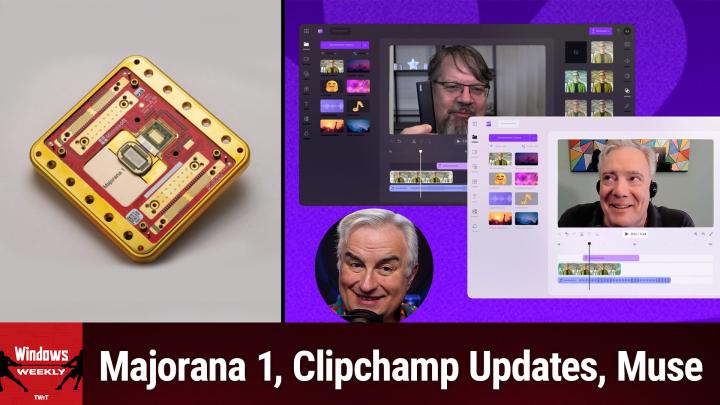
Windows Weekly (Audio)
WW 920: Celebrity Condiments - Quantum Processing Unit, Edge 132, Rust
02:41:41
Quantum Processing Unit, Edge 132, Rust
Loading summary
Transcript956 lines
- [00:00]
Leo Laporte
It's time for Windows Weekly. Paul Thurat's here. Richard Campbell's here. We're going to talk about a couple of new versions of Windows, both the dev channel and the release preview. Some small changes. We'll also talk about AI. And Microsoft has made an announcement. A big breakthrough in quantum computing. It's the next big thing. Coming up next on Windows Weekly, podcasts you love from people you trust.
- [00:30]
Paul Thurat
This is tw.
- [00:38]
Leo Laporte
This is Windows Weekly with Paul Thurat and Richard Campbell. Episode 920, recorded Wednesday, February 19, 2025. Celebrity condiments. It's time for Windows Weekly. Hello, you winners and you dozers. Yes, I'm back. And so is Paul Thurrott and Richard Campbell. Hello, gentlemen. Hello, gentlemen.com leanpub.com Richard Campbell, runasradio.com Wonderful to see you. I missed you guys last week.
- [01:14]
Richard Campbell
Yeah, we missed you, too.
- [01:16]
Leo Laporte
Spent the week with the rocks in Tucson.
- [01:19]
Richard Campbell
How was your crystal experience? Was it great?
- [01:21]
Leo Laporte
I feel energized. Washed in the, in the. Bathed in the mineral vibes.
- [01:27]
Richard Campbell
That might just be silicosis, but okay, could be.
- [01:30]
Leo Laporte
I've never seen anything like it.
- [01:31]
Paul Thurat
I have gold flakes on my soul.
- [01:33]
Leo Laporte
So we went to the convention center, which is, you know, like the Las Vegas Convention center, and the whole floor is filled. And we thought, wow, this is nice. This is nice. And then I asked the person on the rock committee, is there anywhere else to go? She said, yeah, the whole town has giant circus tents that dwarf the convention center. The whole town has taken over, and some of the rocks dwarf me. I mean, I mean, it's really quite. It was quite a scene. Big.
- [01:59]
Paul Thurat
This is pretty much Tucson's claim to fame when you think about it. You know, rocks.
- [02:03]
Leo Laporte
Oh, I think so. This is widely considered the biggest mineral show.
- [02:07]
Paul Thurat
What do we, what do we have that other people do not have?
- [02:09]
Leo Laporte
Rocks.
- [02:10]
Paul Thurat
Lots and lots of rocks.
- [02:13]
Leo Laporte
So was it a good week?
- [02:19]
Paul Thurat
Yeah.
- [02:20]
Leo Laporte
You had a Windows update? You have any.
- [02:25]
Paul Thurat
You have a protagonist of this?
- [02:27]
Leo Laporte
Anything to report?
- [02:28]
Paul Thurat
Is he going through some sort of evolution? Yes. So, yeah. So since last week's show, we have had three insider builds, most recently yesterday, which was a. I'm skipping ahead a little bit here, but this is a. I called it a preview of the preview that we'll preview next time, but it is a release preview build of the next 24H2 cumulative update. So if you follow the natural progression of things, and Microsoft doesn't always, by the way, but this time I think they are, that means that next Tuesday, which is the week d Tuesday that we keep talking about, the day that Microsoft ships the preview updates. We'll see this go into a preview update and then the Patch Tuesday in March. This will be that update. So this is an early look at that. And so this stuff is. I would say it's similar to the Patch Tuesday update that we had this this month. Meaning it's not major. I'm actually. I'm using the dev channel on my Surface laptops. I've seen this stuff before, but I like the battery changes. That's in the graphic from the article. It's like the. It's green now when it's charging and in good health and good shape. Whatever. It's yellow when it's getting low, and then it's just black, normal. But when you look at the icons that are still in the system tray in Windows 11, and you think about it, these are actually from Windows 10, meaning they have that kind of Windows Phone aesthetic. Right. They're black and white. They're transparent. Usually they're not filled, most of them. They're actually starting to look a little out of place. So I think introducing some color in there makes some sense. That's kind of cool.
- [04:18]
Leo Laporte
It's so funny how small these updates, really.
- [04:22]
Paul Thurat
Yeah. Well, no, but you know what I said, right? Because, yeah, we've had some stupid big updates come out of nowhere, and I'm sure we will again, but. Great. And then last week there was a release preview channel build for 23H2 as well. And so here you see these two things being lined up again, right? So the taskbar, jump list, stuff meaning. Stuff, meaning the share thing. So in other words, if you have an app in the taskbar that has a jump list and is document based, you'll be able to share from there. There's a little share icon that appears next to each of the names. The Windows Spotlight changes on the lock screen and in Windows, nothing, nothing major, just, you know, some changes to File Explorer that are minor, all that stuff. So it's just lining up 23 and 24 H2 again, which we keep seeing. You know, something that's been very consistent. But then yesterday or yesterday or two days ago, I guess there was a mysterious dev channel build that Microsoft has not really explained. So Dev channel and temporarily Beta channel, because they're lining up right now with the same builds is where you can get Recall, right? And click to do. If you have a Copilot plus PC. And I've been using Recall since it, you know, first became available, I Think it was back in November. And when I say I've been using it, what I mean is I've been allowing it to take up space on my hard drive and I never once access it on purpose because I don't really need it. But I mean, I just don't really.
- [05:56]
Richard Campbell
Think to ever use it, actually use the output of it for anything.
- [06:00]
Paul Thurat
Yeah. So like, I did an episode for Hands on Windows where I went through the UI and you can see what it looks like and everything. And before that show, I just used it for a little while to kind of reacquaint myself with it. But I don't personally see a huge benefit to this. So the one change they, oh, I don't have it. I'm on the wrong computer. I can't look at it. So the one change they did make that you can see is there's a flyout when you click the recall button in the system tray kind of pops up. And from there you can open Recall. If you want to. To date, you can use that to pause snapshotting. Right. If you want to, just do it on the fly. But they added a filter app or website button to it, which is actually very useful. So in other words, you bring up a website you don't want the thing to record, click that button, say, stop doing it, and it will get rid of all the ones it might have recorded previously and then not record that anymore. So that's actually useful. But the mystery is Microsoft said that they're improving recall in the next update. Now, does that mean the next build? Does that mean the next Windows cumulative? We don't, you know, Microsoft, they don't really communicate very effectively, but in preparation for that, they are changing recall under the COVID somehow. They're not saying how, and they have to delete all of your existing snapshots. So if you've been using it all along, like I pretty much have, I took. Actually, I did take one pause in there. But if you've been using it, you're going to lose everything. So it is a preview. I mean, I guess we should, you know, maybe have expected something like this, but they haven't really. They haven't explained it. So I don't know what's going to. I will see, you know, in a future update, we'll see if they provide more information about that. So, yeah, yeah, not too big. Okay.
- [07:53]
Richard Campbell
Finishing that. They stuff that into the dev channel out of the blue like that.
- [07:56]
Paul Thurat
Like, could not go.
- [07:58]
Richard Campbell
Like.
- [08:01]
Paul Thurat
You'Ve seen the George Washington sketch on SNL with Nate Bargazzi, where people ask him like, why is this? And he's like, nobody knows. It's. It's like Canary, nobody knows. We're not really sure.
- [08:12]
Richard Campbell
You may not be wrong. They might not have the keys to the Canary channel anymore, right?
- [08:16]
Paul Thurat
Yeah. Like, I got locked out of my YouTube channel and they got locked out of Canary.
- [08:19]
Richard Campbell
Yeah.
- [08:20]
Paul Thurat
Yeah, that could be. That's funny. Yeah. I don't know. I don't know. So there is a shift going on. This came up. I don't recall if this is when Richard was around or the week you were gone or whatever, but we're in a temporary window right now where dev and beta or can be the same. So this is confusing, but if you were in beta, you were on 23H2, so you were testing future updates that would go up to 23H2, which is still a current version. And during the window, you can Optionally opt into 24 H2 builds and at some point it will just switch over to 24H2. But for now, they're still doing 23H2 as well. So there are people in the beta channel who are on 24H2 and some who are on 23H2. If you're in 24H2, you're lined up with what we see in dev. But the assumption here is that when they move things forward, Dev will move on to the next version, whatever that is. 25H2, probably. But they've never said that. So, you know, why would there be any clear communication? It's kind of unclear.
- [09:22]
Richard Campbell
Like, you think they know?
- [09:24]
Paul Thurat
Yeah. Right.
- [09:25]
Leo Laporte
Do you think they don't know?
- [09:26]
Paul Thurat
You know.
- [09:29]
Leo Laporte
That would be kind of shocking.
- [09:30]
Paul Thurat
There's an assumption of adult kind of responsibility in anything like this. Right, Right. I remember before I got into the industry, I would buy a. You know, you go to the bookstore, you buy a big, thick computer book, whatever you like. This guy is an expert. And then I realized in writing my own books that it's more likely he became an expert in writing the book, that he might not not have known much about the time. You know what I mean? So that's true.
- [09:53]
Leo Laporte
I've become an expert by doing these shows.
- [09:55]
Paul Thurat
Yeah.
- [09:55]
Leo Laporte
I don't know nothing, but.
- [09:56]
Paul Thurat
Yeah.
- [09:57]
Leo Laporte
So you guys fill me in.
- [09:59]
Paul Thurat
Well, I mean, look, there are different. Whatever. We learn and become better at things. So. Yeah. But there's this suspicion now with the insider program where. Not sure. I think it, like, they did like a bring your kids to work day, and then they never left. I don't know what's going on there. It's very strange.
- [10:16]
Richard Campbell
I think the team's turned over and different people see it different ways, and there's been a limited amount of documentation between the different parts, and I think there is some experimentation going. It's part of the equation. So we're not sure how this feature is going to go, so we're going to put it into insiders and see how people react to it.
- [10:31]
Paul Thurat
Yeah, right. So I don't know what the chain of command is.
- [10:33]
Leo Laporte
So there is a plan.
- [10:35]
Richard Campbell
Well, I think there's multiple. That's the other part. This is not a, you know, space here.
- [10:42]
Paul Thurat
Look, I, I don't get the sense of. What do you call it, like chain of command or whatever, you know, I just don't get that sense anymore. I know. You know, look, Microsoft is, is in a state of flux generally. Right. Because of all the AI stuff. So there's that kind of weirdness. Windows, just like they were during the cloud era, has been caught in kind of a weird place.
- [11:02]
Richard Campbell
Although still trying to figure out what they're about.
- [11:05]
Paul Thurat
Yeah. So then, you know, honestly, they've added some AI features in Windows that I think are pretty good. Like, they've, they've gotten there. Like, I think the initial round was not great, a lot of it. But they're, they're kind of feeling their way through that stuff at least. Okay, fine. But as far as just the. Like, what is the point of Windows 11 these days? Like, what are we focusing on? Where can we make a difference in people's lives, if any? I don't know. I don't know. I don't get a real sense of central strategy filtering down to the troops. I don't know. I don't know. So, yeah, I mean, there's an adult part of this business that is the part making the bills. Right. I mean, like someone with some responsibility is doing that stuff. But as far as determining what goes out, where and when, I don't know. I feel like some middle management walked away from the job and no one ever replaced them and no one noticed. And now it's just. I don't know. It's. It's. It's hard to explain, so let's move on.
- [12:05]
Leo Laporte
So no one knows is what.
- [12:07]
Paul Thurat
Nobody knows is the. Yeah.
- [12:08]
Leo Laporte
So I never, I've never worked in a big corporation, so I only can guess. I can only guess what it's like in one. Yeah, I mean, like for instance, Amazon has a big event with Panos Panay in, in about 10 days, announcing the new Echoes. And we heard from that. I think maybe the information broke it, that they were gonna have a meeting on the 14th to decide whether in two weeks they would announce Amazon's new Echo Intelligence.
- [12:39]
Paul Thurat
Right.
- [12:40]
Leo Laporte
And they got together two weeks before Panos. Poor Panos. I think this has happened to him with other things in the past. And they say, no, we're not gonna do it. So Panos, just talk about something else.
- [12:52]
Paul Thurat
Oh, and by the way, that's gone great for him when that's happened, so.
- [12:55]
Richard Campbell
I know.
- [12:55]
Paul Thurat
Don't worry about that.
- [12:56]
Leo Laporte
What was that? Where was that?
- [12:58]
Paul Thurat
What you want is him without a script.
- [12:59]
Leo Laporte
You know, he just came out and they had obviously pulled whatever he was.
- [13:02]
Paul Thurat
Started wandering around the crowd like a homeless person and then, like, looking for change or something. I think he took someone's laptop away or something. I know he did that to me at one thing, but I'm like, he was just kind of.
- [13:13]
Leo Laporte
It was a very nebulous. Because he didn't have the thing that he was going to talk about.
- [13:16]
Paul Thurat
Right. They took it away from him. Sacho. Yeah.
- [13:21]
Leo Laporte
Oh, that's right. They moved it to the keynote.
- [13:23]
Paul Thurat
What was this? Sasha was like, no, I want this for me. And he's like, great, now I have nothing to talk about. So, yeah, it was like the. The Dana Carvey thing. Like, you know, thousand points of light. What do I have, like, two seconds left? He's like, no, you get five more minutes. A thousand points of light, you know, like, I have nothing. You know, he had nothing else to say. It was just kind of weird.
- [13:41]
Leo Laporte
It was like Jimmy Fallon, actually, on the Saturday Night Live concert where they say, no, Jack White's not ready. So, Phil.
- [13:49]
Paul Thurat
Yes.
- [13:50]
Leo Laporte
He started to, basically. So what did we see tonight?
- [13:54]
Paul Thurat
Sort of going through. Right. You're doing the frog. It's like, hello, my darling. Hello.
- [13:59]
Leo Laporte
You know, like, it was great because he admitted it. He said, yeah, they're not ready yet. So. And he kept looking over. You ready yet? No. Okay, well, here's another anecdote. Oh, man. That's.
- [14:08]
Paul Thurat
Let me tell some stories. Yeah.
- [14:10]
Leo Laporte
So I'm. I'm gonna. I don't know if they. I don't think Amazon streams those events, unfortunately, because I would love to see people.
- [14:15]
Paul Thurat
Yeah, right, right, right. But I. I'd be okay not seeing them. I don't know. I'm going to be okay.
- [14:22]
Leo Laporte
Anyway, my point being, corporations work in mysterious ways. I've never worked for a company like Microsoft, but you would think I've absolutely.
- [14:30]
Paul Thurat
Worked for a gigantic company like this. But I was mostly sheltered from the bigger company.
- [14:34]
Leo Laporte
Right.
- [14:35]
Paul Thurat
And I could. I found out why very late in the game, because when I. Because when they started firing people randomly, I went. What I later found out was like three or five levels above me and complained directly to the vice president who would fire the guy who I accused of just looking at a spreadsheet, sorting it by number, and then firing the two biggest numbers, which he basically admitted to. And. And I said, you just fired the person who was our liaison for TechEd at the time. And he said, I had no idea. I said, I know. That's the problem.
- [15:07]
Leo Laporte
Holy cow. You know, Holy cow.
- [15:10]
Paul Thurat
So I wasn't long for that business. But you can work at a gigantic company with infinite resources, but deal with all of the politics and nonsense. You can work at a small company and have no resources, but at least you don't have eight people up the chain. Or you can do what Panos did and work at a giant company with infinite resources that will give you none of them. And you might as well be working at a small company with no money, because Amazon will never throw money at anything you're doing.
- [15:36]
Leo Laporte
Right.
- [15:37]
Paul Thurat
So it's kind of.
- [15:37]
Leo Laporte
I suspect, though, that it might have been that keynote that he was forced to vamp at Microsoft that pushed him.
- [15:45]
Paul Thurat
I think that was the start. There were a number of things, I think, in that chain that led to that and whatever with him. Part of me respects budgets being slashed, products being slashed, and he's like, I can't. I'm sorry. He's like, this is not business I want to run. Like, you're. You're just throwing this thing into the ground. And if that is what happened, and I think it is, like, I get it. I get him leaving, you know, because of that.
- [16:12]
Richard Campbell
Yeah. You get put into a possible situation. Like, no path here to succeed.
- [16:16]
Paul Thurat
Exactly.
- [16:17]
Leo Laporte
He was. Was. He was pretty high level. He was like a VP level, though, right? Yeah, yeah.
- [16:21]
Paul Thurat
I mean, he was on the end. He was on the senior leadership team, wasn't he?
- [16:26]
Leo Laporte
Wow.
- [16:26]
Paul Thurat
I believe it was. So, yeah. I mean, he was running Windows and.
- [16:31]
Leo Laporte
Surfaces, so in some ways this is a step down. But I think he's responsible for all Amazon hardware.
- [16:37]
Paul Thurat
I mean, at Amazon, this is arguably parallel. Right. I mean, he's in charge of the devices and I think services is how they describe it. And that to me is Alexa plus Echo and all the everything else. I mean, so that's. I know that business has not made money or whatever, but he's used to that. Okay. So anyhow, sorry since the latter days of Windows 10, early days of Windows 11, Microsoft has started being more aggressive about deprecating features in Windows. Right.
- [17:08]
Leo Laporte
What does that word mean, Paul?
- [17:10]
Paul Thurat
Yeah, it means this feature is no longer being updated and it will be removed in a future version.
- [17:15]
Leo Laporte
Oh, I was being facetious because we did that whole thing.
- [17:18]
Paul Thurat
Oh, I'm sorry.
- [17:18]
Leo Laporte
Yes.
- [17:19]
Paul Thurat
So yeah, this was always pretty clear cut to me. But Microsoft explained this a couple of weeks ago for customers in the context of support because I guess there was some question there. So if they deprecate a feature, it's still supported. Right. So if you're using it in your business, you can expect Microsoft to support it. They do. But you. But they also recommend that you start moving users off of it because it will disappear.
- [17:42]
Leo Laporte
Winter is coming.
- [17:45]
Richard Campbell
It's moved to a maintenance team that only deals with security issues and they're unhappy.
- [17:50]
Leo Laporte
They don't have Windows in there.
- [17:51]
Richard Campbell
You don't have a PM anymore. You have nobody who's looking for new features and taking feedback from users. Like, that's what happens when you deprecate it.
- [17:59]
Paul Thurat
Yeah. So there are big features and there are small features. Obviously some people will tell you there are no small features, but there are small features.
- [18:08]
Richard Campbell
Only small people.
- [18:09]
Paul Thurat
That's right. Small ideas. But yeah, so. But the feature they've just deprecated is called location history, which sounds like. Yikes. Wait a minute, what? To me, location history sounds important. Like it sounds like the type of thing you would leave in Windows because every mobile device, every device really we have, has some sense of location history. But actually location history in Windows is specifically tied to Cortana, a feature that was previously deprecated and removed from Windows. It's no longer there anyway, so that's actually all it was used for. There are other location related features in Windows. So for example, Find My PC or Find My Device, whatever they call it, uses obviously your location and will show you on a map where devices are and all that kind of stuff. So that's still there. They're not turning off location anything broadly, but there was a very specific API that Cortana would use to find out the location of your devices and history of that stuff.
- [19:11]
Richard Campbell
Those APIs have been around there forever.
- [19:13]
Paul Thurat
Yep. And yeah, they're never used. And you know, somebody asked somebody, it was like on social media, someone said, well, what about the location history in the cloud? And it's like, look, I get where you're going, I'm with you. But you obviously don't understand how this stuff works because that Stuff is, has not been saved to the cloud in forever. So there's nothing there. And it's Microsoft. So you can go and you know Microsoft.com privacy probably and whatever it is, but you could do it through your Microsoft account website and you could just disable or delete all that if there is any data there. There isn't, but if there is, you can delete it. Like that's, that's always been the case. So there's no, there's no actual privacy worry. Like, like we've been recording your history, you know your location for years and we're going to save it in the cloud. Like no, no, it's just nobody, they're not keeping that stuff so you don't have to worry about that. So that's happening. And then two app related things that are kind of interesting. So last May I think it was Microsoft announced that they were replacing parts of the Microsoft Edge UI which previously had been written with what's that? JavaScript framework, React and was slow and they had come up with something that they described as like a markup first architecture called Web UI 2.0 which depending on the UI or whatever it is could be anywhere from 40 to 75% faster, roughly speaking. And sure enough, I mean like there's a UI in Microsoft Edge called Browser Essentials and if you launch that thing right now, it's Browser Essentials for most people comes on like that, like it's really fast. And they just announced now, it's the first time since last May that they've updated more of the UIs and Edge. So to date they've updated 14 UIs in Edge to Web UI 2.0. And now the browser overall, I don't know how they measure this, but is roughly 60% faster than it was just UI responsiveness. And I have to say this is, I, I take a lot of these kind of claims in a kind of a dubious way.
- [21:19]
Richard Campbell
Stuff is fraction of a second stuff, but I guess it all adds up.
- [21:22]
Paul Thurat
It does. And I actually noticed this. So whatever anyone.
- [21:26]
Leo Laporte
The funny thing about this is it might be a fraction of a second but there's some quality to it. It feels a little hesitant.
- [21:34]
Paul Thurat
There's a collective impact to it that's kind of interesting. And like I said, the example I just used is, I'm not saying it's the best one, it's just one I think of like if you open Edge and launch Browse Essentials you'll see this thing comes on as fast as you can blink like it's it is actually very fast.
- [21:52]
Leo Laporte
It's palpable when it's.
- [21:53]
Paul Thurat
Yeah, I don't, I don't accuse Microsoft of making fast software a lot. Like, this is actually fast. So I'm not saying this is a reason to use Edge, but it certainly is a benefit. I mean, it's real. Like, this is not made up. It's actually, you'll notice it. So that's kind of cool. And then I feel like I haven't talked about Clipchamp enough lately, but they do. I don't know what the update schedule is on Clipchamp, but I use Clipchamp.
- [22:20]
Richard Campbell
You got the eternal.
- [22:21]
Leo Laporte
You both are. You're both champions.
- [22:23]
Paul Thurat
Here's the thing. I, I would say when I first switched over to Clip champ, which was almost two years ago, I bet I was, I know I was here in Mexico and I was having a problem with Adobe Premiere elements just not working properly on any of the PCs I had here. Whether it was like hardware acceleration or not or whatever, I would spend all the time rendering a video and then it would have little hitches in it. And I'm like, I just got to get this done. I'm. I'm not trying to spend my whole life rendering video. Like, I just want to get this thing done. So I tried a bunch of different things. You know, DaVinci resolve is incredibly complex today. I would probably look at something like Capcut, which is actually pretty good, or whatever, but Clipchamp's built and I'm like, I gotta take a look at this thing. So it looked at the time a little cartoonish, like a little, you know, like a little happy consumer app, whatever. But it was really powerful and worked great. And so I've been using it ever since. But the thing I've noticed using it ever since is this thing has evolved pretty dramatically. So the basic UI is the same that the thing you launch into is the same. The editor at a high level is the same. But if you actually look at it, there are a lot of little things and it is becoming more professional looking, if that makes sense. I think before it was very approachable and surprisingly powerful, and now it's starting to. It's not getting harder to use or anything, but it's just starting to look more like what it is, which is a very powerful app for editing video. Like, it's, it's come a long way. It's really, really interesting. So they, they point out some things that are new recently with like light mode support. Okay, great, if you want that for some reason. But to me it's the, like the video editing and the timeline, the ability to group assets and use them as a group. Because a lot of times you might want to select 2, 3, whatever number of elements and have it have all have like the same fade in, the same fade out, the same whatever it is, transitions and things. So you can do that kind of stuff. Like this is a. This is a really powerful.
- [24:23]
Richard Campbell
It's gradually becoming Da Vinci.
- [24:26]
Paul Thurat
Well, that's.
- [24:27]
Leo Laporte
It's looking more and more like Imovie or, you know, kind of. Yes.
- [24:31]
Paul Thurat
Like a battle kind of a tool.
- [24:33]
Leo Laporte
Yeah. Or dare I say Windows Movie maker.
- [24:36]
Richard Campbell
Yeah.
- [24:37]
Paul Thurat
Which for a brief shining moment was actually better than Imovie. Right. Like they stopped doing it.
- [24:42]
Richard Campbell
But yeah, it's always the battle of simple enough for a hobbyist to use, but powerful enough that it can do what you needed to do.
- [24:48]
Leo Laporte
They're not trying to compete with da Vinci or.
- [24:50]
Paul Thurat
Well, yeah, but I think they're a better option for most like mainstream people, like normal people, whatever. But I. The secret to me, to this app is that it's always been super powerful. I think it was a little off putting to professional users or more experienced users for video editing. It was. It looked a little.
- [25:09]
Leo Laporte
Because it wasn't a timeline, right?
- [25:11]
Paul Thurat
Well, no, they always had a timeline. It was just kind of not cartoony. It just looked like a, like a.
- [25:17]
Leo Laporte
It looked too simple. The UI made it look so simple. Yeah.
- [25:20]
Paul Thurat
Even though they were actually hiding great power in there. And now I think it's starting to get to the point where it looks. And is what it looks like is more like what it is.
- [25:31]
Leo Laporte
Yeah.
- [25:31]
Paul Thurat
Which is a really nice kind of prosumer video editing tool. It's nice.
- [25:37]
Leo Laporte
It's not free, right?
- [25:38]
Paul Thurat
No, it is free. So you can, if you pay, you get things like 4k exports, the ability to store your assets in the cloud, which is really nice if you go from machine to machine. Right.
- [25:48]
Leo Laporte
Because it's.
- [25:49]
Paul Thurat
Yeah. And then there's some branding things and if you get more of the like assets that they provide, like video, audio, whatever, graphical assets and so forth. But no, I mean, honestly I actually do pay for it. But the. What I do, I could get away with not paying for it. It's.
- [26:06]
Leo Laporte
Right.
- [26:07]
Paul Thurat
I could do everything I do without paying for it. But I do pay for it primarily for that syncing capability because I do actually use a lot of computers and it's kind of neat. Like I'll recorded like. Like we're doing. Now we're recording a video. I'll do that on Zoom with my wife, say, and then get off the phone. I'll have it render here, which. Well, it has to. It's not my choice, but. And I could take that thing, push it into Clipchamp and then just go in the other room and I'll use my other laptop, but it's already there. You know, it's. It's really nice.
- [26:35]
Leo Laporte
It's so cute that you're in the same apartment, Leo. She goes into one room, you go to another room and you join us.
- [26:41]
Paul Thurat
It's almost 10ft in that direction. I don't understand why this confusing.
- [26:44]
Leo Laporte
You should get what Richard has. What?
- [26:45]
Paul Thurat
That.
- [26:45]
Leo Laporte
The. The road video thing. Right. You could have two cameras. She could be sitting side by side. You could have a mixer. Be like a TV show.
- [26:54]
Richard Campbell
Well, I know. To get you for Christmas so you.
- [26:57]
Paul Thurat
Don'T have to convince me of this. What I'm going to do is I'm going to bring my wife in here and you can say this to her and you'll just see how she looks.
- [27:03]
Leo Laporte
Oh, she's.
- [27:05]
Paul Thurat
She's going to be like, yeah, no.
- [27:08]
Leo Laporte
She doesn't want to be in the same room with you.
- [27:10]
Paul Thurat
Yeah, she doesn't want to be in the same apartment with him. We're stuck.
- [27:14]
Leo Laporte
How do you like, by the way, Richard, how do you like your Rodecaster video?
- [27:17]
Richard Campbell
Well, we've still. We've been tweaking it further just today. Right. It's been. It's an impressive device.
- [27:22]
Leo Laporte
It's not cheap, it's 1200 bucks, but it definitely.
- [27:25]
Richard Campbell
It took over for the Atem Mini Pro and the P8.
- [27:28]
Leo Laporte
Right.
- [27:28]
Richard Campbell
So I've been using it for audio recording as well as some video work. And it's got.
- [27:33]
Leo Laporte
How many cameras does it support? Looks like 8.
- [27:37]
Paul Thurat
7.
- [27:37]
Leo Laporte
8, 7. Yeah, it's crazy.
- [27:39]
Richard Campbell
Four HDMI inputs and then at least two.
- [27:47]
Paul Thurat
Do they have like a. Like a half size version of this that does.
- [27:51]
Richard Campbell
No, this is the small one.
- [27:52]
Paul Thurat
Yeah. See, I don't really like. That's overkill for anything I would ever need.
- [27:56]
Richard Campbell
Yeah, you know, it's not, it's not. Everything else would be more overkill than this, right?
- [28:02]
Leo Laporte
Would probably.
- [28:03]
Richard Campbell
Yeah. Mini still. You're going to give you four channels, right? But it did. But it doesn't handle the good microphones.
- [28:10]
Leo Laporte
Yeah.
- [28:10]
Richard Campbell
This has the Phantom Power XLR, a pair of Fan Power XLRs on it, which I only need one of.
- [28:15]
Leo Laporte
But we're really happy. I was, you know, when we closed the studio, we set up the studio here in the, in the house. I think it was Anthony Nielsen. My team, our team said, get the Rodecaster duo for your mixer. I said, come on, I need. I mean, that's amateur hour, right? I'm gonna use a zoom like you do, or used to, and. Or us or sound devices or something. And they said, no, no, get it. So I got it. And it's been fantastic.
- [28:42]
Richard Campbell
I tell people this story a lot.
- [28:44]
Paul Thurat
Because when you started Twit and we're kind of replicating, what was the TV studio tech?
- [28:50]
Leo Laporte
Yeah, it was crazy.
- [28:51]
Paul Thurat
Much lower cost and whatever. And then. But it's weird because of the evolution of technology that became kind of big, heavy, expensive, whatever, and now, you know, 20 years. Ish later, almost, you can again do the same thing again at much lower cost.
- [29:08]
Leo Laporte
It's so funny.
- [29:09]
Paul Thurat
No, it's amazing. I mean, this is. It's not Moore's Law exactly, but it's that. That benefit you get from technology improvement.
- [29:16]
Richard Campbell
Yeah. I would have bought this if it had existed when the Atems came out. I suspect I'm going to donate this gear to the high school.
- [29:22]
Leo Laporte
Yeah, that's what I did. That's funny that you should say that. That's exactly what we did. Some of it went our fancy audio equipment, which was very expensive from Telos, the Axia stuff, went to a community broadcaster up north and then there's a high school in LA that got all the cameras and the tricaster and everything. So it's a great. But honestly, nowadays, anybody can do what we do out of their house with fairly minimal investment.
- [29:48]
Richard Campbell
Yeah.
- [29:48]
Leo Laporte
The funny thing, as I just read this piece, why every podcast should have video.
- [29:55]
Paul Thurat
Yeah. You know, THEY LAUGH Sure, Lauren, they.
- [29:59]
Leo Laporte
Laughed when I sat down at the tricaster.
- [30:03]
Paul Thurat
Remember when we started, it was audio? It was only audio.
- [30:07]
Leo Laporte
Oh, yeah. We started audio for everything.
- [30:08]
Paul Thurat
Yep.
- [30:09]
Leo Laporte
But it wasn't. It was only a few years before we thought. I thought, and I think it was because in hindsight, it was dumb. I was trying to recreate tech tv. It was a little bit of a.
- [30:18]
Paul Thurat
You didn't want to be too overt about it or whatever.
- [30:21]
Leo Laporte
Well, I just.
- [30:22]
Paul Thurat
Leo, let me. Let me. Let me let you in on a little secret. I don't call it the super site for windows, but throughout.com you could be down.
- [30:32]
Leo Laporte
You know, we're still a little salty over the whole thing. Yeah.
- [30:36]
Paul Thurat
Yes. As you would be.
- [30:37]
Leo Laporte
You know, as one. One is. Hey, let's take a little tiny time out. I'm gonna do an ad and then we come back with more exciting stuff. You're watching Windows Weekly with Paul Thurat and Richard Campbell. Our episode today brought to you in part by US Cloud, the number one Microsoft Unified support replacement. I asked them why do you call it US Cloud if you're a support replacement? They couldn't answer that. But once I talked to them and understood their business, I thought, I don't know why everybody doesn't do this. We've been talking for a few months now about US Cloud. They're the global leader in third party Microsoft support for enterprises. They now support 55.0of the Fortune 500 and one of the reasons they're very popular is because it saves you a lot of money. I mean it's better support, faster support, but it's roughly in many cases 30 to 50% less than Microsoft Unified or Premier support. So half as much, twice as good. That seems like a no brainer. It's twice as fast on average. Time to resolution versus Microsoft. They do something else that I think is really cool. They really support their users in ways that Microsoft isn't incented to do. Right? Microsoft wants you to spend as much money as possible on Azure. They're never going to tell you, oh, you know, you don't really need that Azure vm. I see that it's not being used. Well, US Cloud doesn't make money on your Azure consumption, so they're happy to help you optimize your Azure costs. They have a new Azure cost optimization service. Now think about it. When was the last time you evaluated your Azure usage? If it's been a while, you know, not throwing stones, we all have this problem. Some Azure sprawl, a little spend creep going on. Good news, now you can save on Azure and it's easier than you think. With US Cloud they have an eight week Azure engagement. It's powered by VBox. It runs for eight weeks, identifies key opportunities to reduce costs across your entire Azure environment. And it's not just automated. You're going to get the expert guidance that US Cloud offers. They're senior engineers with an average of over 16 years with Microsoft products. I mean these folks are the best. At the end of the eight weeks, you're going to have an interactive dashboard that will identify, rebuild and downscale opportunities, unused Azure resources. Which means you can take those precious IT dollars and reallocate them towards, you know, something better. Like perhaps investing in US Cloud's Microsoft support. That's what a lot of US Cloud customers do. They end up saving money on Azure enough to completely eliminate their unified spend. So it's a win all round, right? Here's A very nice review we just got from Sam. He's the technical operations manager at Bed Gaming. B E D E. He gave us Cloud 5 stars. He said, quote, we found some things, this might sound familiar. We found some things that have been running for three years. I mean these VMs were, I don't know, 10 grand a month. He said, not a massive chunk in the grand scheme of how much we spend on Azure, but once you get to 40 or $50,000 a month, it could really start to add up. Isn't this a great idea? And you can see why this is something a third party has to do. Because Microsoft's not going to tell you. Stop overpaying for Azure. Identify and eliminate Azure creep. Boost your performance and you can do it all in just a couple of months with US Cloud. Visit uscloud.com right now. Book a call. They're really nice people. You'll enjoy talking to them. I was impressed. No hard sell. They just. They're very matter of fact and they'll show you how much your team can save, not just on Azure but on your Microsoft unified support. USCloud.com, book a call today. Get faster, faster, better. Microsoft support for less. They don't say better, but I, but I say it for them. Uscloud.com and if they ask, would you please say, hey, I saw it on Windows Weekly. So they know that they're getting their money's worth when they buy an ad here, which I know they are. Okay, Paulie. Little Paulie T and big Richie C. It's the new. Their new rap gang here.
- [34:58]
Richard Campbell
Goodness.
- [35:00]
Leo Laporte
Let's talk Microsoft 365er. What are you laughing at?
- [35:06]
Paul Thurat
I want to. I, I can't even imitate what. I want to imitate the. I want to start off with like a hey, Doug. But I can't. I can't pull it.
- [35:17]
Leo Laporte
I've been hanging out with a little too much. He talked. That's exactly how he talks.
- [35:21]
Paul Thurat
Yeah, it's like talking to my son. Language. You know I'm a writer, right? Anyway, so you know how deeply this hurts me. I don't remember if it was a week or two ago, but there was a Microsoft support document that said that they were pretty dramatically changing the sign in experiences on the web for personal Microsoft accounts and apparently also enter ID accounts, although I don't recall that being part of it. Meaning that if you signed into the web using your account, you would stay signed in unless you signed out. So if you're sharing a computer, maybe don't do that or maybe use an incognito window or whatever. So that was kind of confusing. And all these online accounts have some sort of a timeout. I know with my Google account because I use it for email and calendar that I don't know, I want to say every 30 days, it might be every two weeks. Whenever it is I have to re authenticate. Right. It's like hey, we just want to make sure it's you and I have a passkey so it's quick, whatever. Microsoft must do something like that. But apparently they were going to stop doing that, but apparently not because Microsoft and this is so bizarre the way they say this. They said media reports were based on incomplete information mistakenly published by a Microsoft product team. So it was our fault. We took something public facing that you wrote and we took it at your word and that was our mistake. Sorry, we'll never do that again. It turns out they're not doing this so they're not changing how entra ID or Microsoft account sign ins work on the web. So everything I just said is not happening. So I don't know what that was all about but for some reason on a public facing website they said that it was changing, but it's not. Okay, this is coincidental, but sometime, I don't know, two weeks ago, three weeks ago, I switched from Gmail on my phone to Outlook, which is the Microsoft.
- [37:16]
Leo Laporte
Product using Outlook as the back end or Gmail as the back end.
- [37:20]
Paul Thurat
It's still Gmail in the back end, but it's the Outlook app interface to Gmail. Yeah. So the reason is that Microsoft does a better job than Google at display scaling and they support or they better support the display scaling that's built into the OS that I have set up. And with Gmail I used to have to set the display scaling on a per app basis and put it up as high as it could go because some of the text was tiny and some it was just very strange. So I've actually come to like it a lot, assuming I don't ever have to search for anything. That stuff works well. And then this past week they've announced three new. I guess they noticed there were all these new users meaning me, and now they're adding all these new features, some of which will be familiar because they've existed before on other platforms. So Outlook Mobile, meaning The version for iOS and Android is getting a new font picker. So when you write an email there's a little toolbar thing that comes up that gives you various options related to the message. But now you're going to be able to choose the font and then font styles and all that kind of stuff. That's kind of cool.
- [38:22]
Richard Campbell
How often do you change the font on your email?
- [38:25]
Paul Thurat
Well, I think you can only do it in settings for all email.
- [38:28]
Richard Campbell
Right.
- [38:28]
Paul Thurat
So now you can do it like if you want to. If I want to send you a message. It has different fonts for some reason.
- [38:32]
Leo Laporte
Oh, that's important actually.
- [38:34]
Paul Thurat
You can do it on the fly.
- [38:35]
Leo Laporte
Plus I will have a different font for the list of messages that I do for the messages. Yeah, different fonts for fixed with verses here.
- [38:42]
Richard Campbell
I thought you're talking different fonts within the email because I've received.
- [38:49]
Paul Thurat
What do you call it? Like a hostage.
- [38:51]
Leo Laporte
Yeah.
- [38:54]
Paul Thurat
Hopefully don't do that. Although I have been using the AI powered explosions in imessage on the iPhone a lot. I've enjoying that quite a bit. So if I want to emphasize things now or make people feel like children, I'll send them an explosion of confetti.
- [39:08]
Leo Laporte
What does it look like though if somebody's not on an iPhone, do they.
- [39:11]
Paul Thurat
It's a, it's a little picture of dog mess and it says you should get an iPhone.
- [39:15]
Leo Laporte
Oh, you're using and I'm paraphrasing, but.
- [39:18]
Paul Thurat
It'S something like that. It's a really low res dog mess too. It's not even a good.
- [39:22]
Richard Campbell
Just be Comic Sans all the time.
- [39:24]
Paul Thurat
Yes, that's right. Yep. It's just in a symbol font you can't even read.
- [39:29]
Richard Campbell
Oh, it's all dingbats now. Excellent.
- [39:30]
Paul Thurat
Yes. Right. They're also adding the ability to recall an email which, you know, it's been in the desktop version of Outlook since, I don't know, the stone Age or something.
- [39:39]
Richard Campbell
And it works, but at least it's there so you can at least show you were flailing to try and clean up your mess.
- [39:45]
Paul Thurat
Right. And then a minimize email message feature. So in other words, you, when now when you write a message it works like it does in like kind of a web client. So the window kind of comes up in front of the app but you can see over the top, you know, the top of the app still you can minimize that thing because a lot of times you want to reference something that's not in that email thread maybe and that's something I do like on desktop all the time. I'd say it's a. It's a pretty useful little feature. So that's kind of cool.
- [40:13]
Leo Laporte
Add a sync wants to know if you use Wing Dings in your email.
- [40:17]
Paul Thurat
But I do eat Ding Dongs sometimes.
- [40:19]
Leo Laporte
Ding Dongs are good.
- [40:20]
Paul Thurat
They're good Saturday night or like 1:00 in the morning. Ding dong is. Sounds like the right decision.
- [40:25]
Richard Campbell
It's right. It is a wing ding.
- [40:27]
Leo Laporte
Are you eating a Ding Dong?
- [40:30]
Paul Thurat
No. Why? I hear crinkling in the dark. What are you doing? I'm not doing anything.
- [40:36]
Richard Campbell
All about the Little Debbies.
- [40:38]
Leo Laporte
Little Debbies. Oh, Little Debbie snack cakes and the.
- [40:43]
Richard Campbell
Annual dose of trans fats in one easy package.
- [40:47]
Leo Laporte
Imagine that.
- [40:49]
Paul Thurat
Trans. There's nothing wrong with trans fats unless you care about your health. All right, so there are two Rust related stories this week. Go figure.
- [41:00]
Leo Laporte
Rust, as in the programming language, as in oxidation of iron oxide.
- [41:04]
Paul Thurat
Right.
- [41:04]
Leo Laporte
Okay.
- [41:06]
Paul Thurat
The first is pretty straightforward and non controversial. So ExpressVPN, I want to say it was about four years ago, announced a new VPN protocol called Lightweight Lightway. Sorry. Which is secure, fast, whatever, blah blah, blah. So since they announced and released it, they've actually been busy rewriting it in Rust and they actually just finished that.
- [41:27]
Leo Laporte
That's very cool.
- [41:28]
Paul Thurat
100% functionally identical to the previous version.
- [41:31]
Leo Laporte
Express VPN is a sponsor.
- [41:33]
Paul Thurat
Oh, well, there you go. Okay, sorry, I didn't know that and. But this is. I see.
- [41:37]
Leo Laporte
He didn't even know that, folks. That was an unsolicited plug.
- [41:40]
Paul Thurat
No, I wrote about this independently. So Rust is memory save. It's more secure than C. But what they're saying is the code it creates is the more lightweight, that you have to write less code to get to the same place and it works better with multi core processors. So it's also more efficient and you know, so it's got everything.
- [41:58]
Leo Laporte
People love Rust.
- [41:59]
Paul Thurat
Right. So we're going to get to that. So. But yeah, in this case this is a 100% win. So when you think about any kind of code refactoring, which means you've written some code, so maybe it's an app or service. Doesn't matter what it is. The goal is always to write if you have to, for whatever reason, you're changing it, you're improving the code, but you want the end user experience to be the same or better, I guess. But you don't want is anyone to notice something change or something's worse. Right. And so for people that use ExpressVPN, if they had never said anything, you probably never would have noticed it actually works better, but there's no functional regression whatsoever.
- [42:38]
Leo Laporte
Also a plug, it's open source and.
- [42:40]
Paul Thurat
It'S open source and it's Been independently audited by secure to security firms to, you know, for some sort of recognition that actually this does exactly what they say it does.
- [42:53]
Leo Laporte
It's really cool. Yeah, GPL too. Yep, yep.
- [42:56]
Paul Thurat
Yeah. So really neat.
- [42:59]
Leo Laporte
That's why we like them.
- [43:03]
Paul Thurat
But we'll talk about rust again. I promise.
- [43:06]
Leo Laporte
More rust to come.
- [43:07]
Paul Thurat
Oh, yes.
- [43:10]
Leo Laporte
You know what? I know I have an ad blocking.
- [43:13]
Paul Thurat
I can keep going.
- [43:14]
Leo Laporte
Okay, skip it because we just did an ad.
- [43:16]
Paul Thurat
So I've been sitting on this one for almost a week. Maybe more than a week, I don't know. And one of my favorite stories of all time. Someday I'm going to write an article about the Times where I didn't understand anything that someone was talking about in a sort of technical, work related way. Because to my sort of mainstream, normal friends, I'm like really technical. And sometimes I'll be talking to someone like me and they're like, do you even. Do you even hear yourself talking? You're not even talking. You're not even speaking English. I don't know what you're saying. And that's how some things have been for me in my professional life. But the worst example, or maybe the best example is quantum computing. So back in 2017, there was a big splash about Microsoft had made some kind of a quantum computing breakthrough. They announced it at Ignite. And I sat there in the audience and I was like, nope. And I had a meeting the next day, or that day, whatever it was, with the guys who were on stage from Microsoft Quantum, these aliens with the glass fish container thing on their heads. And I had no idea what they were talking about.
- [44:21]
Leo Laporte
What would you like to know?
- [44:23]
Paul Thurat
And they're like, listen, we're going to explain this to you in terms anyone will understand. I'm like, fantastic, that's what I need. 45 minutes later, I walked out of it like I'd been punched in the face repeatedly. I had no idea what they had said. And I sat down and wrote the headline, everything you need to know about quantum computing. And then the first sentence of that article said is the article I wish I could write. I had no idea what they were talking about.
- [44:50]
Leo Laporte
Well, it's still pretty obscure, I have to say.
- [44:52]
Richard Campbell
Well, in 2017, they were just talking about Q Sharp and the Quantum dev kit because they didn't have any hardware.
- [44:58]
Paul Thurat
Well, now they do.
- [44:59]
Leo Laporte
So they.
- [45:01]
Paul Thurat
So I'm just going to read this to you because this is incredible.
- [45:04]
Leo Laporte
Yeah, this is.
- [45:05]
Paul Thurat
I read this to my wife because I was like, you got to listen to this. So they made a Breakthrough. They have created a material that is neither gas nor solid nor liquid, that enables them to in turn create what they call topological, or I think these are hardware, not hardware. Safe hardware. I forgot the term hardware. Back something. Qubits. Is that right?
- [45:34]
Richard Campbell
Yes, topological qubits.
- [45:36]
Paul Thurat
So I don't understand any of this. All right, but here's the go. So quantum computers aren't going to use bits, right? So computers, zeros and ones, right? 8 bit system, every unit is 8 bits, right? Expresses a value of some kind. 64 bits is what we have today. Qubits can store much more information. Qubits, a quantum computer, every time you add a qubit, it doubles its performance. So the scale is like this, like rocket ship of scaling. The problem is, okay, like rocket ships, unstable. So the more you scale, the more unstable it gets. And so Microsoft and other companies that are concerned about quantum computing are trying to get to a point where they can scale with stability. And stability means being able to control it and have it be accurate and all that.
- [46:24]
Leo Laporte
Because qubits don't hang around, right?
- [46:29]
Paul Thurat
Don't ask me questions.
- [46:31]
Richard Campbell
We're the time in quantum computing that is much like the 50s for classical computing. We haven't made the IC yet, we haven't made the transistor yet. That's every. And so every computer is a bit on the bespoke side when it comes to their bits. And the same is here. There's like a half a dozen strategies are being developed for storing and entangling qubits. And honestly, Microsoft took the biggest bet with the margarine qubit because it was literally a new property of matter. Like this is insane. Why are you doing this? There are much safer ways to go about it.
- [47:01]
Paul Thurat
Yeah, you're bending the space time continuum for some reason.
- [47:04]
Richard Campbell
You literally have to describe new science to make this computer.
- [47:08]
Leo Laporte
They expect to get 1 million qubits on a single chip. Which right at that point you have quantum computing.
- [47:14]
Paul Thurat
I mean you have an actual, so a million qubits. And remember, every qubit is a doubling of performance and capability with, with stability. Exponential. Thank you. Hardware protected was the term I was looking for. Yeah, and so they've, they, they're on the path. And so what they say right now is so they have this first generation of their first, their first quantum processor using this technology, a topological core architecture that will help it scale to 1 million qubits, which can do trillions of operations per qubit. Right. Meaning they will have a quantum supercomputer within years, not decades.
- [47:57]
Leo Laporte
It's using the Maharana Fermion just in case you.
- [48:01]
Paul Thurat
I thought that was obvious to everyone. Leo. I didn't. Okay. I mean, I guess, I guess if we're going to talk down to our audience.
- [48:07]
Leo Laporte
No, I know I should actually. It's fascinating.
- [48:10]
Paul Thurat
It's so complicated.
- [48:11]
Leo Laporte
The physicist who hypothesized the existence of this back in the 30s, Etore Majorana.
- [48:20]
Paul Thurat
Right.
- [48:20]
Leo Laporte
Was disappeared at the age of 31. He got, he may have gotten on a boat, may not, but he just disappeared. And they have never figured out where he went.
- [48:29]
Paul Thurat
It's. Well, once they have a quantum computer, they're going to find him. He's going to pop out of thin air and be like, I'm back, baby.
- [48:34]
Leo Laporte
Yeah.
- [48:35]
Paul Thurat
You know.
- [48:36]
Richard Campbell
Yeah.
- [48:36]
Leo Laporte
I mean this is really advanced stuff. I mean I'm. I couldn't claim to understand it.
- [48:44]
Richard Campbell
With each of these strategies, as the number of qubits goes up, it's exponentially more difficult to keep them stable. So I'm sure they say a million, but they're at 8.
- [48:53]
Paul Thurat
Yes.
- [48:54]
Leo Laporte
I mean literally that's all they can do right now.
- [48:57]
Paul Thurat
Yeah, no, but, but again, you know, it's. The scaling is so off the charts, it's.
- [49:02]
Leo Laporte
It's hard, it's amazing.
- [49:04]
Paul Thurat
It's hard to think in terms of these numbers. It just doesn't make sense.
- [49:07]
Leo Laporte
And it may never happen. It might be like cold fusion, be one of those things that never happens. But it's great that they're working on it and NIST believes that it's, or at least takes it seriously enough that they have proposed and now adopted a post quantum encryption technology, Lattice key encryption. And yeah, RSA will not survive a quantum computing, which by the way, I'm thrilled about because that's the encryption on my Bitcoin wallet.
- [49:33]
Paul Thurat
And then you can actually get it out finally.
- [49:35]
Leo Laporte
Exactly. I am just waiting for my first quantum computer in the basement and I will be. I'll be rich.
- [49:41]
Paul Thurat
And then you can just write export it and you'll be rich. That's funny.
- [49:46]
Leo Laporte
It's my retirement plan. Quantum computing.
- [49:49]
Richard Campbell
Nice.
- [49:50]
Paul Thurat
Well, it will be years, not decades, so it may.
- [49:53]
Leo Laporte
We'll be talking about this on the new show, which is back right after this. Intelligent machines because it is a breakthrough that may make a big difference in AI as well.
- [50:02]
Paul Thurat
Yeah, that's the combination of AI and quantum computing is just not at scalar compute.
- [50:09]
Richard Campbell
It's a different model entirely.
- [50:11]
Paul Thurat
Yeah, no, I know, but it's just like the two of them together, you.
- [50:14]
Richard Campbell
Know, it's like good science Fiction.
- [50:17]
Paul Thurat
Superman versus the Hulkback.
- [50:18]
Leo Laporte
You don't think it's going to happen, Richard?
- [50:20]
Richard Campbell
No, no. I think there's possibilities for them happening. But this is a supercomputing problem specifically good at certain math problems.
- [50:25]
Leo Laporte
Yeah. It's not a termistic.
- [50:27]
Richard Campbell
It's not good at scalar compute.
- [50:28]
Leo Laporte
Like all the compute right now in AI is at the front end. It's all front loaded.
- [50:33]
Richard Campbell
Right.
- [50:34]
Leo Laporte
It's all done building the model.
- [50:36]
Richard Campbell
Yeah.
- [50:36]
Leo Laporte
And that's still.
- [50:37]
Paul Thurat
That's where the resources are needed. Yes.
- [50:40]
Leo Laporte
I don't know if you'll do it with a quantum computer. You think you couldn't?
- [50:42]
Richard Campbell
No, I don't. I think they're totally different problems.
- [50:44]
Leo Laporte
The tokenization that happens.
- [50:46]
Richard Campbell
Yeah. It's not the same strategy at all.
- [50:47]
Leo Laporte
Okay.
- [50:48]
Richard Campbell
Right.
- [50:49]
Leo Laporte
So maybe it would be another kind of AI, who knows? I don't know.
- [50:52]
Richard Campbell
Yeah. Well, it's possibilities for new algorithms. Right now it's mostly science, so I should. But there's really important things you could be doing quantum computer computers. None of which has to do with encryption.
- [51:02]
Paul Thurat
If the zombies come back, you got to have a plan for that. If the robots overtake us, you got to have a plan for that.
- [51:09]
Richard Campbell
Yeah.
- [51:10]
Leo Laporte
If both those things happen at the.
- [51:11]
Paul Thurat
Same time, we're just going to wing it. But if it never happens.
- [51:15]
Leo Laporte
Hey, at least you've got, I don't know, a bunch of chainsaws ready. I don't know.
- [51:21]
Paul Thurat
Exactly. You follow the rules of Zombieland, you'll be fine.
- [51:25]
Leo Laporte
Yeah, nice put. Just put a lot of nails in baseball bats and just in case, just.
- [51:31]
Paul Thurat
You know, double tap.
- [51:31]
Leo Laporte
That's ready. Double tap. Right. That's the key.
- [51:36]
Paul Thurat
That's the thing. Everyone screws up in the horror movies. You got to double tap. You don't.
- [51:40]
Leo Laporte
Do you think this announcement from Microsoft, I mean, they actually have show a picture of this thing?
- [51:45]
Paul Thurat
Yeah, yeah. It's too ugly not to be real, you know?
- [51:49]
Leo Laporte
Yeah, it's very interesting.
- [51:51]
Paul Thurat
Yeah. It looks like a steampunk chip design from the 1970s or something. It's very, well, 50s, whatever. But it's very strange looking.
- [51:59]
Richard Campbell
But the fact that they've got Marana fermions even existing for a moment is a brain Amazing.
- [52:04]
Paul Thurat
Yeah.
- [52:04]
Richard Campbell
Whether. But that's the same as, you know, being able to make a transistor. It doesn't make a computer.
- [52:10]
Paul Thurat
Right.
- [52:10]
Richard Campbell
You're still got way far.
- [52:12]
Leo Laporte
But you got to take that first step, Richard.
- [52:14]
Richard Campbell
Without a doubt, this is. This, this will be a milestone event. That will be a one sentence. Should they actually get through all of the hard stuff.
- [52:24]
Leo Laporte
This isn't the hard stuff yet.
- [52:26]
Richard Campbell
No.
- [52:27]
Leo Laporte
Oh, never mind.
- [52:28]
Paul Thurat
I'm just saying. I got an email and it said, we have invented a material that is neither gas nor solid nor liquid. And I was like, just stop talking right now.
- [52:41]
Leo Laporte
Wasn't that plasma? Isn't plasma.
- [52:44]
Richard Campbell
Plasma is another state of matter. But you get, when you get down to these cryogenic temperatures, you get into like Bose condensates and things like there are weird behaviors of matter when the energy levels are low.
- [52:53]
Paul Thurat
Yep.
- [52:54]
Leo Laporte
And when you get to these very tiny sizes too. Right. These quantum.
- [53:00]
Paul Thurat
All you know is you got to hook the DeLorean up to the clock or whatever it is and. 1.8 miles.
- [53:05]
Leo Laporte
Fusion is just a matter of time now.
- [53:08]
Paul Thurat
Yeah.
- [53:08]
Richard Campbell
Yep.
- [53:10]
Leo Laporte
All right.
- [53:11]
Richard Campbell
Science fiction.
- [53:12]
Paul Thurat
A little. A little outside of my normal, you know.
- [53:15]
Leo Laporte
No, I think it's fascinating and I actually bookmarked it for a conversation on the show, the next show, because it is interesting. It's fascinating. I wish I understood it better. And it sounds like Richard, you've, you've, you've done a lot of research on it.
- [53:27]
Richard Campbell
I've done the pieces on this and, and in some ways we've been stalled for a while. This is the first new news in a couple of years.
- [53:33]
Paul Thurat
Yeah.
- [53:33]
Richard Campbell
Although they're still fairly far behind. There's a lot of error correction stuff that's been done. Like we're inching towards the 150 to 250 cubit range, which if you can get them into stable logical cubits, allows us to start to tackle some of the quantum chemistry problems that we really would make a difference in the world long before we could attack encryption.
- [53:52]
Leo Laporte
Okay, good. You know, I'm willing to put off the decryption of my bitcoin wallet for a little while to understand the.
- [54:00]
Richard Campbell
It's. That's much further down the path. It's a lot more cubits than what it would take to actually solve the nitrogen ace problem. To be able to break down how bean plants are able to affix nitrogen to ammonia with almost no energy at all.
- [54:13]
Leo Laporte
Interesting.
- [54:14]
Richard Campbell
Those are real useful problems that are probably in the 250 logical qubit realm that could change the way we produce fertilizers on the planet, make it easier to make more food, like real stuff.
- [54:28]
Leo Laporte
What you're saying is I'm probably going to be dead before I get into my bitcoin wallet.
- [54:33]
Richard Campbell
Possibly. You know what? Your grandkids will be thrilled.
- [54:36]
Leo Laporte
I'll give it. But I gave it to my son and I've actually Given it to many people at this point because.
- [54:41]
Richard Campbell
But it'll be much like, you know.
- [54:42]
Paul Thurat
Finding whoever can get in here first can have it.
- [54:44]
Leo Laporte
Yeah, exactly.
- [54:45]
Richard Campbell
It'll be like finding a stash of Deutsche marks from the 1930s. Look, grandpa had cube ahead drawer full.
- [54:52]
Leo Laporte
Of sold 7.85 bitcoin. Maybe it'll be worth millions by that time. Or maybe it'll be worth nothing.
- [54:59]
Paul Thurat
Yeah, we.
- [55:00]
Richard Campbell
Worth the electrons it's written on.
- [55:02]
Paul Thurat
By the time that happens, we won't have money. It will be like Star Trek, you know, Won't even matter. Like, congratulations, you have billions of dollars. We don't, by the way. We don't have dollars anymore. But enjoy that, you know.
- [55:13]
Leo Laporte
All right, let's. Let's take a little time out and talk about a sponsor. We can get to. AI and more. You know, actually, I wanted to ask you. Lisa's on a Mac, unfortunately.
- [55:25]
Paul Thurat
Yeah, Nobody's perfect, Leo. I keep trying to explain that to people, but, you know.
- [55:28]
Leo Laporte
But I was thinking that Grammarly might be having trouble on Windows because of Copilot. Is that. Do you feel like that's the case?
- [55:36]
Paul Thurat
I think Grammarly is having trouble because Grammarly is terrible.
- [55:39]
Leo Laporte
So I. Yeah, see, you were a big fan and user of it. Yeah.
- [55:43]
Paul Thurat
So I use a different service now.
- [55:44]
Leo Laporte
She's starting to complain about it, too.
- [55:46]
Paul Thurat
My wife and I. You gotta imagine, like, how boring we are. We're both writers, so we're always like, oh, they don't even know how to like. Yeah, it's just. It's. I don't. I don't like this. I don't. There are too many times where. Simple example. You should use this word and said. Okay. You change it and it's like, underlines again. All right, What? You should use this word and said. It's the word I just used before. And you have that little fun. Ron. Robin.
- [56:10]
Leo Laporte
She's complaining about that too.
- [56:11]
Paul Thurat
Yeah, it's just. It's. I think they've lost something. So I will. I. I'll.
- [56:17]
Richard Campbell
Well, they seem to be desperately implementing LLM features, too, because they're afraid of being ready.
- [56:22]
Paul Thurat
And they.
- [56:22]
Leo Laporte
By the way, they made acquisitions in another. I mean, around the corner.
- [56:26]
Paul Thurat
I don't know, there's something called Language Tool, which is very. It works the same way, but it's.
- [56:31]
Leo Laporte
But you don't think Copilot is sufficient. This is what I hypothesized to her is, gee, if you were only running Windows, you could use Copilot and you wouldn't need it.
- [56:39]
Paul Thurat
So co. Okay. So this is a little complex, but the copilot features that matter the most, say for writing, are only available in Microsoft's apps. So you get it as part of Microsoft 365 Word, that kind of thing. In a coming version of Windows 11, you'll get some capabilities in Notepad, but you know, we don't need to worry about that too much. But they're actually pretty good. But just saying Notepad, whatever. So what you want is something that will work in any app you're using. Right. Because, well, assuming you're using any apps.
- [57:11]
Leo Laporte
She'S using it for writing, but the problem is she's probably writing in Google Docs, so.
- [57:15]
Paul Thurat
Right. So in that case, yeah, you could use something that works in the browser. So I use language tool in part because it's a, it's better than Grammarly and it works everywhere. So there's an app, so to speak, that's in Windows. It will work in any app, but it also works in the browser.
- [57:31]
Leo Laporte
I'll mention it to her. Yeah, I like a lot. Okay. Yeah, I just, I thought, oh, I better ask Paul about this.
- [57:37]
Paul Thurat
Yeah. My wife and I unfortunately complain about Grammarly.
- [57:39]
Leo Laporte
Our sponsor for this segment of Windows Weekly is Grammarly. No.
- [57:42]
Paul Thurat
Oh no. I mean Grammarly has its use. I didn't mean to.
- [57:46]
Leo Laporte
No, they were a long time sponsor and when they were a sponsor a few years ago, you loved them.
- [57:50]
Paul Thurat
I.
- [57:50]
Leo Laporte
We loved them.
- [57:51]
Paul Thurat
Yeah. No, like a lot of things that started out great, you know, and it was, you know, the free version was amazing.
- [57:58]
Leo Laporte
Let's not forget that they're in Ukraine. It may be that they're distracted.
- [58:02]
Paul Thurat
Just, you know, I'm not here for excuses, Leo. I just.
- [58:07]
Leo Laporte
Sorry.
- [58:08]
Paul Thurat
But. Yeah, I hope they're okay, but I, Yeah, I prefer this other thing, so. Yep. I don't know.
- [58:15]
Leo Laporte
Let's take a break. More to come with Windows Weekly. Paul Thurat, Richard Campbell, our show today, brought to you by Zscaler. Now, this is a solution that does use AI, that does make you more secure than your. More. Well than the traditional solutions we've all been using. Zscaler is the leader in cloud security right now. See, the reason is so many companies have spent billions of dollars on perimeter defenses like firewalls and then of course VPNs because you have to be able to get in so that you can get some work done. Right. Breaches though, have not gone down. They continue to rise. There's an 18% year over year increase in ransomware attacks. Last year, a record $75 million, payout. And that's probably just the tip of the iceberg we're starting to see. I mean, these traditional security tools are not successful because they expand your attack surface. We were just talking yesterday on security now about a ransomware attack that got in through a vpn. For the VPN to work, you have to have a public facing IP address. And bad guys say, oh look, there's a hook, something I can hang my hat on. And then they're using AI tools and it's getting easier and easier for them to break in. And then there's a problem because once they're inside the perimeter, defenses a lot of situ, you know, these primitive people are using them. Well, we, you know, we have perfect defense. So anybody's in the network's gotta be an employee, gotta be legit. What if they're not? Now, now you've got somebody connected to the entire network, completely lateral movement. They can look everywhere, at every bit. And then if they find something they like, they can start to. And this is what happened in this ransomware attack we were talking about yesterday. They exfiltrate, you know, emails, you know, customer information. This becomes very embarrassing through they encrypt it and the firewalls either not looking at outbound traffic or they can't see what's in the encrypted traffic. So you're now you're compromised. Hackers exploit, this is the bottom line, traditional perimeter security infrastructure. And they're doing it now with AI, they're outpacing your defenses. It's time to rethink security, not let the bad actors win. They're innovating, they're exploiting your defenses. You need to innovate back. With Zscaler, Zero trust plus AI. First of all, with Zscaler hides your attack surface, making your apps and your IPs invisible. So there's nothing to hang their hacking hats on. It also eliminates lateral movement in the network. See the problem with assuming that everybody inside the network is safe? Well that's obvious. So with the zero trust solution, you never assume that you only connect users to specific apps, apps that are approved to use explicitly, not the entire network. And Zscaler continuously verifies every request based on identity and context. Plus, Zscaler simplifies security management with AI powered automation, so it's easier to use. Plus, because Zscaler is analyzing over half a trillion daily transactions, they use AI to find the needle in the haystack. The real threats in all those legit transactions, it's really simple. Hackers can't attack what they can't see. Protect your organization with Zscaler zero trust plus AI. You'll find out more@Zscaler.com security that's Z S C A L E R Z or for Richard, Z S C A l e r zscaler.com Security we thank them so much for supporting Windows Weekly. This is a solution that really makes a lot of sense. Zscaler.com Security by the way, use that address so they know you saw it here. All right, let's. Let's talk AI a little bit. You say it's time to stop the AI. Oh, sorry, yes.
- [62:08]
Paul Thurat
Just because we were talking about this before. So a couple people in Discord have been talking about this. I was just reminded that one of the reasons I turned to Grammarly originally was that the grammar functionality, so to speak, in Word, Microsoft Word started to become really horrible. And right around that same time they put out a product called Microsoft Editor, which was the Grammarly capabilities from Word that you could put in as a browser extension and use in other apps. And that was notably bad still, probably as actually, I fairly say I haven't actually looked at it in a while, but I've always. I see Microsoft blog posts where you can tell they're using it because it's, you know, the grammar is terrible. So. No, I mean it, I mean it's, it's bad, so. But that's what you would think that Word, given how long it's been around and all of the improvements they've made, and some of it is just pretty incredible, would have the best or among the best grammar checking and kind of AI built in stuff. And it doesn't, I don't know why. So that, that was part of the reason for my shift to Grammarly and now more recently to language tool, which I, I do prefer. So in case you were wondering. Okay, yes.
- [63:21]
Richard Campbell
Yeah. The problem is that grammar checking is a feature, not a product.
- [63:25]
Paul Thurat
Yeah, well, that's the problem with AI too. So we're gonna talk. That's sort of where we're going. So I got here in kind of a roundabout way. So I assume you folks and a lot of people listening or watching this, especially if you're doing it live, are just kind of aware of what's going on in our industry and have heard about this kind of drama that occurred in the Linux kernel management area. Right. We all know that Linus Torvald still kind of runs the show. And even if you're not a Linux guy, like I'm not, you might have some vague understanding that there's some system of kernel maintainers and people check in code and those things are accepted or denied and progress occurs. So Linux has been accepting Rust language submissions for the kernel since. I think it was late 2022. Yeah, I think. But whatever year that was October, and in December of that year they accepted their first Rust written driver into the kernel. And then you kind of don't hear about it. Right. And we know that Microsoft is doing something similar with the Windows kernel, Azure kernel, like their OS kernels, they're also doing Rust. Mark Russinovich, who's the CTO of Azure, has been very outspoken. He doesn't want to see any more C or C code being written anywhere. But very specifically for the kernel of these things, I think you have to.
- [64:53]
Richard Campbell
Justify not writing it in Rust.
- [64:54]
Leo Laporte
That's right.
- [64:55]
Paul Thurat
He would like to see it just be Rust. Otherwise. Yeah, you have to explain yourself. Okay, so with that as background, I would have assumed that the world is moving in a very clear direction in the sense that C came around and replaced is a strong word, but replaced in a sense like assembly language or whatever, eventually C will be replaced. There have been attempts like C and Objective C, etc. There have been other languages like Delphi, Object, Pascal and that kind of came and went, you know, whatever. But here we are, it's 2025. C was invented when 71 or whatever year. A million years ago. Okay, so we're on a natural progression. Things are moving forward. Great. We're all on board. But because Linux is developed out in the open, we get to see some of the back and forth that people have in that little community.
- [65:51]
Richard Campbell
And Torrells is famous for his back and forths.
- [65:54]
Paul Thurat
Yeah, he's. I mean, he's very calm and measured. He's never yelled at anyone. He's a good guy, you know, he's not opinionated, you know, whatever. Okay, so whatever. I mean, look, I. None of us, most of us probably would have a hard time replacing ourselves. I don't know what to say to that. But. So Linister, you got to think about.
- [66:13]
Richard Campbell
The amount of crap that guy's taking.
- [66:14]
Paul Thurat
Yep. Oh, no, I'm not.
- [66:15]
Richard Campbell
I'm actually the reason he's where he is right now.
- [66:17]
Paul Thurat
I'm literally not criticizing him. I, I don't. I will leave it the way I wrote it, which is like, I don't really have an opinion. I don't. I think the success of this platform speaks for itself, which in a way is how he handled the story. I'm about to talk about. He basically said, you know, we have this system and it seems to work. So maybe the problem is you. You know to the person who was complaining and I'll get to that. But anyway, so I follow.
- [66:43]
Richard Campbell
He's the old guy and he's the one embracing Rust.
- [66:46]
Paul Thurat
That's right. He, yeah, he had to okay this for the Stephen happen. He was like yeah, no problem. He has himself accepted Rust check ins. So just knowing that like I'm on the outside of the Linux community obviously but I, I'm interested in this stuff and I pay attention to it and it's a, it's a developer topic so you know, it's kind of. It's. It's a little Venn diagram of thing that I things I care about. And recently there was a. A bit of drama around. There's a guy. I'm not going to know anyone's names, I apologize for this, they don't really matter. But he's a guy who started the. I'm not going to pronounce this right either. The Asahi.
- [67:23]
Leo Laporte
Asahi.
- [67:24]
Paul Thurat
Asahi.
- [67:25]
Leo Laporte
Linux actually.
- [67:27]
Paul Thurat
There you go. Distribution to bring Linux to the M series max, right. He has submitted at least one Rust based code request and it basically amounted to an abstraction that would be in the kernel that would allow Rust code to interact with C drivers. I think is the short version. There is a person who maintains that part of the kernel who said nope, we're not doing it. And his argument was that this work should occur elsewhere and we can debate all this stuff. I mean honestly I think the details here don't matter. But as this evolved, the guy who wanted the code to be added to the kernel and was denied went on this little social media campaign to kind of crap on things. And he basically didn't basically literally suggested that what we should do is just keep this thing going. We'll submit it to Linus. Linus. Linus, whatever, Torvalds. And if he accepts it, it won't matter what this guy said. We can just go around him. And then Linus did step in and he said nope, we're not doing that. He said we have a system and it works and maybe the problem is you. That's where that came from. And that guy ended up. Well, I mean look again, I'm not. The point of this isn't to judge who's right or who's wrong or whatever, but the point here is this guy ended up quitting. Not just his kind of unofficial role helping improve the Linux kernel, but he also left The Linux distribution, which he started. He's like, I'm out. And this is actually the second time in the past, I don't know, three, four or five months, whatever, where someone has just kind of quit from this process because of the politics and drama occurring around the Linux kernel and specifically around Rust, by the way. So it was a guy from Microsoft who was contributing, I think in an official capacity, like from Microsoft. And he's like, I'm done. He's like, I can't, I can't deal with this. This is childish. So we don't really know everything but you know, again, it's a more open process. But. So I'm, I'm looking at this from all kinds of different perspectives. But one thing that occurred to me is that this is something I see and I've talked about this a little bit recently where you've got this older generation that, you know we're all about change. For a long time we're all about change. And then they're like, you know, we're not changing anymore. And now these guys are in a position of power. They're in decision making roles, right? And again, without judging who's right or wrong or indifferent in this, there is a very good look. You don't knee jerk, just accept change. Change is not always good. But you also maybe shouldn't knee jerk, just never accept change because change is always bad. I think there's like a, there's kind of a middle ground that's not occurring here. And I think this is what? No, I don't think. Well, I guess my opinion, I guess is that this is similar to what I'm seeing in this pushback to AI. I apologize if I just told this story, but my friend's wife, this is many years ago now, I was visiting them, I brought up my laptop, opened it up as a ThinkPad and she says, oh, I don't use Windows anymore, it's so buggy and terrible. And I was like, okay, when was the last time you used Windows? And she said, seven years ago. And I'm like, well, no offense, but your opinion is way out of date. You understand this thing has improved dramatically. I use Windows and the Mac and I prefer Windows. Windows works. I don't know what you're talking about. So I feel like that's what happens with AI. So everyone, look, we're all curious to some degree. You try it kind of early on and you're like, it's garbage. Or it makes something, it's wrong. Maybe the thing it does is Wrong, it's not what you want. And then you're done. You stop looking at it. And you still keep using this example. You're like, oh, garbage in, garbage out. Am I right? I'm like, yeah, actually, you're not. But aside from that, you know that things change, right? And AI has changed so fast that I think we're having. We already live in a world where I think people have such strong opinions about things they don't know anything about, but now they have strong opinions about things that have changed dramatically since they formed that opinion, but they've not kept up with that. So I kind of originally set out just to write about this Linux thing. I thought it was kind of interesting. But then I realized there was a parallel here with AI. And again, I don't want to keep repeating myself. I. I feel like I can't remember where I tell stories. But my wife, who's also a writer, I must have told this one, had found a way to incorporate AI into her work. Not to write, but to automate the things that are not writing so she could be more efficient and then spend more time on the stuff she cares about, which is writing. That's smart. She's smart and she has common sense. She doesn't care about technology other than the fact that to her, it is a tool that she can use to get things done. In this case, she's using it to save time. And I.
- [72:13]
Richard Campbell
She's just not chipping out letters on stone anymore either, right? Like they're just tools.
- [72:19]
Paul Thurat
That's right. But she's. But look, you can. I'm a writer, so I think it's important to have. I don't know if this is empathy or just understanding that someone who is not a writer, not a professional writer, might need some help writing. You know, Brad, the other morning where you talked and he was outraged that he had pasted something into Microsoft Word and it pasted it in. And at the end, you know, if you paste something into Word, if there's a formatting difference, it will say, hey, did you want to paste this in as plain text? Did you want to paste it in using the destination formatting? Do you want to mix the formatting? You know, there's a choice. So it was like that. But it said, do you want to paste this with copilot? And he was like, you know, like everyone does. Everyone's like, oh, my God, you just put your copilot in my peanut butter. What are you doing? So I said, brad, let me ask you a question. I've never seen this thing to that point. I have now seen it. But I said, what happens when you click on it? And he was like really dismissive of it. And this is what people do, right? They're very dismissive. I said, hold on a sec. What does it say?
- [73:20]
Richard Campbell
You didn't try it, did you?
- [73:21]
Paul Thurat
Yeah. What does it actually do? Because if you don't do anything, it's just like smart tags back in the day or this thing I just described as the paste, whatever they call it. If you don't do anything with it, it just does what it does and then you move on and you don't have to worry about it. Well, it turns out that if you actually look at that little menu that appears if you click on it, it gives you choices related to rewriting or summarizing or making shorter or longer, those things that copilot does with text. And so I said, brad, let me get this straight. You're complaining about a feature in Word that is related to words like are you serious? I mean, did you even look at this thing? I'm like, look, I was outraged as anyone when I see the stupid rainbow colored copilot icon everywhere. But did you actually think about it? Did you actually use it? I'm like, and look, maybe you're the greatest writer in the world and you don't need that, but can we at least accept that you're in the 1% of this equation and that the other 99% might actually benefit from that? So I feel like the people who experience I wrote this knowing that I was going to get a lot of pushback because my audience is a lot of like kind of older guys and they're kind of set in their ways. From what I can tell, they're really almost militant in their opposition to anything AI. They hate it. But if you just give it a second, I think you might be surprised. And so I have these little examples. Before I had any real life examples, I would have said something like every once in a while I have to give a presentation. I don't do this very often anymore, especially now. So if I have to open up PowerPoint, it's like going to a foreign country with a different language. I don't even understand it anymore. That's an example of where I could use tools like this because that would help me, a non expert in that product. And in writing this, it occurred to me, every January I write an article about the previous year PC sales and I compare it to all of the previous years going back to 2005 or six or whatever year it is, and I have this chart. And so what I do is I go back in my archive, I found the document from a year ago, make a copy of it. I add the data from the new year, and then I have to make a new chart. Let me tell you something. This is like me using Excel for the first time in my entire life. Every year, I use it so infrequently that I look back and I'm like, ooh. So if you go back and look at my articles, you'll notice that some of them have multicolor charts. Sometimes they're all the same color. I have no idea what I'm doing. So this year, I got lucky. Or not. Because actually, it occurred to me after the fact that I have Copilot and Excel, and it might have just done it for me, by the way. I don't actually know, but I went to Copilot, I went to Gemini, and I went to Chat GPT, and I said, here's the. Here's the two columns of data. These are what they represent. I would like a chart, a bar chart, vertical bar chart. I want the bars to be thick. I want them all to have their own color. Make me this thing. Let me tell you something. Every single one, each of them did it immediately. Like, immediately. Now, there were. There were little conversations that might have occurred in some cases, one, I remember the details, but one, they were actually thinner than I wanted. So I said, this looks good. Got to compliment the AI. You don't want to get mad at you, but I said, could you make them thicker? And I said, yep, came right up. So here's the thing. I don't want to master Excel or even one feature in Excel. I only use it once a year. I don't care. And there's an example, and it's maybe not the greatest example, but apply that to every single thing you use on your computer, your phone, your whatever it is, and you will find something where you're like, wow, okay. Actually, that made my life easier. Maybe this isn't complete baloney, right? And this is Richard. And I don't remember if it was you or I or us together, we collectively. At some point, I want to say, you did this. Said, look, there is no killer feature for AI, but there are going to be a thousand or a million or whatever the number is of little things. And I think what I'm saying now is that we've gotten to the point where this stuff has gotten so much better. It's everywhere. And we can all identify little areas where this thing has made our life a little bit better. And that the sum of those things.
- [77:32]
Richard Campbell
Well, I think some of them are going to be invisible. You know that. That an LLM was involved in making that.
- [77:38]
Paul Thurat
Yeah. Which is actually to my point. I don't know this for a fact, but I actually got that chart right in January. And it might be because I have. I do have Copilot in Excel and it might have just known because I had done it in the past and it's the same document. So maybe that's what happened.
- [77:53]
Richard Campbell
You know, I'm using the GPT for the home voice interface and I finally got the new hardware for it so that it works well enough that.
- [78:03]
Leo Laporte
Oh, you're running it locally. You're running it locally.
- [78:06]
Richard Campbell
I haven't actually moved the GPT part local yet. I do have local wakework and local controls. But the big thing is just the synonym ability. You just have less frustration. You don't have to get the words precise every time.
- [78:18]
Paul Thurat
Yes.
- [78:18]
Richard Campbell
The tool keeps figuring you out and doing what you want.
- [78:20]
Leo Laporte
Isn't that amazing?
- [78:21]
Richard Campbell
You also impressive.
- [78:22]
Paul Thurat
It's.
- [78:23]
Leo Laporte
I'm not. Go ahead, Paul.
- [78:24]
Paul Thurat
Sorry. No, I'm sorry. I'm sorry. I'm just. I could babble when I'm excited about something, but like, I feel like Google Search trained us in a way to be concise. Like, you're like, I just want to get to the point. And there's something interesting about AI and even more interesting is how natural it feels where you find yourself conversing with it. Because like I said, like, I, I did the chart. I don't remember which one it was, but it came up that they were thin or something. I said, okay, I said this. That's good. Literally, I wrote, I told it it was good. I don't know.
- [78:56]
Richard Campbell
Yeah.
- [78:56]
Paul Thurat
So like, I find myself like, like it's a child, like, good job, you're.
- [78:59]
Richard Campbell
Doing good, but you do it. You know, this is a compliment sandwich, right? A compliment, a criticism.
- [79:03]
Paul Thurat
Compliment. It's the, yeah, the, the word that, the sentence that always has the word but right in the middle. It's like, oh, it's fantastic. But.
- [79:08]
Leo Laporte
But.
- [79:09]
Richard Campbell
I know.
- [79:09]
Leo Laporte
No, and then it's always a but.
- [79:11]
Paul Thurat
But then it just did it, you know, And I have those experiences.
- [79:15]
Richard Campbell
I'd apologize to you while fixing it.
- [79:16]
Paul Thurat
That's right.
- [79:17]
Leo Laporte
It's so funny because if you compare it to our experiences with Siri or Cortana or even Google Voice, it's a light years pass. It kind of understands what you're looking for and ignores your stupidity.
- [79:32]
Paul Thurat
Yeah, look, it's not always right. One of the things, like in my wife's work, she writes about health and wellness. This has to be right. She can't just, you know, accept.
- [79:41]
Richard Campbell
She's not blindly in playing with the game.
- [79:43]
Paul Thurat
But she was very specific in her prompting of this thing where she said, I need at least two recent, you know, verifiable studies in the past five years that prove that this is true or not.
- [79:56]
Leo Laporte
Right.
- [79:57]
Paul Thurat
With citation. And then went and checked each one of them, which is a step a lot of people aren't going to take, frankly. Right.
- [80:05]
Richard Campbell
But now. And you wouldn't if you had to actually do it physically, but now the tool will do it for you.
- [80:09]
Paul Thurat
Yeah, she used to have to do this herself manually.
- [80:11]
Richard Campbell
Yeah.
- [80:11]
Leo Laporte
I've replaced. So remember, I've replaced Google with cocky about a year ago. You're a 25 bucks a month. But it, but it was de. Googled search result. Much, much, much better.
- [80:22]
Paul Thurat
Yeah.
- [80:22]
Leo Laporte
I just recently stopped using cogi and I use Perplexity for all my searching.
- [80:27]
Paul Thurat
Yeah, that's a lot of people saying this right now.
- [80:29]
Leo Laporte
So good. And it gives you citations automatically because it's not only a good model, they have a very good. By the way, they have a new deep research model that is really good. But the base model does the Internet search for you. And so it's applying current information.
- [80:47]
Paul Thurat
I think Google. Google's kind of here in a way, but Google has a business model that's what gets in the way. Right. Yeah.
- [80:54]
Leo Laporte
I always felt like perplexity. 20 bucks a month. It's the best 20 bucks I've spent.
- [80:59]
Paul Thurat
Because you. When you. I mean, I think we've done this without thinking, you know, we. You pick up your phone or maybe you're on your computer, whatever, and you're like, all right, I need something. I mean, whatever it is, a lot of times it's an answer to a very specific question. Right, right. I don't want 20,000 blue links. I just want the answer. That's what's changed freaking question.
- [81:19]
Leo Laporte
And Google knows that, by the way. And that's where Google got in trouble because they started doing that with the knowledge graph. And then everybody said, well, you're not freaking out on my.
- [81:25]
Paul Thurat
Well, of course there are different masters to serve here, I guess. But yeah, I mean, we're going to. Look, we're in this transition period. It's going to be tough because, yeah, I don't want. You can't always tell. But like, maybe the answer is on my website. And they're giving it to you. So they're not coming to my website. So I guess I benefited mankind somehow. Vaguely. But I actually need to feed my kids or whatever it is. So, you know, we get caught up in that loop.
- [81:51]
Leo Laporte
But I understand that, look, you. All three of us rely on advertising to support ourselves. And if Google or anybody just sucked all the information out of us, well, and put it on the web and anyone. There were never any clicks.
- [82:06]
Paul Thurat
You have experienced this. I've experienced this. They have negatively impacted my business several times because they make some seemingly arbitrary change and all of a sudden everything's different. There's less money coming in.
- [82:16]
Richard Campbell
Things don't work the same anymore.
- [82:18]
Paul Thurat
So, yeah, we live in a weird world. But I. Look, I feel like there are a lot of people listening or watching this or whatever who are still in the. You know, it's. It's like when you would go to a cat. This is a million years ago too. It's weird. It's. This might have even been the 80s, but it's probably the 90s. But I went to a. I was paying for something. I think it was Bradley's a million years ago in Boston era. And it's taking a long time. And the woman's like, sorry, you know computers. And I'm like, yeah, I do know computers. What do you mean? What's the matter? You know, like. Like we do that with AI. We're just like. We just immediately just. Well, you know, like, it's AI, you know, it's like garbage in, garbage out. It's like, I. That's not. That made sense six months ago. I don't think you understand how this has evolved. It's changing. It's getting way better, and it's happening wicked fast. I don't know. I. Look, you're resisting this. I get it. I'm still kind of there. Like, I. I tell the story about my wife, and I have a hard time doing that myself. Like, I don't. I still don't. I underuse it. I'm in many ways trying to convince myself, but I think the. You know, the truth is out there. It's not a ufo, but it's. It's real. I mean, it's happening.
- [83:32]
Leo Laporte
No, things have changed. And we're in the middle of this wild change.
- [83:37]
Richard Campbell
It's disrupted for the most part, for the better. Right? I mean.
- [83:40]
Paul Thurat
Right.
- [83:41]
Richard Campbell
I'm not to. To seg this too hard, but Kotaku has an article up as of today about the humane AI. PIN.
- [83:50]
Leo Laporte
Oh, what a sad story.
- [83:52]
Richard Campbell
Yeah.
- [83:52]
Paul Thurat
Acquired HP. HP went to Mark with all that WebOS stuff. What are you worried about?
- [83:58]
Richard Campbell
It's going to be fine. They're shutting down the cloud service in the end of the month.
- [84:03]
Leo Laporte
In 10 days. Yeah.
- [84:04]
Richard Campbell
If you, if you brought it within the first 90 days, the last 90 days, you can return it if you have it. Thanks. See you. I mean, and that's a, that's less than a year.
- [84:14]
Leo Laporte
But I have to say, you and.
- [84:17]
Paul Thurat
I, you know what you were doing here, right?
- [84:20]
Leo Laporte
We looked at the humane pins.
- [84:21]
Paul Thurat
I mean, I was going to say this looks like a prop from the 1960s version of Star Trek. You knew what you were about.
- [84:27]
Leo Laporte
I buy a lot of stupid AI crap.
- [84:30]
Paul Thurat
Right.
- [84:30]
Leo Laporte
But even I didn't buy.
- [84:31]
Paul Thurat
Yeah. Like this is. You could assume. Look at it. It's like, is that a bidet? What am I looking at? Like what. You know, like, what did you think it was gonna. I'm surprised it's full of. I'm surprised it's not just empty. It just has a microphone that connects to an app on your phone or something. Like, it's. Anyway.
- [84:47]
Richard Campbell
And some guy in Indonesia listens to it, Googles it for you and sends it back. Yeah, yeah, okay.
- [84:51]
Leo Laporte
It was that level of it's over.
- [84:53]
Paul Thurat
So I just say from HP's perspective, because I saw that headline and I thought to myself, well, hold on a second. There are two HP's. One thing, is it HP the computer maker or HP the HPE, the enterprise company? So it's HP the computer. And I don't 100% agree with this. If you follow the natural trajectory of crap, we're on PCs and, you know, which they see as value add, etc. HP is on a very big push to add AI capabilities to their computers. Right. And so maybe there's some technology here they think that will benefit, that it.
- [85:25]
Leo Laporte
Will sell you more than 100 million for it. And it had, I mean, I think there's 300 patents.
- [85:29]
Paul Thurat
So there's something in there, something there. But they, they have their own AI assistant. They're doing things like, look, we'll talk about AI and games later in the show, but this notion that, like, you could use AI to optimally configure your computer on the fly as you're doing things is not far fetched. Right.
- [85:48]
Leo Laporte
Like, no, you know what I'm wearing. In fact, we're going to interview the creators of this in about an hour.
- [85:55]
Paul Thurat
Yeah.
- [85:56]
Leo Laporte
This bracelet, this they announced at ces, it listens to everything.
- [86:00]
Paul Thurat
Yeah.
- [86:01]
Leo Laporte
And then I get a synopsis of my day. I've got a potential to do list which I can then move over to my real to do list of things that I might. That. And it's very smart, it's really interesting. But we're going to talk about to the creative Chairman Laporte coming.
- [86:15]
Paul Thurat
Chairman Laporte, Yes. I appreciate you giving all your data.
- [86:19]
Leo Laporte
Away, but I am going to ask him where it's going because it's say. Yeah, it doesn't say, but it's very cool. And it's only with the iPhone, so it's kind of.
- [86:29]
Paul Thurat
You know what, I'm sorry, I'm joking 100%. I want to be clear. But you know, people, people who are allegedly privacy minded or whatever might hear what you just said and be like, are you serious? But you understand, you, you give up information like this all the time to use Google Maps or whatever services. Like this is an implicit. Or if you ask people like, you know, this thing is tracking, you know, because you see ads for things that you talked about, you know it, right. And they're like, yep, like, well, why don't you stop using that? And you're like, what are you talking about? Like, I rely on this thing. Like I don't care. And I think that's the, I think most incredible.
- [87:05]
Richard Campbell
What's the consumer reaction to recall too, right? Yeah, yeah, of course. I want that. That will help me. What about privacy? Who cares?
- [87:12]
Leo Laporte
And so these are suggested to do's. I saved them because we're going to talk to the. Yeah, so but this is. Some of these are very legit that I. And then some of them I don't care about. So if I want them, I add them to my to do list and then it's maintaining a to do list for me, which is awesome. And all of this without any typing on my part just because it's listening to my conversations.
- [87:33]
Paul Thurat
That's correct. So this is. Look again. Actually this thing you're showing is an excellent example of. Because I didn't know what I was writing as I wrote it. I wasn't sure what is my point? What am I building toward? I didn't really know, but in the end I kind of just put it, I kind of framed it as like time saver. The time is the one thing you're never getting back. Right. It's the one thing you can't. But if this thing AI can save you time in little ways all over the place, then that is a net gain. And if that's what that thing is doing for you. And that's what it looks like to me then. And you see the benefit of that. My God, that's incredible. How many. My mother, when I was 6 or 7 years old, said, this is. My mother only said two things to me that were true, that were life lessons for me to carry forward for the rest of my life. This was one of them, and it's specific to me. She said, you need to make lists. You don't remember anything. And she's right. And so I'm 58 years old, and this past year, friends of ours, we're in a bar, and they're talking to someone, and I was like, patty, how did you know that other person's name? It's like three people removed from us. And she says, oh, I keep a list on my phone. Every time I hear a name, I never remember names. I write them down. And so at the age of 58, 57, whatever. At the time, I was like, yep, my mother was right. I got to do that. So now I do that. But that's what that thing's doing for you, right? It's doing that for you. It's saving you time. I think it's smart.
- [89:10]
Leo Laporte
It's also more than. Yes. And if. If it only did that, that'd be fine. That'd be huge. Your mother was right. But it. To me, it's also.
- [89:20]
Paul Thurat
Yeah.
- [89:21]
Leo Laporte
And we'll talk again on intelligent machines with the creators, and I think this is where they're going. It can give you insights. One of the things they want to do is. And you can ask it to do is listen to a conversation you're having with your spouse and give you feedback.
- [89:34]
Paul Thurat
Yeah. Oh, I don't want that. I can tell you if there is.
- [89:39]
Leo Laporte
You judge.
- [89:40]
Paul Thurat
If you, as a man, if you possibly think you've ever won an argument in your life, if you may believe it strongly, I can assure you that thing.
- [89:51]
Richard Campbell
No, you.
- [89:51]
Paul Thurat
That thing will tell you differently.
- [89:53]
Richard Campbell
Yeah.
- [89:53]
Leo Laporte
There's also another. So you can talk to it through the device. So you could press it once. And it gives you a variety of choices. One is a roast, and it's mean as hell. But the one I use is fact checker. It's listening. And you can press this button after somebody says something and say, check that for me.
- [90:10]
Richard Campbell
Nice.
- [90:11]
Leo Laporte
Wow.
- [90:12]
Richard Campbell
Yeah. There's a great way to alienate people in a hurry, you know?
- [90:16]
Leo Laporte
And it says it out loud, by the way, off your phone, it goes.
- [90:19]
Paul Thurat
It says, your friend is an idiot. Yeah, yeah, yeah. I mean, maybe in the mythical kingdom of whatever. That's true. But here on reality land.
- [90:29]
Leo Laporte
But don't. Isn't this kind of a fantasy that you might have had as a young person? And I certainly did.
- [90:34]
Paul Thurat
This is the Babel fish from.
- [90:36]
Richard Campbell
We're old enough to remember when you could go to a bar and actually have an argument about something that couldn't be resolved. And you never whip out your phone. Yeah. Now you whip out your phone and end it. And that's. And by the way, make everybody sad. You just got the highly automated version of that.
- [90:50]
Paul Thurat
I say that's actually my goal of MO in most social encounters. So it's fine to make every.
- [90:56]
Leo Laporte
So you can query it too. And you can also, you could say, analyze this conversation and then it'll give you bullet points.
- [91:03]
Paul Thurat
And by the way, that's. I would say from just sort of a mainstream perspective, I think that programming stuff is amazing. Off the charts useful. But as far as just general purpose whatever. I think summarizing and that sort of thing is huge. Huge feature of all of these things right now.
- [91:18]
Richard Campbell
Yes.
- [91:19]
Leo Laporte
Because there. It's not hallucinating. Right.
- [91:21]
Paul Thurat
You're literally getting an executive overview. Yeah. You're standing there, you're thinking about dinner and like what you're going to someone's mouth is. You're like. Yeah. Nodding. And then.
- [91:31]
Richard Campbell
Funny you mentioned that whole, you know, recording the conversation thing. I did that with my girls when they were teenagers because they were. They woke up mean in the morning and so I would play back the conversation in the afternoon. It's like, can we be nicer to each other in the morning? Like it's just.
- [91:47]
Leo Laporte
That's smart comparing. Very nice.
- [91:49]
Paul Thurat
Yeah.
- [91:49]
Richard Campbell
We just hit you example.
- [91:51]
Leo Laporte
How did they punish you for that?
- [91:52]
Richard Campbell
Oh, no, they were quite angry with me, as usual.
- [91:55]
Paul Thurat
That was especially morning. Yeah.
- [91:57]
Richard Campbell
I. I got whiplash from the eye rolls. Like it was epic. But.
- [92:01]
Paul Thurat
Right.
- [92:01]
Richard Campbell
But it was also just a reminder. It's like, hey, but we wake up a little grouchy in the morning. Saw some time.
- [92:06]
Leo Laporte
I think, you know, that's.
- [92:07]
Richard Campbell
Well, there's nothing like the empirical data. Listen to you speaking to each other.
- [92:12]
Leo Laporte
Yeah.
- [92:13]
Paul Thurat
Right. What else is going on in. In less personal.
- [92:23]
Leo Laporte
What else did your mother lie to you about?
- [92:25]
Paul Thurat
Yeah, she didn't get a lot. Right, Leo.
- [92:27]
Leo Laporte
That's all I'm saying. I. My mom.
- [92:33]
Paul Thurat
Yeah, I know.
- [92:34]
Leo Laporte
I'll stay personal. My mom is. Is in a home, as you probably know.
- [92:39]
Richard Campbell
I love her, helping her.
- [92:40]
Paul Thurat
Sure.
- [92:41]
Leo Laporte
She's 92 and she's on the memory ward because she's got a little Alzheimer's.
- [92:45]
Paul Thurat
Right.
- [92:46]
Leo Laporte
And now when I talk to her, it's like. It's fascinating because it's. Her grasp of reality slipped quite a bit.
- [92:53]
Paul Thurat
Yeah. So you're just getting like an unfiltered. Here's some Vol. Some part of my brain.
- [92:58]
Leo Laporte
It's like her dream. She's like, telling me her dreams, except that to her, they're real.
- [93:01]
Richard Campbell
Yeah.
- [93:02]
Leo Laporte
And it's fat. Really? The mind, the human mind is amazing.
- [93:06]
Paul Thurat
I. So you just. So over the holiday, there's a. My father and mother were divorced when I was three. And so when I was 17, I met my real father and been part of that family ever since. And so the family I have in Pennsylvania is that family. Right. So the mother of my sisters, I. I mean, I care for her in many ways more than my actual mother. Right. She's the woman we bought our house from in Pennsylvania, and now we're living in her condo. Right. We. Very close.
- [93:33]
Leo Laporte
So that's. That's your. Your.
- [93:36]
Paul Thurat
She's not a stepmother, but biological family.
- [93:38]
Leo Laporte
That's amazing.
- [93:39]
Paul Thurat
There's no name for her, but she's, you know. Okay. So anyway, we love her. Sharon is her name. And she's wonderful. We love her. But unfortunately, Sharon is also succumbing to similar things. It's sad to watch the way of all, but she's been. It's weird because we. I've seen her lash out at my sisters and other people in the family. She's always been like, she sees me and she's wonderful to me, and I love her. You know, we get along great. So I. I don't know if it must have been Christmas Eve or maybe I don't remember, but we were. She's in a wheelchair. We're taking her out of the house. And I jokingly kind of smacked her just as part of just joking around. And she looked at me and she goes. She whipped around. She goes, you're just like your father. And I was like, oh. And I was like, the first time. And I was like, sharon, I will snuff you out with a pillow. I swear to God. I am nothing like my father. And then she was like, you're right. I'm sorry. And it was amazing. But I saw it. Like, I saw that you saw the flash was the glint of, like, that demon that's in there, you know, and it was. It's sad, you know, because she's wonderful. I mean, she's the best.
- [94:45]
Leo Laporte
Yeah, that's one. It's Alzheimer's can go A lot of different directions, but often because I think because of the frustration of it.
- [94:51]
Paul Thurat
I think exactly. You frightening anger. You have to know it's happening to some degree. Must be the worst thing in the world.
- [94:57]
Leo Laporte
Yeah, it's awful. Lisa has permission to stuff me out with a pillow the minute it starts.
- [95:03]
Paul Thurat
Yeah.
- [95:04]
Leo Laporte
Starts to go south. She says she won't, but she better.
- [95:08]
Paul Thurat
Yeah.
- [95:08]
Leo Laporte
It's not. Paul, it's up to you.
- [95:11]
Paul Thurat
Oh, Leo. I'm gonna be. I'm gonna be next to you in the bet. We're gonna be able to get each other. I don't know. Who are you? I'm Paul.
- [95:16]
Leo Laporte
Who are you? I'm Leo.
- [95:20]
Paul Thurat
Yeah, it's like memento. We're gonna meet each other every day, you know, It'll be great.
- [95:24]
Leo Laporte
Well, that's cool. Yeah, she can. My mom has watched Succession many times because she's. Yeah, it's different every.
- [95:29]
Paul Thurat
It's weird because I've always asked for that. Like, can I erase the part of my brain that saw Star wars as an 11 year old and just watch it again for the first time? And the truth is, I actually kind of have that. You know, like, I don't. You know, I don't really. It's actually a good thing. Oh, well, I don't know how we got off of that anyway. Just other.
- [95:46]
Leo Laporte
No, honestly, this is why I'm excited about AI because. And things like this. Because as I age, this will be a huge aid. It's going to be a huge aid.
- [95:55]
Paul Thurat
Yep, Yep. No, that's. Yeah, that's absolutely true.
- [95:58]
Leo Laporte
It's coming in the nick of time, Paul.
- [96:02]
Paul Thurat
That's why I'm taking this stance. I'm like, guys, listen, I need this. Make it happen. All right? So compared to what I just said, none of this other stuff is particularly interesting, but Microsoft is improving the voice capabilities that are already in Copilot, basically to support a lot of different languages in both directions. Right. So that's huge. But. But it doesn't require a lot of conversation. It's easier. I don't know that OpenAI ever actually received a buyout offer from whoever that was. Elon Musk.
- [96:34]
Leo Laporte
I think they did. They rejected it.
- [96:36]
Paul Thurat
But they rejected. They did.
- [96:37]
Leo Laporte
97.4 billion.
- [96:38]
Paul Thurat
The day before they rejected it, they said, you know, just so everyone knows, they never actually sent us anything. So the board met. They. I think they waited for the week to go by and they were like, all right, just so we're not. Let me know. I'm assuming we're not doing it.
- [96:50]
Leo Laporte
Just A lesson, a life lesson for all of us. If somebody offers to buy your company.
- [96:54]
Paul Thurat
Yeah. In writing, it's not.
- [96:57]
Leo Laporte
It's not genuine.
- [96:58]
Paul Thurat
So I do like that same Altman, not a person I would characterize as humorous or even necessarily human, does not like. Did write back on Twitter and actually called it Twitter, which I think is beautiful. And he said, we're not interested in the buyout, but if you want us to buy Twitter for the same amount of money, we're happy to do that.
- [97:16]
Richard Campbell
I think he offered 9 billion, not 90, but.
- [97:18]
Leo Laporte
Oh, okay.
- [97:20]
Richard Campbell
Whatever the number was, because that would be more in line with.
- [97:22]
Leo Laporte
Yeah. Twitter is now worth the money Elon paid for, which.
- [97:26]
Paul Thurat
Oh, it's every cent. Exactly. So good job. Yeah. He made that make sense financially. I don't know if you're following this, but there was a brief moment in time, it was about a year and a half ago, when I thought, every time someone comes up with a new AI model, I'm going to write about it. And then I realized that is the stupidest thing I ever set myself up for, because there's a new model, like every two seconds now. Right. And so if you look just at OpenAI, they have so many different variants now of their models, it's actually really confusing. And if you're an end user, and actually it doesn't matter if you pay for it, you're just using their app, mobile or desktop or web or whatever, there's like a model picker. It's like, what is this? This is not something to ask a normal person. And so they know that they're going to fix it, they're going to simplify their product offerings over time, but I think they're moving at the speed of sound like everyone else. So.
- [98:17]
Richard Campbell
Yeah, they. I mean, you can offer multiple modders based on price.
- [98:21]
Paul Thurat
Yeah.
- [98:22]
Richard Campbell
Did you want the ha. You know, half a dollar a month version? The $2 a month version, the $20 a month?
- [98:29]
Paul Thurat
Yeah, but that's like saying you can have airbags in your car, but only if you buy a really expensive Mercedes, which was the case for some period of time. And it's like, what about us? I. I can't afford the Mercedes.
- [98:38]
Richard Campbell
No, but the reality is you can. You know, the. The OpenAI interface I use for the house cost me less than a dollar a month.
- [98:44]
Paul Thurat
Yeah, Nice, right?
- [98:45]
Richard Campbell
Like, you can have a very.
- [98:47]
Leo Laporte
So you're paying, you're using the API, you're paying for token access.
- [98:50]
Paul Thurat
Yeah.
- [98:50]
Richard Campbell
And.
- [98:50]
Paul Thurat
Yeah.
- [98:51]
Richard Campbell
And only when I set up Llama locally, it uses the same API. Like I just changed the endpoint.
- [98:57]
Leo Laporte
Right.
- [98:57]
Paul Thurat
So it's. Is it usage based and so it's not using too much or. Yeah, yeah, so.
- [99:01]
Leo Laporte
So that's. So that's a separate. Like I pay 20 bucks for chat GPT and I have all the models and you pretty much the API directly.
- [99:10]
Richard Campbell
I'm using the API and I put down $20 for a certain number of tokens. It automatically replenishes and it's been more than a year and I'm less than halfway through the money.
- [99:17]
Leo Laporte
It's amazing.
- [99:18]
Richard Campbell
Now it just means we may not be using it all that much, but the reality is it's just not that expensive. But it's there when you need regular household stuff.
- [99:25]
Leo Laporte
I do feel like we're in the uber stage of AI where like they're losing money but they're, they're making that kind of thing.
- [99:32]
Richard Campbell
Everybody's losing money on AI, you know, except the investment guys who are, who are taking commissions off the placing the money.
- [99:40]
Paul Thurat
I had a friend who lived in New York City before the Internet bubble burst. I don't remember the name of service anymore, but it was whatever doordash was at the time, the first one, and I think it was only New York City. The idea was we'll start in the big city and we'll move it. And he ordered a Snickers bar and they brought a guy, brought it to him in person and he said, yeah, he said this isn't going to make it like he is. Like, this doesn't.
- [100:01]
Leo Laporte
We talked about the Paris had ordered from Cosmo too. They'd bring you siggies.
- [100:05]
Paul Thurat
Yeah. Why would you do that? Like, why would that happen? Like, that's ridiculous.
- [100:09]
Leo Laporte
It went out of business.
- [100:10]
Paul Thurat
Yep. I wonder why. Stupid. Yeah. Okay, one thing that this is not unique to Gemini, but Gemini Advanced will now reference past chat. So in effect is creating a memory, if you will, of your interactions with you. That makes sense to me. Anyone who's had a conversation with an AI chatbot will have experienced this. Right. I described the creation of an Excel chart, you know, and said, this is good, but could you do this? Yep. And that's, that's just in place context. But this is like overtime. In other words, this chat history will be associated with your account. I feel like what I just said was obvious. In fact, I feel like half of you are thinking it didn't already do that for some reason. That's weird.
- [100:52]
Leo Laporte
OpenAI does.
- [100:54]
Paul Thurat
I feel like it does. Yeah. I think this is, I think this is just one of Those features catching up. Yep, yep. It's just everywhere. And. Or if it isn't, it will be in two seconds. And as you know, Google, the same thing as ChatGPT copilot, they're revving and revving and revving. And so if you have a Android phone, iOS, it's a little different. You have to get the apps and all this stuff. So for a little while there, Google's putting all their stuff and everything, and now they're starting to scale back a little bit. So, like the Google app on iOS, which you can. There is a Google app on Android, but really for most people, it's that discovery feed that's over to the side of the home screen, has all kinds of extra stuff going on, those widgets. And, you know, they put Gemini in there, so they're getting, they're gonna, they're gonna pull that out of there and just put it in the Gemini app. You get the Gemini standalone app, which is the is or will be the replacement for what used to be like the. I don't know if there was a Google assistant app on iOS, but, you know, it's replacing that. Obviously they have the circle to search functionality, which is a little bit like the. No, not a little bit. It's almost exactly like the click to do feature in Windows that's coming. Google actually did this first. It was on Pixel. First they added it to Samsung, I think last January, flipped forward a year. It's in other phones and they've improved it and there's a new experience for that. But the idea is that anything you see on screen, you should be able to learn more about it, whether it's images or text. You get the idea. So they're bringing this functionality to individual apps because that actually does make sense to have a new individual apps. So you like Chrome web browser, obviously, or Browser Web. You want to. What is this picture? You know, learn more about it, circle it. There you go. And then the Google app, which is, like I said, the discovery feed on Android is a standalone app only on iOS, obviously. And they're losing Gemini, but they're gaining circle to source because a lot of people probably use that app actually like a browser because it's a place you go. You know, there's a few really talk.
- [102:52]
Richard Campbell
About the fact Google's dominance in search is under threat.
- [102:57]
Paul Thurat
Yep, yep.
- [102:58]
Leo Laporte
I just told you. I, I've, I'm, I'm not only post Google, I'm post cocky. I'm. I am now all in.
- [103:06]
Paul Thurat
You are a being of light and Logic.
- [103:09]
Leo Laporte
I have. I haven't used Google Search in a year because it's gotten so crappy.
- [103:13]
Paul Thurat
Yeah. Wow, that's interesting.
- [103:15]
Richard Campbell
It has gotten bad.
- [103:16]
Paul Thurat
It's. We. Okay. I've been playing around with the home screen on my phone. I literally just thought about this today. It's weird how this ties into this. If you have an iPhone, by default, there's a little search button thing on the bottom of the home screen, which I knee jerk. Just get rid of. I don't need that. But I was thinking today, like the way I search is I open a web browser and just type something in. Right. And then whatever the web browser is, it has whatever facility, it usually does the thing. But just today, I thought literally just today, like two hours ago, let me go find that option, turn it back on. I don't even know what it does. And what it does is. Well, it's stupid, but it does a lot of things. But what it does is it gives you search results from things that include things on the phone and data and photos and whatever. But at the top is search with the browser. So I actually figured out a way to do that more slowly by adding that button back. So in my case, that doesn't make any sense. I'm not going to use that feature. But this is like a thing. Like, I bet a lot of people on iPhones and you know, if you have an Android phone, there's a Google search bar. I don't think people think about it too much. I think that is how a lot of people just do it, you know. But yeah, Google has to. You're look, they spend a lot of money on it, but. And I guess Google search is in there somewhere because it doesn't actually give you search. It must be. Right.
- [104:37]
Richard Campbell
Like, but you're also seeing now with search results that you get an AI generated response first on Google.
- [104:45]
Leo Laporte
Right. Google's to start doing that, then that's there.
- [104:47]
Paul Thurat
Which is to mix. Yeah. Mixed results there so far.
- [104:50]
Leo Laporte
That's the one where you get Elmer's glue on your pizza. Or you are.
- [104:53]
Paul Thurat
Yeah. I mean, it's going to stay together. That's what you wanted, right?
- [104:56]
Leo Laporte
I mean, I think they've gotten better.
- [105:00]
Richard Campbell
My ribs.
- [105:01]
Leo Laporte
Yeah.
- [105:02]
Paul Thurat
I can't imagine. So Elon Musk has an AI called xai, right? Of course.
- [105:10]
Richard Campbell
Yeah.
- [105:12]
Paul Thurat
He advertises it or builds it like it's the greatest thing in the world, which he would. Right. But they have a new model, Grok 3. I don't like the names. And if you are paying them, which is ludicrous. You can access this now.
- [105:28]
Leo Laporte
I have it because I have a.
- [105:30]
Paul Thurat
So you actually pay? You pay.
- [105:31]
Leo Laporte
Oh, I don't pay.
- [105:32]
Paul Thurat
Okay.
- [105:32]
Leo Laporte
No, I have a. I am what they what Cory Doctorow calls a non consensual blue tick. At one point a few months ago, I turned on blue ticks for people who have a lot of followers, hoping that we would come back. So I can play with it. If you ever want to, if you ever have a question. So what Elon did was really interesting. He theorized and he's not wrong. This is kind of, I think common knowledge, common wisdom that you could take the same tools, the same techniques and just throw huge compute at it and you'd get a better result. So he bought. What was it? Do you remember Richard? Was it like 10,000 H100 Nvidia GPUs and built a massive data center in Texas.
- [106:14]
Paul Thurat
Okay.
- [106:15]
Leo Laporte
And so he basically made the biggest AI supercomputer ever.
- [106:19]
Paul Thurat
So he went in the opposite direction of the Chinese in a way, right?
- [106:24]
Leo Laporte
He did. Well, Chinese can't even get H1 hundreds.
- [106:26]
Paul Thurat
Yeah, that's what I'm saying.
- [106:28]
Richard Campbell
But they actually had a bunch of them from before the lockdown.
- [106:32]
Leo Laporte
There's a lot of caveats, a lot.
- [106:34]
Richard Campbell
Of so called numbers going on there.
- [106:36]
Leo Laporte
What's interesting is he's also, I think using this new technique that deep seek showed the world for the first time. But it was not a revelation to people in the business. Reinforcement learning, which gives you some really. That's the. That deep research thing gives you some really interesting.
- [106:54]
Richard Campbell
Almost thinking pretty much what all LLMs do, right? Well, all the second order training is reinforcement.
- [107:00]
Leo Laporte
Well, not exactly. They have, they have supervised fine tuning. So this I just watched a really good thing by which I recommend from Andre Kaparthy three and a half hour video on how.
- [107:11]
Paul Thurat
No, I. I was just watching an hour long video about this.
- [107:14]
Leo Laporte
This is three and a half he goes into. It's really well done. It's for. It's for people like us, it's for laymen. But it goes into detail. And so what he describes it as. It's as if you gave a college textbook in physics to an LLM. The first level is it reading that and absorbing it. The second level is it going through the exercises and solving them. And that's. I think it was called supervised fine tuning. But anyway. And then you could even write questions and have answers and then say so forth. But the problem with that is it doesn't go. It can't go beyond what the Knowledge is in that book. It's still based on the existing knowledge, this new reinforcement learning. And by the way, the Chinese are using punishment and rewards as well.
- [107:59]
Paul Thurat
Sounds about right. Yep, mostly punishment. But go on.
- [108:03]
Leo Laporte
The theory is that what you're gonna, you're gonna actually have the AI exceed human capabilities. It's what AlphaGo did in learning how to play Go. It played a billion Go games and actually came up with non human moves that were better.
- [108:20]
Paul Thurat
Okay.
- [108:20]
Leo Laporte
And so, and this is ultimately what we want an AI to do, right? Is to not just.
- [108:24]
Paul Thurat
Well, this is the garbage, right. So because the simplistic view is you've trained it on the Internet, which has contrary views about everything, so now it's mental, it doesn't get anything right. And now we have a new AI and we're going to train our AI on that AI and now we're going to have the AI version of inbred children over some generations. And it's not just garbage. Even worse.
- [108:49]
Leo Laporte
So the first training, which is essentially taking all the text of the Internet, tokenizing it and then doing probabilities like if you have this token, what's the probability of the next token? And that's chunks of text and it can be varying sizes of chunks. That doesn't give you a chat bot, it doesn't give you anything. In fact, it doesn't give you a very smart LLM. But the next step, well, I can.
- [109:11]
Paul Thurat
Tell you the cat's sitting on the mat.
- [109:15]
Leo Laporte
The next step is you start training it on conversations and you teach it how to answer questions. But there are further steps. There's fine tuning, there's super fine tuning, and then there's this new reinforcement learning. Deep SEQ was the first to use it, but OpenAI immediately said, well, we knew that, but we just never released a model. So now they have a deep reasoning model.
- [109:35]
Paul Thurat
The key being that we're going to show you IT thinking because for some reason that's really reassuring to people. Like, and so you get.
- [109:42]
Leo Laporte
Well, that's what you see. There's more going on.
- [109:45]
Paul Thurat
No, of course, but I mean, like, but that's part of it. It's like, you know.
- [109:47]
Leo Laporte
Yeah, that's one of the weird things you get with these reasoning models. Actually, OpenAI does not show a lot. They're afraid people will steal the reasoning.
- [109:54]
Paul Thurat
Right.
- [109:55]
Leo Laporte
But Deep Seek does. So yeah, you can see Deep Seek goes what I think Paul's asking when.
- [110:00]
Paul Thurat
I was in school and like, exactly.
- [110:03]
Leo Laporte
First of all, and, and, and it's going back and forth with itself and Then comparing different results. So it's very interesting. That's somewhat of a breakthrough, Richard. I don't think that that's something that until Deep Seek people were doing in public anyway, so submitting to. Yeah, yeah. So I think Grok is also doing that. Perplexity has a deep reasoning model and it's just you wouldn't want to use it for like correct this writing or write this paragraph or give me some inspiration. You would use it for much things where you were patient because it does take time and something where you wanted to really reason something out. And it's really interesting what it's doing. I think we're making amazing strides in a very short period of time.
- [110:48]
Paul Thurat
Right? That's crazy. It is crazy.
- [110:50]
Leo Laporte
Yeah. So he had a hundred thousand H, one hundred GPUs. Now the cluster Don is telling me in YouTube is 200,000 GPUs. So it is the largest as far as we know, supercomputer, AI supercomputer ever built. And that's for the pre training stuff, that's for the LLM building. It means you can use larger chunks, you could do more tokenization.
- [111:20]
Paul Thurat
Yeah, that was part of the video I watched was explaining just the time and math or money elements to this. So you know, x number of GPUs, computers, whatever to, you know, this size model, blah blah blah. It's going to take eight days, it's going to cost $12 million or whatever the number is.
- [111:38]
Leo Laporte
It's very expensive, It's.
- [111:40]
Paul Thurat
Yikes.
- [111:41]
Leo Laporte
So that's that first, that first building, the model is the most expensive, is the most CPU or GPU intensive and the most expensive. You then can do. Then you do a lot of other stuff. You have humans in the fine tuning where you have them write questions and answers. You'll get a PhD in physics and you'll say write 100 questions and 100 answers and have the LLM absorb that. But it's still building a transformer. That's what's amazing. This is still neural networks, Right. It's kind of magical. Anyway.
- [112:09]
Paul Thurat
No, it is, that's my point. Look, all of us have done this and all of us now have seen this where there's just a lot of pushback on this stuff. And I jokingly, because I don't really in trying to understand it in real time as it's happening, I have referred it to such things as the seven stages of AI grief or whatever, which are denial, denial, denial, denial, denial and acceptance. Or you could just contort it into any seven things. You want. Because we're trying. We have our own grounding and experience in whatever it is. And this flies in the face of a lot of the things we've witnessed in the past. It's hard.
- [112:54]
Leo Laporte
Richard, give me some sort of research like how do natrium reactors work or something like that. Something that you would really want it to think about, to ask. And we can watch the process here. That's the hardest thing for me is coming up with a question. Let's see. How do natrium nuclear reactors differ? Because you know the answer to this from the current water. It's what? They're heavy water.
- [113:30]
Richard Campbell
Light water.
- [113:31]
Leo Laporte
Light water reactors. So then we can watch this process. Oh, wow. No, it came up with the answer. Oh, I didn't do deep search. Let me do the deep search instead. Let's do this. So this is the, this is the more thinking version. Oh boy, here we go. I'm looking into nuclear react. See, it's showing you its work. It's very fast, exploring reactor types, searching for what is an atrium reactor. Browsing results, searching for 10 results found. So you can see. And this takes forever. We're already 21 seconds into this. So you have to be something patient and. But Richard, you know, does this look.
- [114:17]
Paul Thurat
But this isn't.
- [114:18]
Richard Campbell
You know, they're hitting on the, they're hitting on some key issues here.
- [114:20]
Paul Thurat
You don't want the quick. You don't want a quick answer. You want the. You know what I mean? Like that this is taking. I mean, what are we talking about? Seconds. I mean.
- [114:27]
Leo Laporte
Yeah, it took 30 seconds. And here's. And this is kind of. Richard, if you were doing your talk on natrium reactors, this would be the information you would want.
- [114:37]
Richard Campbell
The question is, will they include the part where natures keep catching on fire?
- [114:40]
Leo Laporte
Passive safety due to low pressure, but sodium is reactivity with water and air posts risks. LWRs rely on active systems and containment for high pressure safety. And here's the detailed analysis. All of this was instantly generated.
- [114:53]
Paul Thurat
Yes. Incredible.
- [114:53]
Richard Campbell
Just a few seconds. Yeah, I don't see anything wrong. It's just a question of, you know, do you really understand the problem space.
- [115:01]
Leo Laporte
Right.
- [115:02]
Richard Campbell
The longest running sodium cooled reactors in the. In Russia. And they've just gotten good at putting out the fires.
- [115:10]
Leo Laporte
Yeah, they talk about Terra power. That's Bill Gates effort.
- [115:14]
Richard Campbell
Yeah, it's in Wyoming. Although they don't have a permit for the.
- [115:16]
Leo Laporte
Yeah, they don't. I, I mean look. So this is instead of. In lieu of a Google search.
- [115:24]
Richard Campbell
Yeah. Pretty substantial.
- [115:27]
Leo Laporte
Yeah. And this is, you Know based on the GROK LLM and then applying these new reinforcement learning techniques to give. I think it's. But by the way, you know, and it's hard to grade LLMs and this.
- [115:45]
Richard Campbell
Document is, you know, large. It looks like it's largely derived from a bunch of the.
- [115:49]
Leo Laporte
Yeah, yeah.
- [115:50]
Richard Campbell
The. It's not original research group stuff like. That's what the stuff I read.
- [115:54]
Leo Laporte
Yeah. Was Exactly. This is summary. Is there there an improvement you can think of over natrium? Let's see now. Let's put it to work.
- [116:15]
Paul Thurat
Yes.
- [116:15]
Leo Laporte
Sodium's reactivity with air is a big problem. Yeah, yeah.
- [116:19]
Richard Campbell
That whole I burn in air and I explode in water.
- [116:21]
Leo Laporte
I remember that from high school chemistry.
- [116:23]
Richard Campbell
Yes, very dramatic. Now make an 800 degree liquid sodium and see what happens.
- [116:29]
Leo Laporte
Yeah.
- [116:29]
Richard Campbell
The reason the Russians don't have a big problem was they don't care about the pollution they create when they put out the sodium.
- [116:33]
Leo Laporte
Oh my God. Yeah, they don't care about much. They just blew up Chernobyl's containment.
- [116:40]
Richard Campbell
They hit. They hit the. One of their. One of those Iranian drones hit the roof of the crane structure.
- [116:47]
Leo Laporte
Nothing is reach containment person. Yeah.
- [116:50]
Richard Campbell
But probably.
- [116:51]
Leo Laporte
Honestly that's a pretty irresponsible thing.
- [116:54]
Richard Campbell
I think it was a. I think it was a failed drone. I think they targeted.
- [116:57]
Leo Laporte
Oh, something else.
- [116:59]
Richard Campbell
It didn't explode. The drone fell.
- [117:00]
Leo Laporte
Oh, had it exploded, would that have been a problem?
- [117:03]
Richard Campbell
No, not likely. Their primary containment is still bloody big concrete. Like it. Yeah, yeah. You know, you can shoot artillery shells at a, at a nuclear reactor containment all day long. You're not going to get through it.
- [117:18]
Leo Laporte
All right, Paul, do you want to take a break now or are you done?
- [117:21]
Paul Thurat
Yeah, I think we should take a break.
- [117:22]
Leo Laporte
I guess that really didn't give you many.
- [117:24]
Paul Thurat
Those are the same. Those are the same choice, but yeah, that's fine.
- [117:28]
Richard Campbell
Do you want to make a break now or a break next?
- [117:34]
Leo Laporte
You're watching Windows Weekly. Paul Thurat, Richard Campbell, I'm Leo Laporte. This episode brought to you by 1Password. I know you. You know the name 1Password, but 1Password's got something brand new. Answer this question for me. Do your end users. Oh, they're so good. They always work on just on company owned devices and they always use only use eight IT approved apps, right? No, of course not. They brought their own phone and laptop and who knows what's on there, right? So how do you keep your company's data safe when it's sitting on all those unmanaged devices running all those units managed apps. Well, 1Password can do it. They have an answer. It's called extended access management. 1Password Extended access management helps you secure every sign in for every app on every device. You don't even need to put MDM on these devices. It solves problems traditional IAM and MDM can't touch. I mean, come on, you can't tell a contractor, hey, before you enter our network, you're going to have to put an MDM agent on your. No, they're not going to do that. That's why this is so cool. Imagine your company's security like the quadrangle of one of those Ivy League colleges, Penn State. There are nice brick paths between the buildings, the ivy covered buildings. They're so pretty. Those are the, those are the company owned apps. Company owned devices, the IT approved apps, the managed employee identities. But go to Penn State. Look at that quad. There are also paths. The paths people actually use. The shortcuts worn through the grass. Those are the actual straightest line from building A to building B. Those, those paths, those are the unmanaged devices, the things people actually use. Shadow IT apps, their own laptops and phones. Non employee identities are in there too, like contractors. The problem is most security tools just assume, oh, we're only working on those brick paths. But most security problems happen where on the shortcuts. 1Password Extended Access Management is a first security solution that takes all those unmanaged devices, apps and identities and puts them under your control. It assures that every user credential is strong and protected, every device is known and healthy, and every App is visible. 1Password is ISO 27001 certified. They have regular third party audits. It exceeds the standards set by all the authority, you know, all the big authorities. It's a leader in security. Of course it is. 1Password and this new Extended Access management is security for the way we actually work today. Now generally available to companies that use Okta or Microsoft Entra. They're in beta for Google Workspace customers. Wouldn't you want to secure every app, every device, every identity, even the unmanaged ones in your network? You can. 1Password.com WindowsWeekly that's all lowercase. 1p a s s w o r d.com WindowsWeekly we thank him so much for supporting Windows Weekly. And we thank you for supporting it by using that address so they know you saw it here. 1Password.com Windows Weekly Where'd Ricardo go?
- [120:44]
Richard Campbell
I muted myself.
- [120:46]
Leo Laporte
Oh, okay. Hello Ricardo.
- [120:49]
Richard Campbell
Hello. I'm welcome. I'm happy to be back.
- [120:52]
Leo Laporte
I Love having you on because you have such a wide ranging. You're such a polymath.
- [120:58]
Richard Campbell
Such I'm up to stuff, you know, like to tell stories.
- [121:01]
Leo Laporte
So it's nice. I love it.
- [121:02]
Richard Campbell
Concerned about these. You keep talking about such cool stuff, you know, don't ask me about college sports. Goodness, no, no.
- [121:10]
Leo Laporte
That's Paul's bailiwick. Is it?
- [121:13]
Paul Thurat
Is it?
- [121:15]
Leo Laporte
Let's talk. You have some random net news here.
- [121:18]
Richard Campbell
I think I wrote some notes for you.
- [121:20]
Paul Thurat
Yeah. I mostly post this for Richard because.
- [121:22]
Leo Laporte
He'S the Net man.
- [121:24]
Paul Thurat
What I will do throughout the year is I follow as Net progresses each version. Every once in a while I'll be like, should they release something? And I go to the Net blog to see. Maybe I missed something. I just happened to look back. I did know that the Net9 first preview was earlier in the month a year ago. And then Richard has added some more context there. So I guess the previous version of that was actually after this date two years ago.
- [121:54]
Richard Campbell
You're in the window for where preview one should be. So then I went to GitHub and actually looked at where the issue's at and they're in the unreleased phase of Preview one. So they're still gathering up issues to get to a build.
- [122:06]
Paul Thurat
Yeah. So it's imminent.
- [122:08]
Richard Campbell
I would say probably imminent. It would be surprising if it was another couple of weeks. They're in the span now where it should show up.
- [122:16]
Paul Thurat
Right. Okay.
- [122:18]
Richard Campbell
Yeah. About par for the course. It's around this time.
- [122:21]
Paul Thurat
Yeah. I'm very curious what they'll do around WPF for net 10, but a lot.
- [122:30]
Richard Campbell
Of action in the Maui side of preview.
- [122:34]
Paul Thurat
Yeah. And even if there is, there will be something in there for wpf, but it may not be in preview one. You know, like it might be something they don't talk about till later, so.
- [122:42]
Richard Campbell
Well, it takes time for each of those teams to put their pieces into the overall build. Right. Nominally, this is part of the Win SDK.
- [122:51]
Paul Thurat
Right.
- [122:52]
Richard Campbell
It's actually separate from the core NET framework, so it may be maybe released into different rail.
- [122:58]
Paul Thurat
Yeah.
- [122:59]
Richard Campbell
Yeah.
- [123:00]
Paul Thurat
I just wondered.
- [123:02]
Richard Campbell
Yeah. No, you're. You're right. You should be keeping an eye out for. It should be anytime in the next week or two normally or this. Something's happened. It's going to be a little later. They did seven previews of Net9. Right. And then two release candidates. It's not. That's a lot.
- [123:15]
Paul Thurat
Yep.
- [123:16]
Richard Campbell
And you got to kind of hit it all the time.
- [123:18]
Paul Thurat
Right. So this just arrived in my feed while Leo was doing the ad. So I have to kind of look at it for a second. But if you have an Xbox Series X or S console or an Xbox One, as it turns out, you have to use the internal drive for native games that are specific to that generation. You can use an external drive, which is something connected via USB3. Whatever it is for legacy games. Right. So if you have like an Xbox 360 game that works with backward compatibility, you can download it to that and whatever. So today Microsoft has released a new system update for both of those generations of consoles with support for larger hard drives. And I'm trying to figure out larger.
- [124:08]
Richard Campbell
Hard drive mean, what is.
- [124:09]
Paul Thurat
Yeah, what's the number? So that's what I'm actually looking at.
- [124:13]
Richard Campbell
Number would be 16 terabytes. But you know.
- [124:15]
Paul Thurat
Yeah.
- [124:15]
Richard Campbell
Or maybe 20.
- [124:19]
Paul Thurat
Where it is. Hard drive will create partitions at a maximum of 16 terabytes. 16 terabytes per partition. So that says you could have a hard drive bigger than 16 terabytes, which you'd have a hard time finding, I would think. I don't.
- [124:35]
Richard Campbell
There's a few 20s out there. I wouldn't spend it on an Xbox. That's kind of nuts.
- [124:38]
Paul Thurat
No, that's.
- [124:38]
Richard Campbell
I mean, it makes a lot more sense to say put a 16 terabyte in.
- [124:41]
Paul Thurat
And yeah, I was like, I could you have a single partition, even download 16 terabytes worth of games? I don't. You know.
- [124:46]
Richard Campbell
You know you can, but you probably get a call from your isp. It's like you done. That's a lot of bandwidth. Anyway, I once did it. I once did it after the. The Sendai earthquake. The. The caused fu shiv and all that stuff. In 2011, we were. I was. One of the customers I was working with had a data center in Tokyo and they wanted to move their Exchange server. They were going to move it down to Osaka further south. And so they said, we're starting to file transfer on this. And I think it was something like 40 terabytes.
- [125:16]
Paul Thurat
And I'm like, you might want to sneaker Net this one. Yeah.
- [125:18]
Richard Campbell
Gentlemen, I can get on an airplane today, fly to your office with a big box of hard drives, copy them, fly to a socket. It's all them. And you will still not be done. Like, you have not done the math. Terabytes are big.
- [125:34]
Paul Thurat
I had my own experience over the past week or two. I downloaded my Google takeout of that. You know, the YouTube thing I keep talking about. And if I. Let me see if the top my head, it was. I. The. The first one I did. I did in 2 gigabyte chunks and there were 860. It's some crazy number of files on account. That doesn't make sense because you have to manually click each one. It's stupid. So I was like, all right, I'll take. What's the biggest file size? The biggest file size was 50 gigabytes and I think there were 63 files. That took a while. And I don't have enough disk space. So you have to unarchive them and delete them. And it's a pain.
- [126:12]
Richard Campbell
Three terabytes, man. That's just not going to happen that quickly.
- [126:15]
Paul Thurat
Yeah. It took the better part of a week.
- [126:17]
Richard Campbell
I just got one of these, which is an NVMe with two terabytes on it. So that's now a two terabyte drive, right?
- [126:23]
Paul Thurat
Yeah. So I have slightly bigger versions of that.
- [126:27]
Leo Laporte
Like, I have a lot bigger versions of that. This is a 2 terabyte 4 NVMe RAID array. That's like.
- [126:37]
Paul Thurat
Yeah.
- [126:37]
Richard Campbell
A lot easier, of course. And we're getting too close to the terabyte. That'll fit up your nose.
- [126:41]
Leo Laporte
That's amazing, right?
- [126:43]
Richard Campbell
Yeah.
- [126:43]
Leo Laporte
Is it fast?
- [126:45]
Richard Campbell
Yep.
- [126:46]
Leo Laporte
Wow.
- [126:46]
Richard Campbell
And it's USB C, you know?
- [126:48]
Paul Thurat
Yeah.
- [126:48]
Richard Campbell
I'm playing with different storage options off of the Rodecaster. Right. It's like, how do I want to do this?
- [126:54]
Leo Laporte
Yeah. Does it get really hot? This thing has giant look.
- [126:58]
Paul Thurat
Actually, the Toshiba external SSD I have would serve as a. Like a mug warmer. You know, you can just put a mug right on it and be good.
- [127:08]
Richard Campbell
Yeah. I used to do that with SETI at home. Right. I had the. I had a water cool PC and I had the little mug warmer water loop. And whenever I wanted to warm up my cup of tea, I just run a SETI at home worker unit. No time at all.
- [127:19]
Leo Laporte
It's hysterical. Oh, my God.
- [127:24]
Richard Campbell
All right. But we were talking about Xbox.
- [127:26]
Paul Thurat
Yeah. Oh, yeah. So we got the console thing. Oh, yeah. So second half of. I wrote in the notes. Many other games. There's actually only three other games. So there a total of four games coming up between today and the end of the month through Game Pass. One of them is a big one. That's that avowed game we talked about.
- [127:42]
Richard Campbell
It was a blockbuster title at the time.
- [127:44]
Paul Thurat
Yep. So that's out. A racing game I've never heard of. Watchdogs. I've heard of, but Watchdogs Legion is either. I don't know what that is. Rug trader.
- [127:57]
Richard Campbell
Just to remind you. There's so many more games Than, you know.
- [128:00]
Paul Thurat
Yep. Yeah. Not a lot of act, not a lot of Activision and not a whole.
- [128:04]
Richard Campbell
Lot of Blizzard games in there. So much.
- [128:07]
Paul Thurat
Okay, so I referenced this earlier, but Richard, you. At one point, I've been ridiculous. It might have been as long as a year and a half ago. We're talking about how AI could be used to generate assets in the game, like in real time. Like you could picture an open world game, whether it's like out in space with planets or just like a western on a single planet or whatever it is. And it's like we're going to do side quests and whatever and every game's different. And Microsoft today announced something called Muse AI, which is a generative AI model specifically for game. What they say, game ideation. Not a fan of that word. But. But kind of touches on this topic. Right. And you know. Yeah. I mean, I feel like this is inevitable. Like this, this will happen.
- [128:53]
Richard Campbell
Yeah.
- [128:53]
Paul Thurat
As I need to.
- [128:54]
Richard Campbell
Because the gaming. Gaming development is just too expensive.
- [128:57]
Paul Thurat
Yeah. And even I was, I described this to my wife in the elevator heading to lunch because, you know, she's fascinated by everything I talk about. But I mentioned to her how you.
- [129:08]
Leo Laporte
She can't get away.
- [129:09]
Paul Thurat
She stuck the elevator door closed. You could hear a screaming and it was like this, like for the next.
- [129:14]
Richard Campbell
90 seconds this ride is going to.
- [129:15]
Paul Thurat
Take what it takes. Just suck it up. No, no, but I, but I did mention, you know, Richard had talked about this and I said, you know, I said, I know you don't care about video games, but like in this, we've been talking a lot about AI and how, you know, like the conversation we had, you know, that it's going to apply to places where maybe it's not obvious to you at the time, it's just going to be everywhere. And video games is a great example, whether it's an open world thing, like the type of game I wouldn't really play, whatever, where now you have this infinite number of possibilities for whatever it is, scenarios, places, weapons and vehicles and whatever it is. But even something that you might think is a little simpler, but you just actually touched on, this is expensive. If I play a game like Call of Duty and I specifically go in and play multiplayer only, and I want specific game matches or whatever. One of my frustrations with this game, aside from the players, the people themselves who are all horrible human beings, is it's the same maps over and over and over again. And if you go back over the history of Call of Duty, just to keep it to this One game, there are classic maps from every version of the game and they bring them back and they do these things. But I mean it's not hard to imagine just the game type I play like hardcore team deathmatch or whatever. Every game you play could be different. It could be, you know, two same maps. Yeah, but, but they know what works. They know the things that resonate with players. They know the ones that are the most popular. You could just keep generating those and, and you could kind of imagine the argument against it. There'll be some guy who's like, but hold on a second. I create these game levels. Like I spent months on this. And it's like, right, well.
- [131:00]
Richard Campbell
And that's the problem. They've got a case about, you know, you need a little, you don't want to have a super overlord position that everybody can, you know, whoever gets up there is going to dominate. Like there's lots of control on that, on all those issues. But, but I was just thinking in terms of having worked with a bunch of folks who do the voiceover work for video games. Like the scripts are massive. You're doing these multi path possible conversations, all kinds. And it's a funny thing was Barry saying, I have definitely said things nobody will ever hear in that game.
- [131:31]
Paul Thurat
Right.
- [131:31]
Richard Campbell
Because it was such a.
- [131:32]
Leo Laporte
Generate those as such a rabbit on the fly. Right.
- [131:35]
Richard Campbell
There's a two pieces to that. Not only a far less work, but also you've played a game long enough that you see the same character saying the same things over and over again. The idea that this language could be dynamically created based on intent rather than.
- [131:48]
Paul Thurat
Exactly what happened and also evolve. Right. I mean not just how many times.
- [131:54]
Leo Laporte
You want to hear about my arrow and my knee. Right. It's.
- [131:57]
Richard Campbell
There you go.
- [131:57]
Paul Thurat
Yeah, yeah, yeah. And I, I think this is, this is going to, this is a great example. Like this is going to change everything. And you know. Yes.
- [132:08]
Leo Laporte
Feel bad for all your friends who.
- [132:10]
Paul Thurat
Who are game makers and yeah, of course.
- [132:13]
Richard Campbell
But they were also struggling under the weight of 500 people. $200 million in five years to make a game. Like it's just not. So if the game doesn't sell several billion dollars.
- [132:26]
Paul Thurat
Yeah, it's over. Like you made, you just lost money. Right.
- [132:29]
Leo Laporte
Which is why you see so many sequels is the same problem with movies. Right? Yeah.
- [132:32]
Richard Campbell
Because you can't take the risk.
- [132:33]
Leo Laporte
You can't take the risk. Yeah.
- [132:34]
Paul Thurat
It's incredible. So I think this is neat. I Look, nothing is 100% positive. I get it. Like, but I mean Every technology has led to all job loss, negative things. But the goal is we're pushing forward.
- [132:51]
Richard Campbell
And we're finding a way to get through this hurdle. It appears.
- [132:55]
Leo Laporte
Yeah, sorry.
- [132:57]
Paul Thurat
So let's see. I think it was last week we had some data from take two that suggested that Microsoft might have sold about 30 million current generation consoles. We knew at the time that Sony had sold about, I think it was 65 million. So not too bad, you know, like a little bit worse than 2 to 1, but not as bad as maybe some of us had thought. And then Sony has since put out their latest quarterly financial results and they actually just had the best quarter that PlayStation 5 has ever had.
- [133:31]
Richard Campbell
And it's not like PlayStation 5 is new.
- [133:34]
Paul Thurat
I know, it's crazy. Well, they did, they came out with a pro. I don't think that's it. That's a very expensive console. But I have a hard time rationalizing their success in a way because I don't feel like they've done anything extraordinary. I can't point to anything and say, yeah, clearly this is what they did. But they sold 9.5 million of these things in the quarter. They've now sold 75 million overall. But here's the thing, and I follow this industry, like follow this product. My understanding was that this generation of consoles was falling well short of the previous generation in part because of the pandemic and the supply constraints that kind of got it off to a bad start and whatever. But if you look at a graph of this against the PlayStation 4 at the same point in its life cycle, they are 100% neck and neck. And I think the PlayStation and they're expensive, they're more expensive. Yeah, so. So I do know that things like for example, the best generation for Microsoft was the Xbox 360. It sold somewhere in the 80 something million units, barely beaten out, but basically neck and neck with the PS3. Things started to go south in the next gen PlayStation. Overall, I'm sure the PlayStation 2 is by far the best selling console. But if the goal is to sell better than 88 million or whatever it was for PS3, Sony has done it. The PlayStation 4, I don't know if I have the number here, but I want to say it's 115 million somewhere in there. I don't think we're going to see that PS5. I think things are going to change more quickly now. But I would have assumed this was doing pretty bad, relatively speaking because everyone but Nintendo was doing pretty bad. But actually they're doing Pretty great. So good for them.
- [135:24]
Richard Campbell
Yeah. I'm just astonished that a what, four year old game machine now just had a record quarter.
- [135:29]
Paul Thurat
Yep. Yeah. Usually the first couple years the best and it kind of trails off sometimes you try to do like a. Well, you always try to do like cost savings. You have cost reduced versions of consoles and there are mid season bumps, so to speak. Like Microsoft tried this with a Kinect with the Xbox One series. They did kind of a neat job of like Xbox One to series like the S to X where they kind of improve things across the board each time. PlayStation 4, I don't follow it as close but I. There was a PS4 Pro obviously, but the PS5 line like you said. Yeah, it's much more expensive and it's interesting that hurt Microsoft a lot when they tried to do that with the forced bundling of Kinect with Xbox One. It hurt Sony with PS3 actually because they had the Blu ray was expensive at the time. It clearly has not hurt them with the PS5. I don't. Like I said I can't.
- [136:21]
Richard Campbell
And in some ways it being clear that there's one dominant machine and you should have it. We may be seeing. Yeah, what we may have just seen is a whole bunch of Xbox owners buy a PS5.
- [136:31]
Paul Thurat
Well, yeah, now that they're. Well, yeah, because Microsoft made an ad that showed a PS5 and said this is an Xbox. So I guess we're confusing people now. But more and more games are going to come to PlayStation and Switch too, by the way. But yeah, Microsoft strategy to kind of meet you where you are is, you know, I compare it to what the rest of Microsoft does. This is like a Sachin Adela thing. But the reality is if you accept the fact, and you should, because they are, that Xbox is a game publisher like Activision was when it was a standalone company. That is what they do. And you're not going to sell games on one thing. I mean you're going to support as many platforms as you can. So anyway, Sony's doing wild. Sony's doing great.
- [137:13]
Leo Laporte
They're doing okay. There's your great PlayStation update for the week.
- [137:19]
Paul Thurat
Yeah, that's from the yes, yes, you're Expo. You're a PlayStation fanboy. Report of the week. We're doing great. Everything's great. Yep.
- [137:28]
Leo Laporte
Hey, let's take a little break because back of the book's coming up. We have about 20, 25 minutes left. It means plenty of time for you, Richard and your brown liquor. Pick of the week.
- [137:38]
Richard Campbell
I gotta find one.
- [137:39]
Leo Laporte
Good. I Would like to get out by 2:00 Pacific so we have a guest on IM. I don't want to keep them waiting, but I think we can.
- [137:48]
Richard Campbell
We're here to help.
- [137:49]
Paul Thurat
I think we can wrap it. I can. We can do this quick.
- [137:51]
Leo Laporte
Our show today, brought to you by our Club Twit members. I just want to do a little Club Twit flog and plug because you guys are so great. How many do we have now, Lisa? It's about. It's getting to 14,000. Yeah, I haven't seen the number. 13. 14,000. It's a good number and that's wonderful. We want more. Not because we're greedy, but because the more people in the club, the more we can do. Yes, we're advertising supported that way. It's always free for anybody who can't afford to join the club. And we like that. We also like the fact that, you know, we get some pretty great advertisers, but they don't cover the whole bill by any means. There's still lots of expenses and that's where the club members make a huge difference. Now it's only seven bucks a month for that. You do get ad free versions of all of our shows, which is, you know, nice. You're paying for it so you don't need to hear the ads. You also get access to the Club Twit Discord, which is probably the best place to hang out ever for people like us. Not just talking about the shows, but about everything else that's going on in the world. A lot of AI conversations going on in there and so forth. But you also get special events. We've got some fun ones coming up. Stacy's book club is a week from tomorrow. Good book. I gotta finish it, but it's real. I'm really enjoying it. Those beyond the Wall by Micaiah Johnson. We've got Chris Marquardt's photo workshop every month. If you're a photographer or an aspiring photographer, this is a great place for information. Anyway, seven bucks a month, lots of benefits. Most importantly, it keeps us doing what we're doing. So if you value the programming you get from from Twit and you want to keep going or even expand, join the club. Twitter TV Club Twitter. Deep thanks to all of our existing club members. They. They really are salt of the earth as, as they say. Paul, would you like to kick things off with your tip of the week here?
- [139:55]
Paul Thurat
Yeah, I mean, I kind of ended up talking through this earlier, but I would just say, you know, for you Folks out there denying AI and whatnot.
- [140:04]
Leo Laporte
You know, you deniers.
- [140:06]
Paul Thurat
Yeah, the earth is flat. You know, you and Shaquille and Neil are onto something. I get it. But I think you should look for that aha moment. Like I. You're going to find it. It may not come in that thing. That is the thing you do and the thing you care about the most. But I think that's part of the point. If you want to avoid AI in, you know, like, I'm a writer in writing, okay, fine, but. But I think we're at the point now where you'd almost have to avoid it entirely to try to not have this happen. I think you'd be surprised. And the one thing I didn't mention earlier was that this is one thing I did talk to my wife about before I published this. I was like, I didn't have her read it, but I was like, can I just go? I want to make sure I'm not insulting anyone here. I want people to actually think about this and maybe take this leap or whatever. But I was surprised. Most of the feedback I've gotten was. Was very positive and a lot of people saying, actually this did happen to me. And they, they told their little story. So I think, you know, just. I would just give it the time of day. I think you'd be surprised and just for all the reasons we talked about earlier. So no reason to beat that to death, I guess.
- [141:13]
Leo Laporte
Try. Try. Perplexity AI the free version is pretty good. In fact, there's somebody who's saying, I never pay for it because I. It's. The free is just as good as the paid version, which may be true.
- [141:23]
Paul Thurat
We're in an interesting time right now where that's the case with a lot of stuff. Like I do pay for a Microsoft 365, so I get some AI credits, whatever that nonsense is. But I use it for a lot of the images for the site. I've done stuff with Copilot, which is free for me. I've never run into limits with these things. Every once in a while, go look to see how many credits I've used. And even when I'm three weeks into a four week cycle, I've used like three. It's like that. How so? Like, yeah, there's a lot of free AI. There's no reason, you know, that was one thing I'd asked my wife. I said, you know, she's like, she tries a bunch of different things and she has never paid for anything. But she says, you know, if I Get to the point where I'm using it so much and it's so valuable to me. She's like 20 bucks a month. I mean, like, I would pay that. I'm like, yeah, there you go.
- [142:08]
Leo Laporte
So I give 20 for perplexity, 20 for Claude, 20 for chat GPT. I'm sure there's others I don't pay for, Copilot. It's the one thing I don't pay for.
- [142:17]
Paul Thurat
Yeah.
- [142:18]
Leo Laporte
Or Apple Intelligence, which is not so.
- [142:21]
Paul Thurat
Right. Not so intelligent.
- [142:22]
Leo Laporte
Yeah. If that's one thing, I feel bad if you. If you think AI is as Apple Intelligence, you're missing the boat.
- [142:29]
Paul Thurat
Look, there are cool little sparkly effects in imessage. I'm not really sure what you mean by that, but yeah, it's not. Well, I don't use. I mean, so well. Okay. Actually, this is something I struggle with. Like I don't really. I'm trying to wrap my head around this too. Right. So I don't look at my phone and think, okay, like, what could I do to make my life better on my phone? I guess I think of it in terms of like productivity stuff on my computer and I run into a block with writing. Developer stuff is good for me because it's not my job and I'm not an expert and that maybe is an ideal example for me. Right. So I am, I'm trying. But I also. I'm trying to figure it out too. Right. You know what I mean? So it's kind of. I'm kind of. It's. I am struggling with it. Anyway, do better than I do. That's just. That's the tip. And then the app pick. I wanted to talk about this last week and we ran out of time and now I realize I don't want to take that time today either. But I'll just say that as part of my online services stuff, I don't want to get into Richard Singh too much either. I want the primary source of my data to be local, if you will, and not in a big tech thing. I'm still going to put it in a big tech thing. Right. I need replication as well. I really like Notion. We use it a lot. It's great. But there are some downsides to it, one of which is that there's no offline at all. Basically, it's not files based and I could write in Notion, but it has this sidebar with hierarchies of, yeah, where.
- [143:59]
Leo Laporte
Would you save it?
- [144:01]
Paul Thurat
I. Weird. And by the way, what if Notion does to me what Google did to Me and I just. They say, oh, you can't get into your account. Yeah, I don't have any way to. There's nothing I can do. It's not, it's not, it's not mine.
- [144:11]
Leo Laporte
But we use it for your show notes and it really has worked so much better.
- [144:15]
Paul Thurat
We used to use Astonishingly.
- [144:18]
Leo Laporte
Yeah, yeah, yeah. What do we used to use? I got the name of it.
- [144:21]
Paul Thurat
One Terrible. Mary Jo and I, we didn't argue with each other. We both argued together against OneNote. Like we hated it. It was so bad. Yeah. With Live, we would literally text each other and say, hey, let me know when you're out of the document so I can add something. And like, okay, you're okay. And you know, we would go back and forth. It was stupid. So there are 1 million notion competitors and some of them are the thing I just described. In other words, it's a local file based thing you can save to the file system. It looks and works just like Notion, but you can sync it through the thing you're already using, which might be OneDrive or Google Drive or whatever, or your NAS or whatever, who cares? So I'm kind of investigating that and I'll just leave it at. I'll look at this more in the future. But one of the big ones, and most of you probably heard of it, is Obsidian, which is good.
- [145:11]
Leo Laporte
It's pretty cool. Yeah, it's pretty good. Is this a log seek, which I keep telling you about and you keep forgetting L O G S E Q which is really like, more like a notion, an offline notion.
- [145:21]
Paul Thurat
Say that again. I'm going to L O G S E Q S E Q. Okay, I'm going to look that one up.
- [145:25]
Leo Laporte
I think Obsidian is starting to become the leader.
- [145:29]
Paul Thurat
You know, it's the new AI. A lot of it has to do with the extensions of plugins and huge, huge ecosystem. It's interesting. And then also just from a markdown perspective, IA Writer is my favorite markdown editor on the Mac. The version on Windows is a pale imitation. I've been using Typora, which is very good and, and maybe a little more word processor like. But IA Writer 2.0 is now out for Windows. They had announced this, I think in December with a limited beta. If you bought IA Writer on Windows, you're going to get this one for free, so you might as well just go grab it. Well, you'll get it automatically. Offer to you, it is, it is better. It's still not as good as the Mac. I was like, oh, Maybe it's still not, you know, it's just not it, it's worth looking at if you care about markdown and stuff like that. But it's, it's still not, still not as good as the Mac version of the same app, unfortunately.
- [146:22]
Leo Laporte
All right, thank you, Paul. Sometime, if you want to spend more time on this, I, I think this is a good subject.
- [146:28]
Paul Thurat
It's definitely going to come up again. I, I, yeah, it will. Yeah.
- [146:32]
Leo Laporte
I'm sorry to, I don't want to trunk anything.
- [146:35]
Paul Thurat
No, I did it. I, I, I'm, I'm actually still not ready myself, so. Okay. It's fine.
- [146:40]
Leo Laporte
Yeah. Now it's time to run as radio Richard Campbell, who's coming out more like.
- [146:48]
Richard Campbell
Running as administrator, but yes. So I'm 28 episodes away from a thousand. I got to come up with a good party.
- [146:56]
Leo Laporte
Oh, you got to have a party.
- [146:58]
Richard Campbell
Yeah, sure, yeah. Be this fall Eliza Tarasilla is one of the folks working at Microsoft on Azure DevOps. And so she told her story of emerging a new product that Microsoft needed internally they call managed DevOps pools. So this is about managing dev resources in the CICD pipelines when you're doing testing infrastructure or you're doing pre prod runs or anything like that, where you need to stand all these resources up in Azure and then you need to tear them back down again and you usually want to have them set up with certain standards and so forth. And what she was discovering working internally Microsoft on Azure DevOps was that every team had their own custom code to do this. So they basically turned it into a product that is simplified work at Microsoft. And now they're making it available to everyone to say, okay, we think if we needed this, maybe you need this as well. Whether that's even if it's on prem servers or it's virtual machines or it's container infrastructure or it's instances against SaaS products. All of those things can be built into these packages that you can then assign to a pipeline for a given project. And so eventually you can come up with a set of standards for the way that apps are tested across your organization or based on particular resources. So you don't waste money and you don't expose as much security vulnerabilities. You know, an awful lot of the future secure initiative was about old demo apps and, and lost sort of resources allocated to projects that aren't in development anymore that that represented insecure Surface area. And so these are the kind of tools that help you clean that mess up.
- [148:36]
Leo Laporte
Very nice runisradio.com yeah. Soon to be a thousand years old.
- [148:42]
Richard Campbell
Jeez. I'm starting to feel that way. Like you. I haven't missed a Wednesday since the first episode, April 11, 2007.
- [148:50]
Leo Laporte
Every Wednesday you've been doing. So you've been doing it longer than we've been doing this for sure.
- [148:55]
Richard Campbell
While Net Rocks goes back to 2002. So what are we at 1939 right now? So we're sort of staring. We've been referencing, like, on this year. So now the whole debate is, when we get to 2002, do we reference the fact that the show was going on?
- [149:10]
Leo Laporte
So it wasn't a podcast. I mean, the term podcasting, anyway.
- [149:13]
Richard Campbell
It was an Internet audio talk show for developers. Yes.
- [149:16]
Leo Laporte
Yeah, but did you have an RSS feed?
- [149:19]
Richard Campbell
They didn't exist. But I would argue that Carl implemented. When Dave Weiner published that spec. He implemented it that day. We may have had the third RSS 2 feed in the world.
- [149:29]
Leo Laporte
One of the first. Yeah.
- [149:31]
Richard Campbell
Well, I think it's the only one that's still running like it's the same URL.
- [149:35]
Leo Laporte
You mean it's daily source code with Adam Curry is no longer running?
- [149:39]
Richard Campbell
Yeah, oddly enough. Yeah, exactly. So, yeah, we may have been the longest continuous operating platform.
- [149:45]
Leo Laporte
That's really something to be proud of. That's great.
- [149:47]
Richard Campbell
Yeah. I mean, there's some NPR shows that are older than us that then moved over.
- [149:52]
Leo Laporte
Right.
- [149:52]
Richard Campbell
But it moved into that. But we were there right from the very beginning. And I think it's partly because the tech audience could make it work. Right.
- [149:59]
Leo Laporte
Yeah, well, exactly.
- [150:00]
Paul Thurat
Yeah.
- [150:00]
Leo Laporte
All the first podcasts were technology.
- [150:02]
Paul Thurat
Yeah.
- [150:03]
Richard Campbell
Yeah. They had to be pretty much.
- [150:04]
Leo Laporte
Yeah. We had to pave the way for the murder podcasts. Yep.
- [150:09]
Richard Campbell
First technology murder.
- [150:12]
Paul Thurat
You can actually see how that makes sense.
- [150:14]
Leo Laporte
All right, I want to do some liquor. Let's get some liquor.
- [150:18]
Richard Campbell
This past weekend was the celebration of my 30th wedding anniversary.
- [150:22]
Leo Laporte
Oh, happy anniversary to you both. That's great.
- [150:25]
Richard Campbell
We had a really great time. A bunch of friends came up, and one of the whiskies that was brought was Signal Hill, which is a Canadian whiskey and it is named after the His Signal hero, which is a historical landmark in St. John's Newfoundland, and has been a landmark for a long time. It was arguably the site of the last battle in North America for the Seven Years War from 1756 to 1763. This was a war primarily pitting Britain and Prussia against France and Austria, plus Spain and Saxony and Sweden and a few others, and is the umbrella term for a bunch of other wars that were going on both in Europe and North America, like the French Indian War and the Spanish Portuguese War and the Anglo Spanish War. But the conflict that happened around Sigma Signal Hill was when the French had grabbed that land from the British, who were blockading the St. Lawrence Seaway, which is where what was then known as Lower Canada, today we call Quebec, was cutting off their ability to bring supplies to France. The British succeeded and held the blockade and forced the French to surrender. And that site continued to be a defensive site for another millennia. All the way into World War II, actually. But arguably the most famous thing to happen on Signal Hill, and the real reason it's called Signal Hill more than anything, is that is where Marconi set up his first wireless transatlantic message system in 1901.
- [151:52]
Leo Laporte
I wonder, is that the same station that would receive the signals from the Titanic seven years later?
- [151:59]
Paul Thurat
Or.
- [151:59]
Richard Campbell
Quite possibly. Yeah.
- [152:00]
Leo Laporte
Yeah, well.
- [152:01]
Paul Thurat
Or.
- [152:01]
Leo Laporte
Wow.
- [152:02]
Richard Campbell
Years later.
- [152:02]
Leo Laporte
So cool.
- [152:03]
Paul Thurat
Yeah.
- [152:04]
Richard Campbell
Yeah. So that's where the name comes from. So where'd the whiskey come from? And the answer is Dan Aykroyd. The Blues Brothers, the Ghostbuster.
- [152:15]
Leo Laporte
He has a vodka, too. I have his.
- [152:17]
Richard Campbell
He does. That's where this all starts.
- [152:18]
Leo Laporte
Yeah.
- [152:19]
Richard Campbell
And then in 2008, he started Crystal Head Vodka, which. With a guy named John Alexander, who made the skull bottle. That's what it was famous for, is this whiskey. It was. It's vodka in a skull bottle. But he also was big on no additives, because most vodkas have some sweeteners or flavoring or coloring or glycerin or any number of things. It's like, nope, nothing in it whatsoever. This whole celebrity alcohol thing is interesting because Diane Aykroyd got to it very early on 2008. The only one I can find earlier than that, the one that makes me sad is Sean Combs, because he cut a deal with Diageo for Ciroc vodka back in 2007. Oddly enough, that deals ended. Now wrapped up somewhat acrimoniously. But Diddy's Roofy Vodka, or something along the lines. Yeah, I know. They did say no additives. In some of the research I did around this whole celebrity vodka thing, they made this great statement. It said in 2018, there was about 40 different celebrity alcohols. Today, there's over 400. So the reality is, of course, it's a money maker, these celebrities, and there's a bunch of different ways to go about it. Like, Ackroyd clearly is deeply involved in making the product heavily.
- [153:29]
Leo Laporte
I had an autographed Crystal head I don't. I think I gave it away when we. We shut the studio, I feel.
- [153:34]
Richard Campbell
Yeah, but many folks, many celebrities are pretty hands off. The. The liquor companies have figured out, hey, if I get a celebrity involved, it can give me a boost of sales. And so, you know, they'll just try and recruit a celebrity into stuff. So it depends on the level of involvement. And only a few weeks ago, when we were in Mexico, we talked about Fletcher Azul, which is Mark Wahl Wahlberg involvement, which I. I think was fairly hands off. So Ackroyd added whiskey to his repertoire in 2017 and wanted to kind of do his own signature on it. And so it's quite a light whiskey, actually. It's straight corn and barley malt. So 95% corn, 5% malt. There's no rye in it whatsoever. Regardless of what you may have heard about Canadian whiskey, they don't have to have rye in them. They're not all ryes. Nothing special about the distilleries. It's made at the Hiram Walker Distillery, which is literally the largest distillery in Canada. They make almost 40 million liters of alcohol a year. Their original product that Hiram Walker started with. We talked about this when we're talking about Canadian whiskey is Canadian Club. Although Pernod Ricard owns the Hiram Walker Distillery. Canadian Club, the brand is owned by Suntory, but still Purdue produced the Hiram Walker Distillery. So part of the business of Hiram Walker is making custom bottles of anything. And so Ackroyd's folks, the. The Crystal Skull folks went to them, and it basically making that he actually hired a guy named Michael Booth, who was a master distiller at Hiram Walker, who'd recently retired, who went back to make this whiskey for him. One of the most interesting parts about this whiskey in my mind is, well, it's coarse, aged in ex bourbon casks. It's also split into ex Canadian whiskey casks, probably Canadian club casks, if I had to guess, plus some new oak. So they split across the three, and then they blend them back together. Three to five years old. There's no age statement on the bottle. They do not use chill filtration, which is unusual for a 40% alcohol. But they say that their particular approach to making it means that it tends not to flocculate in ice. Anyway, drinking this stuff, we did polish the bottle off. It is a very sweet. To be that much corn means very, very sweet. And no spices to it at all. It's a good mixer vodka. And at $40 a bottle, why not, you know, you can do anything you want. What it is available in the US at a few other countries. Of course, it's a Canadian whiskey. But yeah, if you just want a. A pretty harmless whiskey, you know, nothing fancy going on here. This is a nice one and it's got a cool looking bottle and it's got a lot of color for a very young whiskey. But that's because I think of the barrels that it's aged in. Oh. And they're very big on the fact that it's actually bottled in Newfoundland and cut with Newfoundland water, which is said to be the best drinking water in.
- [156:21]
Paul Thurat
The world by Newfoundlanders.
- [156:24]
Leo Laporte
Yeah, certainly. Yeah, that's pretty.
- [156:29]
Richard Campbell
Yeah. Just a random, weird, you know, they bring me this whiskey, I poke around it for a bit, I find out, you know, Dan Aykroyd's involved and it only gets stranger from there. But yeah. Yeah, that's cool. It's not the most offensive celebrity mass produced whiskey I've run across. Yeah.
- [156:44]
Leo Laporte
I often wonder, like those guys probably just said, here's my name, give me some money and that's it.
- [156:49]
Paul Thurat
Right.
- [156:49]
Richard Campbell
And lots have done that. Ackroyd, not so much. He's really, given his involvement, it seems more interesting, interested in what he's making there. But he's also early in and still in. You know, you look at what Ryan Reynolds has pulled off with aviation gin where he invested early, was only in for four years and then they sold it off for $600 million. I don't know how much of that he pocketed, but I suspect it's got, you know, significant amount, eight or nine digits in it. So he did very well for that. And he did not get involved in production whatsoever. He just made the best gin ads in the world.
- [157:25]
Leo Laporte
Just as a point of note, you. I think my son is going to issue the first celebrity mayonnaise. So you might want to pay attention to this whole new category of celebrity condiments.
- [157:38]
Paul Thurat
I love it. And I need this.
- [157:40]
Richard Campbell
Yes.
- [157:40]
Paul Thurat
Is there a mayonnaise of the month club that I could perhaps join?
- [157:44]
Leo Laporte
Oh, no, he's got a relation with Hellman's relationship with Hellman that is.
- [157:48]
Paul Thurat
That's beautiful.
- [157:50]
Leo Laporte
And that's really. They're gonna, I think, be the official mayonnaise of his sandwich shop that he's opening in New York. So.
- [157:57]
Richard Campbell
All right.
- [157:58]
Leo Laporte
I think, I really think salt Hank Mayonnaise has a certain ring to it. It's. But you know, you notice Dan Akron doesn't put his name on crystal header signal.
- [158:05]
Richard Campbell
No, he doesn't.
- [158:06]
Leo Laporte
It's just at all, you know, kind of known that he is involved with it.
- [158:09]
Paul Thurat
Yeah.
- [158:10]
Richard Campbell
And again he was in early and he's still in where many of these other celebrities have come and gone quickly.
- [158:14]
Leo Laporte
Like I said, celebrity condiments. My son's going to be the first. 20 years from now you'll be thinking back. You heard it here first.
- [158:21]
Richard Campbell
I remember when Leo told me some days all my condiments, B and D endorsed by celebrities.
- [158:28]
Leo Laporte
Dan Aykroyd's mustard sauce. It's gonna be great. That is my friends Richard Campbell. He is there in Madeira Park, British Columbia.
- [158:38]
Richard Campbell
Still blowing hard. The white caps are large.
- [158:41]
Leo Laporte
We were worried because you have you. Your power was out earlier.
- [158:44]
Paul Thurat
Yeah, I know this isn't a competition, but it's also lousy here. It's only 61 degrees out today.
- [158:50]
Leo Laporte
Oh, shut up.
- [158:52]
Paul Thurat
Easily 15 degrees cooler than normal.
- [158:54]
Leo Laporte
Look at that beautiful loon lake. That is gorgeous. That is gorgeous.
- [158:59]
Richard Campbell
Clouds are stuck on Texada island over there, but there's white caps all down the channel. So it's. I think if the wind is largely missing us. You see the trees aren't moving.
- [159:07]
Leo Laporte
Yeah, the trees aren't really moving. So good.
- [159:08]
Richard Campbell
It is blasting up Trichomilli channel. So know we're safe.
- [159:11]
Leo Laporte
And there's our title Blasting up Trichomilli Channel.
- [159:15]
Paul Thurat
If you know what I mean. If you know what I mean.
- [159:19]
Richard Campbell
I'm calling HR.
- [159:20]
Leo Laporte
That's what P did. He said. Richard is@runnersradio.com don't please don't hold me against him. Not for too long anyway. He is also the host with Carl Franklin of dot net rocks and you'll find both@runnersradio.com Paul Thurat is at therot.com t h u rrodoublegood.com Become a Premium Member for extra goodness and of course his books@leanpub.com including Windows Everywhere, a history of Windows through its Development frameworks and the field guide to Windows 11, both constantly updated. Well, certainly the field guide, probably more.
- [159:59]
Paul Thurat
Although it changes. There's definitely stuff coming for the other one too. Nice. I got to figure out how I'm going to do this. Awesome. Yeah.
- [160:07]
Leo Laporte
Stay tuned. We're about to delve into AI and our rejiggered this weekend, formerly this week in Google nay this week in Google now Intelligent machines. Thanks again to our club members. You can watch us do this show every Wednesday. We do stream it live on eight different platforms. Discord for our club members. YouTube, Twitch, TikTok x.com Kik, Facebook and LinkedIn so if you want to watch 11am Pacific, 2pm Eastern Time, 1900 UTC on one of those channels every Wednesday, after the fact, of course, which is probably the best way to watch. It's at your convenience. You can get audio or video from our website, Twit TV WW. There's a YouTube channel dedicated to Windows Weekly, great for sharing little clips. In fact, we take Richard's whiskey clips and we've made them a playlist so you can share those with a whiskey lover in your life. If maybe you if that's the lover in your life. And then you could subscribe in your favorite podcast player. Probably the best way to get it so you get it automatically. You don't have to think about it. You'll have a episode of Windows Weekly to enjoy every Thursday morning. Gentlemen, thank you so much. Always a pleasure.
- [161:23]
Richard Campbell
Thank you, French.
- [161:23]
Leo Laporte
Really enjoy the show and I will see you next week right here. Thank you, winners. Thank you, dozers. We'll see you next time on Windows Weekly.