← Windows Weekly (Audio)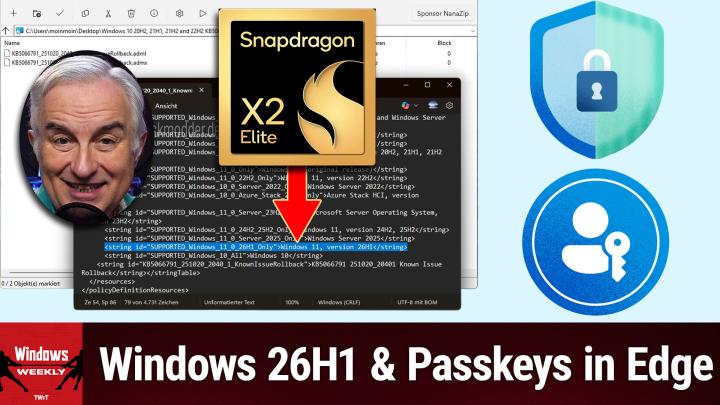
Windows Weekly (Audio)
WW 957: Selectively Transparent - Windows 26H1 Aims For Snapdragon X2 PCs
02:48:13
Windows 26H1 Aims For Snapdragon X2 PCs
Loading summary
Transcript896 lines
- [00:00]
A
It's time for Windows Weekly. Paul Thurat and Richard Campbell are here. Actually, Richard's in New Zealand. He's joining us a little earlier in the morning than he's used to. We will talk about, of course, Microsoft's results and some of the less transparent things that happened there. 26h1 can it be. And Spotify's earnings. How do they make money? Oh, they don't. Okay. All of that and more coming up next on Windows Weekly Podcasts. You from people you trust. This is twit. This is Windows Weekly with Paul Thurat and Richard Campbell. Episode 957, recorded Wednesday, November 5, 2025. Selectively transparent. It's time. Hello, dozers and hello, winners. Maybe it's clear if I say hello, winners and hello, dozers, what I'm talking about. It's time for Win Doz Weekly. Get it?
- [01:05]
B
Ah, yay.
- [01:06]
A
And our international crew of Windows Microsoft observers are here from Beautiful Mexico City, Mr. Paul Thurat. Thurat.com.
- [01:17]
B
Hello. Hello, Leo.
- [01:19]
A
And as usual, his painting is in perfect focus. There's something about that painting. The camera loves it. That's all I'm saying. Don't. Don't worry about it. Don't worry about it.
- [01:29]
B
I'm not super worried about it, but I'm using a. Like a smartphone. It's like it should.
- [01:33]
A
Oh, it should be better. Well, yeah. You know what? Come to think of it, it is better.
- [01:37]
B
I think so.
- [01:38]
A
It is better. And look where Richard is. In Taranga, New Zealand. We live in amazing times, Richard Campbell.
- [01:45]
C
Okay. Yeah. A week later, there's the.
- [01:48]
B
I mean, I kind of like Old Zealand, but this is pretty good.
- [01:51]
A
That's.
- [01:52]
C
Well, the Old Zealand is in the Netherlands.
- [01:55]
A
I love it. Oh, that's right. But that's Z, E E. So I like it because not only did you travel 15 hours in a jet airplane, but you traveled from winter to summer.
- [02:07]
C
Yes.
- [02:07]
A
Yeah. Smart man.
- [02:09]
C
Yesterday, we were down in Mount Manganui at the beach. We did the hike around the volcano, and then we went down to the sandy beach. And my little granddaughter, which is the reason we're down here, brought her parents along. She got her dip in the South Pacific.
- [02:23]
A
Baby's first South Pacific Pacific dip.
- [02:26]
C
Yeah. And also her first flight, which was 15 hours on a 787. Like, start high, my friends. Start high.
- [02:32]
A
So that's actually, you could do it when they're really young.
- [02:35]
C
It's when they get seven months old like this.
- [02:38]
A
So she's probably slept most of the.
- [02:39]
C
Way for the Most part. And hung out with Mom. I. I did that. I did two, like 40 minute. Mom needs to eat. Grandpa gets to walk around the plane with the baby shifts. So she, she did just fine. She's really a happy little kid. And her two cousins, who are three and five here, are just blown away by her. And they're being so careful, right? They're proper chaos monkeys. They're delightful boys, but they've been coached on having a little baby girl in the house, so they're trying to be quiet and they're trying to be gentle. But one of the old, the older one, Tiaki, gave her the. The remote control to the dump truck this morning.
- [03:18]
A
And what did she do with it?
- [03:20]
C
He drove it directly into her father. Now, having no idea what she was doing with it, she just, you know, doesn't understand buttons or anything. But now Tiaki thinks she's the best baby in the world.
- [03:30]
A
She drive a dump truck?
- [03:31]
C
Yeah.
- [03:32]
A
That's impressive for seven months old.
- [03:34]
C
We're just down the hill from Hobbiton, so I think we're going to do the Hobbiton tour at some point.
- [03:38]
A
That's right.
- [03:40]
C
It's outside. Yeah. It's in Matamata, but it's not that far away. And maybe a run to Rotorua, take in the hot springs and things. So we've got a few days and this is vacation. You know, other than hanging out with you guys once a week, I'm pretty much taking the month off, so.
- [03:55]
A
The whole month?
- [03:56]
C
Yeah.
- [03:58]
A
So we call this month November. What do they call it? New Zealand?
- [04:02]
C
November.
- [04:02]
A
Oh, okay. It's just a little confusing that November is, is their spring.
- [04:08]
C
Oh, yeah. No, Christmas is on the beach here because it's flipping hot in December. Right. Like that's, that's just a different dynamic.
- [04:14]
A
But I want to go there.
- [04:16]
C
Well, and I've been pitching to she who Must Be Obeyed about this idea of we could just live summer to summer. Right. I am a citizen. We could have a place down here.
- [04:23]
A
It would be summer all year round.
- [04:25]
C
Summer all the time.
- [04:26]
A
Endless summer.
- [04:27]
C
So she's. I've made. You know, I haven't persuaded her yet, but she's not suffering. Let's be sure.
- [04:33]
A
Well, you two snowbirds, let's talk about Microsoft in particular. I just got 25H2 and already we're talking 26H1.
- [04:44]
B
Yeah, but you're not going to get that.
- [04:46]
A
Oh, good.
- [04:48]
B
So I guess rumors about this for a little while now tied to Snapdragon X2 and the first half of next year And I don't know what this is going to entail, but if you think about what they did with 24H2, there was really a 24H1 as well.
- [05:04]
C
Right.
- [05:04]
B
They called it 24H2, but then they didn't deliver it to everyone else until the end of the year. So they're doing it again but for the X2. So.
- [05:14]
C
Yeah, and I see this as yours. This is. The teams are different, even though they're trying to build the same goal. And so it may. As soon as you say this out loud, I'm like, yeah, of course they are.
- [05:26]
A
So they all do like, like they alternate like, okay, team A, Team B, Team A, Team B.
- [05:30]
C
Or no, I think it's more. They're still. There's a. There's an ARM team that's specializing in the ARM issues and taking advantage of the new chipset.
- [05:38]
A
So this is an ARM only release, right?
- [05:42]
B
Or at least It'll be specifically X2 only release. Yeah.
- [05:46]
A
Oh, interesting. That's the new Snapdragon you saw in Hawaii, right?
- [05:50]
B
Yeah.
- [05:52]
A
That's cool.
- [05:52]
B
Yeah, we don't know what that entails, but the name has since popped up in the release notes for one of the Windows updates that Microsoft screwed up last week. And then the dev channel or the insider program announced that they are moving. They didn't say 26H1.
- [06:13]
C
Right.
- [06:13]
B
But they're moving the dev channel to a new build stream or whatever. Build tree, build branch, I don't know, whatever it is, Beta will soon be moving over to 25H2. Testing. Right now it's on 24H2, so it's clearly going to be 26H1. I mean, it's just.
- [06:29]
C
What else would it be?
- [06:31]
B
Yeah, I mean, that's it. Right.
- [06:32]
C
So it could be slow on it. It'll be 26H2. But you don't know when this machine's going to ship. You know, last time it was June. Like this is barely in the window anyway.
- [06:43]
B
Yeah, but the fact that, look, the name could change, but the fact that they've been calling it 26H1 gives us a little bit of a hint. It's probably the first half of the year, which. June is the first half.
- [06:52]
C
You would hope.
- [06:54]
B
Yeah, I would hope for January. I wanted it for November. I don't, I don't know what's taking.
- [06:58]
C
Dude, I'm ready to replace this machine in a second, but I'll. Only for an X2.
- [07:03]
A
What do we think? Will it be better battery life, faster processing? What's. What's going to be the. What's this pitch?
- [07:12]
B
Yeah.
- [07:12]
A
Versus one better.
- [07:16]
B
It is one better. I mean, no, it benchmarks much better across the board. Graphics are better, CPU is better. MPU is double, I think, too.
- [07:24]
A
Oh, nice. So they're really focusing on the AI?
- [07:27]
B
Well, they're focusing just across the board. I mean, they. I don't know what made them focus on this for V1, honestly, but this.
- [07:35]
C
Was the first time they were trying to build a CPU straight up. Right. Like at this scale. For PCs.
- [07:40]
B
For PCs, yeah.
- [07:41]
A
Well, what do you mean? The X1 was not.
- [07:45]
C
No, the X1 was their first attempt. So now they're making up for everything they had to cut to get it there.
- [07:50]
B
I think they nailed the basic experience across the board pretty well. But, yeah, I mean, there's always improvements.
- [07:56]
A
The X seemed to be a leap forward for Qualcomm.
- [08:00]
B
It's a leap forward for the industry. It's dramatically more reliable than any x86 chip. The performance is incredible, even on the lowest end version, which, by the way, I'm running on this thing here right now. You know, three monitors, external webcam, or Thunderbolt 4 dock, no problem.
- [08:21]
A
So that's because it's a system on a chip, so it's not just a cpu.
- [08:25]
C
Yeah.
- [08:26]
A
So those extra capabilities like the three monitors, that's really a discrete display adapter that's built into the SoC.
- [08:34]
B
That's true, yeah.
- [08:36]
C
Well, what they're doing is finally catching up to what Apple figured out years ago with the M series.
- [08:41]
A
Ironically, Apple 3 monitors were not available on many Apple devices.
- [08:46]
B
Well, right. But I mean, they got there in time and. No, one of the other big things with this chipset is that there's an extreme version that might be called ultra ultra extreme that you can actually have the ram. Like right now.
- [09:00]
C
The bus is high, is wider, it's 192bit bucks.
- [09:03]
B
Yeah. But you can even have it on the die, like, so that will actually dramatically improve the performance as well. So those will be more expensive, obviously. But then you get into that situation where this will never be upgradable, obviously, because it's on the die, but it's.
- [09:15]
A
Apple's in the same boat. It's unified memory.
- [09:17]
B
Yeah.
- [09:17]
C
Yeah.
- [09:18]
A
That means it's faster.
- [09:19]
C
Well, also because the vast majority of machines never do get their memory upgraded and every machine will be faster. Like, it kind of makes sense to do the. What the majority case will be.
- [09:29]
A
Should I, if I'm thinking of buying a PC, wait, for the X2.
- [09:33]
C
It's definitely what I'M doing.
- [09:35]
B
Yeah, maybe.
- [09:36]
A
I mean how long am I going to be waiting?
- [09:38]
B
It's going to be six months I think.
- [09:40]
A
Okay. And that will be time next one year.
- [09:42]
B
Yeah sometime hopefully first half of next year it will probably mirror what they did last year but it's a year apart.
- [09:49]
A
That makes sense.
- [09:49]
B
I'd like it. It's two years. That's the problem.
- [09:53]
C
That's the issue.
- [09:53]
B
Yeah.
- [09:54]
C
They missed all of this year but if they're going to do what they did last year means they announce a build which will probably be sometime in May, April or May ship for June.
- [10:05]
B
And I, I would like it to be earlier than that but maybe we'll see. Earlier the better but okay.
- [10:12]
C
I mean there's some subtle changes like the, the two different kinds of cores in X2. Like they're definitely doing some thinking about the way to improve performance in a single die. Like it is interesting what they're doing here.
- [10:25]
B
Yeah.
- [10:25]
A
And If I get 26H1 on an A Snapdragon X it'll run right? I mean it's not.
- [10:31]
B
Well, we don't know how that's going to work but last year in the through the Insider program you at 24h2 starting in I think it was May on any PC including x86pc. So you could do that if you wanted and we can only speculate right now about features and whatever. There's a pretty good chance this will just be the same exact features we see across 24 and 25 H2 as well. There may be some X2 copilot plus PC specific.
- [10:56]
A
Does Microsoft still use HAL to the hardware?
- [11:00]
C
No, that died in 2000.
- [11:02]
B
Well, well I mean, I mean the.
- [11:05]
A
NT House Old Fashioned I am.
- [11:08]
B
Yeah.
- [11:08]
A
Well the idea was you abstract the hardware away from the operating system so that it could.
- [11:12]
B
No, but that's still, I mean that's still. That's how all systems work right? I mean it's.
- [11:17]
A
Yeah, yeah, yeah. Well yes and no. I mean Apple's abandoning Intel now at the next version of the Apple OS will no longer.
- [11:24]
B
Yeah but they were only able to do that because they had their version of HAL and they were running Army.
- [11:29]
A
Yeah, they had Rosetta too.
- [11:30]
B
So like you know they. I look all we know Apple's working on Risk five right now. So on the day that Snapdragon finally catches up like hey we're switching architectures again. You know, we'll see but well next.
- [11:41]
A
Year I'm going to probably buy an M6 that looks 6.
- [11:45]
C
Yeah, yeah maybe it'll be next Sometime it'll be the fall of next year.
- [11:49]
A
Late next year they're saying.
- [11:50]
B
Yeah, yeah.
- [11:51]
A
I don't know.
- [11:52]
C
Have people actually got their M5s in their hands yet? I haven't actually seen.
- [11:54]
A
Yeah, the M5 shipped the. But just the M5. It's based model and nothing.
- [11:59]
B
Every Apple processor upgrade, it's like massive benchmark advantages and exactly the same in real world. Yeah.
- [12:06]
C
You know I always wait for the actual benchmarks because you know, it doesn't matter what the paper says.
- [12:12]
A
Right, right.
- [12:15]
B
Yeah, no, it's looks good and yeah, a lot.
- [12:18]
A
I mean these machines are kind of overbuilt. Apple actually the big story about Apple this week is that they're going to start selling that cheap version based on the iPhone 16 processor.
- [12:28]
C
Yeah. Well, how many people are buying a new machine because they want a faster processor?
- [12:33]
A
Right. Yeah. This is. You can buy an M1 MacBook Air now at Walmart. Apple sell them for 599.
- [12:40]
B
Well, you shouldn't. No you shouldn't.
- [12:42]
A
The Mac Weekly guy said yeah, you could. Absolutely.
- [12:44]
B
Yeah. But those people are idiots and I'm gonna say they're wrong.
- [12:47]
A
It is only 8 gigs of RAM. It's for.
- [12:49]
B
That's why do not ever buy any computer today with only 8 gigs of RAM. That's ridiculous.
- [12:54]
A
It's for very low end used.
- [12:56]
B
Yes. This will replace that obviously and it will be more broadly available. It's probably going to be great. Honestly, those chips are fantastic.
- [13:01]
A
I mean that's the. I think that's Apple's point is we got a lot of overhead, a lot of headroom rather. And, and we, we can.
- [13:07]
B
It's interesting. They typically keep one of the. Or one or more older versions of things in the market as a, you know, the lower end alternative or whatever. And then so having something that's made specifically, you know, for that. It's probably the mainstream majority of the markets, casual users. Right. I mean. Yeah, I think it's fine.
- [13:29]
A
Most people in general on Windows or Mac are using it as a browser. Yeah.
- [13:34]
B
Yeah.
- [13:35]
A
Maybe getting some email. But even then they're still using the browser to get the email. So I.
- [13:39]
B
That's why Marc Andreessen got it right in 1995 or 6, whatever that was. It's a poorly written pile of device drivers running a browser.
- [13:48]
C
Yeah.
- [13:48]
B
Or whatever. He said something like that. Yeah, that sounds like Windows also Clip Champ and Copilot now. But yeah, pretty much. Actually both of those are web apps. Hilarious. Anyway, yeah, look what they're trying to.
- [14:00]
A
Do with AI is Make it agentic browsers. It's all going to be browser based. That's the, you know.
- [14:06]
C
Yeah. If you care about the cloud. Like the same time we have this huge push towards doing as much as on prem as possible.
- [14:12]
B
Right.
- [14:12]
C
We also have the DGX devices.
- [14:15]
A
Like, by the way, people are a little disappointed with the DGX.
- [14:20]
C
Yeah. Well, you're jumping back to GPT3 and you've forgotten three years ago how basic that was compared to what's going on right now.
- [14:29]
A
Yeah. The DGX is not all that. And it's $4,000.
- [14:34]
C
Yeah.
- [14:35]
A
So I'm glad I didn't buy one. I wasn't gonna, but I'm glad I didn't.
- [14:40]
C
Yeah.
- [14:41]
A
All right, so that's very exciting. We're already in 2026 and that's not, you know, that's. Yeah, I mean, that's what happens.
- [14:49]
B
We're doing the model car thing. It's fine.
- [14:51]
A
Yeah.
- [14:51]
C
You know.
- [14:51]
B
Yeah.
- [14:54]
A
But.
- [14:54]
C
And I would expect that we, outside of the ARM space, we'll be getting all of the same features, but they'll call it a 25H2 or you know, something like that.
- [15:04]
A
Oh, interesting. Okay.
- [15:06]
C
Yeah, but this is a, this is. To me, this is totally the team dynamics. There's an ARM team focused on dealing with Snapdragon issues to build out features. Some new things are going to appear from them and the other teams will see that and adopt them if they think it makes sense. But both teams are contributing to a split code base for a time. And then there will eventually be a synchronization. It'll be a common version because they don't want more than one. But with these early days of ARM on Windows being so important to the company, actually, of course they would put together a team specialized on making sure the ARM implementation goes extremely well. Not this well.
- [15:43]
A
Let's talk about Windows 11. How about that? Oh, wait a minute. That's what we were talking about.
- [15:48]
B
Well, just kind of coming back to the present. Microsoft. So Microsoft last week, just the gift that keeps on giving.
- [15:58]
A
You know, in the transcript it'll say. Deep sigh.
- [16:02]
B
Yeah, well, whatever. I. Well, whatever that was. The two. The. The week d. Tuesday when I wrote up the. I guess it would have been that day. Or maybe it was before that. I'm sorry. Maybe it was the. Whatever it was. Whatever. The, the first time I noticed this, I was like, oh, they, they're changing the, they changed the way they described this thing. It was just called preview update. And I was like, oh, that's Curious, you know. And then the next day they announced, like, we're changing how we name these things. And so they honestly, they did what they did with Windows 11. They oversimplified it. I appreciate the direction they were going in, but as soon as they did this, it admins and people who have to support this were like, excuse me, guys, you need to have the date and the name. That's how we know what it is. We're not going to memorize KB numbers. They then came back less than a week later and said, yeah, you're right, we're gonna. Well, so they're gonna retain the new names, but they're gonna also add the date, which is. Or I should say add back the date.
- [17:04]
C
So this is the schism between consumer updates and. And sysadmin updates.
- [17:10]
B
Yeah, yeah. I mean people, people like consumers don't care about this stuff.
- [17:16]
C
No, they don't at all.
- [17:17]
A
But, but that, but they don't even know.
- [17:19]
B
Well, yeah, I mean, if anyone ever went to Windows Update and looked at what was there, it might be confusing or, you know, until now, I mean, the language is so weird. You know, even this, this was a Windows 10 thing originally, but you know, we used to have version upgrades and then we're all going to be on Windows 10, you know, and we're all going to be in the same version, if possible. There were like 11 different versions in the market, all supported at the same time, whatever that was. We went to the feature update language. There were quality updates, security updates, pretty straightforward driver updates, obviously. Then they started doing the preview updates and it was like, well, this is a non security preview update. It's like, wait, what? The language was just so screwy and so now it's like, yeah, it's a driver update, it's an AI component update, it is a Windows OS whatever it is like a preview update, an actual quality update, meaning a non security update. A security update. Good. Like it's fine. Like it's, you know, it's good. But they lopped off too much. Like they did. They got rid of the date.
- [18:27]
C
Yeah.
- [18:28]
B
And it's like, now we need to know this was October 2025 or whatever the, you know.
- [18:32]
C
Well, and in a remarkable set of coincidences, my guest on Run as Radio also Aria Hanson, the one who tweeted out that.
- [18:41]
B
The one who tweeted that we're going to fix it.
- [18:43]
C
She's, you know, she's the grown up in the room. My goodness. Like she's the every. Everything about update seems to fall in Her Verdun. I'm lucky to get her once a year. Just go how we do it. Because there's been a lot of motion there. And so it's like.
- [18:57]
B
Well, we shipped 192 updates this year. So far we got like 188 of them. Pretty good. The other ones we don't really want to talk about too much.
- [19:05]
C
She's about the update infrastructure because I don't know if you've looked at how many different ways there is to update Windows when you're in systems. It's terrifying.
- [19:13]
B
I think I spend 50% of my life on that topic. Yeah. So anyway, yeah, whatever. It's fine. They screwed it up. It'll be okay. Speaking of screwing it up, last week. Was it last week? I'm losing track of when things are. No, I guess it was last week. Sorry. There was that preview update last Tuesday, the week D update. And if you installed that, you might find that you have duplicate or triplicate even, whatever it is, multiple copies of the same processes listed in Task Manager. It doesn't mean they're actually there. It just means it's displaying it wrong. Yeah. Which I appreciate. I'm working on that Notepad app and I am very good at displaying the name of the previous document but not the current document. So I get the kind of mistake that might be. But yeah, whatever. It's a preview update. That's fine. This is an okay place to make that kind of mistake, frankly. Except that it's going out to the public. Right. So there are probably people installing these things and not realizing what they're doing. But it's not a big one, so not a big deal. It's okay. It's okay. I didn't mention this when we did the 26H1 thing, but with Microsoft's transition to every PC. Is an AI PC a little bit of fun marketing there. I wonder if Copilot plus PC goes away as a brand. So one of the things to look for as we kind of go through the device channel stuff and as it switches over to what will be 26H1 or whatever it is, see if they keep using that language. Right.
- [20:51]
C
Yeah.
- [20:52]
A
I got an idea for your next book.
- [20:54]
B
Yeah.
- [20:55]
A
A history of Microsoft through their marketing code names.
- [20:59]
B
Oh, boy.
- [20:59]
C
Oh, my goodness.
- [21:01]
B
It's like the big book of Microsoft codenames.
- [21:04]
A
That'd be good. I like that.
- [21:05]
B
Just dust that thing off. Yeah. God. I was just making fun of Apple. Apple doesn't do fun code names. And I know someone represents thing from the 80s, right? Well, those are names. I mean, code names.
- [21:21]
A
That's not code. We just don't know because they're so secretive. They might have.
- [21:25]
B
Well, when they come out, it's always Something like that MacBook we were talking about is J100. That's.
- [21:30]
C
Yeah, right.
- [21:31]
A
But they have real. They have code names.
- [21:34]
B
Yeah, I hope so.
- [21:34]
A
They're creative people.
- [21:36]
C
Well, code names are pretty rare in the Microsoft space these days, too. Lots of products just don't get them.
- [21:41]
B
A lot of people just don't like them, you know.
- [21:42]
C
Yeah, it just.
- [21:43]
A
The best use for codenames is to give different codenames to different members of the team to see who leaks to Mark Gurman.
- [21:49]
C
There you go.
- [21:49]
A
And then you got something.
- [21:51]
B
Is this that important? Is it that important?
- [21:54]
A
It was to Steve Jobs. He would do that, actually. Yeah, famously. You're the only one to do that code name. Bye. Pack your bags, you're out of here.
- [22:05]
B
Well, I mentioned the dev and beta changes, and if you are in the beta program on a PC right now, the beta channel, you can temporarily just not install updates. You'll stay on 25H2, but at some point you will be pushed into. I'm sorry, 24H2. You'll be pushed into 25. If you're in the dev channel, you can for a little while. The kind of magic window thing I talk about sometimes, although usually it's with the release version, but there's a window where you can not downgrade but just shift over to beta. Like just in the ui, just click the box. You probably have to reboot or whatever, but it's not going to change anything. I mean, right now you're just the same features, who cares? And then the dev, like I said, is going to move forward to whatever. 26H, we'll see. Dev today is still 25H2. And this new build, which you can get optionally now in beta as well, has that Ask Copilot feature in the taskbar. This is the thing where the search box is going to do, like what browsers do now in some ways, right. Where it's going to route you accordingly based on what you query, like what you type in there. So if you ask it a question, it might bring up like a, you know, a Bing. Sorry, a copilot box instead of the browser, or instead of the. And I just said copilot. And here we go again. It's another week. It's fine. From now on, I'm going to want to install this thing while we're doing it in the next ad break, I should have just kept it to Bing. Anyway, so there's that. This is a full screen experience for Xbox gaming handhelds that are not named Xbox Ally or rag. Xbox Ally starting with A. I actually forget the name. I forget which one it was. It was like MSI maybe or some claw something. I've never heard of this one. But I'm hoping to get this on the Legion go that I'm reviewing and I know it will happen eventually, probably before the end of the year.
- [24:00]
A
Are you playing any games on? I mean, I know you're reviewing it, but is it fun to play on?
- [24:04]
B
You know, I can't explain how this transitioned, but one thing I've noted over the past week because I take notes, you know, when I'm using it. And for the first month or more, this thing was like a jet engine. It was just like the whole time and I was reading. I was reading something someone else wrote about it and. And Lenovo does recommend different power management settings. Whatever. So I've been kind of messing around with that. And the thing I've noticed is like you can just put it on balanced and I don't. It doesn't make any sound anymore. It's actually pretty quiet. Like I was like, okay, great. It's super unreliable. Like I blue screen on this thing a lot. And that I can't explain, but the quality is very good. So like on balance, if I play the now latest Call of Duty, soon to be supplanted, it's between 60 and 90 frames a second, depending on the level and where you are and what's going on in the street.
- [24:57]
A
That's great.
- [24:57]
B
Yeah. And it's, you know, it's. It's like it's 1920 by 1200 or whatever. It's not like it's, you know, 4K but it's. It looks great. And I can't. The other thing I can't quite explain is, you know, like I'm older, right. And so like I don't have them here, but I have these little cheater glasses I need when I'm like, you know, that must be a sight. Yeah. So it's like old guy trying to.
- [25:15]
A
Play in the handheld gaming device.
- [25:18]
B
Yeah.
- [25:19]
C
With his gaming glasses.
- [25:21]
B
I need gaming glasses.
- [25:23]
A
I love gaming glasses. They're on your head, Paul.
- [25:26]
B
They're literally like a CBS $2 special, like plus one or whatever. But I need them to play this thing. The screen is 8.8 inches, which is the biggest of those screens, but it's still not 14 or 16. It's small and I really struggled with this thing for a long time. And again, nothing has changed. This I cannot explain. But lately it's been fine. I've been, I needed, I had, I had a. For a while, forced myself to use it because I have these bigger screens that I prefer.
- [25:57]
A
Right. That's why that was my complaint. It's like, yeah, why wouldn't I just use my PC?
- [26:01]
B
Well, I mean, you could take it off.
- [26:03]
A
I spent a lot of time on the subway.
- [26:05]
B
Yeah, yeah, right. Look, the battery life is not fantastic, but it's. I don't know, it, it, it's a neat example of how good Windows can be as a kind of a gaming handheld. But also the serious problems that still exist with Windows as a gaming handle.
- [26:22]
C
Right.
- [26:22]
B
It's kind of both of those.
- [26:23]
C
Yeah. Last, last time I looked, my Switch 2 hadn't blue screened even once.
- [26:27]
B
Yeah, yeah, yes, yes. Like if you wanted on the plane.
- [26:31]
A
Was that a fun thing to have on the plane? You play a little animal crossing for the Switch 2, that kind of thing. That's what it's for, right? The whole idea.
- [26:41]
C
That's what it's for.
- [26:41]
A
Yeah. You're on the plane.
- [26:42]
C
And I mean, I just appreciate that they're trying to make Windows into a gaming device, but we know what dedicated gaming devices look like, right?
- [26:51]
B
And they're pretty well. So I think this is to like a console, what like nt 3 point whatever it was to a PC. Like it was like, you can see it, it's not quite there yet. Like there's certain things about it that are really good. Like the reliability in that case was fantastic, but the performance was really bad. I mean, it's not that serious, honestly. But I would say I'm not to beat this comparison or metaphor, whatever it is, to death, but the Xbox ally stuff maybe is like NT4. So it's like, okay, we're starting to get there, but yeah, I think we're going to need a rev or two more of the software to get it.
- [27:30]
C
Where it needs to be. We really want one of those X variants of Windows for this type of device because you're not going to be running that one problematic piece of software on this. So lock the snot out of it.
- [27:41]
B
So the processor that it uses is an AMD chip that's part of the Zen 5 family, but it's not the mainstream stuff we get in laptop. So it's designed for these handheld gaming device PCs, but from a gameplay perspective compared to a laptop, I don't Mean like a honking gaming PC with dedicated graphics and awesome stuff but compared to a typical laptop it's in, you know, it's sort of like the X2 or I'm sorry, the Snapdragon X base. Snapdragon X is to the high end version. Like it's actually. There's never been a time when I've been like, oh, this doesn't work as well, you know, it doesn't run as fast or whatever it is. Like it's, it's great. Like it's actually really good.
- [28:26]
C
Yeah.
- [28:29]
B
Anyway, so yeah, so Dead Beta has that, you know they're going to start expanding that to more of the gaming PCs. Every one of my screens just went dark there for some reason. That's funny.
- [28:40]
C
Nice.
- [28:41]
A
It's time for bed, Paul.
- [28:42]
B
I guess I didn't touch the mouse on a two second timer. There's also a preview version of shared audio over Bluetooth LE which is very common now in the mobile space. You'll see that everywhere where you can have one Bluetooth headset or whatever connected to two devices at the same time or whatever, that kind of thing. So obviously that will happen in Windows and then interestingly, or maybe most interestingly they are or they did or they're well, I guess in our process because it's only in the dev and beta channels but they are improving the Prism emulator in Windows 11 on ARM and this is the thing that allows it to run x86 apps, what appears to be full speed if you ever use one. It's fantastic. They didn't really go into a lot of detail but they're adding Support for certain x64 x32 Interestingly instructions that are not currently supported and this opens up the range of apps that can run better, you know, as a result. And again like they didn't say this, but this is for ga. This is pretty much for gaming. Like this is very clearly for gaming and I think pointing to where they want to land when the X2 comes out and have that be a more acceptable platform for gaming than the current gen. So we'll see.
- [29:58]
C
It's cool.
- [29:59]
A
Yeah.
- [30:01]
B
And then there's two kind of two other like Windows related I guess. Microsoft Edge, like all web browsers, has its own password manager. I strongly recommend never using anything built into a browser, but whatever, a lot of people probably do. And now in the latest stable version of Microsoft Edge, you can save and sync pass keys through this thing.
- [30:24]
C
So you really want to lock your password management to a browser it seems like.
- [30:28]
B
Right, so right in the sense that you most often need that with a website. I guess it's okay if you're using Edge on your mobile device as well. Maybe assuming it is there or will ever be there.
- [30:46]
C
I'm sorry, I just don't feel comfortable tying my password management to any given.
- [30:51]
B
Yeah, no, I strongly recommend never doing this. But it's the thing. And look, there is a complexity to pass keys we should all acknowledge, but also a complexity to the system. The OS itself supports passkeys. Windows 11 now supports third party passkey managers, like 1Password, et cetera.
- [31:09]
C
Yeah, and that's sort of thinking like we're kind of at a point now where passkeys can be reasonably used. My only battle with them right now is what passkey manager jumps in exactly.
- [31:21]
B
Where I was going to go. So I had this experience just the other day where I use Proton Pass. There's an app, I don't really need it on Windows, but you use that on mobile and that's how you get it into the apps and websites in browser apps. But I don't. It was like, do you want to use. It was like I had to sign into whatever and it was like, do you want to use a password? Do you want to use a passkey? I'm like, use a passkey. And then this other thing came up and I'm trying to remember, maybe it was Chrome or maybe I don't remember, but it wasn't Proton Pass.
- [31:53]
C
And I was like, who are you? Why do you want my pass key? Get out of my way.
- [31:58]
B
It's like this middleman slid in from the side and was like, and I'll get it.
- [32:02]
C
There's a bunch of them. Right? Like, that's the problem. If any argument I'm going to push back to Bitwarden is like, you need to make it very clear. This is bit warden saying, would you like me to handle this?
- [32:12]
A
I think they do. I mean the pop up says, yeah.
- [32:14]
B
But you know, and often it says.
- [32:15]
A
Who do you want?
- [32:16]
B
Whose pass key do you want to see that? I would like to see. Like, in fact, I'd like to see it one time so I could then turn off the other one. So I never see. Because if there's anything worse than saving a passkey in your browser's password manager, it's using any device, whether it's a PC or mobile device where you have three password managers. So you're on like an iPhone and it's like, do you want to put this in Proton? Do you want to put this in One password. Do you want to put this in Apple passwords like you're an idiot? You know, like, whatever. Like, I know, I want, I just want the one thing, you know.
- [32:48]
C
And, and you made this point in your article, but, and Kev just mentioned it here too. This, this Edge Password Manager is for MSA accounts only. It's not intra.
- [32:58]
B
Yeah, not yet.
- [32:59]
C
That's really evil. Like, that's, that's, that's a main reason not to touch it. If you, if you're one of the few lucky people who doesn't have to live with M365 in any way, fine. But if you aren't, and you probably aren't, you have it to survive your life and you've already had the battle of Am I in my MSA account? Am I in my Entra account? I don't know.
- [33:17]
B
Yeah, I mean Microsoft 3 well, we'll call it Entra to MSA as is Workspace to Google Gmail account. It's like these features go to the consumer version first oftentimes because there's less control necessary. I mean it doesn't have to control. It's centrally controlled, but it's really by Microsoft. Right. So. So it's probably just easier to do it.
- [33:42]
C
I got to write this, you know, sysadmin in the next year and I'm really debating is this the time to start getting serious about passkeys or should we wait another year? Because it's important, you know, the, the attacks are more aggressive than ever before. Password problems can persist. Like this is the. And, and to be clear, this is only valid if you actually then remove the password to.
- [34:05]
B
That's the, this is. Any transition that's anywhere in this sphere is like that. You know, when you talk about password managers, the same thing, Passkeys. Absolutely. Same thing. Passkeys. Now the passkeys are portable. You know, I'm not sure that the spec has actually been ratified yet. But let's, let's.
- [34:20]
C
There are security concerns. Like we're still in the battle, but.
- [34:25]
B
I like that, you know, move along is riskier. Yeah. But yeah, if you are going to go to the new thing because you feel like it's more secure, superior, whatever the reason, great, good for you. But you got to get rid of the old one. And that's the, that's the one people either just don't think about or when they do think about, they're like, oh, I don't know.
- [34:42]
C
That's the one that makes you jump. But, but my point also then is but you know, there's two other strategy on that account for getting back into your account. Right. Like that's right. You know, you also had the I'll send you an email token option.
- [34:56]
B
So that was.
- [34:57]
C
There's a bunch of ways to do.
- [34:58]
B
This related to this and every time I reference this I feel obligated to point out I was with Richard briefly when this happened and then fled the table because figure out what was going on with my YouTube account.
- [35:08]
C
But it was a great day. We had a lovely breakfast without you.
- [35:12]
B
Yeah. I don't have the same memory of it as you do, but it was one of the many things I did after that was start investigating whether we've all used that kind of single sign on capability with like a Google account especially. But if you're in the Apple space, maybe Apple you see that sometimes, obviously Microsoft, you see it sometimes and it's convenient. Right. And you get the benefit of whatever2fa you're using on that account. If you're doing it right. It should be pretty seamless. But if you get locked out of that account. Right. In my case, I own the domain, so it's like Paul.com, okay, great, I can move it to Proton or wherever else. If Google's like, yeah, we're done with you, sorry, you lose all your data, you lose. So what happens to all of those accounts that I've only signed in with a single sign on Google account. Sign in. Right. Like can I still access those? Because that if, if, if you get locked out of that stuff that exponentially.
- [36:07]
C
Yeah.
- [36:08]
B
Expands the pain of, you know, getting locked out of an account. Yeah. And my understanding based on the, the testing I did was no, you can actually get in. You can. If you don't have a password, they can, they'll send you one via email. They'll send you a link via email. Right. I mean there's always that way.
- [36:26]
C
Yeah. And that's almost a good disaster response or disaster recovery plan is. Okay. Before I go remove this password. Let's go. Not use the passkey and get into the account. Like what are my.
- [36:38]
B
Exactly. And listen this, that's a diligence that most people just don't have and myself included. I, I like many people, you know, you kind of react when something goes wrong. You're like, it's the TSA theory of life. Like we're just going to keep reacting to the last bad thing that happened, not thinking ahead to like what might happen next. And yeah, it doesn't always work out. But anyway, I Can't at least I can't stay it for every account type. But I would imagine they're all the same. Like if you're using a single sign on whatever it is, Microsoft, Google, Apple, whatever, you should be able to recover that account if you lose access to your. The actual account.
- [37:19]
C
Like, no, if you're at a place where you need to talk to someone to get this fixed, you are in a world of hurt because getting to talk to any of those tech giants to actually get real support is.
- [37:28]
B
Oh, I never got any real published. The responses. The responses I got from YouTube, which is. I know it's Google, but YouTube were so unhinged and so unrelated to what we were talking about. It would have been funny if it wasn't the most serious thing that's ever happened to me electronically in a long time. And I was.
- [37:48]
C
While trying to relax in Mexico and.
- [37:51]
B
It went on for another week or ten days or whatever. Like it was. It was a nightmare. So, yeah, you don't want to and.
- [37:57]
C
Imagine it, you know, and you just had a dumb account problem if you'd actually had a bad actor acting on you.
- [38:02]
B
I know.
- [38:03]
C
Like it's that much worse.
- [38:05]
B
Yeah.
- [38:05]
C
Although I would argue, and there's very famous memes around this, the system actually works better when you're under attack.
- [38:12]
B
Yeah, well, because that is the thing they plan for, right?
- [38:15]
C
That's right.
- [38:16]
B
I don't think anyone was planning for. Let's not ever warn Paul that something is wrong with his account and then when some arbitrary date passes, we'll just shut him out.
- [38:25]
C
Yeah, it'll be fine. Everything.
- [38:26]
B
I don't think that's the policy, but that's what happened anyway. All right, so yeah, don't use the Edge password manager. It is better now, but don't use it.
- [38:35]
C
And then I'm grateful. The improvement. But it's still not there.
- [38:39]
B
Exactly. It doesn't matter. It doesn't matter how they improve it. There's no way you should ever use that thing.
- [38:44]
C
Binding your passwords to a product.
- [38:46]
A
If you want to use your passkeys on a phone or somewhere else.
- [38:49]
B
Well, I mean, you could get to them through Edge, could register as a password manager on a phone, I believe, and I'm sure enough for passkeys too, but I. What do you do?
- [38:58]
C
It's not the hoop you should jump through.
- [39:00]
B
Yeah. I mean, how many years removed from Windows Phone where you got to be before you wake up? Like, please don't do it.
- [39:04]
A
This use your password manager words. Right. Because it's. And Prototype pass, your favorite. Now uses those pass keys, right?
- [39:13]
B
Oh, my God. Yeah, they were one of the early. I think they were the. I don't want to say what. I'm not really sure.
- [39:20]
A
One password sponsor does that.
- [39:22]
B
The thing. It's not about doing pass keys, it's about doing portable pass keys.
- [39:25]
C
Right.
- [39:26]
B
Like you.
- [39:26]
A
Well, they are if they're in your password manager.
- [39:28]
B
Right. That's the point. Because to the passkey, that's the device. You know, to me, it's on every one of my devices. So it's wonderful. That's becoming, like I said earlier, that that is becoming part of the spec. I. I don't believe that's been ratified yet. But everyone's doing it. Like, it's. Yeah, it's.
- [39:44]
A
Yeah, they. It's. Well, I think Fido left out at first because they were worried about security.
- [39:48]
B
Yeah. You know, I.
- [39:50]
A
But they understand you need it.
- [39:51]
B
Yeah. Because look, a normal human being is not going to go and recreate the same password in every device they ever use. Like, that's ridiculous. Like that. That's where you cross the line between secure and inconvenient. And it's the area where people are like, yeah, I don't care anymore. I'm just not doing it. So you make it portable now. It's like, okay, now it'll work. It's good. The Microsoft Store has a web front end, which is actually pretty. It's fine. There are even links for not all apps, but for many apps where you can download an exe and then it runs a little miniature store instance and a little dialogue and uses the store to download whatever. If you're familiar with the Windows Package Manager or winget, which is like a lot of things like appget or APT get. Right? Yeah. And Linux.
- [40:41]
A
Yeah. APPT get or Homebrew on the Mac and Linux. So it's a Pac man on Arch, that kind of.
- [40:50]
B
It's a package manager. The Windows Package Manager. Winget supports two repositories. One is the Microsoft Store and the other one's the web repository, which doesn't mean the whole web, but the apps that have kind of brought into that system. It's a big, big list. I always sort of wondered. There's been little indications here and there that these things would essentially be part of the same infrastructure and that the Windows Store would essentially be like a graphical front end to winget. Right. Which would be, I still think is a great idea, but they just implemented something that's kind of like a half step in this direction, which I think is really interesting. It's only on the web version right now, but they let you do app bundles. In other words, you go to the store, you would in a package manager or a graphical front end one, and you're like, I want that one, that one, that one, that one. And you could save that as a thing and then you run it and it just installs all those apps. So it's nice. Winget is better because it has the web. I do that in Winget. I run a script, like a PowerShell script. But it's the same theory. Like, I have a list of apps I want to install. I always install the store version when there is one. If there isn't, I'll take it from the web. So the store is just the store. So this won't be a complete thing, but it's a handy feature and it's not in the store app that's in Windows 11 today. But I mean, it will be, right? Of course. It will be like. So you could, if you bring up a brand new computer, run the store, go into your kind of wherever this thing is saved and be like, all right, install all my apps. You know, useful.
- [42:28]
A
Yeah.
- [42:28]
B
And then, of course, yeah, the store keeps them up to date in the background, etc. So it's good.
- [42:33]
A
We will now pause and enjoy the silence. No, we won't, because I'm going to do a commercial. You're watching Windows Weekly. Paul Thurat, Richard Campbell. Paul's in the northern hemisphere. I'm in the northern hemisphere. Richard is in the southern hemisphere.
- [42:52]
C
Third time this year.
- [42:53]
B
I'm barely in the northern hemisphere, but.
- [42:55]
A
Yeah, yeah, you're close to the equator. You know, up here we get the seasonal changes. We're about to enter a cold season, and for that reason, I'm very glad I have my Helix mattress. Our sponsor for this segment is Helix Sleep. If you're preparing for a winter where you're going to spend more time indoors, this would be the time to invest in a new mattress and stay comfortable inside. With your Helix mattress. Your mattress is more than just a place to sleep. It's a place to live. I love my mattress because I've got a Helix Sleep. No more night sweats, no more back pain, no motion transfer, no leaping out of bed saying it's an earthquake when it's just the cat jumping on the bed. Don't settle for a mattress made overseas and then shipped, you know, with low quality, questionable materials and then shipped in a container. Shipped. And then you open the box and it's your house smells like container shipped for weeks. Not with Helix. Rest assured, your Helix mattress is assembled, packaged and shipped from beautiful Arizona within days of placing your order. They actually make it when they get your order right away, just in time manufacture, which means it's fresh. It has the beautiful scent of the desert air. I'm very happy with my Helix Sleep. We opened it up and man, it was great out of the box. In fact, we did something which I would recommend which is go to helix helixsleep.com windows and take the sleep quiz because one of the things Helix does which I think is really perfect is it matches you to your mattress. Are you a side sleeper? Are you a back sleeper? Are you a front sleeper? Do you want you know, what exactly would a perfect mattress say to you because it's different for everybody. Take the Helix sleep quiz and they will match you with the mattress that's just right for you based on your sleep preferences, your needs. Helix really works. In a study, a Wesper sleep study, Helix measured the sleep performance of participants after switching from their old mattress to a Helix mattress. Is exactly what we did and here's what was found. 82% of participants saw an increase in their deep sleep cycle. This is the most important cycle, the one where the brain clears out all those, all that junk, you know, it's, it's so important for your overall health. Participants on average on their helix sleep achieve 25 more minutes of deep sleep per night. On average, 39 more minutes of overall sleep per night. They slept longer, they slept better, they slept healthier. Time and time again, Helix Sleep remains the most awarded mattress brand. Recently wired tested 100 plus. I didn't even know there were this many more than 100 bed in a box mattresses. Number one, pick the Helix Midnight luxe hybrid as the best bed you can buy online. Which one do we have? Lisa, do we have that one? I don't. Whichever one we have, it's perfect. Forbes did the same thing. They tested 90 beds so far this year to find the very best mattress for every sleeper. What do they recommend as their top pick? The Helix Midnight Lux must be what we have. I love it. Go to helixsleep.com windows 27% off site wide during the Black Friday sale. Best ofWeb that's helixsleep.com windows for 27% off of the Black Friday sale. Best of Web this offer ends December 1st. Make sure you enter our show name into the post purchase survey so they know we sent you. And if you're listening after the Sale ends Still. Check them out. Helixsleep.com Windows H-E-L-I x sleep.com Windows I highly recommend it. It's the best mattress we've ever had. Helixsleep.com Windows Microsoft was busy this past week. They had little earnings call.
- [47:00]
C
A little, actually.
- [47:02]
A
You had the early numbers when at the end of the show last week. But have you taken a look at them in more detail now?
- [47:07]
B
No, not at all. I spent 27 hours on this actually. But yeah. So in keeping with this insertification stuff that, you know, Cory Dr. Talks, you.
- [47:20]
A
Wrote a great review by the way of it on, on your website.
- [47:22]
B
I had, I, I swear to God I had to. The thing I wrote originally was easily 6,000 words. I was like, this is a book. So I cut it down and I'm just going to write more about this as we kind of go. But this is an aspect of big tech that he's not actively working on, as far as I can tell. In other words, he talks about the insertifications of platforms mean, like software, services, whatever. As big, you know, as big tech. Kind of sucks all the value out of these things over time I'm starting to realize I brought this up a few times, but that this kind of financial manipulation stuff is a big part of it too, right? That you get to people. It's a very easy criticism of Google to say they're like an advertising company. That's all they are. If you use Gmail and Google Photos and Google Maps and have a Chromebook or whatever, an Android phone, you don't really think about Google that way. But some people who are critics of the company do. And that's a little reductive, but I would say once you are earning, well, 50 billion, but now 100 billion a quarter, as some of these companies are. You're not in the business of making software and services. You're in the business of money and how to best take the money that we have, whether it's actual, like physical, actual holdings, like real money, or just value through the stock market, market cap, et cetera. And that's what you see with OpenAI. It's like this speculative earnings. Yeah. Remember the infamous Microsoft diagram of the little. The orgs all pointing the guns at each other. It's like that, but 100 times bigger with more lines going back and forth. And it's like all the companies in AI, all the money going back and forth between all of them and at some point there will be. And we're probably there right now. There's going to be a line joining every company to every company that no money has come into the circle, but there's a trillion dollars in the circle somehow. And it's all just money we've promised each other. So Microsoft is doing a lot of that and we've been talking about that. I'm sort of focusing it on it or focusing more on it in a.
- [49:39]
C
Sense that, and I would say Microsoft's doing some of it. Like the one that's really doing this is Nvidia. Like Nvidia's playing with trillions and multiplying those trillions.
- [49:49]
B
Yeah. OpenAI is maybe the most egregious in the sense that they have the most number of deals or whatever. Although actually.
- [49:55]
C
And have the least amount of income to compare.
- [49:57]
B
Have the least amount of anything. I mean, at the end of the day, I think I said this last week, Senator or someone kind of said these things are not companies or ideas. And it's like, yeah, I mean there's something to it. Right. I also read some, someone said something like OpenAI today is like Microsoft was in the 90s just making a mad land grab and being super more aggressive than the rest of the world at the time. So this is not the whole Microsoft story, but it is part of the story, right?
- [50:30]
C
Like it is an overwhelming part of the story.
- [50:33]
B
Like it is seems to be consuming.
- [50:35]
C
The company to the point where there's some serious people who are saying this is too much.
- [50:40]
B
Yeah, there are. I mean, look, there have been so many stories over the past year, especially where you get hold of an internal memo or something and it's basically like, look, I get that you're not on board with the AI stuff. Leave because we're doing it. And if you don't want to do it, we're going to find someone who does and we're going to do it. So it doesn't matter what you think, we're doing it. And it's super aggressive. There is a ridiculous interview with Satya Nadella and Sam Altman briefly, although he leaves pretty early in the call with some guy on X of all places. This is two people who are not human beings trying to pretend they are and trying to pretend they're friends. And the first five to seven minutes of this might be the stupidest thing I've ever watched in my life. Painfully bad. I refuse to believe that those people care about each other in the slightest or our friends. It's unbelievable in the literal sense of that word. But in the post earnings conference call in that interview and elsewhere, Microsoft, whatever, they're selling this. They're selling like this is what we're doing, this is why we're doing it. Sorry, why are you doing it? You know, because I don't quite, I still don't quite see it. And you know, look, I know to my mother, to my brother, to sort of mainstream, normal, non technical people, when I start talking about technology, they're like, man, you're talking, it's like you're speaking Latin. I don't understand anything you're saying. And that's what this stuff is like to me. It's like a fungible planet scale fleet. And it's like, dude, learn the language. What are you talking about? Like, and there's this complicity with Wall Street.
- [52:28]
C
Well, so much of it is hidden too, right? Like they're using shell companies, we don't actually know how much they own.
- [52:33]
B
I know, I know. So there's little things that happen. Like this quarter was interesting because OpenAI restructured and in doing that they're not a publicly held company, they're a for profit company. But they will, I mean I'm sure they will eventually have an IPO of some kind. Whatever. I'm sure. Like remember when Google went public it was this really weird kind of, it was so, you know, googly is what we call it, but like just very unusual. And I think whatever OpenAI does will make Google look like the most traditional like good housekeeping company from the 1990s.
- [53:07]
C
But Google was forced by the SEC to go public because they had too many shareholders.
- [53:11]
B
Right.
- [53:11]
C
They fought it tooth and nail though.
- [53:13]
A
And then they did some weird auction.
- [53:14]
B
Yeah, the Dutch auction thing. That is not what's going to happen to OpenAI is my guess. I think they're going to do it as quickly as they can as part of the restructuring though. Microsoft, well, Microsoft, there's always been this line item, this guy, last week I talked about this guy for the Wall Street Journal called out the fact that in their previous earnings there was this thing, I don't think it was in their earnings statement, I think it was in the 10Q which is the SEC filing. It just said net comma other. And it was some, whatever, billion, whatever it was this quarter that was 4.1 billion. And that's just a loss on their investment in OpenAI. They had to report it, which is the only reason they did. The other thing they reported was that their capex spending, which is AI infrastructure build out, is just about $35 billion. A year ago it was $20 billion. So it's like an 80. I think it's 80% ish year over year gain, which is humongous. But I think the previous quarter, off the top of my head, well, I can just look at it, I think it was 24 billion, something like that. 20? Yeah, 24.2. So this is going up and the whole. Every once in a while I write this kind of analysis of the earnings. Well, I write that every quarter, but every once in a while it just takes on a life of its own. A year and a half ago I wrote something that was just all AI. I'm like, I'm just trying to understand where the money's coming from, where it goes, how this makes any sense. I didn't make any sense of it. And this time I'm like, I'm going to focus on this Wall street analyst thing, this call. And this was a bunch of just gross back slapping. Great. Congratulations on the oaks of quarter.
- [54:56]
A
You guys are the best.
- [54:58]
B
It's like, would you say that copilot is a great AI or the greatest AI? You know, it's just ridiculous, right? But there was one guy right in the middle of it, I think he asked, he referenced this $4.1 billion loss, which at the time I didn't understand what it was. I didn't see that anywhere in their financial results. And man, they shut him down hard. Like they shut him down really quick.
- [55:25]
A
What'd they say?
- [55:27]
B
I'm trying to find the exact thing it is because it's. The response to this was so ludicrous. Let me see if I can just find this because there were two questions where they literally said to the CFO of Microsoft, hey, I don't want you to go into the weeds on the accounting stuff like don't worry about the numbers. What? She's the CFO of Microsoft.
- [55:49]
C
That's the job.
- [55:50]
B
Yeah. So this guy asked about this OpenAI thing of the 4.1 billion and he says, he's like, this feels like it's way larger than, you know, what you were saying before in prior quarters. It's like it can't just be your share of the OpenAI loss. Could you describe that and what we can expect in subsequent quarters? This is a. Oh, and whether this signals an accounting change of any kind. This is an excellent question. She did not answer any of those questions. She started off by saying that number was not impacted by the new agreement that they put in place with Open Air last week. Of course it wasn't. That was the previous quarter. The guy on the call knows that he didn't ask that. He says that increased loss. She says the increased loss was due to our percentage of losses and OpenAI equity method. That's an exact quote. Just to be very clear. Also an exact quote because that is not clear. Like what do you. What she says there is nothing or there is not anything there that is not the increased losses from OpenAI. Right. That's what he asked.
- [56:52]
C
Yeah.
- [56:52]
B
So he wanted to know if that was the case. And she said it was. But how's that going to impact future quarters? And are you changing the way you account for this in your numbers? And she never answered those questions.
- [57:03]
C
Yeah. Which obviously they are because the company's restructuring.
- [57:07]
B
Right.
- [57:08]
C
And arguably this is a one time write down which you would never say out loud to adjust for the fact that the equity is measured differently now.
- [57:16]
A
Yep.
- [57:17]
C
But she never said any of those things.
- [57:20]
B
Right. So the correct response to that little bit of nonsense would be like. Right. But the questions I asked were. And then kind of reiterate them. He doesn't do that. He says understood. Thank you. Yeah, like, like he was a school child being admonished by a teacher for screwing up in class.
- [57:35]
C
Did you not see like the envelope passed to him outside of the camera?
- [57:40]
B
I don't know if you were following the.
- [57:43]
A
I think it was a glad handing. But okay.
- [57:46]
B
I just it every other. These other.
- [57:48]
C
Why wouldn't you stick to this?
- [57:50]
B
Yeah. Couldn't you just stick to like we had a great quarter. What's wrong with you, you idiot? We're not here to answer hard questions. Oh, I thought that's why you were here. What are you talking about?
- [57:59]
C
You know, this game has been going on because the market values keep going up and the investors that are on that call are very happy because they're getting their bonuses and they're getting their promotion.
- [58:09]
B
Right.
- [58:09]
C
And you don't say mean things when you're getting what you want. When this bubble bursts and these reports are not going to be so much fun anymore, are we going to get the shareholder revolt now? You aren't getting your bonus and you aren't getting promoted.
- [58:28]
B
Okay.
- [58:28]
C
Aren't you going to be interested why.
- [58:32]
B
I, as a current or potential shareholder in this company? Yeah, I think I'd want to know that. Also, I could be off on this number, but since 40% of our retirement savings are all tied up with these companies, like, I don't know, maybe there should be a little bit of oversight here. Like, I mean, I don't.
- [58:50]
C
Dude, I look at gold Prices and I think I know where a whole lot of retirement money is going right now.
- [58:55]
A
Yeah, it keeps going up, doesn't it?
- [58:56]
C
Yeah.
- [58:57]
B
So yeah, I don't know. Anyway, look, whatever. Microsoft's making a ton of money. We talked about this a little bit last week, but $77.7 billion in revenues, although by the way, well under Alphabet, Amazon and Apple, but whatever. Third, fourth biggest company in the world still, productivity and business processes, revenues off the charts. Both have exceeded $30 billion in a quarter. Personal computing is kind of struggling along, although they're almost at 14 and they indicated that this current quarter will be over moving up as well. They did say that we. Yep, we're going to spend more money on this AI stuff. Don't worry about that. That's going to keep coming like, okay. And then as far as like actual product related information, because I spent so much space just kind of covering in the article I wrote each of these kind of things. I just sort of looked at if there was anything. Is there any like hard data in here that's kind of. No, there is not much. Like they threw things out. Like we have 80,000 customers, including 80% of the Fortune 500. In the context of using Microsoft AI products, whatever that means, you know, in any, you know, in other words, you ran Paint and did like a background removal. You're one of those people, I guess, I don't know. They said things like, you know, we took share. Like Azure took share. Okay, how much share? They said that about Edge, which I looked up and they said it about Bing, which I also looked up because that's ludicrous. Right? Yeah. So the quote on Edge was Microsoft Edge has taken share for 18 consecutive quarters. Well, you can look that up. So if you look at the last, I think it's the last year, maybe I looked at that exact timeframe. Edge did go from 8% to 10.37%. So yes, they've taken share. However, Chrome, the market leader, which shouldn't be really growing at this point, they're roughly 70%. They grew more in the same time period. They grew from 67.5 to 73.8%. So okay, I guess you took share from what? Safari, Firefox, I don't know. Same thing with Bing. It says we took share again in search. With Bing nailing it, I'm like, they'll make be like, tell me I'm going to look. Okay, I'm going to look.
- [61:21]
C
How much was it? Is it 10%?
- [61:23]
B
So Google has 90% share in search. Exactly. The same as one year ago. Yeah. Bing has 4.1% share up from 3.96%. So. All right, 0.5%. Half a percent.
- [61:36]
C
Yeah.
- [61:36]
B
And so I guess they're killing duckduckgo or something. I don't know. I don't know. So I don't know what to tell you, man. This stuff really kind of freaks me out. 155 million monthly active users of Minecraft. Wow, must be that movie, right? I mean, I'm kind of not joking. I bet it was, but I don't.
- [61:57]
A
For Call of Duty. It's probably in the same.
- [61:59]
B
Yeah, we don't know because they're not saying that right now, but it's. Well, yeah, I don't know. I mean that's a good question.
- [62:06]
A
I mean it sounds high, but it doesn't sound that high.
- [62:08]
B
Yeah, that's a good number though, right? It's like you don't want to see.
- [62:12]
A
You don't want people to 20 year old game practice.
- [62:13]
B
Yeah. You don't to want people question it, but you want them to be like, oh, that's cool. Good. That thing's going strong. It's nice. I talk about this sometimes where they're sort of selectively transparent. Like they talked about how the commercial seats for Microsoft 365 grew by whatever percent. They talked about how the same thing happened in consumer, but in consumer this quarter they talked about what the actual number of subscriptions and they didn't talk about the actual number of licenses on the commercial side. Sometimes they do, sometimes they don't. Like that's just kind of whatever, you know, this whole thing freaks me out. I don't know what to tell you. It's just. I don't know. So yeah, there's a lot of stuff going on. Surface disappeared. You don't hear about that anymore. Device revenues are always down. They're going to be down again this current quarter, by the way. Windows revenues from PC makers and also from their own devices business will decline in the current quarter. It's going down. And then they said that in the next sentence, I swear to God was we expect continued momentum from Windows 10 end of support. Continued momentum down. What are you talking about? Shouldn't that be going up? If you're getting momentum, that means to me that people are getting off their Windows 10 PCs and upgrading or are.
- [63:34]
C
They buying extended support? Are you now concerned about that revenue?
- [63:38]
B
Yeah. And where does that revenue get realized? I mean. Yeah, it's kind of hard to say. I also, you know, I think it Was. Yeah, it was. Last quarter, Microsoft for the very first time ever said what the Azure revenue number was, ever. And I made the point at the time I did it for one quarter and maybe two. But you could now go back, backfill, you could backfill and find out when it gets down close to zero. I'd like to see this for Xbox hardware revenues because I don't understand how revenues can keep declining from hardware every single quarter for years. Like at some point, I mean, I know literally you can't go below zero in that because you're always going to have, but can't you? I mean, like at some point we sold three and we took four back on return. I mean, how does this thing change.
- [64:29]
C
Money Red ring of death years, right?
- [64:31]
B
Yeah, I mean, it's bizarre. But so anyway, a lot of information there. But I mean, I really feel just at a very high level that what Microsoft is doing is essentially saying, look, our business is great, our stock price is through the roof, our market cap is amazing. That's all you need to know. You don't need to worry about where it's coming from or where it's going to because we're doing great. I'll just point out this is not the full cost. I'm not a financial guy. I should point that out too. But for a long time there, for several quarters in a row, you could make the case, and we did that whatever Microsoft's CapEx expense was, that quarter was not as high as the profits. And this is not how the accounting works, I guess. But you could say, well, this company made more profits than they spent on capex. They're essentially paying for it with cash. Yeah, right.
- [65:28]
C
And they have big cash reserves.
- [65:31]
B
Yes, but I mean, but as far as you know, you've got whatever money in and out in a quarter, you're still trending this way because you're not spending as much as you made. After all, the cost of business is factored in. Now that's not true because there's a big cost of business factored into all these data centers that I don't think it's actually part of this. But, but ignoring that their profits this past quarter were almost 31 billion and their spending on AA was almost 35 billion. So they are not doing that anymore. Again, you couldn't really do the math, but you could speculate a little bit. Since everyone's doing it. Is there some point in the future where if the spending continues and the profits continue in the same vein, that we just run out of cash, you know, I mean, it's a long way away. They have so much money. But I don't know, I just don't understand this company anymore. I, I really, I wasn't super interested in Microsoft shift to focus on businesses over consumers. Even though they intended to do both, but they just didn't do consumer. Well, the shift to cloud computing was particularly bad for me because you could just feel the emphasis switching away from Windows forever. Like they just didn't care.
- [66:43]
C
Right. And it wasn't the motivator anymore.
- [66:46]
B
And listen, you could find this clip, I'm sure a year ago, six months ago, whatever. At some point I was like, well, at least Windows is in the mix now they're talking about it and it's part of the AI stuff. And now, But I'm thinking now I kind of wish they were ignoring it, you know, I'd rather not have anything to do with any of this stuff. Like I, the funny part is that.
- [67:05]
C
We still haven't seen the new guy really take charge of Windows yet.
- [67:08]
B
Like, yeah, devil or yeah, I mean.
- [67:10]
C
I'm, which I'm kind of excited about. Like, I just want to hear a new voice in this space.
- [67:14]
B
I like him and I, I, I don't know if that means anything for him, doing a good job. But I, yeah, he, I like, he's like enough of an engineer. He's well spoken, he's smart, you know, maybe, I don't know.
- [67:31]
C
He's not ever going to be part of these quarterly reports really. They're going to take whatever reports up to leadership and they're going to, you know, they're going to hood ify it, so to speak, turn it into this.
- [67:43]
B
Exactly.
- [67:43]
C
Song and dance story.
- [67:44]
B
Yeah, I think I made this case last week. You know, even the CEO people don't think this way. But like everyone answers to someone, right? There's always a higher power. And in Davalari's case, like, yeah, the higher power is a much bigger power. And, and there's this going to be corporate initiative that comes down on him. Like, yeah, no, this is what we're doing.
- [68:04]
C
But there's this schism in all of this between what you're actually reporting internal to the company and how the company's going to respond to it and what they say to their shareholders.
- [68:14]
B
Right, right. It's like the lying through omission thing. I think I made the case about this last week again, but the look, I get that in some way every quarterly earnings event is going to be basically marketing. You're Selling the company. You're focusing on the good stuff. If you ever like, we'll talk about Amazon very briefly in a few minutes. But Amazon's earning reports are ridiculous. They talk about money for like two seconds. They mention AWS in passing, and then there's like a 3,000 word list of like all the products they announced that quarter. I don't know if you follow Amazon, but that thing is like a disaster of millions of products. So it's like, hey, we have a new TV show, we have a new Echo device, we sell Pampers in Vietnam now or whatever it is. It's guys, whatever. It's just all milestones and there's nothing to write. It's nothing interesting. And I think that's the point. They're like, look, we're doing great. Don't worry about the numbers.
- [69:15]
A
We're doing great.
- [69:15]
C
You know, everything's fine. If it's fine, we're fine.
- [69:17]
B
Yeah, everything's fine. We like fire. It's warm.
- [69:20]
C
Yeah.
- [69:21]
A
All right, let's take a break. We'll do more. We have some more earnings.
- [69:25]
B
Yeah, we should.
- [69:25]
A
Am. I'm going to.
- [69:26]
B
By the way, if you were bored to tears by what just happened, and I think a lot of people might.
- [69:30]
A
Have been, get ready because there's more.
- [69:32]
B
No, no. I'm going to blow through the rest of it. I'm going to mention it, just to mention it, but I'm going to blow through it.
- [69:36]
C
I'm not going to be like, well, and you'll be fair. All of these companies are playing this game because this is what their shareholders.
- [69:42]
B
I'm going to give you another example of, of a company playing this game.
- [69:46]
A
We talked about this yesterday on Mac Break Weekly. Tim Cook, actually, at one point somebody asked him, oh, what was it? I can't remember.
- [69:56]
B
I know it. I actually, I listened to this conference.
- [69:59]
A
Tim said, I'm not good. I'm not good at default yet. It's like I'm not even going to tell you.
- [70:03]
B
Yep. You're like, huh, I thought you were publicly held company. Am I missing something here?
- [70:11]
A
Is it the. I mean, the SEC, I guess, would enforce this?
- [70:14]
B
Yeah. If the SEC's doors weren't shut to the world and weren't paying attention to anything, because they're not.
- [70:20]
C
I don't know how you tell the difference between SEC closed and SEC not closed. Right.
- [70:25]
B
Yeah. I didn't mean because of the shutdown. I mean, this is the. This organization has been like this for decades. Like, I, I don't know what's going on over here.
- [70:32]
A
If you're an investor before you put your money into a stock for a company, you have the right to know what's going on inside the company.
- [70:42]
B
Yep.
- [70:43]
A
And that's kind of why there are rules about public companies. Public companies reveal more than private companies. Why companies don't want to go public.
- [70:52]
B
That's why this scaling back of transparency that has occurred over the past decade, plus, it's unconscionable. I believe it's illegal. So it's just that. Does it matter if you expede the limit by 20 miles an hour if no cop is ever going to pull you over? No, I guess it. Yeah, it has to be enforced.
- [71:10]
C
The problem is it doesn't stay at 20 miles an hour. It gets faster and faster.
- [71:13]
B
That's the thing. Now we're like 120 miles an hour and it's like, oh, you know, it's a big successful company. What's your problem? Like, what are you asking questions for?
- [71:21]
C
Your pizza got there sooner, by the way. Why are you.
- [71:23]
B
Sorry. So I've referenced this X interview with Sam Altman and Satya Nadella. One of the first things that Sam Altman says, it's disgusting. He says, I just want to. People are starting to question, like, where all the money's coming from. What's wrong with these people? We're doing great. Like, what's wrong with these people is you don't report any of your finances and you have like a trillion dollars of deals. It might be $1.8 trillion, whatever the number is of money you do not have. And then he says, what I want is for those guys to short our stock so then I can see them fail. Yeah. Financially. Yeah. And then he cackled like a Bond villain. And I'm like, I'm sorry, are you kidding me? That man is evil.
- [72:10]
A
So I have the actual quote here. So an analyst asked Tim Cook about Apple's revenue services revenue. Basically, he was trying to find out how much Google pays Apple.
- [72:28]
B
Sorry, you have to wait for the next trial.
- [72:29]
A
Yeah, it was Wamsi Mohan of Bank of America.
- [72:32]
C
Right.
- [72:33]
A
And he said basically, Cook response to his question was, I'm not. We don't divulge. I'm dodging the question intentionally because we don't split at that level.
- [72:47]
B
I mean, I mean, I'm sorry. Really? You don't. You don't have a spreadsheet in your brain.
- [72:52]
A
Yeah, that has those. Exactly. But I ain't telling you, buddy.
- [72:56]
B
That's. That is ludicrous. And by the way, Next quarter when they said they're going to set all these records or whatever, see if that guy's on the call, see if he gets a question in next time. I bet we don't hear from him ever again, you know?
- [73:08]
A
Yeah. I mean, Jason Snell's commentary on this is these calls are almost entirely Apple execs dodging the questions of fiscal analysts. At least Tim Cook admitted it this time.
- [73:19]
B
Yes. So I got to tell you, I listened to the Apple call live. I have since now. Listen to the Microsoft call. I wrote what I wrote based on the transcript. Apple is way more transparent than Microsoft right now. No, I mean way more like those executives on that call were much clearer about what was going on than Microsoft.
- [73:39]
A
Well, at least when they don't tell you, they tell you they're not telling you.
- [73:42]
B
Yeah, well, listen, you got to appreciate the honesty.
- [73:47]
A
Honesty.
- [73:48]
B
I don't think it's right, but I'm.
- [73:50]
A
Not going to tell you that. Sorry, we don't divulge that information. All right, let's take a break. We're going to come back, talk about other companies. We've got AI. We've got a whiskey pick. We got lots of good stuff still to come. You're watching Windows Weekly with Paul Thurat and Mr. Richard Campbell. We're glad you're here. We're especially glad your club members are here. Thank you for supporting everything we do. Club Twit, of course, is a very important part of our overall operation. It allows us to do more of what I think you want us to do. In fact, in a way, I kind. I kind of consider it a vote for the content you hear on Twitter. If you like these shows and you want to hear more of them, you join the club. About 25% of our operating revenue now, which means without it, we can't. We don't operate. So please help us out. You get benefits. I'm not saying we're going to take something for nothing. Your 10 bucks a month gets you ad free versions of all the show. Because I, for one, I know Netflix and nobody else believes this, but I think if you pay us, we don't need to show you ads. Right? You shouldn't have to. So ad free versions of all the shows. You also get access to the Club Twit Discord. I often think of it as the Club Twit Disco. It is the place to be where all the cool kids hang out. Plus lots of fun conversation about all kinds of things that geeks are interested in. You can watch the shows Live in the club and chat with us live. Most of the hosts I know, Paul and Richard, are in there right now. You can also join in on some of the special events we do in the club. There are quite a few of them. We've got Stacy's Book Club. We've got, you know, the photo segment. We've got Paul Thurat's Microsoft Clown Show Corner. No, no, that's not a show yet. Soon, soon. If you would like to support what we do, we would like to have you in the club. Find out more Twit TV Club Twit. By the way, this is a good time. We have a 10% off coupon for annual memberships that could be for you, but also for a gift for the holidays. If you've got a geek in your life and you're trying to think, what should I get the geek in my life? A membership in Club Twitt would be a great gift. We also have a two week free trial, family plans, corporate plans, TWiT TV Club TWiT. We thank you so much for your support of Windows Weekly and all the shows we do here at this Week in Tech. Now let us continue. Oh, wait a minute. Before we do that, the show today brought to you by Framer. If you're still jumping between tools just to update your website, you need to know about Framer. Framer. This is so cool. Framer unifies design, CMS and publishing onto a single canvas. It's more than just a, you know, a web design tool. This gives you everything. No handoff, no hassle, everything you need to design and publish in one place. Framer already built the fastest way to publish beautiful production ready websites. And it's now redefining how we design for the web with the recent launch of Design Pages, a free canvas based design tool. Framer is more than just a site builder. It's a true all in one design platform. From social assets to campaign visuals to vectors and icons, all the way to a live site. Framer is where ideas go live, start to finish. And did I mention it's free. Framer is a free full feature design tool. I mean free, unlimited projects, free unlimited pages, free unlimited collaborators, free. All the essentials. Vectors, 3D transforms, gradients, wireframes, everything you need to design totally free framers. Your entire workflow in one place. You don't need to import from Figma. You don't have any messy HTML to worry about. It's faster, it's cleaner, it's more efficient design more than websites too. It's nice because it's all part of the process. As you're doing the website, you can also create social assets, campaign visuals, icons, site resources, and you don't ever have to leave the tool. So no switching back and forth. Framer head and shoulders above the others because it's, it's not just a site builder. Framer is a true design tool that also happens to publish professional production ready sites ready to design, iterate and publish all in one tool. Start creating for free@framer.com design use the code WW you'll get a free month of Framer Pro. You can see what's there. That's framer.com design. Use the promo code www.framer.com design promo code www. Rules and restrictions may apply. We thank them so much for their support of Windows Weekly. All right, there are there, you know, earnings all come at the same time because the quarter's end, whether it's a fiscal first, second, third quarter, they all.
- [78:53]
B
End at the same time, like Dell, HP and Lenovo. And they're like, our fiscal year runs from April 13th until.
- [79:01]
A
Do they really? So that not everybody ends at the end of the month.
- [79:03]
B
Oh, I didn't know.
- [79:03]
A
That's crazy.
- [79:04]
B
Well, some of them are the end of the month. Adele is the outlier. Dell. Anyway, Dell's confusing because they went mid December. We'll be talking about Dell fighting. I know, it's crazy.
- [79:14]
A
Crazy company.
- [79:15]
B
Yeah. So I just wanted to highlight a company that I've actually kind of praised for being transparent as an example of. You can see what's happening. Like the stuff is happening there as well, and that's Spotify. So Leo, I think just mentioned Club Twit and how you have, you know, some body of viewers and a small percentage roughly is paying, but they're generating.
- [79:37]
A
But they're making the money a quarter of the. It's a quarter of our operating expenses.
- [79:41]
B
Yeah. And that's my experience@ thrott.com as well. Like the vast majority, majority of people don't pay, obviously. And then they see ads and those ads make like $0. And so, you know, whatever. But like it's just the system we have. So they've always done this. And so they separate out their monthly average users into two groups. There's the people who pay the premium subscribers and the people who like ad supported. There are more ad supported than paying. Of course. It used to be a big gap, by the way. It's closing a little bit. But the vast majority of their revenues come from the people who pay. And so you would imagine that as a business, you would want to focus on those people. That's how it works. And so I watch this every quarter and I'm like, okay, I'm not particularly interested in Spotify's business. I sort of vaguely realize they're killing the music industry, but also sort of saving it. I don't know what's going on there. But Spotify is whatever. So they're in this space where, I mean, are they big tech, less than 5 billion euros in revenues? Not even close. Right. So I don't know. But are they little tech? I don't know. They dominate. Right. This part of the market. I mean, I don't know, but I've noticed this before and now I saw it again, which is they mix and match different financial reporting types to make their numbers look better. So, for example, if you're familiar with GAAP versus non GAAP accounting principles, you're not allowed to use constant currency and GAAP accounting, which is the standard most big tech companies, probably most companies only follow big tech. But our tech report both numbers, in Spotify's case, they just mix and match. The reason for constant currency is you're an international company. Their exchange rates, those rates change every day. Sometimes they go up a lot. It just averages that over the reporting period, whatever. It's not really designed to help you lie about your numbers. It's designed to give investors a more accurate look at what the business is like because it's really hard otherwise to understand. You don't want to live and die on an exchange rate because whatever, something happened and whatever, a couple weeks is bad, whatever, okay. But they reported all the numbers in what I would call GAAP numbers. And then for revenues, they were like, it was up 12% in constant currency. And I'm like, that doesn't look like 12% to me. And I don't like when I have to do the math. So some companies, they'll report net income revenues, they'll show you the figure from the year earlier, and then they'll tell you the percent change. And I have to say, I don't ever check that math for the most part, but a couple times lately I've had to because I've looked at the numbers and I was like, I don't think that's correct. And it's not correct if you use the actual same numbers they use for the other things. It went up 2%, not 12%, less than 2%. It was like 1.85%. I was like, wait, What? And I don't know, so I don't like that kind of stuff. But it's the place where we are.
- [82:39]
C
Where we just fictionalize numbers just to make the reports look good.
- [82:43]
B
Yeah. And look, I'm not the smartest guy in the world, and I'm definitely not good at math, but even I looked at the number and I was like, that doesn't look like more than 10%. The other one that they do is the word profit. And I don't mean profit like Mohammed. I mean profit like financial profit. Typically. And by typically, I mean literally is net income. Not every company uses that term, by the way, which is vaguely irritating. But there are different terms that all basically mean profit. But net income is literally cost of business comes out of it, whatever that is. It's everything. Everything that impacts your business negatively. The cost is included in that. And this is not the first time I've noticed this. Spotify, they use a. What's the. I don't think I wrote it down, but the. They're not use. They have a net income, but that's not, by the way, net income. They lost. They lost money. They lost 70, 72 million euros in the quarter. But if you just pretend we didn't have a cost of doing business.
- [83:54]
C
Yeah, we made a lot of money.
- [83:56]
A
If we didn't have to pay any money to the record labels or our staff or just.
- [84:00]
B
Or like. Or rent, property taxes or tax, whatever it is, then they made a profit.
- [84:07]
C
Right.
- [84:07]
B
So did I.
- [84:09]
A
Is that just revenue? I mean, isn't that just revenue?
- [84:12]
B
No, it's. I know. I'm forgetting this. I'm sorry, I don't have the thing in front of me. I'm forgetting the term they use. There's all these different accounting terms that.
- [84:20]
A
Their problem is that record companies determine how much it costs them to do business, and they're not in control of this. And the record companies hate them. So they can change this all the time.
- [84:30]
C
Right.
- [84:30]
A
Because that's who they. That's the publisher of music.
- [84:32]
B
That's who they. Okay, but that's. That's your business. You chose this.
- [84:35]
A
Oh, that's what. That's what they chose.
- [84:36]
B
This is your business.
- [84:37]
A
It's why they try to get into podcasting and then why they're doing audiobooks and all these other things.
- [84:41]
B
Yes, of course. Diversify. A lot of hand waving. Right. So Spotify had a really busy quarter. They launched by their account. I didn't check on this, but 30 new products, lossless audio support, Apple TV app, new Apple TV app OpenAI ChatGPT integration, a deal with Netflix to bring some video podcasts to that service, yada, yada, yada, whatever. But the quote from Danielle Locke, who is still the CEO, he's going to step down on January 1st and become, I don't know, chairman or whatever. He is this guy, I swear to God, this kills me. He said, not only is Spotify profitable, we experienced a profit expansion in the quarter. I don't even. What you lost 72 million euros. What are you talking about? He's talking about operating income. So in other words, if you look at just the business, not the actual. All the things. Like, for example, you could look at if I generate ads or I have money coming in from premium subscribers, you're like, all right, my operating income is that stuff. But it's like, okay, but I have to pay for website hosting. I have to pay for Laurent, who writes my news. I have to pay whatever my costs are. I have cost, right? And at the end, when you factor in all the costs, that thing is profit, but it's also called net income. But technically, the thing he's talking about, which, again, I keep losing, operating income is a form of profit. If you forget, the rest of it excludes a lot of costs.
- [86:17]
A
I guess.
- [86:19]
B
So. I don't know. Anyway, my point is, everyone's doing it. Big, small, whatever. I saw this and I thought, okay, these guys are going great. AMD 1.2 billion net income profit on revenues of 9.2 billion. I'm like, this looks good. The biggest business unit they have right now is Data Center. I'm like, huh? It's weird because I write about this every quarter. I was like, is this the first time this has ever happened? No, this is the fourth or fifth time, but four of the past. No, three of the past four quarters. Data center was, in fact, their biggest business. But of course, year and a half ago, Dr. Lisa Su, their CEO and chairperson, said, you know, we're. We're refocusing on AMD. They're going after Nvidia. And they are. They're not making a lot of inroads there, frankly. And, you know, we'll see. I mean, still plenty of time, obviously. But to me, I look at these numbers, I'm like, this thing's going gangbusters. And Wall street was like, no, you're doing terrible. The stock price fell because they expect bigger numbers because they've been trained by big tech to expect stupid big numbers. Like Google, Alphabet Google, which $102 billion in revenues, $35 billion in net income, profit, double digit growth of both, by the way. 33%, 16% year over year. 72.5% of those revenues did come from advertising. I mean that, you know, whatever. But Google cloud revenues are up 33.5%. This is a business, I think a lot of people wrote off and this is sort of their, like Azure AWS competitor, I guess. So, like that's starting to come together as I guess you would think Amazon, like I said, stupidity. But their profits go up and down dramatically because a lot of their stuff is physical goods and also things like drivers and logistics and whatever. But 21.2 billion in net income and $180 billion in revenues. It's like what Amazon's AWS was 30 billion in revenues. That's up 20% year over year. So I don't have it in front of me. Or do I? Yes, I do. Microsoft, the intelligent cloud business, which is Azure, essentially was also 30, well, 30.9 billion in revenue. So you could argue those are comparable. Although as we're going to say, as we'll discuss in a little bit, OpenAI has signed one of their 118 deals with AWS and it's going to be interesting to see what their reaction is to hosting their stuff on something that is not Azure. Whether there's any difference in either direction, I guess we'll see. In Apple we just talked about a little bit, but 27.5 billion of net income on 102.5 billion. A lot of interesting stuff on that call. Tim Cook talked about Apple intelligence so much, man, you think they were an AI powerhouse, but obviously most of their money is coming from the iPhone and then services.
- [89:22]
A
Well, in fact, we now know that they're going to use Google for Siri, that they're not.
- [89:26]
B
Yeah, and they're going to pay for that, by the way, which is interesting. So Apple this year, I bet 25 billion plus from Google for Google search placement.
- [89:35]
A
That's the thing that Tim would not divulge.
- [89:37]
B
Well, it came out in court, buddy. So we kind of have an idea.
- [89:41]
A
Yeah.
- [89:42]
B
And then the report from Mark Ehrman is that they're going to pay Google a billion dollars a year. So net gain, it's just like the OpenAI Microsoft relationship. A lot of money going in one direction. So they're great. The most interesting thing that they said in some ways was that the current quarter, which of course is a holiday quarter, is going to be their biggest quarter in history. It's going to be out of the park. It could be like 140 or something and it's going to be some stupid number. It's going to be really, really big. So I guess the new iPhone's doing okay. I don't know.
- [90:18]
C
It's interesting that all these companies are AI centric except for Apple.
- [90:22]
B
I know. And honestly, if you, you know, Apple's.
- [90:27]
A
Got a real product. That's the difference.
- [90:28]
B
That's the thing. So what's weird about like I always like this is obvious but you know, Apple makes physical products. These are things that typically do not have high margins. Apple's margins are through the roof. They also do a really great job of selling these things. And you know Apple and Yeah, so Apple and Amazon had roughly the same like profit essentially, but Apple's revenues were like 80% smaller. So Apple's margins are much higher, you know, and look, Apple's product line has become a little complex frankly. You know, the old Steve Jobs chart with the four things, you know, we're kind of past that. But compared to Amazon, they're like a mom and pop shop. Like the fact that they're doing this kind of business is just a reminder.
- [91:14]
C
That Amazon is a warehousing company. Right?
- [91:16]
B
Like, yeah, logistics and. Yeah, exactly. They're like a property manager and a logistics.
- [91:20]
C
Well, any, you know, in reality, of course. And Microsoft is now becoming a property company.
- [91:25]
B
100%. Yeah.
- [91:26]
C
All about data centers. Apple is still the company that just makes technology. Like they don't they.
- [91:32]
B
Yeah.
- [91:33]
C
Their land is, is part of operating costs, not cost of goods.
- [91:36]
B
Oh, there's so much I can't stand about Apple. But I have to say I do, I respect that a little bit.
- [91:40]
C
Like, you know, you know, but we've always looked at the things that they've done as failings. They never got into cloud, even though they needed cloud for their own products.
- [91:49]
B
Right.
- [91:50]
C
And was that really a failing? They did this weird thing where they said they were going to get into AI and did a full smoke and mirrors FUD demo and then just didn't talk about it anymore. And now it looks like it was clever. Like it's literally a hindsight correction.
- [92:05]
B
Yep. And it may be even more clever. And this is like, this might just be a, a timing issue or whatever you want to call it, but because of the data sovereignty has become like this big thing now.
- [92:15]
C
Dude, I just spent a month in Europe. What do you think they're talking about?
- [92:19]
B
Well, they're talking about two things. The stupid cookie pop ups you see all the time like, but then also data sovereignty. Right.
- [92:25]
C
And Apple is really wealth companies, full stop. Right, right.
- [92:29]
B
So if you press, and this has happened, if you press Satya Nadell or anybody at Microsoft on this, it's like, well, we can't actually guarantee we'll do it. We'll, we'll meet the requirements, the all your regulations. We'll try, we'll do what we can. But like at the end of the day, like if the US Government comes down and says, nope, we got to get in there, I don't say no, no.
- [92:47]
C
And arguably this was broken after 9, 11.
- [92:49]
B
Right.
- [92:49]
C
Like the, the, the, the erosion of this idea of, of national sovereignty.
- [92:55]
B
Right.
- [92:55]
C
In exception cases just wasn't, has, it was probably never true, but it's really, really very not true. Like we now say it out loud.
- [93:03]
B
Because data is everything now. And you know, data is not a thing on a piece of paper. It's like in a bit.
- [93:10]
C
Yeah, it's in a giant concrete building with barbed wire around it and almost no humans at all.
- [93:16]
B
Last year when Microsoft, when Apple announced Apple intelligence mid year, one of the things they talked about was this private cloud compute. And of course it's Apple. So you think of Apple as primarily a consumer company, which I guess they are, but was kind of in the context of that it's the, you know, what stays on your iPhone or what happens on your iPhone stays on your iPhone or whatever. And, and it was, look, whether it makes sense or not, it was kind of a unique solution to the, well, I don't want my data going to OpenAI or wherever else. And, and they're like, we, we got it, we're going to solve this problem. You're like, cool. But I think it, you know, that might position them pretty well in the eu, especially where it's really stringent regulations.
- [93:52]
C
Except for that part where they're using third party data centers, which is to say one of the big three or all of the big three. And if that is going to be penetrated, the same rules apply.
- [94:03]
B
See, I don't know what the infrastructure is for the private cloud compute. I don't know if that's all Apple data center stuff. I don't know what their footprint is in different regions, et cetera, et cetera.
- [94:14]
C
Well, and now it's a broader conversation about the Germans insisted that Microsoft set up a German entity to operate data centers in Germany so that they had more control.
- [94:25]
B
Yeah, well that's a very Chinese thing to do.
- [94:29]
C
Well, I argue we saw these waves happen in the 70s as well where governments did assert authority over resources operated by extra national companies. That might happen again.
- [94:41]
B
Yep. Yeah. I mean, no, look, this is a real issue. I mean, I don't know. I don't know that by a location count perspective, I suspect my Microsoft has the biggest international network of data centers or whatever. AWS has got to be up there. Google probably is up there as well. But Apple, I honestly have no idea. I don't know what they're doing. You don't see a lot of it, but I mean they have data centers, obviously, but I just don't know, do.
- [95:11]
C
They or are they just renting time on other data centers?
- [95:14]
B
No, they probably do both. But they have data centers as well.
- [95:18]
A
Yeah.
- [95:21]
B
Okay. I had to try really hard to keep the AI stuff to being pertinent. So there isn't that much but a lot of AI stuff this week. But bigger than that even is this came out of the blue. I woke up this morning and I was like, I cannot believe this actually happened. But Epic Games and Google announced they've agreed to settle their antitrust case.
- [95:43]
A
Right.
- [95:43]
C
What?
- [95:44]
B
This is Epic v. Google, right? This is the one. Google got slapped around at every level.
- [95:49]
C
Can't believe you're talking about this, Mike.
- [95:51]
B
Yeah, well, it's been five years and they lost big time. They appealed every time they could. They went to the Supreme Court. The Supreme Court gave them the middle finger. That was it.
- [96:01]
A
Do we know what the settlement is?
- [96:02]
B
Yeah, it's actually really good. And I have to say this, look, as you might imagine, Google and Apple come to me for advice all the time. And the thing I tell them is I think I would tell them if they listened to me.
- [96:15]
A
Was Sundar, baby, come in.
- [96:18]
B
Yeah, okay.
- [96:19]
C
What do you.
- [96:19]
B
Sweetie, it could be a shame if anything happened to you. So we went through the whole Microsoft thing twice, right? United States and then again in the eu. And the one thing I think that came out of that was don't be found guilty and then have to scrape back from that. You should work proactively with regulators to meet the needs and then move on from there and rescue what you can of what I consider to be sort of ill gotten gains on things like 30% fees and apps and whatever, blah, blah, blah. They don't do that. Right. And Apple in particular is very belligerent.
- [96:55]
A
Right.
- [96:56]
B
So even when they're found guilty of breaking the law and even when they're held, you know they're fined and you know they refused. Like they, they're like they meet the letter sort of and you know, then their months go by and it's like, oh, they're not meeting the requirements and blah, blah, blah, whatever. Time goes by and the whole time they're, you know, they're generating all that income, they're trying not to lose it. But in Apple's case, Phil Schiller, their app store czar, was like, this is unsustainable. We should be lowering these. Tim Cook said, yep, we're not doing that. Thanks for the advice. Not happening. 30%, completely arbitrary fee structure. It's not based on anything. It's not based on the cost. We know that this business is astronomically profitable. We don't know that MasterCard and Visa charge between 1 and 3.5% on similar things. And they're charging 15 to 30% on the same exact thing. And it's like, this is not, this is not in any way fair. So what Google did in their settlement with Epic, which Epic is all for, is say a, we're going to make these changes worldwide, not just the United States. We're going to do this everywhere. We're going to not do it for three years, we're going to do it for six and a half years. We're going to allow everything that was forced on us by the courts, by Judge Donato there, meaning third party app stores. No problem. We're not going to have scare screens. We're just going to let it happen. You can use third party payment systems, et cetera, et cetera. Don't worry about it. No problem. And if you do use us, we're going to lower our fees to 20 or 9%, depending on the type of purchase it is. There you go. And this is the thing. If you go back five years, whatever number of years, the advice I had for these companies was just lower the fee structure.
- [98:37]
C
Just do it, take the air out.
- [98:39]
B
You're still going to take billions of dollars for doing nothing, and no one's going to sue you, ever. And all these companies have said this. They've always been like, yeah, if they just have the fees, like, imagine if they went down to 10%, which is still exorbitant, you know, for what they're doing. Yeah. You're still making billions of dollars every quarter. Just do it. Like, just. And then you can live up to this thing you market about how awesome you are.
- [99:06]
C
Yeah.
- [99:06]
B
You know, but at the same time.
- [99:07]
C
The amount of money you made over the years, the five years of this case, pay for this case dozens of times over.
- [99:15]
B
Yeah. All you got to say is, look, look, we were the scrappy little upstart. We were trying to do something different. Yeah, it's the first major digital computer platform where we didn't build it and hope that developers showed up. We thought this was so good, we're going to charge them for it. It's a crazy reversal of the way things normally happen. I mean, I know there are small platforms like video game consoles, et cetera, that still do this kind of thing or whatever, but that's a different model. Apple's making 40 something percent margins on the iPhone. They're not losing money and making it up in App Store fees. They're just another way to earn money.
- [99:52]
C
Not struggling to survive.
- [99:54]
B
No. So look, they could have just had that adult moment and said it's been 10 years, 15 years, whatever the timeframe. And this app structure made sense when we were building the business out and whatever. Right now it's running itself. We don't actually do any oversight. Anyway, it doesn't matter. We're not spending money on this. It will lower the. If they went down to, I'm going to call it 10% or 12%, whatever, pick a number. This industry would have just been like, nice, and that would have been the end of it. But no, they're all in court.
- [100:23]
C
The good news now is there's case law and precedent set. Apple really is screwed.
- [100:30]
B
Yeah, that's the thing. So every plaintiff in any case against Apple now will always cite the Google application. Yeah. The other thing that's really notable about this settlement is that when Google started the Play Store, which was the Android marketplace at the time, they were like, look, this thing is to bet it's what I said, it's a platform. It's going to benefit our platform. We want developers to be here. We're not trying to make revenues or profits on this thing. We're going to put enough money into it where we'll pay our bills, but we just want people to make apps for Android. And then one day it was like, man, Apple's making a lot of money on the App Store. We should just do the same thing. And literally you could, look, there's a history of this. You could follow it. Like they just do exactly what Apple does every single time.
- [101:16]
C
Well, and I would argue their shareholders demanded it. You know, like they. Yeah, which is, I mean, I would say is an excuse, you know, and a weak one, but it is one you're going to make. And Apple's, by the way, this was totally arbitrary. Remember, they didn't plan set out to make an app store. They were dealing with the reality. Their phone had been Jailbroken, they were about to lose control of it. They released the internal dev tools, which is why they were terrible. And they had to have some place to manage that and that became this thing. And the 30% was utterly arbitrary. But that was also when Jobs had signed the deal for the 99 cent song where he had, he had locked AT&T into a multi year exclusivity agreement with complete control of the network and destroyed them over it. Like it was horrifying.
- [102:01]
B
Yeah.
- [102:02]
C
Now you're going to defend it.
- [102:04]
B
I know, you know, I literally wrote they're defending the indefensible. It's, it's ridiculous. So hopefully I don't think they will, but hopefully Apple will look at this and be like, the writing's on the wall. They've got us in Korea, Europe, United States, wherever else. Let's just do the right thing. Yeah, 30% is the gaming console market because they lose money in the hardware. That's why. That makes sense. This is the agreement in that industry. We're going to subsidize the hardware.
- [102:35]
C
One thing you can say in these companies is they are not losing money on this.
- [102:38]
B
I just made this point. Apple makes money more, bigger margins on hardware than any company ever has, ever. I don't know how they do it. It's incredible. Yeah, good for them. But I mean that thing that more than pays for any app store fees that they have, there's no excuse for this. It's crazy. Anyway, so they're settling. I mean, we'll see. The judge has to accept it. Right? So this has to happen. But the fact that this is going to remember this was a year and a half ago probably. They were in court, the judge begged them to settle.
- [103:10]
C
He's making a deal. Are you guys crazy?
- [103:12]
B
He forced them to talk to an arbitrator. He's like, he's like, you do not want me to rule. Go to a mediator, arbitrator, whatever, and settle. And they didn't, they couldn't reach it. And so now Google has been found guilty again and again and again and again.
- [103:27]
C
Well, and I suspect at some point somebody said to me, you know, the judge can get punitive at some point here.
- [103:32]
B
Well, which is what happened with Apple because Apple got off with a relative slap on the wrist against epic. But then their belligerent non compliance thing, and she was like, you know what, screw you here. We're giving everything away. So you know, like that's, and that's what I mean, work with regulators proactively. Right. So when you see like the DMA in Europe. And different companies respond differently. Like, Microsoft, for all their problems, has been pretty good about this stuff for the most part.
- [103:58]
C
Right.
- [103:59]
B
They've worked with the regulators. Like, all right, what are we going to do? We do it. Apple's like, nope, nope, nope. All right, here's this stupid thing you asked for. And it's like, this is not what we asked for. It's like when they did the video in the Microsoft trial in 1999, or whatever you were, they pulled Internet Explorer out of Windows as the judge told them they had to do. And it's like, oh, it doesn't even boot anymore. Oh, I told you so. And he's like, you thought that's what I wanted? You thought that met my requirement? Like, you know, it's like, this is the spirit of the law versus the.
- [104:28]
C
The letter.
- [104:29]
B
The letter of the law. So anyway, that's fascinating. I never saw this coming. I think that's fantastic. And then we have OpenAI, the world's most successful company. Well, I mean, someone in the financial industry actually did some math and it was basically that given Microsoft's 27 point whatever percent ownership in the company, which was 32.5% in the previous quarter, Microsoft lost $4.1 billion. That means.
- [105:00]
C
That's the write down for that correction.
- [105:02]
B
Yep. So that means that OpenAI lost at least $12 billion in that quarter. It's like $12 billion. I'm sure they lost $120 billion. What are you talking about? So, yeah, I mean, and this is the thing that Sam Altman was lashing out at. He's like, you don't understand. We have all these Enron deals up in the air. He's like, everything's like, look at all the big numbers.
- [105:27]
C
Do you really say Enron?
- [105:28]
B
No, I did. I'm sorry, sorry, sorry. I'm paraphrasing. That was not an exact quote. Please.
- [105:33]
A
I was thinking WorldCom.
- [105:36]
C
Yeah, yeah.
- [105:37]
B
You know, like, I think I made this. I keep repeating myself, but I think I made the case that, like, it's. You can't call it a pyramid scheme because a pyramid is a simple shape. This is like a, you know, like an octopus of like, numbers, you know, and let me see if I can find this thing. I think there's a. No, it's not in here. I guess somewhere I had written the. Maybe it is. No, I think they have now floating out in the world, I believe. I apologize if this is incorrect, but I believe that it's like trillion. Like 1.8 trillion. I think in promises, you know, like money's going to go in different directions.
- [106:14]
C
Is that in the gap? Is that part of generally accepted counting practices?
- [106:18]
B
I don't think it's generally accepted Promises. Yeah. Promise.
- [106:22]
A
I like that. That's what GAPS stands for.
- [106:24]
B
That's what gaps. Generally accepted accounting. Promises. Promises. I mean I'm not an accountant. I don't think that's what it stands for.
- [106:32]
C
I'm pretty sure. Pretty sure.
- [106:34]
B
Anyways, I thought that was kind of interesting then. This isn't related to anything, but I didn't know where else to put it. Microsoft announced Yesterday that Net conf, which is a virtual three day conference for. Net is next week. So this is the 11th to 13th. This is where they're going to launch Net 10.
- [106:51]
C
It's also the place where they launched Net 9 the same time last year and Net 8.
- [106:55]
B
You can go back several years in.
- [106:57]
C
A row now there's a sneak up on us. I'm not allowed to talk about it on Net Rocks. One would speculate sometime in November.
- [107:05]
B
Yes. And this year at least it's not at the same time as Ignite. That's nice. I think it's 24. Seven over those three.
- [107:13]
C
Yeah. They run three days straight.
- [107:14]
B
They go to commute. Yeah.
- [107:16]
C
They do a day of the team and interviews and things like that. And then a day of community stuff. It's really done in. Conf is lovely. And I've, I've had the opportunity to do like a four hour shift.
- [107:28]
B
Yeah. You did a part of the live feed. Was it last year?
- [107:33]
C
I gotta tell you, like the crew works really seriously. Yeah. But we really do have a ton of fun with it because there's, we have so much time. Right?
- [107:42]
B
Right. There's also like look, they're gonna hit all the core thing like what's new in C this is going to happen.
- [107:47]
C
Right. Like nobody knows, Nobody's surprised.
- [107:50]
B
You know what? Yeah. But there's also some fun stuff. Like I'm sure Scott Hanselman is behind this, but there's going to be like a Commodore 64 session. Right.
- [107:58]
C
That's absolutely Hanselman all the way.
- [108:00]
B
Yeah. 100%. Like I, I, you know, it is like I can't wait to see whatever that is.
- [108:04]
C
Dude, he, he brought the, the eight at the Altair on the stage for the keynote at my show in Orlando and it was hysterical.
- [108:13]
B
And it was a real one. Right. Not a, it's not an emulator in a box.
- [108:16]
A
The one I have behind me, a real one.
- [108:17]
B
It's not like Some loser might have.
- [108:20]
C
But it was a mini.
- [108:23]
B
Some wannabe of some kind.
- [108:25]
C
But it has an SD card in it, so, you know, there's been some hardware improvements.
- [108:28]
B
Yeah, yeah, yeah. Well, the new Commodus 64 is an HDMI, too, so.
- [108:32]
C
Yeah. You know, as it should.
- [108:34]
B
By the way, someone just posted the show notes that the Louvre's video security password was reportedly. Louvre. Louvre.
- [108:41]
C
Yeah.
- [108:41]
A
Make sure you do the capital L.
- [108:43]
B
Though not even Louvre, like 1, 2, 3, or.
- [108:48]
A
Hey, who can remember a password so good. It's just a video camera. Oh, my goodness.
- [108:54]
B
Anyway, everyone's making a friend of France.
- [108:57]
C
But my Jeff friend, Jeff Fritz runs.net conf he works incredibly hard, and those. Those guys are all. But it's a great party every year, and I always have a battle on should I be home to be able to be part of that at the.
- [109:09]
A
You know.
- [109:10]
C
Yeah, stay on site with those guys. Or am I out in the world doing a thing? And my granddaughter won this year, so.
- [109:15]
B
Okay.
- [109:16]
C
Not upset. I'm also missing Ignite for the same reason.
- [109:19]
B
Yeah, that's okay.
- [109:21]
C
Yeah. Yeah.
- [109:25]
B
Oh, boy. That's funny.
- [109:27]
A
All right. Do you want to take a break and then talk about the Xbox?
- [109:30]
B
Of course.
- [109:32]
A
Okay. Well, that case, you're watching Windows Weekly. Paul Thurat, little Paulie Thurat, and Mr. Richard Campbell from Taranga, Tauranga, Taronga, New Zealand. Our show today, brought to you by One Password. One Password. You know, One Password. We just talked about One Password. Great Password manager, but it's more than that now. They've announced something called a1Password Extended Access Management. And if you're in it, you need to know about this, because this solves a massive pain point for every IT professional. In fact, more than half of IT professionals say the biggest challenge of their job securing SaaS apps. Does that ring a bell? Of course it is. With the growing problems of SaaS sprawl and shadow it, it's easy to see why SaaS is becoming a problem. AI just added to that, right? How many people are, you know, sending your big important company data out to, you know, ChatGPT or whatever, and it's because it's in the browser. It's hard sometimes it's hard to know what they're doing. Thankfully, TrelicaSync can solve this. They can discover and secure access to all the apps your people are using. Managed or not. Trellica. That's the name. You got to remember this. T R E L I c a trellica by 1Password inventories every app in Use at your company everyone and then pre populated app profiles and they have it for everything. Assess SaaS risks, lets you manage access, optimize, spend and enforce security best practices across every app your employees use. Even those shadow IT apps, the ones they're hiding, the ones they've got the boss key on. Right. Manage shadow IT securely onboard and offboard employees. That's a nice side effect. And meet compliance goals and all with Trelica by 1Password a complete solution for SaaS access governance. This is just one of the many ways that extended access management helps teams strengthen compliance and security. And of course it all starts with 1Password's award winning password manager. Trusted by millions of users at over 150,000 businesses globally from IBM to Slack. And now 1Password is securing more than just passwords with 1Password Extended Access Management. And of course 1Password's absolutely secure. That's job one for them. ISO 27001 certified. They have regular third party audits and the industry's largest bug bounty. That's really important. Just ask Steve Gibson how Important that is.1 password exceeds the standards set by various authorities. They're a leader in security. Take the first step to better security for your team by securing credentials and protecting every application, even unmanaged shadow it. Learn more 1Password.com Windows Weekly that's 1Password.com Windows Weekly it's all lowercase. And if they ask you, say hey, we saw it on Windows Weekly because that helps us out, I guess. If you go to that website that, that does it for us. Please use that address. 1Password.com Windows Weekly Xbox Time Lil Paulie.
- [112:59]
B
Yeah, it's going to be a big month for Xbox. Not for hardware sales. Just kidding. But lots going on. New Call of Duty game coming out in I think next week soon. But that game, Black Ops 7 and then five other games are going to be day one on Game Pass in November with an asterisk because you have to have ultimate or the PC game Pass subscription to get that. And you will pay a pretty penny for ultimate unfortunately. But so Black Ops, you know, we'll see. That's obviously a big one, but you know, Sniper Elite Resistance is in there, Lara Croft and the Temple of Osiris and then Call of Duty. So Call of Duty is.
- [113:44]
C
I mean we know how expensive all the Ultra Ultra is, but this is a bunch of day one games. Like if you had to buy them. Does this pay for a year?
- [113:55]
B
It pays for. Well, yeah. Oh, well, if you wanted all six of them, yeah. I mean, yes. I don't know who might want all six of those, but yes. Yeah, so I might. Let's say I wanted three.
- [114:05]
C
Who takes on a game a year? Maybe. Yeah, no, but.
- [114:09]
B
So if these games are 60, $70 depending on the title and maybe you wanted three of them. So let's call it 60 is Easy. 180 bucks and then that's half a.
- [114:17]
C
Year of ultra right there.
- [114:18]
B
Yeah, yeah, yeah.
- [114:20]
C
So this, all this math almost works except you know, there's still the top tier games.
- [114:26]
B
I just showed up. I think there's a, a mental block over a certain number.
- [114:30]
C
You know, it's too big a number.
- [114:31]
B
It's too. It's more than any version of Netflix. It's more than any version.
- [114:35]
C
Wonder about the right. How many right gamers are there out there?
- [114:38]
B
Yeah, I just want to know. I still believe they price this so no one would do it. I think that's the point. It's like too great. Let's just not do this. We can't step it back, but we can make it so expensive. Just no one will do it.
- [114:51]
C
And if they do, then we get to collect a bunch of money.
- [114:53]
B
Yeah, I mean, so one thing I like, so I'm not. I don't pay for this, right. So I threw some, I don't know, explain this. I guess I technically do pay for it, but I have so many months prepaid, like on my account. Like I've gone out as far as you can go. Like I think it's like three years or something. Like I'm never gonna see this cost increase. But if November 1st or December 1st, whatever came and I had to pay 30 bucks for this thing, I would definitely go down some level. And the math for me would be like, look, okay, I'm gonna buy Call of duty. Okay, so that's 60, 70 bucks. And then it's like, well, what am I getting out of the rest of this? And like I would probably go down pretty far. I don't have to face that question right now. But I wouldn't pay for it.
- [115:39]
C
It's always the debate of the relationship you have with gaming, like how important are new titles to you? What are you doing?
- [115:45]
B
But different things fundamentally. Unless someone figures out game streaming in a way that actually makes sense for every type of game, you can actually play Call of Duty and the latency is fine.
- [115:55]
C
You have to defy the laws of physics to make this happen. But yeah.
- [115:58]
B
Yes. So right. So assuming that happens. And by the way, I think that's what Sam Altman is promising. So it's possible a trillion here, a trillion there.
- [116:07]
C
Pretty soon you could just alter the physics exactly.
- [116:09]
B
Right. We're actually going around the sun the opposite direction now. It's fine. I mean, you know, then you could make the case like, okay, this is a little bit like Netflix or Spotify where you have like access to giant collection. If you could have instantaneous or near instantaneous access to games. Okay, you can make a case for it. But these are big games. These are so big. Well, at least the Call of Duty games where sometimes just randomly I'll turn the computer on. It's like you have a 60, 80, 100, whatever gigabyte download. You're like, what? And it's not even the game. It's like, it's just an update to the game.
- [116:43]
C
Yeah, well, and the space on your device, can you absorb this?
- [116:47]
B
Exactly. I do not want that. So if this was like an instant on thing and, and it just worked, we could talk.
- [116:54]
C
But that's one thing.
- [116:55]
B
But no. So in this case my answer would be, well, I'm scaling this way down and I'm just going to buy the game I want. You know, that would be how I would do it.
- [117:02]
A
Yeah, yeah.
- [117:04]
B
All right. So we also got the October update for the Xbox for Xbox on October 30th. So it came a little late in the month, but big update for Xbox Ally owner. So they've made. I can't say I actually understand this, but I know ray tracing and then they have like graphics shaders or image, I guess it's image shaders. There's a new advanced shader delivery feature which will preload the game shaders during the download process. So games now launch 10 times faster. So this is actually, I believe this is the issue I see in Call of Duty where some updates actually it has to sit there and regenerate the. I think they're shaders. And it takes sometimes it takes like 20, 30 minutes. Like it takes a long time. Interesting. So this and Black Ops 6 will be one of those games. Gears of War is reloaded, Forza Horizon 5, you know, yada yada. So a bunch of Microsoft games. So Outer Worlds 2 which just came out last week is going to be one of those games as well. And then of course third party developers can use this as well. And then outside of that it's minor stuff like if you are on a console, there's this concept of game hubs that is just like a full screen experience for an individual game with different things you can do in there. They've Added a few new modules from developers for developers in there. And then they've added more games to that game streaming collection you get through Xbox cloud gaming, which by the way, now spans all of the subscriptions. Right. And now there are over a thousand cloud enabled games in Game Pass. So that's pretty good.
- [118:37]
C
Yeah.
- [118:39]
B
And then just two quick things from outside of Xbox, Nintendo announced their earnings. Nintendo is one of the companies I struggle with for earnings because of the yen thing. And I'm again, not a money guy, but I feel like yen is like 20,000 to one or something. It's like this crazy math, you know, it's. Yeah, I'm joking, but it's stupid and I really struggle with it. But. But the thing I don't struggle with is these guys have now sold over 10 million Switch 2s.
- [119:06]
A
Yeah.
- [119:06]
B
Get to remember, this thing's 450 bucks, right? So it's more expensive than the, the.
- [119:10]
C
Most expensive Nintendo device ever made.
- [119:13]
A
You have a Switch too, right, Richard?
- [119:14]
C
I don't.
- [119:15]
A
You don't have the new one, you have the old.
- [119:16]
C
No, no. They. The girls have mine.
- [119:19]
A
I have one, but I'm trying to decide. It's hard for me not to buy the Switch 2.
- [119:23]
B
So, you know, they did some things well with this, right? Like obviously it plays most backward. You know, it's mostly backward compatible. It's smart. It's more expensive. That turned out being pretty smart. They haven't hit, like, unlike Xbox, they haven't hit that ceiling where people are like, oh, I don't know, like, what's going on here? This is going so well. They've raised their estimates now for both revenues and units for their fiscal year, which ends at the end of March. So previously they expected to sell 15 million switch 2s. Now they expect to sell 19 million.
- [119:53]
C
And they're still playing the old model of. We make exclusive games for our platforms.
- [120:00]
B
Oh, my God. It reads like an alternative universe. Yeah. This is not my area, right? Like, I don't. These are not my kind of games. But you read like Mario Kart World, King Kong Bonanza, bananas. Like bananas, you know, and you're like, yeah, okay, whatever. But that Mario Kart World, that thing sold almost 10 million copies all by itself, you know, I mean, these things are going gangbust, like.
- [120:24]
A
Yeah.
- [120:25]
C
So they're doing great, I guess. I think the rest of the console market, like all these guys have to look over there and go, what are we doing so wrong?
- [120:32]
B
I know. Well, look, this is something other companies can't replicate. They're Sort of the apple of the space in the sense.
- [120:38]
C
I was going to say use the exact words.
- [120:41]
B
Yeah, they have a Disney like Persona of characters that are kind of cartoony and, you know, 40 plus years.
- [120:48]
C
There is no Call of Duty on the Switch.
- [120:51]
B
No, I mean it should be. And there probably will be first person shooters though.
- [120:54]
C
I mean, it's not, but they're always cartoony.
- [120:57]
A
Oh, really? Okay.
- [120:58]
B
Yeah, Well, I guess so. Xbox has talked about bringing Call of Duty to the Switch, although you'll notice it has not happened.
- [121:05]
C
No, you got to tell. You got to get past Nintendo's requirements on that one. Good luck.
- [121:09]
B
Yeah, yeah.
- [121:09]
C
And I would be disappointed if they did it. I could see a big company, but I'm not going to part of their distinction.
- [121:17]
B
So Call of Duty has been insertified this year and I want to be super clear about what that means because this isn't like, I just don't like where it's going. Like, I don't like that I play the same game every year. No, it's not that. I don't mean that. Like, that's a fact too. But like, that's not insertification. It's just, you know, they stuck to something that works. No, the insertification bit is they let you buy these skins so you can run around like Beavis and Butthead or Chucky from those stupid horror movies in the 1980s. And. And they say things in those characters voices while you're playing the game. So you're playing this military shooter and there's this giant cartoon head going behind the hedgerow or whatever and you're like, I guess I'm going to shoot that thing in the head. Look at that. It's like a balloon. But the thing is, I don't want to see that junk. But these are in app purchases essentially, right? So Seth Rogen, who's like this fat comedian actor guy is one of the characters you can be. He's running around going, that wasn't in my contract. Like, what? What? So the thing is, it's funny just as you were saying, like other companies can't replicate, etc. The thing that occurred to me was some of the weirdness of these. I don't call them skins or whatever you're buying is that people would get these guns where when you shoot them, they'll turn. Like sometimes it will turn like a fire hydrant or like a. It's stupid. It's like this. It's nothing to do with military shooter. Like, it's just dumb stuff like cartoon like flowers Will cascade out of the explosion. And I was like, actually, maybe that helps him get on Nintendo. Right? We'll turn this into a fun game. Like when I was younger and I was. I would play Doom, like the original Doom on my friend's computer and this little kid would sit in his diapers on my lap and he would be like, bad guy, fall down, bad guy, fall down. He had no idea what was going on, right? And I was like, yeah, that's the Nintendo version of this game. It's like, I'm not killing him, demon. I'm this. We're just knocking them over. It's fun. And I don't know, maybe. I don't know, that sounds like a terrible idea, but maybe. And then I don't follow the PlayStation Market too, too well, other than the fact that I know they're killing Xbox, the bastards. But they have their own online services and subscription services and game streaming, cloud streaming. And I believe to date, the only way that you could stream a PlayStation 5 game would be from your console to. To one of those little. It's like a handheld, but it's really just like a remote connection to the.
- [123:38]
C
Price to the meme machine.
- [123:40]
B
Yeah. So they just enabled actual streaming from the cloud. You have to be a PlayStation plus premium subscriber. Right. Which its name suggests is not the $5 a month one. You have to have that handheld thing, which is ridiculous. It's the PlayStation Portal remote player and you have to have bought the game.
- [123:58]
C
Right.
- [123:59]
B
Actually, am I right about that? Actually, I'm sorry, that might not be true. That part I'm not sure of because again, I don't really care. But the point is they're enabling actual cloud streaming. So you're not streaming it from like an install on your PlayStation, you're not streaming it from the cloud, but you're.
- [124:13]
C
Required to have the PlayStation. And it is in the processing loop probably.
- [124:17]
B
Yeah, yeah, yeah, yeah. So it's like a $200 device that's essentially a screen jammed inside of a hand controller. And then. Yeah, you need a high speed connection, of course. But okay. I mean it's. That's interesting.
- [124:33]
C
Yeah. You would have 50 to 50 megabit connection in your own over wi fi. Good luck with that.
- [124:38]
B
Yeah, right. Yeah, yeah, yeah, yeah, yeah. Anyway, this is this the first week. I haven't had any like overtly horrible news about Xbox in a while. I think it is. Is. It's been a while, you know, it's been a tough year.
- [124:54]
C
Sometimes when you're circling the drain, you get out on the outer lip for a while.
- [124:57]
B
It's like you're sailing, you know, you just like get stuck on the side and everything flushes down and you're clinging on there like, I'm gonna be okay. Don't wait for the flusher.
- [125:06]
C
Yeah, yeah. Somebody might put the plug back in.
- [125:08]
B
I don't know.
- [125:08]
C
There's ways back.
- [125:09]
B
The neighborhood comes in. She's like 30 margins.
- [125:12]
C
Yeah. We're on the high edge of the circle there.
- [125:16]
A
Let me show you. Take a break. We're going to get to the back of the book in just a little bit. I did want to show you.
- [125:21]
B
Oh, is this that thing? Is this that e. This is that thing or what do you call it?
- [125:24]
A
It's the aura. The new Aura frame. Yeah. Our sponsor. Whoops.
- [125:28]
B
I love this. I love the way I wanted.
- [125:30]
C
I think I need one.
- [125:31]
A
I just got a rave review by the way. This is so. This is. Yes, this is the aura.
- [125:36]
B
Yeah.
- [125:37]
A
E. Ink frame. I. I really like it. Let me tell you.
- [125:41]
B
Yeah, this is going to be the. Where this market needs to be.
- [125:45]
A
So it would. Here's the idea is basically this looks like a framed photo. A print on your wall. Right. It's kind of hard to tell here because the lights are very bright and stuff. But it's not. The photo changes. I have it set and I think this is what I would recommend to change overnight so that every morning I get up and there's a new photo. This is the Aura Inc. You know, Aura, I mean, Aura is consistently named as the best digital photo frames out there. But this is a new thing that's kind of not digital in a way. It's their all new cordless. Notice, like the magicians, there's no wires. Color E. Paper frame.
- [126:28]
B
Yeah, no, it looks awesome. Like it? Yeah.
- [126:31]
A
I mean it's not. It doesn't look like an lcd, but I think that's kind of the point.
- [126:35]
B
No, that's literally the point.
- [126:37]
A
Yeah, it's. But it's. Yeah, they're super smart, what they did. There's also a built in very subtle light on it. So I mean, it's hard to describe. You gotta see it in person. Or maybe I'll show it to you like this. It's their first ever, by the way. They have buttons on the top that you can change the image. I'll change the image just to put some different. It looks great, by the way. With. I take a lot of monochrome images so it looks great with black and white. Meet Ink Aura's first ever cordless color e paper frame featuring a sleek 0.6 inch profile and a softly lit 13.3 inch display. Ink feels like a print. It functions like a digital frame and perhaps most importantly, lives completely untethered by cords. With a rechargeable battery that lasts up to three months on a single charge. Unlimited storage and the ability to invite others to add photos via the Aura Frames app. It's the cordless wall hanging frame you've been waiting for. So I've changed it now, and this is. There's Lisa and her son Michael. You can change it every. Every other hour if you want. But I. The whole point of this is it's calm and, you know, it's also what people have been asking for. No cords. So a lot. If you have a digital frame, the LCD ones have to be plugged in, right? Which means you've got a wire. When you hang it on the wall, you got a wire. This has a rechargeable battery. I have not charged it since I got it weeks ago. They say it lasts up to three months on a single charge. That will depend on how you can change the image is another reason like to I just change it overnight. It does have unlimited storage and the ability to invite others to add photos via the Aura Frames app. This is the cordless wall hanging frame you've been waiting for. And I love the Aura app. That's one of the reasons Aura is so popular. The app is very clean, very easy to use, and it makes it really easy. For instance, sending one to my mom. She's in, you know, the nursing home. And because she's got Alzheimer's, the modern what's going on today is hard for her to kind of grasp. But when I put the old pictures. So we have all the old family slides. There's more than a thousand of them. And we used to have slideshows. You know, once a year you'd get out the. We had the Kodak carousel. And you go, you have to put the screen up. And it was such a pain. You hardly ever did it. I digitized all the slides my sister did, actually, and it's in her frame. So now. And because it's the old days, she knows more than I do. Every single person, when it's taken, what's the details. So it's really good for her. She loves it. And she doesn't even know it's a digital frame. She just thinks, well, the picture. Somehow the elves come in and change the picture. This is a breakthrough in epaper technology. The ink. When I Say ink. I'm talking about the ink. The Aura ink frame transforms millions of tiny ink capsules into your favorite photos. It's kind of vintage tones, you know, it's a, it's not, it's not an lcd. It's not like burning your retinas. It looks like a print. And by the way, they've really put some thought into the design. It's got a graphite inspired bezel.
- [129:47]
B
The.
- [129:47]
A
The mat is paper textured. The glossy glass front, it makes it look like a piece of decor, not like a digital device. And look how thin it is. It hangs flat on the wall. It's just like this is a picture hanging on your wall. Plus, the app allows unlimited free photos. You just download the Aura app, you connect it to WI Fi. It is a great gift for anyone who appreciates innovative design, cutting edge technology, or who doesn't and doesn't want technology on their wall, just wants a photo frame. Here's a picture. This is I think the Quebec or Montreal.
- [130:22]
B
I was going to say Montreal. Notre Dame.
- [130:24]
A
Yeah, it's the Notre Dame.
- [130:25]
B
I literally saw that. I think that's Notre Dame in Montreal. Yeah. Yeah.
- [130:29]
A
It's so beautiful. And what. So you can, like I said, you can change it manually. It's got the buttons on the top. You can, the, the app lets you change it up to every other hour, I think 12 times a day. But I, my recommendation is I would just do it overnight so you don't even see the change. It just happens. This is also. There's so many little design things. This is you. So you can hang it on the wall, you can hang it portrait or landscape.
- [130:56]
C
And.
- [130:56]
A
But they also comes with this stand. And it's just little thoughtful things like this. It's magnetic. So it just, it goes in and it stays in. It's just a little thing. And it can go on this side or you can go on this side. So you get, you know, you could choose what you want. I just. Everything about this, they've really thought about it, put some energy into it. Look at that. I mean, it's just great.
- [131:18]
B
I was literally just looking at this.
- [131:21]
A
Highly recommended for the holidays. I think it'd be a great gift for yourself, Lisa. I think we're going to put them in the bedroom. We're going to put them in the living room. We're going to buy a lot of them. Sleek, subtle, and stunning. Ink blends the warmth of a printed photo with the versatility of an e paper frame. No chords, no fuss, just your memories beautifully displayed. Wherever you want them. Head to auraframes.com Inc. To see for yourself. Support the show by mentioning us at checkout. That's auraframes.com ink. Imagine if you had like, a piece of paper that you could change daily and hang on. It's like that. It's a new print every day. Auraframes.com Inc. We thank Aura so much for their support.
- [132:02]
C
I think I want to tie that into my home assistant and have pictures follow me around the house.
- [132:07]
A
Bill Gates did that.
- [132:08]
C
Remember?
- [132:08]
B
I was literally going to say that was the Bill Gates thing.
- [132:10]
A
Yeah, but see, this is the thing. That was a TV screen, right?
- [132:14]
C
Yeah.
- [132:15]
A
So it's not. It looks. It's.
- [132:16]
C
It's.
- [132:16]
A
It's lit from within.
- [132:18]
C
It's emittive.
- [132:18]
A
Yeah, it's emittive. As opposed to reflective. This is reflective. It's just. It's a aesthetically different thing. You know, there's a place for that, too. I look at screens all day. That's the thing. I don't want more screens on my wall.
- [132:30]
C
Yeah.
- [132:31]
B
Oh, because you can't see it if it's. You're at an angle. It doesn't look. You can't see it.
- [132:35]
A
You know, I'll put it back on the. On the Nixie clock.
- [132:42]
B
I like this.
- [132:43]
C
It's very pretty.
- [132:44]
A
Very happy. All right, let's start our back of the book segment with your tip of the week, Mr.
- [132:50]
B
Thriller. Yeah, I finally reigned it in and got my book review of Insertification by Cory doctor out. I don't know what to say other.
- [132:59]
A
Than you've been writing this. You said 6,000 words.
- [133:01]
B
I have so much more. Yeah, this is going to go down. This is going to be a deep dive for me. I did not. I don't know if I wrote this in a review or for reason.
- [133:10]
A
Some.
- [133:11]
B
No, it's something I haven't written yet or published yet. But I did not enter this year intending to be radicalized against big tech. But between the event I just referenced at the beginning of the year with YouTube and all this stuff that's been going on this year, it's like, I can't take it anymore. I don't know. So anyway, he's got the right idea. If there's a criticism of the book, there's not a lot you can do as an individual. If I could speak to this guy, if I could ever interview him, I wouldn't really talk about insertification. I would like to talk to him. Like, what do you use? What's the software you use? What do you, you know, I'm kind of curious. I'm sure it's.
- [133:48]
A
Well, I can tell you a little bit. He has a framework laptop running Linux.
- [133:51]
B
Of course he does.
- [133:53]
A
I know he's run Linux. He used to use Lenovo's. He now likes the frameworks.
- [133:58]
B
He uses LibreOffice instead of.
- [133:59]
A
I'm sure he uses LibreOffice. I haven't asked him that, but I'm sure he uses LibreOffice office.
- [134:03]
B
Yeah, I'm just, you know, I think this is something like, I think as individuals. Look, one of the many cases he makes is that, you know, we're all, we all know these phrases like, if you don't pay for the product, you are the product, which he correctly says is complete nonsense. You're the product, regardless. That's true. Yeah. You know, Apple being the great example there. But he also talks about this notion of like, I'm going to vote with my wallet. He's like, yeah, no, you're going to impact the whole $180 trillion company. But from my perspective, it's like, okay, but look, I'm not going to hurt Microsoft or Apple or Google or whatever. I'm not going to hurt them by leaving. But I think we all need to selfishly do the right thing for ourselves. I think the more you learn about these companies and he deep dives on Meta, Apple, Amazon, I think Google. I think the Google Ads, it's gross. You know, it's just, it's terrible and it's way worse than maybe you think it is. So anyway, I have a lot more. There'll be a lot more coming from this kind of thing, but the book is fantastic. Of course, he's a great writer and he's, you know, he's smart. He's. He's on the right side of history. You know, all that stuff.
- [135:15]
C
Well, and arguably other. With the exception of the recent AI insanity, the American consumer collectively is the largest economic force that exists.
- [135:23]
A
Right. Yeah, I would bet that Corey would say, you know, and we get him.
- [135:28]
B
On all the time.
- [135:28]
A
He's on Twitter and we love having him on. I would bet that he'd say to your question, it's impossible not to be stuck.
- [135:37]
B
My.
- [135:37]
A
I mean, I've tried. Everybody's tried to unmire themselves from Amazon.
- [135:42]
B
Right? So in one of the many interviews I've watched with him, he, he made the case, like, he said, look, I, I still use Twitter.
- [135:49]
C
Yeah.
- [135:50]
B
He says, there's no service I hate more than Twitter, but I still use it.
- [135:53]
A
Right.
- [135:53]
B
And that's true. For me as well. And it's like, why? Because that's where everyone is. And that's, you know, I. You stuck. I mean, what are you gonna do?
- [136:02]
A
It's.
- [136:02]
B
I'm not gonna bite my nose off. Despite my face.
- [136:04]
A
You know, it's honorable to be a vegan, but it's not necessarily doable.
- [136:10]
B
Yeah. As my. As my daughter who was once said is, I just miss the taste of meat. You know, Like, I feel bad for the baby animals. That hasn't changed.
- [136:21]
C
But they're delicious.
- [136:23]
B
But they're so good.
- [136:25]
A
Well, in this case, it's. You missed the taste of inshitification.
- [136:31]
B
Let's work on that. We're gonna workshop that idea.
- [136:34]
C
Yeah.
- [136:36]
B
Anyway, it's a great book. Yeah. Arguably the years are over. It's probably the best business, like a tech industry book of the year. Huge attention. And there's some great books out there. There's a book about the epic Google thing and other related things, but mostly epic Google. And then of course the Facebook book, the Careless People, which I think is.
- [136:55]
A
The only reason I haven't read it yet is I feel like I've been with as he has been over 20 years, you know, as he's been producing this thesis. I mean, I've heard it because he's been on our show since the very beginning.
- [137:09]
B
So before he came up with this term, he was already talking about this stuff, but he didn't have a good quippy way to describe it. So he would say something like, what was the term he had for both? Capitalism. Choke point capitalism. And it's like, what does that mean? You know, like. But once he landed on this term, it was like, bam. Because as soon as you hear it, you're like, oh, yeah, I see that all the time.
- [137:31]
C
Yeah.
- [137:32]
B
And he. Right up front, he's like, look, because everyone gets this wrong, they're like, like, I don't like this thing. So I'm going to say it's insertified. And he's like, yeah, that's not what it is. But he's like, I also realize this is a tidal wave and these people using it incorrectly are actually going to help me get the message out.
- [137:47]
C
So, yeah, you may have started the wave, but you don't own it once it arrives.
- [137:49]
A
That's really true.
- [137:50]
B
He completely understands that.
- [137:52]
C
And same thing happened with vibe coding. Right. Like now Andre's even backing away.
- [137:56]
B
I love so by the way. So vibe coding, which started as not what everyone said it was. That guy, that guy who was a developer, was basically like, look, You're a professional developer. This is a cool way to battle through stuff. And it was. So then three months goes, this is not what he said. Everyone got it wrong. Three, four months later, it's like, I swear to God, I saw this headline. Our industry. Oh, I hate it so much. It said, oh, it makes me crazy. It said, even the inventor of vibe coding thinks it's dead. And it's like he'd never seen. Said it was, what you. Anyway, yep, we're terrible and we're all part of the problem.
- [138:35]
C
So, yeah, yeah, you may have made a way, but it's washing over you too, you know?
- [138:39]
B
Yes, exactly. None of us are clean. I, again, in the sense that I just referenced this January event from YouTube and, you know, I got a couple of NASA's and I'm using, you know, changing the things I use, et cetera, et cetera. One of the things I came onto was this notion of Little tech, which is not a term I invented, obviously, although I feel like I kind of came up with it independently. But it's been out there. I did not invent it. Some months ago, I wrote an article just called Little Tech, and I was like, all right, so these are the companies or maybe the products or services that I feel don't just fall into this category, but are worth considering, Right? And one of them was Affinity, because at the time, Affinity had three separate apps, Photos Designer and Publisher. I had gotten. I only need Photos. I use it instead of Photoshop. So when you think about, like, Insertification and Photoshop, everyone is probably familiar with the fact that the CC apps, including Photoshop CC are things you can no longer buy. You have to rent them at great cost. And, you know, okay, I disagree with that, but I feel like maybe you have both or whatever. But, okay, this is their business model seems to be working out for them fine. But they also always had, or have long had for probably 20 years, Photoshop and Premiere Elements, and those were perpetual. Microsoft would call them perpetual license products where you would buy it for $100 a piece or maybe get both for $140 or whatever, and you could just use it forever, essentially.
- [140:12]
C
If you read that Eula, man, it's just a license to use. Ownership is a hard concept.
- [140:17]
B
It's still software with a eula, of course, and they had restrictions built in. Like you had to deauthorize it on a PC before you could put it on another one. Like maybe you could install it on up to two or three PCs, and then you had a whatever. But the last two years they have switched explicitly to a three year license. That's it. So I'm sorry, but you're licensing this for. You just paid for a subscription for three years. So if you paid 100 bucks for Photoshop Elements, that means you're paying 33 bucks a year and then you get to go buy it again in three years like you're. That's a subscription.
- [140:51]
C
I'm sorry, sign up to Creative Cloud at that point.
- [140:54]
B
Yeah, you can call it whatever you want to call it, but you're paying for a subscription.
- [140:57]
C
Oh, Adobe, right.
- [140:59]
B
So Affinity, I like them because you pay for it and you could use it forever, whatever. So in the V2, Apple came out, they had a huge sale a couple years ago. Whatever it was, I got all three. They work on Mac, Windows and iPad actually, which is unbelievable. Then about a month, month and a half ago, Affinity went dark, I should add. Sorry. CANVA acquired Affinity earlier this year, I believe. And one of the big promises was like, guys, we're not going subscription. Don't worry, we're going to keep it the way it is, no problems. But early, I don't know, it was late September maybe somewhere early October, I don't remember. But you couldn't go download these apps easily anymore. Like if you were a new customer, you couldn't get them. Like they've just disappeared. And I noticed because Winget came up earlier, I do these Winget based bulk installs. The latest laptop that I put together, Affinity, was never installed. It's out of the Microsoft Store. It was gone. And I'm like, oh, what's going on here? I'm like, what is this? And they had a message on their website like, big thing happening, wait whatever day.
- [142:05]
C
Stand by, you'll be so excited.
- [142:06]
B
Yep. And then last week came and it was the day. And what they announced was they now have one app called Affinity. It's all three of the apps in one thing. It's Windows, Mac and will be on iPad soon. And it's just free. We're just giving it away for free. There's no catch now.
- [142:19]
C
I'm sorry, this is a good news story. I'm confused.
- [142:22]
B
Yeah, it is a good news story. It's like, this is like. You're kidding me. It just went free. Like sometime in the past year they did a thing where like you could get all three of the apps v2 versions for free and use them for, I don't know, six months, nine months, I don't remember. Now it's just free. And I'm like, okay, come on. There's a catch, right? Like catch. And there is a catch in a sense. Like, they have AI features that you would need a Canvas subscription to access. But all of the core features, the features I use anyway, are all there. And it's like, huh, huh. So this was one of those little tech companies that I kind of held up as notions in there. And I don't remember the full list, but this is like a thing. If you want an alternative to. You could pick. Affinity is like if you want an alternative to Photoshop, there it is. But now Affinity, the full suite and now it's just one app. Is like. I don't even remember. What's the. What's the Adobe Page Publisher app called? I don't even remember.
- [143:21]
A
PageMaker? No.
- [143:22]
B
Paid? No. No. Publisher.
- [143:24]
A
Publisher.
- [143:24]
B
Publisher. I don't remember. But anyway, it's got all this. I wish they would do a video editing app. They would solve all my problems.
- [143:32]
A
But you got DaVinci Resolve, which is free, right?
- [143:34]
B
Yeah, but it's like a battleship. I mean, if you try to. I don't want to learn how to fly a plane. I just want to, like, put a, you know, transition in there. Anyway, there are like, Clip Champ is free too. But anyway, this is. This is worth looking at. I would. Yeah, I would take a look. It's free.
- [143:52]
A
Did we say it's free?
- [143:53]
C
Apparently it's free.
- [143:54]
A
It's free. It was confusing for a while. It was very confusing.
- [143:58]
B
It's not free as in beer. It's like free as in it doesn't cost anything.
- [144:01]
A
Right.
- [144:01]
B
It's just a, you know.
- [144:03]
A
Right.
- [144:03]
B
Plain English it. So yeah, definitely. Check it out.
- [144:07]
A
Hey, kids, know what time it is? What time is it? It's time for Run as radio.
- [144:14]
C
Yay. Episode 1009. Coincidentally, Aria Hanson I recorded a few weeks ago, but she was in the story lineup this week already talking about managing updates because that's Arya's job. She works very hard in the update space. I do not envy the lady for some of the things she has to contend with. And we talked year over year about the evolution of things like Windows Update Services and Windows business. Updates like sysadmins need to manage the updates of their machines differently for consumer and that's a challenge. And there's been generally a move to how do we get rid of managing updates on the local network with more folks working in cloud. Maybe you're using Intune, maybe you're not, because Intune is really more of a mobile device management product too. So that Consolidation is finally coming together around a product called Autopatch, which even ARIA said immediately, listen, we have a tough time with names, but deep down what is Autopatch actually, but the modernization of the Windows updating tools for administrators who want to manage how updates roll out into their organization, ways to cache updates so you're not bearing all your bandwidth, picking and choosing what you're going to apply. And then we get into a conversation about separating security updates from feature updates, that kind of thing, which again ties very much into the conversation we had earlier today. And they're on a path. An ARIA is the first to tell you, like, okay, we've got this out there now we're taking feedback. Just remember wsus, which a lot of people depend on, is being shut down over time. They're never going to take it away per se, but they are going to stop working on it. And it's a bit by bit we do need to think through what our modernization strategy looks like and there's not one answer. And the update landscape's also changing. Like part of this is we're now acknowledging that unpatched servers represent a larger risk security wise than the possibility of a patch causing problems to systems. So how do you streamline this? This actually has got us into a conversation with this whole Windows roadmap idea that Microsoft's separately from the Insider program working on roadmapping out when features are going to appear in Windows so that you can decide through Autopatch ahead of them being deployed whether you're going to have them on your machines or not. So watch the Stay tuned. This is a moving target. I'll be checking with Aria again because it is a challenging time to be managing updates and they're trying to modernize constitute on all of this. And this is the next wave.
- [146:56]
B
Yep.
- [146:59]
A
All right, all right. Now let's talk whiskey.
- [147:03]
C
So this is another one of the A couple of weeks ago I was with my friends in Norway drinking very rare whiskies. I I go back and forth on how much I should talk about these things in some respects because often, and this is certainly the case, I'm about to tell you about a whiskey you cannot buy because there was only 238 bottles of it made in the first looking place. One of the reasons I brought it up at all is it was a distillery I had not ever interacted with before, which is Glen Kadim. And yet Glen Katum is a very old distillery. The Gaelic interpretation of Glen Cadim is the Glen of the Wild goose. And this is in the Eastern Highlands. So normally we talk about the Highlands as the area out outside of Spey in the higher mountain ranges in the northern part of Scotland. But the Highlands is kind of a catch all for everything in the north with the exception of Speyside. And remember, Speyside was actually a declared region late. Like they came up with that term to separate from the rest of the Highlands because there was such a concentration of distilleries on the Spey river in the area around Adopted and so forth. And the Highlands even stretch up to north of Inverness with, with distilleries like Dalmore. So, you know, this is kind of the broadest name region. So what we're talking east side here, the Eastern Highlands. So if you drive out of EDINBURGH on the A90 going north, you're going to get up to the burg of Brecon, which is on the River Esk. And Brecon's been a town for 900 years. Like this is a medieval town. It's been a long time. It's had a, it had a cathedral while the UK was still Catholic. Like that's how old we're talking about. And like many stories of whiskey in this part of the world, its story begins in 1823 because that's when the excise tax laws come into place and it's illegal to have a distillery unless you comply with the excise tax law. So oddly enough, this distillery starts in 1823, although you'll also find someplace where it starts in 1825. But anyway, the beginning of one would argue the modern whiskey movement when it's going through regulation rules and the tax ban is going to come for you and so forth. George Cooper founded it, lost control of it within a couple of years. It was taken over by an operator called David Scott who was trying to tune it up to get it sold. But after a decade of trying in 1837 he is unsuccessful, shuts the place down and it takes another 15 years before Alexander Milne Thomson takes it over and operates it properly. Successful distillery forms a corporation called the Glen Katum Distillery Corporation and it runs very well until it is acquired in 1891 by Gilmer Thompson. This is part of the blending group out of Glasgow that makes an edition called Royal Blend. And CAEDM had a single single malt through all that, but mostly were selling their production to blenders. It's a two still operation. It's not a big place. They were making, you know, a reasonable amount of whiskey, but mostly a local single malt and largely being Sold to blends, including things like Bally's or Ballantines in 1954. So fast forward through World War I, the shutdowns around Prohibition, World War II, Hiram Walker, the Canadian company, while on there, we have lots of money. Let's go buy things. Sprint bought both Glen Kadim and Strass Isla and also modernized facility, although they don't expand it. They replace their old stills, which are now running, you know, over 100 years old, with equivalent design stills in the 1950s. And they formalize a licensing deal with Valentin and Sons to do almost entirely blending. Hiram Walker also being a big blender, not big on the single malts. Now, Hiram Walker will get acquired in the 1980s to Allied Lions, which will then become Allied Domique through the classic. This array of mergers we've talked about over and over again in the 80s, that doesn't save them. Once again, by 2000, they are mothballed, although mothballed being they don't dismantle a place at all. They literally clean it, shut it down, cool it off, clean it out and leave it off for a few years until a local organization, Angus Dundee, who also owns Tum and Tool, turns it back on again within a couple of years. It's in 2003 and they start making blended and batted malts again. All no, no single malts, not for a couple of years. And they bring back the 15, which was the original single malt that had been made for years there. And in 2008, they rebranded, trying to do a larger edition where now they make a full range of Single malts from a 10 up to a 21. Their actual process. They are not growing their own grain because that's essentially impossible. Possible where they are, but they do do their own grinding. So they still have a Proteus mill from the early 1800s when I told the story about milling and how what happens when you make too good of a product that you put yourself out of business? Only so many customers. Proteus was one of the two, along with the Bobby Mill. These mills are 100 plus years old. This one happens to be painted purple. They are completely indestructible with proper maintenance. And yeah, that thing's original equipment still running fine.
- [152:21]
A
Why is he throwing whiskey on it, is my question.
- [152:24]
C
I don't know. You know, it's a ritual.
- [152:26]
A
They don't need. They don't need it anymore. They just. He's gonna drink a little bit and then throw it in there.
- [152:31]
C
It's an offering to the gods.
- [152:32]
A
You know, the whiskey Gods. Is this the oldest continuously running?
- [152:39]
C
Yeah, I don't think any of that's true because they've had several shutdowns over the years.
- [152:43]
A
Okay, right.
- [152:44]
C
So they haven't always. But. And they. But, you know, they didn't have. They've never been burned to the ground like most distilleries, especially through the early era. Yeah, yeah. When you were using direct fire and you were literally heating up those stills with fire while also making alcoholic fumes. Pretty risky business. Which is why you notice if you take a tour of these, the still facilities, they tend to be pretty open air. They've got vents along the roofs and so forth. That was all to allow those alcohol vapors to dissipate. And if there was an explosion for to not actually blow the building APART in the 1970s, of course, we switch all that over to steam. So we take the fire out of the building, build boilers, and pump the steam into the stills. And one can argue that changes the flavor a little bit, but it definitely reduces the risk of explosion and fire.
- [153:29]
B
And that's a feature.
- [153:30]
C
So, you know, these buildings look really.
- [153:32]
A
Smoky, like they've been charged well because they. For, you know, these are old. This is 200 years old.
- [153:38]
C
Yeah. When you're also talking about this is where coal began, right?
- [153:44]
A
Yeah, yeah, yeah. So it's coal country. Yeah, yeah.
- [153:47]
C
So the. So the earliest coal burning happens here. Also. I would also say that alcoholic fumes tend to grow a black mold. And so a lot of buildings that have had alcohol fumes in them for a long time have a lot of texture, black on it. And it's a byproduct of that. It can get really extreme in certain parts of the world. I've toured distilleries where even the trees are covered in that black. It's. It's the byproducts of alcohol exposure. But I never forget when I'm walking through buildings that are 300 years old.
- [154:14]
A
It'S like, look at this.
- [154:15]
B
This is.
- [154:16]
C
This is a place that used to burn wood because that's all there was. Then burned coal. The savior of the forest at the time. And, you know, then was electrified, got indoor plumbing at some point. Like all of those things. These buildings were there before any of that.
- [154:29]
A
They all look like they're slightly tilted as well.
- [154:32]
C
Nothing. Nothing in straight. And even if you built it straight in the first place, the land does move in the, you know, century model. So production wise, this is a million liter operation. So traditional wooden mash tons, six stainless steel washbacks at 28,000 liters, that would be average size. They do a 48 hour fermentation which is remarkably short, you know, 72s and 140s. Not that strange. This is a quick one. They run on exactly two stills. They have always run two stills, although they have been replaced. 14,000 liters each would be very ordinary size. Both the wash and spirit still same size. They haven't done that optimization. What is distinctive about these stills, they are classic ongoing stills is they have an upward line arm. So where if you look up your still goes through the gooseneck and then there's an arm that reaches over to the condenser. And that angle of that arm is the subject of a lot of debate. And many stills that line arm is a downward turn so the alcohol makes it to the top, cools onto the copper and then falls down the line arm into the condenser. In this case it's an upward 15 degree angle, which means if you can't stay warm enough to actually carry right to the condenser, you reflux, you go back down into the pot. And the argument there is this makes a lighter, smoother whiskey. Again very subjective. But these designs of stills are signature elements for every distillery you ever go to, especially Scottish ones. And so we point out the Lyon as a distinctive feature of what Mint Clink Warehousing's very typical wood floor dunnage with racked three high. You've seen pictures of it in the rotation there. It's exactly what you think. Why have you never heard of this distillery? Yeah, this looks pretty cool because for a couple of hundred years this place has sold blends. That's what they do. The vast majority of this product goes into Valentines and Stuart Cream.
- [156:30]
A
Oh, interesting.
- [156:31]
C
And that's which by the way also now brands that are owned by Angus Dundee. So they've sort of pulled those things together. Angus Dundee makes a bunch of other whiskies as well, mostly peated. This is their non peated line. And Glen Katum uses no peat whatsoever. No, Pete, it's the Eastern Highlands. You know, this is not where you.
- [156:48]
A
Would use peat, but they do share a cast.
- [156:51]
C
So they, yeah, mostly bourbon, but they do some sherry finishes. No chill filtration, no coloring. They have never had a visitor center until now, just the past couple of years as they've decided to switch to being more of a branded whiskey. Slowly they are finally building a visitor center. And it's part about the terrain there. This is not the busy part of Scotland. This is, you know, we haven't reached Aberdeen yet. And generally that northeast corner, Aberdeen going up, that's oil country. Like that's where all the oil rigs and stuff staged from. It's not where tourists go. So I mean I wish them well. And I will come to this visitor center if I have an opportunity to. I want to take a look at it because it's an interesting place. I've only been to a couple of distilleries over there in the past. They're rare. Eastern Highlands is not the place where a lot of people go. Now I've told you this great story about this whiskey. While not drinking any of the traditional additions, I encountered this, this at a party with some serious whiskey drinkers. And one of them brought this custom bottling. This is from the distillery brand which makes a line called rather unique. And so and broadly on the label is the 1999 which is the year that it was distilled and barreled into bourbon casks. Single barrel. And it was bottled in. In 2022. So it's a 22 year old whiskey. There are exactly 238 bottles of it which we.
- [158:16]
A
Well, that's why it's so unique. Holy cow.
- [158:19]
C
When it was available for retail, which was a number of years ago, it was about $150 for this bottle. But you have to get it at the time. They sell out rather rapidly. And if you were to try to buy. I went looking for an auction edition of this model and there are none. And that's, I would argue because it's not that famous an addition that anyone would put it to auction. You either knew what you were buying and you're keeping it or you didn't and you just drank it. And that being said, it's a 22 year old bourbon aged non peated whiskey. It's lovely.
- [158:51]
A
I bet.
- [158:52]
C
Beautiful. Just a gorgeous. There's a reason they picked this barrel. Like the guys who did the bottling went to the barrel house and they sampled a bunch of barrels. And what's in this bottle is exactly what was in this barrel. They did nothing to it. They put it out cask strength at 53%. It's the, I would argue many ways one of the most honest representations of whiskey you possibly imagine. A very educated whiskey person walked through this barrel room probably many hours and picked the one cask he liked the most that he could buy at a reasonable price from Glen Catum and made a bottling from it. That's what this is.
- [159:33]
A
Very nice. You don't have any right now though.
- [159:36]
C
I do not.
- [159:37]
A
I Want to go to this party? That would be a fun party to go. Does everybody who goes to these parties bring another unique bottle of typically. And it's also what a party.
- [159:48]
C
It's kind of a very pri. You know, you've also had to have been drinking whiskey long enough for you to even know what you're tasting. Yeah, right. Same with that Red Breast, those special editions.
- [160:00]
A
That is not going to be the title. Paul.
- [160:02]
B
Don't get your hopes up. Can we talk about this one? I don't usually care too much, but.
- [160:08]
A
I was trying to do it as you were drinking. Okay, never mind. No, that's so you. So how often do you go to these whiskey parties? Because that sounds like fun.
- [160:18]
C
It's one of those things where there's a gathering of folks that are all pretty serious about whiskey. And you've been waiting as. What happened at that party is friends had been sitting on bottles they wanted me to try with.
- [160:29]
A
Yeah, yeah. It's like pone to own. They're holding onto this, that zero day bottle event. Special occasion.
- [160:36]
B
Yeah.
- [160:36]
C
And in that sense, like, I. I always debate whether to do this on the show because it's not a product you're going to get.
- [160:42]
A
You can't get it.
- [160:43]
C
Like, it isn't.
- [160:43]
A
No, no. But I think it's great. It's a great story. No, do those. Yeah.
- [160:47]
C
And maybe it's a contrast. Right? It's just a contrast of. Because I also, like, you know, you know, I got back to New Zealand, I'm back here again. You know, one of the bottles I finished last night, the Jura 10 that I picked up to talk about Juror when I was here last time in April, you know, and I got the end of that bottle.
- [161:02]
A
You left it there last time.
- [161:03]
C
I did, yeah.
- [161:05]
A
You're never gonna schlepping it around all year. Okay.
- [161:07]
C
I do not fly with open bottles of whiskey.
- [161:09]
A
Okay.
- [161:10]
C
Ask me why.
- [161:10]
A
Right.
- [161:11]
C
Like, that's not a thing you should ever, ever, ever do. So if I open it, we're gonna finish it or I'm gonna leave it in place, one or the other. And so, yeah, we knocked that out. But, you know, I'm trying my best. Like, believe me, I have a list of every single open distillery in Scotland. We're 20% through. Like, we're not gonna run out of anything nice anytime soon, much less get into different editions. Like, I mentioned red breast 12 when we were talking about Irish whiskey sort of obliquely, without really getting into the distillery. And now I've talked about one of the Dream casks. Like that's unfair. There's many other editions just in red breast alone.
- [161:49]
A
Right.
- [161:49]
C
I, I, you know, people tell me, well, how long can you do this thing for? And I'm like, look, it's not because we're gonna run out of things to drink. Like, that's not an issue.
- [161:57]
B
Yeah.
- [161:57]
A
And if there is, we'll just have another whiskey party and people will bring some good stuff.
- [162:01]
C
Yeah. And I think it's become part of the fun because of this show.
- [162:06]
A
Good.
- [162:06]
C
They're trying to show me something we've never had before.
- [162:09]
A
Yeah.
- [162:09]
C
There's lots established yourself.
- [162:11]
A
Yeah.
- [162:12]
C
Half a dozen different whiskeys that night. I don't think I'm going to talk about them all that I'd never tried before.
- [162:17]
A
Nice, nice. Richard Campbell. Runasradio.com where you'll find not only runasradio but.net rocks. That fabulous show he does with Carl Franklin. So you're going to be there for a month. I'm so jealous. Yeah.
- [162:30]
C
So probably be somewhere in New Zealand next week. I think we're thinking about going up further north into the truck, more tropical area. And then the full week after that, we'll be in Australia. We're going to do a few days.
- [162:41]
A
All right. I hope it looks as beautiful as this ocean view. Gorgeous out here in the snow.
- [162:47]
C
We went down to the mountain. We're on the beach yesterday with the baby. The baby got her feet dipped in the South Pacific, so.
- [162:53]
A
Actually, I think that's Mendocino.
- [162:55]
C
Yeah. California's got an epic coastline. It's all Pacific Ocean.
- [162:59]
A
Yep. That's right. We share an ocean.
- [163:02]
C
We do.
- [163:03]
A
You're on the other side, but we share an ocean. Paul Thurat, he is nowhere near an ocean. He's in the middle of the highlands of Mexico. Mexico City. And you'll find him easily enough on the Internet@thurrot.com T H U R R O-DoubleGood.com Become a Premium Member for all the great extra stuff. But it's a site you must visit every day anyway for all the latest Windows and Microsoft news. His books are@leanpub.com including Windows Everywhere. The history of Windows 3 through its frameworks, of course, the field guide to Windows 11. And soon to come, we're going to do a history of Windows through its code names.
- [163:44]
B
Maybe.
- [163:45]
A
I don't know.
- [163:46]
B
Huh.
- [163:46]
C
Huh.
- [163:47]
A
Maybe not.
- [163:48]
B
Maybe.
- [163:48]
A
Maybe not. Maybe not. Every Wednesday, Paul and Richard and I get together to do Windows Weekly. You can join us. 11am Pacific, 2pm Eastern, 1900 UTC Watch us live on YouTube, Twitch, X.com, facebook, LinkedIn or Kik. If you're in the club. Of course you can watch us in the discord after the fact on demand versions of the show available at the website TWiT TV WW. We have audio and video. Get the video because it includes the audio at no extra cost.
- [164:22]
B
It's a greater value. But then you have to look at us.
- [164:25]
A
It's also a greater download. So, you know, it's your decision. That's what you.
- [164:30]
C
Can I buy the video without the audio? Because maybe I just want.
- [164:33]
A
Oh, wouldn't that be good?
- [164:35]
B
I don't know.
- [164:36]
A
I don't think we make that available. We'll have to work on that.
- [164:38]
C
Probably not.
- [164:40]
A
There's also a YouTube channel. You could just turn off your screen and then you'd get the audio without the video. The YouTube channel is good for sharing clips. We also have made a series of clips of the whiskey segments. You know, we don't have them all up to date, but Kevin is always adding more. You could just go to. What is it? Something weird from my closet.com?
- [165:01]
C
Yeah, I don't think that link's currently working. YouTube got jumpy about the HTTP to HTTPs conversions.
- [165:08]
A
They didn't like that, huh? Okay. No. Well, just go to Twit TV Windows Weekly, I think, and you'll find it. Or Twitter. I'm sorry, YouTube.com well, actually twit TV windows weekly for sure, because there's a.
- [165:20]
B
Link to the YouTube WW, I think www on Twitter and then IndowesWeeklyTube.
- [165:27]
A
IndowesWeekly. Okay. YouTube.com Windows Weekly. I think you're right. I don't know if there's a dash or not. You'll figure it out because you're smart. Because you listen to a great show all about Windows. We will see you right here next week. Don't forget to subscribe. That's the best way to get it, by the way, in your favorite podcast player. And if you do subscribe to the audio or the video, leave us a great review. Tell the world what a wonderful show you're missing. They're missing. You're not missing it. Thank you everybody for joining us. Thank you, Paul. Thank you, Richard. Enjoy your trip to New Zealand, Paul. Enjoy your tacos and we'll see.
- [166:06]
B
We're going to Oaxaca this weekend.
- [166:07]
A
Oh, lovely. They already did their Day of the Dead. But Oaxaca is great.
- [166:13]
B
Well, that's why we waited, too. Too expensive and busy.
- [166:16]
A
But we had a great time in a few years ago for the day of the dead. And the cheese and the coffee and the chocolate. They grow their own chocolate in the highlands up there. It's amazing.
- [166:28]
B
They have really good chocolate drinks. It's kind of different.
- [166:31]
A
Yeah. And the pulque. We. We had fun dancing slightly inebriated with pulque.
- [166:37]
B
You'd have to be to pulque and dancing as like so much fun.
- [166:42]
A
It was the middle of the day but we had a great time. Thank you everybody for joining us. Thank you you winners. We will see you next time. You dozers too on Windows Weekly.
- [167:02]
B
Morning, Zoe Got donuts. Jeff Bridges, why are you still living above our garage? Well, I dig the mattress and I want to be in a team mobile commercial like you teach me. So Dana. Oh no, I'm not really prepared.
- [167:17]
A
I couldn't possibly at t mobile get.
- [167:19]
B
The new iPhone 17 Pro on them. It's designed to be the most powerful iPhone yet and has the ultimate pro camera system. Wow, impressive.
- [167:27]
A
Let me try.
- [167:28]
B
T mobile is the best place to get iPhone 17 Pro because they've got the best network.
- [167:33]
C
Nice.
- [167:34]
B
Jeffrey, you heard them.
- [167:35]
A
T mobile is the best place place.
- [167:37]
B
To get the new iPhone 17 Pro.
- [167:39]
C
On us with eligible traded in any condition.
- [167:42]
B
So what are we having for launch?
- [167:44]
A
Dude, my work here is done.
- [167:46]
B
The 24 month bill credit is on experience beyond for well qualified customers +.
- [167:49]
A
Tax and 35 device connection charge credit.
- [167:50]
B
Sending balance due if you pay off earlier.
- [167:51]
A
Cancel Finance Agreement. IPhone 17 Pro 256 gigs 1099.99 A.
- [167:55]
B
New line minimum 100 plus a month plan with auto pay plus taxes and fees required.
- [167:58]
A
Best mobile network in the US based on analysis by Oaklove Speed Test Intelligence Data 1H 2025 Visit T mobile.com Marketing is hard, but I'll tell you a little secret. It doesn't have to be. Let me point something out. You're listening to a podcast right now and it's great. You love the host, you seek it out and download it. You listen to it while driving, working out, cooking, even going to the bathroom. Podcasts are a pretty close companion. And this is a podcast ad. Did I get your attention? You can reach great listeners like yourself with podcast advertising from Libsyn Ads. Choose from hundreds of top podcasts offering host endorsements or run a pre produced ad like this one across thousands of shows. To reach your target audience in their favorite podcasts with Libsyn ads, go to Libsynads.com that's L I B S Y N ads.com today.