← Women Designers You Should Know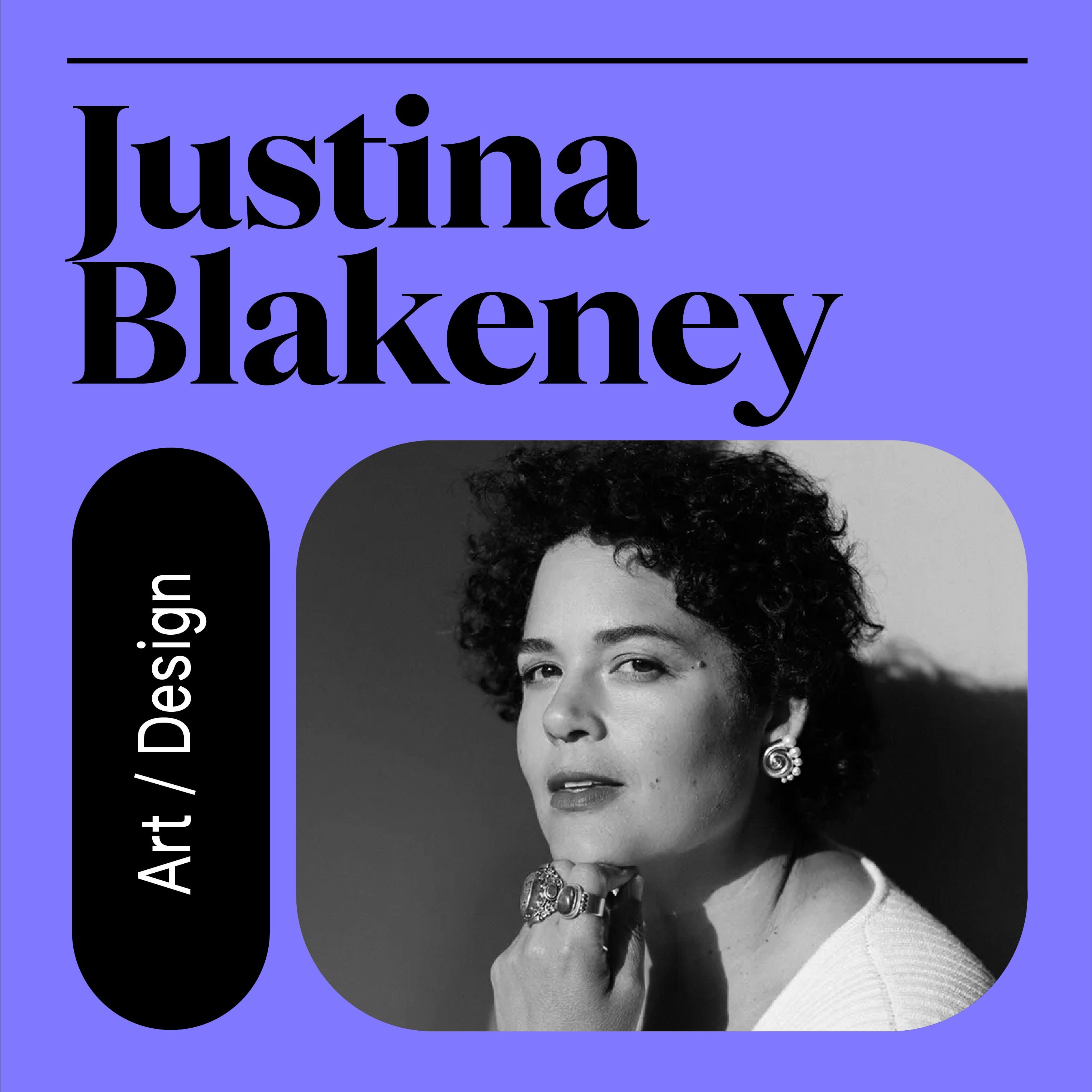
Women Designers You Should Know
042. Justina Blakeney: Creative Evolution
00:44:56
This episode features designer and Jungalow founder Justina Blakeney as she opens up about work-life balance, her art show California Poppy, the impact of the LA fires, and the quiet courage it takes to keep evolving creatively.
Loading summary
Transcript112 lines
- [00:03]
Amber Asey
Welcome back to Women Designers yous Should Know, the podcast that celebrates trailblazing women across design history. And today, I'm your host, Amber Asey, founder of design studio Nice People. And today's guest is one of the most influential voices in design today, Justina Blakeney. A true multi hyphenate artist, designer, author, creative director, entrepreneur, and the founder of the wildly popular lifestyle brand Jungle O. Her signature style is instantly recognizable. It's bold, bohemian, colorful, and deeply rooted in personal expression. But beyond aesthetics, Justina has reshaped what a modern creative career can look like. Over the years, she's collaborated with a long list of major brands including Target, Anthropologie, Laloy, Rugs, Celebot and Keds, bringing her joyful sensibility into homes, wardrobes and even her feet. Her work has been featured in Architectural Digest, Vogue, the New York Times, Dwell, and more. And she's the author of the New Bohemians, the New Bohemian's Handbook, and Decorate Wild books that have helped countless readers reclaim their homes as spaces of healing and self expression. So in this conversation that I have with her, we talk about the LA fires that forced her to evacuate her home and she's still not in her home. And the symbolism behind her solo art show, California Poppy. She's finding her way back to forgotten parts of herself through painting, song and joy. We also dive into work, life, balance, creative risk taking, identity, motherhood, and what it means to define enoughness in in a culture that always demands more. Justina is candid, layered, funny and wise. Honestly, this is one of those conversations you're going to want to sit with. So enjoy my conversation with Justina.
- [02:27]
Justina Blakeney
Feel better world. You should know.
- [02:56]
Interviewer
Hi Justina, welcome to the podcast.
- [02:59]
Justina Blakeney
Thanks for having me.
- [03:00]
Interviewer
I am so honored that you would join me today and so excited. You have such a layered career and you're such a source of inspiration for so many women too and other creatives and all of that. And I always like to go way back to the beginning of your career and or even like childhood. What were the early signs that you would lead a creative life from your childhood?
- [03:27]
Justina Blakeney
I think for me, creativity has always played a really central role in just my own personal enjoyment and self discovery. I've always had a deep creative practice. I've always been very creative and I've always enjoyed expressing myself in so many different media. As a kid I was definitely the one who was in the corner drawing and painting and I also loved crafting, scrapbooking, just like working with my hands. I did carpentry, I did Ceramics, My childhood bedroom. I painted murals on my walls. And, you know, me and my sister would constantly be moving our furniture around and bringing things in from different areas of the house. I pulled a hutch in from our.
- [04:14]
Interviewer
Den, and it's like, reappropriate.
- [04:17]
Justina Blakeney
I know, like, thinking that my parents let me do that. Thinking back to that, I'm like, that's actually really cool that they let me do that. But, yeah, I think just I've always had a sense of being able to access freedom through creativity, and so it's always been my happy place.
- [04:33]
Interviewer
Were you the creative one in your family, or was, like, the whole family creative?
- [04:37]
Justina Blakeney
I believe everybody's creative. I don't believe that one person is more creative than another person. I just feel like some people have been more nourished and more allowed to express their creativity. So if you meet my family, you will see that we are all wildly creative. And I think that what that stems from is having the freedom to feel. Let me say it this way, feeling free enough to be able to express it.
- [05:06]
Interviewer
What do you say to people when they say, oh, I'm not creative. I wish I could be creative like you?
- [05:11]
Justina Blakeney
Yeah, I really hate it when people say that. I feel like it really reminds me of just how limiting we can be to ourselves. And I think that we can be our own best friends or we can be our own worst enemies. And when I hear people say, oh, I'm not creative, I feel like I have to remind people how much creativity just goes into being a human being and our daily life and all the choices that you make throughout your life and throughout your day, whether or not you think of them as being creative choices, they are. Decide to get dressed in the morning, that's a creative decision. What you decide to cook yourself to eat for breakfast, that's a creative decision. Like, every decision that we're making, we're using our creativity to do so. So how much you dig into that or how much you choose to reject it is up to you. But you are creative, and so might as well own it. Yeah, own it and hone it.
- [06:08]
Interviewer
It's kind of like a society flaw, isn't it, where we have to give ourselves roles, or we define ourselves by roles that other people give us or that we figure out early on in our life, and then we kind of stick to those roles. Oh, I'm good at this one thing, and I'm gonna believe that the rest of my life.
- [06:25]
Justina Blakeney
Yeah, it's a limiting belief. And I think it was Matisse who said, Creativity takes courage. And I think that it, it, it stems more. To me, it's more about courage than about creativity. It's about sort of being able to feel free enough or to take a risk and try something. Right. It's that risk taking ability or willingness. To me, that's how you can learn to push past the idea that you are not creative. You have to have the courage to try.
- [06:58]
Interviewer
Yeah, absolutely. I want to know, like early Justina, though, like before you were as iconic as you are now. What did you go to school for? Did you go to ucla? What did you study? All of that?
- [07:12]
Justina Blakeney
Yeah. So I went to UCLA when I was 18. I went in undecided for my major. I was thinking about maybe doing communications. I've always been very interested in communications and visual communications and audio communications. I also was considering going in as a theater major because at the time I was very into theater and into music. And my first day, day there on campus, I went to a new student initiation and there was a major that was called World Arts and Cultures. And it was either the first year or within the, the, the first few years that this program had started. So it was brand new and it was unique to ucla. And it was a combination of visual and performing arts from a theoretical standpoint, through a theoretical lens. So like art history and sociocultural anthropology, things like that. I was like, I heard I just the name World Arts and Cultures and I was like, that's what I want to do. Without even really knowing exactly what it was, it just, it resonated with me right away. And I think one of the reasons it resonated with me was it felt like a very big bubble to live in, like the world art culture. It was like all the things I was kind of interested in. It was very expansive. Yeah. So it was a great program for me. I learned so, so, so much. I still, I'm still friends with people that I, you know, got close to from that program. I still lean on a lot of the ideas that were first introduced to me through that program. Like ideas of liminal space, ideas of edict and emic perspectives and ways of looking at things, ways of engaging with cultures that may not be your own in a way that's hopefully respectful, honoring those other cultures. So that program definitely had a big effect, a lasting effect on me and my trajectory.
- [09:15]
Interviewer
Great. So then after you graduated, where did you go first?
- [09:19]
Justina Blakeney
So after I graduated, I had spent a year abroad in Italy, my junior year abroad in Italy, and I was in Florence and I was studying mainly fashion design. And communication while I was out there. And I sort of was starting to dig in a little bit more to the visual arts. Leading up to that point, I thought I was going to go more in the direction of performing arts, theater, music. I love to sing, I play instruments, I love performing, I love being in choirs, all that kind of stuff. So I kind of thought I was heading in that direction. But I think the first three years of me living in la, after having grown up in Berkeley, in the Bay Area, I sort of got a bad taste in my mouth from sort of the Hollywood world. And I was like, actually, I don't know if that's what I want to do professionally, even though I loved the art of it. So I started to get a little bit more interested and flex a little bit more on the visual art side of things. And I was really into fashion and textiles. I've always been really passionate about textiles. So I took my first fashion design classes that year abroad in Italy, and then came back to la, graduated from ucla, and then decided with my sister Faith, who's also a designer, to move back to Italy. And so she and I packed up. This was in 1999. Yeah.
- [10:47]
Interviewer
That's a brave time to, like, know. Like, hardly any Internet's still budding. There's no social media, there's no Google maps.
- [10:55]
Justina Blakeney
Yeah, no, for real. I mean, everything sort of started to change from a technological standpoint, you know, around that time. But yeah, we went and it was still the lira. It wasn't even like Euro yet. So we witnessed a lot of change and ended up staying for seven years, actually.
- [11:12]
Interviewer
Oh, I didn't realize you were there that long. Was it Florence?
- [11:16]
Justina Blakeney
Yes, I was in Florence the first couple years we were taking fashion design classes, and then we ended up opening up a little Bottega, a little boutique in Florence. In Florence? In the historical center of Florence. And it was mainly vintage stuff, mainly vintage. But then we had a little sewing machine and we would kind of cut up a lot of the clothes and upcycle them into new pieces. I was called it Jungle O. It was like the jungle of that time. And it kind of became like a little like mini creative hub in the historical center of Florence, especially for a lot of the foreign. There were so many foreign students who came through Florence and, you know, people would come and ask us for all the cool tips of where to go and how to get away from the other Americans. And so we lived there and we did that for. For quite a few years. So after Florence, I moved to New York City and was like, if I'm going to live in New York City, I should do it now because I don't know when else I'm going to do it. I always wanted to live there. So I moved to New York City and stayed for a couple of years. But by that time I was in a long distance relationship with my now husband Jason and he was here in LA and the sunshine was calling me. New York, New York was a little rough for this California girl. I was like, I miss the sunshine, I miss my man. I was just ready to come back home. So I've been back since then.
- [12:41]
Interviewer
Wow, that's so cool. Okay. Don't you do like your own musical nights with friends and things like that too? I think I saw that once.
- [12:50]
Justina Blakeney
Yeah, that's my song club. Yeah, our song club. Yeah. So I think in these last couple of years especially I'm 46 now and I missed it. I missed singing in community through Covid and so much focus on my work and my family and these sorts of parts of myself that I realized I had lost somewhere along the way and, and that I wanted to re cultivate. And so song club was a part of that where it was like I want to get back into doing things for the sheer joy of it, for the community aspect of it. And so that is one thing that I did and that I'm doing in order to kind of re harness some of that magic and some of who I am and bring that back into my life now as an adult.
- [13:43]
Interviewer
Yeah, that's incredible. And it's kind of nice to bring back old versions of yourself because then it becomes kind of a full picture moment too of I'm all of these things and not just this one thing.
- [13:56]
Justina Blakeney
Yeah. I think one thing that I have always found is that I've always been sort of a multi hyphenate. I mean, when I went into UCLA undecided, it was just because I had so many interests and so many things that I like to do that it felt really hard to narrow it down. And that hasn't changed. Like I've been able to focus enough to grow a business and to become successful in the design world and all of that. But there have always been so many parts of me that I've tried to figure out ways and have been pretty successful at incorporating into my work life. You know, for example, I love to write. Writing is a huge part of who I am. And in fact, Jungle started as a blog where I was writing every day. So, you know, writing and these kinds of Conversations and public speaking and music and painting and, you know, all of these things have just always been a big part of who I am as a person. And I definitely get claustrophobic so quickly when people try to put me in a box or in a lane, and I feel like I'm pigeonholed in that way or if I do that to myself. And so I think a big part of where I am right now in this chapter of my life is allowing myself to just dig in and have fun and play with all those different aspects of myself and just see what happens without feeling like, oh, I'm doing too much, or, I shouldn't be trying this out. I should be focusing here. And, no, I just want to allow myself to do whatever I feel like doing.
- [15:33]
Interviewer
Yeah. Yeah. It kind of feels like there's no limits to what you can do. And every time you do something new, it's like, wow, she can paint so well. Is there anything she can't do? And so it feels like if there's something calling your name, you go for it, and it's like your new venture or new passion project or stuff like that.
- [15:56]
Justina Blakeney
Thank you. Yeah. I think that one thing that I do want to say out loud, because it happens so, like, quietly behind the scenes, and I know that sometimes Instagram and things like that can make things feel so. Oh, all of a sudden, she's painting, and then. Oh, and she's good at. How. How is she good at that, too? Like, that kind of energy. And I think that the fact is, I've been painting my whole life. Do you know what I mean? And, like, so it's a part of me that may not have been so apparent necessarily from, like, my Instagram feed, because obviously, we. We pick parts of ourselves to share. And my painting practice has definitely been kicked up a notch in the past few years where, like, I didn't used to spend 20 hours a weekend painting, and now I do. So, you know. Yeah, it's kicked into high gear, but I've been painting my whole life, just like I've been singing my whole life. It's part of who I am.
- [16:50]
Interviewer
And so are we gonna look out for your album coming up and future years maybe, and be like, she can.
- [16:56]
Justina Blakeney
Sing if the mood strikes.
- [17:01]
Interviewer
That would be so cool. I mean, you. I wouldn't just, like, embracing whatever.
- [17:05]
Justina Blakeney
Yeah. I wouldn't put it past myself because I also think, like, I was just listening to a podcast yesterday. It was Hidden Brain, and on it, they were talking about what makes long, long relationships work over long Periods of time and how to keep love alive and interesting and. And like, the scientist who is on there explaining his research basically boiled it down to not getting bored.
- [17:29]
Interviewer
Wow.
- [17:30]
Justina Blakeney
And I was like, that really resonated for me, not just in my long relationships and long friendships, but also just with myself. Like, when I'm starting to get bored with something, I'm like, dude, this is a vast world. Why am I trying to push this boring thing along? Why don't I try something new and keep things exciting for myself? So I think we trap ourselves into these patterns and feeling like, you know, you have to do it this way or you have to do this thing. And I'm like, why?
- [18:02]
Interviewer
I think it goes back to those limiting beliefs again and that archaic way of working and a career, and once you have one career, you stick with that. I think a lot of people. There's a lot of fears there and hesitations in moving around and doing new things. I think it really does take courage to say, why not? And why can't I do that? And finding a way to make it work.
- [18:26]
Justina Blakeney
Totally. And it's not that I don't have the fear. Yeah. I've. I've had a lot of sleepless nights about, what are people gonna think? I don't know. She thinks she's a painter now or, you know, whatever that thing is. But I think the key is to just shut out that voice or drown out that voice with louder, more loving, more encouraging, more fearless voices. Courageous. Thank you. Yes.
- [18:49]
Interviewer
Speaking of painting, that's a very relevant topic right now because you have a solo exhibit happening this month, California Poppy at. Is it Wolf? What's the gallery name?
- [19:01]
Justina Blakeney
It's Art Wolf Gallery, and it's being held at Una Casa Privada, which is a showroom home that belongs to the lovely Una Milan.
- [19:11]
Interviewer
How's that been going?
- [19:12]
Justina Blakeney
It's been absolutely incredible. It's exceeded, like, all of my expectations for just how magical the whole experience has been. I've been really yearning for more creative collaboration in these past few years, and to be working alongside so many amazing women. I mean, my team, Sarah and Amy Piper, like, amazing team. And then Artwolf, Yael and Una, and, like, everyone bringing their magical smile spice to the table. It's just. It's been so incredible. The opening was just all the feels just to be able to share my art and to have everyone come through, and it's.
- [19:51]
Interviewer
Yeah, it's.
- [19:51]
Justina Blakeney
It's. It's been really magical. And the show was just extended for a month, so it's now going through June. Yeah.
- [19:58]
Interviewer
Good.
- [19:58]
Justina Blakeney
Yeah.
- [19:59]
Interviewer
Cool. Yeah. There's something about the colors that you bring to your paintings that's so refreshing. And then the themes, too. A lot of women and a lot of culture and life. I'm curious to know the name California Poppy. What's the symbolism there for you too?
- [20:20]
Justina Blakeney
Yeah, so it's got a lot of symbolism. So I actually wrote an essay before I knew I was going to name the show California Poppy. I wrote an essay titled California Poppy, which was about my experience in the wake of the fires here in Los Angeles. I'm still displaced from my home. My whole neighborhood was decimated. My home didn't burn down. But we're still waiting to be able to properly clean it because we're basically on the burn scar. I've been doing a lot of writing to help me process everything in this time. And so I wrote an essay called California Poppy, which is about the poppy itself, because the poppy seeds lay dormant underground for years and then get activated only by fire. And so that was a powerful metaphor for me about how difficult this time was, but how I didn't know what might bloom from this time. So a beautiful message of optimism. There is also a lot of symbolism in the California poppy itself. You know, me being a California native and the California poppy being the California state flower. Growing up, the flower was protected. I think it still is. You're not supposed to pick the. The poppies. Then there is also the fact that California poppies open in the morning and close at night.
- [21:41]
Interviewer
Oh, yeah.
- [21:43]
Justina Blakeney
And so the natural rhythms and how they are in step with the rhythms of the world and the rhythms of our world was something that I'm trying to cultivate for myself in my life. And so this opening and this closing and just following the rhythms of what unfolds is something I am trying to cultivate in my life. And so that's what the essay was about. And so I wrote the essay, and then I had been doing all these paintings, and then Amy from my team was like, oh, yeah. Elle wants to know if the show is gonna have a theme. And I hadn't thought about it at all, and I decided. We made a catalog. I was designing the catalog. I was like, I kind of want there to just be a pattern on the front of the catalog. I didn't want to just pick one piece of art to be the hero piece or something. Like. So I'm looking at all the patterns that I have, and realizing all these poppies are in the artwork already. It's already there. And so it was one of those weird moments where it was like, almost like time bent. And it was as though I had planned this whole thing already, but I hadn't. It just was there. It already existed. The poppies were already on the painting. I already had the essay written. And then it was just a matter of pulling it all together. And then so that when I was saying earlier that everything felt magical, it felt magical from the very start.
- [23:06]
Interviewer
Yeah, that's beautiful. And I've never really thought about the California Poppy that way either. Like, there's so much to the single flower. And it's so cool to hear about and to understand all of that symbolism. What was that night like for you, if you don't mind sharing?
- [23:24]
Justina Blakeney
Yeah, it was very surreal. I think surreal is the best way I can describe it. I got home from my office, and I was there with my husband and our kid and our kiddies, and the electricity had gone out. Because we live in the foothills, we don't have great cell service when there's no Internet, which are obviously because there was no electricity. So I started lighting candles around the house and putting them on high shelves so that they would be out of the way of the kitties. And, you know, me and my husband grabbed our guitars and we just started playing some music, and we were just sitting around. What are you going to do? And. And so we're just sitting there and then, oh, what are we going to eat for dinner? My husband's like, why don't I just go pick up a pizza? I'm like, okay, great. And then I get a phone call from him maybe like 15 minutes later, and he is like, I am looking up at the canyon and it's on fire. We got to get out of here. I just remember, and I always thought, oh, if I'm ever having to leave a burning house, like, I'm just going to take what's sentimental. So I just had a tote bag, and I started putting photos, family photos and art and, you know, my heirloom jewelry, that kind of stuff in there. And I was being very selective to the point where I was like, I could be taking more stuff. I'm being so selective.
- [24:45]
Interviewer
Yeah.
- [24:48]
Justina Blakeney
My husband gets back, no pizza. And then we start getting the alerts on our phone, and we were like, oh, this is. This is getting close. We packed up a car load of stuff. I had a bunch of stuff already in my car because, you know, I'm, like, always moving furniture and things back and forth, you know, with my work. And I just threw a Few tote bags of stuff in. I grabbed Ida and our kitties and didn't even go find the kitty carriers because they were in our basement. And I was like, am I going down there? It was very surreal when we left. It was kind of quiet in our neighborhood still.
- [25:27]
Interviewer
Yeah. It sounds like you got out early, which is good to see that.
- [25:31]
Justina Blakeney
Oh, yeah. So we, Ida and I got out early. My husband, Jason, decided to stay on the property, and he was, like, hosing things down and just trying to, like, batten the hatches, you know what I mean? Just trying to. So he was doing that, which, you know, terrified me. I was just like. Just come, like. And so he stayed on the property for several more hours until they turned off the water, you know, and we also just didn't know and didn't grasp and didn't fathom how destructive the whole thing had been. It definitely was way worse than I ever imagined.
- [26:07]
Interviewer
Mm.
- [26:08]
Justina Blakeney
Like, I just. I've never experienced anything like that. I didn't realize how under understaffed, but whatever. There was just there were. Because of the Palisades fire, a lot of the resources were going there, and there was no water. And, you know, it was thing after thing after thing. And one of the reasons why we're not back in our home yet, even though, again, it. It didn't burn down, is because we don't know how safe it is. We had toxic testing done in our home, and we had to come out of pocket because insurance will not pay to get the testing done. It was thousands of dollars, so a lot of people cannot afford that. And our test results showed asbestos, cobalt, no, all kinds of things you don't want to be around, especially not if you've got kids. So, yeah, we are in the process of trying to clean it all up now. And the mantra is one day at a time, because it's pretty maddening. And the whole situation with insurance and all that has been very, very frustrating. And I know that a lot of people have it a lot worse than we do. So all that having been said, it's been quite a thing.
- [27:18]
Interviewer
Does that feel like it's affected your creativity over the last few months?
- [27:23]
Justina Blakeney
I feel like my creativity has been my salvation in the past few months. So it's like my safe harbor is to be able to write and to paint and to sing and to do the things that I love to do has been what feels like home in this moment where I don't have time.
- [27:43]
Interviewer
Like a perspective shift.
- [27:45]
Justina Blakeney
Yeah.
- [27:47]
Interviewer
Yeah. And I bet the exhibit is kind of A nice cherry on top of all of that chaos that happened.
- [27:55]
Justina Blakeney
Yeah, definitely.
- [27:58]
Interviewer
Yeah, It's. It is such a wild thing to think about. So while shifting gears a little bit, because I do want to talk more about your work and career and everything, I think one thing that you've been really great at is talking a lot about mental health and your role as a mother and a wife and being able to have somewhat of a work life balance and trying to figure that out and navigate that and talk about it too. Like, how have you navigated that and evolved over your career in terms of making sure that your role to other people is significant and present and all of that.
- [28:42]
Justina Blakeney
I think where you are in your life stage has so much to do with how, like, at least my notions of work life balance have shifted. I think if you are a mother or a parent and you also are trying to push forward a career, I think especially when the kiddos are little, it's impossible. Like, there. There's no real such thing. I think we're just so pulled in so many different directions. And so I think, at least for me, I feel like the idea of having, like, a really healthy balance in that time is not real.
- [29:25]
Interviewer
Me, four year old at home.
- [29:27]
Justina Blakeney
Yeah, it's not real and it's not realistic. And so I think that, like, to anyone who's in that right now, who maybe has guilty feelings for putting more energy in one place versus another or all of that, like, I would just say you're doing your best and, like, that's good enough. And to not be hard on yourself about it and to just know that, like, the time where you feel so stretched in so many different directions so hard is temporary. I think that we have a tendency to be very hard on ourselves. I don't think that helps anything. So giving yourself some grace, I think is like the first thing to remember our generation working as much as we do, trying to raise families, having so little support from the government or from community or society. I think especially for those folks who had kids during the pandemic, like, juggling everything like this has not been done like this before.
- [30:30]
Interviewer
Yeah.
- [30:31]
Justina Blakeney
So we're charting new territory. It's hard, it's messy. Give yourself some grace.
- [30:37]
Interviewer
How old is ida now?
- [30:39]
Justina Blakeney
Ida's 12.
- [30:40]
Interviewer
Okay.
- [30:41]
Justina Blakeney
Yeah. So I think that's the first thing I think when I think about where I am now in my life, I do have more balance. And I think that the thing that I will say about seeking that balance is that I do think in many regards it is that you have to make trade offs. Right. And so I was really focused on building. When I was in my 30s, I was building wealth, I was building a business, I was trying to buy a house, I was doing all that stuff, brand collaborations. And I just, I felt so much urgency to be able to be doing that building. I felt like this is my time to build. You know, I'm 46 now. I have built.
- [31:27]
Interviewer
Yeah.
- [31:28]
Justina Blakeney
And so what I think is important for people who might be at a similar life stage to where I am right now is to ask yourself, what does enoughness look like to you? Yeah, I think that's the first question I needed to ask myself when I was choosing between spending more time with my kid or with my family or with my friends or with myself. And to say, just take a step back and say, what does enoughness look like? Because I do think that we have a culture of too much is never enough, you know, and that will just continue to throw your life off balance and off kilter, in my opinion. So once you feel like, you know, I mean, there were years, years, maybe Dec. Maybe more than a decade where I didn't say no to anything.
- [32:15]
Interviewer
Wow.
- [32:16]
Justina Blakeney
You know, because I was like, oh, I can't say no to this. This is incredible. You know, I got to say yes to this. And it's really just been in the last several years that I have had a sense of enoughness to be able to say, oh, you know what? Actually that's, that's going to be a no for me.
- [32:33]
Interviewer
Yeah. Like you closed your online shop, right?
- [32:36]
Justina Blakeney
Yes, I closed my online shop. Big.
- [32:39]
Interviewer
Like I'm. That's enough for me.
- [32:41]
Justina Blakeney
Yeah, I'd add enough, you know, definitely. There's been a lot of internal and external shifts for me in the past three or four years in order to seek balance. But the reason why I'm saying this also is because I am at that stage where my child is a little older. You know, it doesn't take as much from me. You know what I mean? And so I think that again, like, the way that we work and that we're parents and that, you know, everything just feels so fast and much and a little bit relentless in our culture here in the US and when I think about that, sometimes I have to remember what life was like when I lived in Italy and just that there is a different rhythm. And. But in order to cultivate that rhythm, you. You have to be, first of all, be aware of the rhythm that you're working at and be aware of the rhythm and how you're parenting and all of that. And. And I had gotten to a point where I just noticed how much I was looking at the clock, waiting for my workday to be over and like, I own my own business, so, like, why am I doing that?
- [33:49]
Interviewer
Yeah. Like a slave to your own business.
- [33:51]
Justina Blakeney
Yeah. And when I realized that, I was like, ooh, okay, this is something I need to take a very deep look at because that is not how I want my life to feel. And then you gotta start making changes and then take it easy on yourself and do it a little tiny bit at a time. Don't give yourself whiplash. Yeah.
- [34:11]
Interviewer
You know, I mean, it's so admirable to even just the idea of checking in with yourself and listening to your intuition and having that gut check and really thinking something needs to shift or change because it's so easy to just keep going on that treadmill and you're here, you're on it. Like, why not stay here? That's the easy path at this point.
- [34:34]
Justina Blakeney
Yeah, it's easy until it's not, you know, until it's. It takes its toll on your soul, you know, and that's what was starting to happen to me. So. Yeah.
- [34:45]
Interviewer
Yeah. And you've. I mean, you've worked with and collaborated with so many other brands and businesses and all of that. And like this idea of being a woman designer, I mean, you are kind of forging a new path and a woman of color too. Like, you're working with brands who probably need that or, I mean, this timely with Target and their whole like, DEI pull out and everything, you're kind of forging this new path for other women and women of color too. I'm curious to know, what did that experience look like for you? Were there ever moments where you felt, I don't know, like less than or maybe like felt anyone was condescending towards you or. What experiences did you navigate as? Like all of that.
- [35:31]
Justina Blakeney
I don't know if I would have framed it exactly that way. I also only have the experience that I experience in my body. I don't know how things feel to other people who don't have my same. Who aren't in my body. I think the way that I. I don't think I ever felt less than. What I would say is I maybe didn't feel seen. I think that's how I would frame it. Maybe didn't feel seen, maybe didn't feel heard, maybe felt tokenized is maybe a piece of it. But I think with tokenization, there is a dehumanization that happens. And I think that maybe that at least leans in the direction a little bit more of how things have felt for me or a de. Individualization. And what I mean by that is sort of like, you know, I'm of mixed heritage. You know, I'm black and Jewish, and that's a pretty unusual and unique makeup from my. From my vantage point. And I don't speak for all black people, and I don't speak for all Jewish people, and I don't speak for all mixed people, and I don't speak for all women, and I don't speak for all mothers, and I don't, you know, I just speak for myself. And so what I think sometimes can happen and sometimes how I have felt is that that tokenization that can happen sometimes people want me to be a spokesperson for, you know, every other woman of color who's a designer or something like that. And how that makes me feel is like I'm not being seen or heard for who I am as an individual and as a human being.
- [37:16]
Interviewer
Yeah, that's so well put. Well, it's funny because I feel like even just 10 years ago, the landscape was so different. I think society as a whole and brands and designers have shifted so much in the last 10 years, and it's interesting to see people still learning and understanding and listening to others experiences, perspectives, and preferences and all of that. And I think that's really what it all comes down to, is feeling seen and heard and understood. And I think that's what people are still striving to get better at, too.
- [37:52]
Justina Blakeney
Yeah. And I think there's a great unlearning.
- [37:55]
Interviewer
Yes.
- [37:56]
Justina Blakeney
Maybe even more than a great learning.
- [37:59]
Interviewer
Yeah.
- [38:00]
Justina Blakeney
Because I do think that the way we behave oftentimes in this society is a learned behavior. It's not something that we're born with. You know what I mean? And so it's really about unlearning some of these patterns that we have and some of these ways of acting and of being learned. And I think at the end of the day, are all rooted in fear. And so having the ability and some awareness about that and, like, being able to unwind it a little bit or a lot is the first step there.
- [38:36]
Interviewer
Yeah, that's so true. And even unlearning about yourself, too. Like, if you really need to evolve and want to evolve, you have to shed some layers a little bit, too.
- [38:45]
Justina Blakeney
Absolutely.
- [38:47]
Interviewer
Because this podcast is all about women designers, and we talk a lot about women from history. I'd love to know, are there any women from history that you've looked up to for inspiration.
- [38:58]
Justina Blakeney
Oh, my gosh. So many. I mean, I think a lot of people probably know that Frida Kahlo is a big inspiration. Inspiration to me.
- [39:04]
Interviewer
Yes. Tell me more about that.
- [39:06]
Justina Blakeney
Yeah. So Frida, you know, she and I were on a first name base. Frida and I go way back. So I love Frida. Not just her artwork, which I also love, but just her whole, like, Persona from everything that I've read and experienced about her and how she lived her life. Talk about fearless, you know what I mean? And talk about courage and creative courage. And to be a woman in that time period and really live her truth out the way that she did. Wow. I just. So incredibly powerful. I also, from an aesthetic standpoint, I'm really drawn to sort of how she expressed who she was through how she dressed and how she lived. And just. I don't know if you. You had an opportunity to visit her home in Mexico City.
- [39:57]
Interviewer
Not yet a goal of mine.
- [39:59]
Justina Blakeney
Yeah. Oh, my gosh. I mean, it is just. Just experiencing that and seeing sort of her aesthetic sensibility and looking at the book she read, and it's just an inspiring human being. And for me, when I think about authenticity and like, learning who you are through your work and really just trying to invite the world to see that and to experience that and to be known to yourself, there is no better example that I can think of of someone who embodied that as Frida did. So she's someone who I am just hugely inspired by. I think there are a lot of other female artists who, in their own ways, Georgia o' Keeffe is another one who, for me, again, visiting her home, and I don't know how it's pronounced, ubiqui in New Mexico was just something that really painted a picture for me of how, like, intentional she was in her way of living and her, again, her design sensibility, like, her home is so beautiful and so just so. And you can just get a such a sense of who she is by how she lived. She worked to purchase the piece of land that her home was on for 15 years.
- [41:15]
Interviewer
Oh, wow.
- [41:16]
Justina Blakeney
The amount of vision and intentionality in order to be like, no, this is where my house is gonna be. And to, like, make that happen, like, that kind of thing, to me is just so incredible and so inspiring. And to do it in a time period where women also had so many less resources. And I could go on, but those are.
- [41:40]
Interviewer
Those are two really great examples. And now Georgia Okeeffes house is now on my bucket list. I Didn't even realize I needed to go see that either.
- [41:48]
Justina Blakeney
You 100% need to go see. You can see her gardens where she grew. All that is beautifully maintained. So it's like the same flowers that she painted and her rock collections and it's just so stunning.
- [42:02]
Interviewer
Well, my last question for you today is, I mean, thinking about those women and the path you've already forged for yourself and the legacy that you're already leaving behind, what do you hope to leave behind for, like women in the future? What is that legacy look like when they go visit your house?
- [42:24]
Justina Blakeney
Feel like the feeling of freedom that I yearn for and that I see in when I look back at like Frida or Georgia Again, first name basis.
- [42:40]
Interviewer
In Georgia, my girlfriend.
- [42:42]
Justina Blakeney
Where are my girls at? But yeah, like, I think that. And to be honest, I don't even want to just say with women. I just want everyone to be able to just be who they are, you know, and feel safe to be who they are and feel free enough to be who they are. And I want to feel safe and free enough to be who I am. And I want to, like, keep unlearning and I want to keep learning and keep digging and keep excavating that to find that. And if somebody can look at me and my life or my art or whatever that is left behind and say, say, wow, she felt free, she explored. I want to explore, I want to feel free. I think that would be a beautiful thing.
- [43:25]
Interviewer
Absolutely. That is so beautifully said and you are such a good writer. And it doesn't surprise me that I'm just like taken back by all of your words today. And thank you so much for your inspiration, your wisdom, your heart, your humanness. You do so much for everyone, really.
- [43:47]
Amber Asey
Thank you for joining me.
- [43:49]
Justina Blakeney
My pleasure. It's been nice talking to you.
- [43:52]
Amber Asey
That's it for today's episode. I'm still sitting with so many of Justina's words, from her idea of own it and hone it to the emotional symbolism behind the California Poppy and her thoughts on how we define success and creativity. So thank you so much, Justina, for your wisdom and for joining me today. If this episode moved any of you, please take a moment to leave a five star review, share it with someone who needs a little reminder that it's okay to evolve. And if you want to keep up with Justina's ever evolving work, you can find her at ustinablakeney on Instagram and ustinablakeney.com thanks again for listening. And remember, there's no right way to live a creative life life, as Justina mentions today. And another reminder, let's redesign history by celebrating women.