← Work with Erika Ayers Badan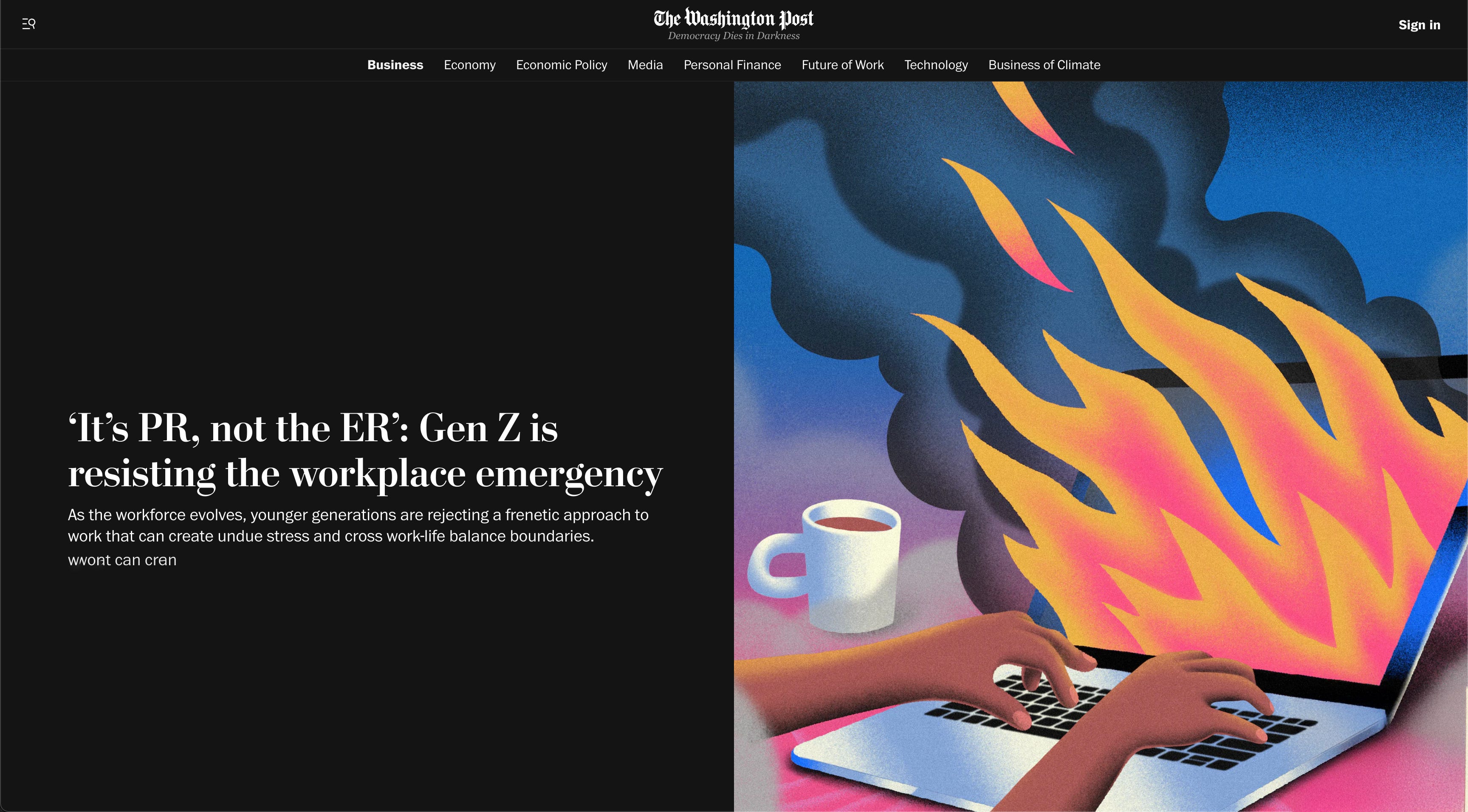
Loading summary
Transcript1 lines
- [00:00]
A
Welcome back to Net Net. We are talking about Gen Z. We love talking about Gen Z. Who doesn't love talking about Gen Z at work? I love Gen Z at work. I don't know if I'm alone in that or with the majority in that. I don't know. But what we're talking about is a headline that is it's pr, not the er, Gen Z is resisting the Workplace Emergency. The net net of this article or this perspective is that Gen Z is not going to get wrapped up in your workplace drama. They're not going to work all night, drop everything, cancel plans, feel the stress, feel the anxiety, feel the personal pressure or accountability to solve your work problem. They're kind of like, hey, nobody's dying from this. There's nothing truly catastrophic that comes from this. This is a company problem. It's not. And so Gen Z is being, I would say, incredibly Zen in the workplace and not getting wrapped up into the frenzy and the chaos and the crisis at work. I think this is a good thing at large. I think when people get too unhinged at work or too wrapped around the axle around a crisis, it can be a bad thing. At the same time, I think if you are trying to build something or you're trying to make something, having people who are apathetic about making it really sucks. And I think ultimately the people who leaders and managers and entrepreneurs and people who want to build things, I think the people those people want to bring with them are people who care. And when shit's about to go wrong and it really matters and the team or the Gen zers are apathetic, it makes you be like, fuck, you're not bought into what I'm doing. You don't care. You certainly don't care as much as I care and you're not going to really help me solve the problem. I think it also has reverberations where you find people who then over index and do all the work and then end up resentful towards the Gen Z people. So I think this dynamic is happening at work. I had a conversation with someone this morning and she was saying, hey, I work with this person. They don't really care. They tend to do the least amount of work possible and they tend to shift the project always to someone else. And this person was saying, when I give assignments I tend to give myself the most work because I know I care the most and I know I will get the job done. And I think this is actually the bigger dynamic happening at work. It's a question of accountability. It's a question of responsibility. If you're a manager and you have a lot of Gen Z people, I find that if you're just straight with them on, hey, this is your project, you're accountable to it, you're responsible for it, and if it doesn't go well, it's on you. And if it does go great, it's also on you. A lot of the psychology that people are talking about at work is that Gen Z doesn't feel bought into the reward, so they don't feel like taking the pain. And I think by changing that, it makes humans, regardless of what generation you are, it makes humans feel more bought in to what you're trying to achieve. Overall, I don't know where this goes. I think what's going to be really interesting is in a couple of years Gen Zs are going to be the managers and a couple years after that they're going to be the corporate bosses. I actually think it's just taking Gen Z a little bit of a different, more winding, longer path to find the stuff they're passionate about. I don't think Gen Z isn't passionate. I don't think Gen Z isn't. Doesn't believe there's an emergency and doesn't want to help or take part in it. I think they haven't found the thing that grabs them. I think the challenge is if they never find the thing. Because if you don't find the thing and you're just kind of floating along, then you're going to be in a place where AI is going to take your job. Your manager is not going to choose you if there's a shortage of budget or time and you're not actually going to develop the grit, the resilience and the skills that you need to be more and more successful in your career. I also think, you know, and I give Gen Z a lot of credit, is there are too many emergencies at work and you know, a lot of times there's just hype and drama. If you work in pr, right, literally everything is a crisis, everything's an emergency and it's really easy to get, you know, stressed and anxiety and anger and all these like, escalated, elevated emotions around that when you really don't have to. You're like, I just need to get the job done. Like Jamie Dimon had a. Someone posted a Jamie diamond thing this morning that was basically like, if you're worked up at work, that's on you. Like if you're frazzled, that's a you problem. That's not a company problem. That's a you problem. And I think that's very Gen Z, which is Jamie Dimon's, obviously not Gen Z. But, like, why is everybody so worked up? Like, let's take a deep breath. I think it's okay to be mad. I think it's okay to be passionate. I think it's great to be passionate. But I also think having a little bit of perspective and also really focusing on what do we have to get done for whom, why, and by when and in what format or at what level of quality. And I think so long as you have that and you get those pieces done and you're a good teammate and a good partner in making that happen, everything goes okay. So then the last thing I would just say is what happens when you're a manager and nothing is a fire drill, right? Like, you don't have any passion, you don't care. You're utterly apathetic to what's happening. I mean, in my opinion, you're not going to have a job anymore. So I think that's a problem. I think the second piece is there's really two different types of managers. One are like the passionate people people, and you're about a miss and you're bringing people along with your energy. And then there's a lot of managers that are actually more technical and more perfunctory. You can learn from both types of people. You don't always have to have a passionate manager. I think I'm a passionate manager. I actually like working for dispassionate managers, to be honest with you. That's actually interesting. I've never thought about that. I like working for the perfunctory people who are like, just make the numbers work and you can go do what you want. I think other people like to work for the passion person. And I think you can learn from both. I think learning from someone who doesn't care, though, is very dangerous because then you pick up those habits, you adopt those behaviors, those type of attitudes, type kind of infiltrate who you are and what you do, and that is not going to set you up well for the long term. Now, work, That's net. Net. You can follow us wherever. You follow work and think about work and want to talk about work, and we're here for it.