← Wretched Radio with Todd Friel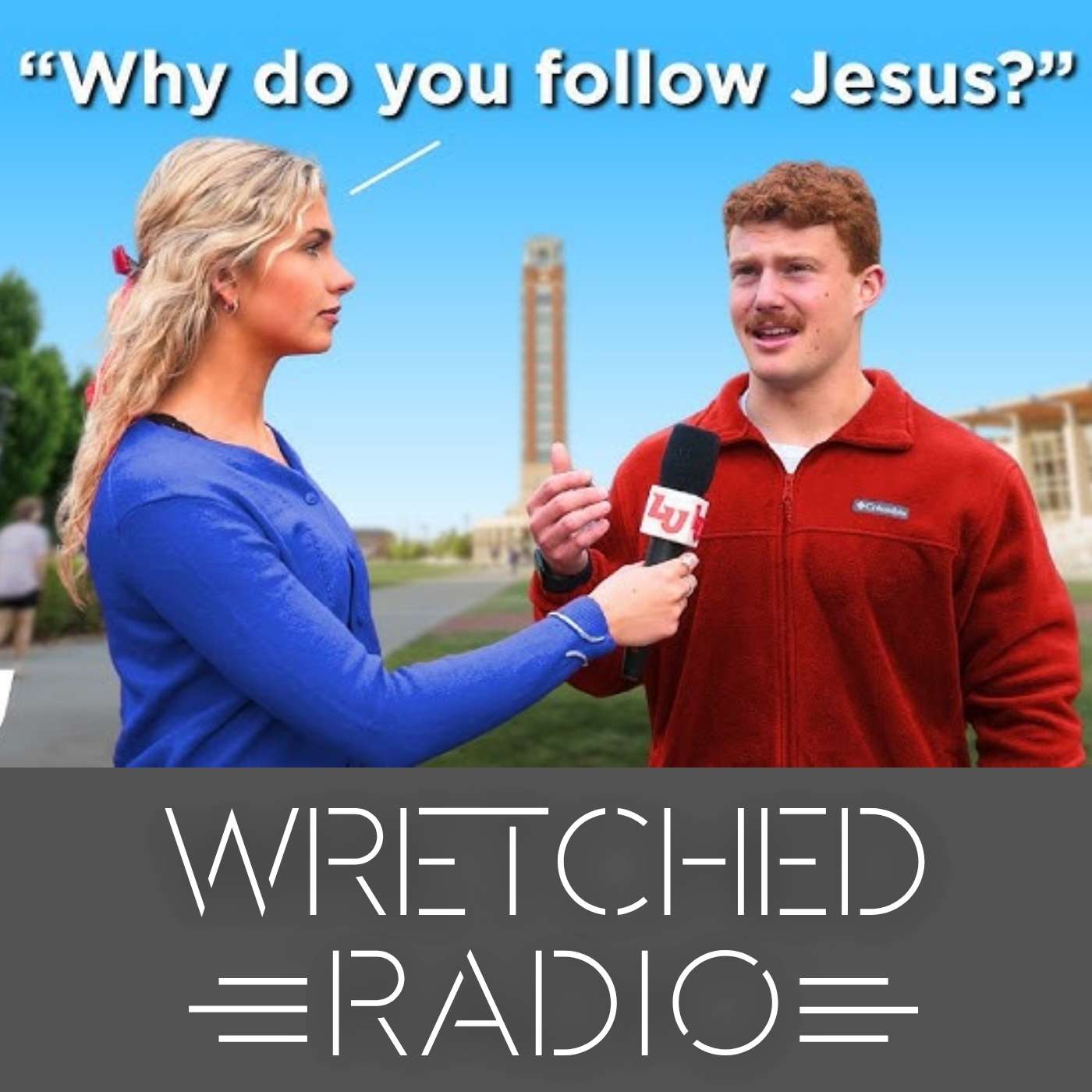
Wretched Radio with Todd Friel
“Why Are You A Christian?” 100 Students Answer
00:55:00
Segment 1 • 100 students, professing to be Christians, asked one simple question. Can they answer it? • Some share the benefits of a relationship with Christ, but miss the thrust of the gospel. • If an unbeliever heard your testimony,
Loading summary
Transcript153 lines
- [00:04]
Todd Friel
Wretched radio begins in 3, 2, 1.
- [00:09]
Mike Johnson
Seriously, if you want to relieve stress,
- [00:10]
Jimmy Hicks
go to the word of God.
- [00:12]
Mike Johnson
Oh, my goodness.
- [00:12]
Host/Interviewer (possibly Todd Friel or another main host)
It's just so weird, isn't it, that
- [00:14]
Jimmy Hicks
these people say stuff like that?
- [00:15]
Host/Interviewer (possibly Todd Friel or another main host)
I apologize for them.
- [00:16]
Mike Johnson
Are you kidding me?
- [00:17]
Host/Interviewer (possibly Todd Friel or another main host)
Let's all do baptism and I have
- [00:19]
Jimmy Hicks
a little pool here and we'll all
- [00:21]
Host/Interviewer (possibly Todd Friel or another main host)
feel nice and relaxed. That's baptism. No, baptism is a sacred Christian rite. All the various yogas are sacred.
- [00:28]
Christian University Students
Hindu rite.
- [00:29]
Jimmy Hicks
Wake up, America.
- [00:30]
Todd Friel
It's time for Wretched Radio with Todd Friel.
- [00:34]
Christian University Students
Today we're asking 100 Christian students why they're Christian. Why are you a Christian?
- [00:38]
Host/Interviewer (possibly Todd Friel or another main host)
Wow. Yeah, I'm a Christian because.
- [00:41]
Christian University Students
Oh, that's a tough one.
- [00:42]
Host/Interviewer (possibly Todd Friel or another main host)
Oh, I think there's definitely a turning point for me.
- [00:46]
Voddie Baucham
That question is. It actually caused a lot of conviction
- [00:48]
Christian University Students
to come up and each time the stories get more powerful.
- [00:52]
Host/Interviewer (possibly Todd Friel or another main host)
Do they? This is Wretched Radio. No, I'm not condemning anybody to hell as if I have the authority or ability to do that. We are going to assume that all of the kids that you're about to hear who were asked a very simple question, and it is a simple question. Why are you a Christian? We should be ready to give a reason for the hope that lies within us. Just bing right there, you ask, boom. I give it to you right there. Because this is the foundation of our faith. Why are you a Christian? This should be on the tip of the tongue of every born again believer. But what you're going to hear, in my opinion, are students that we are going to assume are saved. They simply don't have the ability to articulate the reason for the hope that lies within them. And this ought not to be. I believe this is one of the current scourges in evangelical Christianity because we so obfuscate the gospel, we don't regularly preach it or teach it in its judicial nature, that the gospel is about being saved from the wrath that is to come. Instead, we have cliches all over the place and explanations and how you become a Christian and what you should say and what prayer you should utter. And I think there is a massive amount of confusion in evangelical Christianity, and I think that we're going to hear that right now. Again, this is not to hack on these students. They simply represent what I believe is a pandemic in evangelical Christianity, and that is the inability to articulate the reason for the hope that lies within them.
- [02:39]
Christian University Students
Why are you a Christian? Oh, well, Jesus saved my life. I almost wasn't here anymore, and Jesus gave me hope in the future.
- [02:49]
Host/Interviewer (possibly Todd Friel or another main host)
Now I'm sure that happened, but that was not the answer to the question, why do you believe in Jesus Christ? Why are you a Christian? Why do you believe the Bible is reliable? So all of these answers, it's like they're fine. What I'm suggesting is we got to stop letting this stuff go. We've got to stop with the ambivalence. We've got to start being more articulate with the Gospel. Listen to these answers and ask yourself the question as you hear them. Is that why somebody should become a Christian? So listen. Listen and ask yourself this question this way. If I were an unbeliever and I heard this person's testimony, because that's basically what we're hearing here, would that persuade me to become a Christian? Would that give me enough information to become a Christian?
- [03:39]
Christian University Students
Honestly, I encountered the Lord at a young age and I grew up in church. He just touched my heart. From a young age, before the story started getting stronger, we heard some answers. We already.
- [03:48]
Jimmy Hicks
I grew up in a faith centered house with wonderful, loving parents that taught
- [03:52]
Host/Interviewer (possibly Todd Friel or another main host)
me about the Word and how to be a good Christian. Ooh, that's a great question.
- [03:56]
Jimmy Hicks
Well, I grew up in the faith and I have seen the Lord work in my life.
- [04:01]
Host/Interviewer (possibly Todd Friel or another main host)
And for me, when I look back on my life and I just see
- [04:03]
Jimmy Hicks
what the Lord has done, it encourages me and it really fuels my faith.
- [04:06]
Christian University Students
Oh, that's a tough one. I mean, I think that it started with my parents being Christians and raising me up in that environment. But I think the reason why we stayed Christians, or my family and me specifically, would be because it brings you hope and it gives you a purpose outside of what we can provide ourselves as humans?
- [04:27]
Host/Interviewer (possibly Todd Friel or another main host)
Is that true? Do we get a hope, a purpose that lies outside of our grasp if it were not for Jesus Christ? Yes, it is. Is that why you should become a Christian? No. No, it isn't. This would be a demonstration of an individual who is proclaiming the benefits of the gospel, but not the gospel itself. This is what I got out of Christia. I got hope. Therefore, you should believe in Jesus. Is that why you should believe in Jesus? And the answer is no, not exactly. Does that come with the package? Yes, but the question is still being begged and I'm not talking about Alistair. It is not being answered, at least not yet.
- [05:09]
Christian University Students
Some had other reasons. In my personal life, I've seen the impact that a relationship with Jesus has on my life, and so I know it to be true, saw how it changes the lives of others, and I
- [05:19]
Host/Interviewer (possibly Todd Friel or another main host)
wanted to change my life like that again. These are nice kids. I'm going to trust that they're genuine believers. I really hope that. But is that why somebody should become a Christian? Hey, become a Christian. You'll see him working in your life. That's not the gospel.
- [05:37]
Christian University Students
I really love loving people, loving my neighbors, even my enemies. And that's why I'm a Christian. I've seen how the world doesn't satisfy me at all. And the only thing that's ever satisfied is Jesus.
- [05:49]
Host/Interviewer (possibly Todd Friel or another main host)
That's. You've got a God shaped hole in your heart that only Jesus can fill. Is that why somebody should believe in the gospel? Because you need heart surgery? Well, not. You do need heart surgery, but you just don't need putty put in there. You need a heart transplant.
- [06:04]
Voddie Baucham
Now.
- [06:05]
Christian University Students
He's my everything. Well, some people talked about evidence because based on the evidence, I've seen Jesus arrival. And the Bible is the best thing to follow if you want to lead a good life. It's just.
- [06:15]
Host/Interviewer (possibly Todd Friel or another main host)
Okay. Hey, that's not bad. That's getting better. That's, that's, that's okay. I've seen the evidence. Why do I believe in Jesus Christ? Okay, I, I would suggest take believing the evidence and, and you could, you could refine that a little bit more. I believe in the Bible. I believe in Jesus because it's true. Now that's a simple answer. Now if you want to make that a more complicated answer, you could do what Vodi Bauckham does with that question.
- [06:54]
Voddie Baucham
I choose to believe the Bible because it's a reliable collection of historical documents written down by eyewitnesses during the lifetime of other eyewitnesses. They report to us supernatural events that took place in fulfillment of specific prophecies and claim that their writings are divine rather than human in origin.
- [07:08]
Host/Interviewer (possibly Todd Friel or another main host)
Got it. Let's go back to the Christian campus.
- [07:15]
Christian University Students
Evident, so evident in the world around me. And you know, I just think it's the only logical conclusion.
- [07:22]
Host/Interviewer (possibly Todd Friel or another main host)
Okay, that is true, but that is not an articulation of why I believe in Jesus Christ.
- [07:29]
Jimmy Hicks
It's, you know, just like the evidence that he's. The things that he's done in my life, you know, just where I was
- [07:34]
Host/Interviewer (possibly Todd Friel or another main host)
and where I am now, you know,
- [07:35]
Jimmy Hicks
just helping me find purpose, identity and, you know, shelter. So I think that's the reason why,
- [07:40]
Host/Interviewer (possibly Todd Friel or another main host)
yeah, he's provided all of those things. Is that why somebody should believe in Jesus? Incidentally, may I ask, have you heard anything about that? The reality of God's existence? Have you heard anything about somebody experiencing Conviction of sin, feeling shame and guilt. Have you heard anybody yet explain that Jesus Christ is fully God, fully man, and his mission was to come to die, to be the propitiation for sinners. And he died and he rose again. And I believe it because it's true. Have we heard anything close to that? Again, this is not to just trash these kids. I get it. What I'm encouraging is we gotta be ready that we're commanded for that. Be ready to give a reason for the hope that lies within you.
- [08:40]
Christian University Students
I believe in Christianity scientifically, which causes
- [08:45]
Host/Interviewer (possibly Todd Friel or another main host)
me to have a much stronger relationship
- [08:47]
Christian University Students
with Christ because I want to understand
- [08:49]
Host/Interviewer (possibly Todd Friel or another main host)
him and then grow in personal relationship with him.
- [08:51]
Christian University Students
And other students talked about eternal life because I don't want to die and have, like, nothing. So to have.
- [08:58]
Host/Interviewer (possibly Todd Friel or another main host)
That's a common answer. And I get that. Should somebody become a Christian because they don't want to go to hell? Well, I think that's obvious and natural, but that isn't the primary reason. There's a massive distinction between becoming a Christian so you don't go to hell, and becoming a Christian because you get to be united with the one who was so kind and loving that he died to save you from hell. That's a big difference. You know, I kind of want to
- [09:32]
Christian University Students
spend eternity with God, the everlasting love.
- [09:34]
Host/Interviewer (possibly Todd Friel or another main host)
Okay. By the way, I want to spend eternity with God. All right, now that's. That's. I get that you're a Christian because you want to spend eternity with God. And notably, there isn't, like, the right answer every single time, the perfect answer. But I think that sentiment was a little bit better. I want to be with God. Isn't that what Christianity and you get to be because of Jesus Christ? You know, I kind of want to
- [10:00]
Christian University Students
spend eternity with God, the everlasting love that's within him. He died on the cross for my sins, and I'm just so eternally grateful.
- [10:07]
Host/Interviewer (possibly Todd Friel or another main host)
There you go. There you go. I believe in Jesus because he died. Okay, that was number 49 out of 100. Number 49 out of a hundred. The rest, trusting that they're saved, simply did not articulate a valid reason for the. Okay, maybe a couple now, so far. So what are we at here? About 4%.
- [10:27]
Christian University Students
Because I love Jesus and He's changed my life. Why are you a Christian?
- [10:33]
Host/Interviewer (possibly Todd Friel or another main host)
It's a dog.
- [10:34]
Christian University Students
But then the story started to get more powerful.
- [10:38]
Host/Interviewer (possibly Todd Friel or another main host)
Well, we'll see and we'll hope for that, won't we? It's my hope that this review of these students we're going to get to number 51. I hope that you're not hearing that. Well, that's being nitpicky. This is the foundation of our faith. This is 101. This isn't like asking, tell me, what is your understanding of the hypostatic union of Jesus Christ? We're not talking about complicated theology. We're talking about the basic. The very basic. And if nothing else, this exercise would be good for all of us in that we get better at sharpening our understanding of our why we believe what we believe and to make sure our kids understand the gospel. This is wretched radio.
- [11:37]
Jimmy Hicks
Be honest. When's the last time you shared the gospel with a stranger? Not posted something online, not liked a Christian meme, but actually opened your mouth and told someone about Jesus? If your stomach tightened just a little bit, you're not alone. Most Christians would rather do almost anything than evangelize. It's terrifying. What if they get mad? What if I say something wrong? What if they ask me a question I can't answer? Our resource Terrified too. It exists because Jesus gave us the Great Commission, not the Great Suggestion, and he actually gave us the tools to obey it. And this resource will walk you through how to share the Gospel with strangers, even family members, without needing Pepto Bismol to get through it. You'll still be nervous. That's normal. But you'll also be equipped. And equipped beats terrified every single time. Terrified2 it is streaming right now for free on Fortis. Download the app right now on your smartphone, on your smart TV or. Or head to fortisplus.org
- [12:36]
Host/Interviewer (possibly Todd Friel or another main host)
Is it possible a Christian university can actually be ranked high when it comes to preparing students for the real world? The hat tip to Masters University. You want to send your kids someplace where they actually still teach the Bible, not just based on a document that they may be spabbing a file cabinet someplace, but they actually use the Bible there. The education at the Master's University. Not only biblical, but oh so practical courses, diplomas, degrees. They can be achieved online or of course, on their beautiful campus in Southern California. Would you like to learn more about the Master's University? To prepare you or your child for the future, I encourage you to visit Masters. Edu Wretched Masters. Edu Wretched.
- [13:36]
Jimmy Hicks
Most men don't make one big decision that takes them off course. No, it happens gradually and eventually you look up and you realize, I've been coasting for years. Well, Dr. Adam Tyson has created Walk Like a Man. It's available now on Fortis Plus, Dr. Tyson knows that's the story for way too many guys right now. And so he gets into God's word and he lays out what it actually looks like to walk with wisdom and live with real conviction. And the way he teaches it, you'll walk away from every episode knowing exactly what to do and why it matters. This is biblical teaching that puts solid ground under your feet and gives you a clear path forward. It's streaming right now, with new episodes dropping every Monday on Fortis for free. Download the Fortis app right now. Wherever you download apps on your screen, your smart TV, or just go to fortisplus.org and walk like a man.
- [14:36]
Todd Friel
Know your church fathers Gregory of Nyssa was an opponent of Arianism. At the Council of Constantinople. In 381, he wrote a book called Not Three Gods, explaining that there is one God in three persons. Each member of the Trinity is fully God with all the divine attributes, yet each member of the Trinity is a distinct person. This is Wretched Radio with Todd Friel.
- [15:03]
Voddie Baucham
I choose to believe the Bible because it's a reliable collection of historical documents written down by eyewitnesses during the lifetime of other eyewitnesses. They report to us supernatural events that took place in fulfillment of specific prophecies and claim that their writings are divine rather than human in origin.
- [15:18]
Host/Interviewer (possibly Todd Friel or another main host)
Well, that'll do it right there. This is Wretched Radio. Do your kids have the ability to articulate the gospel? Do you and I have the ability to articulate the gospel? If in somebody approached you with a microphone, put it in your face and said, why are you a Christian? Would you be prepared to give a reason for the hope that lies within you? Would you be ready to take advantage of that opportunity? Would you give them enough information that they would understand the gospel and its reliability? A number of years ago, okay, it wasn't that many years ago. I was at Kennesaw State University, and I this issue, the number of kids that I bump into on university campuses, especially in the south, they claim to be Christians. When I ask them, what's the gospel, they have no idea. Well, there was a group of young people out at the Kennesaw State University campus on the Village Green. I had talked to them. They seemed like they were studying their Bible. They were sharp theologically. And so I wanted to do a little bit of a test. Would they have the ability to articulate the gospel, or are we just asking too much of young people? In the Bible Belt, it is not uncommon to bump into a professing Christian. But when asked to articulate their faith. The details tend to be a little bit fuzzy. Should we lower the bar? Should our expectation for our youth be so low that they can't even explain what the gospel is? This is going to be a test. All right, who's my first. My first guinea pig. My first person. Watch your step. There's a bit of a pothole there. I think it has to do with global warming. What's your name?
- [17:10]
Christian University Students
Emily Berquist.
- [17:11]
Host/Interviewer (possibly Todd Friel or another main host)
Emily, are you a Christian?
- [17:13]
Christian University Students
Yes, sir.
- [17:14]
Host/Interviewer (possibly Todd Friel or another main host)
I just approached you. I have a knife in my back. I'm bleeding out. I've got 30 seconds to live. I don't know what's going to happen to me when I die. What must I do to inherit eternal life? Go.
- [17:27]
Christian University Students
Well, you have to understand that Jesus loves you. But we're sinners, and so we're eternally separated from God. But he sent his son Jesus to die on the cross for you. And it wiped away all our sins. He took all our sins, and now he's up in heaven. And the only thing you have to do is you have to profess your faith, confess your sin and believe in Jesus. Love him with all your heart.
- [17:48]
Host/Interviewer (possibly Todd Friel or another main host)
You've got eight seconds. Anything you want to know? That was excellent. Thank you very much. Well done.
- [17:51]
Christian University Students
Have a great day.
- [17:54]
Host/Interviewer (possibly Todd Friel or another main host)
Don't tell, don't tell. There'll be no cheating here at the university. All right, who's next? All righty, then. This kid, he's going to do fine. He's got Bible verses on his T shirt. All right, young man, what's your name?
- [18:06]
Christian University Students
My name's Justin.
- [18:07]
Host/Interviewer (possibly Todd Friel or another main host)
Justin, I just approached you. Yes, I've got a knife in my back. I'm going down. I can tell. It's getting fuzzy. I've got 30 seconds to live. I understand you're a Christian. What must I do to inherit eternal life?
- [18:18]
Christian University Students
Okay, so first, God commands all men everywhere to repent. Repent. Turns towards God from your sin and placing your faith in the sinless life. The sinless life that Christ lived his substitutionary death on the cross, taking the wrath of God for our sin in our place. When I place my faith in him, God imputes the righteousness of Christ to me and his. His blood covers all my sins. And then three days later, Christ rose from the dead. He defeated death. God vindicated him for our justification. And when I place my faith in him, he gives me eternal life as a gift.
- [18:47]
Host/Interviewer (possibly Todd Friel or another main host)
Dude, you nailed it. It's a little different, isn't it, than what we're hearing now. I grant you, it's A slightly different question. But nevertheless, there's a difference. The core of the gospel, it must include a recognition. God exists. We have to explain his character and nature. We have to explain our character and nature. What God should do to us, what he has done for us, and what I must do in response to it. That is an articulation of all of the necessary information so that somebody can actually go, okay, I get it. I understand what Christianity is, and I understand why you're a Christian. You believe in Jesus Christ because it's true. You believe in Jesus Christ because it is intuitive and obvious that God exists. It is intuitive and obvious that we have a really big problem with God because we sin so much. And my conscience bears witness to that fact. We also know that there was a man who actually lived. His name is Jesus Christ. He flipped the calendar. He lived a perfect life of righteousness. Why? Because he was the God man, fully God, fully man who came to die for sinners to receive the punishment that we deserve for our sin breaking so that we can be reconciled to God. That is the core of Christianity. And I believe it because it is true. Let's go back to Kennesaw for a moment. Don't tell anybody. Would you go grab the next. Did he use the word imputed? Justified? Maybe the bar doesn't need to be as low as we think. Aye. All right. Get over here. 10 days. What does that stand for? It is a mission organization. It is? Yeah.
- [20:39]
Christian University Students
It's by a ministry called Every Nation.
- [20:41]
Host/Interviewer (possibly Todd Friel or another main host)
I'm so glad that I bumped into you. You see, I've got a knife in my back. I'm going down. Things are getting a little bit cloudy for me. I think I've got 30 seconds to live. What must I do to inherit eternal life? You have to repent and put your trust in Christ.
- [20:55]
Jimmy Hicks
Which means.
- [20:55]
Host/Interviewer (possibly Todd Friel or another main host)
So Christ came down to his ears.
- [20:57]
Jimmy Hicks
He died for our sins.
- [20:59]
Host/Interviewer (possibly Todd Friel or another main host)
We were both worthy of hell. We deserve hell.
- [21:02]
Christian University Students
But because of his sacrifice, we were able to have eternity with our Father.
- [21:07]
Host/Interviewer (possibly Todd Friel or another main host)
And so we have to repent, which
- [21:08]
Christian University Students
means turn from our sin and put
- [21:10]
Jimmy Hicks
our trust in him.
- [21:10]
Christian University Students
The same way we would trust a parachute.
- [21:12]
Jimmy Hicks
It's not just kind of trusting him
- [21:14]
Christian University Students
from the side, but we trust.
- [21:15]
Host/Interviewer (possibly Todd Friel or another main host)
We cling to him for life. That's the gospel. Now let's go back to the other Christian university. Here's the promise. In interviewing 100 students, asking them, why are you a Christian? This young lady claims the story started out like okay. But then they got more powerful. This is number 51, a Christian.
- [21:37]
Jimmy Hicks
I'm A Christian.
- [21:39]
Host/Interviewer (possibly Todd Friel or another main host)
Because when I was at my lowest, he picked me up.
- [21:44]
Jimmy Hicks
I was nothing.
- [21:45]
Host/Interviewer (possibly Todd Friel or another main host)
And he turned me into something.
- [21:46]
Jimmy Hicks
I was addicted to a lot of things, including meaningless relationship. But he filled that hole with something else for his love. And that.
- [21:56]
Host/Interviewer (possibly Todd Friel or another main host)
This is nice, but I'm asking you again. Is that why we believe in Jesus Christ? Is that the gospel? I'm a Christian.
- [22:05]
Christian University Students
Well, years ago, I had really bad depression. I'd grown up in a Christian family. And I don't know, I just, like, always heard about God, but I didn't have a relationship with Him. So it just made me want to dig deeper. And I was like, God, like, if you're not real, then I don't want to live this life. And so the Bible says, when you search me with your whole, whole heart, you'll find me. And I found him. And I was not met empty at all.
- [22:28]
Host/Interviewer (possibly Todd Friel or another main host)
Wow.
- [22:29]
Christian University Students
Why am I a Christian? Jesus saved my life. Literally. I literally had debilitating anxiety. I lost my job. I lost. I literally could not get up. And it was through a series of events that just brought me to my knees. And I got to ask the question, like, why is this happening to me? Like, you know, what did I do to deserve this? And it was through asking those questions that I got to find Jesus. And he completely changed my life. And here I am in grad school.
- [22:56]
Host/Interviewer (possibly Todd Friel or another main host)
Good for you. I'm really glad she's doing great. Is that the gospel? It's not. Now, these stories, these details, I don't doubt them for a second, but this is like asking somebody the most foundational aspect of any corporate enterprise, any sort of business sector, any worldview. This is the entry level stuff. This is entry level stuff. To perhaps be ridiculous, but hopefully bring some clarification to this. Why do you like eating popcorn, Todd? Why do you like eating popcorn? Well, because when I'm on the couch, it gives me something to do. Okay, I'm sure it does. But why do I like popcorn? It's because it tastes delicious, especially with a lot of butter and salt. My point is, as lame as that illustration was, we should be able to articulate the very basics of the faith. When somebody asks us, which is crazy, that question is, it actually caused a lot of conviction to come up.
- [24:14]
Voddie Baucham
But why am I a Christian? Is because when I was at my darkest moment in life, suicidal lack of identity, confused in my sexuality, I was by myself.
- [24:25]
Host/Interviewer (possibly Todd Friel or another main host)
I was lost.
- [24:27]
Voddie Baucham
And when Christ found me, I had ever helped, he never gave up on me. He kept showing me that he cared for me and that I can trust him with my life. And so when I gave my life
- [24:37]
Host/Interviewer (possibly Todd Friel or another main host)
to him, it didn't all change in one day.
- [24:39]
Voddie Baucham
But he has been so faithful and
- [24:41]
Host/Interviewer (possibly Todd Friel or another main host)
so consistent and so loving that my yes is everything.
- [24:45]
Voddie Baucham
So that's why I'm a Christian, because he loves me so much.
- [24:48]
Host/Interviewer (possibly Todd Friel or another main host)
Now, that was a good answer right at the end there. I believe in Jesus because he loves me so much. Now, obviously that can be painted out, but that's at least on the path. That's at least giving a reason that is grounded in the character and nature of God, who He is, who we are, what he has done for us. And that apparently was number 60 some in this montage from the Christian University. Again, please note, we are not doubting the salvation of these young people. They've probably never been challenged to articulate it. They've maybe never even been asked this question, which would be a shocker because if you got a youth group program going on, this should be something that is being taught frankly, pretty much every single time you are with the kids. Why are you a Christian? Are you able to give a reason for the hope that lies within you? If not, sharpen it up, practice it, rehearse it, and make sure your kids are able to do the same. This is Wretched Radio,
- [26:02]
Jimmy Hicks
And it's now time for your daily Fortis News break of production of Fortis Institute. President Trump is weighing sending the National Guard to airports as TSA agents continue working without pay during the DHS shutdown. Over 480 officers have quit since the shutdown began. TSA Deputy Administrator Adam Stahl warned bluntly that, quote, this is gonna get worse. ICE agents have stepped in to help with crowd control and exit lanes, while officers handle specialized screening. But Democrats are demanding they leave leave immediately. Meanwhile, in Texas, Democratic Senate nominee James Tallarico is out telling audiences that his illegal immigrant students were the most patriotic kids he ever taught and that America's Southern border should function like a front porch with a welcome mat. What a beautiful sentiment, assuming you don't mind strangers walking through your house uninvited. In Georgia, state Senator Blake Tillery is warning taxpayers they're unknown, unknowingly funding transgender surgeries thanks to a legal loophole. While state law bans such procedures on minors, Georgia's state health benefit plan can still be used to get those same surgeries done in states like New York or California, all on the Georgia taxpayer's dime. A new survey from the Institute for family studies finds 42% of young men between 18 and 29 consider themselves failures. But the numbers improve dramatically for men who are married, with children and working full time. In other words, men living the life her culture has spent generations telling them they don't need. 68% of unmarried young men want to get married, while 62% of those without kids would like to become fathers. They know what they need. The question is whether a culture addicted to telling them otherwise will get out of the way. In Concord, California, locals discovered an Islamic banner hung directly over a 911 memorial and a cemetery physically covering the monument honoring those who died that day. And on the view, Whoopi Goldberg, who has never served a day in uniform in the military, took it upon herself to lecture decorated combat veteran and the Secretary of War, Pete Hegseth about what it means to be a soldier. Apparently, actual military service is no longer a prerequisite for expertise on this subject. Wonder how she feels about brain surgeons? Finally, a bell. Belgium bishop has announced plans to ordain married men to the priesthood by 2028. Like married men, as in married to one another. Calling it a matter of conscience, Bishop Johann Bonny of Antwerp, already known for supporting same sex blessings and defending euthanasia, also called the church's rejection of female ordination theologically weak. When a bishop's conscience aligns more comfortably with the culture than 2000 years of church teaching, might be worth asking whose voice he's actually listening to. And that wraps up today's Fortis Newsbreak. I'm Jimmy Hicks. If you want more, you can download Fortis plus or sign up to become a Fortis insider for exclusive daily content. Both of those things can be done@fortisinstitute.org, also, don't forget, you can subscribe to Fortis News, find your favorite podcast app in order to get these updates daily. And until tomorrow, go serve your king.
- [29:04]
Todd Friel
Books of the Bible. Philippians was written by Paul from a Roman prison. It is often called the Epistle of Joy for its encouraging tone. In this letter, Paul encourages the Philippians to live in a manner worthy of the gospel, by steadfastness and humility in Christ and cheerful obedience to God, who is working in us to bring about his good pleasure. This is Wretched Radio with Todd Friel.
- [29:31]
Host/Interviewer (possibly Todd Friel or another main host)
Jimmy?
- [29:32]
Jimmy Hicks
Yes?
- [29:35]
Host/Interviewer (possibly Todd Friel or another main host)
Why are you a Christian? This is Wretched radio. You have 30 seconds. Mr. Go.
- [29:44]
Jimmy Hicks
Well, I'm a Christian because God made me one. I think that's the simple answer.
- [29:49]
Host/Interviewer (possibly Todd Friel or another main host)
Okay.
- [29:50]
Jimmy Hicks
I was such a good.
- [29:52]
Host/Interviewer (possibly Todd Friel or another main host)
You are exactly right. And you probably beat every record because that is correct. Because God made you one.
- [29:58]
Jimmy Hicks
That's right.
- [29:58]
Host/Interviewer (possibly Todd Friel or another main host)
But I'm going to reset the clock. 30 seconds. Why are you a Christian?
- [30:04]
Jimmy Hicks
I was dead in my sin, and I didn't realize it. I didn't know it. I wasn't looking for God, but He came looking for me. He opened my eyes to see that he was righteous and that he was holy, and I'm not. That I owed a debt that I could never pay. And he showed me that Jesus paid it, that I didn't choose him first. He chose me. And that changed my life. That's why I'm a Christian.
- [30:26]
Host/Interviewer (possibly Todd Friel or another main host)
Well, that's pretty good. But I'm not sure it's as good as Vodi Bakam.
- [30:31]
Jimmy Hicks
Well, probably not.
- [30:32]
Voddie Baucham
I choose to believe the Bible because it's a lie.
- [30:35]
Host/Interviewer (possibly Todd Friel or another main host)
It's a slightly different question. Nevertheless, I do want to hear the totality of this presentation of Vodie Bauckham because it is so helpful.
- [30:45]
Voddie Baucham
I choose to believe the Bible because it's a reliable collection of historical documents written down by eyewitnesses during the lifetime of other eyewitnesses. They report to us supernatural events that took place in fulfillment of specific prophecies and claim that their writings are divine rather than human in origin.
- [30:59]
Host/Interviewer (possibly Todd Friel or another main host)
May know that that is so good, I chose to memorize that. So, Jimmy, I'll just share with you what he just said, okay? Yeah, okay. Because this is so important that we're able to articulate this. I believe the Bible because it's a reliable collection of historical documents written down by eyewitnesses during the lifetime of other witnesses. They report supernatural events that took place in fulfillment of specific prophecies and claim that their writings and are divine rather than human in origin. Huh. I nailed it.
- [31:29]
Jimmy Hicks
That was good.
- [31:30]
Host/Interviewer (possibly Todd Friel or another main host)
Reading it off the back of this T shirt. I don't know who made this thing. Was this rat? It's Vodi Baucam Ministry. On the front of the T shirt, it says, I choose to believe the Bible because. And it's written on the back. I'm not sure who would have the time. You'd have to be walking behind somebody wearing this shirt for a long time to get all of that. But the point is that that's why we believe the Bible. They are reliable historical documents of eyewitnesses of actual events.
- [32:01]
Voddie Baucham
In case you think I just made that up. Second Peter, chapter one, beginning at verse 16. For we did not follow cleverly devised tales when we made known to you the power and coming of our Lord Jesus Christ. But we were eyewitnesses of his majesty. For when he received honor and Glory from God the Father. Such an utterance as this was made to him by the majestic glory. This is my beloved Son, with whom I am well pleased. And we ourselves heard this utterance made from heaven when we were with him on the holy mountain. So we have the prophetic word made more sure, to which you do well to pay attention, as to a lamp shining in a dark place until the day dawns and the morning star arises in your hearts. But know this, first of all, that no prophecy of Scripture is a matter of one's own interpretation. For no prophecy was ever made by an act of human will. But men moved by the Holy Spirit spoke from God. Now let's unpack this. First of all, the Bible is a reliable collection of historical documents. Look at what he says here in verse 16. For we did not follow cleverly devised tales when we made known to you the power and coming of our Lord Jesus Christ. We did not follow cleverly devised tales. We did not follow myths or fairy tales or legends. We did not follow things that were made up. Luke puts it this way in his Prologue. Inasmuch as many have undertaken to compile an account of the things accomplished among us, just as they were passed down to us by those who were beforehand eyewitnesses and servants of the Word, it seemed fitting to me, having investigated everything carefully from the beginning, to write it out for you in consecutive order. Most excellent, Theophilus. So that you might believe God on blind faith.
- [33:42]
Host/Interviewer (possibly Todd Friel or another main host)
That's so good. That's just so good. That's why we're Christians, because it's true. And we have a document that's historically reliable and accurate.
- [33:54]
Voddie Baucham
No. So that you might know the exact truth about the things you have been taught. We have a reliable collection of historical documents. Not myths, not fairy tales, not legends. This is not the Gilgamesh epic here. These are things that actually transpired in history and were recorded for us.
- [34:17]
Host/Interviewer (possibly Todd Friel or another main host)
I miss Vod in moments like this, don't you? My question for all of us is, whichever way you choose to do it, if somebody asks you why you are a Christian, are you able to articulate it so that the Gospel can be understood? So that you give a credible testimony, so that you give a reason for the hope that lies within you, is there one way to do it? No, of course there isn't. There's all kinds of ways to do it. It can be done via testimony, but it has to include all of those aforementioned elements. Can you do it the way that Bodie did it? Yep, you certainly can. Can you do it the way the kids on the campus of Kennesaw did it. Yeah, you can do it that way. It doesn't have to be this beat out. It's got to be this every single time. But when we simply say, well, I grew up in a Christian home, so I'm a Christian, well, that doesn't cut the mustard. That's not enough. If we say, well, we're a Christian, want to go to heaven, that sentiment isn't wrong, but that isn't why we should become a Christian. We should become a Christian because it is true and the message is spectacular. That's why we are Christians. And it is my concern. And I hope this has not come across as a screed against those young people who just, you know, they were put on the spot, so let's just cut them some slack. But nevertheless, what did we hear? Out of the number of kids that we heard, what did we hear? Like, two, three that were kind of like on the trail or at least contained elements of. Okay, that's something credible. We got to do better than that. We've got to do better than that. Next week, I get to be at Georgia Tech, and I'm going to be meeting with the youth leaders, the students that are interacting with the other students and the ministry leaders to talk about this very thing, to make sure that we articulate the gospel well. Because here's my concern. As I ponder throughout the years, why do we see the statistic of 60 to 80% of kids who run off to university notoriously backslide, meaning they reveal that they were never saved in the first place? And this is my contention. I think it is because now there's a lot of reasons, but I think this is kind of maybe the biggie, or certainly a biggie. We have assimilated kids to Christianity, but we have not converted them. Now, I know we don't convert them, so just cut me a little slack with that lingo. We've assimilated kids into Christianity, but we haven't focused on their conversion. Meaning we hope that they come to youth group. We hope that they'll keep coming to church, and maybe they'll even keep coming when they're teenagers. If there's a whoopie doo fest, then, oh, that's great. By the way. By the way. Ah, no, I'm standing in line, a long queue waiting to register at a. At a doctor's office, and a guy comes behind me, and we're just chatting because things ain't moving so quick. And I said, where do you go? To church. And he said, well, we're. We're looking. What are you looking for? And he goes. And he literally said that. He literally said this. He articulated the thing that we've identified for years here on Wretched. And he said, I want a place where my kids can be entertained. So we entertain them in an effort to assimilate them. Well, then maybe they won't gripe if there's an inflatable, if there's good enough pizza. But then maybe they'll just keep coming. We just kind of get them, you know, just kind of get them into Christianity. And maybe if they go off on their rumspringer for a season, maybe they'll come back. Because we're assimilating them and we're not focusing on, you must believe in this Savior, otherwise you will perish on the day of judgment. We don't even seem to talk like that anymore. We've lost the judicial nature of the gospel. That it is about forgiveness of sins, that it is about everlasting life, that it is about being damned righteously by God for our violation of his commandments. And if we don't put our trust in the only escape, the propitiation, Jesus Christ, and will perish. When I saw that God would do something like that for me, I wanted him. That's why I'm a Christian. And I fear that we aren't focusing on that with our kids. And we try to assimilate them and we try to kind of get them into the Christian flow and maybe develop some patterns and some habits. And we think maybe it'll just kind of rub off when they see it and all of those things, by the way, they're fine and good. But that's not. To get to the core of why they should believe in Christianity, why they should believe Christ. We must be pressing them with the gospel because I think we're afraid to do that. Too often it just seems like kind of severe. Okay, call it that if you will, but I think it's to our own detriment and peril, because that's what the gospel is about. It is about being saved by a God who is so good and he so loved the world that he gave his only begotten Son. This doesn't mean that we don't talk about the love of God. I'm not suggesting that at all. In fact, I'm saying that the judgment to come magnifies his goodness and his love because he sent his Son to take the thrashing that you and I deserve for eternity. I wonder. I wonder if that is why we lose so many kids. I wonder why that is. So many kids are just not able to articulate the gospel because frankly, we haven't pressed it, we haven't explained it, we haven't clarified it, and they don't know it. This is wretched radio.
- [40:10]
Jimmy Hicks
As a Christian, at some point you're going to be in a conversation about about abortion. Maybe it's at work, maybe it's at Thanksgiving dinner, or maybe even with your own kids. And when that moment comes, you're either going to be ready for the conversation or you're not. Life is Best get you ready. It's hosted by Scott Klusendorf, one of, if not the sharpest pro life apologists in the world. This 13 episode series walks through every major argument you'll hear and shows you how to respond with clarity and compassion. You'll also hear from boys who like Paul Washer and Dr. John MacArthur, bringing the weight of scripture to an issue the world wants to keep shallow. You won't find angry debate tactics or gotcha moments. This is thoughtful teaching that engages the mind and the heart. Because the goal isn't to win an argument, it's to change minds and point people to Christ. Life is best. All 13 episodes streaming now on Fortis for free. Download the app on your smartphone, on your smart TV, or just simply go to fortisplus.org thanks for listening to Wretched Radio today. Look, here's something that I've noticed, and maybe you have too, but it's really easy for us to treat our faith sometimes like a category. Sunday is Sunday. Work is work, parenting is parenting, and somewhere in there you try to be a Christian. But it doesn't always feel like it's all connected. That's why Dr. Jon Kratz in his podcast Integrated is so incredibly important. Dr. Kratz is a pastor, he's an author, he's a biblical counselor, and he's a Fortis Institute fellow and the host of Integrated. And he is helping people see how scripture speaks to every part of their life. Not just the spiritual stuff, but the practical, everyday how do I actually live this stuff out stuff? And if what we're doing at Fortis Institute has been a source of encouragement for you, I want to ask you to consider joining us as an ongoing monthly gospel partner. Help us continue producing content just like Integrated that connect the dots. Go to fortisinstitute.org right now and find out how to join us. Wretched Amazing Grace Amazing Gospel Remember when the craziest cultural ideas stayed in dystopian novels. Yeah, those days are over. We're living in the brave new world now. And it showed up faster than anyone expected it to. Social media didn't just change how we communicate, it changed how everyone thinks. And if you're not ready as a Christian to defend what you believe about gender and sexuality and race and entertainment and a dozen other hot button issues, you're gonna get steamrolled. Worldview 2 picks up where the first one left off. Todd Frill and Dr. Nathan Buznitz tackled 22 more issues through a biblical lens. Critical race theory, modesty, persecution, environmentalism, secular entertainment and more. The stuff you're actually seeing in the headlines and hearing at your dinner table. Because the Christian worldview is under assault and, I don't know, isn't going to cut it anymore. Wretched Worldview 2 is available and streaming right now for free on Fortis Plus. You can download the app on your smartphone, on your smart TV or simply visit fortisplus.org.
- [43:14]
Todd Friel
God has given the church many gifts for the building up the of one gift is exhortation, the spiritual ability to encourage, comfort and admonish God's people. Whether God's people are oppressed, confused, or in error, God has provided the gift of exhortation to comfort, urge, and correct them. This is Wretched Radio with Todd Friel.
- [43:36]
Host/Interviewer (possibly Todd Friel or another main host)
Hopefully this will help a little bit. This is Wretched Radio. Mike Johnson, whip smart, an attorney and he used to work for Alliance Defending Freedom. Although it didn't used to be called Alliance Defending Freedom, it used to be called something else. You know what it was called?
- [43:52]
Jimmy Hicks
The Alliance Defense Fund.
- [43:54]
Host/Interviewer (possibly Todd Friel or another main host)
Okay.
- [43:55]
Jimmy Hicks
Yep.
- [43:55]
Host/Interviewer (possibly Todd Friel or another main host)
So they kept the adf, which is. I'm not going to judge because Alpharetta Bible Church. Did I mention we're in First Peter Alpharetta Bible Church? We've been looking for a property for the church. Rather than leasing the space that we're currently in, we want to actually get a building. And finding something in Alpharetta has been so difficult. We actually thought about calling ourselves Atlanta Bible Church so that we could go like outside of the boundaries of Alpharetta and still keep the abc. So who am I to judge the Alliance Defense Fund for changing their name to Alliance Defending Freedom so they could keep the initials Mike Johnson. He dove into deep waters. These are choppy waters. Frankly, they're shark infested waters. It's the issue of church state. It's the issue of faith and politics before we hear what the speaker has to say to help all of us individually navigate what is the intersection between faith and politics, between church and state? We need to recognize. Historically, this has been a very challenging subject. In fact, it's been one of the most prominent subjects of throughout church history, with the ascendancy of the Holy Roman Catholic empire to the state church in Great Britain. It has for centuries been an issue that we have debated. A lot of blood has been spilled, and the American experiment also was fully aware of because they did not want the government to be endorsing a state religion, and yet they still wanted individuals to let their religion be heard inside of politics. And so, boing, there we are today with the challenge of what that actually looks like, especially when you have so many antagonistic voices saying, how dare you? You can't be doing that unless you're James Talarico, unless you're a liberal, unless you're Nancy Pelosi. And you, at a certain time of the year, for some reason you quote a Bible verse, that's fine because you're on our team. But if you're conservative, how dare you? Let's give a listen to Mike Johnson. He was speaking recently on this subject, a subject that we need to recognize. It ain't easy.
- [46:21]
Mike Johnson
Religion in the public square happens to be one of my favorite topics. It's one that I've debated and taught and written about for almost 30 years. I used to litigate these issues, and I've been a professor and taught this to the next generation coming behind us. I'm convinced it's one of the most misunderstood issues in American public life.
- [46:39]
Host/Interviewer (possibly Todd Friel or another main host)
Misunderstood. I agree with that assessment, but I would also simply add, it is complicated.
- [46:49]
Mike Johnson
I'm often criticized for invoking my faith, but I remind people that's not some innovative thing. It's what previous generations did. When I go to the little chapel right outside the speaker's office in the Capitol to pray, you know, they mock me for that. There's some very angry voices out there trying to convince us breathlessly that there must be a rigid separation between church and state. It's a phrase that's often repeated, as we know, but very rarely understood. That phrase, as you all know, derives from not the Constitution, but a personal letter that Thomas Jefferson wrote to the Danbury Baptist Association.
- [47:25]
Host/Interviewer (possibly Todd Friel or another main host)
Isn't it amazing that that letter and that line has been lifted as if it was, like, carved into stone? Somewhere in Washington, D.C. they found a letter. We love to use that line to cause confusion, but it isn't something that the government ever signed off on.
- [47:45]
Mike Johnson
And in that letter, he explained that because, quote, religion is a matter which lies solely between man and his God. The first amendment is a vital safeguard for our rights of conscience. Jefferson wrote that he revered that act of the American people which declared that their legislature should make no law respecting an establishment of religion or prohibiting the free exercise thereof.
- [48:08]
Host/Interviewer (possibly Todd Friel or another main host)
It's amazing they've taken that statement, ripped it out of its context completely, to use it as a cudgel to say that Christians can't ever speak their voice in the public square, when it was actually saying that he didn't want the government to be mandating a particular religion,
- [48:28]
Mike Johnson
thus building a wall of separation between church and state. Now they take that phrase and they turn it around.
- [48:34]
Host/Interviewer (possibly Todd Friel or another main host)
Yep.
- [48:34]
Mike Johnson
Jefferson clearly did not mean that wall to keep religion from influencing our government and public life. To the contrary, the founders wanted to protect the church and the religious practice of citizens from an encroaching state, not the other way around. Our founders understood that a free society and a healthy republic depend upon religious and moral virtue, not only because these things help prevent the abuse of power, but also because those convictions make it possible to preserve our essential freedoms. The father of our country, George Washington, famously said in his farewell address, of all the dispositions and habits which lead to political prosperity, religion and morality are indispensable supports. John Adams came next, our second president. He said, our Constitution is made only for a moral and religious people that is wholly inadequate to the government of any other. The founders wanted a flourishing of faith in the public square because they knew that religion and moral virtues strengthen our nation by encouraging and inspiring things like individual responsibility and self sacrifice and civility, family and community, the dignity of hard work, the rule of law, and the sanctity of every human life. Without those virtues indispensably supported by religion and morality, no nation can endure, at
- [49:54]
Host/Interviewer (possibly Todd Friel or another main host)
least not with this. This government structure that we currently have. It is made for a moral people. There must be an internal policing system if you're going to have the benefit and enjoyment of so much liberty. Having said that, Mike Johnson speaking at a different event. This was the House Republicans briefing issues conference in Doral, Florida, 2026. This was very recently because there's a lot of folks online and even in Congress that are concerned about a particular religion having influence in this country. Islam.
- [50:35]
Mike Johnson
Look, there's a lot of energy in the country and a lot of popular sentiment that the demand to impose Sharia law on America is a serious problem. That's what animates this, and that's the, you know, the language that people use. It's different language than I would use. But I think that there's. That's a serious issue. Sharia law in the imposition of Sharia law is contrary to the U.S. constitution. We are. Our Constitution is the greatest in the world. It's the longest surviving constitution on the planet. And we're 250 years into this grand experiment in self governance. And one of the principles that we believe in, stated first in the nation's birth certificate, is that all of us are created equal by God. It means every single person has inestimable dignity and value and that hold on. And that we respect everyone's beliefs and their right to live out their beliefs and to speak freely about their beliefs and have that conviction. But when you impose, when you seek to come to a country and not assimilate, but to impose Sharia law, Sharia laws in conflict with the US Constitution. That is the conflict that people are talking about. It is not about people as Muslims. It's about those who seek to impose a different belief system that is. That is not. That is in direct conflict with the Constitution. That's where I think that comes from.
- [51:49]
Host/Interviewer (possibly Todd Friel or another main host)
Indeed it is. It's heating up. Are you familiar with one representative from Texas, Brandon Gill? He pops up. If you ever watch any of these shorts or YouTube videos where they're doing the interviews, they've got these hearings that really tend to be more of a play than actual hearings. What comes out of those things, really? Who knows? Except some great clips. This guy tends to be pretty fiery and he's very concerned about Sharia law and its influence. Representative Brandon Gill warning about Muslim immigration. Quote, if we want to preserve America, the country that we know and love, our constitutional order, we have to wake up and realize that mass Islamic immigration is incredibly harmful. What we don't want to see is the American way of life fundamentally transformed because you have Islamic pressure on our legal system, which is exactly what is happening in Great Britain right now. There are actually quarters of London where they operate under Sharia law. It's a religion that is not compatible with the American way of life. It's just not. It wants to supersede everything and not submit to the Constitution. It wants to override the Constitution. What we don't want to see is a parallel legal institution popping up in the United States, which they are the same way that you have in Europe. And so he's trying to. For he's a part of the Sharia Free America Caucus. In other words, it seems to be a problem now, with a great deal of irony, of course. The Council of American Islamic Relations care so pretty much whatever they say just go the opposite way. That's I'm not sure about an issue. Well listen to one of like Jimmy Omar who's the most liberal person. Boy that's hard to pick. Whoever's like whatever Bernie Sanders says go the opposite direction. Ilhan Omar. What did she say? I'm going to believe the opposite. The Council of American Islamic Relations. It's a civil rights and advocacy organization designated the caucus as get ready for this. An extremist organization. Wow wow wow wow wow wow. The irony of that. We still have to continue to have this conversation. The founding fathers never said that religion should not ever influence in any way shape or form politics. They didn't want the government influencing the church or imposing religious views on people what that looks like especially when you've got competing religions that are anti constitutional vying for a voice in that square. This is going to get interesting. And until tomorrow go serve your king.