Loading summary
Transcript49 lines
- [00:00]
A
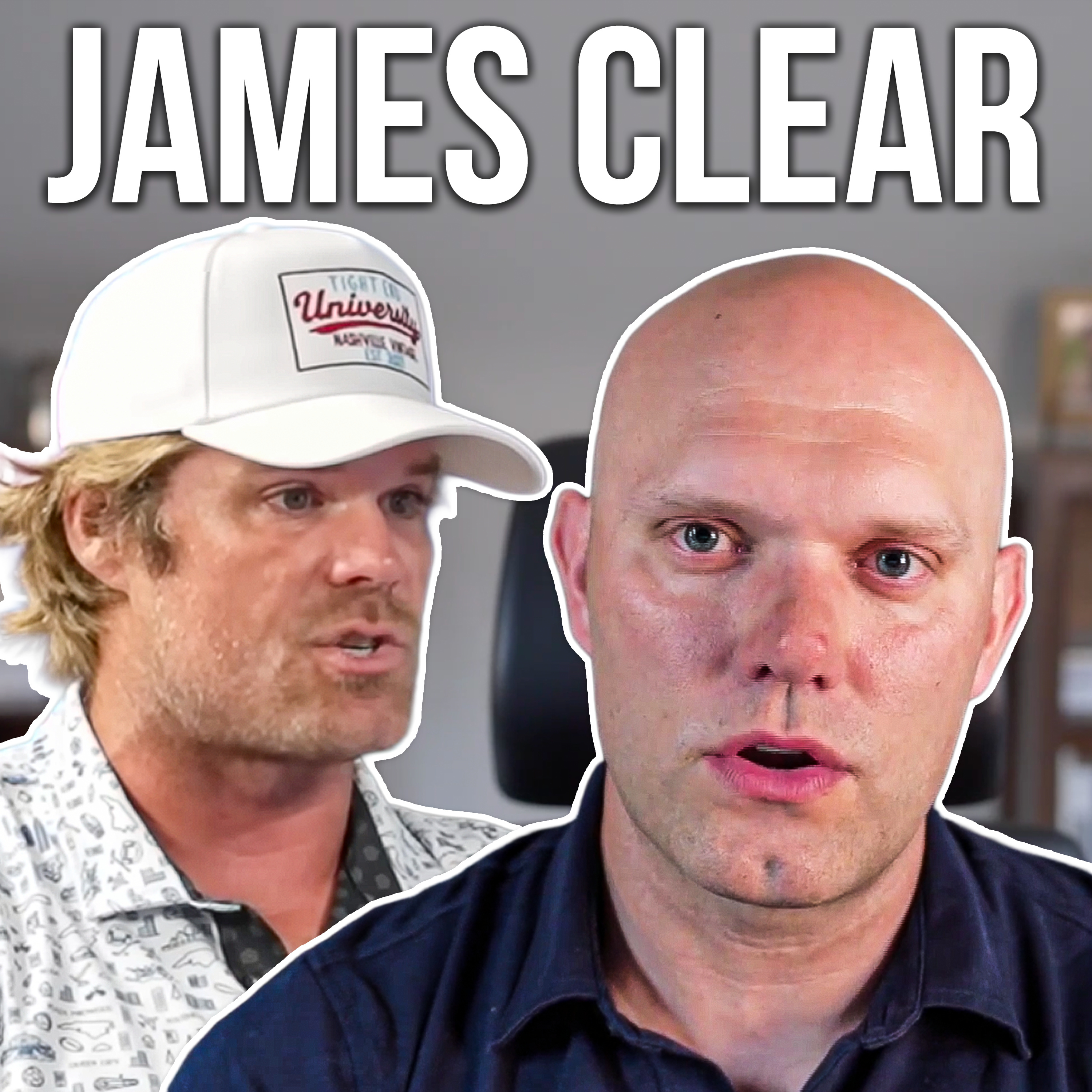
Make sure you subscribe to both our YouTube channel and our RSS feed for all future conversations here at youthink. What's up everybody? Welcome back to a really special edition here on youthink. I am joined by New York Times best selling author James Clear, author of one of personally one of the most probably breakthrough books that I've ever personally read. And that is genuine. That is not a plug, that is not being paid like. And that's the reason I reached out to you. James. Like, thank you so much for joining us here. I can't wait to dive into Atomic Habits, your big best seller and all your other newsletters and all the other information you share weekly with your followers. I just think it's going to be such a great resource for all of our listeners here on. You think so? Really appreciate your time.
- [00:43]
B
Yeah, of course. Thanks for saying that. And excited to do it. Thanks, Greg.
- [00:47]
A
Yeah, so, so I was telling you before we started, so I have like a stack of books. I'm an avid reader. I love reading new things, whether it's things that I'm familiar with or just completely out of the blue. So I have a very wide array of different book. So I was actually gifted Atomic Habits by a friend. I just finished it within the last three weeks, two, three weeks, shortly after I reached out to you for this conversation. And so I want to start here. We live every day in the youth sports world. I'm a dad of three. I grew up the son of a coach. All of our listeners, all of our families are all going through these same struggles where they're trying to navigate a very weird world. I know you have your own really interesting background as a baseball player in college and overcoming really significant injury. And it's the opening of your book and we can touch on that in a minute. But I want, I want to start here. I think the number one moment reading your book where I was like, this guy gets it. You talk about latent potential, you talk about the melting of the ice cube where the temperature gets warmer and all of a sudden the ice cube melted. But nobody saw the degrees rising to 31. They only saw 32 and above like. And I just thought it was such a great metaphor for kind of the world we're in in youth sports where we don't delay satisfaction. It's instant results. We don't develop, we don't worry. It's just instant in the moment wins, losses, like start big picture there for me, like frame that. To me, that was the part of the book where I was like wow. Like, this is this. And obviously I chewed up through the rest of the whole entire, you know, every page.
- [02:21]
B
So, yeah, it's a great point. You know, I think we all have thought about results versus process, and you know, that we've heard things like that before. But the reality is the world is very results oriented. You know, like, everything usually gets discussed after the milestone is crossed, right? You hear about Hamilton after it's a Broadway hit. Not like when Lin Manuel Miranda is sitting there writing it. You know, you hear about it after Tom Brady sets some record. You hear about, you know, the New York Times bestseller after it hits the bestseller list. Not when somebody's writing it. So that's fine. Like, I'm very achievement oriented, too. Like, we all, you know, we all want results, we all want better outcomes, but I think because we see them again and again, like, nothing is ever a news story until it's an outcome. You're never going to see a news story that's like, man eats chicken and salad for lunch today. You know, it's going to be. It's only a story when it's like, man loses 100 pounds. So we tend to overvalue the outcome and undervalue the process. And, you know, there's all this work that has to be done in order to get to that, that result. Like the San Antonio spurs have this quote that hangs in their locker room, right? They've won five NBA championships and says something like, whenever I feel like giving up, I think about the stone cutter who takes his hammer and bangs on the rock 100 times without it splitting in two. And then at the 101st blow, it cracks. And I know that it wasn't the 101st that did. It was all the 100 that came before. And, man, you can say that about almost anything. Certainly in sports, you know, it wasn't the last rep that, you know, got you the outcome you wanted. It was all the 100 that came before. It wasn't the last sentence that finished the novel was all the hundred that came before. And I think if you can have that attitude and realize that the work is not being wasted, it's just being stored, then it gives you, you know, a new lens for thinking about putting your reps in each day. The. The ice cube metaphor that you mentioned, I always like to say, you know, imagine you walk into this room. It's cold. You can, like, see your breath. You know, it's like 25 degrees. Then you start heating the room up. 26, 27, 28. The ice cube is sitting on the table. Nothing's happened to it yet. 29, 30, 31 ice cube still sitting there. And then you hit 32 degrees and it's this, it's this one degree shift, you know, not unlike the ones that came before. But all of a sudden you hit this phase transition. And I think that is often what the process of building better habits and what the process of trying to improve, whether it's in sports or just in life in general, what it's like because you show up and you do the right thing and a lot of the time you have nothing to show for it that day. You know, like my parents like to swim, right? So they, you know, they jump in the water, their body looks exactly the same when they get out as it did when they jumped in. If they're doing it for the physical results, well, that, that takes way too long. That takes a year or two or three. Like you're not going to see it on that day. And so you have to have this willingness to show up and continue to put your reps in and this mindset where you realize that just because you didn't get the outcome you wanted that day does not mean that the work was wasted. It's just being stored.
- [05:16]
A
Every building, every professional team, every college team, maybe every business organization has a sign that says get 1% better. I know it's a big part of your research, a big part of your kind of philosophies you lay out throughout the course of the book. Let's boil it down though, to some practical applications and we're going to get into some of the habit building and the four, you know, kind of the four sections of Q and reward and all that, we'll get to that. But for our followers, whether they're coaches, whether they're parents, like when you talk about delaying gratification and it's not about, you know, that moment in time, but it's about stacking those moments over time. How do we get in this world where it's highlight reel culture, it's only putting the highlights of our life, the game winning goal, the home run, we never put the strikeouts in the bottom of the ninth on Instagram. How. What is a practical approach for parents, teachers, coaches, leaders to get young people to understand this is a, this is a long term play. Don't cheat the moment now to sacrifice what you say or really want down the road?
- [06:23]
B
Yeah, well, I think first of all, I think just saying out loud some of the things you just said is helpful. Like I have three kids I certainly will be saying that to my kids, you know, like, they. They're very young right now, but when as they get older and get into sports, like, that's something that they need to hear, you know, So I think some of it is that. But more broadly, there is a huge cultural emphasis on position. And what I'm trying to get across when I talk about 1% better each day is I'm trying to shift that focus from being focused on position to being focused on trajectory. So, so much of the discussion is about position. What's the number on the scale, how. How much money's in the bank account, how many games have you won? It's all about, what position are we in right now? Who's in first, who's in last? And instead, I am trying to shift it to say, hey, instead of worrying about what our current position, let's focus a little bit more on our current trajectory. Are we getting 1% better or 1% worse? You know, is the arrow pointed up and to the right or have we flatlined? Because if you're on a good trajectory, all you need is time. You know, you just need to let the days keep working for you. But if you're on a bad trajectory, even if you're in a pretty strong position right now, it's not going to end well. And so this idea of getting 1% better each day, it's not really about getting wrapped up in the number. You know, it's not like, oh, is it a 1% improvement or 1.6% or something like that. It's just. It's an attitude, it's a philosophy, this approach for life where you can say, I'm going to show up today and I'm going to try to find some small way to improve. And I'm going to trust that if I do the same thing tomorrow and keep stacking these days up, then I'm going to end up in a pretty good place. And this is where you start to see the power of building better habits. It's not that doing some small thing really benefits you on any given day. It's that when you start to accumulate the days, you realize that time will magnify whatever you feed it. So if you have good habits, time becomes your ally. And every day that goes by, you're putting yourself in a stronger position. But the person who has bad habits, every day that goes by, they dig the hole a little bit deeper. And so you start putting yourself, you know, behind the eight ball to try to figure out, how do I. How Do I get the results I want? And that all comes back to this philosophy or this approach of trying to emphasize trajectory over position.
- [08:42]
A
Again, I can name 50 points you made in the book that I'm like, oh, my God. Like, this is so. It's what I've been taught. You know, every team is trying to implement and. But, like, no one really feels like, got it right. Like, I felt like you were one of the few people that were able to lay it out as clearly as you just did there and, like, have it and make it make sense. So we had. We have a. We had a kind of a slogan on teams that I've been on and whatnot, where the goal is just who can get better the longest. Right? It's not a matter of, are you in first place? Second place, it's very similar to what you're talking about there. And the idea of it's not about setting goals, it's about building systems and about building processes. And, you know, the team we coach now is like a middle school football team. And I tell them all the time, I say, guys, we don't have team rules. I'm not going to tell you what we have expectations and we have standards. So, like, all these similar things, I think you word it a lot better. So, like, again, teaching these kids that it's where you're going and not where you are, and it makes a lot of sense. It's very clear for all of us. In my experience with get better, go ahead.
- [09:49]
B
You know, like, that's. That I, you know, I never played professionally like you did, but I ended up having a good college career and was an academic All American my senior year. And that who can get better the longest is basically a description of my career because I was never the best player on any team I was on. And I didn't have, like, even a good high school career. But I just decided that I was not going to stop. And, you know, like, by the time I was 22 years old, I ended up being decent. And so there, you know, I think you can apply that to a lot of things in life. And I, you know, I try to do the same thing with my writing career now. And I think that's really one of the big gifts of sports, too, is that it's not only a way to win games, it's a way to live. You know, it's a way of being. It's a way to live life. And you're kind of equipping them with a mindset that they can use in many different situations.
- [10:35]
A
And in today's world where we want to crown 12 year olds and 14 year olds and 10 year olds and you're laughing. You have kids, how old are they?
- [10:43]
B
Four, two and four months.
- [10:45]
A
Okay. Yeah. So you, you got, you got a little ways, but you'll see what I'm talking about in a couple years yet.
- [10:50]
B
But I'm sure it'll come, it'll be.
- [10:52]
A
It'S getting younger, trust me. I have, I have a 13 year old and two 12 year olds and the landscape. That frustration is why we're even doing this show and having these conversations. So be patient. You know, the other, the other thing that I, that really struck me was like this idea that get rid of goals, right. I feel like every player on their team, or motivation, people want to call them goals or motivation, whatever you want to call it. There's a lot of ways to be motivated, right? Some guys in the NFL are motivated by money. Some guys in the NFL are motivated to get their family into a better situation. They want to make a Pro bowl, they want a second contract. And throughout the course of my career, I always felt I was always chasing the next goal. And then the goal came and then it was like, but now what? I just reached my goal. So do I stop? Do I? And that was something that I had to really wrestle through to like always move the carrot down the road. And atomic habits, you really dive into. Like, goals are not, they're fine, they're immediate satisfaction, but they're not really of the importance that everybody makes them. I'd love for you to kind of expand on that idea because again, like so many of these chapters, like hit me so head on because I'm like, I can relate to this.
- [12:07]
B
Yeah, yeah. I think what you said, goals are fine, is that's probably how I would land on it now. They serve a purpose, but they aren't the solution that people are kind of hoping they would be. You know, if you take most domains in life, take an Olympic athlete, for example. Presumably every athlete at the Olympic Games has the goal of winning the gold medal. You know, the goal is not the thing that determines the performance. It's genetic ability, coaching and strategy for the event, how much sleep they got the night before, like all kinds of things, right? Or if you have a job opening and 100 people apply, presumably every candidate has the goal of getting the job. No, the goal does not determine the outcome. It's education, experience, presentation, skills in the interview, who they know at the company, all kinds of stuff. So if this pattern is true in many areas of life that the winners and the losers often have the same goals. Well, then clearly the goal cannot be the thing that determines the outcome. You know, like we're all told, hey, you should be more ambitious, 10x your vision, think bigger. Set of bigger goals for yourself. But the goal is kind of the easy part. You know, like if I wanted, I'm an author, right? So I could set a goal to sell 100 million books. Took me three seconds. You know, the goal is not the hard part. It's building a system of behaviors, a collection of habits that carries you toward that outcome. So what I would say is, look, you don't rise to the level of your goals. You fall to the level of your systems. And so often in life, we're surprised by this dynamic, but we see it again and again. And so if I was going to put a little finer point on the language, what do I mean when I say goal and system? Your goal is your desired outcome. It's like the target, the thing you're shooting for. What is your system? It's the collection of daily habits that you, you follow. And if there is ever a gap, if there's ever this difference between your desired outcome, your goal, and your daily habits, your system, your daily habits will always win. You know, almost by definition, your current habits are perfectly designed to deliver your current results. So whatever habits you've been following or the team has been following, whatever collection of, of habits you've been following for, say, the last six months or year or two years, it's carried you almost inevitably to the outcomes that you have right now. Now, you know, I'm not saying that habits are the only thing that matter in life, right? Certainly there are other things that influence outcomes. You've got luck and randomness. You have misfortune. But by definition, luck and randomness are not under your control, and your habits are. And the only reasonable rational approach in life is focus on the pieces of the situation that are within your control. So, you know, after the book's been out about five years now, and I've, you know, got to talk to a lot of businesses and teams and players about this stuff. And so where I've come down on it now is goals are good for setting us into direction. So it's good to say, hey, this is our goal. This is what we're all working toward. That's, that's good for focus and clarity. They're good for filtering. So if somebody comes to you and they say, hey, do you guys want to do this, you can run it through the filter, your goals, and you say, does it get us closer to that or not? And if not, it's easier to say no. But once you've selected the goal, you should probably kind of set it on the shelf because. And spend most of your time focused on your daily habits and the system that you're building. Because goals are good for people who care about winning once. Systems are best for people who care about winning repeatedly. You know, if you really want to make progress again and again, you're going to need some kind of system, some process to keep you up there. So, you know, ultimately, I'm kind of describing this like a dichotomy, right? We have goals and we have systems, but of course, what we really want is both. We want an alignment between your daily. Your, you know, your daily habits and the outcomes that you ultimately want. And I think most people spend a lot of time thinking about the goals or dreaming up of what results they would like and not nearly enough time thinking about the system and the daily habits required to get there.
- [15:59]
A
What's up, guys? Do you want custom fanware like this cricket shirt for Charlotte Christian School? We've got premium apparel from your favorite brands. The best part about it is I don't have to just wear it to Charlotte Christmas Christians events. I can wear it to golf. I can wear it to lunch. It's turned into my uniform. Go right now over to youth.in Sign up for our newsletter. It talks about our podcast for that week, our interview guests, all the breaking news across the landscape of youth sports, and you can win one piece of merch for your school by going to sign up today. And remember, it's not.com it's youth.in now back to our episode. So is it fair? Like, as my brain process is hearing you say that, like, is it fair to say that whether you want to call it winning or you want to call it success or you want to call it reaching, said goal is almost a byproduct. Like, it's almost a secondary component where it's like, you know, what if we win, great, but we're going to win because we train hard in the off seasons, we show up on time. Xyz. Winning almost becomes a byproduct goal. You know, reaching goals almost becomes a byproduct. Like, is that a fair characterization?
- [17:04]
B
Almost have to admit that that is, like, probably the case. You. It's kind of that famous Bill Walsh quote. The score takes care of itself. Yeah, I mean, right? You know, imagine you're a basketball team. And in one scenario, you're only going to focus on the score. Every time you get a possession, the first thing you do is you look at the scoreboard and then imagine another basketball team that the scoreboard, like, is off or something, the power went out, and all you can do is focus on how well you're going to execute that possession. I mean, which team is in the better position to win? You know, it's like the score is not the thing that you need to focus on. Um, and it's true even for, like, dumb little stuff too. Like, you know, you want to clean out your garage. Well, that's fine. You can have a goal of having, having a clean garage. But if you don't have the habits of living in, you know, kind of a clean and orderly lifestyle, then even if you clean it for a day, you're going to turn around a month later and it's going to be messy again. And, you know, so it just, it works that way in, like, big and small ways in life. And it almost, it almost is to the point where I think people should. If you don't want to live the lifestyle that is required, you should release yourself from the desire for that result. Because to desire the outcome and to not want the lifestyle is just to end up frustrated. And so it's really. I think this is what you see with these people who get really incredible results in most fields is they like living that way. You know, they like living the way that is required, doing the habits that are required day in and day out. It's the person who likes the lifestyle that is much more likely to get the result as the byproduct.
- [18:36]
A
Well, it's a great segue because I want to spend some time talking about identity. I know identity is a big part. You know, you use the idea, you know, someone offers you a cigarette and you say, I don't smoke, or I'm not a smoker. Right. It's not necessarily, I work out. I am an athlete. Like, you give a lot of those examples. Even just how we talk to ourselves, how we classify ourselves wrapped up in our identity. That might be what you just said, though, that that needs to be on every youth, high school, college, name it. Across the board, frustration comes from people that have their goals but aren't willing to live the lifestyle that will lead to that goal. Like if you could put one saying and wrap it in a bundle and send it out to all young kids right now, they all want to be LeBron James. They all want to Be whoever.
- [19:23]
B
Sure.
- [19:24]
A
How many kids are really willing to do that day in, day out, over and over and stack that.
- [19:31]
B
Which is why some of the most. I mean, this is. I heard this when I was a kid too, but like, you know, you should focus on what you really love or what you're obsessed by, or at least what you're. Maybe if we don't like words like that, you know, people say what you're passionate about or something, maybe you could say, like, what are you genuinely interested in? You know, or like, what are you enthusiastic about? That is just like pulling you in. You almost can't stop yourself from doing it because you just think it's so fun or cool. And maybe that's programming on the computer. Maybe it's playing basketball, maybe it's, I don't know, something else. Gardening, Whatever, it doesn't matter. I. I almost think for my kids, what I really want, almost more than anything, is for them to find the thing that lights them up. Because if they can find that, then you're like, okay, you have so many ways to get better at that thing now because you're already in. You're in the game. You want to be doing it. You want to live that lifestyle. And, you know, the performance can come naturally if. If you're really lit up by it.
- [20:20]
A
Yeah. All right, so let's stay on identity.
- [20:23]
B
Yeah.
- [20:24]
A
You hear a lot of, you know, we had Dr. Michael Gervais, a world renowned sports psychologist, and me and him have had a lot of really interesting conversations and my ways that worked for me maybe don't work great for my kids. And one thing, to a person that I think all athletes struggle with, I know me personally went through this where from the big part of my life, I was a football player. Now I lived that lifestyle every day. I was really. I enjoyed living and breathing and eating that every single day of my life. And it worked out for me. But that's not everybody. Right. Like, not everyone's going to have the outcome that merits putting that kind of effort and work. So then there is the other side of that coin where if it does become your identity and you only see yourself through, through, it could be sports, it could be academics, whatever. It doesn't, whatever it is.
- [21:14]
B
Yep.
- [21:15]
A
Are we now lending these kids to wrapping their identity too much up in what they're doing and the outcome that comes, like, how do we find that balance, especially with young kids?
- [21:25]
B
Okay, all right, so there's a lot to say here. So give me, just give me a minute. All right, so the Floor is yours. All right, so ultimately, I think where we want to get to is the point where we are taking pride in being that type of person. You know, there are all kinds of external reasons to do stuff. Hey, you might go to work to get a paycheck in two weeks, or you might, you know, play the game because you hope to win the championship at the end of season or whatever. And the external rewards are great. But ultimately, we want to get to a point where we take pride in being that kind of person. Because if you take pride in that aspect of your identity, you'll fight to maintain the habit. You know, like, if you take pride in the size of your biceps, you never skip arm day at the gym. You know, if you take pride in how your hair looks, you have this long hair care routine. You do it every day. Like, I wouldn't know, but you know what I mean? You know, and it's like, the more that you do those things and start to adopt them as part of your story, the more likely you are to stick with it. And so I think that's where you can see the value of these small habits, is that they reinforce being that type of person. And to me, this is really the reason that that habits matter is that it's not because of the external results. Hey, habits will help you make, you know, twice the money or get in the best shape of your life or reduce stress. Like, it's true that habits can do that stuff, but the real reason they matter is every action you take is like a vote for the type of person you wish to become. And so, no, doing one push up does not transform your body, but it does cast a vote for, I'm the type of person who doesn't miss workouts. And, no, giving one bit of positive feedback to somebody on your team does not make you the world's best teammate, but it does cast a vote for, I'm the type of teammate who cares about the guys I play with or the people around me. And so every step that you take in that direction, you start to reinforce that story. All right, so this is on the positive side of identity, right? Like, as we're building the habit, we want to build up evidence of being that kind of person. And I think, just to give a real simple example here, if you go outside and shoot a basketball for 20 minutes this afternoon, you don't, like, instantly think, oh, I'm a basketball player. But if you do it every afternoon for the next six months or year or two years, like, at some point you cross this invisible line where you got to be like, you know what? Playing basketball is kind of a big part of my life. And so it works that way for everything. You know, I. I almost think that, like, whatever you want to be or whatever outcome you want or identity you want to have, it's almost. It's like it's on the other side of a certain number of repetitions, and nobody knows exactly how many repetitions that is, but maybe it's 100, maybe it's a thousand. But really, all there is left to do is get your. Get your reps in and start to prove that identity to yourself. All right, so that's. That's the good part, right? You build up these reps, and you start to foster this identity, and you put yourself in a stronger position where you feel like, yeah, I want to do this habit every day because it's just part of who I am. I'm being the type of person. Person I want to be. But on the far side of that, as you just mentioned, well, okay, what if you've been an athlete for 20 years, and now all of a sudden you're not one day and your career's over, and then you're like, well, who am I? Or another example I came across when I was working on the book. People have been in the military, you know, for. For a decade. Their. Their identity is, I'm a soldier. And then they leave the military, and suddenly they're civilian, and they're like, well, who am I now? And I think two things come to mind. So the first is when I played, my dad used to tell me, he said, look, when you step between those lines, you have to play like nothing else matters. And then as soon as you walk off the field, you got to realize that it never mattered at all. And I think that there's this, like, dual place that you need to be in your mind where you are both going to compete like there's nothing else that you're working for in the world. But also realize that you are more than just the sport, right? You are more than just this game. You are more than just this one thing. And that you are a whole person. And that this is not. The loss of. This does not mean the loss of a good life. There are many ways to live a good life, and this is just one of them that you happen to be exploring right now. So I think there's. There's that part of it and then the second piece. And this is what I came across when I was studying that soldier civilian example. Is that you need to look for the elements of your current identity that can be transported or trans, are transferable to the next chapter of your life. You know, so the soldier might be able to say, well, you know, I'm not a soldier anymore, but I can still be a good teammate. Or I can still be the type of person that follows through on the mission that's given to them. You know, you find these. I can still be reliable. You find these aspects of your previous identity that you can say, okay, I can apply that to the job I'm in or to, you know, whatever scenario I'm in. And I think if you can do that, you start to realize that maybe if you lean into your strengths a little bit more as you transition from chapter to chapter, then it becomes a little less about the label and more about, you know, just who you are as a person. So identity. Identity can be a very powerful thing for getting a habit established. But then on the back side of it, you always need to be. I. I kind of equate it to, like a painting that's always being retouched. You know, the picture is never finished. You're always kind of adjusting and upgrading, editing and expanding your identity for whatever your next chapter requires.
- [26:33]
A
I like that.
- [26:33]
B
That.
- [26:34]
A
I just think it's such a powerful conversation that kids are struggling with, I think parents are struggling with. The more we get wrapped up into, you know, in our case, the youth sports world, it. For a lot of these kids, it does become their identity. And maybe it didn't become our identity until we were in high school and college. But for some of these young kids, it becomes their identity and what they're told is their purpose when they're in fifth grade. And I just.
- [26:56]
B
When you're 10 and 12 and, like, it's your whole world, you know, I mean, you haven't. You haven't seen that much of the world yet. So it's. I. I think it's a tricky thing. The younger that you are, no doubt.
- [27:05]
A
Let me ask you this. How much of what you're describing as far as the ability to execute, all of this is a product of just innate makeup and just unique mindset and unique approach, but also environmental. The environment. I know you're obviously big on the environment that you're in, and you take on the personality of the people around you, whether it's family, friends, teams, whatever. Like, what is that balance between, you know, wiring. We can call it just hardwiring personality, innate traits, but also the importance of environment, the importance of surrounding yourself Your children, your family, with other like minded people, other positive influences. Because if you're not building good habits, you're building bad habits. There's really no neutral ground. And you know, so how would you kind of lay out what that looks like?
- [27:54]
B
I think environment's critical. I almost recommend that being one of the first places you start if you're trying to build a better habit is by. I think you can first start with adjusting the physical environment. So, you know, one simple question you could ask yourself. Think of a habit you're trying to build and just hold it in the back of your mind and then walk into the rooms where you spend most of your time each day. Your office, your living room, your bedroom, your kitchen. And then look around and ask yourself, what is this space designed to encourage? You know, what behaviors are obvious here, what behaviors are easy here? And you might be surprised by what the path of least resistance is. You know, we all have these habits we say are important to us. But then you look and it's like, to do the easy thing, it only takes one step. And to do the thing I want to do, it takes like seven steps in this room. So how can we change that? So there's a bunch of examples. You know, there's obvious stuff like if you want to go for a run every morning, set your workout clothes and your shoes out the night before, or, you know, when I wanted to read more books, I would sprinkle books around the room so that I was never far from one. I took audible for audiobooks and I put that on the home screen of my phone so it'd be like the first thing that I would see when I opened it up. Like you're just trying to find ways to reduce distance, reduce friction between you and the habit you want to perform. So that's, that's the physical environment and then social environment. I think if you're trying to get a habit to stick for a long time, a year, two, maybe even a decade, the social environment is one of the most powerful factors. You know, we, we perform habits because of the results that we think they'll get us. But that's not the only reason we do them. We also perform habits because of what they signal to the people around us. Hey, I get it. I understand how we act here. I fit in, I belong. And we're all, you know, humans are very social creatures. We all want to bond and connect. We all want to be part of something, whether it's your little friend group or your family or whatever it is. Like people don't want to go against the grain of the group. And so I think the punchline is you want to join groups where your desired behavior is the normal behavior. If it's normal in that group, then it's going to be really motivating for you to stick to it and for you to follow through, because your friends and your teammates and, you know, your coworkers are going to be doing that thing, too. I always, you know, like to joke about, like, every school that I went to, the swimming and cross country teams, their GPAs were incredible. It was like they were always the top two teams. Meanwhile, the baseball team's like, you know, down at the bottom or whatever. But I swam for seven years, and I ended up having a bunch of friends that really liked school and got good grades, and I kind of liked it, too. And I wonder how much of that was me soaking it up from them, because it's like, look, if all your friends are going to study for the test, like, you kind of care about the test, but mostly you just want to hang out with your friends. And I'm not saying that you should, like, have your kids swim if you want them to be smart. I don't know that it works exactly that cleanly, but you get the point right there. In all groups, in all pockets of life, there are expectations and standards for how you act in that group. And most of them are unspoken. They're just kind of, like, soaked up from the people around you. And so I think this is good career advice. I think it's good sports advice. I think it's good life advice. Look at the people you're hanging around and then ask yourself, do I want to be where they're at? The people that are at the top of this group? Is that where I want to be in five years? Like, what does that lifestyle look like? What do those outcomes look like? And do I want what they have? Because if so, then I should hang out here. If not, maybe this is the wrong group for me. And so I do think both of those elements, the physical environment and what is easy and what is low friction for you to do, and the social environment, what are you rewarded and praised for? What are you criticized if you do? What's the standard? What's the normal behavior in that group? I think those are two really powerful ways to look at your habits. Yeah.
- [31:41]
A
And then not only do you want it, then to your earlier point, are you willing to live the lifestyle to achieve it? Right. And I think that's always, sometimes the disconnect Especially at the young age. And I think that's a lot of these lessons of what we're trying to tell coaches and parents and kids that listen to our shows. Like, there's a big difference between being wanting something and being willing to achieve something. It doesn't. Typically those things don't run a line. So I think the way you frame it is just so good for our listeners to hear. The last thing. I would love you to talk about that. Go ahead.
- [32:13]
B
Just to click on that for a second. The other thing that's really hard about that is that it kind of can't be faked, you know, there. That's why I use words like interested or you're enthused, natural enthusiasm for something or whatever. Like there's. There are some things that just draw you in and so you can kind of play this game where you're like, well, I'm gonna really want it, you know, and like, try to, I don't know, force yourself to do it for a while. But if you don't genuinely love it, if it's not really, like pulling you in, naturally, it's going to be hard to stick to that for five, six, 10 years, however long it takes to become really good at that thing. And I think this is one of the potential downsides. You know, I'm not even really in deep in the youth sports world yet as a parent, but I do think this is one of the potential downsides of kids niching down faster and focusing on one sport faster there. What are the odds that the first thing you pick is also the thing that you're like, naturally really interested in? I mean, you should. You should have a wide exploration to find the thing that's right for you, and then you can start to double down on it. But when you. When you narrow your focus so quickly, it's just mathematically it's pretty unlikely that, like, the first one or two things you try are the. Also the thing that's the perfect fit for your natural interest and enthusiasm. Yeah.
- [33:26]
A
Because you think you got to ma. You have to guess right at 10 years old that you're going to have the interest level.
- [33:32]
B
Yeah.
- [33:32]
A
Everything you've talked about.
- [33:33]
B
Yeah.
- [33:34]
A
You're going to have the physical skill sets required. Right. I dream about being a basketball player, but you're going to be 5, 9. There's not a whole lot there. And then also are you going to have the opportunities, the pathway, the fortune, the, you know, the element of luck and chance and all the other actors for all those things to get Thrown into a bucket and work out from the time you're 10 to whatever age this would know come to fruition. You're. You're exactly right. I have these conversations with, with the high school kids that we work with, and they all want to pick their sport by freshman year because. And I tell them, I say, guys, like, I couldn't advise against that strong more strongly.
- [34:12]
B
And it is tricky.
- [34:14]
A
It's a hard battle though, nowadays.
- [34:16]
B
Compete right like they want to. They want to be able to compete at a high level. And I get that. But it just, I think this is another message that I want to give my kids as they get older, is that there are many ways to live a good life. You know, there, there are many good lives out there for you, and you're just trying to find one of them. And there is no perfect outcome. You're going to have to make the best of it, regardless of what it shakes out. Like, and if you, if you are willing to accept that, you know, if you can believe that, then it doesn't feel quite as brittle. You know, if you get cut from that one team or if you don't make it into that one college or if you don't, you know, what you, like, you don't need, you don't need things to go perfectly. And I think that actually, ironically, we kind of talk about mental toughness and grit and discipline as like, I'm going to force my way through and it's going to be this way and I'm going to make it happen. But ironically, that's actually a very brittle mindset because if you, if you need things to go a certain way, then you are now held hostage by that scenario. And if it doesn't go like that, all of a sudden your world comes crashing down. And instead, actually the most mentally tough and resilient mindset. Mindset is to be adaptable, to be flexible, to be willing to see. I am in a position where I will figure out I can be happy in many situations. You know, I can be. I can enjoy success in many different ways. And it's once you adopt that mindset that I think you, you put yourself on the path to a much better outcome.
- [35:36]
A
I love that. I mean, there's so many nuggets in this. Like, this is. This is exactly why I asked you to come have this conversation. And this is the last thing I have for you. And I'm just curious. So you speak to teams, corporate America, some of the biggest business leaders, thought provokers, name it. You have so many great Nuggets. So many key pieces. You've laid a lot of them out for us today. There's probably some we haven't even touched on because there's. Is there one element that you get as feedback from coaches or CEOs or executives? Is there one element of your work, of your studies, of whether it's the book or just your thoughts? Like, is there something that you feel like connects the most often?
- [36:20]
B
I'll get. So I'll give you two. So one is a very practical strategy. I like to. I try to make things actionable. So I like to weave this in there. So I call the two minute rule. And it's just whatever habit you're trying to build, you scale it down to something that takes two minutes or less to do. So read 30 books a year becomes read one page or do yoga four days a week becomes take out my yoga mat. And sometimes when I tell people that, they resist it a little bit, you know, like, okay, buddy, like, I know the real goal isn't just to take my yoga mat out. I know I'm actually trying to do the workout and I get where people are coming from. But there's this story that I tell in the book. There's this guy named Mitch, and he lost over a hundred pounds and he's kept off for more than a decade now. And when he first started going to the gym, he had this strange little rule where he wasn't allowed to stay for longer than five minutes. So he'd get in the car, drive to the gym, get out, do like half an exercise, get back in the car, drive home. And it sounds silly because you're like, this is not going to get the results that he wants. But what you realize is he was mastering the art of showing up. And man, I think that lesson of can I master the art of showing up? That just applies to, like, everything. You know, we. This is a deep truth about habits that I think people often overlook, which is a habit must be established before it can be improved. You know, we're so busy optimizing. We're so busy focused on the best workout program, the perfect diet plan, the ideal sales strategy. We're so focused on optimizing that we don't give ourselves permission to show up in a small way. But I think particularly for busy people, you know, like, I, I don't know what's important to you right now, Greg, like, what project you're working on or something. But, you know, I could tell you right now, like, okay, let's scale it down. Find something you can do in the next five minutes to move forward on that and it would make sense to you. And then what's going to happen two weeks from now? You're busy again, bunch of stuff's in your inbox, people are waiting for replies from you. You're, you know, and then all of a sudden it's like you have to remind yourself again, scale it down, get back to, you know, it's just like that durable advice that you just can endlessly remind yourself to try to make it easy and scale it down. That something takes two minutes or less to do. And then the. So that's the first one and then the second one. The last thing I'll say is, in a lot of ways I feel like the two time frames in life that really matter are 10 years or one hour. And what I mean by that is like 10 years is shorthand for pretty much all the really meaningful things in life that we all want. The big meaningful stuff, you know, building a business that you're proud of, raising a great family, creating a successful marriage, getting in the best shape of your life. Pick whatever the thing is. But it's probably a multi year process. Those are those things that really provide a lot of meaning to us. And so what is that 10 year vision? And then one hour is shorthand for what can I do right now that's going to move me toward where I want to be in 10 years? And you know, there's a lot of stuff that just has to get done every day, right? Like you got to take care of your kids, you got to get to practice, you got to make meals, whatever. There's just stuff that needs to happen. So not every minute of the day can be oriented in that way. But I think if you can do something each day that works toward where you want to be in 10 years, that you show up two or five or 10 years later, you're in a really great spot because you're thinking long term, but you're acting short term. And that I think that's a powerful combination. And so I. The last thing I would say is don't underestimate what five good minutes can do. You know, five good minutes of try, just go do push ups for five minutes like you'll be winded. You know, five good minutes of push ups can be a good workout. Reset your mood for the day. Five minutes of writing will make you feel like the manuscript's moving forward again. Five minutes of conversation can restore a strained relationship. Like you can do a lot with five minutes if it's oriented toward one of those things you really want in 10 years.
- [39:58]
A
Power of progress.
- [39:59]
B
Right? Keep moving forward.
- [40:00]
A
Well, James, I had high expectations. Obviously I reached out to you just as a fan of your work and your thoughts and your mindset and your, and your work. I think for our, for our audience and our listeners to be able to hear it in your words, explain so clearly the amount of nuggets, the amount of practical, simple advice that I think can have such a big impact on their ability to raise kids as parents, coach kids as youth sports coaches and just improve their own personal life. So on all levels, I think the amount of information that people are going to take from this is the reason why I reached out to you and I can't thank you enough for your time. It's super appreciated by all of us at you think. And you have a really special way of making complicated things simple and practical and accessible. And I don't know, I don't know. I don't, I can't pay you enough compliments. So I really appreciate you doing.
- [40:53]
B
Thank you so much, Greg. I appreciate it. It's a pleasure to talk to everybody and I hope the, the parents and teams and kids listen to this, find it useful. So thanks again for the opportunity.
- [41:01]
A
We'll catch you again next week right here on you think.