← Youth Inc. with Greg Olsen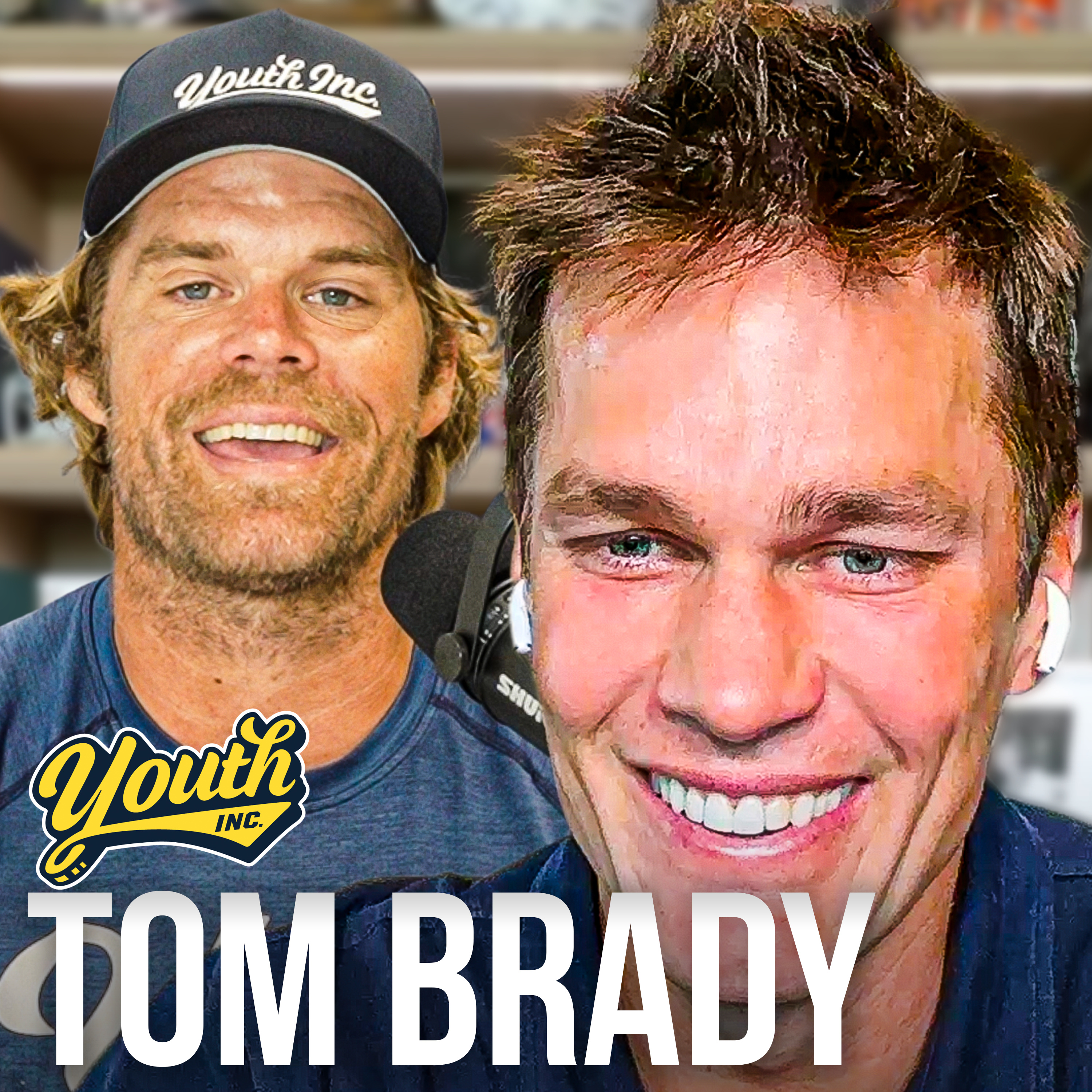
Youth Inc. with Greg Olsen
Tom Brady on Youth Sports, Broadcasting and His Relationship with Greg Olsen
01:07:22
Loading summary
Transcript99 lines
- [00:00]
A
So before you guys go check out our conversation with Tom Brady, make sure you subscribe to both our YouTube channel and our RSS feed for all future conversations here at you Think. All right, so when, when we laid out about two years ago the journey and the path and the vision of what you think was going to be trying to bring great stories, great processes, great experiences to the masses about the journey of youth sports, we had kind of a Mount Rushmore of guests, and we sat down on a whiteboard and we said, if we could ever get these guys. Well, our guest today is at or near the top. He's probably the top of everyone's Mount Rushmore. We have the great, the greatest football player of all time, widely regarded greatest quarterback of all time, seven times super bowl winner, a guy that I played against a handful of times as a competitor. Now I'm a colleague with him in the sports media with our work at Fox. And I think the coolest thing is over the last year or so, someone that now I call a friend, someone that we talk to, share stories personally as dads and whatnot, the one and only Tom Brady. What's up, buddy?
- [01:02]
B
Hey, Greg. I appreciate you having me on, and I really appreciate what you're doing in the world of youth sports and guiding parents who maybe don't always have, you know, they have the advice they get, but to get it from a, from a place like this with a lot of the guests that you've already talked about, and for them to be able to listen and to respond and to hear the different insights, because I think that's what we've all had the opportunity to go through some unique experiences, and all we really know is our own experience. But, you know, we've all paid attention and observed for a long period of time as well about the things that work maybe a little bit better than others. And I think both of us have a great opportunity going forward to just share the way that we see things and the way that may be right for us maybe may not be right for others, but at least, you know, we could. They can hear our viewpoint and go from there.
- [01:53]
A
Absolutely. Well, I, I just think it's so cool. Like, again, everyone knows you from your career and your story, and obviously it transcends more than just sports. But, you know, I've gotten to know you a little bit as a dad. I've gotten to know you as a son, a brother, and, and I want to start there.
- [02:07]
B
But I want to read a quote.
- [02:09]
A
A wise man once said, I encourage everyone to play Football for the simple reason that it is hard. And I think I. I want to start there because I think it's a really. If anyone doesn't know, Tom is the one who said that. I just think it really paints a picture into just your entire approach, just the way you view things, the way you went after things, not only in your career, your post career, your business ventures. Where did that mindset. Where did that mindset of embracing difficult challenges and pushing through the hard, like, where did that all start for you?
- [02:42]
B
I think the interesting part is the journey of football for me started at a young age. But I wasn't probably the typical kid that you think would reach 23 seasons in the NFL and to be a part of seven championship teams. I didn't play Pop Warner football. It really wasn't available where I grew up. And when I started playing, I was a freshman in high school. We had three teams at our school. The freshman team, the JV team, and the varsity team. I started on the freshman team, but I didn't even start. I started playing as a freshman, but I was the backup quarterback on our freshman team and we were.07 to start my freshman career. I fell in love with the sport because the 49ers, I didn't know how to put pads in my pants at that age. I was looking around on all the other kids.
- [03:30]
A
The kids still don't. If it makes you feel any better, the kids still don't know how.
- [03:33]
B
Okay, good. Thank God. Because I was looking around like, how. How do I put the. The butt pad in and the back can't even see it. And you got to put it on the loop through the paddle was a disaster. And I just remember getting out on the field and I, of course, I had watched football growing up and I was. But I never played it. And then you start hearing all the play calls and what do I do on a pinch stunt and on a, you know, how am I going to play lineback? Well, thankfully, I couldn't play linebacker. They. They found me at quarterback, but because I had a decent arm, but I didn't really play. And I'll make a long story short, it was a. It was a struggle for me and people wouldn't see this now, but my second year I played junior varsity and I ended up winning the starting job because the guy was the freshman quarterback quit. And we were okay that year, but I really fell in love with the sport. And then my third and fourth year, I started on varsity and I got lightly recruited to Michigan and ended up choosing There because I thought, okay, I was a bit naive of how hard it actually would be, but I was like, you know, if I want. If you want to be the best, you got to beat the best. But of course, I was nowhere in the realm physically or mentally or emotionally where a lot of these other kids were when they arrived at campus of Michigan. I was. There were six other quarterbacks ahead of me at Michigan when I started. And I fought my whole career, college career, to end up getting to start. And I started my fourth and fifth year and there was a lot of struggles along the way. And I would say I had a good college career. It wasn't great. I thought I'd be a second or third round pick in the NFL because I developed and I was very much late bloomer. And then I got picked by the Patriots at 199 and then was the fourth quarterback on the depth chart when I started at the Patriots. So I guess my point in saying this is I really valued. When I did get a chance to play as a starter, I really valued where I was at because it was hard for me. And every step along the way was a challenge for me to get from one year to the next, to get from the freshman team to the junior varsity team, the junior varsity team to the senior team, the varsity team to the college team. And in my red shirt, freshman year was hard. Everything about it was a challenge, but I really valued it. And I knew that, okay. And I always said this thing, well, if they put me on the field, Tommy, they're never going to take you off. And fortunately for me, and it was tough situation for Drew, but he got injured in his second year. And when I remember running on the field, I felt I was really prepared because I knew how to compete. And I, I ran out on my field in the second year. I think I was 24 years old. And I basically played for. For 21 straight seasons after that. And every step along the journey for those 21 years was a challenge. And I think when I referenced how hard it was, it was never something that to me, you could just, hey, let's just roll my helmet on the field. I think you and I both played with players like that, that they're really talented as youth. They never really learn how to develop a great work ethic. And I'm not saying they don't work hard. I'm just don't say they don't work as hard as they could possibly work. They work to a level of their comfort and then they don't. They're competitive, but they never have to be ultra competitive because they're physically just a lot better than everybody else. So I think just some of those teachings and learnings that I had ended up being great blessings in my life. It was a blessing that it was hard. And I think.
- [07:00]
A
No, sorry, go ahead. No, go ahead.
- [07:02]
B
No. Well, I just think it's a blessing when it is hard because you. There were so many times along the way where I thought, man, maybe it should be easier than this or maybe I should go take an easier route. Maybe I should go to a lesser competitive school than Michigan. You know, that was one. Maybe I should quit football because that would have been easier in high school. But I look back and I go, you know what? I'm so happy I didn't because it built up a level of determination and resilience in me that was able to transcend decades in professional sports. And when we think of the great players and not everyone's going to be a great player, but whether you want to be a great player in life, you want to be a great athlete in life, you want to be a great member of your family, you want to be a great member of your community, you want to do great in your, in your office job, well, you better be a great teammate and you better learn to overcome the things that don't go your way. Because a lot of times the things that don't go in your way, if you look at them as a blessing and you learn from it and you get more determined for it and more resilient, then it will be a blessing. And that will carry you a lot further in life than something that's given to you.
- [08:08]
A
You think is proud to present this episode in partnership with Unrivaled Sports. This summer, while in Cooperstown, New York, I had the chance to sit down with Andy Campion, chairman and CEO of Unrivaled Sports, to hear how they are providing top tier experiences and at every level of youth sports. All right, so welcome to what's a really special edition. Here we are in Cooperstown, New York, Andy Campion, Chairman, CEO of Unrivaled Sports. We are here at Cooperstown allstar Village. A lot to dive into. We're talking before here on you think. Just give us a snapshot. Like, what are we looking at? What is. This is. This is absolutely incredible. We're going to talk about my Cooperstown experience, but give us an idea of just where are we, what are we looking at? This is incredible.
- [08:52]
C
Well, we're pretty close to the baseball hall of Fame here in Cooperstown. Right? Cooperstown All Star Village is the name of this property. I would say this property represents our mission in unrivaled sports in its most sublime state. So it's 12 year old youth baseball, only 12 year olds. It's a little bit of a rite of passage as they move on to the next level of baseball. Bigger fields, high school, etc. You know, you know, the way we think about it is keep the main thing the main thing. So we have amazing fields themed by, you know, New York, Louisiana, California, et cetera. If you're a Boston fan, we got a green monster out there and that's the main thing. We want it to be awesome tournament experience and we want to inspire the kids. And then we've created this environment, a player's village. They stay in a tavern space for parents lodging. And our philosophy is pretty much if we inspire the kids and they have an awesome time, it'll be memory making for the parents.
- [09:48]
A
We're going to talk more about just the intricacies of the All Star Village here in a second, but I want to talk a little bit about the work you guys are doing with Unrivaled. So there's not a day that goes by that there is not an article about investment in youth sports, the big business of youth sports. Tell us a little bit more about Unrivaled. What was the motivation? Why youth sports? Why do you guys have such a passion, but not only here for All Star Village, but Cal Ripken and some of your other projects? Just what is it about not only the business of youth sports, but just the experience you guys can help create for so many of these young families and young kids.
- [10:19]
C
All right, so I'll answer that a little bit through the lens of why am I doing this? So I was more lucky than good. I was really lucky to have had the opportunity to work at Disney 11 years, work at Nike for 17 years. I'm actually wearing Kobe 6 Dodgers shoes for a reason.
- [10:36]
A
Would cut your leg off. They don't even know what size they are. My kid would cut your leg off to steal your shoes. Right now those are Kobe's are a big deal.
- [10:45]
C
Basically in the last few years before he passed away, I was really lucky to get to know Kobe. And on a few occasions he gave me advice and it was almost like he was giving himself advice after basketball. He said a few times, and I have some sign things from him that say, Andy, do epic shit always. And it just stuck with me. And in a way it's like well, obviously we'd all love to do epic shit. Everybody loves youth sports, right? Everyone wants their kids to play youth sports. Our mission is provide unrivaled sports experiences to young athletes everywhere. So for us, that's not just provide the pinnacle like Cooperstown All Star Village. It's a dimension of this kind of experience at every level. That could be league, tournament, a showcase. I think you talked about your oldest playing in some showcases, local, regional, national. And so, you know, if you think about what epic means, right, it's like a long journey but a huge impact. And I just think youth sports is one of those things where you go, it's almost never ending how much impact you could have in it. And that's, that's what unrivaled sports is about. And it's frankly why we chose the name. We want our experiences to be inspiring and memory making, inspiring for the kids. And if that's true, it'll be memory making for the families. We think about it as competitive and developmental. We want people to go home and say, this was awesome. The win might be kids are going home going like, I never thought about baseball that way. And frankly, I'd say even more so. There's a value we have which is we want to set the standard for youth sports in every aspect of esports we're in. So if we're managing a flag league like our flag league under the lights, or we just launched unrivaled flag, a flag football focused new brand. We launched it with a high school girls national championship at our property in Canton, Ohio, which is adjacent. It's part of the hall of Fame complex. We invited the top eight teams from around the country for free to come play. And we invited other teams into an invitational to come see if they could, if they could compete. We had Ashley Clams on the US national team. She came and spent the the whole two day tournament interviewing the kids, giving them advice. Then we wanted them to leave thinking the future of football is female. And I think they did. They felt like, they felt like, I'm Greg Olse. I think they left going like, I'm.
- [13:06]
A
A pro football player, I'm part of the future here. I'm part of this growth. That's awesome. I think it's such a timely point that is so important for a lot of the families and a lot of our listeners to hear because we live in a very, and I'm not trying to be like the old guys here say back in our day, but it is a very different youth sports world. High school Sports, college, and obviously beyond environment that kids are being raised in today than the story you just mentioned. If, if your journey's going on today, you've probably transferred schools two or three times by the time you've even gone to Michigan. You've probably played for three high schools, you've probably moved around, you know, travel teams and, and the kind of the circuits that involve now. So we try to tell a lot of our families and our kids like hard is coming and, and I would much rather my kids stand on the mound and have a bad inning and walk the first three batters and give up a grand slam at 12, 10, 12 years old, come home to mom and dad, cry, talk, be upset. And let's go through those emotions now, because if you play sports long enough and that moment comes for the first time because you've been sheltered, you've been protected, you never were put in a position to try hard things to your point and risk failure. That might come at 18. It might, your first struggle might have come the first day of spring ball. And who knows how your whole camp, when you were the starting star quarterback of San Mateo High School for four years, never faced anybody. And all of a sudden now you go to Michigan and your fourth string, your head might have popped off.
- [14:34]
B
Totally. Absolutely.
- [14:36]
A
You know, so I just think. Go ahead. No, I want to hear your thoughts on that.
- [14:39]
B
Was your journey simple, Greg? When you thought about your journey and how you made it to University of Miami and, you know, growing up in Jersey and your dad was a great coach, but like, for you, where did you learn your resilience? In determination? Because I think that's the value. The value is, okay, I want to become whatever I want to become, and it doesn't need to be a professional football player or professional athlete. I want to maximize my ability. But how did you, in your mind, maximize your ability as an athlete?
- [15:09]
A
Yeah, no, it's a, it's a good question. And I think everyone's journey is so unique to themselves. I mean, as a young athlete, I was a good player. I mean, I played in a small little town in a suburb in northern New Jersey. I think the talent around us was, was good. I wouldn't say it was incredible. It was very different than the talent I saw when I went down to South Florida for the first time. Yeah, you know, so. But I, I grew up like you said. My dad was my high school coach. I had an older brother who was a quarterback degrade above me. He went to, he went to Notre Dame and then finished his Career at Virginia. I had a younger brother, 10 years younger than me, who also played Division 1 quarterback. So like I was surrounded by quarterbacks, surrounded by football, my dad the coach, but I was like the grunt, you know, I was the kid on the basketball team that if someone needed to guard, my brother would score 20. And I had a, I had to guard the other kids, you know, the other star kid who was going to score 20. I was the running back, I was the receiver. I got moved to tight end, I played defense. Like I was more of like the grunt guy, bigger, more physical. And like my brother and everyone, they were the stars, right? They were the quarterbacks, they were the guys. So I think that really helped me growing up where I was the younger brother, I was second fiddle. He was being recruited and I was being tagged along. So like, I had a good high school career, I was a good player, I got recruited. But I think the best thing about my journey and what I try to share with my own children and I try to share with the kids we coach and whatnot, my greatest strength was I got better at every level the longer I went. Like I was a better football player and had a better career, 10 years in the NFL than I was as a rookie, than I was in college. Like in college I was a good player. I didn't set any records, I wasn't an all American. I might have made second team, all acc. Like I wasn't a star. I wasn't a star my first three years in the NFL. I was a good player, I played. I wasn't the man by any means. I got better the longer I went. And I think my greatest realization, you talk about failure and you talk about being honest with yourselves. When I went to Miami and I looked around the room and I looked around the locker room in the early 2000s, the thought of me ever playing there from a physical capacity was hard for me to believe. As an 18 year old kid when I looked around and saw Sean Taylor and Kellen Winslow and Vince Wilfork and Jonathan Vilma and DJ Williams and on and on and on, I'm looking around, I'm saying, I'm not like these guys, right? Like, I don't look like them, I don't jump as high, my muscles aren't as big. But I realized pretty quickly if I was willing to do things, the guys I was competing against weren't willing to do, work ethic, time management, not going out to parties at night, not coming in late, like all the easy things, maybe I could close the Gap from a talent perspective. And I carried that lesson with me all the way through my career. I got progressively better deeper into my career. I was better at 30 than I was at 21. And that I, I had. That's the only way I could have survived. I could not have just walked into the fe, onto the field to your point, put my helmet on and said, hey, I'm just going to run past you, block you, run you over. That was never me. And I think those early lessons, being around the game, seeing the game at a high school, just small town level, kind of shaped my view. My view where it's not about being a star, it's just about being on the team, being contribute, build a role and then grow that role as time.
- [18:31]
B
Went on, I think, and it's great, it's a great point, a great story. And I think what as you think about the physical development, because you're, you're looking around the room, the locker room in Miami with all those great players, but you had to figure out another path to success. And I think a lot of people listening should really understand that, that there is a mental and emotional component to sports that actually in my mind can be a superpower, more so than your ability to, to your vertical jump or your 40 speed or everything that they measure to combine. And if I'm looking at a lot of the great players I've been, I would say, yeah, there were absolute superstars, but there's a lot of other ones that did play the game and succeeded through a mental emotional superstardom that we don't evaluate properly. And I think a lot of the parents listening can really develop that within their own children and the people at the impact, if they're a coach, that they shouldn't make it easy and they should constantly test competitiveness, resilience, how do the kids react to losses? How can I challenge this young man to get better? What's his work ethic like? Is he showing up on time and hold them accountability accountable to those standards as well. So I just think that just because you don't see the physical improvement doesn't mean you're not making a lot of other improvements in a lot of other areas that can actually transcend a physical ability.
- [19:55]
A
It's a highlight reel culture that we live in. Everyone posts. No one's on Instagram posting the picture of their kid striking out. No one's on Instagram posting the picture of their kid missing the game, winning three. Right? We only see the positive outcomes. Right? We, and I think our kids look around and they go, everyone is only having success. Tom Brady won seven Super Bowls. Tom Brady played in 50 AFC championship games. He must have only had success. And then you take a look, you peel the onion back and you go, no, no, no, no. Like you might have only seen that because that's really in this society what we prop forward and rightfully so. But like there is so much going on behind the scenes. So when they hear you say that, the most accomplished player in the history of the sport. Now I think my 12 year old son is saying, okay, I'm not the best 12 year old on my baseball team or I'm not the best girls basketball player or soccer player, but neither was Tom Brady.
- [20:52]
B
Absolutely. And I think that you, to see that you know this. I was having a conversation with my son this morning. He's my son Jack, he's 17, he loves basketball. And he's like, and we're talking about work ethic. And you know, I was saying, look, there's some guys that I played with that didn't. Some of the best players, they only worked at 70, 80% of how hard they really could have worked. And then I pointed out some other guys that hey, he worked at 100%. He worked at 100%. I use like Wes Welker and Julian and Danny Amendola's, I would say three of them. All three of them. They maxed out every day. And he goes, dad, was there ever an athlete that you think worked like at 100% but was also a physical freak? And I said, yeah, Michael Jordan. And he looked at me and he's like, well, he wasn't really a physical freak. And I'm like, wait a minute, what are we talking about? I mean, six foot six and a half, you know, hands that were fingers, you know, that were nine inches long, could jump 40 plus inches. But it's interesting because when they're associating physical freak, all they're looking at is size, power, speed. And I said, well, Ray Lewis was pretty. Ray Lewis worked really hard. He was probably 100% and was a physical freak. So yeah, I think the reality is it's, I don't know if those are. I think it's, it's very difficult when people tell you how great you are all the time to develop a, a great work ethic. I think when they tell you that you're not, you're so great, you know, you, you don't have to be coached, then I, I find it hard to think that that kid is going to go have sleepless nights because he feel like he let the team down. And I feel like the point is, is everyone can improve something. Michael Jordan, and this is a story that we had when we were kids. What does everyone know about Michael Jordan in high school?
- [22:41]
A
Yep. He's cut from the team.
- [22:43]
B
You got cut from the team. So it's like, that's what we grew up with. And now you're right, Greg. We're not hearing that, hey, this kid struggled or this kid wasn't great, or this kid, you know, lost out to this other kid. And I think the point is, it's like we as parents should embrace the struggles of our children just like they are. What we really need to do is allow them to overcome their struggles and support them. Absolutely. In my opinion, support them through their journey and whatever they want to do. But we're trying to make champions in life. We're not trying to make champions. And they can be champions in sports. It's great. And if they make their pro career, it's a long shot. And I would never discourage anyone from trying to approach that because it's amazing. But if they don't make it, that's perfect anyway. They're supposed to be what they're supposed to be. But why don't we develop? If we think of the great teammates that we play with, Greg, and you were certainly one of them on the teams. You were a captain, you were a leader. You know, you played your ass off every time out. Like, what are the real values of sports that they teach us? If we're out there and we're trying to build a successful business and you're supposed to be a great employee or a great boss or whatever it is, or you want to be an entrepreneur, or you better learn to overcome failure and adversity. You better learn to have a good work ethic and show up in time. You better learn to show up with a good, positive, optimistic attitude and. Or else you're going to be pointing blame at everybody your entire life of why things didn't go right for you. I mean, the point is, if we want things to go right for all of us, and I think what we refer to, Greg, when we think about this crazy culture that we're in of self promotion because of social media, we're missing out on the team promotion. We're missing out on this fact that when we succeed, and I'm sure you would feel this way, too, aren't the best things about sports the relationships? Of course, it's the memories.
- [24:41]
A
It's the part we all miss the most.
- [24:44]
B
Yeah. So that to me is like, man, these guys, if I think of any. Anything that someone could say about me as a. As a former teammate of mine, because they know me really well, it wasn't me. And that guy, he won a super. It's like, man, I love playing with that guy. I would go to war with that guy because he always gave it his best for me and for the team. And I'm like, I can go down with that. And I think it doesn't matter your level of skill to do that. It doesn't matter your level of. It requires your energy, it requires your effort, it requires your commitment, it requires your selflessness. It doesn't require your physical ability to be that. And I think that's what we respect about sports and the lessons it really teaches us.
- [25:28]
A
We'll be right back to my conversation with Tom Brady. But first, more from my conversation with Unrivaled Sports chairman and CEO Andy Campion. How do you guys balance here at All Star Village? The baseball experience, which is maybe a couple hours a day, and then all the other time, like, how do you capture the priorities of the experience when they're here on and off the field?
- [25:50]
C
Yeah. So first of all, I'd say Cooperstown All Star Village is the best possible expression of youth sports from our perspective. To your point, it's because it combines so many things. It's a baseball tournament. It's camp. Every one of the kids, we have 82 teams, 82 to 84 teams a week stay in bunkhouses with their team, with their coaches. They're having food, playing wiffle ball, hanging out with their teams in the players village. So it's camp meets baseball, and then there is some theming. But I'll put it this way, like, I was at Disney 11 years, and I look back and go, nobody at Disney must have ever visited Cooper Stallister Village, because if they did, they would have said, this is better than Disneyland.
- [26:35]
A
Is there something unique about baseball? Like, give me an idea. When you guys look at the landscape creating these destination facilities, can we do this?
- [26:44]
C
Awesome. Other sports way we're looking at it unrivaled is baseball is actually, as you know, with your kids, right. One of the most developed sports ecosystem. You have Little League, you have travel, you have showcases, you have the Little League World Series.
- [26:59]
A
Something for everybody.
- [27:00]
C
There's something for everybody, right? Starting at T ball and all the way up to, like, high school select tournaments. Okay, let's keep doing that in baseball. Now, by contrast, flag football, to me, I Think we're in the equivalent of the dot com era. When before has there been a sport that's a new sport that's very accessible? Think of how easy it is to play flag football, but then has all of the fandom and emotion that you and your teammates and the NFL and college football have created. People love football and all of a sudden there's this opportunity to bring it to a ton more kids and to girls. And so I look at Unrivaled Flag and our other businesses in flag football under the Lights, our league, as we get to create the future of flag football and baseball, we get to take this like amazing ecosystem of baseball and go like, let's make every part of it we play in better because it's such an amazing sport.
- [27:54]
A
So how do we keep the integrity, the kids, their best intentions at heart, how do we keep that as the main thing, but also build really well thought out, well constructed businesses around it to not only grow and make money, but also elevate the expectation and the level of experience these families and kids can have. Like this, like, I think it's a little bit of a fine line. How do you guys manage that?
- [28:19]
C
Yeah. One of the things I've learned over the years is instead of trying to make everything in life absolute, it's this or that. Lean into the paradox. The more kids playing sports, the better. And that's a much more inspiring way to run a business. I think there's a role for philanthropy in youth sports and a role for business, and I don't think they're distinct. I think you can do some of those things together. Thinking can offer an amazing, sustainable, growing portfolio of businesses like we are with Cooperstown, All Star Village, Ripken Baseball, Unrivaled Flag, which we launched. And so I think there's a way to do that in business. Work with high schools, local parks and recs, et cetera, and work together. I think if you can lean into both ends of that spectrum, that's the only way you can have epic impact. What I think about is I want to do something epic. Like I look out here and I go like, there's nothing better than making all of these kids.
- [29:17]
A
I said, you said a home run as you were talking. That was like fake.
- [29:20]
C
Exactly.
- [29:21]
A
You guys talk about like your, your, your, your pyramid, Right. What your priorities, your hierarchies of how you guys set. You have these elite high level destinations. Yeah. And then you build out those portfolio kind of downstream. Explain it to us. Give us an idea. Because I think it's important to picture not only where you guys are now, but I think it'll give our listeners and our followers a really good idea of kind of what's to come. Where are you guys going to continue? Kind of pave this totally.
- [29:45]
C
I love it. We run leagues and so that's, that's the most inclusive. Like that is that lifeblood of the pyramid. We run tournaments, but think about it this way. In USports there are destinations and there's programming like running a tournament. The model we love the best is destination plus programming equals experience. So we love these destinations like exactly. Like we can make sure the fields are turfed and if they need to be re turfed, they're re turfed. We've got the right officials, we know that they're available. Right. You know, like field time is a thing and we've got the field time, we can control that. And then what is the tournament play, etc. So that I would say that level of our pyramid would be like a really well run diamond or rectangle facility. The next level in our pyramid is Ripken baseball. So that level is you control the destination and the programming. But you have really dialed it up. The destinations theme. Like there's an emotion and I even haven't started playing that Ripken. And then that takes you to like Cooperstown All Star Village and Rocker Beat. But when you're here, you're not wondering what's over there. Like you're in this is life. Right. So that's the pinnacle of the pyramid for us.
- [30:55]
A
I say for a long time if the idea of youth sports was to create professionals, we should just all disband the entire industry because it wouldn't be worth it. Right. We're to your point. We're creating things so much greater than that. I'd be remiss if I didn't, if I didn't ask you though, because as I hear you talk and now you're preaching this to your son and obviously you have, you know, three kids and different ages and different interests and different sports and obviously that comes with a whole nother litany of situations as Tom Brady's kid. And I'm not going to ask you to dive into any of that.
- [31:25]
B
Yeah.
- [31:25]
A
But I do want to ask about your growing up and you're the backup quarterback on the freshman team and you're fighting and you're facing adversity. What environment did you come home to? You're obviously very close with your family, your three sisters, your mom and dad. You're a very close knit group. We've talked at length just about what your family means to you and how obviously now with your children and your family now, like, what environment did you come through? You talk about helping your children through adversity. When you came home, were mom and dad saying, it's okay, it's not on you? Were they saying, get your ass up and go back? Like, what world were you living in as you were going through these early stages of your growth and journey in the football world, but really just as a young kid finding your way.
- [32:07]
B
It's a great question. And I think I. So the three girls I had in my family were my three sisters, all older than me, all played sports, all very competitive, all very athletic. It was a very sports centric family. My mom was very competitive, but my mom was very nurturing. And my mom was there too. She loved being the team mom. She loved being at the game. She loved, you know, bringing the Capri Suns at halftime and, and it was like awesome to always know my mom was there. My dad, my dad was there, absolutely. But my dad was working a lot too. But my dad was always be at the games. And I would say my dad was always available, you know, and I, if I, if I was struggling throwing the football as I got into my high school years and I said, dad, I just, when I'm throwing it, the ball's not quite coming off my hand, right. It just feels like it's wobbling a little bit. I. Not really I could say, okay. And fortunately, I had some coaching mentors in high school that I could go to and we could get locked in on some throwing mechanics, which were great. And in baseball, dad, I'm just not hitting the ball great. Like, I just feel like, you know, I'm swinging but I'm missing too much or I'm, you know, I'm swinging hard at the ball, but the balls, you know, it doesn't feel like I'm really just hitting the middle of the bat. Okay, we're going to go to the batting cage. You know, my dad would come home from work and he was like, a lot of dads in America, they go home, they try to make a living for their family and work their tail off. He was out the door before we left for school, and then he would be come home and he'd have his dress shirt on. He'd roll up his sleeves and he'd say, all right, let's go out there to the batting cage. So I think it was a very supportive dad and a very nurturing mom. And I Would say that the great part about my parents was they never discouraged the dream. You know, hey, you know, dad, I want to go. And again, this is for all dreams. This is in sports. You know, I wanted to be a professional athlete. And I was very naive, the fact that. How hard it actually was. But my parents never said, hey, you know, I think we should think about something else, you know, And I think, whatever. And that's one thing I really try to do as a parent. I really try to listen to my kids and I say, well, what do you know? What do you want to do? My middle son loves anime, you know, Japanese sci fi cartoons. And I'm like, dude, we're going to open an anime studio someday. You know, I want you to draw. I want you to create. And he's like, really? You know, and it's like whatever he wants to do. And that may change 50 times between now and then, you know, but the reality is, whatever he's all in on, then I'm all in on right behind it. And I think that's, to me, as a parent, like, being available to the kids and also supporting wherever they're at. That, to me, is the most important thing from a parenting standpoint.
- [34:51]
A
I love that, that it's like support, and then you can push a little bit, right? But if it's the other way, then it turns into you're living your dream and just knowing you, playing against you, watching you play from afar, up close, this is something that I've struggled with. Now, as a dad, I'd be curious your. Your perspective. So I got. I got two sons and a daughter similar to you.
- [35:12]
B
Yeah.
- [35:13]
A
Different sports, different interests, girls and boys. Our house, very different at different times. A lot going on.
- [35:19]
B
But my.
- [35:22]
A
My biggest issue is I look and I say, okay, I know what helped me. And I. And I, we've talked at length. You've talked a lot about your drive, your competitive, your spirit. Like that motivated you every single day. You were just gonna outwork out, grind out, hustle, and you were just gonna force your way into the lineup and so on and so forth. I. I respect that. Like, that gravitate that. That connects with me. I get that. That's how my brain works. Like, what do you mean? We're not. We're just gonna go figure it out, and we're not gonna take no for an answer. I've brought, at times incorrectly, I've brought that level of fire and competitiveness and tried to, like, implement it on my kids and saying the only way is to grind all day. The only way is to never let that kid stand in front of you in the line when the coach calls, I need the first run out there. Like, I at time, my own competitive spirit. I'm like, hey, I know this worked for me, so I know this will work for you. And then I, as I, as my kids have gotten older, I say, you know what, it doesn't match their personality. Like, just because it was a good fight for me doesn't mean it's a good fight for them. Like, how have you harnessed your competitive spirit that's fueled you your whole life and say, okay, which of my kids does this resonate with and which of my kids am I actually doing more harm than good? Because I've had to spend a lot of time kind of navigating when's too much, when's enough. Like, and it hasn't always been a good thing for my kids to approach things the way I have approached things.
- [36:48]
B
Great point, Greg. And I think from my standpoint, if I think about it, and this isn't something I think, you know, it's a great question because I haven't thought about it much, but like, maybe I resonate where they're at, you know, And I don't, like, if they're really competitive, then I'll be competitive with them. If they're not uber competitive about it, then I won't be uber. I'm trying to read them, I guess a lot more. I guess if I'm thinking about how I deal with their interactions with them and their, their competitiveness. I think we were ultra competitive. I mean, if I'm looking at, look, I didn't have a 44 inch vertical, but I was, I had a 44 inch vertical and competitiveness. And that was something I was born with. And I don't know how you, I.
- [37:32]
A
Don'T know how can you teach someone that.
- [37:35]
B
I don't know. That's, that's a, that's a great question. I think we can teach people how to deal with adversity. I think we can teach people how to have more resilience. I don't know if you can teach someone to be more competitive or less competitive. Like, if you said, tommy, I need you to be less competitive, I'd be like, you know, take that.
- [37:56]
A
No chance. Yeah, no chance.
- [37:58]
B
And I, I think if you're trying to make someone a mid level competitor, I think they can compete harder. I don't know if they'll be more competitive over time. It's, that's a great Question. I don't know if you can improve that.
- [38:11]
A
Yeah. And again, that's been my greatest struggle. I'm like, all right, I want to give my kids everything that I can. They say they want to be a basketball player, a baseball player, a football player, or astronaut, whatever. My first instinct as a dad is, like, you just said, like, great. I'm. I'm gonna pour everything into that. Because if you say that's your dream, I. I'm gonna give you all the lessons I've learned, all the failures, all the successes, all the things that I've done, and say, hey, here's the blueprint. I'm laying it out. Follow these steps. This will help you. You're struggling in the batting cake. You're struggling at bat. What's your pregame routine like? Do you have a set routine? Don't worry about where the ball goes. What did you do before the game? What was your pregame routine? What'd you do in the cage? Did you do your arm warm ups? Did you do all your shoulder mobilities? My arm's been bothering me. Well, when was the last time? Like, I'm always questioning and challenging them on, like, did you do A, B and C? And then we can live with whatever the result. But sometimes I'm like, it's like driving me insane because I'm like, I'm literally telling you this stuff matters. And, you know, your kids, they don't think what your dad. What dad says. They. At least mine don't. They're like, yeah, but my coach says.
- [39:20]
B
I'm like, okay, like, but I'm telling.
- [39:22]
A
You, like, this shit works. But. And I got to sometimes check myself and be like, you know what I gave it. If they take it, great. If they don't, I can't let it become too much because then I'm just making this worse than it really is. All right, so you didn't hit the ball great. I don't want to make it worse, you know?
- [39:39]
B
Yeah, I. I think it's a challenge. Yeah. And I think, like, if my son, like, it's a good example from my oldest son, you know, he had a basketball game and he didn't, you know, he was. Let's say, I don't know, it was a game I was seeing. He. He lives up in New York. He was like, didn't have a good shooting days. Maybe like 1 for 8, 0 for 8. When I watched and we got in the car and I was like, you know, how you feeling? Because I know how he's feeling. I felt that, you know, I'm like, how you feeling? And he's like, you know, not good. And I was like, okay, well, you know, tell me about it. I don't know. I just didn't play good. And then my next question was, okay, well, what are you going to do about it? You know? And I wasn't saying, hey, when we get home, we're going to go shoot. I was insane. I wanted to see what he wanted to do, you know, And I think that's more an indicator to me of, like, what the competitiveness is, or.
- [40:41]
A
You.
- [40:42]
B
Know, like, we always look at kind of the top of the top as like, Kobe Bryant. What would Kobe Bryant do? You know, Kobe Bryant would go shoot 7,000 jumpers. You know, most kids would shoot, you know, seven jumpers. Kobe shot 7,000. Probably some would shoot 700 after that. I think a lot of it is, like, it's really got to be in them. And I would love to cultivate whatever they want because I think that's going to tell you a lot about whether that was a basketball game or a hockey game. That's going to tell you how they're going to deal with life. I really do. And over a course of time, maybe we can nudge the children in the right direction and say, okay, if something doesn't go your way or the way you want to, you will have to be active in determining what you do post game, post moment to try to improve it the next time you're in that situation. Maybe that's the goal. And I don't. Again, maybe it's a failed test. I don't know. How'd you do on the ACT or the sat? How'd you do on your bio exam? Not as good. Well, what are we going to do differently to make it better? And I think. Or you could just say, well, like I hear most people say, it just wasn't my day. Just wasn't my day. And I, man, we got the pro sports. And I heard that a lot, you know, oh, it's ref's fault. Oh, it was the crowd noise. Oh, it was at 7 million excuses. And I was like, it's not about the excuse. It's about properly identifying where in that process, as you're referring to, Greg, where it wasn't up to the, to the spot where it needed to be to be prepared for the outcome that we wanted. And it's. It doesn't involve sports. It involves a lot of other aspects of life because we're very rarely in life going to get exactly what we want. Some of us more so than others. We'll get lucky, things will bounce our way. But a lot of the times and sometimes it really doesn't and it's like, what are we going to do? And I think if I think of surrounding myself with people to create success in life, I want to be around people that know how to deal with adversity, who are resilient and determined that their actions can influence an outcome. And not that we're always going to get what we want, but that it can improve if we put our time and energy into that.
- [42:55]
A
That, that's, that last 20 seconds. That, that's it, right? It's not the outcome. You went over three or three for three. What did you do leading up to that game? Did you hit every day? Did you go through your process? Hey, you went 0 for 8 shooting. But the last three days, man, I saw you, you were out there grinding, you were going through all your mechanics, you were going through all your progression drills. You know what, you put the work in, they'll fall. That's very different than, hey, you went 0 for 8. But the last three days all you did was play video games. So like, why do you expect to go 6 for 8? Those are the conversations I'm having in my house and I'm. And again, it's a fine line between over harping where they just tune me out because they're tired of dad. But also, like to your earlier point, you mentioned where it's okay for parents like hold your kid accountable, teach them these lessons, because it's not about going 6 for 8 verse, 0 for 8 on the 3. You came home and you got a 74 on your science exam. Did you study, did you make a, did you make a study sheet? Did you go over, did you go for extra help? If the answers to all that are yes and you got a 74, I feel a lot different than if you did nothing and you got a 74. So like I. And again, the problem is, it goes back to our earlier point. We are in an end result world. We are in a culture of highlight, a culture of achievement, which at the NFL level, I get it, it is a result oriented business. How you get there, there's a lot of ways to get there. But for these kids, like, you know, it's like the old, like the obstacle is the way, like the hard way is the way. Like we. No one wants to send their kid down that path. And, and I, I think you summed it up perfectly because the problem is it has nothing to do with the sport. This is the lessons they're going to take throughout the rest of their life. So I think you, you absolutely killed it. I have two, two last things. And I'll let you go.
- [44:48]
B
Yeah.
- [44:48]
A
And I very generously. Yeah, please.
- [44:50]
B
I got one thing for you because, you know, this is such a great initiative with what you're doing, and I think we got to be honest for a minute. Like you, you got you and Luke and Jonathan Stewart, as you know, coaching a middle school football team. Is that somewhat unfair? And, and did, did the kid listen to you like your parent, like your kids listen to you? Or less than or more than? Because it is interesting, the family dynamic, but when it's not the family that I make and I have these, you know, I got, I got Jonathan running the offense, I got Luke running the defense. I mean, what is that like for the other teams that we're competing against here?
- [45:25]
A
Well, I'm glad you brought that up. So I, I will say I, I had the, the happiest classroom we had the entire season. For those, most of our listeners know, we talk about it a decent amount. For those who don't, I coach my son's middle school team here in Charlotte. It's me and my dad, who was my high school coach. Luke Keakley, Jonathan Stewart, Todd Blackledge, former quarterback, Penn State first round pick. Todd's on the staff. He works with NBC calling their college slated games. So that's our staff. It's a great group of kids. It's a great school. The varsity coach, Chris, he does a great job, so we try to support him. Last year, Tom was nice enough to film a selfie video to get the kids before we kicked off the season.
- [46:03]
B
Hey, guys. Good morning. I know this is a huge day for you guys at the Charlotte Christian School. All the middle school football players who have worked so hard all summer long in the heat when it was really hard, when all your friends were out there having fun, you guys were getting ready for football season. And tonight's the night when you guys get going. I'm really proud of you guys for all your efforts. I wish you the best of luck this year. Go out and play for each other. Play as hard as you can every time you're out there and have so much fun. Good luck.
- [46:36]
A
When I surprise the kids and put that on in the classroom before we took the field, it was like, you know, like in Braveheart when, like, he gives that big speech and then like, everyone just runs across the battlefield and like, Takes axes in the face. We. We could have run the kids out of the room when they saw your face on the TV delivering that message. I wish we, like, turned the camera around and filmed them, because it was a special moment. So, again, thank you for that. But to answer your question, I think in the beginning, every year, the kids who aren't around us, they're not used to it. They haven't played for us in years past. We did this for two years in Pop Warner before we came to the middle school. So we had some kids that played with us before. I think to some of the kids and to some of the parents in the beginning, it's a little jarring. It's a little more serious than maybe what they're anticipated. It's a little bit more intense than what they've been around, and it probably takes a couple weeks. And then all of a sudden, you see the spark in their eye, and you see the light bulb go off, and you go, you know what? No one's ever challenged me to be better than I thought I was capable of. And now I've exceeded all expectations of myself, my parents, whoever. I can do this. And once you got them, once you have the kids there where you. They say, you know what? I'm doing this because I love you. I believe in you. I believe that you're capable of things you haven't even seen before. If you trust me and you trust us to coach you and push you, when we look back on this and you can't ever tell a kid that, you got to take them through it, man, Halfway through the season, when that spark goes off, they go, coach me, pour into me. I like. But it takes a little while in the beginning. Teenage boys, you know, they're. They're a little tough. You know, I'm a pretty good athlete. I've gotten by well, okay, but that doesn't. Yeah, you're good. That doesn't mean you can't be better. Like, so that's always a tough balance with the. With the middle school kids. But we had a great group last year. We had some really talented kids. But more importantly, we just had a bunch of great families. Not one kid quit. We do a whole summer workout plan. I mean, we approach it kind of like high school, and I think the kids learned a lot about themselves, carried it into the next couple seasons of sports and kind of elevated from there. We'll do it again this year. My kid will be a eighth grader next year. And the other coaches are great. The other coaches we have very little conflict. We had very little issues. There's no, you know, in football. I mean, you know, like in football you're so far, like, even if someone. It's different. You know, baseball, your dugouts are right there. There's some more chirping. In basketball, you're really close. So in football there's very little back and forth before and after the game you shake hands. So we've had very little conflict, if at any, if at all.
- [49:16]
B
Yeah.
- [49:17]
A
Our focus is 100% on our kids, our family, our team, what everyone else is doing around us. A lot of the times I don't even know what's going on.
- [49:27]
B
Yeah.
- [49:29]
A
Ever in Charlotte, we're going to get you out to a game, we're going to throw you into the deep end. We're going to have you call the opening script.
- [49:35]
B
Oh, man, it's amazing to see you guys all doing it together and how fun that would be. And just for these kids to get that type of commit commitment by a coaching staff that has so much experience and, you know, they're just, they don't know how. Well, they're, they're blessed because they're out there playing, but they're also blessed because they have some great instruction and people that are really pouring into them. So just congratulations to you and all those great coaches who are doing that. That's an amazing thing.
- [50:03]
A
We get more satisfaction out of it than any of the kids. Like me and Luke are at breakfast on Monday mornings and we're using like salt and pepper and little, you know, little Splenda packets and we're lining up. All right, so if you, if so. And so middle school comes out and they want to play us in 4 wide. How are we going to, you know, how do we make the kids pressure without making it complicated on our coverages? And we're trying to like take what we know, but then you got to like really filter it down saying, okay, it's not about what we know. We got to get 13, 14 year old boys to be able to do this. And we're not on the field, you know, so that's the game that we've learned over the years. And it's just a blast to connect with these kids. And then you see them in the hallway, you know, two months later and they're running up, coach, what's, you know, and again, you mentioned relationships and the players you connect with, like that's what you remember. You remember the kids that want to come up and give you a big hug because they had never scored a touchdown before and that, I don't know, like, those are the moments you remember. And hopefully that's the moment the kids. I want to end with this, and I'm going to let you go because you've been super gracious with your time and your insight, and I can't thank you enough for doing this. And. And we've never discussed it. We've discussed this a lot privately. There's been a lot of speculation about our relationship, a lot of speculation about our working relationship. You and I have had many private conversations about it. I think people would be surprised at the friendship and the relationship we've built over the last 12 months or so. I used to. Something we used to try to preach with our kids all the time is you can compete against people, but in order to prop myself up, I don't have to pull you down. Right? There is enough. There is enough. You said it perfectly earlier. You said the concept of team in an individual world, the concept of team had been lost, where, you know, high tide raises all ships, where if the team does great, there's room for multiple people to have success. Obviously, there's been a lot talked about with you and I at Fox and whatnot, I think. And I'm not patting ourselves on the back by any means. I'm just using it as an example where you can be highly competitive and you can be highly motivated in a very competitive world that you and I now live in and still be incredible supporters of one another and still share information and still want to see each other do well. Like, I want you to talk about not just your journey now, but, like, all along, your approach to team, to competition, to how you treated backup quarterbacks, how you now treat me, which is in a similar, all but different kind of world. Like, I think it's an important conversation. I've been very comfortable with sharing it with you and sharing with everyone else. Like, I'm cool. Like, I kind of think it's cool for you and I in this moment to kind of show, like, we can both want to be great and it doesn't mean I want either of us to be bad.
- [52:46]
B
Yeah, it's a great point. And I think a lot of. Even as you refer to that too, Greg, and as I think so much about, like, my career journey as a football player. And I had competed in a lot of room, in a lot of rooms. And a lot of the lessons I learned about competitive football started in college. And I was very lucky because it wasn't easy in college. And there were a lot of guys that were better than me, and there were a lot of guys that had more experience. And I just realized. And I had a. I had a great sports psychologist mentor that said to me, would you quit bitching and whining about what everyone else is doing and quit bitching and whining about how this quarterback gets his chances and why don't you do that? And this is when I wasn't playing as my second why don't you do the best with the opportunity you get? And I was like, man, it totally shifted my mind because before it was always me comparing myself to other people, and it was like, well, if he does bad and I do good, then it's good for me. And the reality I learned was it didn't matter who did good, because there was a year, my third year, where I didn't play and we won a national championship. But I got a lot better because the only person I was focused on, on practice, was myself and how I needed to prepare in case I was called upon and ready to go. Because I never knew when I was going to get my chance because I went to a place that was competitive. And when I started worrying about my opportunity and my chance, I just worried about the work I was putting into it. And I finally did get my chance in my fourth year, and I played pretty well. And I played my fifth year, I played pretty well, and I got drafted. I went to the Patriots, and I thought, man, I'm never going to get a chance now. I didn't think that. A lot of people thought, you're in New England. You got Drew Bledsoe. He signed a 10 year, $100 million contract. You're never. Tommy, you're never going to play. And I was just like, what do you mean? I'm just going to work and I'm going to do what I always did, what I learned in college. And I knew that if I was ever going to get my chance, I was going to be ready to go. And I think that's how I've applied that as I've gone forward. Because when I look in broadcasting, I was very much a rookie this last year, but I looked up to a lot of people who that I thought, man, he does a great job, and you're obviously one of the greats already at such a young age. I want to be like Greg. I watched so much Greg Olson broadcasting tape, you know, and I just said, okay, well, what can. What's he do that I really like that maybe I can apply to what I'm doing in my prep or my prep or my on air, and then other people that have been in this business a long time, you know, because I don't. You're trying something that's totally new and totally different. And I. I would say I approach it very much like I did. And as long as this is my, I think, general thought as we go about this in life, as long as I'm good with the man in the mirror that's looking back at me at the end of every day, I'm cool with it. I realize that not everyone's going to like it or love it. Some people may like it more know this. But I'm trying my best. And if I try my best, for me, that's how we should look at life. Whether you're a broadcaster, a football player, or teacher or coach or parent, there's parents that probably come home and go, man, I suck today at this. But you got to look at yourself in the mirror and say, okay.
- [56:03]
A
How.
- [56:03]
B
Can I be a little bit better tomorrow? There were times at quarterback, I went in there after practice and I threw two interceptions. And I was in my 17th year, and I had won five Super Bowls at that point. And I said, you were the worst quarterback in the world. Why would any team want you to be the quarterback? You know, what do I got to do tomorrow so I can come out and be better? And I think that's all it is, Greg, for me, is I'm being. I'm trying to be cool with the man in the mirror. I really am. I'm trying to be proud of the person that shows up and does my best, knowing that it's never going to be perfect. It's always good. I'm always going to want to be a little bit better. And I think that's the beauty of our connection, too. Like, I'll be here for you for anything. That's the reality. You ask anything from now to the rest of my life because you've been available to me, and that's what a great teammate is. And there's a part with our jobs that, you know, people or people want to write about that I don't give a. About any of that. I just care about my relationship with you because I know if I'm cool with you, that's all that matters. And I know that when you call, I answer. And I know when I call you, you answer. When I got a question, you answer it. And when you got a question, I answer it. And that's. That's all that cares, because this time will come and go and the articles will come and go, but the only people that need to be cool are me and you, because that's all that matters to me in my life. So that's, that's how I view it.
- [57:22]
A
Before we get back to the episode, let's wrap up my conversation with Andy Campion discussing what future experiences Unrivaled is bringing to the youth sports marketplace. All right, so for anyone who's lived the youth sports journey and lived in this world, there's really two elements to it, right? There's two groups of people, there's the kids that they need to be the goal. And I think for a lot of adults, at times they lose track of who really all this is for, because then the other side of the coin are all the adults that could be coaches, parents, umpires, referees, tournament directors, all the adults that of course, make events possible, make teams possible, and all that with your efforts, not only here at allstar Village, but just all of your projects, all of your properties at unrivaled. Like, how do you guys make sure that even though adults are making all the decisions and you're driving adult experiences and family experiences, all of that never loses sight that it is about the kids at the end of the day and ultimately their experience.
- [58:22]
C
You're pretty fond of saying something like, focus on the dreams and desire and drive of the kids, not of the parents in youth sports. And I love it because that's. You could end the sentence there. You could say, focus on the dreams and aspirations of kids, not on the parents or the adults, as you said. Right, but then as you. And you've talked about this a lot too, but it's a little more dynamic than that. Right? And what you've talked about is so kids first. The short of it with kids is the more kids that play sport, the better. It's almost that simple. Like if you said, what do you guys measure? If that's the best. That's the single most important measure for us is more kids playing sports and kids playing more sports. Right? So. So that's most important. But then you go to the adults and you kind of lump this all into one category. And so I know, I kind of know what I'm up against with parents because I have kids that. Kids that play sports. So the way I think about it is what we'd love to do is, is get the parents engaged in the most family oriented way possible, not in the game itself. So tonight at Cooperstown All Star Village, for example, we Have Fan Appreciation Night and a credit to our team here. They just launched it this year. So Fan Appreciation Night. This one. Like, you can't help but smile when you say it. Mom's Home Run Derby, we've had to expand it to like qualifying rounds because it's become so popular in just a few weeks into the summer that every mom wants to do, do it. Us as parents, we're, we're on the sidelines going, like, I kind of want to get around on the field.
- [59:54]
B
Great.
- [59:55]
C
Get on the field and play in the Home Run Derby. I'd say the second element of adults that you talk about a lot is coaches. There might be almost nothing more important at that at this age. Right. Because they're an authority figure. They're teaching the kids. But we don't hire the coaches. The clubs and teams hire the coaches. And our assumption, but we pay pretty close attention is, is are we giving them the right environment to be a great coach? Then you have the officials. You know, you put like, you know, black and white stripes on someone and you get a negative connotation. Usually the reality is in youth sports, it's got to be the opposite one. You want the games to be fair. That's baseline. But the officials in the umpires are basically running the field. They're kind of the general manager of the game. Right. You have the teams on the field and you have the coaches. And there's really one adult, to use your term, out there. And it's the ump. And so we have kids that are like taking selfies with umpire Mike and posting them. Like our umps are. They're great at officiating and they're great people. Like, it's 12 year old kids. We want them to be great.
- [60:56]
A
How do I experience any of the unrivaled properties? Next. Like, how do I say this was incredible? Yep. But I want to do it again next year. Where do I go? Take me there.
- [61:06]
C
Okay, so first I'll just give you the landscape. Over the past year, we've become a national organization in baseball. We now have a national footprint. We've got everything from Cooperstown All Star Village to Diamond Nation, which is actually the high school age. You probably are familiar with that. In New Jersey, we have Ripken baseball in a number of different locations. But the one I've been kind of saving for last is called Rocker B Ranch in Texas. So it's 325 acres, a little over an hour outside Dallas. It's right now baseball. So we've expanded the number of Baseball fields. But we have some acres. We have some land. It's Texas, right? We're definitely going to expand rectangle fields, as you might call it, flag football, soccer, etc. We're in that process. But what's awesome about it, it's Texas. So we have lodging there. It's our other, only other property where we have casitas, lodges, etc. There's a music hall and again, food wise, we got Traegers out there.
- [61:59]
A
It's like a dude ranch ranch to play baseball.
- [62:01]
C
It's called Rocker B Ranch. It's a, it literally is. It's like, it's country meets baseball. It's awesome. So this, I'd say is the Disneyland of baseball. That'll be the Walt Disney World of youth sports.
- [62:13]
A
I mean, that's the perfect way to end it. And I, and I thought this would be such a cool way again, not to make it about us, not to make it about that. But I do think after everything we've talked about in this youth sports world and individualism versus team and propping up teammates, but being ultra competitive and wanting to excel and wanting to do well, there's nothing wrong with being motivated. There's nothing wrong with being driven to want to be the best. That is, that's okay you share. I mean we, that's the way the world goes. But the point is you can do that and still be a very supportive teammate, friend, competitor, colleague, like. And I think that's kind of the bow of the whole conversation. And I'm glad we like, I think it's cool we've had this over golf, we've had this over breakfast, we've had this over drinks. But I think it's cool for the everyone to see and use it and hear it as another example. This is going on in all aspects of the world sports TV business. And it's okay. And you can compete and you can be friends and you can support one another, you can do favors for one another, you can talk about your families. That's okay. So, dude, I'm going to thank you to the end of the moon. You say you'll do anything with me. I have you talking about youth sports for an hour on a beautiful day in Miami. But dude, I can't thank you enough for someone of your stature, your accomplishments, your perspective to take the time to talk to our listeners, our viewers, the families that support you. Think there's not a greater voice in my mind there is not a greater voice to share life lessons, a greater story than yours and the People who are going to be impacted, the people who are going to be who are going to change a lot about their parenting, their coaching, their place that whatever it is from hearing your journey and your insight, I can't thank you enough. And dude, fortunate to call you a friend. Fortunate that we've gotten to connect over the last year and get to know each other better. And dude, I can't thank you enough for joining us on you think.
- [64:09]
B
Same here babe. Great, great senior and keep up the great work and I know you got yours. You're as great as a person there is. I wish and I tried to recruit you to be a real teammate of mine at one point where I could throw passes to you.
- [64:21]
A
Can we tell that story?
- [64:22]
B
Workout?
- [64:23]
A
Can we tell that story?
- [64:25]
B
Yeah, please.
- [64:25]
A
So I okay, so I get released from the Panthers and to after the 2019 season. So I'm down at the Super bowl in 20. So this is like January 2020. The Panthers fly down there. They tell me they're going to move on. We had coaching changes. I. I kind of expected it. So now for anyone. So I'm not a free agent. So Tom was a free agent. So Tom couldn't technically sign until like March, middle of March, second week of March.
- [64:51]
B
Yeah, whatever. It was 10th ish. 11. Whatever it was.
- [64:54]
A
So I'm talking to my agent, I'm like, you know, where are we going to go? And I'm like, I want to go play with, you know, the Tom Brady's of the world, I think. Could you imagine? I was like, Gronk had been retired. I was like, could you imagine if I got to go play with Tom Rewind years ago. I'm not even sure if I told you this story. I feel like we might have 2011 draft. The year Gronk was drafted. I got called in the night before the draft by Jerry Angelo and the Bears and they go, hey, we're just letting you know we have a tape. We have a drade on the table with the Patriots. They have three second round picks. We have a trade. They're targeting a guy in the draft. It turned out to be Gronkowski. If he slips out of the first round, stay alive because this weekend I'm just going to be honest with you. We could we have a trade in place with the Patriots. So now I'm like, holy. You're like partly mad but you're partly like, okay, I could get down with that. Like I that's cool. Long story short history. Obviously Gronk drops, he gets taken in a second they call the draft off. So now here it is, almost 10 years later. I'm like, all right, I got one more shot to play with Brady. I'm going to try to get his number. I don't remember how I got your number. Oh, yes, I do. I got it from Edelman because me and Edelman would trade stories because we both broke. Broke our foot 50 times in our last couple of years. So I reached out to Edelman to be like, dude, what did you do? So I got my. Your number from him and all of a sudden I get a message back, Greg, happy to talk tb. And I was like, I'm pretty sure this is Tom. So long story short, the timing wasn't great. It was February. I would have had to wait like four or five weeks because you couldn't sign. And the timing didn't work. And then Gronk ended up coming out and you guys won the frickin Super Bowl. Oh, but it was close. It was close.
- [66:36]
B
We were close a couple times, but. But we found a way to make it happen in the end.
- [66:41]
A
Hey. And here we are. And now we get to go golf together.
- [66:44]
B
Now we get to go golf. I like that. We're gonna play in a member guest somewhere as teammates. That's the best we could do at our age.
- [66:50]
A
Ah, the Internet will go crazy.
- [66:52]
B
Yeah.
- [66:54]
A
Appreciate you, buddy. Man, the family's great. Enjoy and I'll see you. I'll see you here soon. You think is officially back our biggest season ever. We got guests like Malcolm Gladwell, Ryan Day, C.J. stroud. The episodes are incredible. We can't wait for you guys to hear what we have in store. Follow along, subscribe to our YouTube page, follow us on all of our social channels and see what we have in store here at you think.