Loading summary
Transcript27 lines
- [00:02]
A
Every country wants its industries to be strong and competitive. Tariffs are often sold as the way to get there. But do they really deliver? Or do they end up raising prices for everyone? And is there a smarter way than tariffs to compete in today's global economy? Hi, everyone. I'm Lynne Thoman, and this is three Takeaways. On three Takeaways, I talk with some of the world's best thinkers, business leaders, writers, politicians, newsmakers and scientists. Each episode ends with three key takeaways to help us understand the world, and maybe even ourselves a little better. Today I'm excited to be with Mike Froman. Mike served as the US Trade Representative under President Obama, where he was America's chief negotiator on major trade agreements like the Trans Pacific Partnership. Before that, he was a senior economic advisor in the White House and a key figure shaping global economic policy. Today he's president of the Council on Foreign Relations, leading one of the world's most influential institutions on international affairs. Few people have had a closer view of how trade, tariffs and globalization shape both the US Economy and the global order. Welcome, Mike, and thanks so much for joining three Take Takeaways today.
- [01:35]
B
Well, thanks for having me.
- [01:37]
A
It is my pleasure. Most people hear about tariffs in the news, but they don't always connect tariffs to their daily lives. If you're a family buying a car or food, clothes or appliances, what's the hidden cost of tariffs that they might not realize that they're already paying?
- [01:58]
B
It's a great question because as President Trump has increased the average tariff rate facing imports into the United states from about 2.5% to about 17%, that cost has to be passed on somehow. And we're waiting to see exactly how it's passed on. To some degree, it might be eaten by the exporters, by the foreign companies that are exporting things to the United States by lowering their prices. So if Walmart has a lot of negotiating power, it can turn to its suppliers and say, well, only, only take things at 10 or 15% discount to take into account some of the costs of the tariffs that may take up some of it. The second part is that companies that import, whether they're retailers or whether they're manufacturers who import inputs into the manufacturing process, they may have to eat some of that cost as well. That should show up in the earnings of companies and ultimately in the stock market. So if we see companies beginning to report lower earnings because of tariffs, that will be part of that. And we've seen that already in some of the auto companies and others. Some of the tractor companies that have announced the tariffs that impact. And then finally, a lot of the tariffs will be passed on to the consumers. And that is ultimately how people are going to be affected by this. Right now, nobody walks out of a Walmart and says, thank goodness for the World Trade Organization and for globalization, even though that has meant that they've been able to spend a smaller and smaller percentage of their income on basic clothing and shoes and back to school items and all the things that we import from around the world with tariffs, they may see those, the prices go up on all those items and feel it very directly. And so when we see the inflation numbers come out, we begin to see ticking up in inflation. There's usually a lag time between when tariffs are imposed and when it shows up in inflation. And economists right now are looking very hard to see how much of it's going to be passed on to consumers and importers and how much is going to be absorbed elsewhere.
- [04:08]
A
When we step back from families to the whole US Economy, what's the real impact of tariffs? Do they save more jobs than they cost, or is it the other way around?
- [04:20]
B
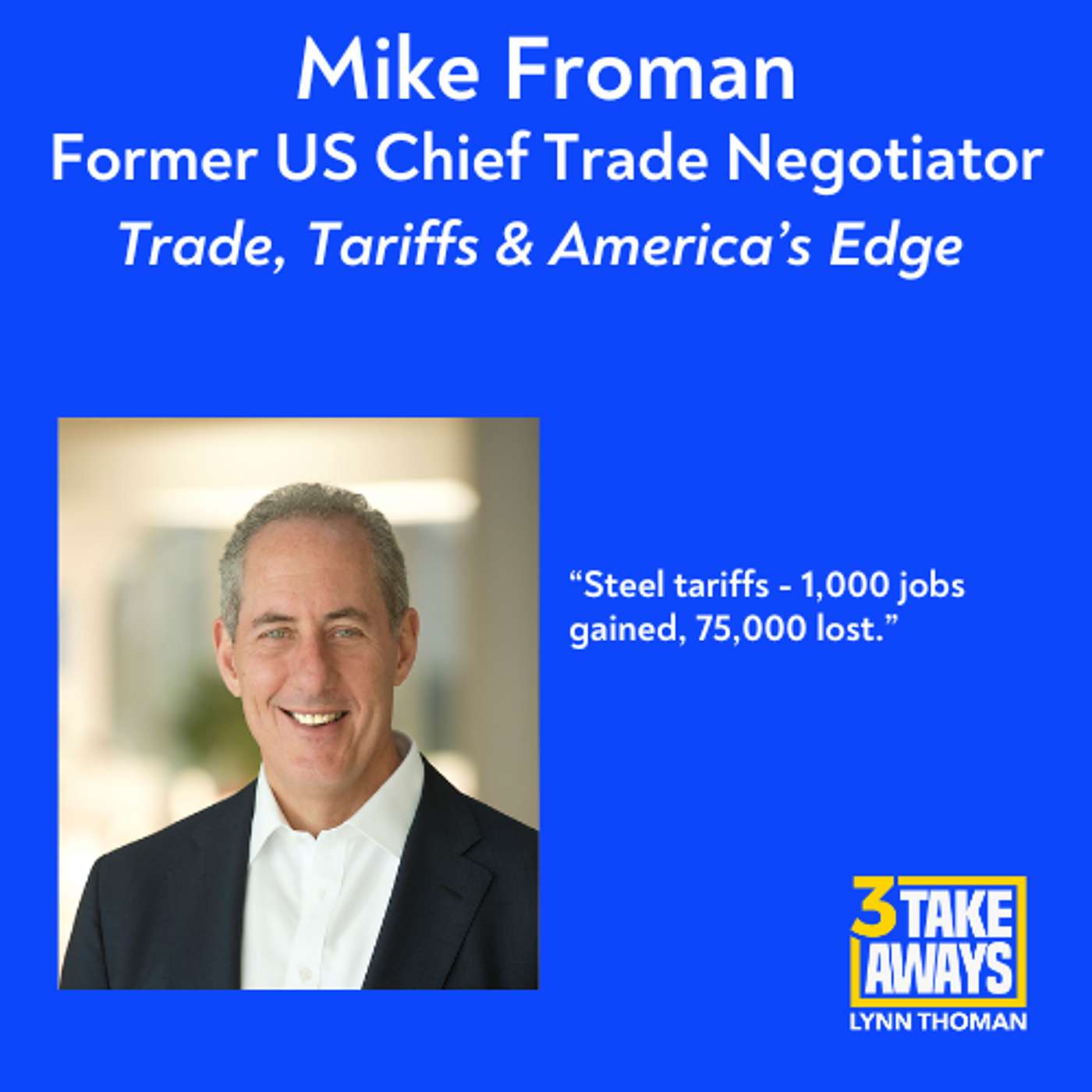
Well, historically, it's been the other way around. I give you one example. In 2018, during the first Trump administration, the president impose tariffs on steel. So we have data now, seven years later, we have 1,000 more workers in the steel sector and 75,000 fewer workers in the industries that use steel as a significant input. And for every steel job that was saved, cost something like $600,000 to the US economy. So historically, it's not been a very efficient way to create jobs in manufacturing or in other sectors. The President has a different philosophy about this. President believes that if we set up a wall of tariffs to every country around the world, ultimately companies will need to move their production and their supply chains to the United States to take advantage of the US Market, which is still the largest market in the world, that we'll see whether it plays out over the next four or six or eight years. But since the economy is already largely at full employment, it may just shift jobs from one sector to another rather than create new jobs.
- [05:29]
A
When you talk about 1,000 jobs being saved in steel and 75,000 being lost in other industries, you're really talking about downstream industries, industries that use steel, like maybe cars or construction. Is that right?
- [05:45]
B
That's exactly right.
- [05:46]
A
And when you're saying that, it mean the tariffs may not create jobs in the U.S. that's because only a very small percentage. I think it's 10 or 11% of American workers even work in manufacturing.
- [06:01]
B
That's correct. Now that's what the President is trying to address. He would like to see manufacturing play a much more significant role in the U.S. economy. And manufacturing as a percentage of the U.S. economy, at least as a percentage of workers, has gone down decade after decade here as it has in every other industrialized country like Germany, which is largely seen as a manufacturing powerhouse. They've actually had the same reduction in the workforce in manufacturing because there's been more productivity. You know, the factories of today don't look like the factories of 30 years ago. The factories of today here don't necessarily look like some of the ones in China. And so we're using more automation, more robotics, and even if we have more manufacturing here, it may not mean a lot more manufacturing jobs.
- [06:46]
A
You've said that history shows that tariffs don't always deliver it. And you cited the steel tariffs in the first Trump administration. What's happened in countries like India and Brazil where they actually did have high tariffs for a long time? Did those high tariffs actually make their domestic industries stronger or weaker?
- [07:08]
B
Lots of other countries have tried this strategy in the past. We called it import substitution. So countries like Brazil and India put up high tariffs in the hopes of developing their own manufacturing sectors. What has tended to happen is that they've created inefficient, less productive manufacturing sectors. And so it's become more of a burden on the economy than, than anything else. Now the US Economy is different. We're not Brazil, we're not India. And so again, the President has a theory that if we do this, we're going to have a different result and we're going to attract so much more capital to the United States, getting other countries and companies from around the world to invest in the United States, that we will continue to build strong and competitive manufacturing. The jury is out. And one thing that's interesting is that the costs of his approach, the tariffs, they're likely to be felt quite immediately and by everybody as a consumer or as an importer, and be quite visible. The benefits of tariffs, if the President is correct in his assumptions, are likely to be felt four, six, eight years from now and affect quite a limited group of workers in a limited group of sectors in a limited number of geographies. That's a really interesting political challenge when everybody feels the pain. Now, for the benefit that might or might not come to a few people.
- [08:30]
A
Later, the US Helped build the post war free trade system. Can you talk very briefly about that system and what the biggest Benefits have been for American companies and workers and also for other countries.
- [08:46]
B
The post war economic system and ultimately what became sort of peak globalization lifted over a billion people out of poverty. Now that is the most significant achievement around the alleviation of poverty in human history. That is a very significant development. Now a lot of those people were in developing countries like China, like India, like Brazil. But here in the United States, it is a misnomer to say that globalization only benefited other countries and not the United States. First of all, we benefited as consumers. We were able to clothe and feed and equip our family. We have greater choice of products from all around the world. As a consumer society, we benefit enormously, but not just as a consumer society. The competition, while it had a significant impact in a limited number of sectors like steel, like autos, which was very painful for a number of workers in certain geographies, it made the US the most competitive, most resilient economy in the world. And we see that even today, whether it was through the global financial crisis and how quickly the US recovered compared to other economies or with COVID and again, how quickly the U.S. recovered, that we are the place where virtually all of the innovation of the digital economy is taking place. Any entrepreneur around the world who has an idea wants to build their company in the United States. And that is an indication of the strength of the US Economy, not the weakness of the US economy. So while people talk about just how terrible things are in the US Economy, we should really take a hard look at that because we're nearly full employment. We're still the largest economy in the world. We produce more manufactured product now than we ever have in history. We're doing so with fewer workers because they're more productive. We have a highly competitive agricultural sector that's the envy of the world. And we're exporting agricultural products all over, all over the world. And we are the leading services economy in the world as well. So we have a lot of strengths going for us. And the key thing is how do we maintain those strengths going forward?
- [10:54]
A
If we start raising tariffs and pulling back on global trade, what do we risk losing?
- [11:01]
B
First of all, I think we impose a potentially significant cost on American consumers. So you're just. Your standard of living goes down. We saw how sensitive Americans were to inflation. And tariffs are inherently inflationary. They raise costs. Somewhere in that value chain, they raise costs. And so I think that's one thing that we lose. We lose the pressure of competition, which makes us more productive. Competition is difficult, but we've always been able to succeed when we have an open and level playing field. Now, we haven't always had an open level playing field. And again, if the President uses the leverage that we have to create a more level playing field with other countries around the trading system, that would be a good thing, including getting China to reduce its excess capacity and not subsidize its exports at the expense of the rest of the world. But ultimately, the US is the leading economy in the world and the envy of the world because we have relatively open markets. We've had relatively open markets, we've got deep capital markets, we have risk capital, we have the rule of law, we have leading universities, we have leading research and development investments across all the major sectors. And that is why people want to come to the U.S. they want to come to school here, they want to build their companies here, they want to work for US Companies. And why the US still has the greatest potential to be a leader going forward.
- [12:27]
A
What happens when governments here, the American government picks winners like investing billions of dollars into intel, in addition to selecting winners, also punishes other companies. Is there a risk of so called crony capitalism where political favors dominate the economy?
- [12:47]
B
Well, first of all, I think there's been a convergence of economics and national security over the last several years. So I think there is room for government intervention. And we've always had government intervention in the economy to one degree or another. Regulation, Right. We all would agree that regulation to a certain degree for health and safety is a good thing. We don't have a completely laissez faire economy. We probably became overly complacent about our supply chains. China became such an attractive place to manufacture that every company thought it was irresistible to put their next factory in China. And it's not just the cost of labor. It was the infrastructure, it was the management, it was the whole ecosystem that China created. But as a result, we became overly dependent on China in a lot of critical areas, including products that go into our military equipment. So there is a case for the government to say, okay, stop. We need to have a domestic industry around the most advanced chips, or we need to have a domestic industry or a diversified supply chain around critical minerals or magnets or products that are key to our military capacity and are key to our overall competitiveness going forward. So I think the question is how is that done and what are the limiting principles? What are the guardrails? When do we know it's appropriate to do it versus when does it become an opportunity for, as you say, crony capitalism or something of that sort. And I think that's what we're now wrestling with. I think everyone would agree. We don't want to be overly dependent on Taiwan for chips. We want to have some capacity to make chips here in the United States again. So I think it's got to be taken on a sector by sector basis. And it would be good if there were some limiting principles or guardrails so that it wasn't just the squeakiest wheel or who had the closest relationship with the president, but rather reflected some broader strategic planning.
- [14:42]
A
Looking ahead, do you think America's edge will come from putting up more trade barriers or from out innovating others?
- [14:51]
B
I think America's edge will come from out innovating others, and I'm still optimistic about our capacity to do so. I'm hopeful that the Trump administration will come around to see that, for example, research and development is a key part of that. Now, thankfully, in the United States, we've seen over the last 60 years, the research and development in the United States that used to be largely funded by government is now largely funded by the private sector. But the government still has a vital role to play when it comes to the stage of research and development in certain areas where there's just no incentive for the private sector to make the necessary investments. So I am hopeful that the Trump administration will come around and identify those areas that are just too important to ignore and ensure that we're putting enough research and development dollars into it to continue to develop the next generation of scientists and technologists who can continue to lead that innovation.
- [15:48]
A
If tariffs aren't the answer, can you summarize what the smarter strategy is?
- [15:54]
B
I think tariffs have a role to play when there's unfair trade and there's no other way of dealing with it. I think putting blanket tariffs on the rest of the world, which only just raises the cost and makes us less productive, probably is going to prove to be less productive. And so I think the better way is to gather countries together around common interests, whether those interests are opening to trade. Some countries will do that. A lot of the Asia Pacific countries, plus the UK Are continuing to open their markets to each other. If the US Is not interested in opening its markets at the moment, but it has common interests in ensuring we have a common approach to industrial policy or to export controls or to foreign investment screening, and to work with other countries to create rules around these issues. Sort of coalitions of the willing coalitions of the ambitious coming together to create what I would call plurilateral agreements. You're not going to have the whole world agree. I think we're at a stage where we have to admit that the multilateral system is not going to produce these kinds of agreements. But we can get 10 or 20 or 50 or 70 countries together around a common set of issues and continue to have some predictability that comes with rules and standards that a critical mass agree to.
- [17:11]
A
What are the three takeaways you'd like to leave the audience with today?
- [17:16]
B
First, the global trading system as we know it is dead. It had been under strain for some time, but I think the Trump administration has put the final nail in the coffin and we're not going to be able to go back, even if it was desirable to the way things were before. And therefore we need to think through what takes its place going forward. The second one is the unknown question, what impact will our aggressive approach on tariffs have on broader relations and U.S. leadership in the world world? It's clear that threatening or actually imposing tariffs is a source of leverage that brings other countries to the table to agree on certain issues. But when it comes time in the future, when we need them for a particularly difficult issue to work with us on a key security issue or vis a vis an export control issue to China, or something along those lines, will they be there for us or not? And the third takeaway I would have is how AI relates to all the lessons that we are drawing from globalization and the global trading system. A lot of concern about job loss, people who are dislocated by globalization and by technology in the past. All of that, I believe, is going to be dwarfed by the impact of artificial intelligence when we look back. I think one of the mistakes that Democratic and Republican administrations and Congresses made in the past is that we never accompanied our international economic strategies with a robust domestic economic policy around helping American workers survive and thrive in a rapidly changing economy. I think the potential impact of AI on American workers is so much greater. It's going to pose a real challenge for American policy politicians to say, what is the domestic policy response to ensure that this incredible set of developments around technology, which has great potential for benefiting humanity, that we can also make sure that the benefits are broadly shared and that the people who might be adversely effective are adequately taken care of.
- [19:36]
A
Thank you, Mike. This has been great.
- [19:39]
B
Thanks for having me.
- [19:41]
A
If you're enjoying the podcast, and I really hope you are, please review us on Apple Podcasts or Spotify or wherever you get your podcasts. It really helps get the word out. If you're interested, you can also Sign up for the Three Takeaways newsletter at 3takeaways.com, where you can also listen to previous episodes. You can also follow us on LinkedIn, X Instagram and Facebook. I'm Lynn Thoman, and this is three Takeaways. Thanks for listening.