Loading summary
Transcript33 lines
- [00:02]
A
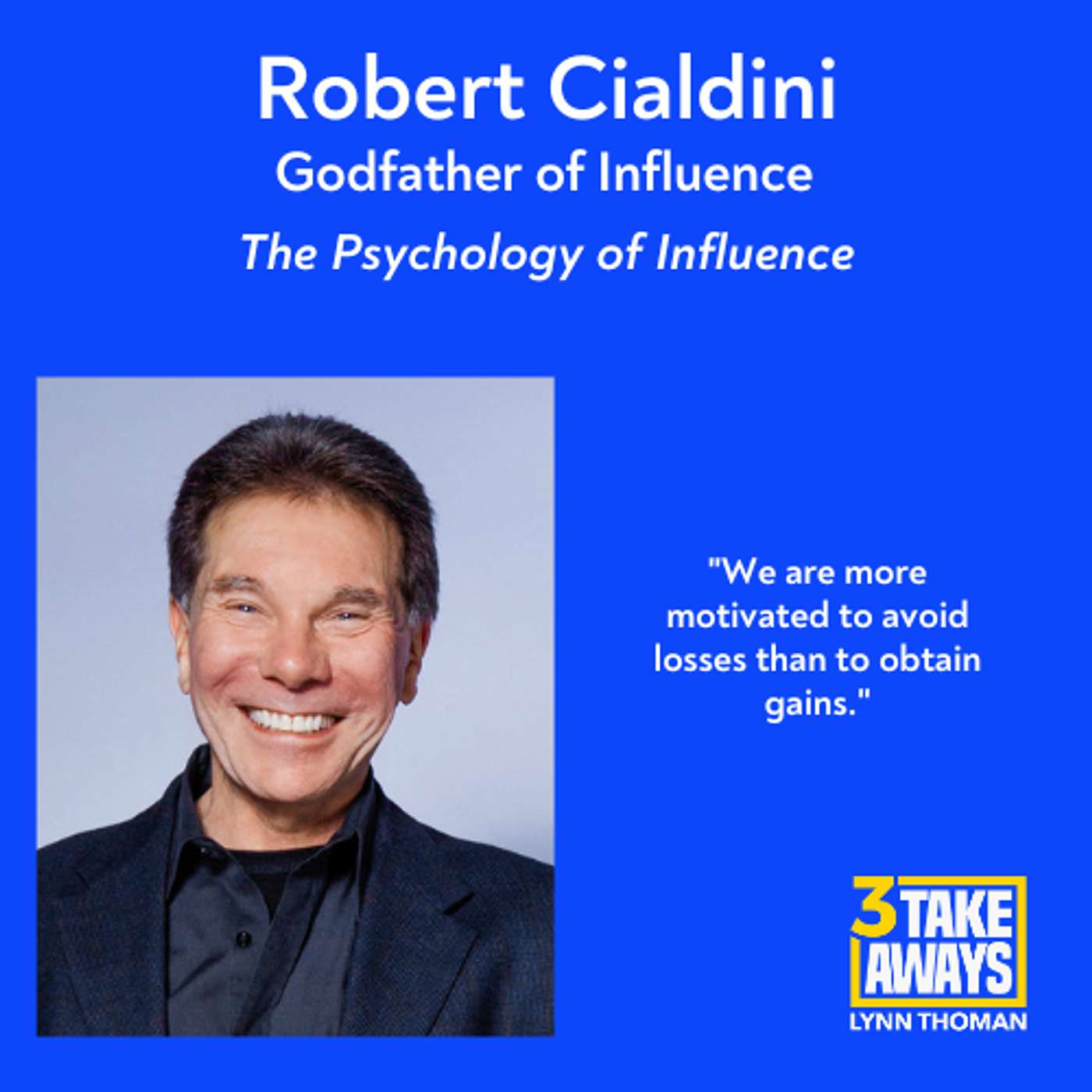
We believe our choices are deliberate and rational, guided by facts, logic and free will. But research into human behavior suggests something else is going on. So what really leads people to say yes? And how can we get better at influencing others while also recognizing those same tactics when they're being used on us? Hi everyone, I'm Lynn Thom and this is three Takeaways. On three Takeaways, I talk with some of the world's best thinkers, business leaders, writers, politicians, newsmakers and scientists. Each episode ends with three key takeaways to help us understand the world and maybe even ourselves a little better. Today I'm excited to be here with Dr. Robert Cialdini. He is the New York Times, Wall Street Journal and USA Today best selling author of Influence, which has sold over 5 million copies. Warren Buffett and his partner Charlie Munger called Dr. Cialdini's book Influence one of the most important books they've ever read. Dr. Cialdini has spent his entire career conducting scientific research on what leads people to say yes. He will share today how we can all use the tactics of influence and persuasion to get people to say yes to us. And he's also going to share how we can avoid being manipulated by others. Welcome, Bob, and thanks so much for being here today.
- [01:38]
B
Well, thank you. I'm pleased to be with you, Lynne.
- [01:41]
A
It is my pleasure. I really enjoyed your book. I was also horrified at how well the tactics work. Your principles of influence and persuasion and the simple tactics really demolish the belief that we are making decisions rationally and of our own free will. These tools are so powerful. Powerful that I'm shocked that even you, as a scholar of influence, have been manipulated by them. It's extraordinary.
- [02:09]
B
It is. And I think part of the reason that it seems unusual that even I, who studies the influence process would be swept by them from time to time, I still am, is how primitive they are. By that I don't mean primitive in the dark derogatory sense of crude or brutish. I mean fundamental. I mean elemental to the way we function. They are the things that have evolved over eons and that we are socialized into, that lend themselves to ascent. The things that lead us to choose to say yes to requests or proposals or recommendations.
- [02:56]
A
Can you tell us about reciprocity and give us some examples?
- [03:01]
B
One of the things that we've learned about human behavior that exists in all human cultures. There's not a single society that fails to train its members from childhood in this rule, and that is that we are obligated to give back to others. Who have first given to us. One study that was done in restaurants showed that if a server puts on the tray with the bill at the end of the meal, again, all the merits of the case have already been decided. The food has been ordered, it's been prepared, it's been served, it's been consumed, it's been cleared. All of that is done. If the waiter puts a mint on the tray for each diner, the server's tip goes up 3.3%, because people give back to those who have given to them, even something as small as a mint. Now, the researchers showed that if the server put two mints on the tray for each diner, tips went up 14%. What this tells me is something I advise. People who say they go into a new situation, maybe a new employment situation, they want to be more influential within this group, and they go into a room, they should not say to themselves, of the people in that room, who can most help me here? The question they should ask first is, whom can I most help here? Whose circumstances can I elevate? Whose outcomes can I enhance? Because by this rule, rule that's been installed in every one of those people in that room, they will stand ready to help in return in ways that you see especially valuable for what you need.
- [04:59]
A
Can you talk about the waiter, Vincent? I thought that was a really amusing example.
- [05:05]
B
Well, in the restaurant industry, they live on tips. There was a guy named Vincent in one of the restaurants that I observed who was always the one who got the greatest tips. And he combined two principles, one of which is reciprocity in how he arranged for people to give him the largest tip and buy the most food so that the tip would be figured on a larger base. So let's say it was a large group, 8 to 10. He would reserve this particular strategy for that one. He would begin by taking orders of the first person, and whatever that person ordered, he would pause his pen, would pause over his pad, he would lean down so everyone at the table could hear, and he'd give the whole table a gift. He would say, you know what? That's not as good tonight as it usually is. And then he would recommend something slightly less expensive from the menu. What that did, first of all, was to say, oh, we've just received from this man. He's given us valuable information. And besides that, he's a credible source of information, because he wasn't recommending the top of the line. Instead, he was recommending something less expensive, which certified him as interested in our interests, in our outcomes, in our satisfaction here Then when he would volunteer, would you like me to suggest a wine for the table or vintages with your food? Or when he would come back and recommend the desserts, people would say, of course, Vincent, you've done this for us already. You know what's good here. And Vincent would pile on additional charges to the bill. And he had already established that the percentage of the bill he would receive as a gratuity was high because the rule for reciprocity, he would every month outstrip everyone else on the waitstaff by what he did.
- [07:26]
A
Can you talk a bit more about how personalization can magnify the power of reciprocation?
- [07:33]
B
If we want an accelerant to the principle of reciprocation, something that really increases its impact, it should be that what we give first should be something that's personalized to the preferences, the challenges or the needs of the people who we are giving to. I have a colleague in Europe who is a speaker's agent, and she represents me in Central Europe. And she has one particular client who is notoriously a late payer. He takes six months to pay his bills, the invoices. This is very difficult for her business. And she began doing something based on the rule for reciprocity that significantly reduced the amount of time that it took him to pay the invoice. She would include with the invoice a little gift. Sometimes it was a little box of chocolates. It might be a Starbucks gift card or something like this. And the time to pay went from six months to three months. Now she's using personalization.
- [08:48]
A
These strategies, to me, are so fascinating, and the practices are just simple. Social proof is another one of your very powerful strategies. Can you tell us about that?
- [09:01]
B
Very frequently in modern life, we're uncertain about the right step to take forward because there are so many choices. There's so much information that we have to deal with. And one way that we can reduce that uncertainty is to look around us at what others like us have done or are doing something like star ratings online and so on. In Beijing, there was a string of restaurants that put a little asterisk next to certain items on their menu. But what did the asterisk stand for? It stood for, this is one of our most popular items. And each one became 13 to 20% more popular for its popularity. So a simple thing like that can greatly increase the likelihood that people will move in a direction because it reduces their uncertainty. Now, here's the best evidence. Researchers looked at the demographic characteristics of the various kinds of people in those restaurants. There was one group that out distanced all the others. First time guests, people who were uncertain about what were the most recommended or most delicious items on the menu. They were taking their cue from social proof. It wasn't empirical proof, it wasn't logical proof. The proof was that other people had done it and that was enough.
- [10:43]
A
How do we get hooked by scarcity? How does that work?
- [10:47]
B
The scarcity principle says that people want more of those things they can have less of. If an individual can honestly inform us that something is rare or scarce or dwindling in availability, we're much more likely to move in its direction as a result. If we start out by giving people a jar of 10 cookies, have them taste and rate one of them versus a jar with just two cookies, and then they get to taste it, they rate the cookie that came from the jar with just two as better. They all came out of the same Nabisco box in the back room. They rate that cookie better because it was scarcer. Again, one of these things that just drives our behavior without rationale behind it. It's really all about what has always been case and a tendency that's been socialized or evolved into us to make good decisions, usually about what to choose.
- [11:54]
A
Liking is another one of the strategies of influence and persuasion. You call it the friendly thief. Can you tell us about it and give an example of how one can get people to like you?
- [12:08]
B
No one would be surprised to know that we prefer to say yes to those people we like. But there are two very simple strategies we can use to enhance that sense of rapport people feel with us. One is to identify genuine similarities that exist. And the other is to give genuine compliments where they are warranted. I'll give you an example where it's worked terrifically for me. I have a newspaper deliverer, his name is Carl. And every morning, morning for years, he's rolled by my house and he throws my morning newspaper from the window of his car onto my driveway. And most of the time, about 75% of the time, he gets it in the middle of the driveway so it doesn't get wet from the wet watering systems on either side. And also every year he includes around the holidays a little envelope, self addressed envelope, which I know means that it's a envelope where I can put a tip for him, a check for his service during the year. And I always do. But this past year I included a note. I said, carl, I want to thank you for your conscientiousness in getting my newspaper in the middle of the driveway most of the time so it doesn't get wet. Lynn, in the past he was get it in the middle about 75% of the time so far this year, 100%.
- [13:40]
A
That is phenomenal. So compliment a lot and compliment a behavior that you want more of.
- [13:47]
B
Precisely right with that compliment. Give people a reputation to live up to.
- [13:53]
A
Can you tell us about the contrast principle, which is another one of the strategies that you talk about that can be undetectable to most people?
- [14:03]
B
Yes, this is something that is employed, for example, by car salesmen who first get you to decide on the overall price, the base price for a new car, many thousands of dollars. And then they will suggest upgrades of one sort, better wheel covers or better sound system. So compared to the many thousand dollar price that you've already been made to think about as the price, this new one seems trivial in comparison. And people stand in amazement at the end of the deal with all of these upgrades, how the base price has ballooned out of proportion because they've bought all these things that were presented one at a time after the larger price was established, the base price, and they
- [15:04]
A
blame themselves for this. The customer blames themselves and they don't realize that the contrast principle has been used on them.
- [15:13]
B
Precisely right.
- [15:15]
A
The rejection and retreat strategy is very similar to me. Again because the person on the receiving end doesn't realize what's happened. Can you tell us about that?
- [15:27]
B
Because of the rule for reciprocation and the rule for contrast working together, here's a technique that works very well. In fact, my research team did it. We walked up to people on campus at the university students and said, we're here from the Arizona Blood Services Organization and we're asking for people who'd be willing to serve as a long term blood donor to come in every six weeks for two years and donate blood. Would you be willing to do that? That was a very large request. Everybody said no, two years. I don't even know where I'll be in. I can't, I can't commit to that. And then we said, oh, if you can't do that, would you be willing to give a single unit of blood tomorrow at the campus blood drive? We had asked people as well, just for that small request, would you be willing to just walk without the larger one? If we did that, we got 33% of the people said, yes, I will do it. But if we started with the large request and then retreated to the small request, smaller request, it wasn't a small request, but it was smaller. 55% show up at the blood center.
- [16:52]
A
Bob, so far we've been talking about individual strategies and tactics. Can we shift slightly and can you tell us the. The strategies and tactics that could be used? If, let's say, we're the seller of a house, how do we get buyers to raise their prices? And the flip side of that, let's assume that we're the buyer of a house, how do we get the seller to reduce their price?
- [17:16]
B
In both instances, I would use competition. That is to say, if you're the seller, you can honestly tell people how many others have been looking at the house and how many real estate agents have called you about it, and so on. Give them honest information that there are others who are interested in this. So you have two things working for you there. One is social proof. A lot of other people are interested in the house, and you have scarcity. You might lose it. All right? You have loss aversion. In the case of the buyer, you honestly say, we're looking at several places and we want to choose the one that would give us the best overall deal. So now the seller is in competition against other sellers and has to recognize that they have to sharpen their pencil and provide a better offer than these others might. In both cases, if you do that honestly, you've invoked the rule of scarcity and competition for scarce resources.
- [18:27]
A
Interesting. What are the biggest mistakes that you see people making? And how do we protect ourselves from all of these remarkably effective strategies being used on us?
- [18:39]
B
Here's the biggest mistake I see people making. When they try to be influential, when they try to be more persuasive, they try to identify a favorite strategy, a favorite approach that they can take. They ask me, so what's the strongest? What's the most powerful? What's the best procedure I should use to get people to move in my direction? Well, I answer that by describing a research program that a colleague of mine initiated, he's a marketing professional professor, to find the single most effective influence approach, the one that works across the widest range of situations and so on. That will be most effective because it's the most powerful. I saw him at a conference and they said, how's it going with that? He said, well, I found it. I found the single most effective influence approach. It is not to have a single influence approach. That's a fool's game. To think that the same strategy is going to work in all situations, on all audiences, with all manner of previous histories with you and so on, that's naive. What you do is you look for what's already there in the situation. Is there real authority there that you can pull? Is there real social proof? Is there real scarcity? Is there a real commitment that people have already made to a feature that's part of what you have to offer? You bring that to the surface, you look for something that's there and you raise it to consciousness. That way, you're using something whose engine is already running. It's just required. Requires that you connect it to an individual's consciousness. And it strikes me that that allows us to be ethical in all of this. We're not fabricating or creating or counterfeiting one or another of these principles dishonestly. We're simply pointing to something and allowing the power of that rule that normal steers people correctly to infuse our request. Now, what's my advice to people who want to recognize and resist and be aware of these principles? First of all, you have to know what those principles are. But it turns out just knowing those principles doesn't cover all the bases. I wrote a book a couple of years ago called Priests Persuasion that has to do with the moment before a communicator sends his or her message. What can they do in the moment before that causes people to be sympathetic with the message before they've encountered it? What I'd say is to be sure that you're properly defended against these things, don't just look at what what this person is saying inside the message. Look at what they've arranged for you before they've sent that message. Look at what's happened before the message is sent.
- [21:58]
A
What are the three takeaways or insights you'd like to leave the audience with today? Bob,
- [22:05]
B
when you go into a new situation where you don't know the people there, expect the best of them and from them, that allows you to be generous with them. And that generosity has three important downstream consequences. First of all, the liking rule. They like you more for being generous with them. Second, the rule for reciprocation. They will give generosity back to you. And finally, commitment and consistency. In the process of seeing themselves committing themselves to you with this generous set of outcomes that they provide you, they will want to be consistent with that into the future.
- [23:02]
A
Bob, this has been wonderful. I loved your book. Thank you.
- [23:07]
B
Well, I have to say I enjoyed our interaction.
- [23:10]
A
If you're enjoying the podcast, and I really hope you are, please review us on Apple Podcasts or Spotify or wherever you get your podcasts. It really helps get the word out. If you're interested you can also sign up for the Three Takeaways newsletter at 3takeaways.com, where you can also listen to previous episodes. You can also follow us on LinkedIn, X, Instagram and Facebook. I'm Lynn Thoman, and this is three Takeaways. Thanks for listening.