← 3 Takeaways™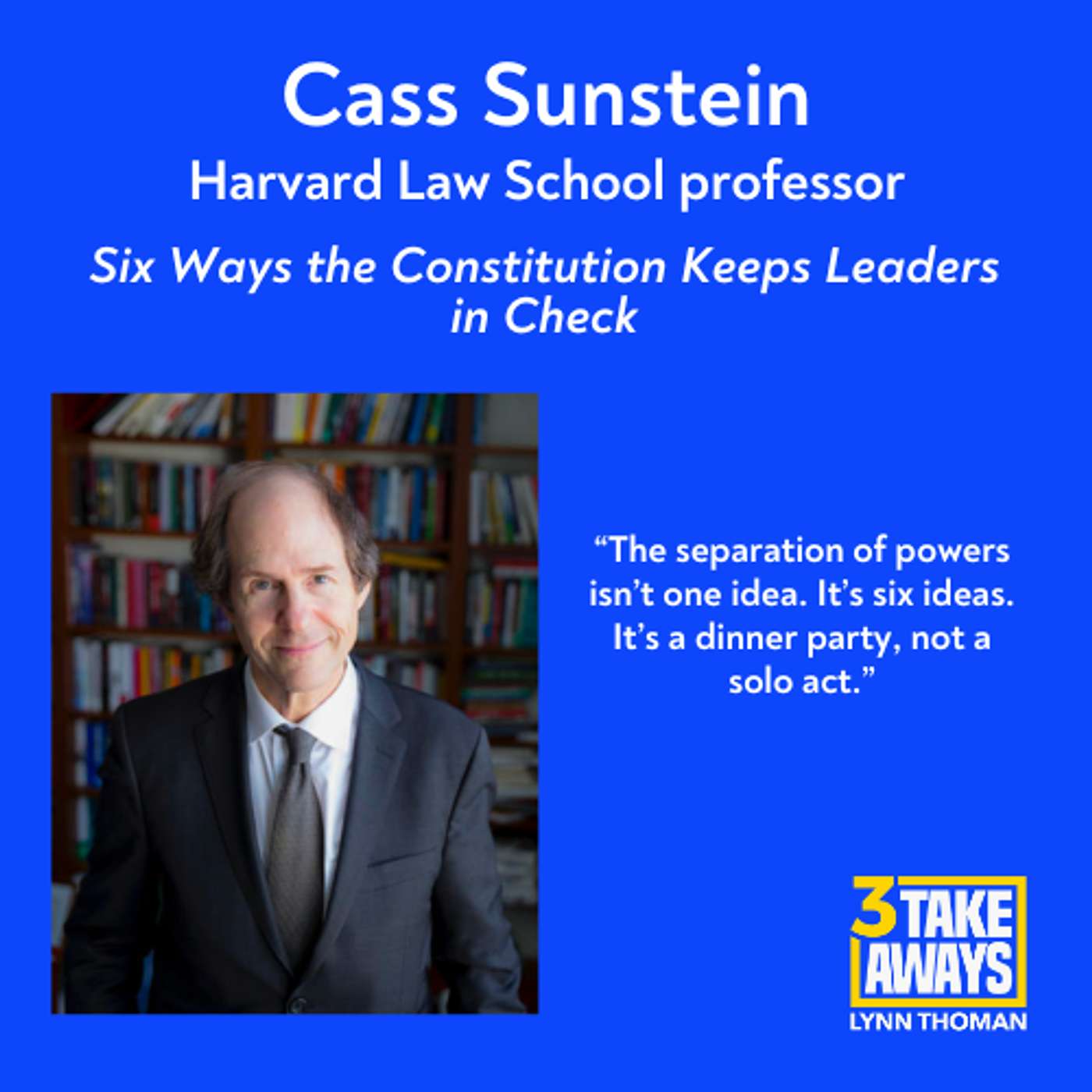
Loading summary
Transcript30 lines
- [00:02]
A
The Constitution isn't just a statement of ideals. It's a framework for power. The Founders believed liberty depended not only on rights, but on how authority is divided. Who makes the law, who enforces it, and who interprets it. They built a system designed to prevent any one institution from becoming too powerful. That system slows decisions and complicates actions. But is that structure a weakness or the very safeguard that protects freedom?
- [00:42]
B
Hi, everyone, I'm Lynne Thoman, and this is three Takeaways. On three Takeaways, I talk with some of the world's best thinkers, business leaders, writers, politicians, newsmakers, and scientists. Each episode ends with three key takeaways to help us understand the world, and maybe even ourselves a little better.
- [01:04]
A
Today, I'm excited to be with Cass Sunstein. Cass is a professor at Harvard Law School and one of the most cited legal scholars in the world. He's the author or co author of dozens of books, including books with Nobel laureates Danny Kahneman and Richard Thaler. From 2009 to 2012, Cass served under President Obama as the Administrator of the Office of Information and Regulations, Regulatory Affairs. It's not a sexy sounding job, and it's not a job that most people have ever heard of, but it sits at the center of American power. He reviewed and oversaw federal regulations across the executive branch, from the Justice Department and the EPA to Homeland Security and the Department of Agriculture. His new book is Separation of Powers. Cass, it's great to be back with you. Thanks so much for joining us.
- [02:05]
C
It's great to see you and I am very grateful to you for having me.
- [02:09]
A
Cass, the founders obsessed over separation of powers. What were they afraid would happen if it failed?
- [02:18]
C
There's a kind of pedestrian answer that's extremely unoriginal. And then there's something I think, more interesting. I'll start with pedestrian, which is that James Madison said that the accumulation of powers in a single person would produce tyranny. So I'm speaking from Massachusetts, and that's where the American Revolution kind of started. And the idea of a monarchical authority was something that the founders sought to avoid. And good students of Montesquieu, they thought that separating the executive legislative and judicial authority was necessary to protect, first and foremost in their account, liberty, but secondarily not like a distant second, the conditions for self government and what they did with the separation of powers. And this is the, I hope the less pedestrian thought is six different separation of powers. It's not the separation of powers. It's six separation of powers. And the separation of powers is A they not an it. It's a little dinner party rather than a solo endeavor. And that I think is the genius of our constitutional structure. It's something of maybe a little more importance today than let's just call it the day before yesterday, but it's something of enduring importance. 6. Separations of powers in plain terms, what.
- [03:50]
A
Does separation of power actually mean and what does it do for ordinary people?
- [03:57]
C
Let's get at the six, shall we? Courts can't make law. And that for ordinary people means that we get to govern ourselves. And that people with life tenure and guarantees of independence, they don't tell us what the law is. So courts can't make law. That ensures a kind of capacity for self government. Second, courts can't execute the laws. That's extremely important because we have an executor of the laws. That is the executive branch, which has incentives and safeguards if things are working well. And independence, which means if the judge is mad at you, the judge can't go putting you in jail. There's a separation between lawmaking and execution of the laws. That's really important. And if we think of fascist or communist systems, the combination of judicial and executive authority is a very bad thing from the standpoint of liberty. The legislature can't execute the laws. That's very important. It means that you have two safeguards before you get in trouble. The legislature has to authorize the executive to act and then the executive has to decide independently to go against you. The legislature can't interpret the laws. That's very important because the legislature doesn't have neutrality with respect to the meaning of, let's say, the Constitution of the United States. So we need a different body so as to prevent self interested interpretation. The main event, which is the executive can't interpret the laws or make the laws is something I'm just going to put in bold letters and it's going to be like an airplane in the sky. And we can talk more about it if we like. But the framers got one thing wrong. They were most scared of the legislature. They should have been most scared of the executive. They did something right, which is they forbade the executive from being the authoritative interpreter of the law. That's a separation of powers. And they prohibited the executive from making the law. That's the separation of powers. Also. That's her little family of six friendly diners.
- [06:07]
A
And how is separation of powers different from checks and balances? Many people conflate them.
- [06:14]
C
What Madison emphasized in talking about how the Constitution protect against tyranny was Separation so the executive doesn't make the law. The executive doesn't interpret the law. The legislature doesn't execute the law. The legislature doesn't interpret the law. That's separation of powers. Checks and balances means that each gets to constrain the independent of the mere fact of separation. That might sound like gobbledygook. You can't have a law without presidential participation. Through the opportunity to veto, the head of the executive branch can be impeached by the legislature. That's a check. The system of checks and balances involves some mutual constraints. That is independent of separation. You can think of the fact that the court can strike down laws as unconstitutional, constitutional as both separation of powers and checks and balances. Separation meaning it's a different body. And check meaning the court gets to say to Congress, sorry, but the First Amendment stands in your way.
- [07:24]
A
The Constitution says that all legislative power, the power to make laws, belongs to Congress. What does that mean in practice? And why is that so essential to preserving freedom?
- [07:38]
C
If a legislature is around, and it is, it gets to say what the law is, and the President can't do that. So if the President wants the Clean Air act to say something very different, it wants the Clean Air act, let's say, to be scaled back or to be much more aggressive. Congress does that. If the President wants, let's say, there to be some law about cryptocurrency, it goes in one or another direction. Congress has to do it. The President can't get it to happen. So any exercise of authority by the president, this is going to have some exceptions, but broadly speaking, needs to have legislative permission. So you can't have a Department of Transportation regulating road safety or an Occupational Safety and Health Administration regulating occupational safety and health unless Congress has told you to. You have to ask Congress for permission. Recent presidents, and not so recent presidents have occasionally transgressed that limitation on authority. Nonetheless, the constitutional restriction is clear. Article one, Section one. Amazing. That's how it starts.
- [08:52]
A
Why do you think so many people today seem comfortable with power being concentrated in one strong leader?
- [09:00]
C
People's judgments about who has power often are framed as judgments that are enduring about, like, institutions and who can be trusted. But they're often, in fact judgments about the person who would exercise the power. So under President Obama, I noticed this is something I don't know whether to be amused by or aghast that under President Obama, a lot of President Obama's critics were complaining about all the executive orders he issued. And because I was there, I spent a lot of time on it. And he actually didn't issue an unusually high number of executive orders. There's a national debate, so many executive orders from Obama with the Democrats saying not so many, not so bad. And Obama's critics say he's gone crazy with all the executive orders. And then there was a flurry, this is kind of ancient history now, of complaints that President Obama had created czars. And that was, you know, we don't have czars in the United States now. This was all institutional objection to the president, A, issuing executive orders and B, having czars. President Trump has issued a very large number of executive orders. And the people who criticize President Obama for a much smaller number of executive orders don't seem alarmed at the Trump executive orders and vice versa. And the founders were very wary of that. They wanted institutional judgments to outrun this week's judgment about particular people.
- [10:37]
A
Cass, emergency powers are meant to be temporary. What are the President's emergency powers and what stops them from becoming normal under the Constitution?
- [10:49]
C
There's a question whether the President has emergency powers. There's one that the President clearly has, which is to repel a sudden attack. So Congress has the authority to declare war. That's a precondition for war making. If we are attacked, God forbid, today, or we're about to be attacked, the President can act on an emergency basis. That was described in the Constitutional Convention. Whether the President has any other emergency powers under the Constitution is most unclear. That's an unresolved question. If there's some economic or health related horror, does the president, by virtue of having the executive power, have authority to respond? People dispute that. The safest answer is rarely, if ever. Then there are statutes that give the President some emergency authority to respond to crises so long as it's short term and so long as it's got a factual predicate. There aren't a lot of those, but there are some in the domain of economics and health.
- [11:59]
A
If separation of powers slows things down, what's the danger of speeding things up?
- [12:07]
C
Fascists and communists often don't like separation of powers much because they think they need to respond quickly. And while yours truly has no enthusiasm for fascism or communism, it's a point. I had an acquaintance who was in Russia and had a meeting with President Putin. And Putin's schedule was very crowded and he was late for the meeting. And my friend said that she couldn't make the meeting because she had to fly back to the United States and Putin's meeting was too late. And when she went in to see Putin. She said, I'm so sorry, I have to leave right now. We can't do the meeting because I have to make my flight. And he said, you'll make your flight? And she said, I'm going to make my flight. And he said, I'll make sure you make your flight. She said, how can I do that? There's traffic, it's far away and they can't get there. And he said, I'll close all the streets. I'm going to close all the streets. You can just go. You won't have any traffic. You'll be there ahead of time. Okay, so our presidents can't do that. That's not exactly an emergency of the first order, but if you slow things down, it might be the President can't do anything about school loans, can't do enough about a sudden economic downturn, can't do enough about immigration, can't do enough about violence in the streets. There are any number of things that the separation of powers potentially forbids a necessary response to. Now, the bet is that Congress will either have previously or will now authorize relevant presidential action. So the right way to think of it is the separation of powers as a bet. There's very good reason to think it's the right bet, but your question correctly points to the fact that any bet can go sour.
- [14:04]
A
What do we lose when separation of.
- [14:06]
C
Powers weakens freedom first and self government second? So the freedom, I think is intuitive, that if you know the legislature can execute the laws or interpret the laws, then you and I are vulnerable. If the executive can act without a court, then you and I are definitely vulnerable. So the separation between executive and judicial authority, at least today, that's my favorite of the six. That one I put. First, the power of the prosecutor is terrifying, though essential. If the power of the prosecutor includes the power of adjudication, then any one of us or someone we know can end up in prison and be shattered. There's no independent entity to call to account, so that's what we lose. Liberty. Self government is less obvious because if you have, let's say, an elected monarch, why don't you have self government? The absence of checks on that elected monarch means that in practice, the capacity for self governance will be severely compromised. The person isn't, on an ongoing basis, subject to electoral control. No one is. And if the separation of powers isn't in play, that person can go off in all sorts of directions that defy the will of the people.
- [15:38]
A
Can midterm elections be canceled?
- [15:42]
C
If you cancel midterms this lawyer immediately wonders what's the legal authority for that? And there's not likely to be an answer to that question. If you cancel the midterms, you're canceling something which is fundamental to our system of constitutional self government. It's inconsistent with the text of the Constitution, which calls for election of the House every two years and actually election of senators every six years. So there's that. Then we would get less lawyerly and think that we're canceling the outcome of something which is fundamental to our system in a way that makes self government tatters. So that's, that's pretty unspeakably horrifying to cancel the midterms insurrection. This is a term, its application to any set of events should be approached with caution and humility and fear and trembling. And to wield the word insurrection would be, you know, not forbidden. There could be an insurrection, but I'm looking out the window and not really seeing it.
- [17:03]
A
How do you see presidential immunity?
- [17:06]
C
Okay, so if one is a treatise writer, one would say that under the Trump case, the President has absolute immunity for things that are in his core authorities, including oversight of, let's say the Department of Justice can't make what he says to the Attorney General a criminal offense. Pardon power is something where there's absolute immunity. Then there are other authorities which are, if they're within his general presidential job, but not in the core, they are presumptive immunities which, where you can overcome the immunity, showing that holding him subject to, let's say, criminal penalty after he's president wouldn't compromise his ability to perform his job. That's kind of the treatise writing. So the music of the Supreme Court's decision in the Trump case is it's going to be really hard to hold the President criminally accountable for anything. But outside of the core, it's not impossible. That's the treatise, the law review article, let's call it, or the op ed. The op Ed would say that the Supreme Court was very adventurous in establishing such broad immunity from the President. The more inflammatory way to say it, which I subscribe to, is the Court made it up. And this was not a good moment for Chief Justice Roberts, whom I generally admire.
- [18:40]
A
What are the three takeaways you'd like to leave the audience with today?
- [18:47]
C
First and foremost is that the separation of powers includes six ideas. And each of them is something to honor and celebrate. Not one idea. The second idea is that the most important of the six, separation of powers in the modern era denies the executive the power of to make the law. And the second of the two we celebrate most denies the executive the power to interpret the law that courts have the power to interpret the law. And whether you like donkeys or elephants or Biden or Trump, those things deserve the firmest imaginable endorsement. The third takeaway is the idea of a unitary executive. Whether you like it or don't like it means only that the executive is in control of the executive branch. It doesn't mean that the executive is in control of the government's apparatus. Even the President of the United States generally requires legislative authorization to do anything at all.
- [19:58]
A
Thank you, Cass. I've enjoyed our conversation and I especially enjoyed your book Separation of Powers.
- [20:05]
C
Thanks ladies. Good to see you.
- [20:08]
B
If you're enjoying the podcast, and I really hope you are, please review us on Apple Podcasts or Spotify or wherever you get your podcasts. It really helps get the word out. If you're interested, you can also sign up for the Three Takeaways newsletter at 3takeaways.com, where you can also listen to previous episodes. You can also follow us on LinkedIn, X Instagram, and Facebook. I'm Lynn Thoman and this is three Takeaways.
- [20:38]
C
Thanks for listening.