← 3 Takeaways™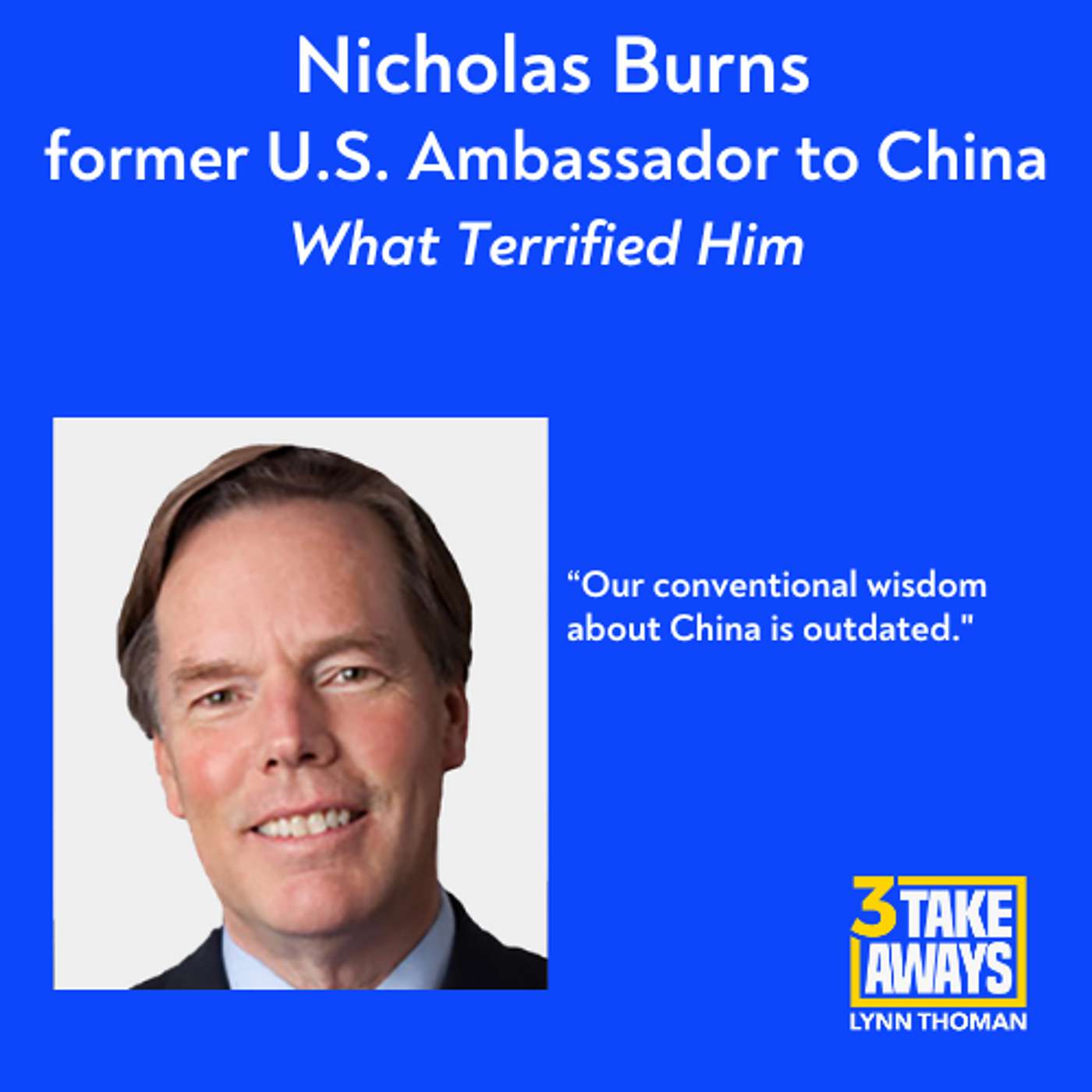
Loading summary
Transcript43 lines
- [00:02]
A
The US And China are the two most powerful nations in the world. Their relationship will shape everything in the future, from climate change to questions of war and peace. But many Americans don't really understand China or why the relationship between the two countries has become so tense. So what is really happening in China, and what should we be the most worried about?
- [00:32]
Hi, everyone. I'm Lynne Thoman, and this is three Takeaways. On three Takeaways, I talk with some of the world's best thinkers, business leaders, writers, politicians, newsmakers, and scientists. Each episode ends with three key takeaways to help us understand the world, and maybe even ourselves, a little better.
- [00:55]
Today, I'm really delighted to be with Nicholas Burns. He is one of the very few people who truly understand US China relations from the inside. Not from headlines, but from being in the room when huge decisions are being made. He was the US ambassador to China from 2021 to 2025, when tensions were high and every conversation mattered. But that's just one chapter of his extraordinary career. He was also Undersecretary of State for Political affairs, the third highest ranking official at the State Department. He's represented the US at NATO, negotiated with Russia, and seen firsthand how the relationship between great powers can steady the world or push it toward danger. Now he's at Harvard's Kennedy School. Welcome, Nick, and thanks so much for joining three Takeaways today.
- [01:54]
B
Lyn, thank you very much. It's great to be back on three Takeaways. It's been several years. I think before I went to China, I was on your program, and I enjoyed it. So thanks for having me on today.
- [02:04]
A
And thank you. Nick. You knew China well before being named ambassador, but you had never lived in China. What surprised you about living in China?
- [02:15]
B
I first went to China in 1988 as a young diplomat with our Secretary of State, George Shultz. Visited many times, worked with the Chinese government on Afghanistan, on Iran, sanctions, on North. North Korea. But living there is different. And while it's hard to generalize about 1.4 billion Chinese people, what did surprise me, and I think my wife Libby, who was there with me and we traveled throughout the country, is just how extraordinarily energetic and impressive the Chinese people are. They're entrepreneurial, they're business people, they're traders. It's in their DNA. They're very family oriented and. And they work extremely hard. The Chinese say, Lyn, they Say we have a 9, 96 culture. They say we work 9am to 9pm Six days a week. And I found that's not true. They have a 997 culture. They actually work on Sundays, a lot of them. And just the energy in that society, you can just feel it on the streets of Beijing, Shanghai, Guangzhou. It's extraordinary. So that might be the thing that surprised me the most about actually living there, as my wife and I did for three years.
- [03:21]
A
And what do Americans and others most misunderstand about China?
- [03:26]
B
I think our conventional wisdom about China is outdated. The old conventional wisdom, and it was true 20 years ago, 30 years ago, maybe even 15 years ago, that the Chinese copied American, Japanese, Korean technologies, but they didn't innovate in their economy. They have profound strength in science and technology. More than a third of their first year university students declare a STEM major. About 5% of our American first year students and I teach at a university declare a STEM major. They are innovators. They're on the cutting edge of lithium batteries, electric vehicles, solar and wind energies, robotics. And obviously we're competing with them. And I want America to innovate in this competition in a more profound way than China. But there's a real competitor out there called the People's Republic of China, China.
- [04:21]
A
And what do the Chinese most misunderstand about the United States?
- [04:26]
B
If you talk about the people of China, and I met thousands of people in all walks of life, they're interested in the United States, they're interested in what life is like. Many of them have relatives, some of them have traveled. But I think the government of China, the Communist Party of China, they have a lot of misunderstandings about us. They look at our fractious democracy, you know, our red blue dividend, Washington that doesn't always appear functional. The Congress and the executive branch. And here's what they misunderstand. The United States is failing. The United States is yesterday's power. We're going to overtake the United States as the leading global power. Where yesterday's story, and Xi Jinping is fond of saying, and this I always objected to this, he would say the east is rising and the west is falling. That is, China is rising, America is falling. I believe that the United States still has significant strengths. We are a rule of law society. We have a corrective mechanism in our DNA. And while things are messy now, there are a lot of things going well in the United States from our tech companies, our great universities. We just have a wealth of talent in our country, our private sector strong. Half of Americans still say that they're people of faith. And so I used to tell the Chinese, don't misunderstand us. You are a closed dictatorship. We are an open book democracy. And so warts and all, you can see all of our flaws. But don't misunderstand or underestimate the many strengths of the United States. And the most important one is we believe in human freedom.
- [06:06]
A
What do you think that China's greatest vulnerabilities are?
- [06:10]
B
Well, certainly the fact that they're a dictatorship, a communist dictatorship. It means that everything that we profoundly love about America, our Bill of Rights, we have freedom of speech, we have freedom of the press, we have freedom of assembly, we have freedom of religion, we have the rule of law. China is a dictatorship that denies those rights to its own population. That's its greatest weakness.
- [06:35]
A
You've met with China's leader, Xi Jinping. What is he like and what do you think he really wants?
- [06:43]
B
He's a very experienced leader. He's been President of China since 2012. He was Vice president. Before that, he was the Communist Party secretary, meaning the leading official in Shanghai, the largest city in China. Before that, he's had a 40 odd year career in government, in the Chinese government. So he's very experienced, number one. He's strategic, he's very intelligent, he listens in meetings. I'll give you an example. Senator Chuck Schumer and Senator Mike Crapo, Democrat and Republican, led a Congressional Senate delegation two years ago to China. I was with them for five days. We went in to see President Xi and there were three Republican senators, three Democratic senators. They all talked about fentanyl being the leading cause of death in our society and how China needed to help us because the majority of the precursor chemicals that make up fentanyl come from the Chinese black market. And he listened for 43 minutes as those six senators each told of stories in Louisiana, in Idaho, New Hampshire and Georgia and New York State about they'd gone to funerals of people that they knew who died of fentanyl overdose. And then after listening for 43 minutes, and this doesn't happen very often in China, usually the leader does all the speaking. He then replied to each senator. So he's a listener, he's supremely powerful and he sits atop a brutal system. He is someone who has worked, I think cooperatively at times with President Obama, President Trump and President Biden. And yet he's also someone whose, I think, ambition for China is that it will overtake the United States as the leading power in the world. And we certainly do not want to live in a world dominated by the Communist Party of China or its leader.
- [08:31]
A
Let's Talk more about this rivalry and competition between the US And China. How do you see the military rivalry?
- [08:39]
B
Well, it comes down to this, Lyn. We both want to be number one. And the United States has been the number one military in the world since the defeat of Nazi Germany and Japan and Italy in the Second World War. I've seen that throughout my career. In the Indo Pacific, you know, we have treaty alliances, military alliances with Japan, with South Korea, with the Philippines, with Thailand, with Australia, security partnerships with India, Singapore and other countries. And our navy has kept the peace and kept the sea lanes open in Asia, which is the dominant part of the world now for trade. And China wants to overtake us in military power. The People's Liberation army. That's the name of the military in China. They are engaged in a massive buildup of their naval forces, their air forces, their carrier battle groups, their submarine capacity, their nuclear weapons. They want to be our equal in military power in a few short years. And I think that there's no question, under President Xi's leadership, they want to overtake us in the Indo Pacific, and we're not going anywhere. And so that military rivalry is really acute. I worked very closely with our Indo Pacific Command in Honolulu, Hawaii, and we simply cannot afford to wake up 10 years from now as the second strongest military power in the world. We've got to work with our allies because they make us stronger.
- [10:02]
A
And what most people don't realize is how aggressive China has been in the South China Sea, claiming parts of the sea that our allies, such as Philippines, Japan, Vietnam, Malaysia and others contest.
- [10:18]
B
That's exactly right. If we put a map up the South China Sea, the East China Sea, the Taiwan Strait, the Yellow Sea, which divides China from Korea, the People's Liberation Navy is pushing out beyond what is legally the borders of China. You know, the Law of the Sea Treaty, and we subscribe to that. We have not put it into law in the United States, but we follow it. But the Chinese are part of it. And it says you. You own about 12 nautical miles out from your continental shelf. Well, the Chinese are claiming 4 and 5 and 600 miles out in the Spratly and Paracel Islands of the South China Sea, the Senkaku Islands of the East China Sea, and this is a very dangerous and irresponsible behavior by the Chinese government.
- [10:58]
A
How does China and China's leader Xi Jinping, view Taiwan?
- [11:03]
B
Oh, it's the holy grail in Chinese political life. And as far as we can tell, most Chinese believe that Taiwan should come under the control of Mainland China. Mainland China has not ruled Taiwan since 1895. No government in China has since the Qing dynasty. And Taiwan's a free island nation of 25 million people and a very strong democracy. And they don't want to go back to. They don't want to live under the Communist Party's rule. So the American position since President Nixon's time when he went to China in 72 and open relations has been that we need to help Taiwan build up its defense, to have a strong deterrent to convince the Chinese never to attack. And we need to keep sufficient defense forces in the region. This is the Taiwan Relations act, which is US Law to help keep the peace. And so the Chinese have been entirely unreasonable. They've been trying to intimidate Taiwan, encircle it, show that they can encircle it by military force. And they've been bellicose in demanding that Taiwan capitulate, throw away its democracy and live under communist rule.
- [12:14]
A
If China were to blockade, successfully invade or take control of Taiwan, do you think that other countries reactions such as economic sanctions would slow the Chinese economy and put risk on the Chinese Communist Party staying in power?
- [12:33]
B
It would have just very damaging implications for the global economy because so much of the container traffic in the world that ships goods in and out of countries flows through the Taiwan Strait. It's a critical waterway. So it'd be very irresponsible. You'd see the economic impact. And I do think that Japan and the Philippines would have to consider their options. The new Japanese Prime Minister, Sanai Takaichi, in fact said a couple of weeks ago in the Japanese Parliament, the Diet, a Chinese invasion would be an existential threat to Japan. And if your listeners Google the geography of Japan, the Philippines and Taiwan, it's all interrelated. The southernmost Japanese island is just 70 miles from Taiwan. So I think that Chinese need to understand it's not just the United States, it's Japan, it's the Philippines. Many other countries would be seriously, seriously opposed to the use of force in the Taiwan Strait.
- [13:32]
A
How central is technology and artificial intelligence to geopolitical influence?
- [13:39]
B
It's become center stage. It's central, as you say, Len, in your question. We are living through a revolutionary age in technology. We all know that artificial intelligence, quantum computing, biotechnology, cyber technology, and the country that is first mover in producing the innovations in these technological realms and the first adapter of a technology for commercial use is going to be in the dominant position. The Chinese want to be that country. We want to be that country. It might be Interesting to think of this in the following way. During the old Cold War, the key technology was nuclear weapons. And nuclear weapons technology was originated, conceptualized, built and owned by governments. In this technological race, all the power is in the private sector of the United States of China. So it's really our tech companies versus the Chinese tech companies. And I do agree with both President Biden and President Trump, who said the US Government needs to get behind our tech companies. One of our strengths is there's a lot of Republican and Democrat agreement on the need to compete with China.
- [14:52]
A
Let's talk about intellectual property theft and forced technology transfer. How does that actually work in China, and what do most people misunderstand about it?
- [15:04]
B
We have thousands of American companies doing business in China on the ground. And a lot of times what Americans do well is we have intellectual property that's been developed. That's the key part and the most valuable part of what that American company does in the United States. If some other rival company tries to rip it off or steal your technology, there are recourses in the courts. In China, the court system is very spotty. Every now and then, an American company wins a judgment, but mostly they don't. And so intellectual property theft is a major problem. I issued as ambassador an annual report criticizing the government of China for not doing enough forced technology transfer. Quite similar. If you go into China, in most cases, the authorities there force you as a company, American company, to have a joint venture partner, and you go in with a key technology, and you don't want to give away the secrets to how that technology is produced. But the government of China says to you, well, if you won't give your joint venture partner your key recipe, your key technology can't do business here. But once you give that joint venture partner your technology the keys to the kingdom, they're going to mass produce it and try to put you out of business. It is a vicious circle. And I spent a lot of time with American CEOs trying to help them with these problems and have a lot of difficult conversations, a lot of arguments with Chinese officials about the fact that they're not helping us on these issues. It's been a problem for several decades.
- [16:34]
A
And it is a problem for not just Americans, but companies from all other countries as well.
- [16:41]
B
Exactly.
- [16:42]
A
On the economic side, China is selling electric vehicles, lithium batteries, and solar panels in huge volumes around the world. How do you view China's commercial strategy.
- [16:55]
B
In some of these categories that you named? Lyn? The Chinese are producing manufacturing in China two to three times what they can sell in China. So what do they do with the excess production? They dump it below the cost of production into foreign markets so they can grab market share and kill the French companies and the French market, the American companies in the American market. And too many American businesses have seen this happen over the last 30, 40 years. From China, you know, we've got to stand up to the Chinese. President Biden did. He put 100% tariffs on Chinese electric vehicles coming into America because that was unfair competition against our big car manufacturers in Michigan and other states. He put 50% tariffs on semiconductors, Chinese semiconductors coming into our market. President Trump's done the same thing with tariffs again. You have a Republican Democratic consensus of sorts that we've got to protect our domestic industries against unfair Chinese competition.
- [17:59]
A
Nick, you've worked extensively on Russia throughout your career. How do you see the China Russia relationship evolving and how much of a threat is it?
- [18:09]
B
It's very close relationship, particularly between the two leaders, Vladimir Putin and Xi jinping. They're both 72. They're not emotional people, as you know, but they both said, the other guy's my best friend. They are working together. China's supporting Russia and Ukraine, and Russia is supporting China in many of its arguments with the United States and our allies. So it's a powerful combination, but it's not as powerful as the American alliance system. I was ambassador to NATO for President George W. Bush, and during 9 11, when the NATO allies came to our defense, when they went into Afghanistan and Iraq with us. China and Russia have no allies like that who will actually go into battle, support you through thick and thin. And that's why I'm very much alliance oriented. Because in my career, I've seen the value of having allies who will stand up in a tough, tough situation with you.
- [19:02]
A
The war in Ukraine has global implications. What lessons do you think that Chinese leaders are taking from Ukraine, especially regarding Taiwan?
- [19:13]
B
The Chinese are looking very intently at the battlefield in Ukraine. I think they're learning two lessons. One is that a smaller army, the Ukrainian army in this case, has held up a much larger army through the use of drone technology and asymmetric warfare and through ingenuity. And that's a lesson that the Chinese fear because the Taiwanese now are mass producing drones. And one of the ways that it can deter a Chinese invasion is to be as tough a nut, kind of a porcupine strategy as Ukraine has been. The second lesson is a difficult one. If the United States favors Vladimir Putin in the agreement of a ceasefire in Ukraine, and that's underway right now or if Putin gets away with his crime trying to extinguish and destroy another nation. And if the United States doesn't stand up to Putin, then Xi Jinping might calculate, well, if they're not willing to stand up to Putin in Europe, where the United States clearly has existential interests, because we do, why would it fight for Taiwan? And it might weaken Taiwan's ability to therefore defend itself. I think these are very different lessons for the Chinese. I know, I've talked to them about this. These are the two issues that they're thinking most intently about.
- [20:33]
A
What is your nightmare scenario and how do we keep the US China relationship competitive but peaceful?
- [20:41]
B
My nightmare scenario was a conflict between us over Taiwan and then another one quite closely related was our U.S. naval and Air forces are operating in international waters in the south and East China Seas in very close juxtaposition to the Chinese naval and air forces. And so the nightmare scenario is two ships collide by accident or two planes collide. And that has happened before. And I worry that we might not have the ability to get the Chinese on the phone and to be able to talk them down from a crisis, to separate the 24 year olds driving the ships or the pilots so that the more experienced leaders might be able to defuse the situation. When we had an air collision in 2001, George W. Bush was in his first months as president, Secretary Powell, Colin Powell, great leader, Condoleezza Rice, another great leader. They tried to get the Chinese on the phone. It took three days. So that's what I worried about, that we're not connected enough and the Chinese sometimes don't answer that 3am phone call and you don't want that in a situation where you're trying to keep the peace.
- [21:54]
A
And what are the three takeaways you'd like to leave the audience with today?
- [22:00]
B
Number one, we are in a highly competitive relationship with China. It's our strongest future rival, so we have to compete.
- [22:11]
Number two, it's a however, while China is our strongest rival, there are some issues where our interests align. We're the two largest carbon emitters, so we got to work together on climate change. China needs to help us on the fentanyl crisis because a lot of the ingredients of fentanyl come from China. And so you've got this strange situation where on takeaway one, our greatest competitor is China. But to take away two, but sometimes on some issues we've got to cooperate with that is a difficult balancing act, but we've got to achieve it.
- [22:42]
And third and most importantly, Americans are a peaceful people. We remember the two world wars and the huge loss of life around the world in our own country. We have to live in peace with China. And it's been gratifying to me that both President Biden and President Trump have said this. They have both said on multiple occasions, look, we're going to compete with China. We don't like the government of China, but we must live in peace with China in the nuclear weapons world because war is unthinkable. It would be a catastrophe. So we, Americans and Chinese have to communicate enough so that we ensure a long lasting peace for the next generation in both of our countries. That's a big responsibility of our leaders of both countries.
- [23:30]
A
It certainly is. Nick, thank you so much. Thank you for your service in government, for your service as ambassador to China, and for joining three Takeaways again today. It's always a pleasure, Lynn.
- [23:44]
B
It's been my pleasure and you always ask the most searching and interesting questions. So thank you for having me on your podcast.
- [23:52]
A
If you're enjoying the podcast, and I really hope you are, please review us on Apple Podcasts or Spotify or wherever you get your podcasts. It really helps get the word out. If you're interested, you can also sign up for the Three Takeaways for newsletter@3takeaways.com where you can also listen to previous episodes. You can also follow us on LinkedIn, X Instagram and Facebook. I'm Lynn Toman and this is three Takeaways. Thanks for listening.