
Podcast
5 Minute Biographies
Hosted by 5 Minute Biographies · EN
Biographies to read or listen to in about 5 minutes
13episodes
Episodes
Newest firstAll episodes

Huckleberry Finn
Nov 1200:11:36Tap to summarizeIn the decades before the American Civil War, when the Mississippi River was both a frontier and a lifeline, a boy named Huckleberry Finn drifted down its currents and into legend. Born poor, restless, and suspicious of authority, he became one of the most recognisable figures in American folklore, not because of wealth or power, but because of his stubborn devotion to freedom and his instinctive sense of right and wrong. Early Life on the Frontier Huckleberry Finn was born around 1835 in the small river town of St. Petersburg, Missouri. His mother died when he was young, and his father, known locally as Pap Finn, was a violent drunkard who drifted between labour jobs and petty theft. With no stable home and little schooling, Huck learned early to fend for himself. He spent his childhood along the riverbanks, sleeping in barrels or on doorsteps, fishing for food, and dodging his father’s fists. Townsfolk pitied him, but few offered real help. In the rough democracy of the frontier, where reputation was everything, Huck’s ragged clothes and unruly manners marked him as an outsider. Yet beneath his dirt-streaked face and quick grin lay a sharp intelligence and an independence that no upbringing could smother. The Search for Freedom Huck’s first taste of ordered life came when the Widow Douglas and her sister Miss Watson took him in, determined to “civilise” him with clean clothes, prayers, and school lessons. Though he respected their kindness, he felt trapped. The small routines of domestic life, bedtimes, manners, and church, were cages to a boy who had grown up with the river’s endless horizon as his playground. His father’s return forced a crisis. Pap Finn, enraged that his son was being educated and well-treated, seized him and dragged him to a log cabin in the woods, intending to reclaim authority, and Huck’s small inheritance. Huck endured months of captivity before escaping one night by faking his own death. The act was both desperate and ingenious, marking the beginning of his journey toward self-discovery. Life on the River Fleeing along the Mississippi, Huck encountered Jim, a man enslaved by Miss Watson who had run away after learning he might be sold south. Their meeting transformed both their lives. The two fugitives, one white, one black, found in each other a bond stronger than society’s divisions. They built a raft and drifted through the heart of a divided America. The river became their world, a place of silence, danger, and reflection. By day, they hid among willows or floated lazily in the current; by night, they shared stories beneath the stars. Huck, raised among men who treated slavery as natural, began to see the hypocrisy of a world that called itself Christian while denying humanity to others. His moral awakening came quietly. When faced with the choice between betraying Jim or breaking the law, Huck chose friendship over obedience. “All right, then,” he famously said to himself, “I’ll go to hell.” To him, it was no heroic declaration, merely the decision to follow his heart when every voice around him said he was wrong. Trials Along the Way The river, for all its beauty, was no sanctuary. Huck and Jim faced storms, shifting currents, and the constant threat of capture. Onshore, the pair encountered every shade of human greed and folly: feuding families whose pride led to bloodshed, con artists masquerading as royalty, and towns still poisoned by the cruelty of slavery. Huck’s quick thinking saved them more than once. He learned to spin lies as easily as he once skipped stones, disguising himself as a girl, a servant, even a runaway apprentice. Yet each deception left him uneasy. Freedom, he discovered, required honesty, not with others, but with oneself. After months on the river, a collision with a steamboat separated the companions. Huck’s wanderings took him deep into the plantations of Arkansas, where he saw more clearly than ever the moral rot that slavery bred. When he and Jim were finally reunited, it was through luck, loyalty, and Huck’s refusal to give up on his friend. The Return and Restlessness Eventually, their odyssey ended not with triumph but with exhaustion. Jim gained his freedom through legal means, and Huck found himself once more at the threshold of civilisation, offered comfort, education, and safety. But the boy who had slept beneath open skies could not abide walls for long. In his final known account, Huck spoke of “lighting out for the Territory”, heading west, where the land was still untamed and a man might live without hypocrisy. Whether he ever reached those distant plains is uncertain. Some say he worked on steamboats; others that he joined settlers in Kansas or vanished into the wilderness. What is certain is that he never truly returned to the world he had left behind. Character and Beliefs Huck Finn’s character reflected the contradictions of his age. He distrusted authority yet valued honesty, mocked religion yet lived by a moral code stronger than that of most preachers. His view of the world was simple but profound: people were good or bad by their deeds, not by their rank, race, or reputation. Though often described as uneducated, he possessed a natural intelligence born of observation. He could read a storm, interpret a stranger’s expression, and sense danger in a tone of voice. His humour and adaptability made him both survivor and philosopher. Historians of the period view him as a symbol of the American frontier spirit, restless, sceptical, and unwilling to submit to convention. Yet his empathy, particularly toward Jim, transcended his time. In an era defined by division, he acted according to a sense of shared humanity that placed him decades ahead of his contemporaries. The River as Destiny To understand Huckleberry Finn is to understand the Mississippi River itself. Stretching from the northern forests to the Gulf of Mexico, it was the spine of a nation, beautiful, dangerous, and always moving. The river carried Huck not just from one place to another but from ignorance to understanding, from boyhood to moral adulthood. On his journey, the river served as a teacher and a mirror. Its floods and calms reflected the turbulence of a country torn between freedom and bondage. To the boy adrift on his raft, the current was both companion and judge, reminding him that the only constant in life was change. Legacy By the time of the Civil War, the story of Huckleberry Finn had become a folk legend retold in river towns and frontier camps. Some remembered him as a trickster, others as a runaway, still others as a prophet of conscience. His tale captured the contradictions of a nation learning, painfully, what equality really meant. Educators later held up his moral decision to protect Jim as one of the earliest expressions of individual conscience in American history. Abolitionists, humanists, and writers of the next century would cite him as proof that even a child raised in ignorance could recognise injustice when he saw it. The “boy from the river” became an emblem of youthful integrity, a reminder that morality is often clearest in those least corrupted by civilisation. His story, though rooted in one time and place, continues to speak to every generation that struggles between social expectation and personal truth. Historical Reflection Huck’s life embodies the broader American frontier movement. He represents the transition from the old world of rigid hierarchy to the restless democracy of the new. His suspicion of authority echoed the growing distrust of institutions that would shape the nation’s politics and culture. At the same time, his friendship with Jim marked a quiet revolution in moral understanding. It suggested that decency was not a matter of law but of empathy, a truth America itself would wrestle with for generations. Historians still debate his fate. Some imagine him settling somewhere beyond the Mississippi, a grown man telling stories to children by a campfire. Others believe he never stopped travelling, chasing the next horizon as if the river were still beneath him. Perhaps that uncertainty is fitting. Huckleberry Finn was, above all, a wanderer. To know his ending would be to confine him, and he belonged to no one. Final Word Huckleberry Finn remains one of the most enduring symbols of freedom in American history. His life reminds us that morality is often found not in laws or sermons, but in quiet acts of compassion. He was poor, uneducated, and perpetually adrift, yet his moral compass pointed true when the world’s did not. In following the current of his own conscience, he showed that real courage is not the absence of fear but the ability to act rightly when all others are wrong. The boy who lit out for the Territory still rides the river in the imagination, forever young, forever searching, an...
Transcribe →
Captain Ahab
Nov 1100:11:05Tap to summarizeAmong the sailors of the great American whaling era, no figure looms larger or more haunted than Captain Ahab of the Pequod. Part visionary, part madman, he was a commander whose name became a warning whispered in every harbour. His pursuit of the great white whale that maimed him remains one of the most extraordinary and cautionary tales in maritime history, a study in obsession, courage, and the limits of human defiance against the natural world. Early Life and the Call to the Sea Ahab was born in Nantucket at the turn of the nineteenth century, a time when the island’s fortunes were tied to whaling. His father was lost at sea before Ahab was old enough to walk, and his mother died soon after, leaving him to be raised by seafaring relatives and the community’s rough code of faith and endurance. From childhood, he was drawn to the ocean, not merely for a livelihood but for an unshakable sense that his destiny lay there. By his late teens, he was already a seasoned sailor. Whaling ships of the era were floating worlds, part factory, part monastery, part battlefield. Ahab rose quickly through the ranks, admired for his intelligence, courage, and the near-religious discipline he demanded of himself and his crew. The Captain of the Pequod By his mid-thirties, Ahab had taken command of the Pequod, a stout three-masted whaler built in Nantucket and known for long voyages into the southern oceans. He earned a reputation as a fair but fearsome leader. He neither drank nor gambled, spoke little in port, and lived for the hunt. His crew, drawn from every corner of the globe, respected him for his precision and unflinching courage during the brutal work of killing whales and rendering their oil. It was on one of these voyages, deep in the Pacific, that fate marked him forever. A massive albino sperm whale, a creature sailors called Moby Dick, struck the ship’s whaleboats without warning and bit off Ahab’s leg below the knee before vanishing into the depths. Ahab survived, but the encounter changed him completely. The whalebone prosthetic that replaced his leg became both symbol and burden. Where once he had been a disciplined seaman, he returned to Nantucket a man consumed by a single thought: vengeance upon the whale that had taken his limb and, in his mind, his humanity. The Final Voyage In the spring of 1840, Ahab set sail once more aboard the Pequod. Officially, it was to be another whaling voyage, routine, profitable, and long. Unofficially, it was something else entirely. From the beginning, those on board sensed that this would not be an ordinary hunt. The ship carried a multinational crew: Starbuck, the steady Quaker first mate; Stubb, cheerful but fatalistic; Flask, blunt and fearless; and a harpooner named Queequeg, renowned among whalers for his strength and honour. Above them all stood Ahab, whose presence seemed to bend the very air around him. For the first weeks, the voyage followed the pattern of any whaling expedition, sightings, pursuits, the long, grim labour of cutting blubber and boiling oil. But as the Pequod sailed deeper into the southern oceans, Ahab began to reveal his true purpose. Standing before the crew, he drove a gold coin into the mast and declared it the prize for the man who first sighted the white whale. From that moment, the ship became a vessel of obsession. Routine gave way to ritual. Each new whale that appeared was ignored unless it was white. The officers muttered of blasphemy; the crew whispered of madness. But Ahab’s charisma, fuelled by his towering will, held them fast. The Nature of the Hunt Ahab’s pursuit of the whale was more than revenge; it was rebellion. He saw in Moby Dick not merely a beast but a symbol of all that mocked human purpose: nature’s indifference, divine cruelty, fate itself. “To strike through the mask,” he was heard to say, as if he meant to wound not the animal but the hidden power behind it. He became the embodiment of the tragic seafarer, brilliant, fearless, and doomed by the very fire that made him extraordinary. His men followed him partly out of loyalty, partly out of fear, and partly because his defiance spoke to something deep within every sailor who had ever faced the ocean’s merciless vastness. Weeks turned into months. The Pequod crossed every ocean, from the Cape of Good Hope to the Java Sea, ignoring storms and mutinous murmurs alike. When other captains hailed him with warnings or news, Ahab’s only question was whether they had seen the white whale. The Encounter After more than a year at sea, the Pequod entered the waters near the equator. There, in a calm sea glimmering like glass, lookouts sighted the creature that had haunted their captain’s dreams. What followed has passed into maritime legend. For three days, the Pequod pursued the whale. The ocean boiled with fury as the enormous creature smashed boats, snapped harpoons, and defied all human effort to subdue it. Ahab fought as though possessed, his voice carrying across the waves, urging his men onward even as the ship itself began to splinter. On the final day, as the whale rammed the Pequod and opened its hull, Ahab cast his last harpoon. Lines tangled; the rope wrapped around him; and he was dragged beneath the sea, vanishing into the depths with the very creature he sought to destroy. The ship followed soon after, swallowed by the ocean in a whirl of timber and foam. Only one sailor survived to tell the tale, clinging to a floating coffin until rescued by another vessel. The sea, indifferent as ever, closed over the rest. Interpretations and Legacy In the years that followed, seafarers and scholars alike debated the meaning of Captain Ahab’s life. To some, he was a hero, a man who refused to submit to fate, whose defiance elevated him above ordinary mortals. To others, he was a warning, proof that obsession can destroy not only its victim but all who follow him. Maritime historians point out that Ahab’s tragedy mirrored the age itself. The whaling industry, once a symbol of human mastery over nature, was already nearing its decline. Steam power began to replace the sail, and petroleum would soon replace whale oil. In that sense, Ahab was the last of a breed, a man who stood at the edge of history, raging against a future that had no place for his kind. His story also illuminates the psychology of leadership. Ahab commanded absolute loyalty because he embodied conviction, even when wrong. He showed that charisma, when coupled with obsession, can inspire devotion or destruction in equal measure. The Man Behind the Myth Those who knew Ahab before his final voyage remembered a different man: solitary but kind, capable of humour, and respected for his intelligence. The transformation after his injury was profound. Some claimed it was not madness but grief, not hatred of the whale, but hatred of his own helplessness. In private logs and journals recovered from earlier voyages, he wrote of the sea with both reverence and fear. “The ocean,” one entry reads, “is the mirror of the soul. In its calm, deceit; in its storm, truth.” That sentence, if indeed his, reveals a man who understood his own doom but could not turn aside from it. Historical Reflections Whether viewed as a hero, victim, or warning, Captain Ahab remains one of the most enduring figures of maritime history. His life captures the essence of an era when men measured themselves against the elements, and when the pursuit of mastery often ended in ruin. Modern scholars see in him the archetype of the modern individual, isolated, ambitious, and tormented by the search for meaning in an indifferent universe. His ship, the Pequod, has come to represent humanity itself: diverse, restless, and bound to a destiny of its own making. Final Word Captain Ahab’s story is not merely that of a man and a whale, but of humanity’s struggle against the limits of knowledge and control. He reminds us that obsession, when fused with purpose, can either ennoble or destroy. In seeking to conquer the unknowable, he became both martyr and monster, a figure at once terrifying and magnificent. The sea took his body, but his legend endures. Every captain who stands at the helm and feels the humbling power of the open ocean carries a trace of Ahab’s defiance. He remains the eternal mariner, scarred, relentless, and forever chasing the horizon. Captain Ahab FAQ Who was Captain Ahab? Captain Ahab was a 19th-century American whaling captain from Nantucket, remembered for his relentless pursuit of a giant w...
Transcribe →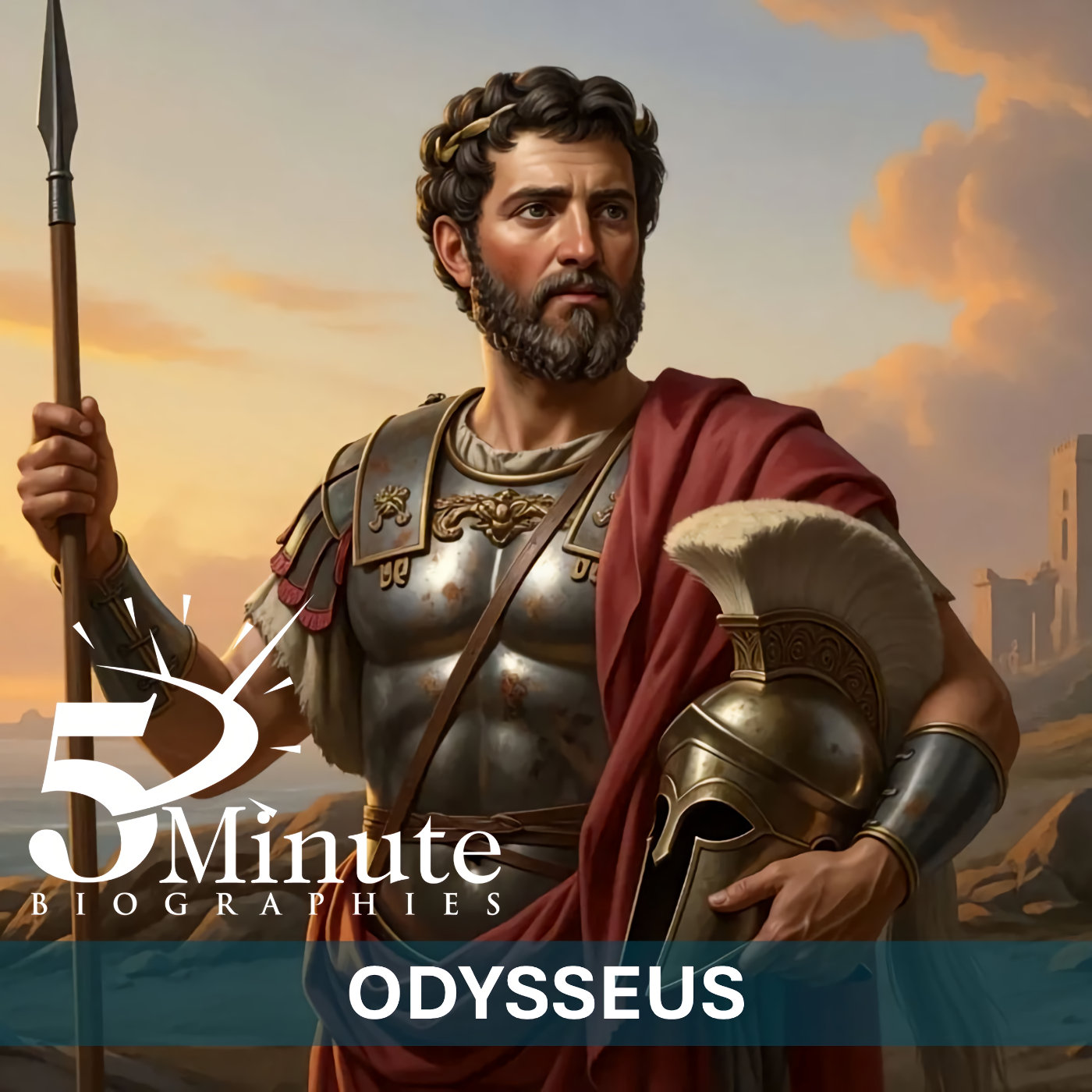
Odysseus
Nov 1000:11:41Tap to summarizeAmong the warriors of ancient Greece, none has left a legacy as complex or enduring as Odysseus, King of Ithaca. Soldier, sailor, strategist, and storyteller, he was a man of contradictions, courageous yet cautious, proud yet humble before the gods, cunning yet bound by honour. His journey from war hero to weary wanderer, and finally to homecoming king, stands as one of the earliest and most human accounts of endurance, intellect, and the longing for peace. Origins and Early Life Odysseus was born on the rugged island of Ithaca, one of the smaller Ionian isles off the western coast of Greece. His father, Laertes, was a respected ruler descended from Zeus through the line of Arcesius, while his mother, Anticlea, was known for her wisdom and piety. Ithaca itself was no great kingdom; its terrain was rocky and its people humble, yet its isolation bred independence and resilience. From an early age, Odysseus distinguished himself not by brute strength but by intelligence. Tutors and elders described him as a boy who preferred thought to action, yet when he acted, his decisions carried precision and purpose. He trained in the arts of combat and rhetoric, learning that leadership demanded not only courage but persuasion. As a young man, he travelled to other Greek states, forging alliances and observing the fractious politics that bound the Achaean world together. It was during these journeys that his gift for diplomacy first became clear, and it would serve him as powerfully as his sword. The Marriage to Penelope Odysseus’s marriage to Penelope, the daughter of King Icarus of Sparta, became one of the most admired unions of the age. Accounts describe her as both intelligent and steadfast, qualities that matched her husband’s character rather than merely adorning it. Together they ruled Ithaca with moderation and wisdom, earning the loyalty of their people through fairness rather than fear. Their son, Telemachus, was born shortly before the fateful events that would draw Odysseus into the most destructive war of the ancient world. It is said that when the call to arms came, Odysseus hesitated, unwilling to leave his young family and his fragile island home. But destiny, once set in motion, cannot be easily denied. The Trojan War Odysseus’s involvement in the Trojan War began long before the first spear was thrown. When Paris of Troy took Helen of Sparta, the Greek kings swore to restore her to her husband, Menelaus. Odysseus, who had once courted Helen himself, was bound by oath to join the campaign. Yet he foresaw the cost, ten years of slaughter and ruin. At first, he sought to avoid the war, feigning madness to escape conscription. When the ruse failed, he accepted his duty, bringing with him twelve ships from Ithaca and its surrounding isles. During the long siege of Troy, his intellect often proved more valuable than any army. He advised Agamemnon, the high king of Mycenae, and acted as an envoy between rival leaders whose pride threatened the Greek alliance. When Achilles refused to fight, it was Odysseus who persuaded him to return to battle. And when diplomacy failed, it was Odysseus who devised the most famous stratagem in history: the wooden horse that brought Troy to ruin. The Journey Home If the war made Odysseus a hero, the voyage home made him a legend. Setting sail for Ithaca with a small fleet, he found his path barred by storms, monsters, and divine wrath. His men, though loyal, often fell victim to greed and disobedience, and each island brought new trials. On the land of the Lotus-Eaters, his crew forgot their purpose; on the island of the Cyclopes, they faced the monstrous Polyphemus, whose blinding earned Odysseus both survival and the lasting enmity of the sea god Poseidon. Trapped by the enchantress Circe, he learned that not all power was brute force, and that persuasion, even charm, could be as potent a weapon as any spear. He descended into the Underworld seeking counsel from the shade of the prophet Tiresias, who warned him of the perils ahead and the dangers of hubris. At sea, he resisted the songs of the Sirens, navigated the deadly straits of Scylla and Charybdis, and watched his shipmates perish one by one. For ten long years, he wandered, a man caught between gods and men, clinging to memory and the promise of home. His survival was due not to divine favour but to an unbreakable will, a refusal to surrender his identity even when stripped of everything else. The Return to Ithaca When at last Odysseus reached Ithaca’s shores, he did so not in triumph but in secrecy. The gods who had tormented him had at last relented, yet his homecoming was not the simple joy he had imagined. In his absence, suitors had overrun his palace, vying for Penelope’s hand and consuming his wealth. Disguised as a beggar, he entered his own hall and saw the depth of the corruption that had taken root. His faithful wife, believing him dead, had delayed remarriage by weaving and unweaving the same shroud, night after night, for twenty years. His son, Telemachus, had grown into manhood without ever knowing his father’s face. When the time came, Odysseus revealed himself, first to his son, then to his wife, and finally to the suitors. What followed was swift and brutal: justice meted out with the precision of a man who had endured too much deceit to suffer any more. Yet even in vengeance, Odysseus tempered wrath with restraint. He spared those who had shown loyalty, reminding all of Ithaca that a king’s power lay not in fear but in fairness. The Later Years Accounts of Odysseus’s later life vary, but all agree that he found peace elusive. After years defined by conflict and cunning, he struggled to adjust to a world without peril. Some sources suggest he travelled once more, to appease Poseidon and fulfil a prophecy that demanded he carry an oar inland until someone mistook it for a winnowing fan, symbolising the end of his seafaring days. Whether or not this journey truly occurred, it reflects a deeper truth: that Odysseus was a man fated always to wander, even when at home. His restless mind, sharpened by experience, could not readily submit to stillness. Yet those who knew him in old age spoke of a gentler wisdom, a man humbled by time but still guided by reason. He died, it is said, as he had lived: with his mind clear, his family beside him, and his name already secure among the immortals of memory. The Man and the Myth Odysseus’s legacy endures because he represented a new kind of hero. Unlike Achilles, who embodied strength, or Hector, who stood for honour, Odysseus triumphed through intellect. His victories were not the result of divine birth or brute power but of adaptability, wit, and endurance. He was, in many ways, the first truly human hero, one whose flaws made him relatable and whose cunning made him indispensable. Yet his life also serves as a warning. His cunning often bordered on deceit, and his pride sometimes provoked divine punishment. The same qualities that saved him also condemned him to years of wandering. His story is thus not simply one of adventure, but of self-discovery, of a man learning the limits of cleverness and the cost of ambition. Legacy and Historical Influence Odysseus’s influence stretched far beyond Ithaca. In later centuries, he became the archetype for explorers, politicians, and thinkers who prized intellect over impulse. His legacy informed the Greek concept of metis, cunning intelligence, and the belief that wisdom could achieve what brute strength could not. His story also shaped cultural ideals of leadership. Odysseus was not infallible, but he was accountable; he commanded loyalty through empathy as much as authority. For ancient Greeks, his homecoming represented the eternal human struggle to reconcile public duty with private longing. For later generations, he became the embodiment of perseverance, proof that reason, not rage, defines the greatest of men. Final Word Odysseus’s life stands as a timeless meditation on what it means to be human. He was a soldier who longed for peace, a ruler who valued humility, and a wanderer who never lost faith in the possibility of home. His journey, across seas, through suffering, and into legend, reflects the trials faced by every generation that seeks meaning in endurance. He taught that courage is not the absence of fear but the will to act despite it; that intelligence, tempered by compassion, is the highest virtue; and that even in the darkest storm, the light of home can guide us forward. Odysseus, King of Ithaca, sailor, survivor, and storyteller, remains, after three millennia, the truest symbol of the human spirit: clever, flawed, and unbreakable. Odysseus FAQ <div class...
Transcribe →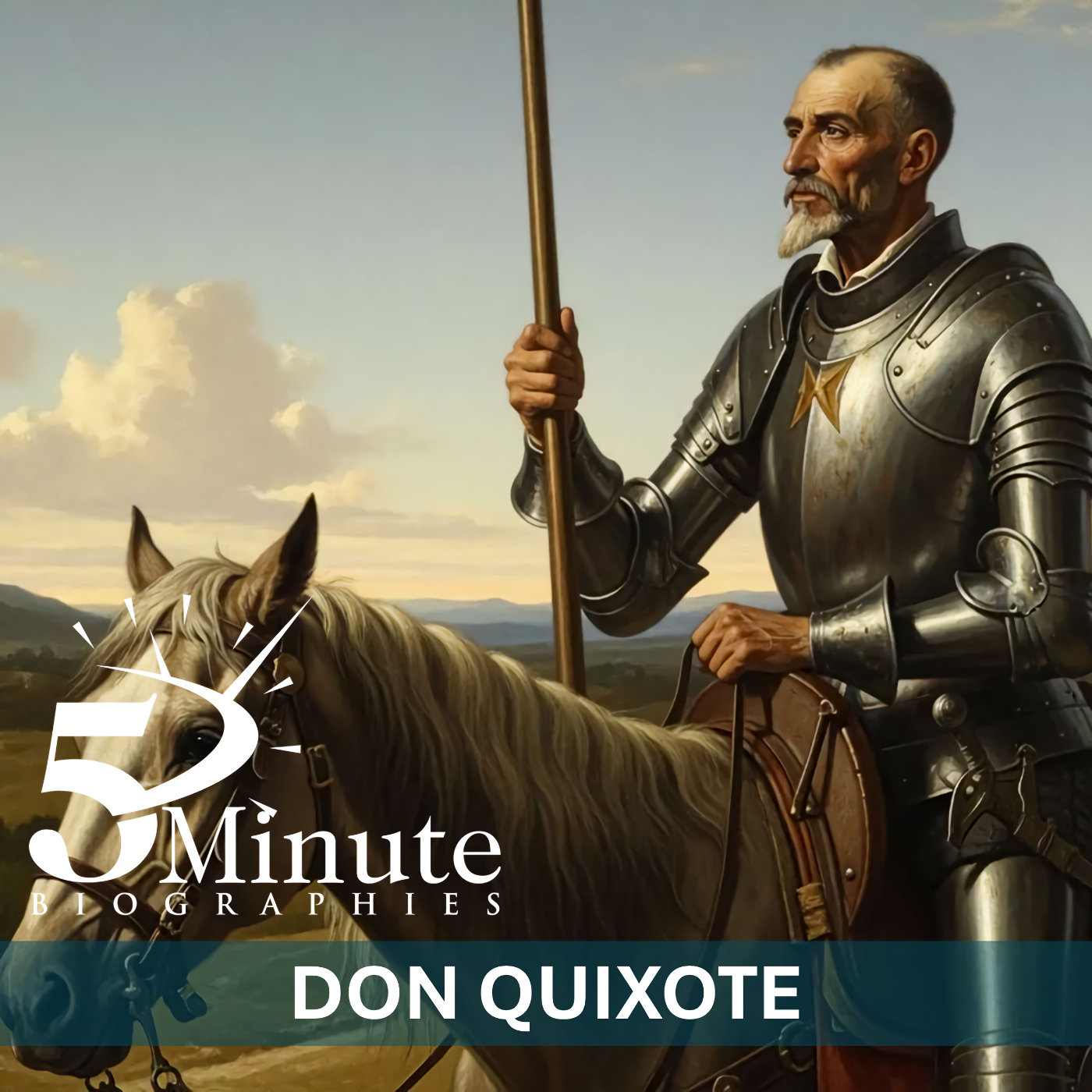
Don Quixote
Nov 700:10:25Tap to summarizeIn an age when the world was turning from faith to reason, from chivalry to commerce, there lived in central Spain a man who refused to surrender to the march of time. His name was Don Quixote de la Mancha, soldier, dreamer, and self-proclaimed knight-errant. Though history remembers him with both admiration and amusement, he stands today as a symbol of idealism in a world that has forgotten how to dream. Early Life and Heritage Don Quixote was born in the region of La Mancha, around the middle of the sixteenth century, into a family of modest country nobility. The world of his youth was one of dusty plains, olive groves, and fading grandeur. Spain, once the spearhead of empire, was beginning to show the strain of endless wars and religious rigidity. For a rural hidalgo, a gentleman of small estate but proud lineage, life was defined by honour, faith, and the maintenance of appearances. Little is recorded of his early years, but accounts agree that he was a man of learning and contemplation. He read widely in the histories of the Reconquista and the romances of knightly adventure that had long since fallen out of fashion. While his peers pursued wealth and influence, Don Quixote turned his thoughts to virtue, courage, and the defence of the helpless. As the modern world crept across Europe, bringing with it trade, science, and cynicism, he remained devoted to the older order of ideals, service, honour, and the belief that one righteous act could redeem the world. The Call to Adventure It was in his middle years that Don Quixote resolved to live according to the principles he admired. Convinced that chivalry was not a relic but a remedy for his country’s ills, he dusted off the armour of his ancestors and declared himself a knight-errant. His family and neighbours considered the decision a harmless eccentricity; he saw it as a sacred vow. He took up the name Don Quixote de la Mancha, after his homeland, and pledged to defend the innocent, right the world’s wrongs, and serve his chosen lady, Dulcinea del Toboso, a peasant woman he regarded through the lens of poetic idealism. His first forays into knighthood were marked by both courage and calamity. With a borrowed horse he named Rocinante and a loyal farmer, Sancho Panza, as his squire, he set out across Castile in search of adventure. The land he found was not one of gallant knights and maidens but of inns, windmills, and weary travellers, yet he treated each encounter as if it belonged to an epic. The Knight and His Squire The bond between Don Quixote and Sancho Panza remains one of the most remarkable partnerships in recorded history. Sancho, a simple man with a sharp wit and a bottomless appetite, followed his master out of loyalty, curiosity, and the promise of a future governorship. Their companionship became the heart of Quixote’s long journey, reason and faith walking side by side. Sancho’s practicality grounded his master’s idealism, yet even he found himself drawn into the older man’s vision of a nobler world. When Quixote mistook windmills for giants, Sancho laughed; when Quixote rose bloodied but unbowed from defeat, Sancho began to believe that perhaps his master’s madness contained its own truth. Through hardships and humiliation, they travelled together across the plains of Spain, confronting innkeepers, soldiers, and shepherds with the same mixture of bravery and delusion. To some, Don Quixote was a fool. To others, he was a saint. To Sancho, he was simply a man determined to live as the world ought to be, not as it was. Trials of Honour Don Quixote’s encounters were both comic and tragic. He defended prisoners he mistook for oppressed peasants, attempted to reconcile lovers, and lectured brigands on the virtues of mercy. Wherever he went, he spoke of justice, honour, and the sacred duties of knighthood, ideas that made little sense to the merchants and farmers of a weary Spain. Yet beneath the laughter, his actions carried a strange dignity. He believed that courage was not measured by success but by persistence; that failure in a noble cause was better than victory in a base one. When others mocked him, he answered with courtesy. When beaten, he forgave. His wounds, he said, were the price of faith in a cynical age. The Return to La Mancha After years of wandering, Don Quixote returned to his home in La Mancha, older, battered, and briefly cured of his illusions. Friends and family rejoiced, believing he had finally abandoned his impossible dreams. For a time, he rested, speaking quietly of the need for reason and moderation. But reason alone could not sustain him. Though his mind cleared, his spirit dimmed. The world he had sought to change remained indifferent. On his deathbed, he made peace with those who had loved him and asked forgiveness of those he had offended. His final words, according to witnesses, expressed gratitude for friendship, faith, and the chance to have lived for something greater than himself. He died as he had lived, believing that goodness, however impractical, was still worth the effort. The Meaning of Madness Modern historians and philosophers have long debated whether Don Quixote was mad or merely misunderstood. Some describe him as a casualty of idealism, a man broken by the disillusionment of a changing world. Others see him as a visionary who recognised that civilisation without virtue is a kind of madness itself. His insistence that chivalry could still matter in an age of greed and cynicism made him both an object of ridicule and a mirror for humanity’s longing to believe in something better. His so-called madness forced his contemporaries to question their own sanity, their acceptance of injustice, their complacency in cruelty, their surrender to despair. In his failure, Don Quixote achieved what no conqueror could: he reminded the world that imagination is the soul’s rebellion against apathy. Legacy Don Quixote’s influence endured long after his death. His journeys inspired countless others to reflect on the tension between idealism and realism, between dreams and duty. Artists, philosophers, and reformers across Europe cited his life as proof that conviction could outlast ridicule. In Spain, he came to symbolise the nation’s conscience, noble, wounded, and unyielding. Statues and poems celebrated him as the last true knight, a figure who defended the dignity of the human spirit when reason alone was not enough. He also left behind a legacy of compassion. Though mocked and misunderstood, he treated all people with respect, from peasants to princes. His kindness toward the powerless and his respect for women marked him as a man ahead of his time. Historical Reflection To understand Don Quixote is to understand the era that made him. The late Renaissance was an age of contradictions, faith challenged by science, empire undermined by bureaucracy, and art shadowed by doubt. Spain’s grandeur had begun to fade, but its pride remained. In this setting, a solitary man who refused to accept disillusionment became both a product and a critic of his age. He was not merely fighting imaginary giants; he was resisting the erosion of meaning itself. His belief in honour was not nostalgia but protest, a refusal to live in a world that measured value by profit and power alone. Final Word Don Quixote de la Mancha remains one of history’s most paradoxical figures: a man both foolish and wise, deluded and enlightened, broken and yet whole. His story endures because it touches something unchanging: the human need to believe that courage, kindness, and imagination can still redeem the world. He may have tilted at windmills, but in doing so, he taught us to see giants where others saw machinery, and ideals where others saw only futility. His life reminds us that sometimes the noblest battles are those that cannot be won, and that even in failure, the pursuit of goodness ennobles the heart. He died a relic of another age, and yet, centuries later, his spirit feels oddly modern. For as long as the world mocks idealism, there will always be a need for another Don Quixote: a dreamer, a believer, and the eternal knight of La Mancha. Don Quixote FAQ Who was Don Quixote? Don Quixote was a Spanish gentleman from La Mancha who, inspired by tales of knighthood, set out to revive the ideals of chivalry in the 17th century. Why is Don Quixote considered an important historical figure? His journey symbolised the c...
Transcribe →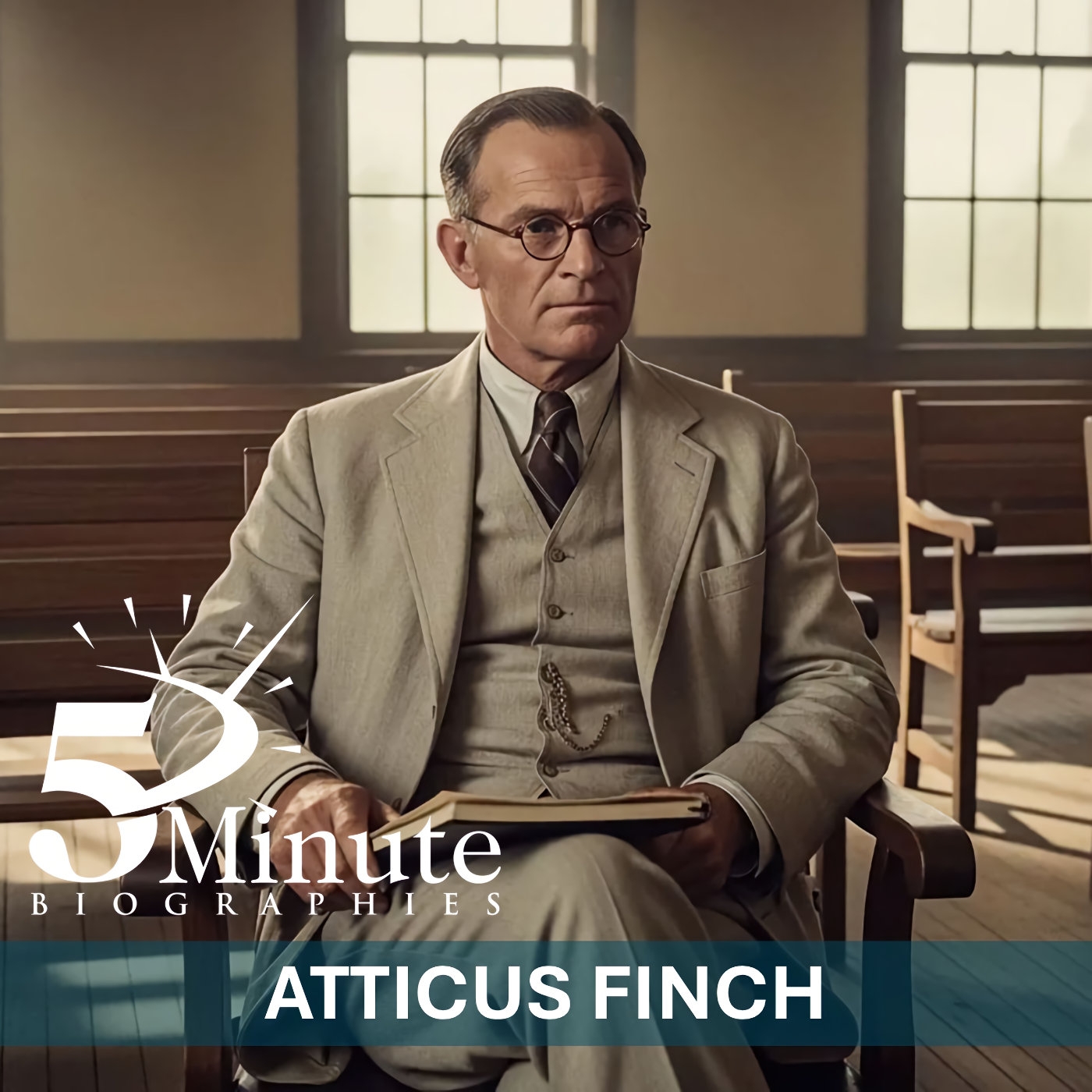
Atticus Finch
Nov 600:10:46Tap to summarizeIn the turbulent landscape of the American South during the 1930s, few figures embodied moral integrity and human decency more completely than Atticus Finch. A lawyer, father, and reluctant hero, Finch stood against the prejudice and injustice of his time with the calm conviction that truth and fairness were worth defending, even when the cost was high. His life became a touchstone for ethical courage, proof that dignity could survive even amid society’s worst failures. Early Life and Education Atticus Finch was born in the closing years of the nineteenth century in the small town of Finch’s Landing, Alabama. The Finch family traced its roots back to English settlers who had arrived generations earlier, establishing themselves as part of the old agrarian order of the Deep South. While his ancestors were planters and landowners, Atticus chose a different path, one that would set him apart from the tradition-bound expectations of his heritage. He attended the state university, where he studied law at a time when the South was still struggling to rebuild its identity after the Civil War and Reconstruction. Unlike many of his contemporaries, Finch believed the law should serve as a shield for the vulnerable, not a weapon for the powerful. He returned to his hometown of Maycomb to open a small legal practice, determined to uphold justice in a society still divided by class, race, and memory. Maycomb and the Moral Landscape Maycomb, Alabama, was the kind of town that seemed preserved in amber, sleepy, sun-drenched, and bound by old habits. The Great Depression had stripped away what little prosperity the community had enjoyed, leaving its people poor but proud, and its divisions more visible than ever. It was here that Atticus Finch built both his career and his quiet reputation for fairness. He lived in a modest house near the town square with his two children, Jeremy (known as Jem) and Jean Louise (nicknamed Scout). Widowed when the children were young, Finch devoted himself to their upbringing with the same calm patience he brought to the courtroom. His household was watched over by Calpurnia, the family’s African American housekeeper, whose intelligence and authority helped shape the children’s sense of justice and equality. Despite his gentle manner, Finch was a man of deep conviction. He served on the local legislature, guided by the belief that democracy demanded participation, even in places where change came slowly. He was respected, though not universally admired; his empathy and moderation were often mistaken for weakness by those who valued conformity over conscience. The Case That Defined Him The defining test of Atticus Finch’s life came in the early 1930s, when he was appointed to defend a Black man, Tom Robinson, accused of assaulting a white woman, Mayella Ewell. The case was explosive, not only for its subject but for what it revealed about Maycomb’s soul. In a society built on segregation and fear, the idea of a white lawyer defending a Black defendant against a white accuser was considered a betrayal of custom and race. Finch accepted the case not out of pride or ambition, but because he believed that every person deserved a fair trial, and that justice meant little if it was not extended to those whom society preferred to ignore. His decision brought quiet hostility from neighbours and open insults from strangers, but he never wavered. In court, Atticus dismantled the prosecution’s argument with precision and restraint. He demonstrated that Mayella’s injuries had been inflicted by someone left-handed and that Tom Robinson’s left arm had been rendered useless in an accident. He exposed the prejudice that underpinned the accusation, revealing it as the desperate act of a poor, ignorant family trying to preserve a false sense of superiority. Yet despite the clarity of the evidence, the jury returned a guilty verdict. Finch accepted the decision with dignity, though he knew it was unjust. When Tom Robinson was later killed attempting to escape from prison, Finch bore the grief with quiet composure, knowing that his small act of defiance had at least forced his community to look at itself honestly, even if it did not yet have the courage to change. Father, Teacher, and Conscience Beyond his role as a lawyer, Atticus Finch was above all a father. He raised Jem and Scout not through lectures but by example. He taught them that courage was not a man with a gun in his hand, but someone who fights for what is right, even when he knows he will lose. His lessons were profound but straightforward: that empathy was the foundation of understanding, and that morality meant standing in another person’s shoes before passing judgment. In a world still ruled by hierarchy and prejudice, these ideas were revolutionary. Through his quiet words and steady integrity, he became not only a model of parenthood but a symbol of conscience itself. Neighbours often mistook his calm for passivity, but those who knew him best understood that Atticus possessed a steel of character that could not be bent. His restraint came not from weakness but from principle. He believed that anger clouded reason, and that progress, however slow, was built on dialogue rather than hatred. Service and Public Life In the years following the Robinson trial, Finch continued his legal work, often taking on unpopular cases that others refused. Though he never sought higher office, he became a moral authority in the county, a man whose opinion was sought even by those who disagreed with him. He opposed lynching and voter suppression, arguing that the law’s legitimacy depended on its fairness. He also supported education as a means to break the cycle of poverty and ignorance that sustained prejudice. In later years, he served as an advisor on state committees focused on legal reform, pressing quietly for change in an era when loud voices were often silenced by violence. His law office remained modest, lined with books and papers rather than wealth. He refused to profit from injustice or accept cases that conflicted with his conscience. “The one thing that doesn’t abide by majority rule,” he once said, “is a person’s conscience.” It was a sentiment that defined him as much as any verdict ever could. Legacy and Cultural Impact By the time of his death in the late 1950s, Atticus Finch had become more than a small-town lawyer. He was a moral compass for a generation. His life inspired young lawyers, civil rights advocates, and ordinary citizens who saw in him a reminder that justice required courage, patience, and humanity. Historians later came to see Finch as a bridge between the Old South and the modern era, a man who upheld the rule of law even when it exposed the flaws of the society he loved. His approach was evolutionary, not revolutionary; he sought to change hearts as well as laws. Critics argued that his faith in the system was naïve, yet few could deny that his quiet example helped lay the moral groundwork for the Civil Rights Movement that followed. In education, Finch became a staple of American classrooms, studied as a symbol of ethical integrity and moral reasoning. For generations of students, his story served as both a historical lesson and a moral challenge: to see the world as it is, but strive for what it ought to be. A Complex Ideal Atticus Finch’s enduring appeal lies in his humanity. He was not perfect. His restraint sometimes frustrated those who wanted faster justice; his optimism sometimes seemed misplaced. Yet his imperfections made him real, a man navigating moral complexity without losing his centre. He understood that law and morality were not always aligned, and that change was a slow and often painful process. But he also believed that progress, however incremental, began with individuals who refused to compromise their conscience. In his quiet defiance, Finch captured something universal: the struggle to do good in a flawed world. Final Word Atticus Finch’s life remains a testament to the idea that decency can be a form of rebellion. He lived by principle rather than popularity, guided by a belief that justice was not an abstract concept but a daily practice. In the courtroom, he spoke for the voiceless; at home, he taught his children to think for themselves; in his community, he stood firm when it would have been easier to bend. He was, in the truest sense, a gentleman, not by birth or wealth, but by conduct. His quiet voice, tempered by reason and compassion, continues to echo across generations, reminding us that the measure of character is not found in triumph, but in the courage to stand alone when standing alone is the only right thing to do. Atticus Finch FAQ <div class="schema-faq wp-block-yoas...
Transcribe →
Elizabeth Bennet
Nov 500:10:18Tap to summarizeAmong the notable women of early nineteenth-century England, few have left such a vivid impression on history and society as Elizabeth Bennet. Intelligent, spirited, and unafraid to defy convention, she embodied the gradual shift from rigid Georgian propriety toward a more modern understanding of individual thought and independence. Her life, shaped by family, love, and social expectation, remains one of the clearest reflections of the complexities facing women of her era. Early Life and Family Elizabeth Bennet was born in the closing years of the eighteenth century, the second of five daughters to Mr and Mrs Thomas Bennet of Longbourn, a modest estate near the Hertfordshire village of Meryton. The Bennets were members of the landed gentry, a class caught between aristocratic wealth and the industrious middle class emerging at the turn of the century. Elizabeth’s father was known for his dry wit and preference for books over society, while her mother’s chief ambition lay in securing prosperous marriages for her daughters. In a household full of noise, laughter, and frequent embarrassment, Elizabeth’s intelligence and composure set her apart. Educated at home under her father’s guidance, she developed a sharp intellect and a taste for reading, which was unusual in young women of her station. Her upbringing instilled in her both the manners expected of a genteel young lady and a keen awareness of the limitations imposed by inheritance laws and gender norms. The Bennet estate, entailed to a male heir, meant that Elizabeth and her sisters faced an uncertain financial future. Yet she seemed determined not to let circumstance dictate the boundaries of her happiness. Early Impressions and Character Those who knew Elizabeth in her youth often remarked upon her lively expression and quick tongue. She possessed, as one contemporary put it, “a mind too strong for idleness and a heart too honest for artifice.” Unlike many of her contemporaries, she was not easily flattered and had little patience for vanity or pretension. Her independence of thought sometimes scandalised more traditional acquaintances. She was known to engage in spirited debates, even with men of higher rank, and had a particular dislike for those who valued lineage above character. Yet her confidence was tempered by genuine warmth and compassion, qualities that made her widely admired among her friends and family. Encounters and Courtship In 1811, the arrival of two wealthy bachelors in the neighbourhood, Charles Bingley and his friend Fitzwilliam Darcy, altered the course of Elizabeth’s life. Bingley’s good nature quickly endeared him to her eldest sister, Jane, while Darcy’s proud demeanour provoked in Elizabeth an equal measure of amusement and irritation. At first, Elizabeth found Darcy’s manner insufferable. His hauteur at public gatherings, coupled with an unguarded remark about her being “tolerable, but not handsome enough to tempt me,” ensured that her opinion of him was set. When the obsequious clergyman Mr Collins proposed marriage soon afterwards, Elizabeth’s refusal shocked her mother but delighted her father, who valued his daughter’s courage to reject a comfortable match that lacked affection. In the months that followed, Elizabeth’s acquaintance with George Wickham, a charming but unreliable officer, deepened her dislike of Darcy. Wickham’s tales of injustice at Darcy’s hands painted the man as cruel and arrogant. It was not until later, through Darcy’s own frank explanation, that she learned the truth: Wickham had squandered his inheritance and attempted to elope with Darcy’s younger sister for her fortune. The revelation forced Elizabeth to confront her own prejudice. “Till this moment, I never knew myself,” she is reported to have said, marking one of the most profound turning points in her life. The Turning of Fortune Elizabeth’s visit to the north of England in the summer of 1812 proved equally transformative. When she and her relatives toured Darcy’s estate, Pemberley, she was struck not only by its beauty but by the respect and affection shown to its master by his servants. Her opinion of Darcy softened further when he greeted her with unexpected warmth, showing no resentment over their past disagreements. Shortly afterwards, news reached her that her youngest sister, Lydia, had eloped with Wickham, threatening the family’s reputation. Unknown to Elizabeth at the time, Darcy quietly intervened, locating the couple, arranging their marriage, and ensuring Lydia’s honour was preserved. When she later learned of his actions, Elizabeth was moved by both his generosity and his discretion. Marriage and Domestic Life By the close of 1812, Elizabeth’s opinion of Darcy had transformed entirely, as had his of her. His renewed proposal, this time humble and heartfelt, was accepted with equal affection. Their marriage, in 1813, was widely noted not only for its union of love and respect but for bridging a considerable social divide. As mistress of Pemberley, Elizabeth’s intelligence and warmth proved invaluable. She became known for her kindness to tenants, her efficient management of the estate, and her ability to engage even the most formidable of Darcy’s aristocratic relations on equal terms. Her charm, coupled with her husband’s integrity, made them one of the most admired couples in Derbyshire society. Those who visited Pemberley often spoke of the balance between their temperaments: Darcy’s seriousness softened by Elizabeth’s wit, and her spirited nature steadied by his calm sense of honour. Their marriage was considered proof that equality of mind could be as strong a foundation for happiness as equality of birth. Influence and Legacy Elizabeth Bennet’s life marked a subtle yet significant turning point in social expectations for women of her time. She demonstrated that intelligence, independence, and virtue could coexist with grace and respectability. In an age when marriage was often viewed as an economic arrangement, she insisted on affection and mutual respect as its foundation. Her refusal to marry for convenience and her eventual triumph, finding both love and stability without compromising her principles, made her a quiet icon of feminine self-determination in Regency England. Her story circulated widely in domestic accounts and was often cited in drawing rooms as a lesson in discernment, humility, and courage. Those who knew her in later years described her as a devoted mother and steadfast friend. She remained close to her elder sister Jane, who settled nearby, and continued to serve as a voice of reason within her extended family. Her blend of rational judgment and emotional intelligence became the model for an emerging ideal of the “modern gentlewoman”, one who could think as clearly as she could feel deeply. Historical Perspective Historians now view Elizabeth Bennet as emblematic of a broader societal shift. Her insistence on personal happiness, moral integrity, and intellectual equality anticipated the changes that would define the Victorian age to come. Though she lived in a world still bound by hierarchy and inheritance, she showed that dignity could be earned through character rather than birthright. In literature and education, her life is often cited in discussions of early nineteenth-century gender roles, moral philosophy, and the evolution of social mobility. Scholars of the period have noted that her marriage to Darcy represented not simply a romantic union, but the reconciliation of old wealth and new merit, an allegory for Britain’s gradual transition from aristocratic rigidity to enlightened modernity. Final Thoughts Elizabeth Bennet’s life stands as a testament to the power of wit, integrity, and emotional courage. In an age that often silenced women of intellect, she spoke with honesty; in a society obsessed with status, she valued sincerity; and in a world quick to judge, she learned to see beyond appearances. Her story endures because it captures something timeless: the belief that understanding oneself is the first step toward understanding others. In her own quiet, determined way, Elizabeth Bennet helped redefine what it meant to be both a lady and an individual, and in doing so, left a legacy as enduring as the English countryside she called home. Elizabeth Bennet FAQ Who was Elizabeth Bennet? Elizabeth Bennet was a young woman from Hertfordshire during the early 19th century, known for her intelligence, independence, and refusal to marry for wealth or status. What made Elizabeth Bennet unusual for her time?</stro...
Transcribe →
Harry Potter
Nov 400:11:35Tap to summarizeFew figures in modern magical history have inspired as much admiration and curiosity as Harry James Potter, the boy who survived the Killing Curse, the young wizard who helped bring down Lord Voldemort, and a man whose life continues to shape the wizarding world. His journey from orphaned infant to symbol of courage remains one of the most compelling stories of the post-war magical era. Early Life and Family Background Harry James Potter was born on 31 July 1980 in the village of Godric’s Hollow, a place known for its deep magical heritage. His parents, James and Lily Potter (née Evans), were members of the Order of the Phoenix, a secret organisation formed to resist the rise of the Dark wizard Lord Voldemort during the First Wizarding War. When Harry was only fifteen months old, Voldemort tracked down the Potters, betrayed by their secret-keeper Peter Pettigrew. On the night of 31 October 1981, Voldemort murdered James and Lily but failed to kill Harry. The Killing Curse rebounded, leaving Voldemort nearly destroyed and Harry with his distinctive lightning-shaped scar. Harry’s miraculous survival brought an end to Voldemort’s reign of terror and made him famous across the wizarding world as “The Boy Who Lived.” However, to protect him from danger and public attention, Albus Dumbledore, Headmaster of Hogwarts, placed Harry in the care of his only living relatives, his aunt and uncle, Petunia and Vernon Dursley, Muggles who lived in Little Whinging, Surrey. A Difficult Childhood Harry’s early life with the Dursleys was marked by neglect and cruelty. Forced to live in the cupboard under the stairs at Number Four, Privet Drive, he grew up unaware of his magical heritage. His cousin, Dudley Dursley, bullied him relentlessly, while Petunia and Vernon sought to suppress any sign of magic. Despite their efforts, strange incidents often occurred around Harry, hair growing back overnight, objects moving without explanation, and one notorious episode involving a vanishing zoo enclosure. Everything changed in the summer of 1991, when Harry began receiving mysterious letters. The Dursleys tried to keep them from him, but Rubeus Hagrid, Keeper of Keys and Grounds at Hogwarts, personally delivered his acceptance letter to the Hogwarts School of Witchcraft and Wizardry, revealing Harry’s true identity as a wizard. Education at Hogwarts Harry began attending Hogwarts in September 1991, where he was sorted into Gryffindor House. For the first time in his life, he found friendship, belonging, and purpose. He quickly became close to Ron Weasley and Hermione Granger, friendships that would define his youth. His natural talent for Quidditch earned him a place on the Gryffindor team as the youngest Seeker in over a century. Yet his fame as The Boy Who Lived brought constant attention, not all of it welcome. During his seven years at Hogwarts, Harry became entangled in events that would ultimately decide the fate of the wizarding world. In his first year, he faced Professor Quirrell and prevented the theft of the Philosopher’s Stone, thereby thwarting Voldemort’s initial attempt to regain physical form.In his second year, he discovered and defeated the monster of the Chamber of Secrets, saving Ginny Weasley and proving that his bravery matched his reputation.His third year saw the revelation that his godfather, Sirius Black, had been wrongly imprisoned, and that the real betrayer of his parents was Peter Pettigrew.The Triwizard Tournament of his fourth year ended in tragedy with the death of Cedric Diggory and Voldemort’s full return to power. From that point onward, Harry’s life became a battle between truth and denial. In his fifth year, despite the Ministry of Magic’s attempts to discredit him, Harry founded Dumbledore’s Army to train fellow students in defensive magic. The ensuing Battle of the Department of Mysteries confirmed Voldemort’s return to the entire wizarding world, but at the cost of Sirius Black’s life. His sixth year was dominated by preparation. Under Dumbledore’s guidance, Harry learned about Voldemort’s Horcruxes, objects containing fragments of his soul, and the two began searching for ways to destroy them. That same year, Dumbledore was murdered by Severus Snape, setting the stage for the final conflict. The Second Wizarding War After Dumbledore’s death, Harry, Ron, and Hermione did not return to Hogwarts. Instead, they embarked on a dangerous mission to locate and destroy the remaining Horcruxes. The trio lived in secrecy, hunted by Voldemort’s followers, the Death Eaters, while the Ministry of Magic fell under Voldemort’s control. Their journey was long and perilous. They recovered key Horcruxes, including Slytherin’s locket, Hufflepuff’s cup, and Ravenclaw’s diadem, and uncovered the legend of the Deathly Hallows, three mythical objects said to make their bearer the Master of Death. The war reached its climax with the Battle of Hogwarts on 2 May 1998. Hundreds of students, teachers, and members of the resistance fought against Voldemort’s forces. Harry willingly sacrificed himself to save others, confronting Voldemort in the Forbidden Forest. The Killing Curse struck him, but the protective magic from his mother’s sacrifice, and the connection between their wands, allowed him to survive once more. In the final confrontation inside the Great Hall, Voldemort was killed by his own rebounding curse, ending decades of fear and bloodshed. Harry Potter, still only seventeen years old, had fulfilled the prophecy that tied their fates together. Life After the War Following Voldemort’s defeat, Harry declined the offer of an honorary position at the Ministry and chose instead to complete his education at Hogwarts. Afterwards, he joined the Auror Office, where he worked under Kingsley Shacklebolt to reform the Ministry of Magic. In his career, Harry became known not only for his bravery but for his commitment to fairness and justice. He was later promoted to Head of the Auror Office, helping rebuild trust in the institution after years of corruption and fear. Harry also maintained close relationships with his friends. Hermione Granger went on to become Minister for Magic. At the same time, Ron Weasley joined him briefly at the Auror Office before working with his brother George at Weasleys’ Wizard Wheezes in Diagon Alley. In his personal life, Harry married Ginevra “Ginny” Weasley, a professional Quidditch player for the Holyhead Harpies and later a respected journalist for the Daily Prophet. Together, they had three children: James Sirius, Albus Severus, and Lily Luna. The family settled near Ottery St. Catchpole in Devon, maintaining strong ties with both the Weasley and Granger families. Despite his fame, Harry lived modestly and avoided publicity, preferring a quiet life focused on family, work, and community. Legacy and Modern Influence Harry Potter’s influence extends far beyond his personal achievements. He remains a symbol of resilience, compassion, and the triumph of moral courage over tyranny. His life story is now part of the wizarding curriculum across Britain and beyond, studied in courses on Magical History, Ethics, and Defence Against the Dark Arts. He is credited with ushering in an era of openness between magical and non-magical communities and for helping dismantle the prejudices that once divided wizarding society by blood status. Harry himself has repeatedly downplayed his fame, insisting that the real heroes were “the ones who never came home.” Still, memorials to those who fell during both wizarding wars stand in places he helped protect, notably at Hogwarts, Godric’s Hollow, and the Ministry of Magic atrium. Now in his forties, Harry continues to serve in the Ministry and occasionally lectures at Hogwarts, emphasising the value of empathy and accountability in the use of magic. Those who know him describe him as humble, steady, and intensely loyal, the same qualities that made him, as a young man, capable of changing the world. Historical Assessment Within the broader tapestry of magical history, Harry Potter’s story represents the enduring conflict between love and fear, freedom and control. His refusal to seek power, despite countless opportunities to claim it, distinguishes him from many of the significant figures of his time. Historians have noted that Harry’s strength lay not in his magical ability, though formidable, but in his capacity for forgiveness. His decision to spare Draco Malfoy, to save Peter Pettigrew, and to honour Severus Snape after learning the truth of his sacrifices all speak to a moral clarity rare in times of war. His story, taught in wizarding schools worldwide, continues to inspire young witches and wizards to question authority, value friendship, and act with conscience even when the world seems lost to darkness. Final Thoughts The life of Harry James Potter is, above all, a story of choice...
Transcribe →
Sherlock Holmes
Nov 300:12:30Tap to summarizeRenowned for his extraordinary powers of deduction, attention to detail, and eccentric personality, Sherlock Holmes is celebrated as the world’s greatest detective. His influence has spanned generations, and his legacy continues to inspire admiration among both the public and professionals in the field of criminal investigation. Early Life and Family Background Much of Sherlock Holmes’s early life remains shrouded in mystery, though tantalising glimpses into his background have emerged over the years. Born in the mid-1800s in England, the exact date and location of his birth remain uncertain. Holmes hailed from a family of notable intellectual distinction. His elder brother, Mycroft Holmes, is described as possessing deductive abilities even greater than Sherlock’s, although Mycroft prefers the theoretical over the practical. The Holmes family enjoyed comfortable means, as indicated by Mycroft’s senior position within the British government and Sherlock’s ability to pursue a sometimes-sporadic career as a “consulting detective” without apparent financial pressure. Their ancestry suggests a lineage that values education and rational thought, providing fertile ground for Sherlock’s own analytical brilliance. Education and Development of His Methods Sherlock Holmes displayed a wide-ranging intellectual curiosity from a young age. While details of his formal education are scarce, it is known that he attended university, possibly Cambridge, given certain references. During these formative years, Holmes refined his unique methods of observation and deduction. He engaged in chemical analysis, developed expertise in several scientific fields long before such disciplines were standard in police work, and cultivated skills in disguise and covert entry, always put to use in the pursuit of justice. Holmes described the science of deduction as the “science of observation, of inference, and of knowledge,” devoting countless hours in the laboratory to unravel the complexities of human behaviour and criminal activity. His studies spanned anatomy, botany, geology, chemistry, and even music, all of which he would later employ to great effect in his detective work. Establishing Himself as a Consulting Detective After honing his remarkable abilities, Holmes established himself as the world’s only “consulting detective”, a profession of his own invention. Operating from his famous rooms at 221B Baker Street, London, Holmes quickly attracted clients from all walks of life: aristocrats, government officials, and police forces sought his services in cases that baffled ordinary investigators. Holmes’s singular status was sealed by his success in a series of remarkable cases, chronicled by his close friend and companion, Dr John H. Watson. Holmes’s approach to detection revolutionised investigative work. He considered “observation” an art, noticing details that others overlooked and drawing conclusions from the slightest trace, whether a smudge of ash or a footprint in mud. He wrote a monograph on tobacco ash, catalogued criminal methodologies, and built a network of informants, including the “Baker Street Irregulars”, a group of resourceful street urchins who gathered intelligence from every corner of London. Relationships and Personal Life Holmes is perhaps as well known for his eccentricities and preference for isolation as for his intellect. Yet, his relationships, particularly with Dr John Watson, form the emotional core of his life. Watson, a former military doctor who was wounded in the shoulder in Afghanistan, became Holmes’s friend, chronicler, and frequent partner in investigation. Their partnership was one of deep trust, camaraderie, and mutual respect. Holmes’s personal life was marked by emotional detachment and a tendency toward solitude, but he was not devoid of feeling. He deeply admired Irene Adler, the only woman known to have outwitted him, and he showed both compassion and respect to clients in distress. Holmes displayed little interest in romantic entanglements, believing they distracted from the precise thinking required for his work. Instead, his passions were devoted entirely to the pursuit of truth and justice. His relationship with his brother, Mycroft, was one of mutual respect and friendly rivalry. Mycroft’s intelligence, described as even greater than Sherlock’s, was matched only by his indolence, leading him to a comfortable post in Whitehall, where he influenced government policy from behind the scenes. Notable Cases and Adventures Holmes’s career was punctuated by a series of celebrated cases, many of which have become classics in the annals of criminal investigation. From the sinister hound haunting the moors in the Baskerville affair to the international intrigue of the Bruce-Partington Plans, Holmes confronted adversaries who tested his intellect to its limits. Among his most formidable opponents was Professor James Moriarty, the so-called “Napoleon of crime,” whose criminal genius rivalled Holmes’s own. Their epic struggle culminated at the Reichenbach Falls in Switzerland, where both men reportedly plunged to their deaths, a moment that stunned the public. Holmes’s subsequent reappearance in London, after a period spent in disguise and travel, marked a triumphant return to his life’s work. Other memorable cases include the mysterious Speckled Band, the enigmatic Red-Headed League, the saga of the Sign of Four, and the study of a scarlet murder, all showcasing Holmes’s extraordinary mind and unwavering commitment to justice. Working Methods and Philosophy Holmes’s methods set new standards in the field of detection. He advocated a rigorous adherence to logic and empirical evidence, dismissing intuition and guesswork as unreliable. His oft-quoted maxim, “When you have eliminated the impossible, whatever remains, however improbable, must be the truth,” encapsulates his core philosophy. Holmes maintained vast personal files on crimes, criminal types, and unusual cases, continuously updating his knowledge. He was an early adopter of advanced investigative techniques such as fingerprinting and chemical analysis, often outpacing official police in both expertise and results. Holmes’s success owed as much to his encyclopaedic learning as to his relentless pursuit of truth. While brilliant, Holmes was not infallible. On rare occasions, he made mistakes, usually when personal feelings interfered with his judgment or when he underestimated his adversaries. Nevertheless, his record remains unparalleled in the history of detection. Holmes’s Interests and Hobbies Away from crime-solving, Holmes was an accomplished violinist, often using music as a form of emotional release. He also excelled at boxing, fencing, and single-stick fighting, skills that frequently proved useful in dangerous situations. His eccentricities extended to his domestic habits: Holmes was notorious for conducting chemical experiments in his sitting room, for firing bullets into his wall in the shape of a ‘VR’ (for Victoria Regina), and for occasional periods of melancholia or intense abstraction. Holmes’s use of cocaine has been the subject of much discussion. He occasionally resorted to a seven-per-cent solution during periods of boredom, a habit frowned upon even in his own era and one that Dr Watson persistently tried to curb. Holmes justified its use as a means of staving off ennui when not engaged in cases. Ultimately, the demands of his work and the friendship of Watson helped him abandon the habit. Retirement and Later Years Sherlock Holmes eventually withdrew from active detective work, retiring to a small farm in Sussex, where he took up beekeeping. There, he wrote a monograph on apiculture, demonstrating that his powers of observation could be applied to any field of inquiry. Nevertheless, Holmes remained available for consultation in particularly challenging cases and, on occasion, assisted the government in matters of national security. In retirement, Holmes maintained a keen interest in international affairs and continued to influence the world of criminal investigation. His legacy was already secure, having inspired generations of detectives across the globe. Legacy and Cultural Impact Sherlock Holmes’s influence extends far beyond his own era. He has inspired countless adaptations, studies, and reimaginings across every medium, from stage and screen to radio and video games. Holmes is credited with popularising scientific methods in criminal investigation and shaping the modern expectations of what a detective should be. Statues, museums, and societies dedicated to Holmes can be found around the world, particularly in London, where 221B Baker Street remains a site of pilgrimage for admirers. The Baker Street Irregulars, once his group of street informants, gave rise to a society devoted to the discussion and study of his adventures. Holmes’s phrases, such as “Elementary, my dear Watson,” have entered everyday language and are recognised globally. Sherlock Holmes in Popular Culture</...
Transcribe →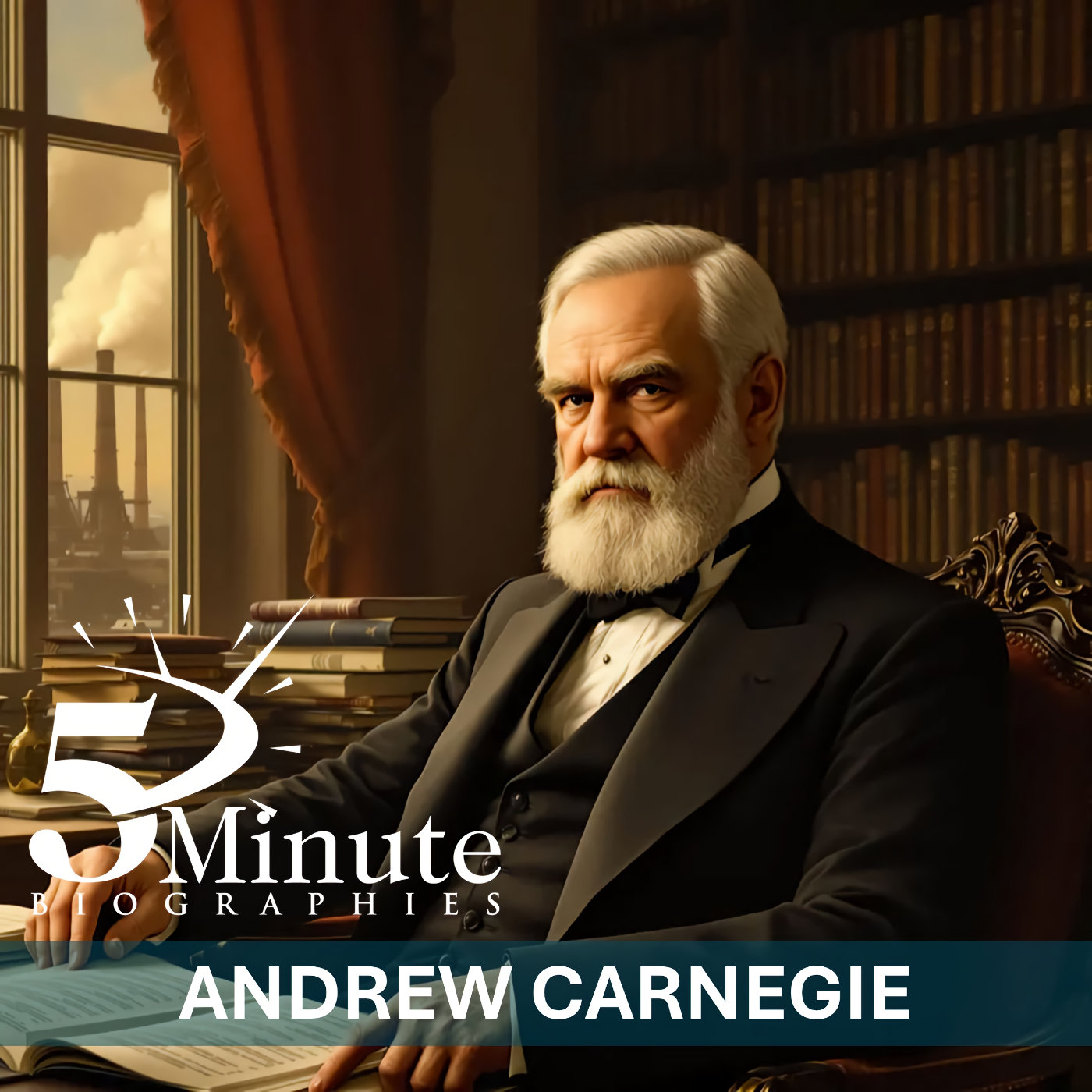
Andrew Carnegie
Oct 2700:12:00Tap to summarizeAndrew Carnegie’s life reads like the blueprint of the American dream. Rising from a Scottish weaver’s cottage to become one of the wealthiest men in history, he embodied both the triumphs and contradictions of industrial capitalism. His name became synonymous with steel, philanthropy, and the idea that wealth carried moral responsibility. From Dunfermline to the New World Andrew Carnegie was born on 25 November 1835 in Dunfermline, Scotland, a small industrial town whose hum of looms and smell of coal smoke would leave a lasting impression. His father, William Carnegie, was a handloom weaver, and his mother, Margaret, kept the household afloat by mending shoes and selling food to neighbours. The family lived modestly but proudly, bound by the ideals of hard work, education, and self-improvement. When mechanised looms began to replace traditional weavers, the Carnegies found themselves in financial hardship. Seeking a better life, they emigrated to the United States in 1848, settling in Allegheny, Pennsylvania. Andrew was just twelve. The journey across the Atlantic was long and miserable, but he later recalled the moment he first saw the lights of New York as the beginning of everything. The Factory Floor and First Lessons In America, young Carnegie found work in a cotton factory, earning barely a dollar and twenty cents a week. The work was exhausting and dangerous, yet he studied by candlelight after long shifts, driven by a hunger for learning that would never fade. He later moved to a job as a telegraph messenger, where his quick mind and photographic memory made him invaluable. By listening to the clicking of the telegraph, he taught himself to decipher messages by sound, an early sign of the resourcefulness that would define his career. His next opportunity came at the Pennsylvania Railroad Company, where he was hired as a secretary to Thomas A. Scott, a man who recognised Carnegie’s talent and ambition. Under Scott’s mentorship, Carnegie learned how business, technology, and investment intertwined. He also learned to seize opportunity, purchasing his first shares in the Adams Express Company, which transported packages along the railway. By his early twenties, he was earning far more than most men twice his age. The boy who once swept factory floors was now riding the rails of America’s industrial expansion. Building an Empire of Steel The American Civil War transformed Carnegie’s prospects. Tasked with organising telegraph lines for the Union, he discovered how to manage large-scale logistics and people under pressure. After the war, he turned his attention to iron bridges and railway materials, recognising the growing demand for durable infrastructure. By the 1870s, he had founded the Carnegie Steel Company, based in Pittsburgh. There, he applied both ruthless efficiency and technical innovation. His factories embraced the Bessemer process, a new method for producing steel quickly and cheaply, which allowed him to undercut competitors and dominate the market. Carnegie’s genius lay not only in recognising new technology but in mastering organisation. He surrounded himself with capable men such as Henry Clay Frick and Charles Schwab, delegated responsibility with precision, and demanded results. His factories ran around the clock, and his costs remained lower than anyone else’s. By the 1890s, Carnegie Steel had become the largest and most profitable industrial enterprise in the world. The company’s annual output exceeded that of the entire British Empire’s steel industry, and its profits made Carnegie one of the wealthiest men alive. The Gospel of Wealth Despite his fortune, Carnegie remained haunted by his humble origins and the lessons of his mother’s thrift. In 1889, he published an essay that would define his philosophy: The Gospel of Wealth. In it, he argued that the rich had a moral obligation to use their fortunes for the good of society. “The man who dies rich dies disgraced,” he wrote, challenging his fellow industrialists to follow his example. Carnegie believed that wealth should not be handed out as charity but invested in projects that empowered people, libraries, schools, and cultural institutions that would enable self-improvement. His philosophy was both visionary and self-serving: it offered moral justification for great inequality while insisting on personal responsibility for social betterment. He began to put his words into action almost immediately. By the early 1900s, Carnegie had sold his steel empire to J. P. Morgan for $480 million, roughly $15 billion today, and devoted the rest of his life to giving it away. Philanthropy and Legacy Carnegie’s philanthropy was immense and meticulously organised. He established over 2,500 public libraries across the United States, the United Kingdom, Canada, and beyond, believing that access to knowledge could lift anyone out of poverty, just as it had lifted him. He endowed universities, built concert halls, and funded scientific research. The Carnegie Institution for Science, Carnegie Mellon University, and the Carnegie Endowment for International Peace all trace their origins to his generosity. He also funded pensions for teachers and established the Carnegie Hero Fund to recognise acts of civilian bravery. In total, he gave away more than 90 per cent of his fortune before his death, over $350 million, equivalent to many billions today. Yet his philanthropy was not without controversy. Critics accused him of hypocrisy, pointing to his earlier business practices and the harsh conditions in his steel mills. The Homestead Strike of 1892, in which several workers were killed during a violent labour dispute, left a permanent stain on his reputation. Carnegie, who was abroad during the strike, later expressed regret that such brutality had occurred in his company’s name. The episode revealed the deep contradictions of his life, a man who preached benevolence yet built his fortune on the sweat and suffering of industrial labourers. Personal Life and Character Carnegie married relatively late in life. In 1887, at the age of fifty-one, he wed Louise Whitfield, a woman twenty years his junior who shared his quiet dignity and philanthropy. They had one daughter, Margaret, who became the centre of his domestic world. He was known for his charm and generosity in private life, but also for an ego as large as his fortune. He enjoyed conversation, literature, and music, and counted among his friends figures such as Mark Twain, Theodore Roosevelt, and William Gladstone. He was also an advocate for world peace, funding efforts to prevent conflict in the years leading up to the First World War. Despite his wealth, he lived relatively simply. His home, Skibo Castle in Scotland, was grand but not ostentatious, reflecting his attachment to his roots. In correspondence, he often reflected on the contrast between his childhood poverty and his later riches, concluding that fortune was meaningless unless used to improve the world. The Final Years Carnegie spent his final years largely retired from public life, dividing his time between Scotland and New York. The outbreak of the First World War deeply troubled him. He had long believed that international cooperation could make war obsolete, and the conflict shattered that ideal. His health declined rapidly in his later years, and he died on 11 August 1919 at his summer home in Lenox, Massachusetts, aged eighty-three. At the time of his death, he had given away more money than any man in history, leaving only a modest sum for his family and his charitable foundations. His will instructed that the remaining funds continue to promote education, peace, and scientific discovery. Historical Perspective Historians remain divided on Andrew Carnegie’s legacy. To some, he was the quintessential self-made man, an immigrant who built an empire and then spent his life trying to give back. To others, he symbolised the moral contradictions of the Gilded Age, a man whose philanthropy sought to cleanse the inequities created by his own success. His steel empire helped build modern America: its railways, bridges, and skyscrapers all bore his mark. Yet the cost of that progress was often paid by those who laboured in dangerous, exhausting conditions. The Homestead Strike stands as a reminder that progress and exploitation frequently walk hand in hand. Nevertheless, Carnegie’s commitment to public learning reshaped entire communities. Towns across Britain and America still boast libraries bearing his name, quiet temples of self-education, built on his belief that knowledge was the truest form of charity. Final Word Andrew Carnegie’s life is a paradox of brilliance and contradiction. He proved that ambition could lift a man from poverty to power, yet also that wealth, left un...
Transcribe →
Quincy Jones
Oct 2000:12:01Tap to summarizeAcross more than seven decades of musical innovation, Quincy Jones has shaped the sound of the modern world. Composer, arranger, trumpeter, producer, and cultural ambassador, he bridged genres and generations with effortless fluency. From the smoky jazz clubs of post-war America to the global stage of pop music, Jones’s influence has been so extensive that it’s almost impossible to trace the history of twentieth-century music without his name somewhere near the centre. Early Life and First Notes Quincy Delight Jones Jr. was born on 14 March 1933 on the South Side of Chicago, a city that pulsed with the rhythms of jazz and the blues. His father, Quincy Sr., was a carpenter, and his mother, Sarah Frances, worked as a bank officer and apartment manager. When the Second World War broke out, the family relocated to Bremerton, Washington, near a naval base where his father found work in the shipyards. It was in Seattle, where the family eventually settled, that Quincy’s fascination with music took hold. He attended Garfield High School, a local institution that would later become a cornerstone of his legend. He took up the trumpet and immersed himself in the vibrant local jazz scene, performing in clubs while still a teenager. There, he crossed paths with another young Seattle musician, Ray Charles, beginning a lifelong friendship and creative partnership. From an early age, Jones showed not just musical skill but a remarkable instinct for arrangement and leadership. He wasn’t content to simply play; he wanted to understand how music worked from the inside out, how harmonies intertwined, how melodies could build emotion, how rhythm could move a crowd. Breaking into the Big Band Era After a brief scholarship at what is now the Berklee College of Music in Boston, Jones left to tour as a trumpeter and arranger with Lionel Hampton’s band in 1951. The road became his classroom. Hampton’s ensemble played a crucial role in jazz history, blending the swing of the 1930s with the bebop innovations that were reshaping American music. By the mid-1950s, Jones had gained a reputation as a gifted arranger. His ability to combine sophistication with accessibility caught the attention of bandleaders across the Atlantic. In 1956, he joined the Dizzy Gillespie Orchestra for a world tour that took him to the Middle East and South America, expanding his musical vocabulary with new sounds and rhythms. When he moved to Paris in 1957 to study composition and theory at the Schola Cantorum under Nadia Boulanger, he entered a new phase of artistic maturity. Boulanger, a teacher to many of the twentieth century’s great composers, taught him that music, no matter the style, had to come from the heart as well as the intellect. Jones later said that this period “opened the entire world” to him. Conquering the Studio and Screen Returning to the United States at the turn of the 1960s, Jones joined Mercury Records, quickly rising to become its vice president, one of the first African Americans to hold such a position in a major record company. He balanced executive duties with creative projects, producing albums for Count Basie, Sarah Vaughan, and Dinah Washington. At the same time, Jones began composing for film and television. Hollywood had long been resistant to Black composers, but his undeniable talent opened doors. He scored more than thirty films, including In the Heat of the Night, The Italian Job, The Getaway, and The Color Purple. His work brought jazz into the cinematic mainstream, infusing traditional orchestration with syncopation, soul, and swing. In 1964, he arranged and conducted the music for The Pawnbroker, marking a turning point for modern film scoring. The soundtrack’s use of brass and rhythm as emotional cues paved the way for a generation of composers who would follow his lead. By the end of the decade, he was one of the most sought-after arrangers in the industry, able to shift seamlessly from a 60-piece orchestra to a small combo. The Michael Jackson Partnership Jones’s next chapter would make him a household name. In 1978, he met a young Michael Jackson while working on the film The Wiz, an adaptation of The Wizard of Oz featuring an all-Black cast. Recognising Jackson’s ambition and raw potential, Jones agreed to produce his next solo album. The result, 1979’s Off the Wall album, changed everything. A perfect fusion of funk, soul, pop, and disco, it set a new standard for crossover music. Their collaboration deepened with 1982’s Thriller, which became the best-selling album of all time. Its seamless blend of genres, meticulous production, and cinematic storytelling bore the unmistakable stamp of Quincy Jones’s perfectionism. He insisted on dozens of takes for a single vocal, layered rhythms with surgical precision, and built arrangements that felt both timeless and futuristic. Their final album together, Bad, in 1987, cemented both men’s status as icons. By then, Jones was not only producing hits, he was redefining how records were made. His approach to the studio as an instrument in itself influenced everyone from Prince to Beyoncé. Beyond Pop: The Humanitarian and Innovator While music made him famous, Jones’s humanitarian and cultural contributions are equally remarkable. In 1985, he produced the charity single We Are the World, written by Lionel Richie and Michael Jackson, which brought together dozens of the era’s most prominent artists to raise money for famine relief in Africa. The project raised over $60 million and demonstrated the power of music to unite people across boundaries of race, genre, and geography. Jones continued to champion social causes throughout his career, supporting arts education, civil rights, and intercultural exchange. He helped establish the Quincy Jones Foundation, dedicated to connecting underserved youth with opportunities in the arts. His advocacy for musical literacy and creative freedom has inspired generations of young musicians. At the same time, he remained a restless innovator. He co-founded Vibe magazine, promoted new technology in music production, and worked with emerging talent well into the twenty-first century. His ear for potential remained uncannily sharp, whether discovering a jazz singer in a local club or mentoring a producer half a century his junior. Awards and Recognition Few musicians in history have received such a staggering array of honours. Quincy Jones has won 28 Grammy Awards out of more than 80 nominations, a record for any living artist, and in 1992 received the Grammy Legend Award. He has been inducted into the Rock and Roll Hall of Fame, honoured by the Kennedy Center, and awarded the National Medal of Arts. Yet Jones himself has often dismissed awards as mere decoration. He once quipped that trophies were “just metal and marble, what matters is the message.” His focus has always been on growth, collaboration, and the shared human experience behind the music. Later Years and Reflection Even in his later years, Jones has remained astonishingly active. He oversaw the 25th-anniversary reissue of Thriller, produced documentaries exploring jazz and global music, and continued to champion diversity in the entertainment industry. His 2018 Netflix documentary Quincy, directed by his daughter Rashida Jones, offered a moving portrait of a man who had lived several lifetimes in one. When asked how he wanted to be remembered, Jones once said, “As a cat who fought for love, through music.” That sentiment captures the essence of his life: a journey not defined by fame or fortune, but by the relentless pursuit of connection through art. Quincy Jones died at his home in Los Angeles on 3 November 2024 at the age of 91 following a diagnosis of pancreatic cancer. Legacy The magnitude of Quincy Jones’s legacy is difficult to quantify. His fingerprints are on the evolution of modern jazz, soul, pop, film music, and hip-hop. He elevated the role of the producer to that of an artist, transforming recording studios into laboratories of innovation. But beyond the technical and commercial success lies something more profound: a belief that music could heal divisions and express what words could not. His collaborations with artists from Ella Fitzgerald to Miles Davis, Frank Sinatra to Aretha Franklin, reflect not just his versatility but his faith in the universality of rhythm and melody. Today, his work continues to be studied by musicians, historians, and producers alike. His arrangements remain models of balance and clarity, his production methods still taught in music schools around the world. Perhaps most importantly, his life demonstrates that genius need not be solitary, that collaboration, humility, and curiosity are the true engines of creativity. <h2 c...
Transcribe →