Loading summary
Transcript24 lines
- [00:00]
A
Are you feeling nervous?
- [00:01]
B
We're just going to keep walking please.
- [00:03]
A
About a four month time.
- [00:05]
B
Alan Jones is used to attracting attention. But not like this.
- [00:08]
A
You think you'll be here for every day of the trial.
- [00:11]
B
At 85, the once powerful shock jock who for decades acted as judge, jury and executioner in the court of public opinion is now the one on trial. Jones is accused of historical offenses involving the indecent assault and sexual touching of teenagers and young men. Claims he has always denied.
- [00:30]
A
I have never indecently assaulted these people. The law assumes that I'm not guilty
- [00:38]
B
and I am not guilty. Now a judge will decide with the trial slated to run over the next four months. I'm Daniel James and you're listening to 7am today. National Affairs Editor at 10News, Hugh Remington on how the first few days of the Alan Jones trial played out in court and what's still to come. It's Thursday, August 6th and a warning while we try not to get too graphic, the following story does cover sexual assault. Take care listening you. Thanks so much for joining us. Alan Jones's trial began this week in Sydney. He's facing charges of indecent assault and sexual touching. You've been there in court every day thus far. Can you describe the scenes particularly on that very first day as Jones arrived.
- [01:35]
A
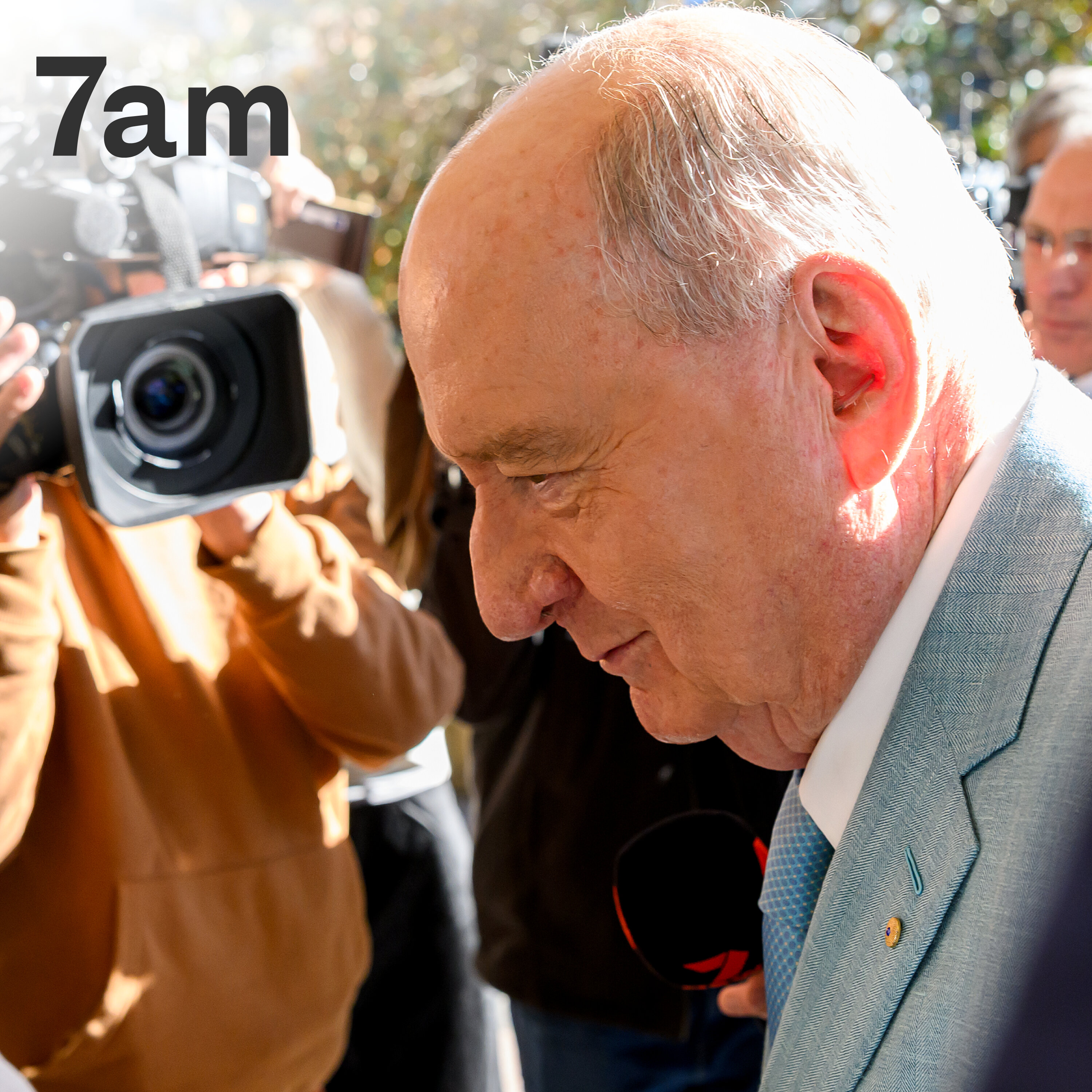
So there were really two elements that were a bit unusual about this on the opening day. One is the mere fact of Jones arrival. He's not your normal defendant in a criminal trial as you might expect. He arrives in a in a chauffeured limousine. He has security. As he turns up he walks in somewhat gingerly. Don't worry. Do you have anything more to say about how you plan to defend these charges? He's an 85 year old man who's got knee problems. He goes with a walking stick that he leans on as he proceeds into the court. And of course there's a forest of cameras and mics and everything as he turns up. Meanwhile something else was going on and that is that this is despite the seriousness of the charges and the reputational stakes for Alan Jones it is a relatively low order criminal matter. It is dealt with in the local court. It's not in the higher courts. It's a judge alone trial, no jury. There is a jail option for the judge in this case but at the lower order for a summary offence. And so it's been assigned to a relatively small courtroom, Court 3.1 on the third floor of the Downing Centre in Sydney. And there are plenty, not enough seats for all the interest that exists. And so there were a variety of people who were just curious about Jones, curious about the case and or might have felt as if they had some stake or interest in him. And they were trying to queue up to get into the court. There was never going to be enough room for them. They weren't allowed to get into the court, so they were quickly turfed out. So all of this made it more of a spectacle than your average Downing
- [03:09]
B
Street Centre event, not your average case at all. So, Hugh, how did the prosecution open its case? What did they say about the allegations they're seeking to prove against Jones?
- [03:20]
A
So there are 22 charges and it should be said that 20 of those charges are what's called technically assault with an act of indecency, in short form, indecent assault. The other two charges are called sexual touching without consent. Now in practice they are the same offence, they were renamed a couple of years ago. There are six complainants now. They range from two people who had one brief encounter with him, didn't know her and two other people who came into his orbit. So the main accuser. So nine of the 22 charges relate to a person who's called Complainant J. And this is a person who's been giving evidence initially. Complainant J first came into Joan's orbit when he was 12 years old and met him frequently from the age of about 14 or 15 through sport. And Jones took an interest in him. He was from a very poor background, had a solo mum and he had a number of siblings and they had no money. And Jones was willing to support him for his sporting career by giving him money in a later form, giving him a phone and giving him a car. So the prosecution case was that he was subjected to a series of indecent acts happening at Jones Sydney apartment there, just by the Sydney Opera House, but also in the worst cases that are being alleged at his farm, his state, down in the Southern Highlands at a place called Fitzroy Falls. So that's him. And then there are others who also had these alleged offenses of a somewhat lower order, but certainly that meet the threshold of crime if they were to be found by the courts to have been proven.
- [05:09]
B
Some of the testimony we've been hearing from Witness J has been very detailed and very graphic in court and pretty tough listening and I'm sure viewing from window court itself. What can you tell us about some of the claims that Witness J has made thus far?
- [05:22]
A
Well, the most egregious, if you like, claims that Alan Jones came to this is the allegation Alan Jones came to say to him that he loved him, planted kisses on him, would pull him in vigorously for hugs. He invited him to his property in the Southern Highlands on the way down. So it's alleged this young man was driving. He just got his driving license. So he was driving Alan Jones Mercedes Benz. And during the course of this, Complainant Jay says that he grabbed him by the penis. And then once they got inside the house itself, he says that Alan Jones told him to go and have a shower and put on a robe and nothing else. And complainant J portrays himself as being a young man who felt trapped. He'd never had, he said, financial support in his life. Alan Jones was giving him financial support. He feared that if he made anything of this that he would lose that financial support. He'd been given a car, for example. He was afraid he was going to lose the car and he felt that. He said he was a, you know, he was a heterosexual young man, he had a girlfriend, he wasn't interested in men. He felt that this was something he just had to deal with with Alan Jones. But on that particular night in the Southern Highlands, it went beyond grabbing and touching into an assault, which is fairly excruciating to sort of detail inside a courtroom, and I'm not about to repeat it, but it involved nakedness, body penises and so on. And it was alleged that he went back to his girlfriend, and his girlfriend later said he came back from that trip looking like he'd seen a ghost and that he was withdrawn and emotionless after that trip, but he didn't tell his girlfriend or anyone else for some time. So that is. That's the evidence in Chief from Complainant J.
- [07:23]
B
As you've been outlining Hugh, the court heard a great deal about the money Jones gave witness Jay. How important is that financial relationship to Jay's account of what happened?
- [07:35]
A
Well, it's important to both the prosecution and the defence. So the prosecution allegation, or at least his statement to police was that he was being groomed. And the prosecution says there was a pattern of behavior by Jones of financial support. So that forms part of the prosecution kind of setting of the scene as to how Jones operated. But in the opening address, Jones lawyer Gabriel Bashir sc, said that what you're going to see of Alan Jones is nothing more than the behaviour of a man who was, quote, unfailingly generous. So these are the two Joneses that the judge has got to decide between. Is this a man who's just unfailingly generous, who gives money to young, poor people, people on Struggle Street. The joke he used to say about Complainant J was that he didn't just live on Struggle street, he lived on Number One Struggle street. And so that's why he was giving him financial support. Another view of that was that there was an ulterior motive to the money. And this is stuff that lies at the heart of the contestation that the judge has got to sort out.
- [08:51]
B
So Hugh Jones's lawyers have now begun their cross examining of Witness J. What parts of his account are they testing?
- [08:59]
A
So they have indicated that, and this would be normal in any defended criminal case, is where you've got the key witnesses, where there are not, or the key complainants, if you like, the alleged victims, and they're not witnesses to events that took place in rooms where there was no one else. It becomes a case of who do you believe? And so it is perfectly normal for them to challenge the credibility of this alleged victim, Complainant J. They've said that's what they're setting out to do. And in their opening address, they said they had received a bundle of dynamite was, in the words of Gabriel Bashir, the counsel for Alan Jones, a bundle of dynamite that would blow up the credibility of Complainant J. Now, this bundle of dynamite has been the subject of the cross examination that happened on Wednesday. And so the full day, effectively on Wednesday, was involved in the defence making the case that Complainant J was not credible. And we can't say anything about that because the prosecution has already raised an objection, signaled an objection, and they want that evidence and that line of argument to be rendered inadmissible. The judge says that he will reserve his decision on the relevance and the inadmissibility, but he will hear it. But in the meantime, it's under a non publication order.
- [10:30]
B
And so what do we know about Jones's defence? His defence team claims he's facing trial by media and that Jones's rivals, both within the media and across society and political circles, are out there to destroy him. What have we learned about the defence he will be running over the coming months? Because this thing will take months, won't it?
- [10:50]
A
Well, we don't know the full extent of the defence arguments and the way that that will play out. But we do know in that from their opening that they are going to make the case that Alan Jones, of course, a divisive figure in many ways, is the subject of rivalry. Rivalry by the nine newspapers who launched the investigation that then drew these complainants, these witnesses, some of them came out after it was being reported in the nine newspapers. So there's a claim there that there was a media rivalry that was involved. Part of that involves Peter Fitzsimons. So Peter Fitzsimons is a very well known columnist for the Sydney Morning Herald, chiefly on sports, but he ranges fading wide and he's written a whole number of best selling books.
- [11:36]
B
And a former wallaby that was coached by Jones at one point, coached and
- [11:40]
A
dropped by Alan Jones. So we'll see whether that will be whether he's, you know, he burns with fury over that to the extent I'm not going to get ahead of where their arguments on that are. So part of the claim is that at least one of these complainants had a connection with Peter Fitzsimons and then somehow or other that wound up being part. Although the person who actually carried the stories at the Sydney Morning Herald was Kate McClyment, the investigations reporter, investigative reporter. The other arch rival, so called, was Ray Hadley at 2GB. So one of the alleged victims worked at 2GB. And the case being made by the defense, at least outlined in their opening statement, is that this gentleman went on to work for Ray Hadley and so Ray Hadley was involved and that Ray Hadley was an arch rival of Alan Jones. Gabriel Bashir, the lead counsel for Alan Jones, says that the whole case is a matter of rivalry, treachery, opportunism, hatred and desperation. She chucked in double dealing as well for good measure. So she doesn't have to absolutely make the case because of course the burden of proof is on the prosecution. But she has set out that she intends to make the case that there are people there who for various reasons were motivated to tell untruths about Alan Jones and therefore they can't be believed. The Crown in this case has a interesting challenge and that is because to quote the great musical Hamilton, you know, no one was in the room where it happened. They're relying on a process called tendency evidence, where it may not be clear beyond reasonable doubt that a single incident happened. But if there is a pattern of behavior that's consistently happening and a range of people who have no connections with each other report similar behaviors, the criminal behaviours, then the court is entitled to conclude that the person has a tendency to behave in a particular way that is unlawful. So therefore taken as a whole, they can be believed. And so this is a particular approach in a case like this and the tendency elements of it will be challenged by the defence as well.
- [14:08]
B
Well, thank you so much for speaking with us today, Hugh. I know it must be grilling after a day like today. But once again, thanks for coming on the show.
- [14:16]
A
Great to talk to you.
- [14:24]
B
Also in the news, Australian authorities are investigating what could be the country's first far left terrorist attack after a group allegedly firebombed the Melbourne defence manufacturer and threatened further attacks. Lava Technologies was allegedly targeted for its production of parts for F35 fighter jets and links to Israel's defense supply chain. Police say the group released a video that claimed responsibility for the attack, threatened workers and providing instructions for carrying out similar firebombings. Australian security agencies say there has been a rise in arson, vandalism and violent protest by anti Israel activists targeting defence companies. But this is the first time such an attack has been investigated as terrorism. And a four tonne section of a SpaceX rocket has crashed into the moon at 8,000km an hour, prompting concerns that it could be a precedent for the disposal of space junk. The upper stage was left drifting in space after launching two private lunar landers from Florida in January last year. Scientists warned that the impact could permanently alter and contaminate part of the lunar surface and say it highlights the lack of rules governing space junk around the moon, with uncontrolled collisions expected to become more common. I'm Daniel James. Thanks for listening to 7am we'll be back tomorrow.