Loading summary
Transcript33 lines
- [00:00]
A
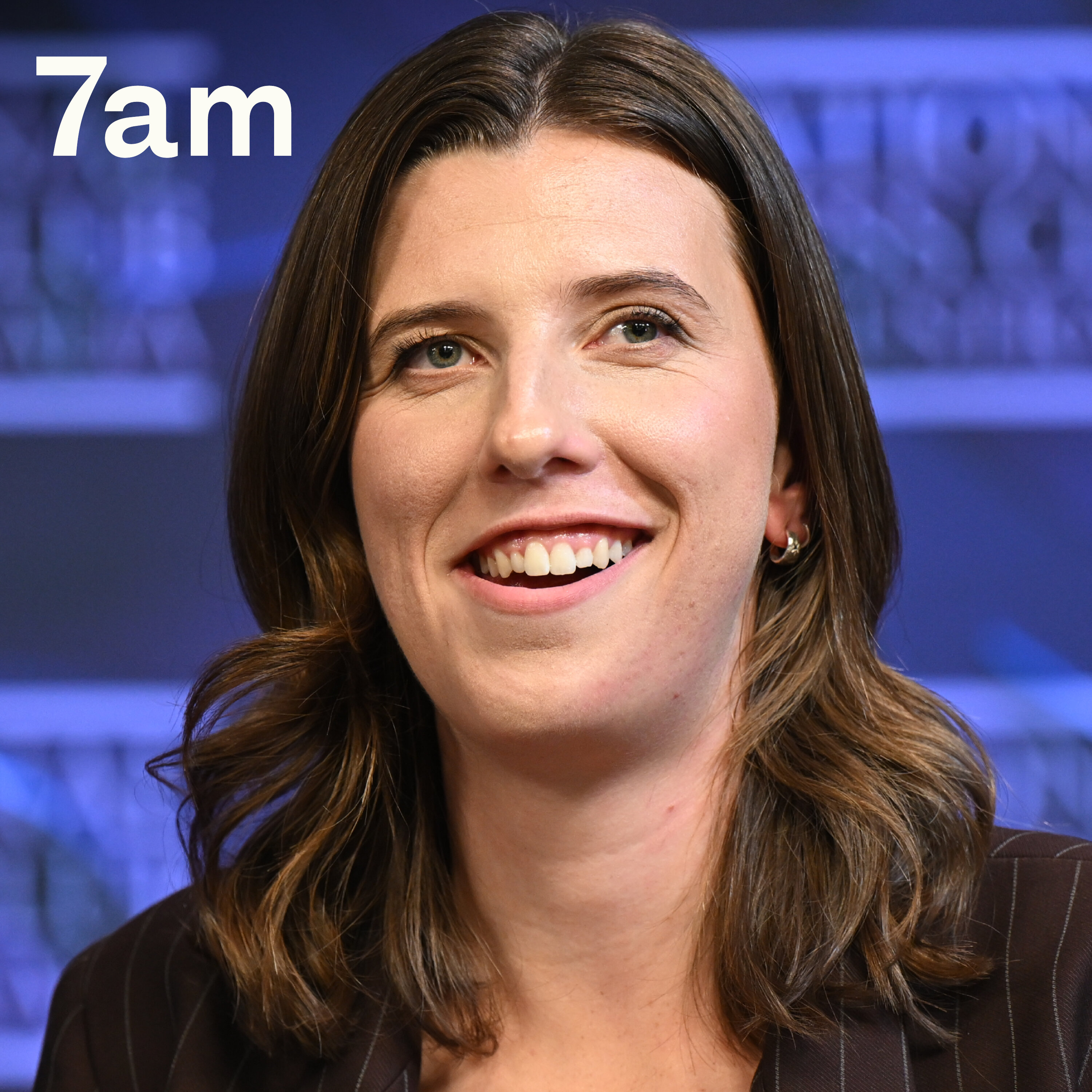
Foreign Jones. And you're listening to 7am. Next election, the Prime Minister, Anthony Albanese, will have a new contender for his Western Sydney seat, with commentator and Cheek Media founder Hannah Ferguson announcing she's taking a tilt. She says she's started canvassing locals to find out what they want from their representative and that she's already been warned that attempts to build a dirt file on her have begun. Today we speak with Hannah Ferguson and journalist Karen Middleton about what it takes to actually oust a PM and what else could be in store. It's Thursday, July 30th. So, Hannah, you've been planning a move into politics for quite some time now, but the seat that you've chosen and the opponent in it, the Prime Minister, couldn't be more of a challenge. So why did you decide to take on the Prime Minister, Anthony Albanese?
- [01:03]
B
Yeah. So, Grindler, where the Prime Minister currently represents is my home electorate. And last year when I announced the Senate run, I was so passionate about challenging in the Senate as an independent. But the more I had conversations with locals, the more I was talking to the people around me. The question just kept coming up towards the end of last year and start of this year, which is, well, why not Grindler? Why not a crack at the Lower House? And I think, to be honest with you, in part that was because it is the seat that he holds and that is a big pursuit and it's something I take incredibly seriously. So for me, it's about listening to the local community, hearing the frustration and disappointment and then saying, okay, well, now it's an opportunity to start hosting these community events, to understand, to engage, to see if there's appetite for an independent campaign here and what the issues are at a local and national level that people around me care about. As soon as I started hosting local events and, you know, engaging in that way, of course the media has kind of reported on it and it's all come out very, very early. But it's still something I'm passionate about, that I really believe in, that we are all entit to better community representation.
- [02:04]
A
And I know that you're only at the very beginning of this, you've just started hosting these community meetings to hear from the electorate. But how are you thinking about your platform and what you're going to be advocating for?
- [02:15]
B
Well, already the things that I'm hearing from the community are around specifically gambling regulation, artificial intelligence regulation, how we're taxing and actually regulating data centres as they are brought to Australia and expanded rapidly in different parts of Australia including the Cooks river, which is kind of local to my community as well. And I think it's also about looking at things like, like a gas export tax. Labor's just had their national conference and all of the issues that were on the table that I think a lot of Australians at a national level care about. The dissent was silenced, the debate was stifled. I think there's so much frustration in the community at a super majority government that's sitting on their hands. They were handed a mandate at the last federal election and yet we are so frustrated and disappointed at the lack of action which I believe has contributed to, to One Nation's rise. So there are a few issues that I'm obviously deeply passionate about, but I continue hearing at every feedback session I'm doing with locals, at these community meetings. You know, I keep saying the three GS for grain, blah, gas, gambling and Gaza. People want action, they have an appetite for change.
- [03:19]
A
And Hannah, you come to politics with this ready made media platform. You have always been upfront about your political ambitions, but you've built Cheek not as a politician, as a journalist or a commentator. You've been on seven in that capacity. So how are you going to manage that? How are you going to divide the media business, the journalism, the commentating at Cheek from the politics?
- [03:41]
B
Yeah. So I have an amazing team of journalists that Cheek has brought on board to facilitate this transition as well. So there's a great team that I trust deeply to continue delivering this progressive commentary platform that is trusted by our audience. From my perspective, I've already been disclosing on the opinion pieces that I produce for the platform, saying that I intend to run as an independent candidate at the next election. Obviously, this public transition from Senate to the seat of Grindler really changes that dynamic. Like, I don't want to hide about that conflict as well. It's. It's loud and clear. But people also have been exposed to my views every day, every week, every month for like six years now as well. So I think people have a familiarity with my belief systems and with my beliefs and my belief systems and what I, what I'm advocating for. And I want to continue being honest and upfront about my views, but I also think there's an opportunity here. So I think it's about handing over to the team, ensuring that Cheek is able to survive and thrive and criticise me too. And sometime next year, depending on when the election will be, I will step away from Cheek and run a campaign full time.
- [04:44]
A
It's difficult though, isn't it? Because Any critique that Cheek now makes of labor or Anthony Albanese, even if it's not written by you, is going to be seen through the lens of your candidacy.
- [04:54]
B
Absolutely. It's a massive issue. Like, I'm going to sit here and say the hats that I am trying to wear right now are genuinely impossible. I'm not going to pretend otherwise because it's the thing that keeps me awake at night. Every day I'm thinking about what is the best path forward where I can serve our audience. Because the one thing that I don't want here is for Cheek to become some sort of propaganda arm for a campaign. That's not what I want. Now, of course, every piece that we publish that is about the Labor Party, that is about the government, that's about the workings of Parliament, people are going to assume that, and I understand that. And actually, it's a conversation that's been ongoing with our team where I consistently am communicating to journalists in our team, like, how are you feeling about this? I want your work to be valued and your voice to be valued outside of mine and my influence here too. It's imperfect. I know there's a conflict, but all I can do for now is trust our editorial team to continue doing their job to the best of their ability, to share their opinions, to continue publishing great work and for me to step out as much as I can.
- [05:51]
A
Being in the media, being a journalist or a commentator isn't easy, but being a politician, I would say is even harder. You're going to be under a lot of scrutiny for the next 18 months, particularly as a young left leaning woman. So how are you feeling about that?
- [06:05]
B
Oh, terrified, Absolutely. I mean, it's so funny to me when people will come to me and say, oh, is this a publicity stunt? I don't know why any 28 year old woman in Australian society would subject themselves to the kind of coverage that I am expecting as well. There is going to be blatant sexism, these assumptions of capacity surrounding my age and my gender that I know that's going to happen. It's already in comment sections. I get it. I'm going to be called an influencer a million times over. I understand and I expect it at the end of the day. I've been a public person for five or six years now and people know so much about me and I hope that's built a trust, but also an understanding of who I am authentically. And I think that that's a really powerful thing to be heading into this campaign with, is that I'VE been open. I share so much of my life that I think actually that's a superpower that, you know, anything that. And I'm sure there will be a lot of kind of attempts from different political operatives, from media operatives to undermine me. I expect that. I understand that. It does not deter me because ultimately all I can be is upfront and honest and myself.
- [07:09]
A
Have you heard from Albanese or anyone in labor yet?
- [07:11]
B
I. To be completely honest, Ruby, a couple of months ago, I received, through a different sort of source, a tip off that labor believed that I might be running in the seat and that they were building a dirt file on me. I haven't heard anything since. And it's designed to intimidate, that is designed to scare me. And it hasn't. And that was done a few months ago. I don't know how true that was because it didn't come directly from them, but it was designed to be a tactic that was used to, you know, instill fear in a young woman that wants to have a crack. And I think that's really telling.
- [07:46]
A
Well, Hannah, thank you so much for your time.
- [07:48]
B
Thank you so much.
- [07:51]
A
Still to come, press gallery journalist Karen Middleton weighs in on Hannah's chances. So, Karen, the Prime minister, Anthony Albanese, he's represented the seat of Greenlaw for 30 years now.
- [08:10]
C
For myself, I will be satisfied if I can be remembered as someone who will stand up for the interests of my electorate, for working class people, for the labor movement, and for our progressive advancement as a nation into the next century. Thank you, Mr. Speaker.
- [08:24]
A
Tell me, though, a bit about what the electorate used to be like, what Greenlaw was when he first won it back in 1996.
- [08:31]
D
Well, it was much more working class. It's a seat with a long history of working class residents.
- [08:38]
C
Graneler is very much a working class electorate alongside the more established families. The 1991 census showed that 46% of the total population of Graneler were born overseas.
- [08:48]
D
There are still areas that are as they were when Anthony Albanese was young. The council house that he lived in with his mother and grew up in is still there and it is still council housing. But this is in his bones. This is the place that he grew up.
- [09:05]
C
I grew up in public housing in the inner city of Sydney as the son of a pensioner.
- [09:10]
D
But over those decades, it's become a lot more gentrified as people with more money have moved in. And so the demographic now is far more kind of white collar, I suppose you'd say. Some of the bones of that original electorate are still there in the original demographic. For example, Leichardt, Norton street and areas like that that fall within that electorate have heavy Italian influence. Slowly, over the years, you've seen different waves of migration. So you've seen migrants from China, migrants from India. So it's a far more diverse population, I think, than it was when Anthony Albanese first won that seat.
- [09:47]
A
And so has becoming prime minister changed his popularity in the seat at all? Because as pm, he's not just making decisions for the electorate, he's making decisions for the entire country.
- [09:59]
D
Yes, and there always is when someone is elevated to the prime ministership, and it can kind of go in both directions. So I think there's a section of the population in his electorate who would say they're really pleased that he is now the prime minister, and that can increase your personal support in an electorate. But then there's a cohort that might say, well, now that he's the prime minister, he's not paying as much attention to us in our seat, or he's not doing what we thought he would do, or he's not the same politician demonstrating the same values as he did when he was younger. And so there can be criticisms as well, and I think there's a little bit of both. But if you look at Anthony Albanese's vote in that seat over the last few elections, it was strong when he first won it. Then, through the period of the instability of labor leadership, the Rudd, Gillard, Rudd years, his personal vote dropped. And I think that reflected the general chaos in the Labor Party. But since he became prime minister, and really since he became opposition leader in 2019, his personal vote, his primary vote has steadily increased. So you would think that that is partly to do with the fact that he's now the prime minister, the leader of the country, and then there's a degree of sort of local pride in that.
- [11:14]
A
And the Greens have made many unsuccessful attempts for Groenlor over the years, and that's led to notoriously testy relations between Albanese and the Greens. Given that, what kind of campaign do you think we're going to see Albanese run against the new threat of an independent like Hannah Ferguson?
- [11:32]
D
Yeah, well, this is interesting because that is the downside, I suppose. The upside is what we were just talking about for him, that extra the sense of we've got the prime minister in our seat, but equally, there can be harsh critics and people who are dissatisfied. And I think you've seen a rise in Greens support. The Greens have done Relatively well. He had a big fight on his hands back in 2016. He's managed to see off Green challenges since then. But now, as you say, we've got this extra interesting dimension with Hannah Ferguson running in the seat. She will be another young progressive force. It's not clear whether the Greens will run their same candidate that they had before they ran Hannah Thomas. You know, just to make it doubly confusing, we're going to have if they run her again, we'll have two Hannahs opposing the Prime Minister, but he will be still very focused on seeing off any threat that he sees from either of those two candidates.
- [12:30]
A
And how ruthless do you think he and the Labor Party get when it comes to something like this? Because I just spoke to Hannah Ferguson and she said that she'd been told by a third party that there was some so dirt file that had been compiled by labor about her already.
- [12:44]
D
Unfortunately, that is. That is exactly what happens. In fact, if we've got the situation like we have now, where there's another party candidate or an independent challenging, the opponents will be gathering up whatever they can find and holding that back and probably rolling that out closer to the election to sort of cast doubt in the minds of voters. It can be a grubby business, Ruby, unfortunately. And it wouldn't be the first time they've done it. So I'm not surprised to hear that that might be happening.
- [13:13]
A
And so, Karen, we've seen former Prime Minister Tony Abbott toppled by an independent, Sally Steggle. That was back in 2019. Since then, the teals have only grown in numbers. Still unseating a serving prime minister, It's a huge ask. Can it be done, do you think?
- [13:30]
D
Well, look, you never say never about anything in these crazy political days. Given all sorts of upsets that we've seen in recent years, you'd have to say it is a big ask. If you look at the primary vote that Anthony Albanese has achieved in Grayler in the last two elections, it's going to be extremely hard for a challenger to better him when he's getting, you know, 50, 53% of the primary vote. The other thing that is going to be difficult for Hannah Ferguson and indeed the Greens is that they could potentially split that, that extra vote. So it'd be interesting to see where preferences go. But I think they will struggle to unseat him. Having said that, the thing that is really gold in politics when you want to be a candidate is having a public profile, having name recognition, and certainly Hannah Ferguson has that because of her cheek media enterprise and the fact that she's got a huge following on social media. And in fact, if Hannah Thomas was to run again for the Greens, you know, she's also got a higher profile now than she had before the last election because she was involved in a protest, she was involved in a struggle with police. And she, as we've seen in the media, got terribly injured. She's lost sight in one eye and that got a lot of coverage. So she's got a profile, too. So you're now dealing with a slightly different contest than you had even in 2025, and it'll be fascinating to see how those votes go at the next election.
- [15:01]
A
Karen, thank you so much for your time.
- [15:02]
D
Thanks, Ruby.
- [15:17]
A
Also in the news, official inflation figures show prices are not growing as fast as feared by the Reserve bank, meaning there's less chance of an interest rate rise next month. Month inflation fell to 3.8% in June compared to economists forecasts of 4.1%. And the federal government has confirmed that motorists will lose their fuel discount from Monday. The scheme was introduced in April to help motorists experiencing price shock due to the war with Iran. Last week, oil prices crept over US$100 a barrel for the first time since May. I'm Ruby Jones, this is 7:00am thanks for listening.