Loading summary
Transcript52 lines
- [00:01]
A
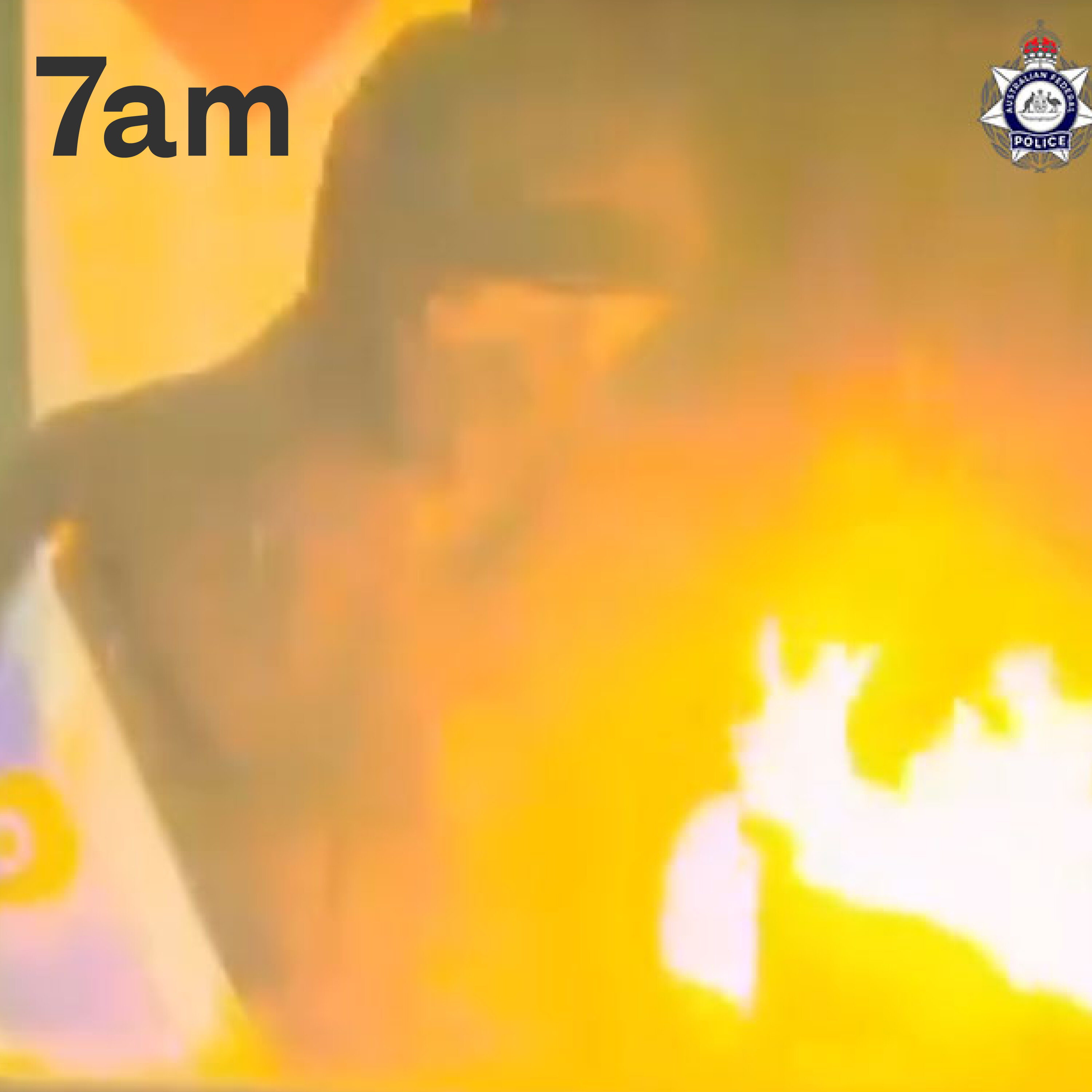
I'm Daniel James and you're listening to 7am. In the early hours of July 5 last year, a group of masked people allegedly broke into a defence manufacturer in Melbourne's northeast. Three cars were set alight, the building was vandalised and later a video message appeared online with a masked man claiming responsibility and warning workers involved in the weapons supply chain that they were being watched.
- [00:31]
B
The afp, together with our partners, would not tolerate acts of terror motivated by extremist ideologies aiming to cause fear and anguish in our community.
- [00:40]
A
Waleed ali has a PhD in global terrorism and says the message left behind is crucial to understanding what happened and what might happen next. Today, Waleed Ali on what makes political violence terrorism and whether this attack is a sign of something much bigger taking hold. It's Monday, august 10th. Wally, can you describe this attack on Lovett Technologies in the early hours of July last year? What happened?
- [01:15]
B
Well, we want to be careful here because these are allegations and we could end up before courts. Sorry, when I say we, not you and me. At least I hope not. No, no, no, that's.
- [01:23]
A
That's a totally different story.
- [01:25]
B
That is a very different story. And not for this podcast, no. So we're talking July 5th last year, about 4 in the morning, I think 3:55. And allegedly what happens is a five person group, they break into an organization called Lovett Technologies, which is a defence manufacturer in Victoria. So they cut into the property, they set fire to three cars and then they vandalise the building. So they spray graffiti on the building and then they leave.
- [01:54]
C
Police are on the hunt for five masked offenders after a targeted arson attack
- [01:59]
B
at a business in Melbourne's northeast cctv. Captain, I think the reporting suggests they go home on their E bike, which I think is an interesting touch.
- [02:07]
A
So Melbourne.
- [02:08]
B
So yeah, indeed. So that's the event. Then there is the aftermath of the event which has a group of people claiming responsibility for the attack that is published online by a pro Palestinian group called Unity of Fields.
- [02:25]
D
This is an anonymous communique by the cell that torched three cars of Lover Technologies on them all.
- [02:31]
B
In that video they explained why they did all this.
- [02:34]
D
Let there be no illusions as to what this was. This was not an accident nor thoughtless vandalism.
- [02:41]
B
That's just the information that we have in front of us at this particular point.
- [02:44]
A
Can you tell me more about that video and what it revealed about what the group was trying to achieve?
- [02:50]
B
Yeah. So they explain why they wanted to attack Lovett Industries in doing this. They say that Lovett Industries or Lovett Technologies are, because they're a defence manufacturer, they make weapons. Now they regard them as a bottleneck in the Australian supply chain for the manufacturing of Lockheed Martin F35 fighter jet components. They say that this has been used in a whole range of military oppressions. So the service of colonialism, the idea of American imperialism, and specifically in this case, the arming of Israel. And so their argument is that this company or this organization is contributing to what they call the accelerated genocide against the Palestinian people.
- [03:37]
D
Every worker in this supply chain is complicit. You have had years to contemplate the consequences of your actions. We will decided your fate as you have decided the fate of millions.
- [03:53]
B
The thing about the way they frame this though, is that they don't just say we're doing this because we want to stop the manufacturing. They say they're doing it because they also want to send a message that this is addressed to people who are complicit in the manufacturing of these weapons.
- [04:08]
D
For the past few months, we have been closely watching you. We have your addresses. All the information we have about you will be distributed to our underground networks. We stop harming Israel or else.
- [04:24]
B
And so if we believe that the video is a fair representation of the motivations of what happens, this attack is not merely instrumental. It's not, we're disabling a machine. So you can't build a component that will then end up in a fighter jet, which would still involve criminal activity if it involved trespass and damage to property and all those sorts of things. But the point is, it's not just saying that. It's also saying this is a warning. I think that the phrase was a clear and serious threat to those who continue making weapons. And so there are two things going on here. There is the alleged attack itself, and then there is the messaging dimension of that particular attack. And that's a really important thing to keep in mind.
- [05:06]
A
And there were instructions in the video for others to follow their lead if people so desire.
- [05:12]
B
Yeah, yeah. So you can see the intent here. You see the idea of trying to create a broader political movement, create a broader environment of threat and let's call it disincentive for those who are involved in this sort of thing.
- [05:30]
A
So the authorities now say this is the first alleged far left attack to be investigated as terrorism in Australia. How unprecedented is that? Not only here, but around the world?
- [05:40]
B
Well, it is the first one to be investigated as a far left terrorism attack. But we should keep in mind with that that terrorism offenses are actually quite New in Australia. So it's not necessarily the first action of this kind that we've seen from the far left, as you have spoken in the past about sort of late 60s, early 70s, they were investigating some groups. I think one of them was called the Australian Liberation army, for example, that had kind of a series, maybe, I think it was 17 different acts of vandalism and there's a bunch of property damage in there. They used some incendiary devices, there were bombings, there were shootings. But it was all very. It was all fairly small scale and it didn't last very long. It was very intermittent and as far as I can tell, I've not been able to see any evidence that there were any charges at any point. So we see this reference, but you don't. It's not a big moment. It's not like, I think, for example, in the late 70s in Australia, and I think it was 1979, you had the Croatian Sikhs who were charged with what would now be terrorism offences. They were sort of a, you know, a Croatian nationalist group.
- [06:42]
C
They.
- [06:43]
B
But you don't really see any charges of this kind, at least not that I can think of with far left groups. But you do see, I mean, the fact that I'm referencing things that were under investigation or being monitored in the late 60s and 70s is actually, of course, that's when it was, because that was around the world, especially in the Western world, that was a real fashion actually through the 60s.
- [07:06]
A
Yeah.
- [07:08]
D
Hello.
- [07:09]
B
I'm going to read a declaration of
- [07:10]
A
a state of war.
- [07:13]
B
This is the first communication from the Weathermen underground. You know, thinking about the Weathermen in the United States. A federal grand jury in Detroit today charged the 13 top leaders of the Weathermen with plotting to bomb public buildings in Chicago, Detroit, New York and Berkeley, California. You know, the Baader Meinhof gang in Germany, these sorts of organizations that were part of this kind of new left movement. And we should observe also. I mean, the police are talking about this as an anarchist animated by anarch ideology. You know, most histories of modern terrorism would say, well, yes, the anarchists actually invented modern terrorism. And they're thinking here of the anarchists in Russia. So these were, you know, in the 1880s when they assassinated the. The Russian Tsar. It was the anarchists who did this. It was actually the anarchists who came up with the term terrorism to describe what they were doing. They didn't take it as an insult. They actually said, no, no, this isn't just criminality, this is. We're not just doing violence. This is terrorism and they described it as propaganda by deed. In doing that, they wanted to claim something that was more noble than mere criminality.
- [08:22]
A
Do you think the terrorism label fits in terms of what we know about this attack?
- [08:26]
B
Well, it's. Here it gets complicated because it depends a little bit on what, what definition of terrorism you want to adopt. So if you're talking about the legal definition of terrorism under Australian law, then that'll all be determined in court. It's entirely possible under that definition to have committed a terrorist offense even when you don't have any violence against people. So violence against property is sufficient for that. Think for example of a group that blows up an abortion clinic when no one's in it. Most scholars of terrorism would say, well, that's still terrorism, even though you're not enacting violence against people, because what you're actually doing is. And this is another element of the definition of terrorism, it's political in nature for the sake of sending a message. So when you put all those sort of factors together, the facts as we have them, it wouldn't be at all a controversial statement to say, yeah, this is an act of terrorism. It's not the highest level act of terrorism, but very arguably you could fit it within that definition. Yeah.
- [09:27]
A
Still to come where this fits within a broader global uptick of political violence,
- [09:39]
B
Growing levels of grievance, conspiracy and anti authority beliefs are driving spikes in politically motivated violence and making acts of terrorism more likely.
- [09:48]
A
Waleed Asio has been warning about a rise in anarchist and revolutionary violence connected to the war in Gaza.
- [09:55]
B
We are now tracking a troubling increase in anarchist and revolutionary extremism, often targeting industry itself.
- [10:02]
A
Are we seeing that and does this support that warning?
- [10:05]
B
Well, it seems to at this point. Again, we'll see how it plays out in court. I've got to say, in some ways this is A, not a surprise development and B, doesn't even strike me as the first salvo in it. I mean, I immediately think of, you know, we saw those attacks on politicians, officers, for example. When would that have been? At least a year ago, more, I think. Yeah. Where what was interesting about those, or what was instructive about those was the violence was clear, there was an attack on property and the vandalism was clear. But there was also the, the affectation being used in those cases, or at least some of those cases of painting a red triangle on them. That was actually something that is referencing Hamas videos. So Hamas would put up videos online of them attacking some target, they would pause the video and then put a red triangle pointing to what the target is. And so you could then follow the action as the target gets obliterated. So to see those sort of things painted on parliamentary offices, is he saying, this is our legitimate target of violence here? So the build up to this has kind of been there. We've been a little bit distracted from it because ASIO has been speaking so much about the neo Nazi threat, about far right violence, about Islamist violence. Of course, we had Bondi, which shifted the focus very much to Islamist terrorism, you know, in a really profound way. But this has been churning in the background. And so I think it's a huge surprise in that way.
- [11:34]
A
So could this attack and the fact that it's going to be treated as terrorism change how police and politicians treat direct action against weapon companies moving forward? Could it also lead to a crackdown effect on direct action or protests against things like mining companies, for instance?
- [11:51]
B
Well, I think the thing with that question is the word, the phrase direct action does a lot of work. So it's going to depend on the nature of the direct action. I mean, there's no case for using this event or this alleged attack as a way of then seeking to criminalize protest. It's where you cross a threshold into some act of violence that the police will have every reason to look at this. The broader question really is a cultural one. That is, does this unleash a culture within police whereby they start trying to categorize everything as a threat and get involved in that way? Yeah, that's possible and we should be vigilant about that. But I don't think it's necessarily what follows from this. We just have to wait and see.
- [12:38]
A
Yeah, I think the vigilance is an interesting point because we live in a very hyperbolic world at the moment. Well, lead. Especially when we look at the global politics around this type of language. The Trump administration is urging allied countries to prioritise what is called radical left terrorism. How significant is that going to be for Australia in terms of us using similar language or that type of language creeping into our national conversations?
- [13:05]
B
I actually don't think it will be that significant. It certainly doesn't need to be. We haven't seen in the Albanese government, you know, a political focus on the idea that far left radicalization is the thing. What's happening in the United States is that the Trump administration is, particularly in the aftermath of the assassination of Charlie Kirk, saying that far left or radical left, I have different language for it, but radical left violence, radical left extremism is the threat, and that's where our focus should be. And the implication is to the exclusion of other threats, apart from maybe the Islamist threat. There's no sign that ASIO is taking that approach. There's certainly no sign the Albanese government is taking that approach. When we look at this attack, if the police are correct in their assessment of it, or their investigation yields that it is genuinely a radical left attack, then to call it that is just to describe what's in front of you. The politicization of it is very different. I interpret the way the Trump administration talks about these things as part of its broader call. You know, it's support for Viktor Orban in Hungary, for example. It's cozying up not so much Trump himself, but you've seen a bit of this with JD Vance, certainly with Elon Musk, when he was involved in the Trump administration cozying up to organisations like the AfD, which is effectively a neo Nazi echo in Germany. I see it as part of that campaign. I don't think we're looking at anything like that here. I just think sometimes we've got to get over this bun fight, that we end up in trying to associate terrorism with this or that ideology because it suits our political purposes, instead of actually just assessing the phenomenon that is in front of us. And the phenomenon that we are seeing is very clearly, and we're seeing this across the English speaking world and the democratic world. It is a growing phenomenon of political violence, frequently crossing over into what is properly called terrorism across the spectrum. You've seen it in the uk, you've seen it in the us, and we might be seeing the beginnings of it here as well. And when you think about the United States, I've been looking at some data from the US recently. Polling is now showing that somewhere between 14 and 21% of Americans think that political violence is legitimate in some circumstances. Just for context, that's probably about 40 million people. This number is growing. So wherever on the spectrum you are, on whatever scale of attack you're talking about, the phenomenon we're looking at is the growing licitness of political violence.
- [15:31]
A
Does those numbers speak to the fact that there's a belief amongst people across the world that politics is failing them?
- [15:38]
B
Yeah. Yes. There are a few things going on there. You're talking here about a phenomenon of radicalization. Radicalization is, I was going to say, almost always, I think, always something that stems from a belief that the conventional means that are available have failed or are insufficient to meet the problem that you perceive and that is a sentiment that is growing. So we shouldn't at all be surprised that we then start to see this show up in the hard end of radicalization, which is the embrace of violence. We could have a long conversation about the pathway of radicalization and what the research on that says. But basically, you don't wake up one morning and say, oh, let's blow something up. What usually happens is you begin with a disillusionment, you decide there's no conventional way to deal with that disillusionment, and then you start to engage with ideas that begin to morally disengage from what we might call mainstream morality and an aversion to violence, and then start to engage with the possibility of violence as a moral political action. And once you hit that point, then things can accelerate fairly quickly. The evidence seems to be that more and more people are reaching that point.
- [16:50]
A
Waleed, thank you so much for your time.
- [16:52]
B
Thanks for having me.
- [17:02]
C
Sleep Number's new collections are designed to adapt to the changing nature of your life and your sleep needs, whether it's the personalized comfort of the Comfort Mode mattress, the targeted pressure relief of the Comfort Next mattress, or the climate collection that actively cools or warms to help you fall asleep and stay asleep.
- [17:19]
B
And now get early access to our biggest sale of the year.
- [17:22]
C
Save 25% on the new Comfort Next
- [17:25]
B
Luxe for a limited time only at a Sleep number store or sleepnumber.com.
- [17:34]
A
Also in the news, Iran has issued new demands around the opening of the Strait of Hormuz. Its state broadcaster says the Strait won't reopen, but unless the US Never threatens Iran again, permanently ends the war with Iran and its allies, lifts its sanctions and compensates the nation for the damage caused during the conflict. It comes just over a week before the 60 day period to negotiate a final peace deal is set to expire. And New South Wales has recorded its first case of H5 bird flu in two local birds, including one in the Murray Darling Basin. Experts say it should ring alarm bells for authorities because it suggests it could be spreading amongst inland bird colonies. Australia now has more than 200 cases nationally. I'm Daniel James. Thank you for listening to 7am we'll be back tomorrow.