Loading summary
Transcript35 lines
- [00:01]
Ruby Jones
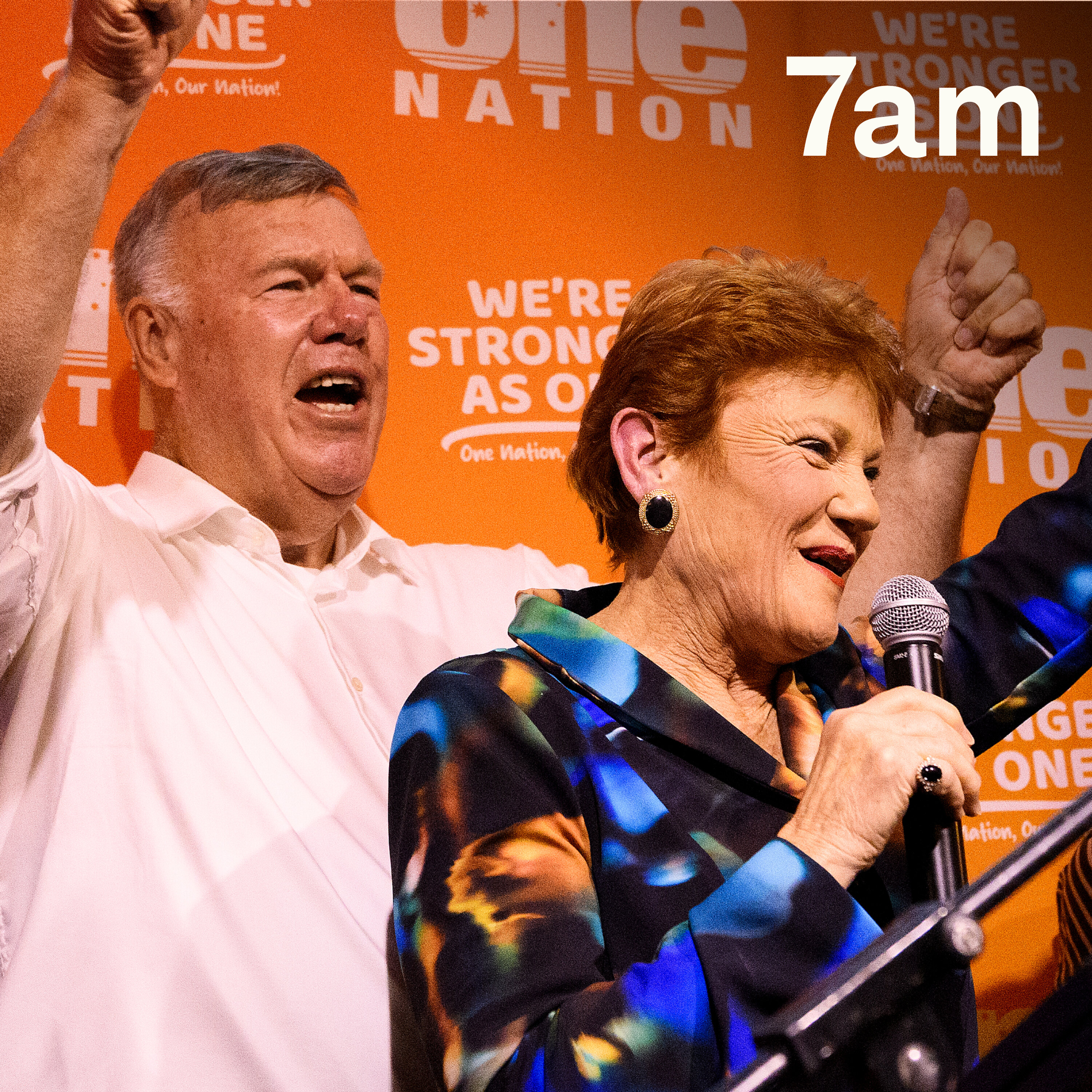
I'm Ruby Jones and you're listening to 7am. It's something Pauline Hanson has been eyeing for years. And on the weekend she finally got it, a seat in the lower house. Her candidate for Farah, David Farley, did even better than expected. He was elected on 57% of the vote. It changes things, not just for Pauline Hanson and One Nation, but for the Country Today contributing editor for the new Daily, Amy Ramikis on the power of populism right now and what One Nation wants next. It's Monday, may 11th.
- [00:56]
David Farley
We're like a mason with a chisel
- [00:58]
Amy Ramikis
and a hammer and we're recarving the
- [01:02]
David Farley
letters into the Australian democracy. One Nation has reached the end of its beginning.
- [01:13]
Ruby Jones
So, Amy, One Nation's victory in Farah was historic. It's the first time One Nation has won a federal lower house seat since Pauline Hanson herself was elected back in the 90s. She is of course synonymous with the party. So tell me about how she's taking credit for this.
- [01:30]
Amy Ramikis
Pauline Hanson is having a victory lap at the moment. I think it's maybe the happiest that I've ever seen her in 30 years of watching her on the national stage because even when she was elected, it was as an independent. Barnaby Joyce jumped ship from the nationals. But this is people putting one next to a One Nation candidate at the voting booth.
- [01:52]
Pauline Hanson
This is not only a win for Farrah, it's a win for the rest of Australia. I'm seeing of these proud Australian spaces here in front of me, hundreds of you, but millions are watching on ITV's now and I believe it's giving them hope.
- [02:11]
Amy Ramikis
While the Liberals and the nationals had preference, David Farley, in the end, he didn't even really need those preferences because he was so far ahead on first preferences that, you know, it was overwhelmingly he was the choice of the electorate.
- [02:27]
Pauline Hanson
When I was walking down the deer earlier and I looked up and I saw sky it that we won the seat, I actually got a tear in my eye.
- [02:39]
Amy Ramikis
And so, yeah, Pauline Hanson is very, very happy. And she started talking about, you know, One Nation's dominance and to which an extent that is absolutely true. What we're seeing is a reordering of the right when it comes to mainstream politics in Australia. One Nation's rise has correspondent with the coalition's decline and it's all happened quite rapidly after the last federal. And the people out there who may
- [03:06]
Pauline Hanson
be watching this, we're coming after those other seats. If they have no friends, you are not known to be the forgotten people. Anymore. We are proud of you.
- [03:21]
Amy Ramikis
So what Pauline Hanson now is doing is talking about where one nation is heading next and that's national seats, but it's also outer suburban seats. And Pauline Hanson has said that western Sydney is on her list, including in the Liberal held seat of Lindsey, which Melissa McIntosh, who considers herself one of the future leaders of the Liberal Party currently holds. And the Liberal Party is quite worried about one nation's impact on seats like Lindsay and what that's going to mean over the next couple of years.
- [03:54]
Ruby Jones
And it was the most regional parts of the seat of Farah that voted the most emphatically for one nation. So how do you think that those voters and people who are in these regional seats, suburban seats in general, are thinking about the country that they want to live in? And how much anger do you think there is?
- [04:10]
Amy Ramikis
I think there is a lot of anger, but there always has been, particularly in regional Australia. Regional Australia feels very abandoned by mainstream politics. That's not new. We need a change.
- [04:22]
David Farley
All the others are liars.
- [04:23]
Amy Ramikis
They don't back up on their promises. We've had enough and it's time to bring in some new blood. I think there for the people. I feel our local areas been neglected for a fairly long time and in a lot of cases they're right to feel abandoned. I mean, Barnaby Joyce, when he was Nationals leader used to make a point of saying that the Nationals electorates were the poorest in the country. He did not change that While he was Nationals leader and while he had a lot of influence over the nationals, the coalition who have been in government for most of the time over the last 30 years have not changed that in terms of the national elections. They have not been able to create new industry, new opportunity or address the inequality between the regions and the more urban seats in Australia. Everybody else has had a bit of a go at trying to get this country into order. And I love Pauline Hanson's straightforward approach and doesn't hold back and says exactly what the normal everyday Australian is thinking, that the country needs a good turnover. Rob Harris from the nine newspapers went to Griffith, which is one of the more multicultural seats within Farah, and he did a profile ahead of the by election where the general view that he was quoting from voters was f the lot of use, which is I think really indicative of people just saying to the major parties, we are done with what you're offering. The regions and the outer suburban seats is always where one nation has had its biggest success. But the problem now for the major parties is that People a little bit more in from the regions are starting to listen to one nation. They're really showing a lot of discontent with the status quo. And Anthony Albanese is starting to weave in a lot more. People are telling us they no longer want to see things done as they always have been. And we have to respond to that change quite clearly.
- [06:25]
David Farley
There's a lot of people under financial pressure who feel like the system isn't working for them. And that's a message for all political parties in the system.
- [06:37]
Amy Ramikis
He has a little bit more room to respond to that change than the Liberal Party do, who are under a lot of threat from one nation and the nationals who may very well find themselves wiped out at the next election. But labor would be very foolish to ignore these signs, particularly if they don't start to give people a little bit more hope that there is going to be economic reform that addresses the inequality and the inequity in Australia's economy.
- [07:09]
Ruby Jones
And it's interesting, Andy, if you look at what's happening in the uk, Nigel Farage's Reform Party also had a significant win late last week, and there's now speculation about him being the next UK prime minister. So how similar is what is happening here? Do you think that we're going to end up looking back on this moment as the beginning of the far right, so political ascent in Australia?
- [07:31]
Amy Ramikis
Yeah, it's really interesting because we can also go back to Trump and what happened in the United States. You know, like Pauline Hanson was being Trump before Trump was Trump, you know, at least in Australia. And Nigel Farage is probably the closest Pauline Hanson character in the United Kingdom, having played a major role in Brexit. And what, what links the three movements is that economic discontent? It is blaming people who are not necessarily to blame, like migrants, for government failures in infrastructure and policy over the last three decades.
- [08:07]
Pauline Hanson
And we want people that want to be Australians. I don't love immigration, by no means, but I want people to come here to this country. I don't want Sharia law on our doors.
- [08:18]
Amy Ramikis
We're seeing economic instability in all three countries, which has been worsened by a global inflation crisis that some analysts say is going to be bigger than GFC and also potentially bigger and longer than what we saw in the early stages of COVID And that is going to force more people into that real politics of grievance mindset, because they are not seeing the same benefits as previous generations and also no real hope. But the other thing is that in the uk, the centre left government, labor of the UK has not responded in ways that their platform would suggest that they would respond. They've gone for more austerity style policies when it comes to economics rather than leaning into some of those old school labor values of giving people money and, you know, trying to artificially inflate the economy to ensure that people can get through it. We've also seen that with the Democrats who did not address the economic inequality and in fact, you know, upheld a lot of corporate America in their policies. And in Australia we're sort of at that tipping point with this next budget. Is labor going to start addressing some of those issues that have been embedded for the last 20 years or so and follow through with some of what Labor's platform says that its values are or is it going to maintain the status quo? And a lot of voters, they're going for a disruptor. Donald Trump, Nigel Farage, Pauline Hanson, potentially in Australia to break up the status quo and hopefully shock the, you know, the major institutions into doing something different. And I think that's going to be the story of this period of time.
- [10:12]
Ruby Jones
Coming up. Could the libs mats and one nation ever form a new thropolition? Can we talk a little more, Amy, about the effect on the Liberal Party? I mean they were already extremely worried about one nation. That concern turn costs them a leader. It's behind recent policy pivots. So has that concern turned into blind panic yet?
- [10:44]
Amy Ramikis
I'm not sure if it's blind panic from the parliamentary wing, but it's getting to be blind panic in a lot of the, the apparatus that supports it, I think, and I think we're going to be, I think Angus Taylor would be very lucky to be leading the Liberal Party in the coalition at the next election. And if he is, it's will because they haven't yet come up with another answer as to who might be able to fend off one nation. Angus Taylor has come out in an interview with the Australian Financial Review where he said that the answer is to go back to some of the Howard principles being culturally conservative as well and economically rational. But the problem with that is that the Howard principles worked because Australia was in a once in a generation mining boom which meant that there were rivers of gold flowing into Australia's treasury. And no government since has had that same impact in terms of having like a sudden influx in resources, rent and in tax receipts flowing into the economy. What Angus Taylor has is the legitimacy of one nation helped along by a Liberal party that is legitimising their message. Angus Taylor's most recent Speeches on migration, where he advocates for a return to a discriminatory MIG policy is, you know, very much in line with what one nation has been offering.
- [12:09]
David Farley
Not everyone wanting to migrate to Australia has a noble intent. Not everyone wanting to migrate to Australia will be a net benefit to Australia. Indeed, some will be a net train.
- [12:19]
Amy Ramikis
And then they're preferencing one nation as well, which is what one former Liberal MP told me was maybe the stupidest suicide note for a modern political party. And so they do need to be worried, because the seat is that are going to fall to one nation or the seats that are currently most in danger of falling to one nation are coalition seats. Marinoa was in trouble even before one nation's most recent rise. Capricornia, Herbert, Lindsay La Trobe these are all seats that are at risk of falling to one nation. We've seen research too. There's been studies that have been done that have looked at, you know, what's happened to political parties that have gone further to the right to try to appease the right. And basically what's happened is they've just legitimized the far right and people go to the originator rather than the imitator. So it is a reordering of the right. It does not look like the modern Liberal Party is going to make it through this. It does not look like the coalition will make it through this. That doesn't mean that centre right politics won't exist. It just means that we're probably going to see something new emerge. And Barnaby Joyce was openly saying that recently, where he was saying this might be it, they might be done.
- [13:38]
David Farley
Obviously the Liberal Party really do have to do some soul searching after the weekend, because that was catastrophic. That is almost. That's almost a signal that things might be over.
- [13:49]
Amy Ramikis
And that's because he's looked at the electoral landscape as somebody who was a member of the national apparatus and is now a member of one nation, and he's seeing which way those votes are. That's not to say that labor won't be in trouble, but at the moment, the most immediate danger to a major political party is to the coalition and they do not seem to have the answers of how they're going to address that.
- [14:12]
Ruby Jones
And I know that senior Liberal politicians are distancing themselves from this now, but there has been speculation about whether the Liberal Party would form a new coalition, one that includes one nation.
- [14:24]
Amy Ramikis
Yeah, the thrupolition has been in play, I think, for a while, but that only makes sense if there's new seats to be won. Because if it's just one nation taking coalition seats, then it's just a one nation takeover of the coalition. One of the reasons why the Liberal Party lost the inner city seats to the teal independence was because it was becoming increasingly difficult for small l Liberals to uphold and apologise for the policies that the Liberal Party was creating to try and address the one nation threat. So until they can come up with a way to win inner city seats that are not as open to the politics of grievance in the same way that we're seeing with one nation voters, until they can come up with a way to convince them to vote for one nation and the coalition, we're not going to see any sort of successful thrupolition which would lead to them taking government.
- [15:24]
Ruby Jones
Well, Amy, thank you so much for your time.
- [15:26]
Amy Ramikis
Anytime.
- [15:39]
Ruby Jones
7am will be back tomorrow with an episode on the case against Coles and Woolies. As the judge weighs the evidence, will they be found to have conned customers? And what are the implications for shoppers everywhere?
- [15:51]
David Farley
It is a huge one, especially because of who we're dealing with here. I mean, we're not just this isn't a corner store, this is everyone's corner store. Coles and Woolies dominate the supermarket industry. But the good thing is it will have broader implications for all businesses. No one else will be able to do this if the ACCC wins.
- [16:14]
Ruby Jones
That'll be in your feed tomorrow. I'm Ruby Jones. Thanks for listening.