Loading summary
Transcript31 lines
- [00:00]
Paul Bongiorno
Hate cleaning, hate scrubbing, hate dishwashing. Bro, we got you millions of videos about smart cleaning hacks will make your chores feel like a breeze. Download TikTok and check it out.
- [00:16]
Daniel James
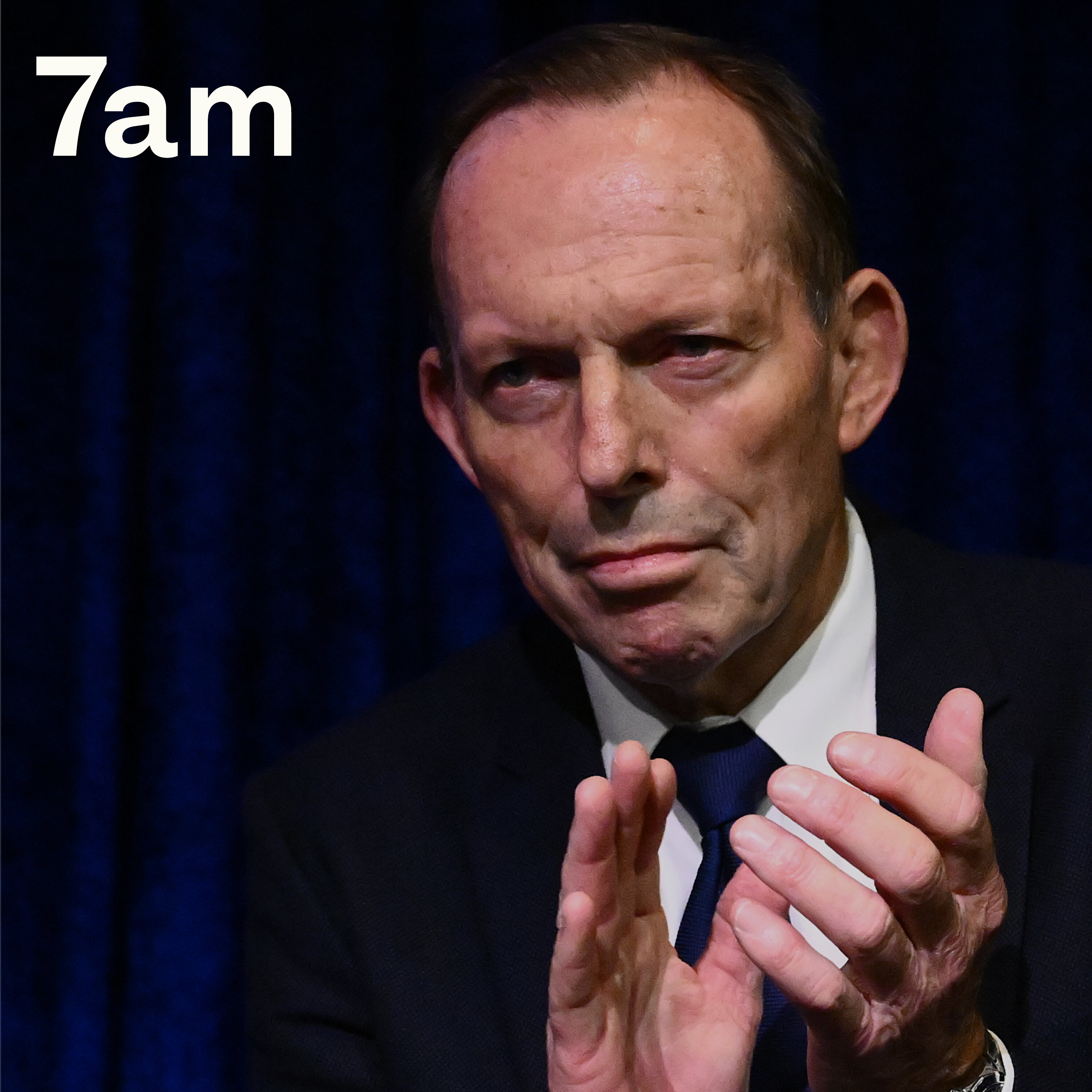
I'm Daniel James and you're listening to 7am. Tony Abbott is back at the centre of Liberal party politics. The former prime minister has been elected un as federal Liberal Party president, a role that sounds administrative but carries real political weight. And a moment of deep trouble for the coalition. The Liberals are watching voters drift to one nation while Abbott argues the answer is to take the fight directly to Labor. But his return sharpens a deeper question inside the party about whether the Liberals can rebuild by reviving the politics of the Abbott era or whether that only deepens the crisis they're trying to escape. Today, Press gallery veteran Paul Bongiorno on Tony Abbott's comeback, the future of the Liberal Party and how the government is trying to turn the opposition's crisis into a test of its own authority. It's Saturday, june 6th. Paul this week One Nation became the most popular political party in the country. It's obviously bad news for the coalition which hasn't been very effective at fending off Hanson's party. But now former PM Tony Abbott has put his hand up to be the white knight that saves the Liberals as party president. Paul is Abbott the answer?
- [01:44]
Paul Bongiorno
Well, I can tell you that the Conservatives in the Liberal Party certainly believe he is and certainly have reached out to him. But mind you, I believe he reached out to them as well. And what we should keep in mind is that the so called right wing Liberals or Conservative Liberals are dominant in the national party structure. So he always had the numbers and it was quite interesting to see that the other potential saviour, Alexander Downer, who all his life has been a very conservative liberal, well the moderates were behind Downer but in the end Downer pulled out and everybody said look, we've got to give Abbott a go. We know he'll be like a dog with a bone. He's a brutally effective communicator and let's face it, our backs are to the wall. So basically what they were counting on was the fact that Tony Abbott won in a landslide from opposition in 2013 against the Rudd Gillard Rudd government. But that great victory, which was a landslide victory, said, well look, he knows how to win government. They maybe forgot he didn't quite know how to hang on to government, but that's not quite their problem at the moment.
- [02:58]
Daniel James
ABS indicated that his focus will be on labor rather than One nation.
- [03:02]
Tony Abbott
Obviously we are in a degree of competition with other parties and voices on the centre right. But in the end, our opponent, our enemy, if you like, is a really bad labor government, a really bad green left labor government.
- [03:20]
Daniel James
Is that the right strategy at this point, Paul?
- [03:23]
Paul Bongiorno
Well, there've been nine polls since the budget and in those nine polls the coalition has gone backwards. In three polls this week, the coalition's primary vote was just 20%. And what we've seen is for the first time this week, one nation in two polls even had more support than Labor. So the strategy that's been employed since the Budget by Angus Taylor and the Coalition to go hard, to attack labor, to talk about broken promises, to talk about how damaging it will be to Australia as we know it, all that sort of language, if anything, it's fed into one nation rather than fed into the coalition. All of this simply isn't working. And Paul Kelly, the venerable Paul Kelly and the Australian, said that basically there's defeatism in the Liberals and the nationals, with some of them saying, oh, we should form an alliance with one nation, forgetting that one nation is part of the existential threat to the Liberals and the Nationals for a very good reason. If the primary vote stays where it is and where it's been for a while now, then the Liberal or national candidate will come in behind one nation and therefore their preferences will elect a one nation candidate and at the expense of a Liberal. It's like cutting their own throats. And there's a bit of an example of this. Even though the nationals did extremely well in Farah, they still didn't get a majority in their own right. They needed preferences to get over the line. And there is an argument, and people within the parliamentary party are having this argument that had the Libs and the Nats preference, for example, the leading independent, maybe that would have pushed her over the line, but it certainly would have sent the message that, look, if you're inclined to our way of politics, then don't vote one nation. Instead, by preferencing one nation in the way they did, they helped it get up and they, I don't like to use the word legitimize. It's a democracy and they're a legitimate, you know, player. But it certainly, as it were, authorised one nation as a mainstream option. And this is a tactic that Abbott seems happy with. That, when you analyse it a bit further, does seem to be a recipe for even greater disaster.
- [05:54]
Daniel James
I've often wondered, Paul, about party presidents of all persuasions. I mean, how much power does Abbott have? As Liberal Party president. And what does the party president actually do?
- [06:05]
Paul Bongiorno
Well, they make sure the party is organised, that its branches are there, that it's fundraising, that it's able to back up the parliamentary party. In fact, Robert Menzies, when he found Liberals, he wanted to make sure that the organisational wing, unlike the structure formerly of the Labor Party, was subservient to the parliamentary party, couldn't direct it on anything and was there merely to serve what the parliamentary leader and the parliamentary party wanted. However, what we do know, that a party president, let's just talk Liberals for the moment, has the cachet of being leader of the organisation when the organisation is in such dire straits and they turn to someone like Abbott, a former prime minister, a political pugilist of some note, it's clear they're saying, look, we want you to be the president and probably lift us, do more than just make sure we're fundraising.
- [07:04]
Tony Abbott
Look, I don't expect to be in the media every day, but on the other hand, I do think that my presence now in this senior role will demonstrate to people who might have been sceptical that Liberal Party is faired income about abolishing net zero faired income about cutting back mass migration.
- [07:25]
Paul Bongiorno
And the danger here is that in making someone like Abbott the president, they're creating another focus other than the parliamentary leader.
- [07:34]
SpinQuest Advertiser
There will be some public facing to this role rather than it just being an administrative role.
- [07:41]
Tony Abbott
Look, the party president is the organisational leader, not the political leader. But I don't think there' ever been a party president who's taken a vow of silence and I'm certainly not going to start.
- [07:56]
Daniel James
Do you think Tony Abbott will be satisfied with just being party president or could we see him trying to make a full political comeback and return to Parliament? There's been musings, Paul.
- [08:05]
Paul Bongiorno
Well, it's certainly in his blood, there's no doubt about that. He has been asked this question and he's given the impression that if he ever does make a comeback which is not on his mind now, it'd be after the next election. I guess one of his problems would be finding a seat where the voters would actually vote for him, given that he lost his seat to. He was the first to lose a rock solid liberal seat to a teal independent. He knows how to do that.
- [08:33]
Daniel James
Coming up, how one nation's rise is changing the calculation for labor as well. Paul, if we go back to one nation, the party has risen in every single opinion poll since the budget. Now, the election is still a long way Away two years. So where does this leave Labor? What's the worst case scenario for them?
- [08:59]
Paul Bongiorno
Well, if you take some of the work done by the Redbridge polling group, first of all, their MRP poll, which went to every electorate in Australia trying to work out which way they would go, and then just the normal poll, if you like, this week that found one nation the most popular political party. The challenge is there for labor to hang on to government either as minority or majority or worst case scenario, depending on the trend of the polls, it seems to be established they could be pushed themselves into opposition. So, you know, it's very high stakes. In fact, Wayne Swan, the national president of the Labor Party, sent out a fundraiser this week pointing out that the, that Pauline Hanson gave last weekend on sky where she for the first time went into quite a bit of what she thinks and where she wants to head her agenda on workplace relations, on hiring and firing people, on who should be paid. What was basically a revisiting of John Howard's work choices on steroids, where the employer has all the cards and the employee cops the hindmost.
- [10:14]
Pauline Hanson
You can't even sack anyone if they're not working, they steal from you, then you see yourself through the courts. This has to change. It has to change. There's a give and take in employment and people have the right to employ who they want to. We've become too dogmatic and we're not listening to the employer out there.
- [10:36]
Paul Bongiorno
Well, Wayne Swan and the Labor Party jumped on this. They sent out a fundraising letter to their supporters and they pointed out that this is part of one nation's agenda and furthermore, it's being bankrolled by billionaires. And the plea was, look, labor has to get busy. We have to be fighting fit on the ground now because the only time to begin holding on to power is now, not when an election is called. So the other point to make too is that the budget without a doubt has cost labor politically. But I was talking to a cabinet minister during the week who said, look, look, the political design of this budget is once it has passed, once it is no longer creating the headlines, people say, well, what was that all about? Because they've grandfathered most of it and some of it doesn't come in for a couple of years and anyway, it won't directly affect millions in the way in which, you know, which the naysayers are pointing out.
- [11:41]
Daniel James
I mean, if we look at the way that the commentary has gone around the budget pool, I mean, what have you made of the reaction from the mainstream media in particular, when it comes to this, you watch the nightly news, you watch the commercial television news, you listen to commercial radio, and you would swear that the budget was the worst thing to happen to the country since federation. What have you made of it? As a veteran of the press gallery,
- [12:08]
Paul Bongiorno
you'd have to say that the Australian and the Murdoch tabloids have become, well, basically propaganda sheets, you know, if not of the Liberals, certainly of the opponents of the labor government and make very little attempt to any sort of balanced approach to it. I mean, we just see acres of negative stories digging up the most extreme examples as reasons why this budget is such a failure. I was told in a group meeting with the Prime Minister about three or four weeks ago that the people at the Australian warned him that if you do touch negative gearing or capital gains tax, then we will go in hard on the broken promises. So Albanese was given forewarning that this sort of approach would happen. The government, however, says, look, we're at the stage where we could not just sit back and do nothing for the next two years without addressing the core, the radical causes of what is a genuine housing crisis.
- [13:13]
Daniel James
And finally, Paul, if we turn to our great friends across the Pacific, the, the Americans, this week's been a busy week on that front too. First we were told we would only be getting second hand subs from the US under the Aukus deal. And then Trump slapped a 12.5% tariff on US and 43 other countries. Is America making the government look good or bad right now?
- [13:37]
Paul Bongiorno
Well, it's making us look like a client state. And I'd have to say to you, General, that's exactly what we are. It's what we've come to. We're now in the situation where our most important ally is doing us and basically the rest of the world more damage than any of our putative enemies. I mean, Trump's war in the Middle east has completely thrown the world trading order and economy into disarray at great cost. Now, when it comes to Trump putting tariffs on us, well, the reality is that Trump has to pay for his excesses, especially for his massive tax cuts to himself and his billionaire mates. And this is the way he's doing it. As we know, tariffs are actually a tax that American consumers pay. But what it does, of course, is make our exports dearer and harder to get into the market. But the other point, of course, is the decision on the submarines. The discussion there is it's better to get in service submarines than used submarines.
- [14:40]
Tony Abbott
That.
- [14:41]
Paul Bongiorno
Did you see the argument put by the Defence Minister that these nuclear powered submarines have 30 year life and if you get them in the first six years, it's like getting a demo, a demo car.
- [14:54]
Daniel James
They are sounding like used car salespeople, Paul.
- [14:57]
Paul Bongiorno
That's exactly right here. This demo's just, it's only got 200 kilometres on the clock, you know, so. Yes, so it looks like, well, what we've got up in lights is that we take what the Americans will give us. And of course, Paul Keating, the former prime minister, just can't believe that we would cede so much of our sovereign wealth to the Americans. You know, what is it, $300 billion worth in the process?
- [15:23]
Daniel James
Paul it's hard to make sense of it all, but you do a really good job of it. So thank you once again for joining us.
- [15:29]
Paul Bongiorno
Thanks very much, Daniel. Bachelor.
- [15:37]
SpinQuest Advertiser
Whether it's slots or live dealers, Spinquest.com has the fun and action you're looking for with Spin Quest exclusives. Blackjack, roulette, baccarat and even live dice with craps and bubble craps. The games never stop so you don't have to. And right now new users get $30 coin packs for just 10 bucks. Play now@Spinquest.com SpinQuest is a free to
- [16:02]
Daniel James
play social casino void where prohibited. Visit spinquest.com for more details. 7:00am is a Daily show from Solstice Media. It's made by Ariel Richards, Atticus Bastow, Chris Dengate, Crystal Keller, Ruby Jones, Travis Evans, Zoltan Fetcho and me, Daniel James. Our theme music is by Ned Beckley and Josh Hogan of Envelope Audio. Thanks so much once again for listening to 7am this week. Have yourself a great weekend.