Loading summary
Transcript32 lines
- [00:01]
Cam Wilson
I think if you cast your mind back and you think about what it was like at the start of the pandemic, this was this time where a whole world changed.
- [00:10]
Reporter
Good evening and thanks for joining us. The World Health Organization has now confirmed what many epidemiologists have been saying for weeks. The coronavirus is a pandemic.
- [00:20]
Cam Wilson
It was a time of great uncertainty, of like little information. And what information we had, there was not a lot of confidence in it. And so when people decided to grasp for understanding of it, we found that some people went towards these fringe, extreme ideas of COVID conspiracies and conspiratorial thinking that gave them a kind of certainty and a simple understanding of the world at a time that really don't.
- [00:53]
Reporter
A quarter of the world's population is
- [00:56]
Ruby Jones
now living under some form of lockdown due to coronavirus. More than 3 billion people in almost
- [01:02]
Reporter
70 countries and territories have been asked
- [01:05]
Ruby Jones
to stay at home.
- [01:16]
Cam Wilson
We saw the protests in the streets. We saw narratives about elite control and secret shadowy plots. But it's actually not a very weird thing. It's a very human and relatable thing, which is they wanted to make sense of the stuff that was happening to them.
- [01:32]
Daniel James
During the COVID 19 pandemic, we saw protesters take to the streets. They weren't just protesting lockdowns. They were rallying around a tangle of fears and conspiracies. Those threads fused together into a broader worldview that pulled people down a pipeline and built a small industry of influencers. I'm Daniel James and You're listening to 7am today. We're bringing you an episode where Ruby Jones speaks to Conspiracy Nation authors Cam Wilson and Ariel Bogle on the conspiracy pipeline. How it works, who benefits and where it's heading now. It's Sunday, June 28th and this is part one of a two part episode that was originally published in August 2025.
- [02:21]
Ruby Jones
Ariel and Cam, thank you so much for joining me on 7am thanks for having us.
- [02:25]
Cam Wilson
Great to be here.
- [02:26]
Ruby Jones
I want to talk about the protest movements that emerged from the COVID lockdowns in Australia. And in particular there is one rally that you went to and witnessed, Ariel, which was the May 2023 rally for freedom. Tell me about it.
- [02:41]
Reporter
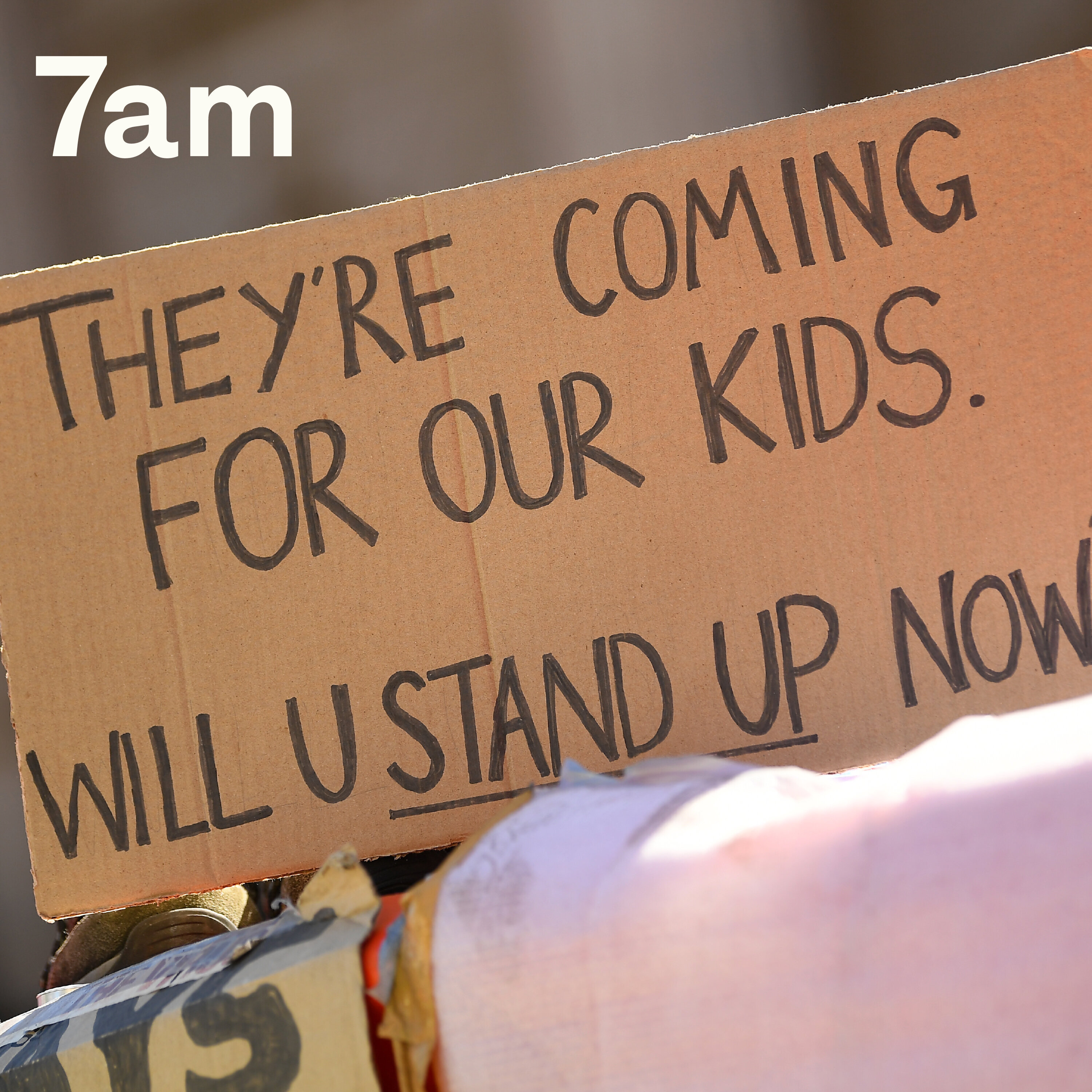
Yeah, I went to this one and it was started at Sydney Town Hall. There's always protests there if you've been to Sydney, you know, for all different kind causes. But what was really distinct to me about this one was the cacophony of issues that were on display. 2023, you know, a lot of those restrictions had been lifted. We were coming out of that period of staying at home, but yet these marches were persisting and of pretty decent size. So as I turned up and like turned onto George Street, I could see posters about vaccines. I could see posters about 15 minute cities, which is a kind of conspiratorial understanding of a town planning idea that claims it's a way to lock us down and put us under government control. Instead of being about walkable cities, I could see T shirts with the line exposed, the 28 on it. That refers to a conspiracy theory that spread widely in Australia about a list of 28 elite paedophiles, including a prime minister. I saw things about the Russia, Ukraine war. You know, it really showed to me how so many of these ideas had kind of merged and were able to share space even if people didn't show up for the exact same reason. They shared a common sentiment. And the idea was that there was something really wrong in the world. And, you know, that's not a unique feeling. A lot of us feel like that. But they had decided the, the blame was on a sort of shadowy force that was out there trying to put us under the thumb to control our lives against the common good.
- [04:18]
Ruby Jones
Can we talk a little bit more about that kind of cacophony of issues that you mentioned? So 5G vaccines, child abuse rings, how these ideas that do seem disconnected and random, how they come together into this kind of overarching belief system.
- [04:36]
Cam Wilson
Many of the people there believe completely different things. And it's almost bizarre to see the different kinds of people and their array of grievances that sometimes, if you think about it actually all couldn't be true at the same time. Like it actually wouldn't make sense. And yet that's not a problem for these movements. Like you might believe that 911 was done by Mossad, or you might believe it was done by another group of people. But actually you can kind of be arm in arm because what you agree on is this idea that you're not getting the whole truth, that there are these bad forces and that you're on the right side of history. People have all kinds of reasons ultimately that they get into these groups and start to espouse these beliefs. But we understand that these are all kind of influenced by these broader societal factors. Like, for example, the inter has been such a big force in bringing the these people with disparate views together. So ultimately you end up with this really like connected group of people united by the same kind of energy.
- [05:37]
Ruby Jones
Yeah. And on the one hand, it's obviously a pretty bleak way of looking at the world, but just having access to that belief system provide comfort to people who believe in it.
- [05:51]
Reporter
I think it can certainly like it is a way to put a kind of simple us versus them, enemies versus good guys narrative around really complex. The COVID 19 pandemic. As Cam was saying, you know, this evolving situation where the Science was not 100% firm, we were gaining understanding every day. But I think it's important to say here, like, there are real conspiracies. You know, if you just take any kind of look at Australian politics, you see the revolving door of lobbyists, you see how power and money operates. So we're not denying that at all. What we're talking about here is a kind of dedication to an us versus them narrative, despite all available evidence and an unwillingness to accept, you know, counter claims. And there's some really interesting sort of work on this. There's an academic in the United States, Joseph Ushinsky, who's framed this as an understanding of power. He argues that conspiracy theories are a way to comprehend power. Our institutions, the global sort of community of nations, a very complex ecosystem. Some of us might turn to these narratives as a way to kind of understand what is happening in the world.
- [07:00]
Ruby Jones
Coming up, how online communities replace real ones and the people left behind. You've been speaking to people who have family members, partners, loved ones who have gone down various conspiracy rabbit holes. Can you tell me about Danielle and Emily?
- [07:28]
Cam Wilson
Yeah, I spoke to Danielle, who I found through a subreddit, an online community space dedicated to people who had lost loved ones to conspiracy theories. And she was someone who had been in a long term relationship with another woman, Emily. They'd been together for, I believe, more than a decade before the pandemic. Emily was already quite a nervous, anxious person. She had early life trauma that had predisposed her to being that kind of way. But when Covid happened, it just supercharged it. And so it drastically changed her behavior over just a few months. You know, she started worrying about vaccine genocides. She started begging her partner to start storing stuff in the house and preparing for a doomsday. They got chickens as a way of kind of future proofing themselves against anything that would happen to food supplies. And while she did have some kind of work that did keep her somewhat attached to the outside world, it really didn't do much to shake this grip on her. She would spend hours and hours every day just ingesting enormous amounts of conspiracy content through social media. That Was on one hand, you know, kind of like giving her the answer, you know, was telling her what was going on, explaining it, but the other hand was completely freaking her out. It was telling her everything was going wrong, that everyone she knew was under threat it was going to die. And then as time went on, this really had a enormous strain in their relationship. There's this heartbreaking moment that Danielle told me where she was, like, it was her 50th birthday or around then, and they decided to travel across Australia. Danielle would remember, they would stop in the middle of nowhere and Emily would like jump on top of the car or go find hills and trees to get on top of to try and find just some Internet connection so that she could stay attached to the latest theories coming from these conspiracy theory influences who she was connected to. Emily even started to share these transphobic and homophobic views despite herself being in a gay relationship. Ultimately, this change in her loved one took such a toll, Danielle couldn't handle it anymore. You know, they tried, they went to therapy, but the long term relationship broke down as a result of it.
- [09:49]
Ruby Jones
And so it sounds like Emily was consuming content 24 7. So can we talk about what it was that she was watching and listening to and the people who were actually producing that content and what was motivating them?
- [10:04]
Cam Wilson
Yeah, so like many of them, she was in a whole bunch of different online communities. Some are just like, you know, other people with similar beliefs and some are more led by figures at the top who are kind of more dedicated to this and publish content on it.
- [10:21]
Ricardo Bozzi
Good evening, Australia. Ricardo Boesey national leader of Australia1. Well, it's been a busy couple of weeks and the war for the world continues.
- [10:29]
Cam Wilson
You know, one example is a guy called Ricardo Bozzi, who is a ex SAS guy who at one point during the pandemic said that all doctors and nurses should be hungry.
- [10:40]
Ricardo Bozzi
The loathsome individuals that run this country for the time being and not for much longer have persuaded too many of us that we have to kill our kids.
- [10:48]
Cam Wilson
And he was one of those people that Emily was really locked into.
- [10:53]
Ricardo Bozzi
So if the wars are coming, it's because the globalists want the war. They wanted a trigger for world control and they tried global cooling in the 70s. Then they tried global warming, they tried all sorts of nonsense. And they finally got the pandemic scandemic.
- [11:07]
Cam Wilson
And so you had, you know, at the same time as, as Danielle was, you know, waiting for updates on Covid numbers, like all of us, Emily was simultaneously in on platforms like Telegram and other Fringe spaces where they were getting this completely alternate reality that was helping transform her into someone that Danielle didn't recognize.
- [11:27]
Ruby Jones
And so how cynical are you now about these influences? Do you think that they all believe what they're saying, or is there a kind of cohort who are manipulating people for profit?
- [11:40]
Cam Wilson
It's really hard to know exactly what people believe. Sometimes you have suspicions. But ultimately we can see that there are incentive structures that make it possible for these figures with influence to keep doing it. You know, they make money off it, or at the very least they get attention. You know, they promote these ideas. They tell you to be fearful of everyone and everything and the only person you should trust is them. And very often they directly even cash in on that by, you know, selling things, whether it's courses or supplements or something like that. So we try to be quite empathetic towards people who believe conspiracy theories because we actually think it's a very human and understandable thing to search for answers, even if they're not things that most of us would agree with. But the people who are responsible for encouraging people's beliefs, feeding those, regardless of whatever they actually think, we view them critically because ultimately they are helping feeding beliefs that end up changing these people's lives and are often directly benefiting from it themselves.
- [12:38]
Ruby Jones
And we all know that Covid was a time of uncertainty and disruption. And it makes sense in a lot of ways that conspiracy theories, you know, people were more susceptible to believing them during that time. Has the effect of that been long lasting? Or do you think that people are now less susceptible because we're mostly out of that era?
- [13:00]
Reporter
It's a great question. There was a lot of discussion about whether this anti lockdown, you know, quote unquote freedom movement might emerge as a political force in Australia. So in the 2022 election, I can remember I was reporting on that, we saw a lot of influences from that ecosystem promoting connections with some of the minor parties here in Australia. And so there was this open question about whether they would be able to get actual members of parliament senators elected. Ultimately that didn't really bear out in kind of state or federal level. That's a bit different actually at the council level. In recent council elections in Victoria, New South Wales, we did see candidates get onto councils in various sort of regional areas in particular that do have ties to some of these pandemic era movements and have fringe beliefs about, say, vaccines or town planning. You know, when we look at some of the science around conspiratorial belief, you know, there are limitations on a lot of these studies, but there is some correlation between perceptions of inequality and corruption and conspiratorial belief at the national level. I think, as all journalists on this program right now, we can safely say that transparency is lacking in government. If you've ever tried to foi any government department, you'll come up against so many different barriers. I have turned a lot in this book to some work from Naomi Klein. She wrote a book called Doppelganger, which really sort of fits into this discussion. And she said that conspiracy theorists get the facts wrong, but the feelings right. So the feeling of living in a world with shadowlands, the feeling that every human misery is someone else's profit, the feeling of being exhausted by predation extraction, and the feeling that important truths are being hidden. Like, I don't disagree with that feeling at all. And I can see why people might turn to these ideas when faced with that. And that's the kind of question that we should be asking on a national level, how to address not the feeling so much as the reality of how that happens.
- [15:01]
Ruby Jones
In the next episode, we look at how conspiracies can leap from the dark corners of message boards to mainstream politics and the devastating and deadly consequences of unchecked lies. It's called From Fringe to Parliament, and it's in your feed now.